Bouillabaisse – Marseille in a Soup Plate
Saffron, the sea and toasted bread in Provence’s most famous fish stew.
First comes the scent of fennel and saffron, then the briny taste of the sea and the warm kick of rouille. Bouillabaisse is Marseille’s great fish dish: born of Mediterranean catches, transformed into a restaurant classic and perfectly possible to cook with care in a Swedish kitchen.
 By Lina BergFood editor · European and Nordic cuisines – Italy, France, Spain, Greece and Swedish home cooking
Translated from Swedish with AI assistance.
Go to the recipes (2) ↓When the sea meets the pot
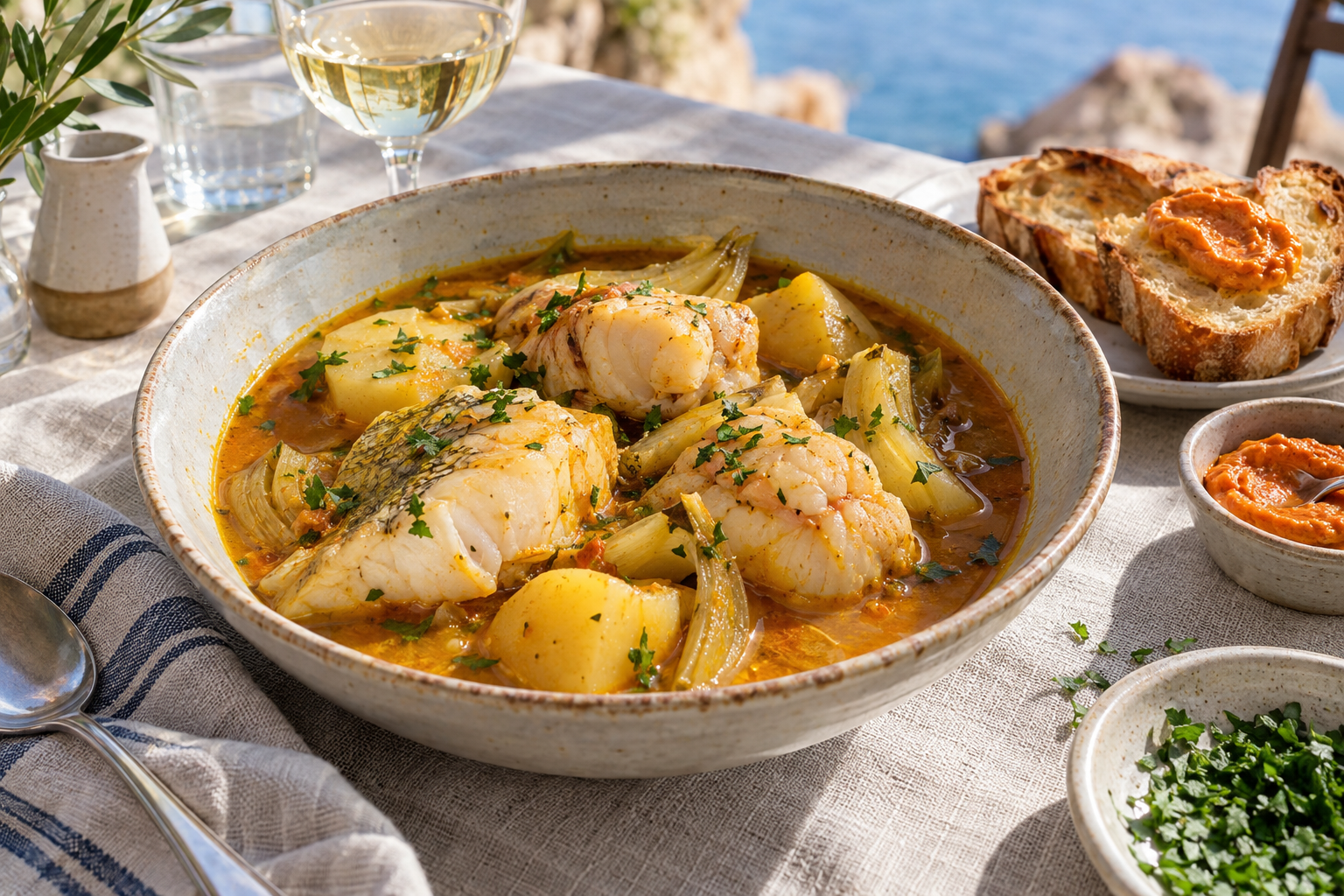
The toasted bread crackles as it breaks. Small, glossy islands of olive oil float on the orange-gold broth, and the steam carries saffron, garlic and a faint note of orange peel. Beneath the surface lies fish that has only just finished cooking: firm enough to lift with a spoon, tender enough to fall apart on the palate. A dollop of rouille on the bread brings heat and richness. This is food that slows the conversation around the table.
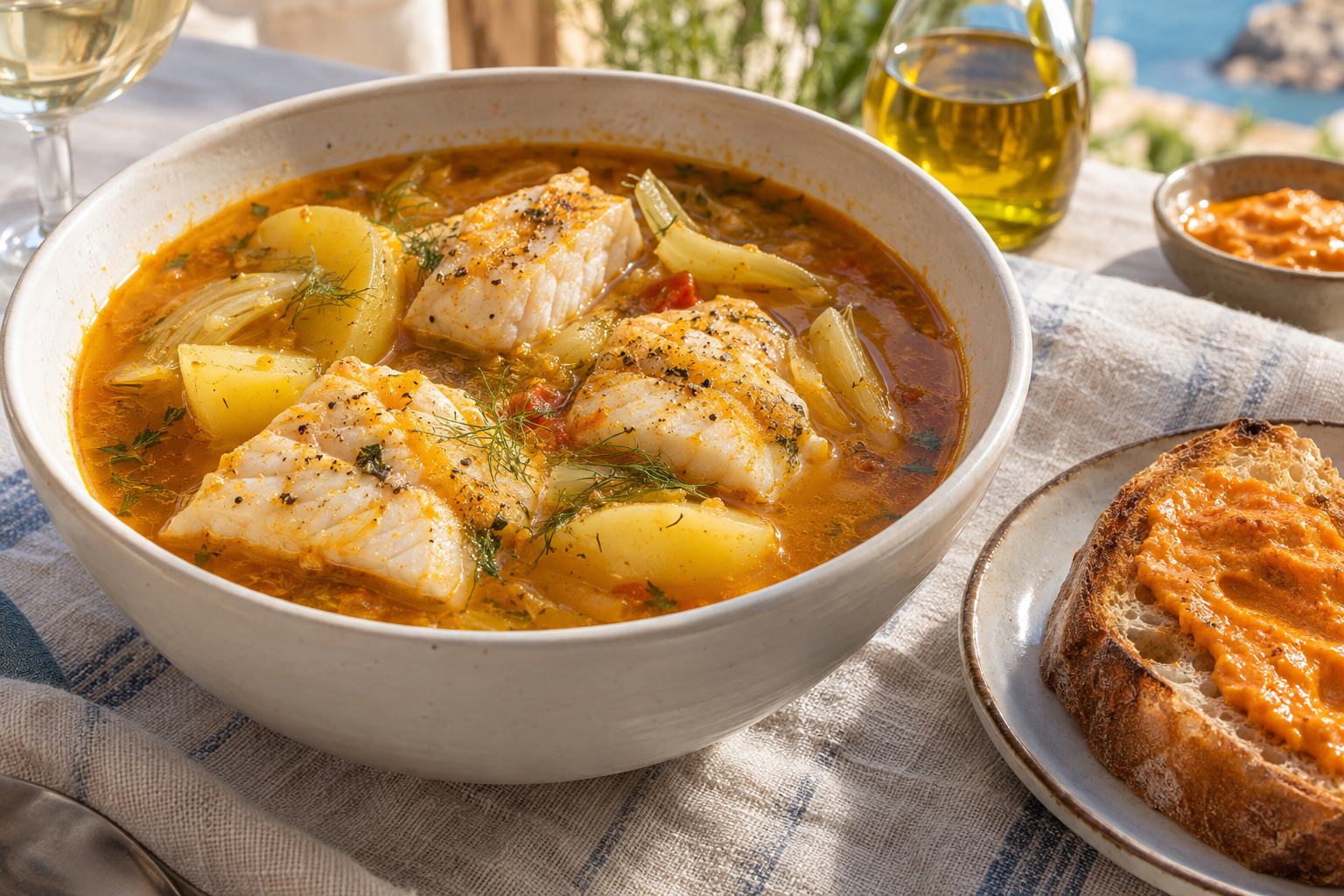
Bouillabaisse belongs to Marseille, the port city where Provence faces the Mediterranean. At the Vieux-Port, boats, quays and city life come together; at the fish counters, the catch is a reminder that the sea does not supply identical fillets every day. Small fish and large, spiny heads, silvery flanks and red skins all bring different qualities to a stew. That very variety is one of the keys to the dish.
It is tempting to call bouillabaisse a luxurious fish soup. But that misses something of its essence. Here, broth and fish share the leading role, sometimes served separately, sometimes together. The bread and sauce are not garnishes but ways of capturing the flavour.
A truly good bouillabaisse should not taste only of saffron. Above all, it should taste of fish and the sea, with the vegetables and spices casting a warm glow around them.
From the fishermen’s pot to the pride of the city
The accepted story links bouillabaisse to fishermen cooking the parts of their catch that were difficult to sell. Small, bony fish from rocky waters could make an excellent broth even if they held little appeal at market. It is a plausible origin, and one repeated in established food reference works. Yet there is no reliably documented first pot, no named inventor and no birth year to point to.
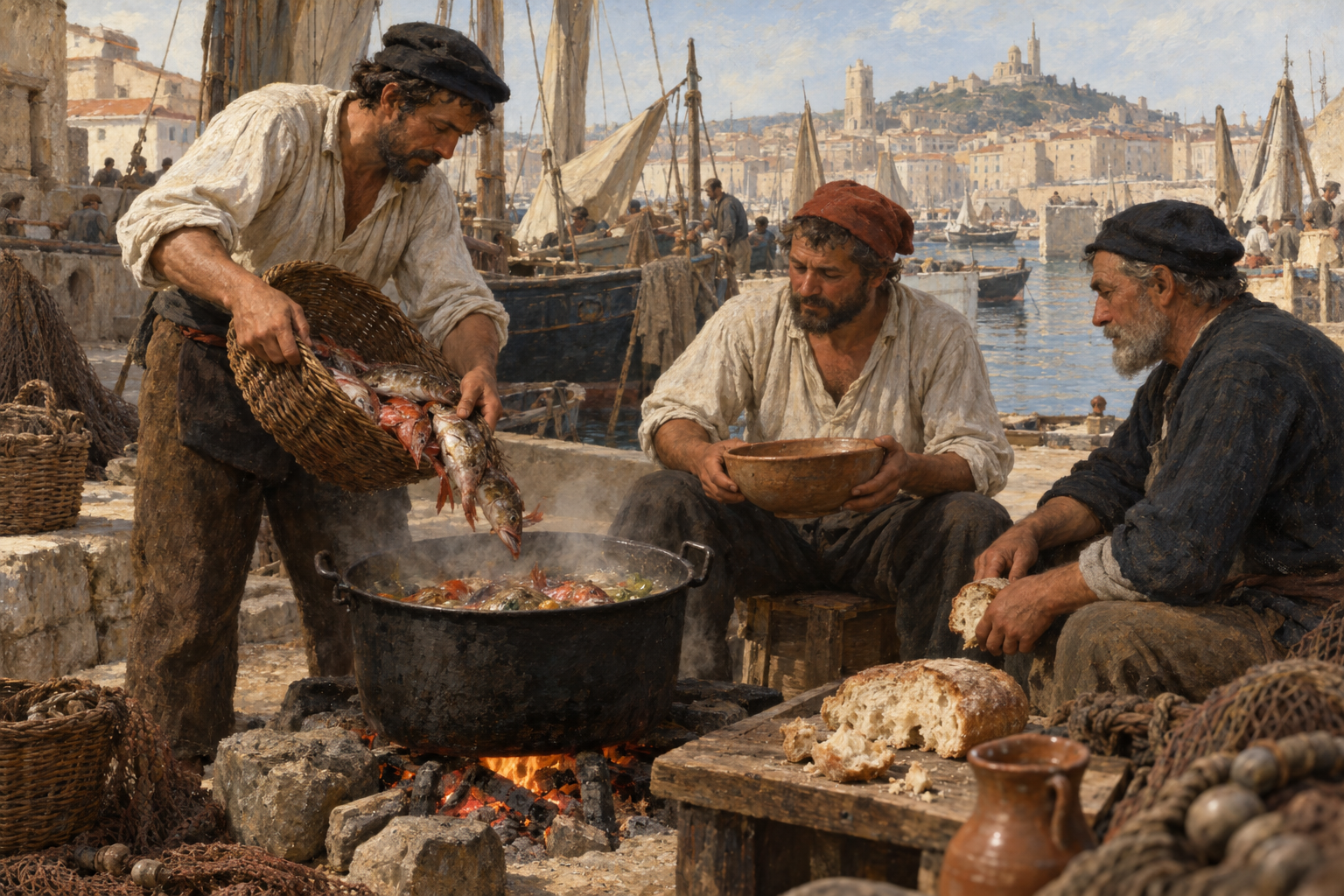
The name comes from Provençal and is usually explained through words meaning to boil and to lower. That fits the dish’s shifts between vigorous boiling and gentler cooking, but the history of the word is not a complete set of kitchen instructions. Both methods and ingredients have varied over time.
Marseille’s Greek founders are sometimes drawn into the story, along with older Mediterranean fish soups. Such connections are conceivable in a broad sense: people have long boiled fish wherever fish were available. But an unbroken line from antiquity to today’s saffron-scented bouillabaisse cannot be established. The tomato found in many modern versions is, moreover, a later addition to European cooking.
As restaurants developed, the simple stew also became a showcase meal. Large fish, careful presentation and sometimes luxurious shellfish could take it a long way from the idea of an inexpensive meal on the quayside. During the 20th century, the dish spread further through restaurants and cookbooks, while its name began to be used rather freely.
Marseille’s bouillabaisse charter, drawn up in 1980 at the initiative of local restaurateurs, is an attempt to safeguard a recognisable tradition. It matters as a local mark of quality, but is not proof that every household in the past cooked exactly the same dish.
The fish that build the flavour
Traditional bouillabaisse relies on several kinds of fish. Names that often appear include rascasse and other scorpionfish, as well as gurnard, weever, conger eel and monkfish. The combinations vary, but the principle is the same: the fish should contribute different flavours, firmness and richness. A single species rarely gives the same depth.
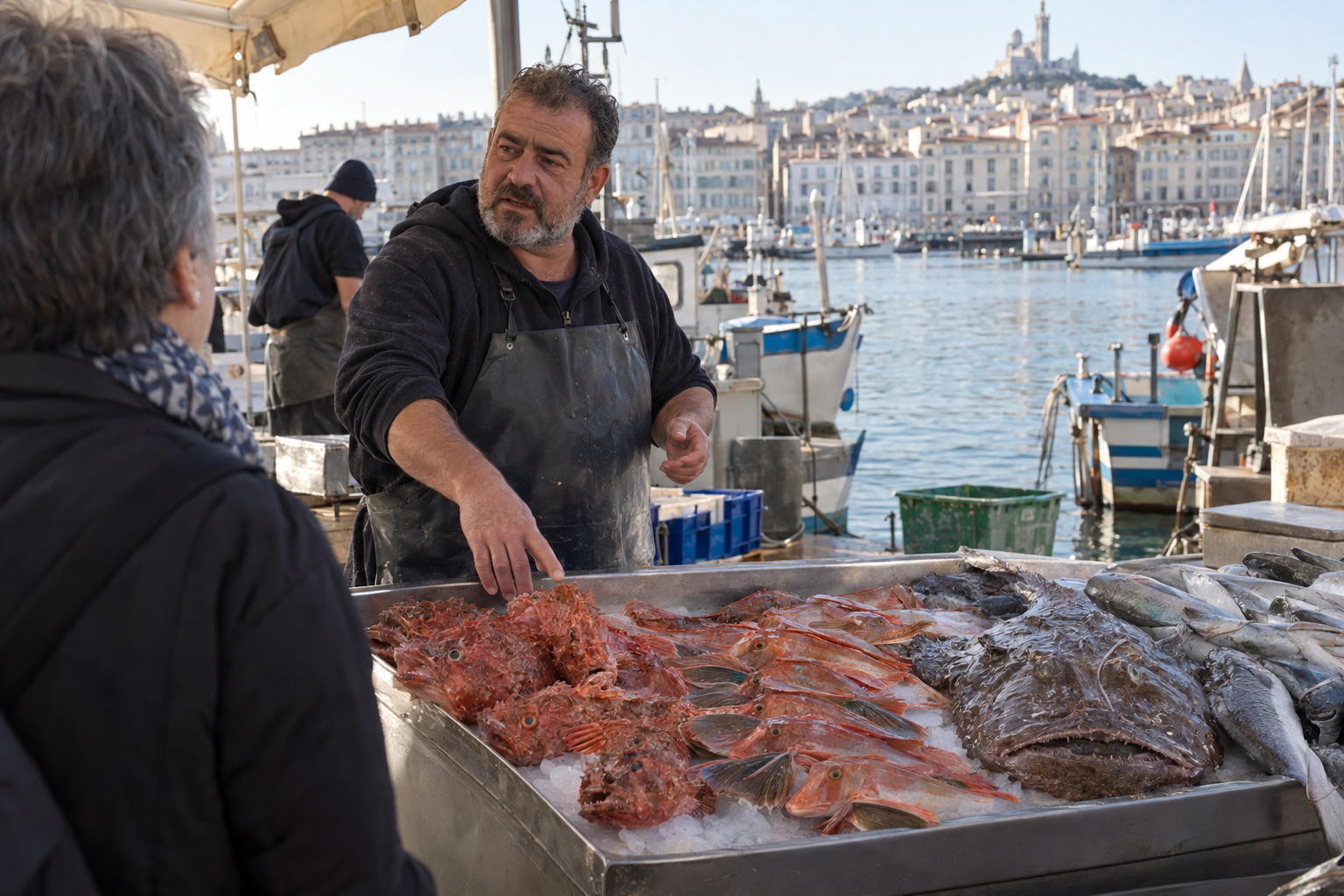
Rascasse has a special place in Marseille’s idea of the proper stew. It is hardly something you can count on finding at every Swedish fishmonger, though. Replacing it is therefore a practical decision, not a reason to give up on dinner. It is more honest, however, to call the result a home version inspired by Marseille than to promise an exact copy.
In Sweden, a mixture of monkfish, haddock and hake, for example, works well. Monkfish provides firmness, while the others give more tender pieces. Choose according to availability and current sustainability guidance, and ask your fishmonger for bones and heads from lean fish for the broth. The gills should be removed; they can impart an unpleasant flavour. Rinse away any traces of blood before you start cooking.
It is tempting to fill the pot with salmon, prawns and mussels because they are easy to find. The result may be delicious, but the flavour changes. The richness of salmon makes itself felt, and shellfish can take the dish towards another kind of French fish and seafood soup. You do not need them to make the meal feel special.
Potatoes appear in many versions and make a substantial meal. They absorb the broth and provide a mild counterpoint to the garlic sauce. Choose a waxy variety that holds its shape, rather than a floury one that falls apart before the fish is cooked.
Give the broth vigour and the fish a gentle touch
Onion, leek, tomato, garlic and often fennel build the aromatic foundation. They should soften in olive oil without developing deeply browned edges. Bouillabaisse does not need the dark, roasted flavours that suit a meat stew. Here we are looking for something brighter: sweetness from the onion, freshness from the tomato and fennel’s gentle aniseed note.
The saffron should be noticeable, but must not mask the ingredients. Crumble it and steep it in a little warm liquid to help distribute the flavour. A thin strip of orange peel can add a bright, bittersweet lift. Cut away the white pith, which might otherwise dominate. A splash of pastis appears in modern kitchens, but is by no means essential; fresh fennel is quite enough in our version, which has no added alcohol.
One of the dish’s interesting features is its vigorous boiling. When broth and olive oil boil together, the liquid can become slightly cloudy and full-bodied, rather than clear like a consommé. That is not a failure. But it is no reason to keep a pot full of delicate fish fillets at a rolling boil for long.
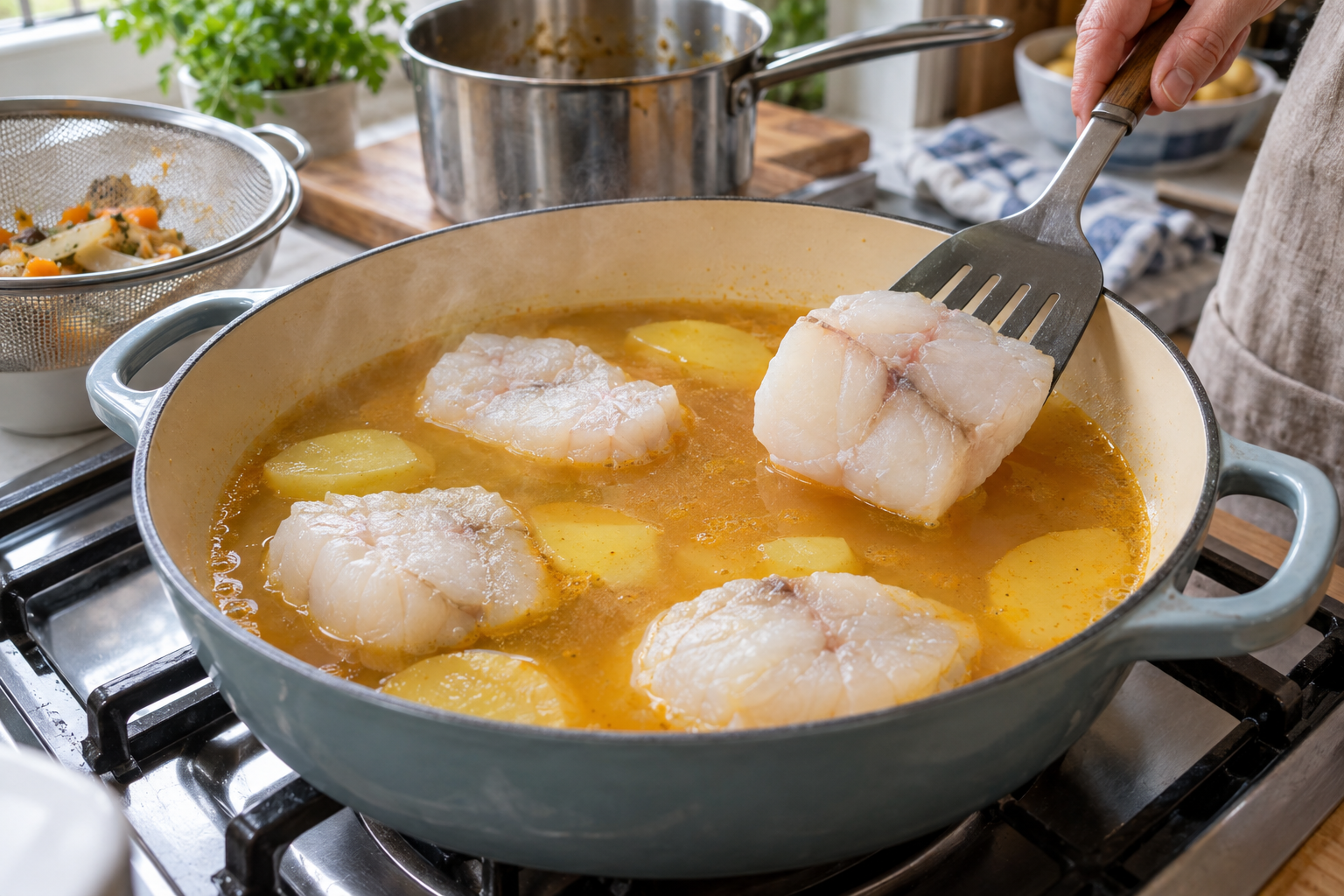
At home, it therefore makes sense to separate the stages: build and strain the broth first, reduce it to the right concentration, then cook the serving pieces of fish gently. Add firm, thick pieces before thinner ones. Use a wide pot and shake it gently rather than stirring with a spoon. That way, dinner will not dissolve into fish flakes.
The most common mistake is not too little saffron but too weak a broth. Taste before adding the fish. Even at that stage, the liquid should be something you want to eat by the spoonful.
Bread, rouille and time at the table
Bouillabaisse is a meal to gather around, especially when its different elements are served with care. A classic presentation lets guests begin with broth and bread, while the fish is presented separately. At other tables, everything arrives together in deep plates. At home, the distinction matters less than ensuring the fish is succulent and the broth piping hot.
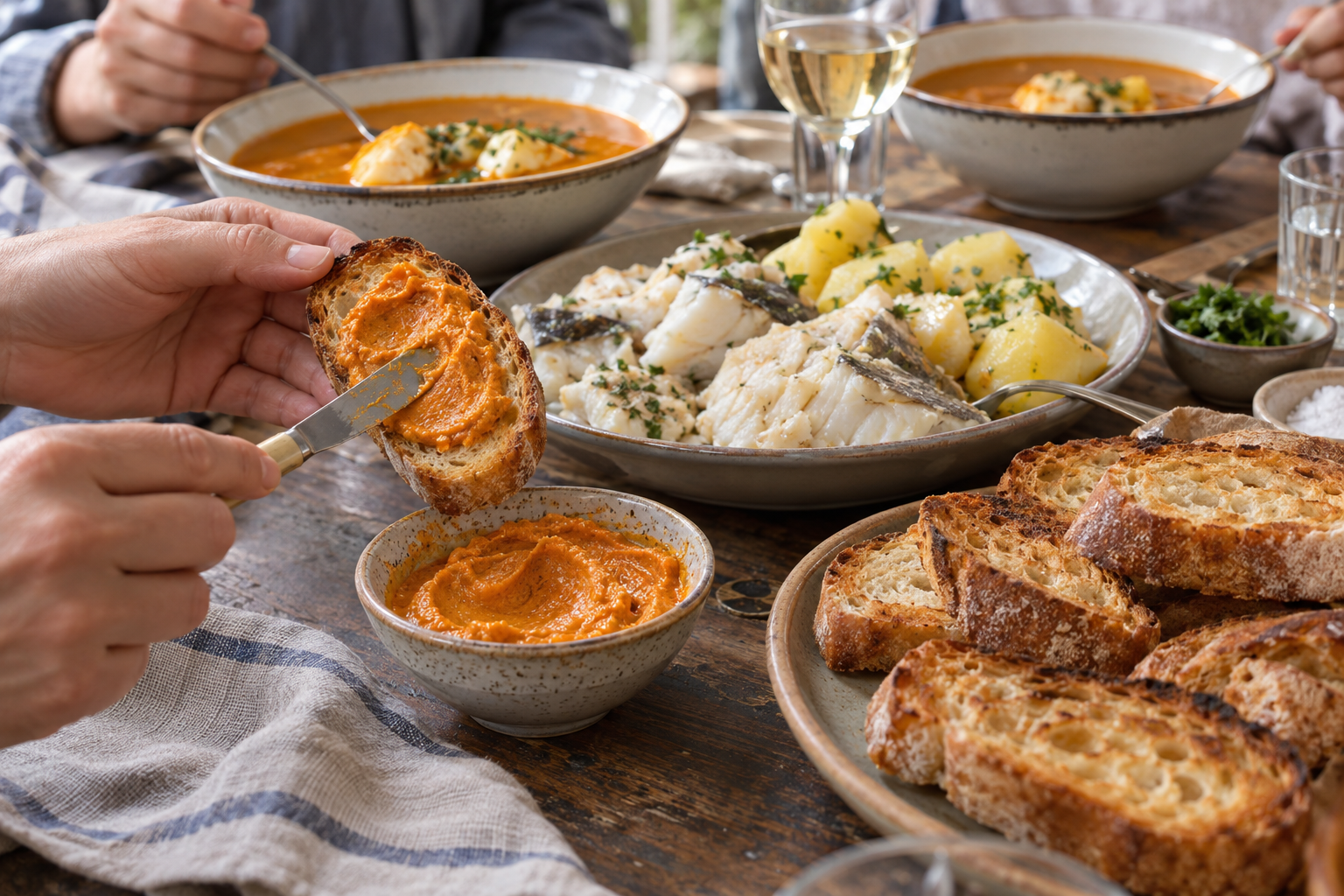
The accompaniment that brings the meal together is rouille, whose name refers to its rust colour. The sauce comes in several forms, using bread or potato, for example, to give it body, and varying amounts of chilli and saffron. What they share is garlic, oil and a rich texture. Even a small dollop should pack plenty of flavour.
In the recipe, we use cooked potato and egg yolk for a stable home version. It is a practical choice among several traditions, not the one true formula. The flavour should be warming and garlicky, not so hot that the fish’s subtler notes disappear.
The bread needs a thoroughly toasted surface. Soft bread quickly disappears into the broth, whereas a crisp slice offers resistance at first, then soaks up the liquid. Spread it with rouille and place it in the plate, or eat it alongside.
Put out extra sauce and bread so everyone can find their own balance. There is a generosity to serving it this way: first a tentative spoonful of broth, then more garlic, another piece of fish and, finally, the bread to soak up the last drops.
How to make it work in a Swedish kitchen
The best shortcut is not more seasoning but a good fish stock. Homemade gives you control over saltiness and concentration. Shop-bought works too, but choose one with a distinct fish flavour and take care with the quantity: stock made from concentrate can easily become too salty when heavily reduced. It is better to start mild and adjust once the vegetables and spices have released their flavours.
You can prepare the broth the day before. Cool it quickly and refrigerate, leaving mainly the potatoes, sauce and cooking of the fish for when your guests arrive. Cut the fish into evenly sized pieces and keep it cold until it goes into the pot. Warm the plates; fish cools quickly.
The recipe here is a Marseille-inspired home version using fish available in Sweden. Fish bones, fennel and tomato give the broth depth, while the rouille brings garlic and gentle heat. No lobster required. Put your care into the broth and the cooking of the fish, and bring out the pot while the steam still carries the full fragrance of saffron to the table.
Bouillabaisse for Swedish Kitchens
A Marseille-inspired home version, rather than a bouillabaisse that strictly follows the charter. Homemade fish stock provides the foundation, and three kinds of fish bring variety. Serve with the rouille in the next recipe.
Ingredients
Method
- 1Rinse the fish bones and heads thoroughly in cold water. Put them in a saucepan with 15 dl water, the onion, bay leaf and white peppercorns. Bring slowly to the boil and skim. Simmer uncovered for 20–25 minutes; avoid prolonged cooking, which can make the stock bitter or gluey.
- 2Strain the stock through a fine sieve without pressing the bones. Measure out 10 dl for the stew and reserve the rest for thinning if needed. If there is not enough, top up with water. If you have plenty of stock, you can reduce it a little first for more flavour.
- 3Check the fish fillets for bones. Cut the monkfish into roughly 4 cm pieces and the other fish into slightly larger pieces. Keep covered in the fridge while you prepare the stew base.
- 4Heat the olive oil in a wide, heavy-based pot. Gently fry the onion, leek and fennel over a medium heat for 8–10 minutes until softened but not browned. Add the garlic and tomato purée and cook for another 2 minutes.
- 5Crumble the saffron into a cup and stir in a little of the warm stock. Pour into the pot along with the tomatoes, the remaining measured stock, orange peel and thyme. Boil fairly vigorously, uncovered, for 10 minutes.
- 6Add the potatoes and simmer for 12–18 minutes, until almost completely tender. Thin with reserved stock if necessary. Remove the orange peel. Season with salt and pepper; the broth should already have a pronounced flavour.
- 7Meanwhile, make the rouille. Slice the baguette and toast on a baking tray in the middle of the oven at 225 °C conventional heat for 5–8 minutes, until the edges are golden.
- 8Lower the heat so the broth is barely simmering. Add the monkfish and cook for about 3 minutes. Then add the haddock and hake. Simmer for another 4–6 minutes, depending on the thickness of the pieces. Shake the pot gently rather than stirring.
- 9Check the thickest piece of fish: the flesh should have just turned opaque and flake easily. Stop cooking as soon as the fish is done. Scatter with parsley and serve in warmed deep plates with toasted bread and rouille.
- Vary the fish according to availability and sustainability guidance. Ideally, choose one firm variety and two more tender ones; adjust the cooking time to their thickness.
- For a shortcut, replace the homemade fish stock with 10 dl ready-made fish stock, preferably moderately salted. Keep extra water to hand for thinning.
- The broth can be made the day before. Cool quickly, refrigerate and bring to the boil before using. Ideally, cook the serving pieces of fish just before serving.
- Reheat leftovers gently the next day. Repeated boiling can easily dry out the fish.
Rouille with Potato, Saffron and Garlic
A rich home version made with both potato and egg yolk. Cooked potato gives it body, while saffron and chilli add colour and warming spice.
Ingredients
Method
- 1Cut the potato into small pieces. Boil in water for 10–15 minutes until completely tender. Drain and leave to steam dry.
- 2Crumble the saffron and mix with 1 tbsp warm water. Leave to infuse for 5 minutes, then cool.
- 3Pound the garlic with the salt in a mortar to make a smooth paste. Rice or mash the potato very finely and leave to cool to room temperature.
- 4Mix the potato, garlic, egg yolk, saffron water and cayenne pepper in a bowl. The ingredients should all be at roughly the same temperature.
- 5Combine the oils. Whisk them in, drop by drop at first, then in a very thin stream, until the sauce is thick and emulsified. Work by hand; vigorous blending can make the potato gluey.
- 6Season with lemon juice and more salt if needed. Add a few drops of water if the sauce is too thick to spread. Refrigerate until serving and preferably use the same day.
- For a milder garlic flavour, start with one clove and taste before adding the rest.
- If the sauce splits, start with a fresh egg yolk in a clean bowl and slowly whisk in the split sauce.
- Choose a mild olive oil; a very peppery, bitter oil can overwhelm the fish.
What goes in the glass
- WineDry white wine from Cassis or another fresh, medium-bodied whiteFresh acidity balances the olive oil and rouille, while sufficient body carries the saffron, fennel and concentrated fish broth. Choose one without pronounced oak character.
- WineDry rosé from ProvenceA fresh rosé that is not too light suits the tomato’s acidity and the herbs in the dish. Keep the chilli moderate, as alcohol can heighten the sensation of heat.
- Alcohol-freeDry-tasting, alcohol-free pressed apple juice diluted with mineral waterThe apple’s acidity refreshes the palate between spoonfuls, and the bubbles lighten the oil-rich sauce. Choose a tart pressed juice and dilute to taste so the sweetness does not dominate.
Enjoy alcohol in moderation. Alcohol-free options go just as well with the food.
Sources
- Alan Davidson; tredje upplagan redigerad av Tom Jaine, The Oxford Companion to Food (2014)
- Elizabeth David, A Book of Mediterranean Food (1950)
- Prosper Montagné, Larousse Gastronomique (1938)
- Marseilles bouillabaissecharter, La Charte de la Bouillabaisse (1980)
Ask questions about "Bouillabaisse – Marseille in a Soup Plate". Answers are based on the magazine's own articles.