Bouillabaisse – Marseille in a bowl
Saffron, sea and garlic in Provence’s most celebrated fish stew
Bouillabaisse begins with fish, but its greatness lies in the broth: fragrant with fennel, saffron and orange peel. We trace Marseille’s proud fish dish from coastal kitchens to today’s table – and make a Swedish home version with a gentle touch and plenty of flavour.
 By Lina BergFood editor · European and Nordic cuisines – Italy, France, Spain, Greece and Swedish home cooking
Translated from Swedish with AI assistance.
Go to the recipes (2) ↓Where the sea meets the hot pot
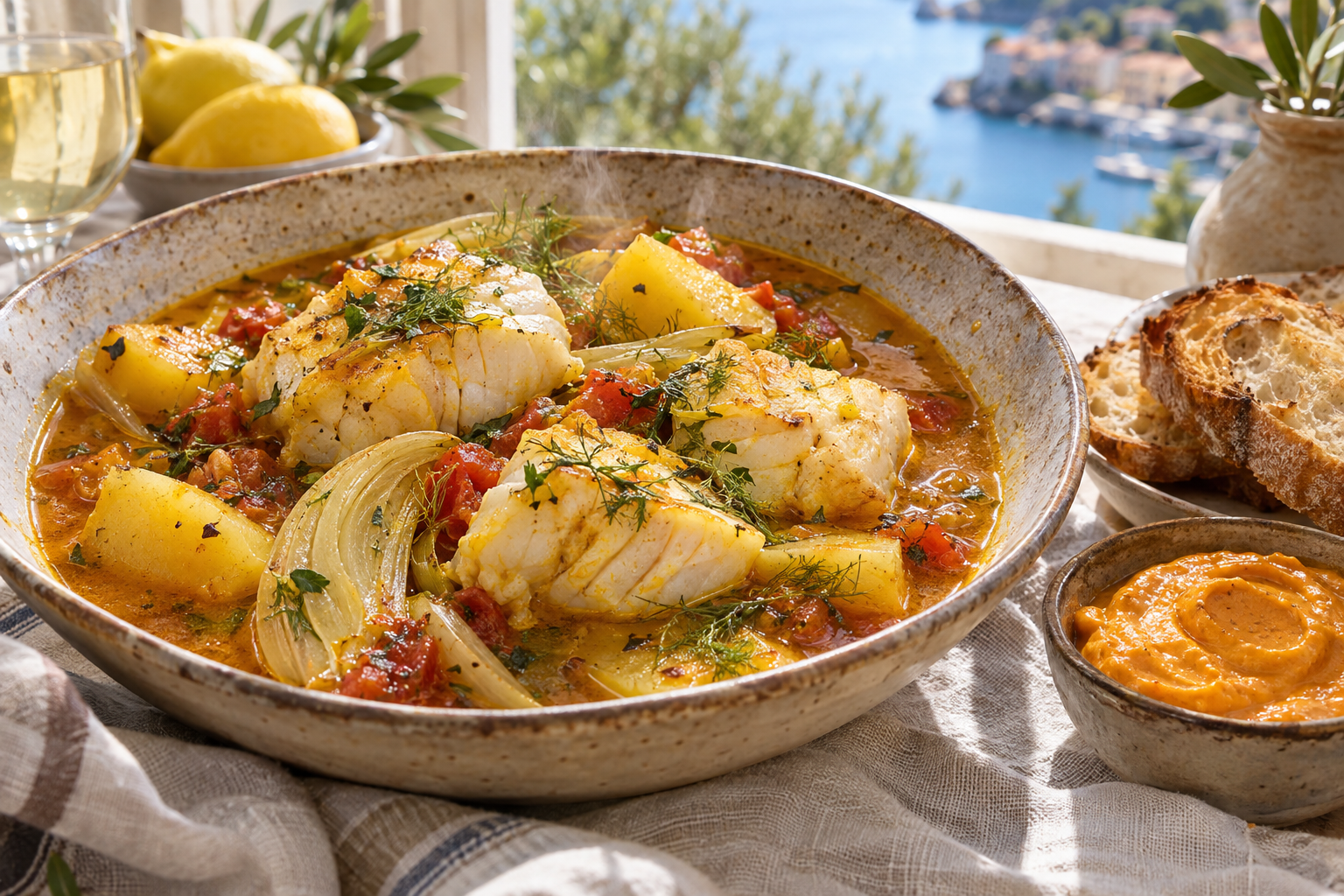
Olive oil sizzles around the onion. As the fennel goes in, a sweet, green aroma rises from the pot, soon followed by garlic, tomato and a thin strip of orange peel. Then in goes the fish stock. The saffron leaves a trail of red threads before the liquid deepens to gold. On the chopping board, the fish waits, cut into large pieces: it must not cook to shreds, but remain succulent and just cooked through.
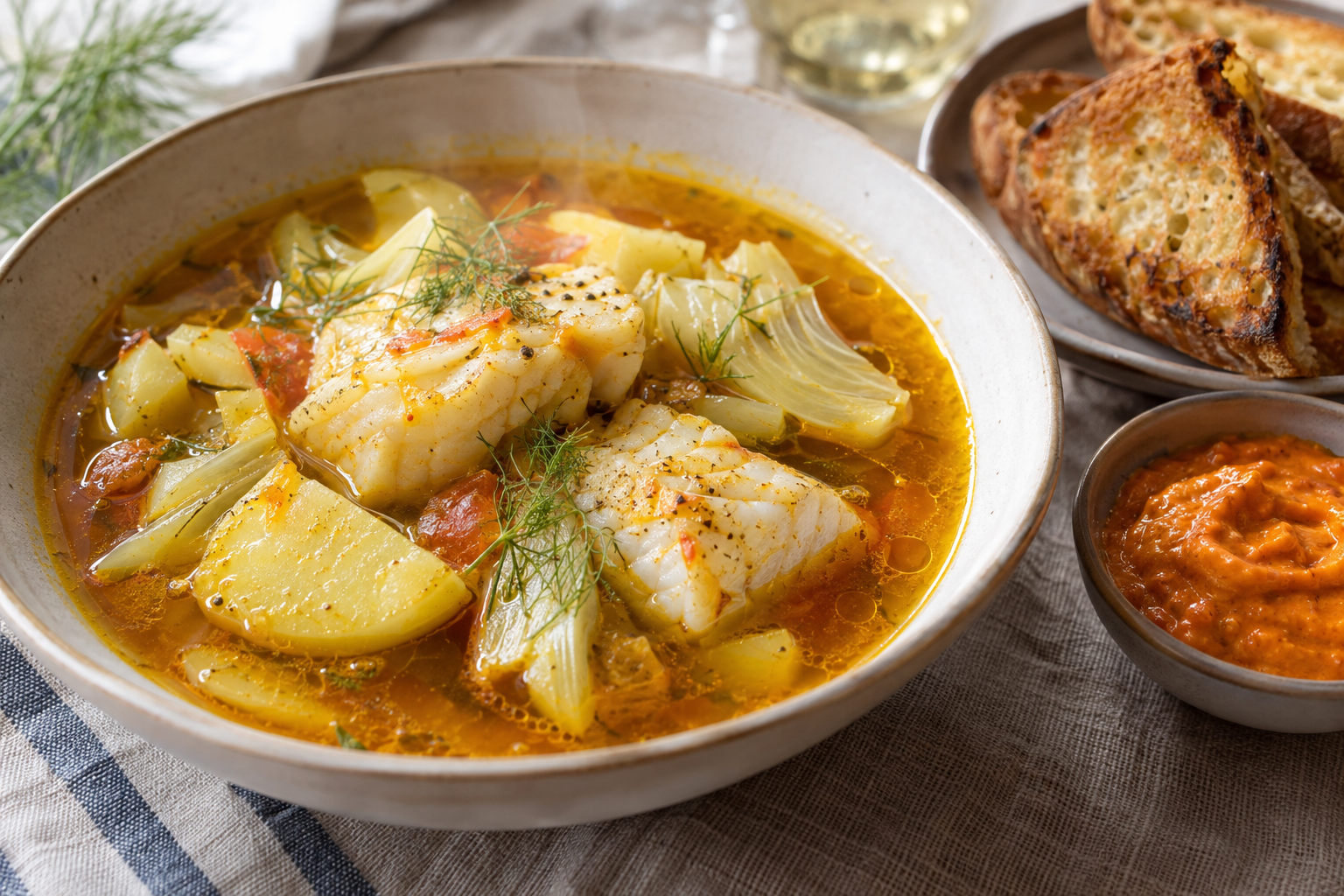
It is easy to think of bouillabaisse as just another fish stew. But in Marseille, the Mediterranean port where the dish has its strongest roots, it is both a meal and an expression of identity. Here, it is not simply about what is in the bowl, but which fish have been used, how the broth has been built and how everything is brought to the table. Adding saffron to a clear fish soup with a few prawns does not automatically make it bouillabaisse.
Put out toasted bread and rouille, the boldly garlicky sauce with its warm colour and touch of heat, and the whole meal comes alive. The bread soaks up the broth while keeping a crisp edge. The sauce softens in the warmth and gives the soup body. The fish still tastes of fish, not the spice cupboard. It is precisely this balance that makes the dish worth cooking with care.
For home cooks in Sweden, there is a practical way to get there. It begins by accepting that our fish counters are not those of Marseille, but that good stock, several kinds of fish and the right sequence at the stove can produce a very fine meal. Our version is an adaptation, not an attempt to reproduce every detail of a local original.
A port city’s dish, with no certain birth date
Bouillabaisse belongs to Provençal cooking and is associated above all with Marseille. It is usually described as a dish rooted in fishermen’s cooking, combining different fish that fetched little at market. That is a plausible background in a coastal setting, but the story should not be confused with a documented moment when someone invented the finished dish. No exact year of birth or sole creator can be named.
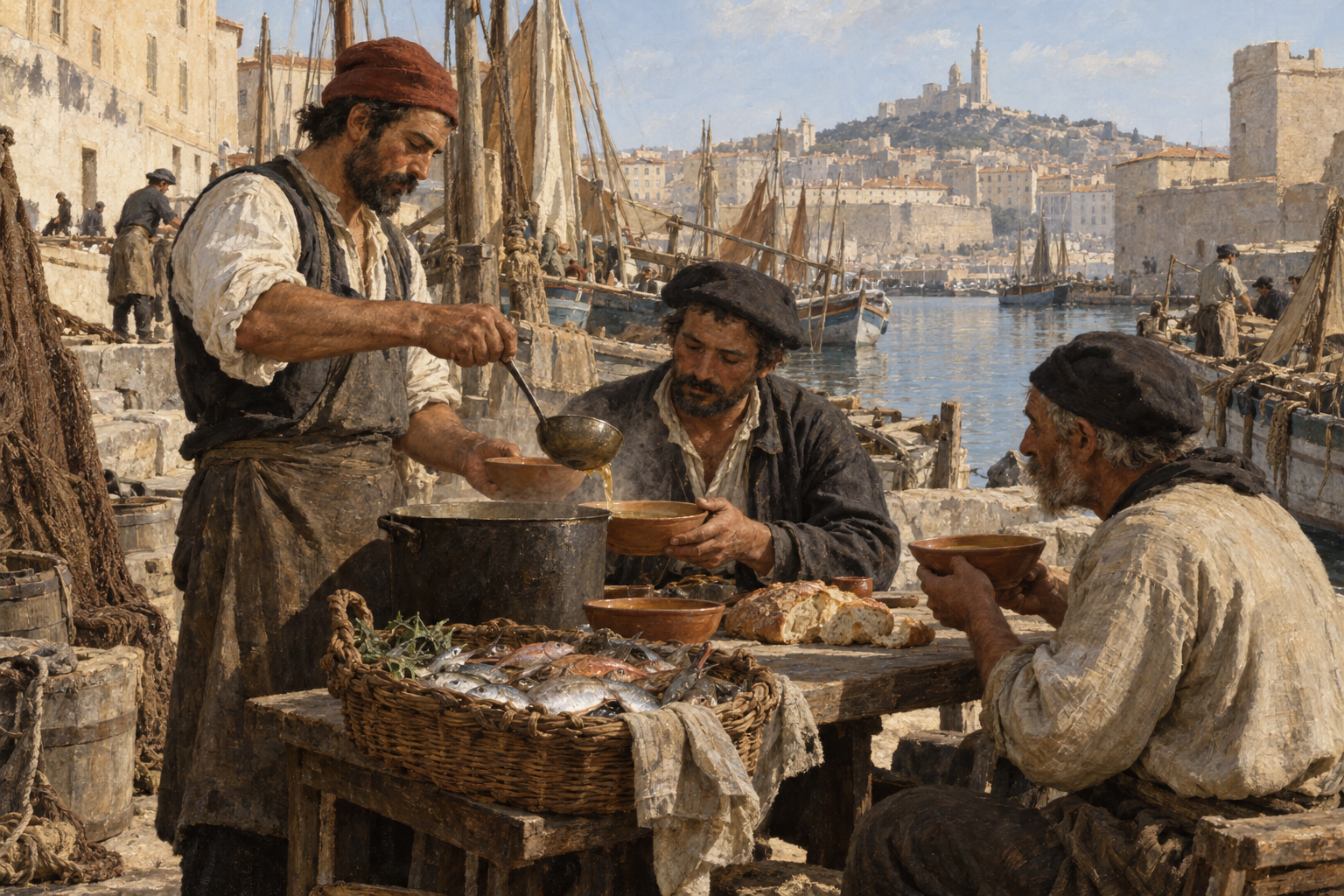
Fish stews have existed around the Mediterranean for a very long time. Sometimes the history of bouillabaisse is traced all the way back to the ancient Greeks, who founded Marseille. That tells us more about the city’s long relationship with the sea than about an unbroken recipe. Tomatoes, for instance, an ingredient in many modern versions, only reached Europe after contact with the Americas. Today’s stew cannot therefore simply be called an unchanged dish from antiquity.
The name is generally explained through Provençal words meaning to boil and to lower or reduce. The familiar interpretation is roughly “bring to the boil and turn down”. It is a useful way to remember the name, but not a complete set of cooking instructions. In traditional cooking, the broth may be boiled vigorously so that the olive oil and the fish’s own components help give it body. When using delicate fillets at home, however, the heat needs careful control.
During the 19th and 20th centuries, bouillabaisse also became a restaurant dish and a symbol of Marseille for visitors. Its humble origins therefore do not tell the whole story of the meal today. Several kinds of fresh fish, a well-made stock and plenty of kitchen work can make it both lavish and time-consuming. In 1980, Marseille restaurateurs drew up a bouillabaisse charter to protect the dish’s character. It is a professional agreement, not a law that invalidates every family variation.
The fish gives body, the seasonings set the course
Fish from the Mediterranean’s rocky seabed play a central role in Marseille’s tradition. Rascasse, a name used for scorpionfish, is particularly associated with bouillabaisse. Gurnard, conger eel and John Dory also feature in descriptions of the dish. The point is not simply variety on the plate: different fish bring different textures, flavours and gelatin to the broth.
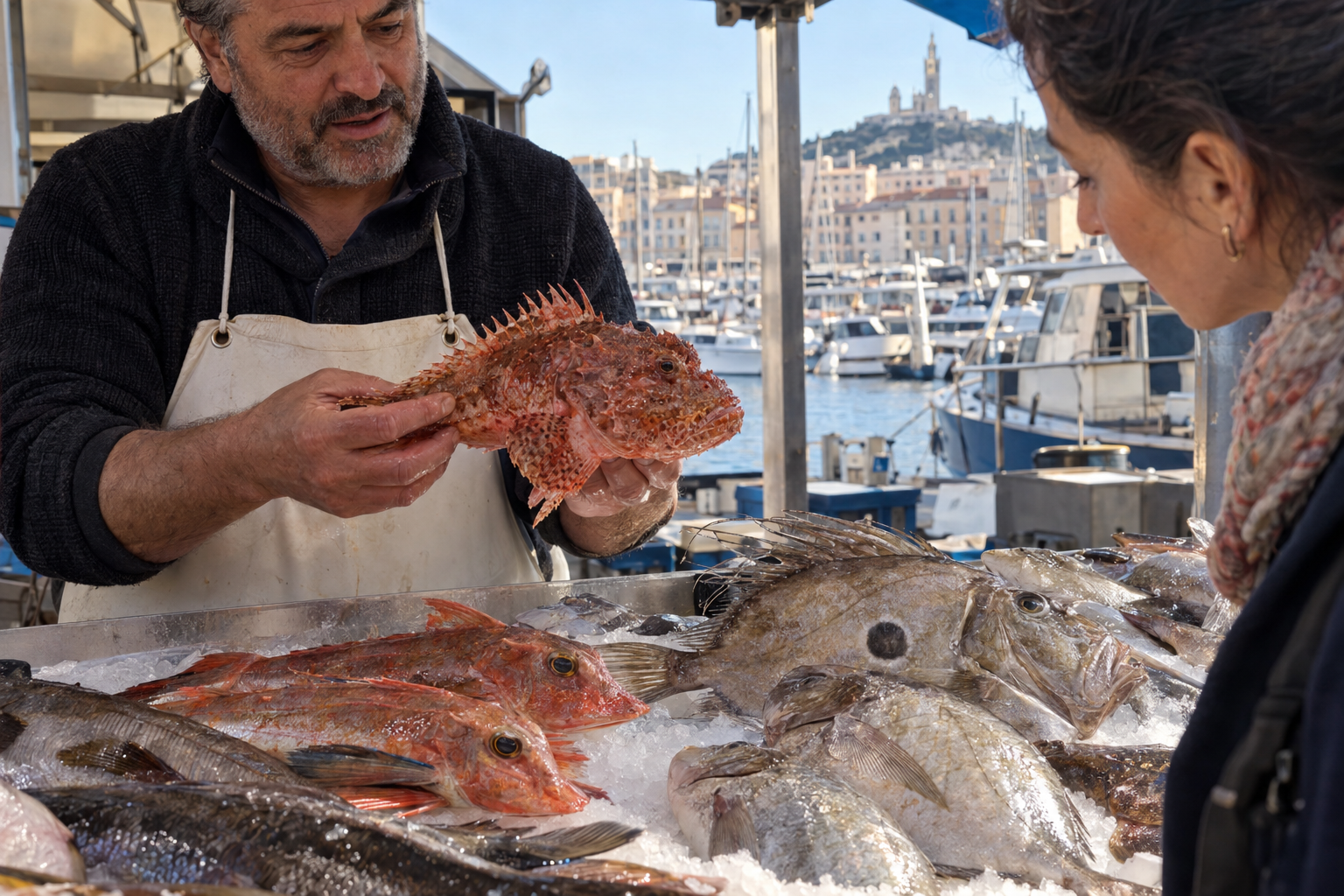
That is precisely why it is difficult to replace a whole range of Mediterranean fish with a single bag of frozen fillet pieces. This does not mean Swedish ingredients are unsuitable, but that they need to be treated according to their qualities. Monkfish gives firm pieces, haddock a milder flavour and more delicate texture, and saithe a slightly more pronounced fish flavour. Choose two or three varieties if you can, and ask at the fish counter what is fresh, traceable and suitable that day.
The broth is the dish’s foundation. Bones and heads from lean fish can provide a good base, but the gills should be removed and everything must be very fresh. Fish stock does not need to simmer for hours; prolonged cooking can give it a less clean flavour. In our home recipe, we use a mild ready-made fish stock or a homemade one. Always taste before adding salt: concentrated stocks vary considerably and can become far too salty as they reduce.
The fennel’s aniseed notes, saffron’s dry floral aroma and the bitter freshness of orange peel should support the fish flavour, not hide it. Pare the orange thinly, taking as little white pith as possible. Tomato adds acidity and colour, but the stew should not taste like tomato sauce. The garlic can make its presence felt, particularly in the rouille, while the chilli should mainly lend warmth.
Shellfish are a common sight in international versions of bouillabaisse, but they are not what defines Marseille’s fish dish. We therefore let the fish take centre stage. Potatoes appear in many versions and here they make the meal complete. They are cooked until almost done before the fish goes in, so there is no need to choose between hard potatoes and overcooked fish.
A meal to make room for
Bouillabaisse is food to gather around, but it need not arrive as a rustic pot in the middle of the table. In a classic restaurant presentation, the broth may come first, with bread and sauce, while the fish is presented separately. Elsewhere, everything is eaten together. The separation makes an important point: the broth is a part of the meal in its own right, not merely the liquid surrounding the fish.
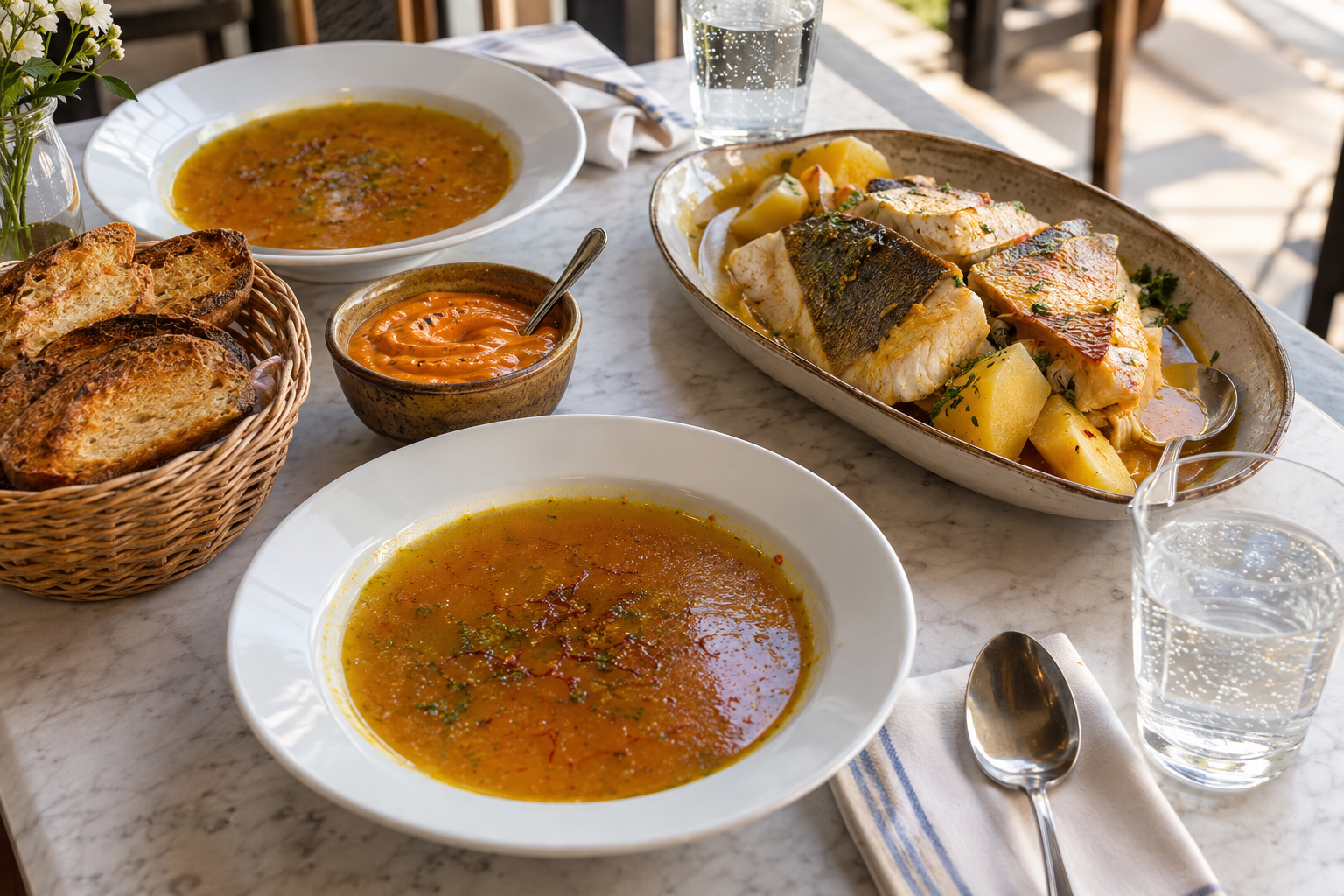
Rouille means rust, and the name suits the warm colour that saffron and chilli can give the sauce. Recipes vary. Bread or potato can provide body, and there are egg yolk-based versions too. Garlic, oil and some form of heat are often common to them all. Our rouille is made with egg yolk and is easy to get right if the oil is worked in slowly at the start.
Toast the bread until its surface is dry and golden. It should hold a dollop of sauce and a few spoonfuls of broth without immediately falling apart. If you like, rub a cut garlic clove over the warm bread. Tiny amounts of garlic catch on the rough surface, giving it a distinct bite. Put out extra bread; the last mouthfuls in the bowl are often the best.
A dry white wine with fresh acidity and restrained oak works well with the food, as does a dry rosé that is not too light. But alcohol is not needed for the meal to find its rhythm. A dry alcohol-free white wine works too, as does sparkling water with just a hint of lemon. Avoid very sweet drinks, which can make the fish broth taste flat and the garlic in the rouille seem sharper.
How to get it right in a Swedish kitchen
The best trick is to separate what can wait from what must be done at the last minute. The broth base can be made ahead, cooled quickly and kept chilled until the next day. The bread can be sliced and the ingredients measured out. The fish, however, should only go into the pot when your guests are almost seated. That way, you will not have to keep it warm while the rest of the meal is finished.
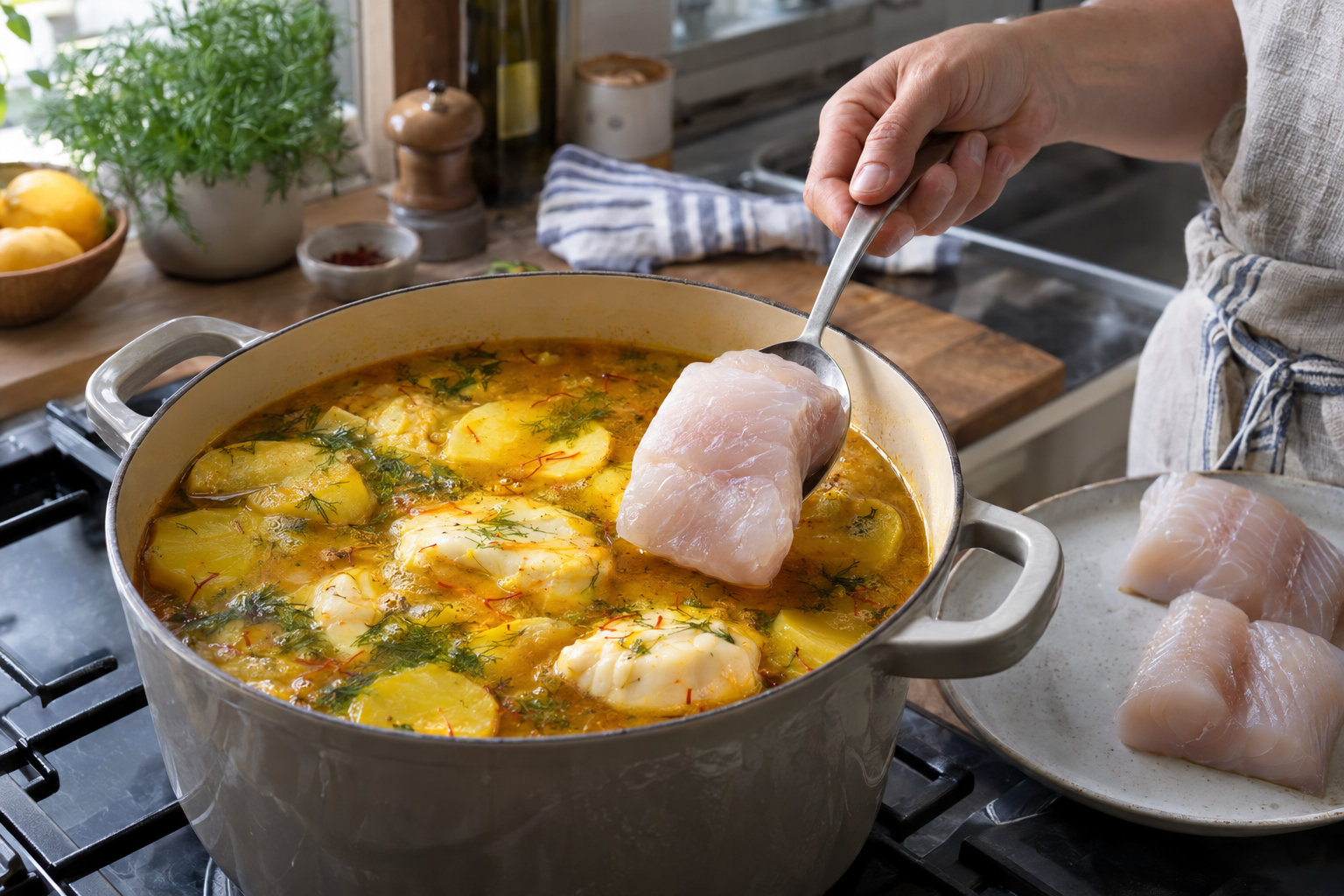
Cut the fish into generous pieces of as even a thickness as possible. Add the firmest variety first and the more delicate one later. Simmer rather than boil vigorously, and do not stir with a spoon. Instead, gently rock the pot so the broth flows between the pieces. This is the difference between a stew with distinct pieces of fish and a soup full of tiny flakes.
Taste and adjust the base before adding the fish, but make a final check at serving time. Does it need salt, a little acidity or simply a spoonful of rouille? A well-balanced bouillabaisse should feel full-bodied but not heavy, aromatic but not perfumed. Warm the bowls if you can, and serve straight away. With bread close at hand and broth steaming in the bowl, there is no need for grand gestures – just time to eat while the fish is at its best.
Bouillabaisse for Swedish kitchens
A home version inspired by Marseille’s bouillabaisse, using fish available in Sweden. Mild fish stock, saffron and several varieties of fish give it depth; rouille and toasted bread are served alongside.
Ingredients
Method
- 1Check the fish carefully for bones and cut into large pieces, about 4–5 cm. Keep chilled while you make the base. Preheat the oven to 225 °C conventional heat.
- 2Heat 3 tbsp olive oil in a wide pot. Gently fry the onion, leek and fennel over a medium heat for 8–10 minutes. Stir occasionally; the vegetables should soften without browning.
- 3Add the garlic and tomato purée and cook for 1 minute. Add the tomatoes and saffron and cook for another 2 minutes.
- 4Pour in the stock and add the orange peel, bay leaves and thyme. Bring to the boil, then simmer uncovered for 10 minutes.
- 5Add the potatoes and simmer for 12–18 minutes, until almost tender. Add a little water if much of the liquid has evaporated; there should be plenty of broth.
- 6Meanwhile, make the rouille. Lightly brush the bread slices with olive oil and toast on a baking tray for 6–8 minutes, until golden and crisp.
- 7Remove the orange peel and bay leaves. Season the base to taste with salt and pepper. Add the monkfish and simmer gently for 3 minutes.
- 8Add the saithe and haddock. Simmer for another 4–6 minutes or so, depending on the thickness of the pieces. Gently rock the pot rather than stirring. The fish is ready when the centre is no longer translucent and the flesh flakes easily; a centre temperature of about 56 °C gives succulent fish.
- 9Taste the broth and add lemon juice if needed. Divide the potatoes and fish between warm, deep bowls and ladle over the broth. Serve immediately with the bread and rouille.
- Vary the fish according to availability and sustainability certification. Ideally, use one firmer variety and one more delicate one; adjust cooking time to the thickness rather than the species alone.
- The base can be made the day before. Cool quickly and refrigerate at about 4 °C. Bring it to the boil before cooking the potatoes and fish.
- If using frozen fish, thaw it in the fridge and drain off any excess liquid. Do not put frozen blocks straight into the pot.
- Cool any leftovers quickly, refrigerate and preferably eat the next day. Reheat gently but thoroughly; the fish will become firmer when reheated.
Rouille with saffron and garlic
An egg yolk-based version of the Provençal sauce. It should be thick enough to spread on bread, with pronounced garlic and a pleasant heat.
Ingredients
Method
- 1Let the egg yolk and oils come to roughly the same temperature. Lightly crush the saffron and mix with the lukewarm water. Leave to infuse for 5 minutes.
- 2Mash the grated garlic with the salt to a fine paste. Place in a stable bowl with the egg yolk, saffron water, cayenne pepper and lemon juice.
- 3Whisk together. Add the rapeseed oil drop by drop, whisking constantly, until the mixture begins to thicken, about 2–3 minutes.
- 4Continue adding the remaining rapeseed oil in a thin stream. Then slowly whisk in the olive oil until the sauce is thick and smooth.
- 5Taste and adjust the seasoning. If the sauce is too stiff, whisk in a little cold water, half a teaspoon at a time. Cover and refrigerate until serving.
- Choose a mild olive oil: pronounced bitterness can overpower the sauce.
- If the sauce splits, start with a fresh egg yolk in a clean bowl and whisk in the split sauce a little at a time.
- You can make the sauce a few hours before serving. Store at about 4 °C and use within 1–2 days.
What goes in the glass
- WineDry white from Cassis or another fresh, unoaked Rhône-style whiteFresh acidity balances the olive oil and rouille, while the wine’s body suits the richly flavoured fish broth. Choose a style without pronounced oak.
- WineDry rosé from ProvenceBerry notes and freshness complement the tomato and saffron without dominating the fish. A rosé with a little body stands up better to the garlic.
- Alcohol-freeDry alcohol-free white wineAcidity and low sweetness provide a fresh contrast to the richness of the sauce and let the fish’s gentler flavours shine through.
- Alcohol-freeSparkling water with thinly pared lemon peelThe bubbles refresh the palate between spoonfuls, and the lemon aroma echoes the stew’s orange peel without adding sweetness.
Enjoy alcohol in moderation. Alcohol-free options go just as well with the food.
Sources
- Alan Davidson; tredje upplagan redigerad av Tom Jaine, The Oxford Companion to Food (2014)
- Elizabeth David, A Book of Mediterranean Food (1950)
- Prosper Montagné, Larousse Gastronomique (1938)
- Office Métropolitain de Tourisme et des Congrès de Marseille, Marseille Tourist Office – information om bouillabaisse och bouillabaissechartern
Ask questions about "Bouillabaisse – Marseille in a bowl". Answers are based on the magazine's own articles.