Bouillabaisse – Marseille in a Bowl
Saffron, sea fish and garlicky rouille in a stew that calls for more care than luxury.
Bouillabaisse smells of fennel, saffron and the Mediterranean, but its soul lies in the fish and broth. We follow Marseille’s celebrated fish dish from coastal homes to white-tablecloth restaurants – and cook a Swedish home version with firm fish, well-made stock and rust-red rouille.
 By Lina BergFood editor · European and Nordic cuisines – Italy, France, Spain, Greece and Swedish home cooking
Translated from Swedish with AI assistance.
Go to the recipes (2) ↓When the sea meets the warm pot
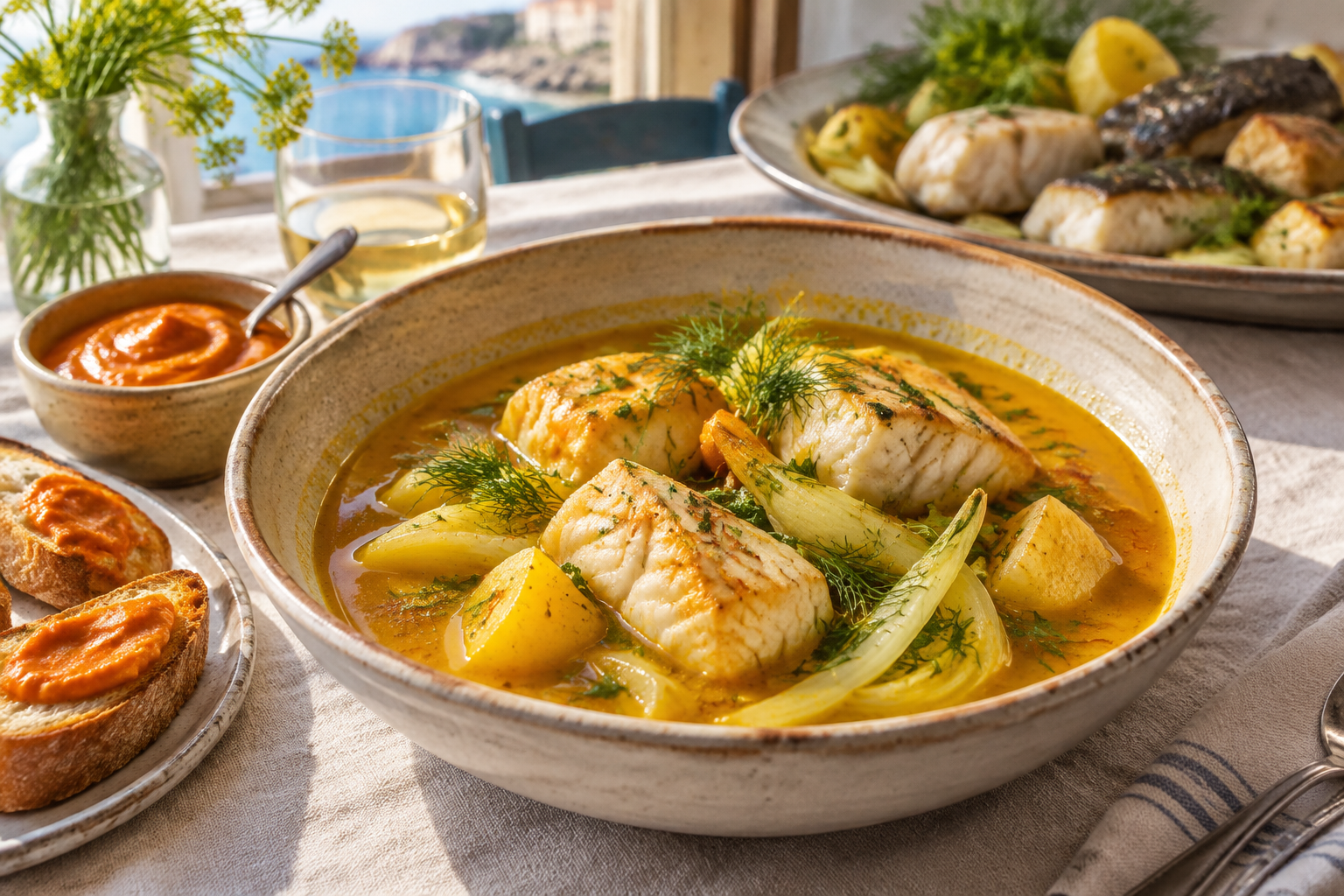
First comes the sound of oil. A gentle sizzle as onion and fennel slide into the wide pot, then the dry tap of a knife chopping garlic. The tomato releases its juices and the saffron colours everything a warm golden orange. As the fish stock goes in, a scent rises that is both sweet and salty: simmered fish bones, herbs, fennel and a thin strip of orange zest. The fish waits on the chopping board. Its moment has not yet come.
It is precisely this waiting that distinguishes a thoughtfully made bouillabaisse from a stew in which everything has cooked for the same length of time. The broth needs to develop; the fish needs protecting. One should become rich and rounded, the other just cooked, juicy and firm enough to lift from the pot without breaking into tiny flakes.
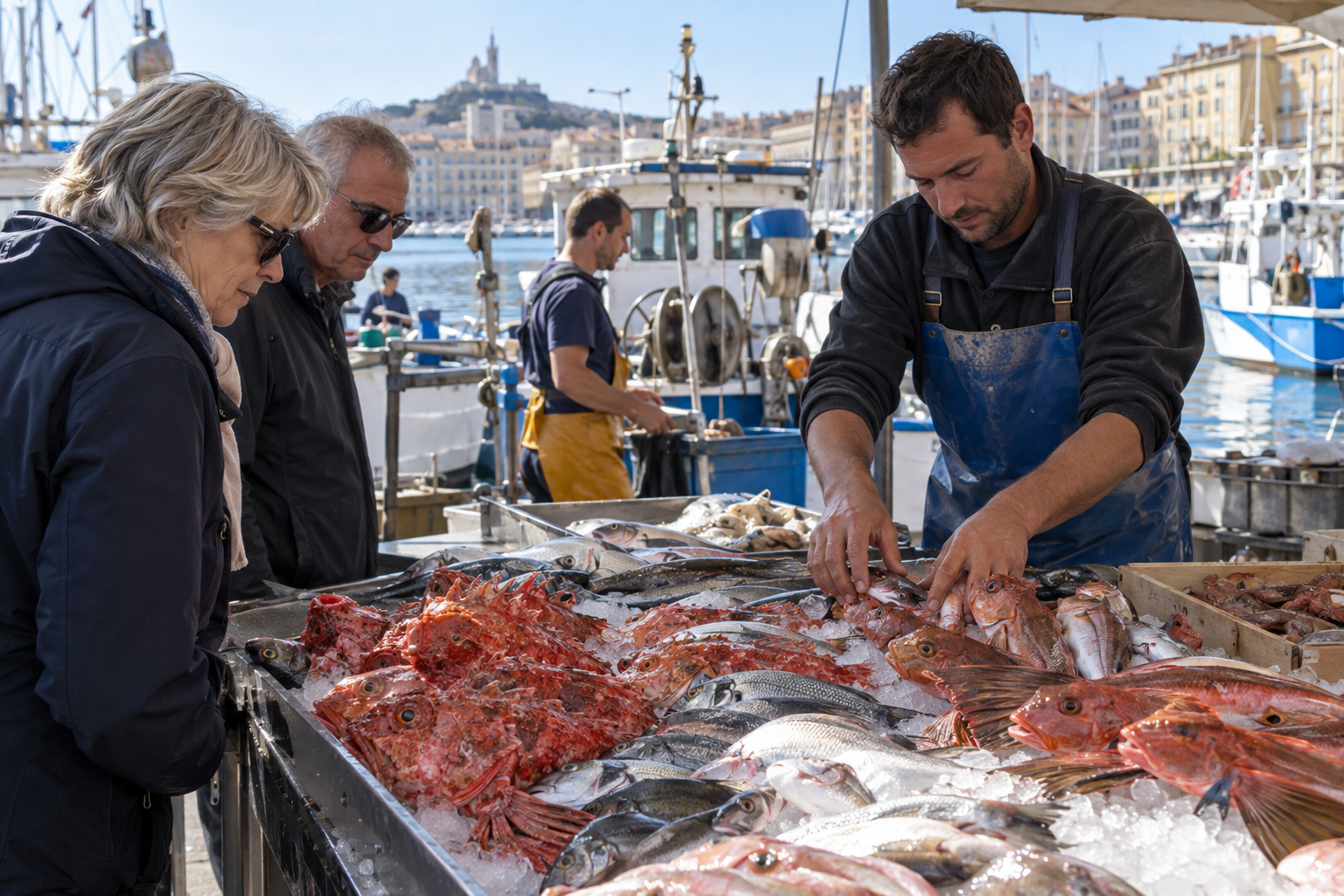
At Marseille’s old harbour, Vieux-Port, the sea is never merely a view. It has been a workplace, a transport route and a larder. The fish market makes that connection visible: whole fish with heads and fins, and species that defy the simple division between cod and salmon found in Swedish shops. This is where bouillabaisse belongs, in a food culture where different fish serve different purposes.
The table also needs bread and rouille, the rust-coloured sauce with a powerful garlic kick. A spoonful of rouille on a slice of bread, hot broth poured over: first comes the bite of garlic, then the sweetness of fish and saffron’s dry, almost hay-like aroma. It is a generous meal, but not an indistinct jumble of a stew. Each element should still be recognisable.
The fishermen’s stew – and the story that grew
Bouillabaisse is associated with fishing households in Marseille and along the Provençal coast. The familiar origin story describes a meal made from fish left over or difficult to sell: small, bony, irregularly shaped species that offered more flavour than neat portions. It is a plausible picture of coastal thrift, but not a documented moment of invention. We know of no single creator and no first pot.
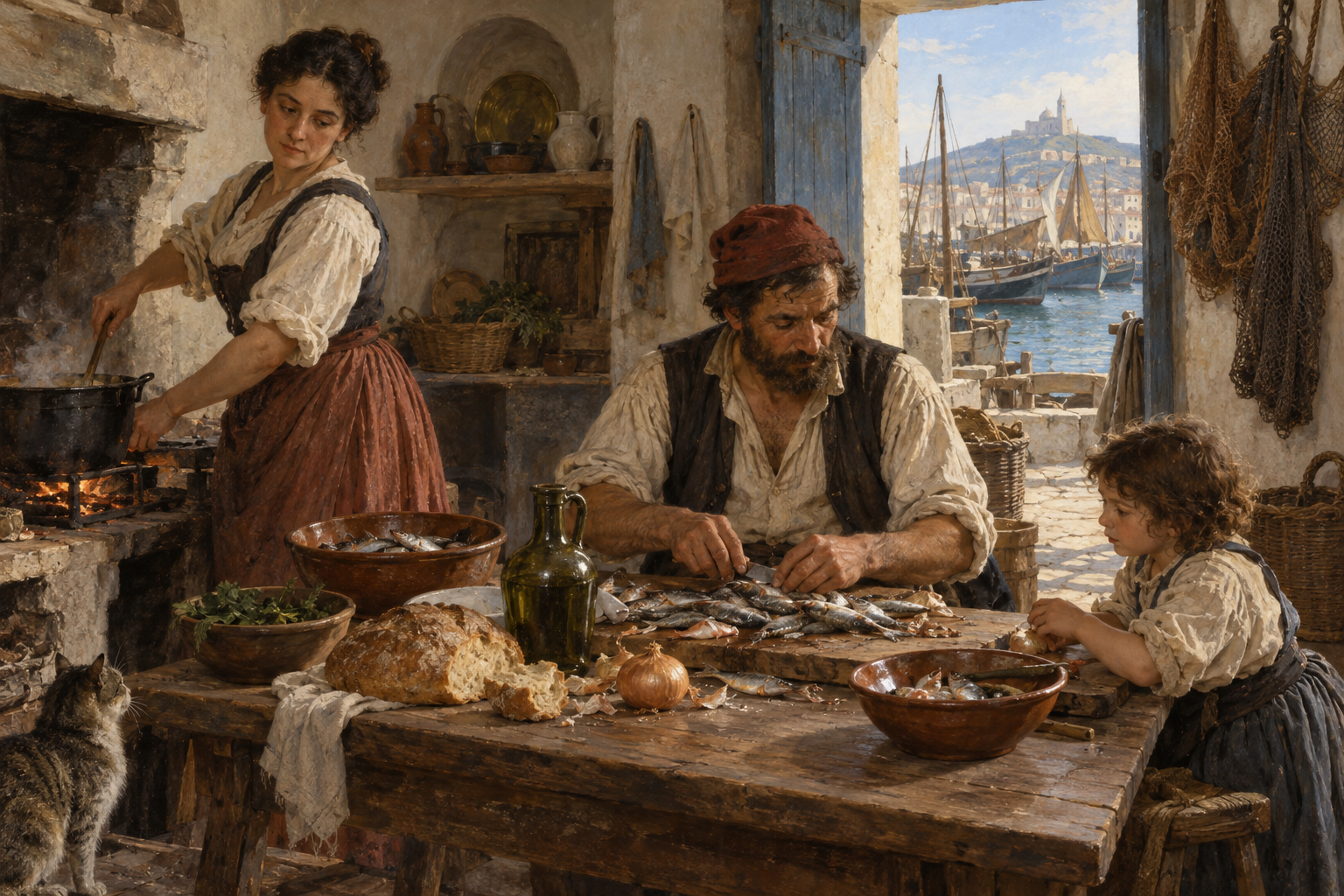
Describing the ingredients as poor-quality fish, however, misses the point. Fish that is hard to sell is not necessarily poor eating. A spiny fish with a large head may be awkward to clean but excellent in a broth. The distinction between market value and culinary value is an important part of the bouillabaisse story. What failed to meet a customer’s wishes might suit the pot very well.
The story is often traced further back, to the Greek settlers who founded Massalia around 600 BC. Greeks cooked fish in pots, and Marseille undeniably has Greek roots. But that does not establish that today’s saffron-scented bouillabaisse existed in antiquity. It is better to speak of a very old Mediterranean tradition of cooking fish in liquid than of an unbroken, unchanged recipe.
The name comes from Provençal and is usually explained through words meaning to boil and to lower. The explanation is often presented as a kitchen instruction: let it boil, then lower the heat. It suits the dish’s technique, but should not be read as a complete original recipe. The history of language is rarely as tidy as an instruction printed on a tea towel.
By the 19th century, bouillabaisse was firmly established in culinary literature. Alexandre Dumas discusses it in his posthumously published Grand dictionnaire de cuisine of 1873, and Jean-Baptiste Reboul includes it in La Cuisinière provençale, first published in 1897. Such works reveal a dish with a regional identity and recognisable ingredients, but also show that it already had several interpreters.
Along the way, fishermen’s food became restaurant food. Larger fish for serving, careful presentation and service in several stages made the meal more elaborate and expensive. Today, a serious bouillabaisse may need ordering in advance rather than choosing on the spot for a quick lunch. This does not contradict its humble origins; it shows how labour-intensive recreating a catch-based dish can become when every ingredient must be bought specially.
The 1980 charter: drawing a line around the name
When a regional dish becomes famous, its name soon begins to be used more freely. A smooth fish broth with cream, a seafood stew with salmon or a tomato soup with a few mussels may be good food, but adding saffron does not automatically make it bouillabaisse. It was precisely this dilution that prompted Marseille restaurateurs to draw up the Charte de la Bouillabaisse in 1980.
The charter is a professional agreement on the dish’s identity, not a law governing every French home kitchen. It highlights particular fish species, cooking methods and service. Its description calls for at least four species from the specified selection. These include rascasse, congre, grondin and vive, alongside other fish associated with the local tradition.
So it is not simply the number of varieties that matters. A mixture of four arbitrary fish fillets will not necessarily produce the same result. The species contribute different amounts of bone, connective tissue, fat and flavour. The charter also makes the fish visible as the main ingredient: it is served separately from the broth, which is accompanied by bread and sauce. Diners should be able to see that they are eating fish, rather than simply drinking a delicious liquid in which the ingredients have disappeared.
At the same time, a charter must be understood in its historical context. It tells us how certain restaurateurs wanted to safeguard the dish in 1980, not exactly how every fishing family cooked dinner a hundred years earlier. Tradition is bigger than a document, but the document helps us distinguish a bouillabaisse rooted in Marseille from a broadly Mediterranean-inspired fish stew.
The recipe here is therefore explicitly a Swedish home version. It follows the dish’s flavour principles with fish stock, several species of fish, olive oil, saffron, fennel and rouille served separately. It does not, however, claim to meet the Marseille charter’s species requirements. Being clear about the adaptation is more respectful than calling every substitution authentic.
Rascasse, bones and the Swedish fish counter
Rascasse is a central name in the world of bouillabaisse and refers to scorpionfish. These fish are associated with rocky seabeds, and their heads and bones can contribute to a flavourful broth. When Swedish texts describe them as klippfisk, or rock fish, they are referring to their habitat. This should not be confused with klippfisk meaning salted and dried fish. That has no place in this stew.
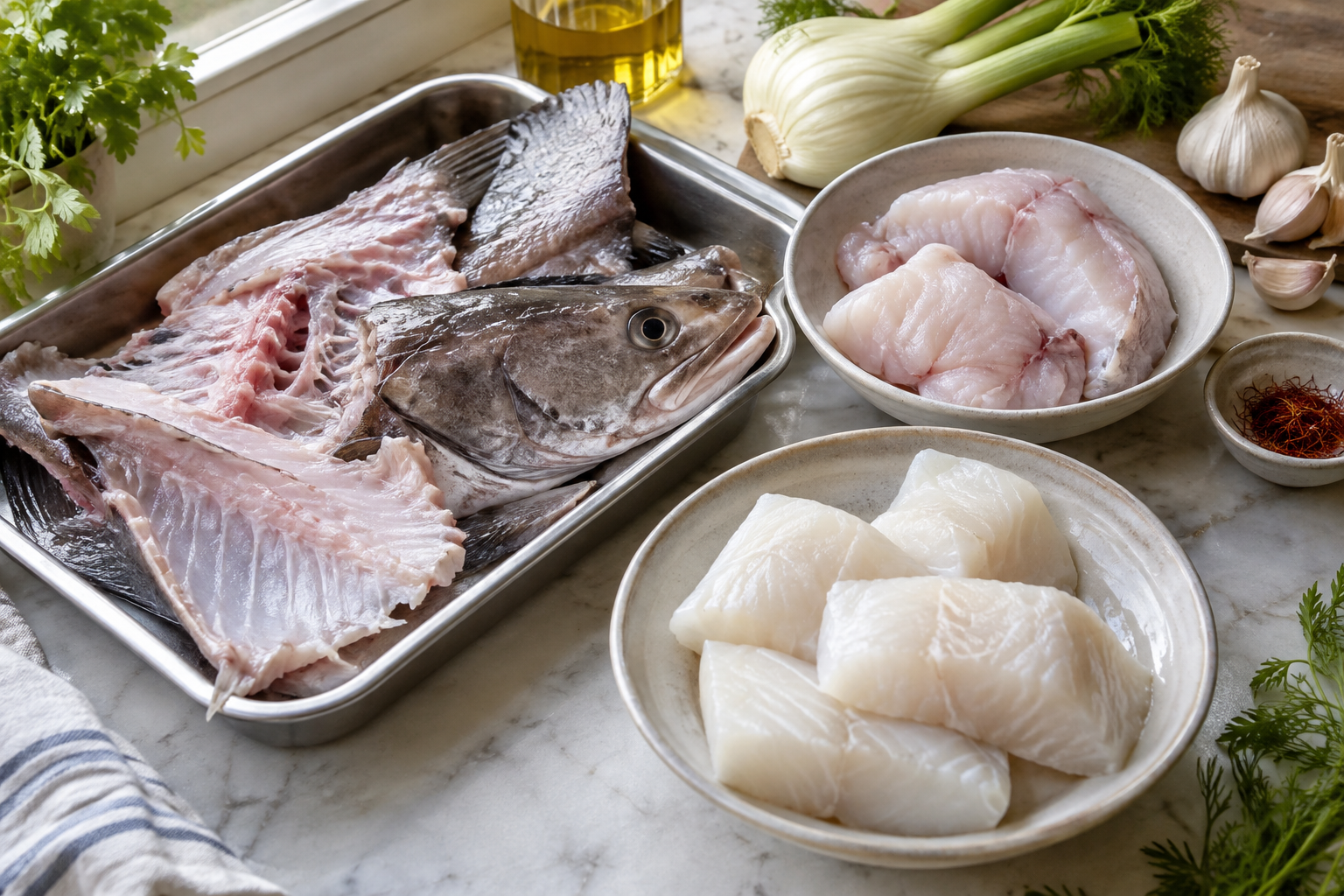
Congre is conger eel and grondin is gurnard; vive means weever fish. Knowing their Swedish names will not necessarily make them easy to buy, as availability varies greatly. Weever fish and scorpionfish also have venomous spines that require expert handling. If you find them, ask the fishmonger to clean and prepare them. There is no culinary merit in learning that part through a puncture wound in your hand.
In Sweden, it is more practical to think in terms of function. You need a good foundation of bones and frames, a firm fish that holds its shape and ideally another species or two to vary the flavour and texture. Monkfish is firm and almost springy. Cod or haddock offers softer flesh with distinct flakes. Hake is another possible choice. Gurnard, when available, provides a closer link to the southern French range of fish.
None of these combinations is an exact replica of rascasse and its companions. Above all, you cannot replace the contribution of fish heads and frames by buying even finer boneless fillets. Ask for frames from lean white fish, with the gills and guts removed. They should smell fresh and mild, not sharp or stale. A larger head may need splitting by the fishmonger to fit in the pan.
Salmon is easy to find but takes the flavour in a different direction. Its fat and distinctive character dominate the broth. Smoked fish does so even more. Save them for other soups and base this stew on lean sea fish. Choose according to current availability and ask about the species, catch area and fishing method; sustainability cannot be judged by the fish’s name alone.
Mussels, prawns and lobster appear in various restaurant versions and international recipes. They are not necessary to make the dish generous. A handful of prawns may simply disguise a thin fish broth. Spend the money on enough fish and a good stock instead of a decorative shellfish topping.
The broth carries everything – the rouille adds bite
A good bouillabaisse should taste of more than saffron. Fennel brings a green, gently aniseed-like sweetness. Onion rounds things out, tomato adds acidity and depth, and garlic sits beneath the fish flavour. Orange zest can bring a bright, bitter-aromatic lift, but only a little is needed. Too much makes the stew perfumed, especially if any white pith comes with it.
Saffron is expensive and deserves care. Crumble it and leave it to steep in a little warm stock before adding it. This helps distribute both colour and aroma. Do not toast it fiercely in hot oil with the vegetables. Burnt saffron cannot be rescued by diluting the stew. Its aroma here should be warm and dry, not bitter.
Olive oil is more than a cooking fat. In bouillabaisse, it contributes to the broth’s body. A vigorous boil can help the oil and liquid form a temporary emulsion, making the broth slightly cloudy and more cohesive. This is quite different from a clear fish consommé. It does not, however, mean that delicate fillets should be boiled hard until they break apart.
In a home kitchen, it makes sense to separate the stages. First, the fish bones flavour a simple stock over a relatively short cooking time. The strained stock is then cooked with the stew’s aromatic base. Once the flavour is ready, the serving pieces of fish go in according to their firmness and thickness. This gives the broth the vigorous cooking it needs without drying out the most expensive ingredient in the meal.
The most common shortcut is ready-made fish stock, and it can work. The problem is often salt: a broth that seems well balanced at first becomes too salty as it reduces. Dilute concentrated stock cautiously, then taste and adjust towards the end. Look for a stock with a clean fish flavour rather than one dominated by dill, wine or other seasonings that have already set the stew’s direction.
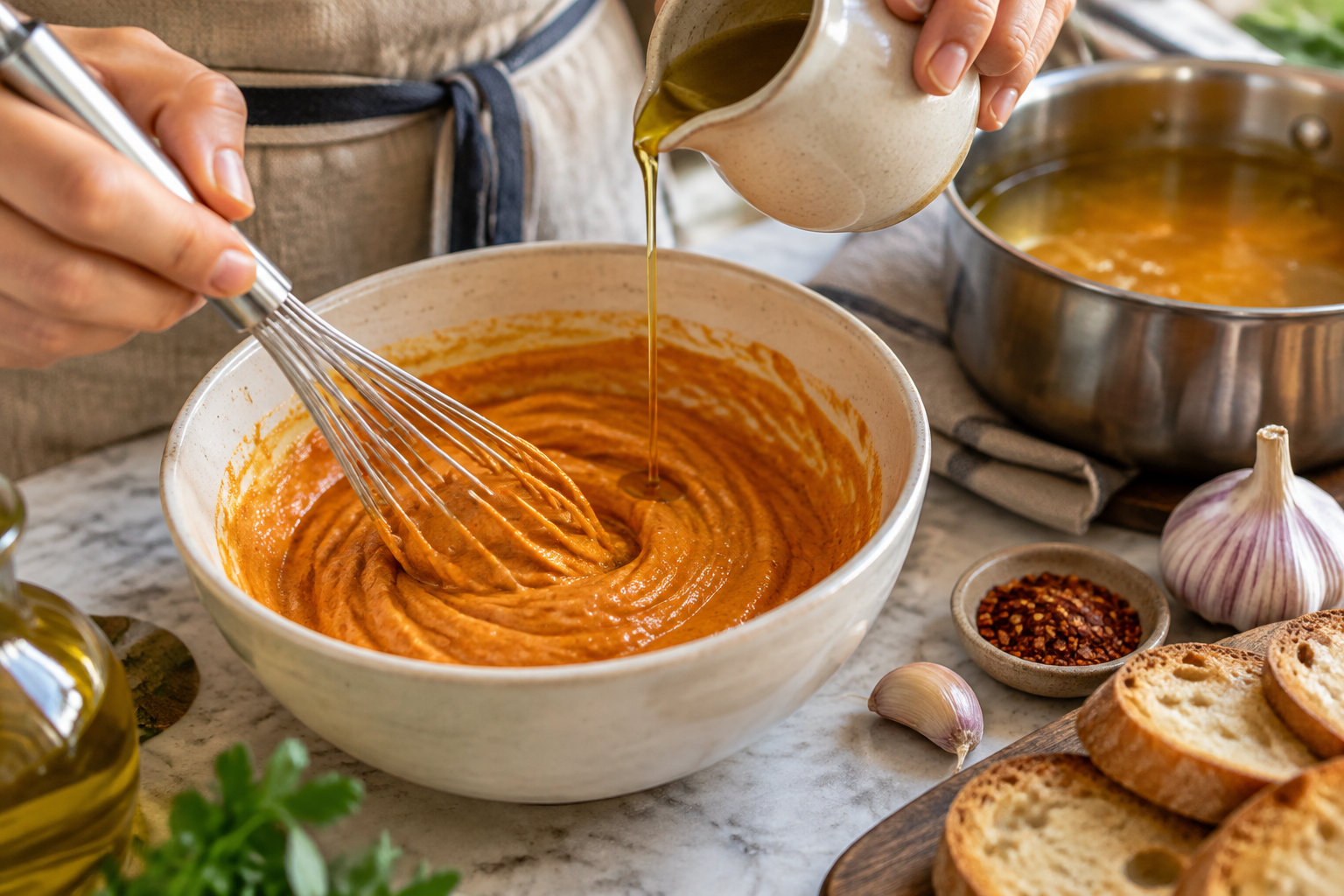
Rouille means rust and refers to the sauce’s colour. It comes in several forms, including versions thickened with bread or potato; egg yolk is also used. Garlic, oil and chilli are key flavour builders, while saffron can enhance the colour and aroma. The version here is a practical sauce bound with bread and egg yolk, not a claim that every kitchen in Marseille uses the same method.
The sauce should be bold enough to make itself felt through the broth, but need not numb the mouth. Grate the garlic finely and start cautiously with the chilli. Whisk in the oil slowly so the sauce has time to absorb it. A mild olive oil, preferably mixed with neutral rapeseed oil, makes a rounder home version than a very peppery oil competing with both garlic and saffron.
A meal in several movements
Bouillabaisse is a dish that likes to spread across the table. The bread, sauce, broth and fish make the meal something more than a bowl set down ready to eat. In the classic restaurant service described by the charter, fish and broth are kept separate. Exactly how diners combine them, and in what order they eat them, can vary.
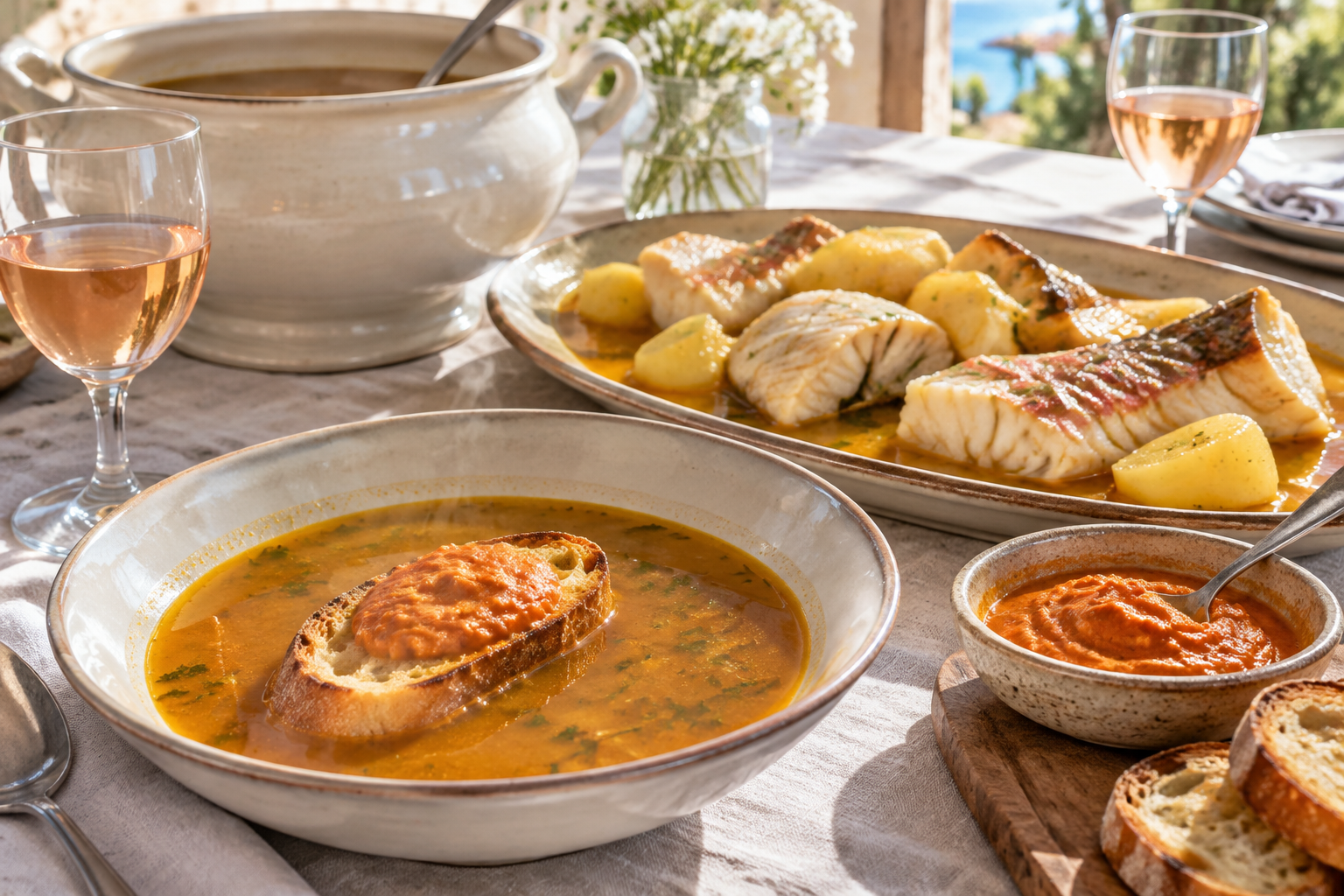
At home, you can place a warm platter of fish in the centre of the table and serve the broth from a tureen or straight from the pot. Let everyone spread rouille on their toast. As the bread meets the broth, its underside softens while the edges still crunch. The sauce slowly dissolves, making every spoonful a little richer and hotter.
Potatoes appear in many versions and make the meal substantial without taking over. They are practical, too: they can cook in the broth before the fish goes in. The pieces should not be so large, however, that you have to choose between hard potatoes and overcooked fish. Bouillabaisse rewards getting the cooking sequence right.
A dry rosé from Provence pairs well, but colour alone does not tell you how a wine will work. Look for freshness and enough flavour to match the broth. A rosé from Bandol can have the structure needed for olive oil and garlic. Keep the chilli fairly restrained if serving wine, as alcohol can make the heat more pronounced.
Cassis, the coastal appellation near Marseille, is particularly known for its white wines, although rosé is also produced there. A dry white Cassis is therefore just as natural a choice as Provençal rosé. The aim is a wine that complements the mild fish and aromatic broth without adding heavy oak or noticeable sweetness.
Alcohol-free drinks need the same care. A dry alcohol-free rosé can work, but check the sweetness: a very sweet drink often makes the salty broth seem less nuanced. Another option is lightly brewed, chilled green tea with a little lemon zest. Its gentle astringency balances the oil, while the lemon aroma lifts the fish. Do not brew it too strongly; a bitter drink and fiery, garlicky rouille make an unnecessarily harsh combination.
Making the stew work in a Swedish kitchen
Plan backwards from serving time. The bread should be toasted, the rouille ready and the bowls warm when the fish goes in. That is not the moment to start searching for the hand blender or setting the table. Bouillabaisse lends itself well to advance preparation right up to the final stage, but cooked fish suffers if left waiting on a warm hob.
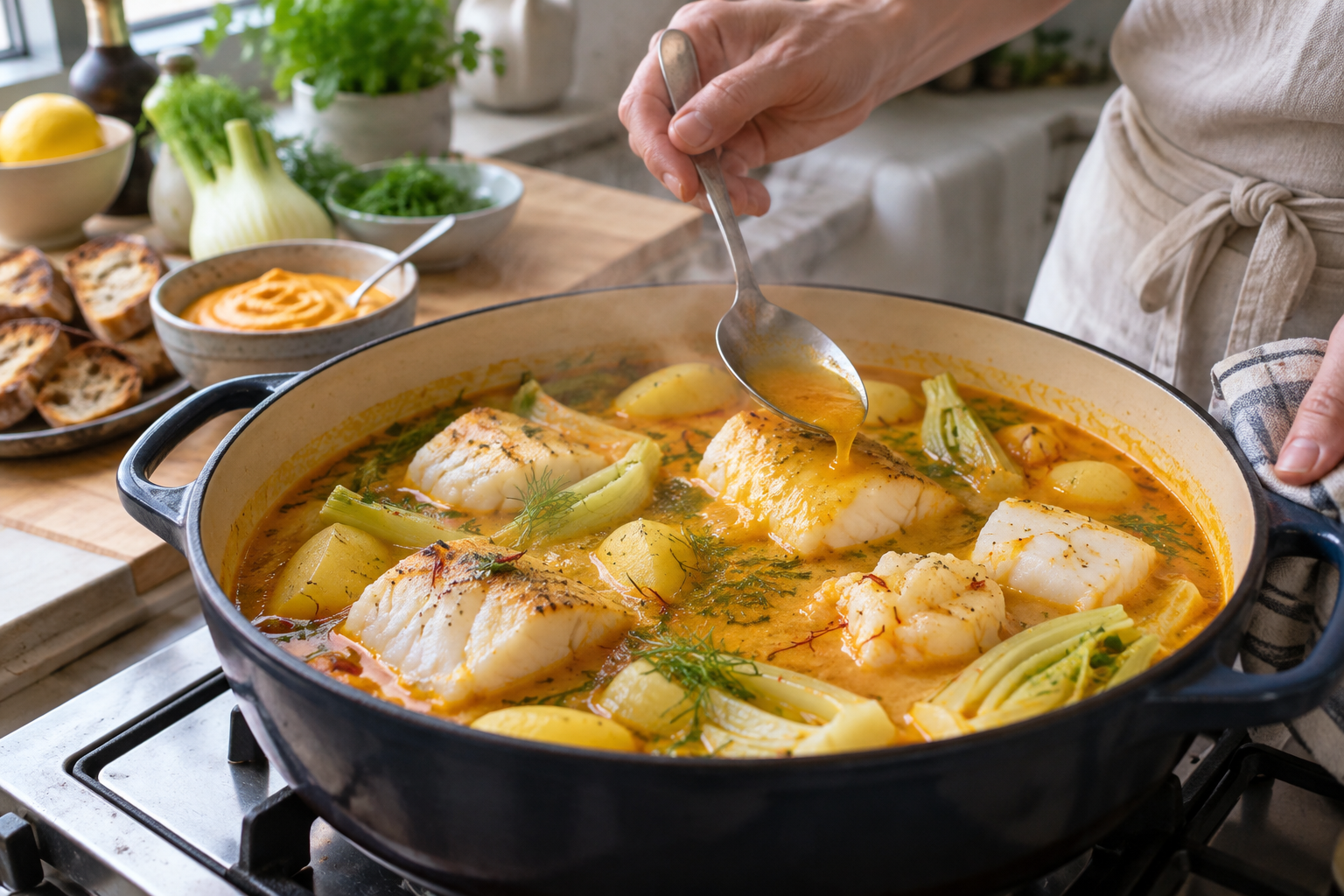
The broth can be made the day before. Cool it quickly, refrigerate and bring it to the boil when cooking. The vegetable base can also be prepared ahead. Keep the fish separately in the fridge and cut it into fairly large, evenly sized pieces. Small cubes are easy to overcook and difficult to serve neatly. Let the thickness of the fish, not just its species, determine the order in which it goes into the pot.
Use a wide pot so the fish has a little room around it. Once it is in, do not stir it with a spoon as you would a meat stew. Instead, gently shake the pot or spoon hot broth over the uppermost pieces. Lift out a piece to check: the flesh should have just turned opaque and separate under gentle pressure, rather than feel hard and springy.
Frozen fish works if thawed slowly in the fridge and allowed to drain. Well-handled frozen fish is better than fresh fish past its best. Ready-made stock is also a reasonable option if you have no fish frames. What matters is understanding what the shortcut changes and adjusting the seasoning accordingly, not making every stage as labour-intensive as possible.
The recipe cards below therefore hold two ideas in balance: respect for Marseille’s dish and practicality at a Swedish fish counter in an ordinary week. Make the rouille first, then build the broth and finally give the fish its few minutes of cooking. When the bowls reach the table, the aroma should be deep and warm, the bread crisp and the fish still juicy. That is where the true generosity of bouillabaisse lies.
Bouillabaisse for a Swedish Home Kitchen
A Marseille-inspired home version with three readily available fish species, saffron and fennel. It does not meet the Bouillabaisse charter’s species requirements. The recipe includes a simple fish stock; alternatively, use 1.2 litres of ready-made, lightly salted fish stock and skip steps 1–2. Serve with the rouille in the next recipe.
Ingredients
Method
- 1Place the cleaned fish frames in a saucepan with the water, roughly sliced onion and bay leaf. Bring slowly to the boil and skim off any foam. Simmer uncovered for 20–25 minutes; avoid prolonged, vigorous boiling.
- 2Strain the stock through a fine-mesh sieve without pressing hard on the bones. Measure out 1.2 litres. If you have less, add water; if you have more, reduce the strained stock. Set aside 0.5 dl of warm stock and steep the saffron in it for 10 minutes.
- 3Finely chop the onion for the stew, thinly slice the fennel and chop the garlic. Dice the tomatoes. Peel the potatoes and cut into roughly 2 cm pieces. Cut the fish into large serving pieces, about 5–6 cm, and keep chilled.
- 4Heat 3 tbsp olive oil in a wide pot. Gently fry the onion and fennel over a medium heat for 8–10 minutes until softened but not browned. Add the garlic and tomato purée and cook for another 1 minute.
- 5Add the tomatoes and cook, stirring, for 4–5 minutes. Pour in the stock and saffron liquid. Add the potatoes, bay leaf, thyme and orange zest. Bring to a lively boil for 2 minutes, then simmer for about 15 minutes, until the potatoes are almost tender.
- 6Meanwhile, make the rouille following the next recipe. Lightly brush the bread with olive oil and toast in a conventional oven at 225°C for 6–8 minutes until golden. Watch closely towards the end.
- 7Remove the orange zest and bay leaf. Season the broth with salt and pepper to taste. Check that the potatoes are nearly cooked before adding the fish.
- 8Add the monkfish first and simmer very gently for 3 minutes. Then add the cod and haddock or hake. Simmer for a further 4–6 minutes, depending on the thickness of the pieces. Spoon broth over the fish rather than stirring. The fish should be opaque and just separate under gentle pressure; for fully cooked fish, check that the thickest piece has reached 63°C.
- 9Carefully lift the fish onto a warm platter with a slotted spoon. Ladle the broth and potatoes into warm bowls or serve them separately. Serve immediately with the fish, toast and rouille.
- You can replace the monkfish with more thick cod loin, but add it later. Always adjust the cooking time to the thickness of the fish.
- The stock can be made the day before; cool it quickly and store at no more than 4°C. Wait until serving time to cook the fish portions.
- If using shop-bought concentrated stock, start with less concentrate than the packet recommends and taste after cooking.
- Cool any leftovers quickly and eat the next day. Reheat gently until hot throughout; the fish will, however, become firmer.
Rouille with Saffron, Garlic and Chilli
A rust-red, boldly garlicky sauce to spread on toast or let melt into the broth. This home version is bound with bread and egg yolk; traditional recipes vary and may also use potato.
Ingredients
Method
- 1Crumble the saffron into the warm water and leave to steep for 5 minutes. Add the bread and let it soak up the liquid. Allow the mixture to cool to room temperature.
- 2Mash the bread very finely in a bowl. Stir in the garlic, egg yolk, paprika, cayenne pepper, lemon juice and salt. Whisk until as smooth as possible.
- 3Combine the olive oil and rapeseed oil in a jug. Begin by whisking the oil into the bread mixture drop by drop.
- 4Once the sauce begins to thicken, add the oil in a very thin stream, whisking constantly. Let each addition become fully incorporated before adding more.
- 5Taste and add more salt or cayenne if needed. If the sauce is too thick, whisk in 1–2 tsp water. It should spread easily on bread without feeling stodgy.
- 6Cover and refrigerate until serving. Serve a dollop on toast alongside the hot broth.
- If the sauce splits, start with a fresh egg yolk in a clean bowl and whisk in the split sauce very slowly.
- Preferably use Swedish or pasteurised eggs. Store the sauce at no more than 4°C and use within 24 hours.
- The garlic becomes more pronounced as the sauce stands. Start with one clove if you prefer a milder rouille.
What goes in the glass
- WineDry rosé from Bandol, ProvenceA flavourful, fresh rosé has enough body for the fish broth and olive oil. Look for a restrained alcohol level and keep the rouille moderately hot.
- WineDry white wine from CassisCassis is particularly known for its white wines. Fresh acidity and herbal or citrus notes suit the fish, fennel and richness of the rouille.
- Alcohol-freeDry alcohol-free roséFresh acidity cuts through the olive oil and sauce, while gentle berry notes complement the tomato. Choose a less sweet style to give the fish flavour room to shine.
- Alcohol-freeChilled, lightly brewed green tea with lemon zestGentle astringency balances the rouille, while the citrus zest’s aroma lifts the broth. Brew lightly to avoid bitterness.
Enjoy alcohol in moderation. Alcohol-free options go just as well with the food.
Sources
- Restauratörer i Marseille, Charte de la Bouillabaisse (1980)
- Alexandre Dumas, Grand dictionnaire de cuisine (1873)
- Jean-Baptiste Reboul, La Cuisinière provençale (1897)
- Elizabeth David, French Provincial Cooking (1960)
- Alan Davidson; tredje upplagan redigerad av Tom Jaine, The Oxford Companion to Food (2014)
- Larousse, Larousse Gastronomique (2009)
- Institut national de l'origine et de la qualité, INAO, Cassis – appellationsinformation
Ask questions about "Bouillabaisse – Marseille in a Bowl". Answers are based on the magazine's own articles.