Sea Buckthorn – the Coast’s Tart, Vitamin-Rich Berry
From thorny coastal bushes to golden compote
Sea buckthorn glows orange as late summer turns to autumn. Rich in vitamin C, intensely tart and tricky to pick, these berries can become one of the Nordic kitchen’s most distinctive ingredients with the right handling. Here is where to find them, when they ripen and how to make the most of their flavour.
 By Lina BergFood editor · European and Nordic cuisines – Italy, France, Spain, Greece and Swedish home cooking
Translated from Swedish with AI assistance.
Go to the recipe ↓An orange glow by the shore
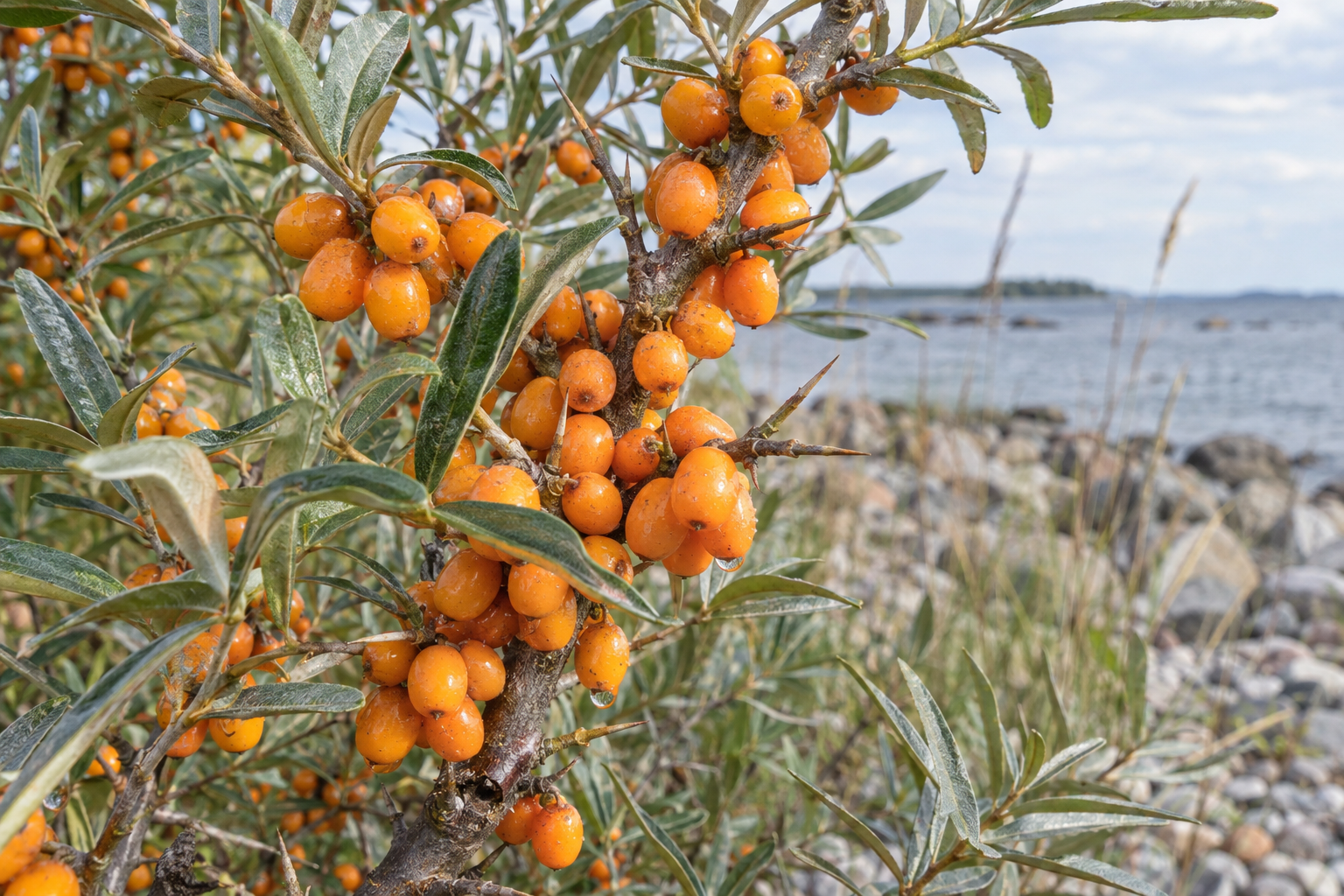
Gravel crunches underfoot, the wind rustles through the reeds, and between the narrow, silvery-grey leaves, berries cling close to the wood. Not in convenient clusters, but as though stitched along the branches. Sea buckthorn is a beautiful but prickly acquaintance. Reach in too quickly and you meet a thorn; squeeze a ripe berry too firmly and it bursts between your fingers. The juice is orange-yellow, the scent fresh and the flavour so tart that your mouth almost puckers before the fruitiness has a chance to emerge.
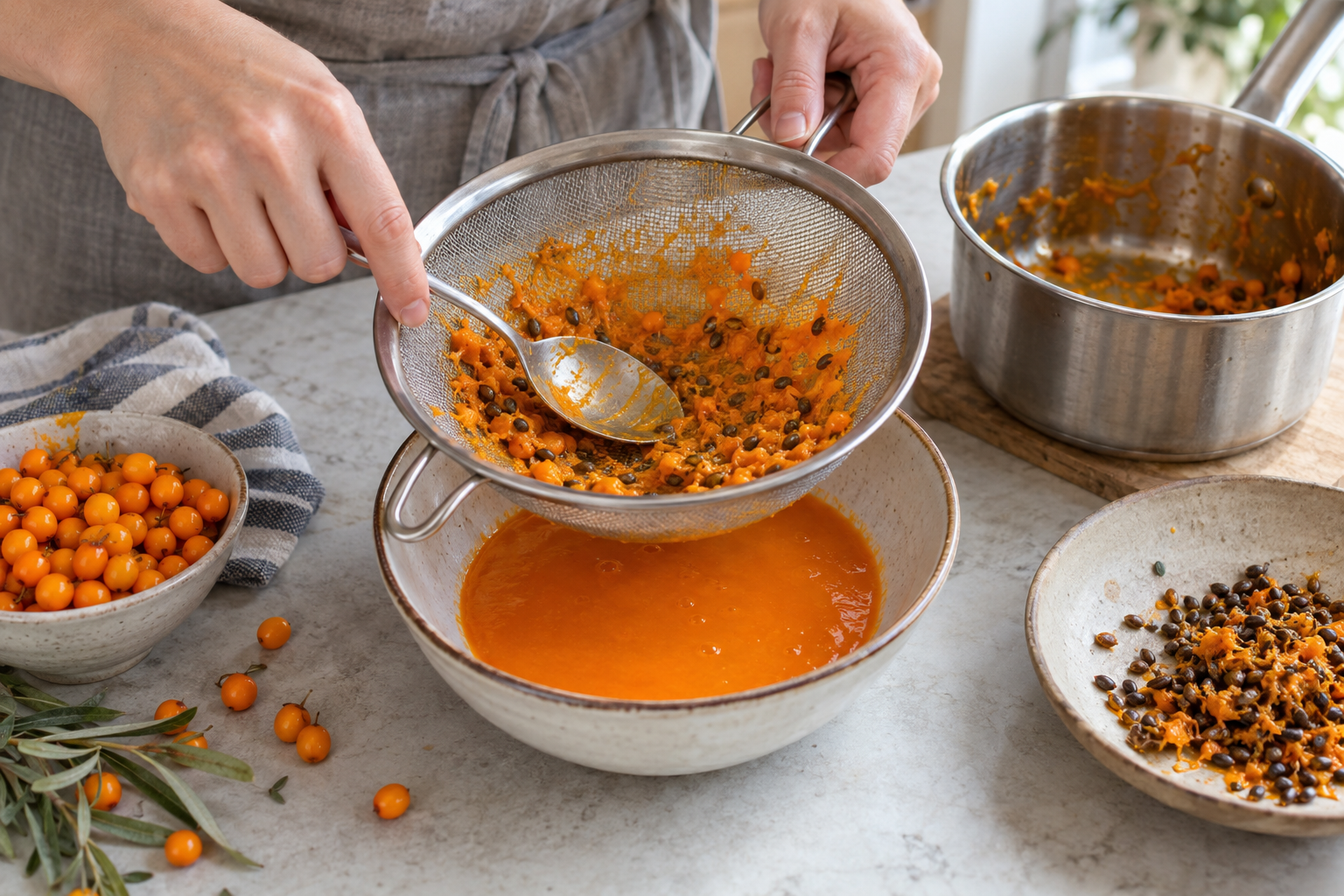
In the kitchen, the encounter is gentler. Warm the berries gently with a little sugar and a scent rises that might bring citrus, apricot and pineapple to mind, yet with a distinctive austere note. A spoon scrapes against the sieve, the seeds stay behind, and a thick, luminous purée collects in the bowl. Paired with mild yoghurt, creamy panna cotta or warm apple compote, that acidity has something to lean on. This is often where sea buckthorn shines: as a bold accent rather than a large bowl of berries to eat just as they are.
The name brings the sea to mind, and along parts of the Swedish coast the connection is obvious. But sea buckthorn also belongs to a much broader landscape, with a home far from salt-splashed rocks. To understand the berry, we need to follow both the shorelines and the routes east.
From Swedish shores to inland Asia
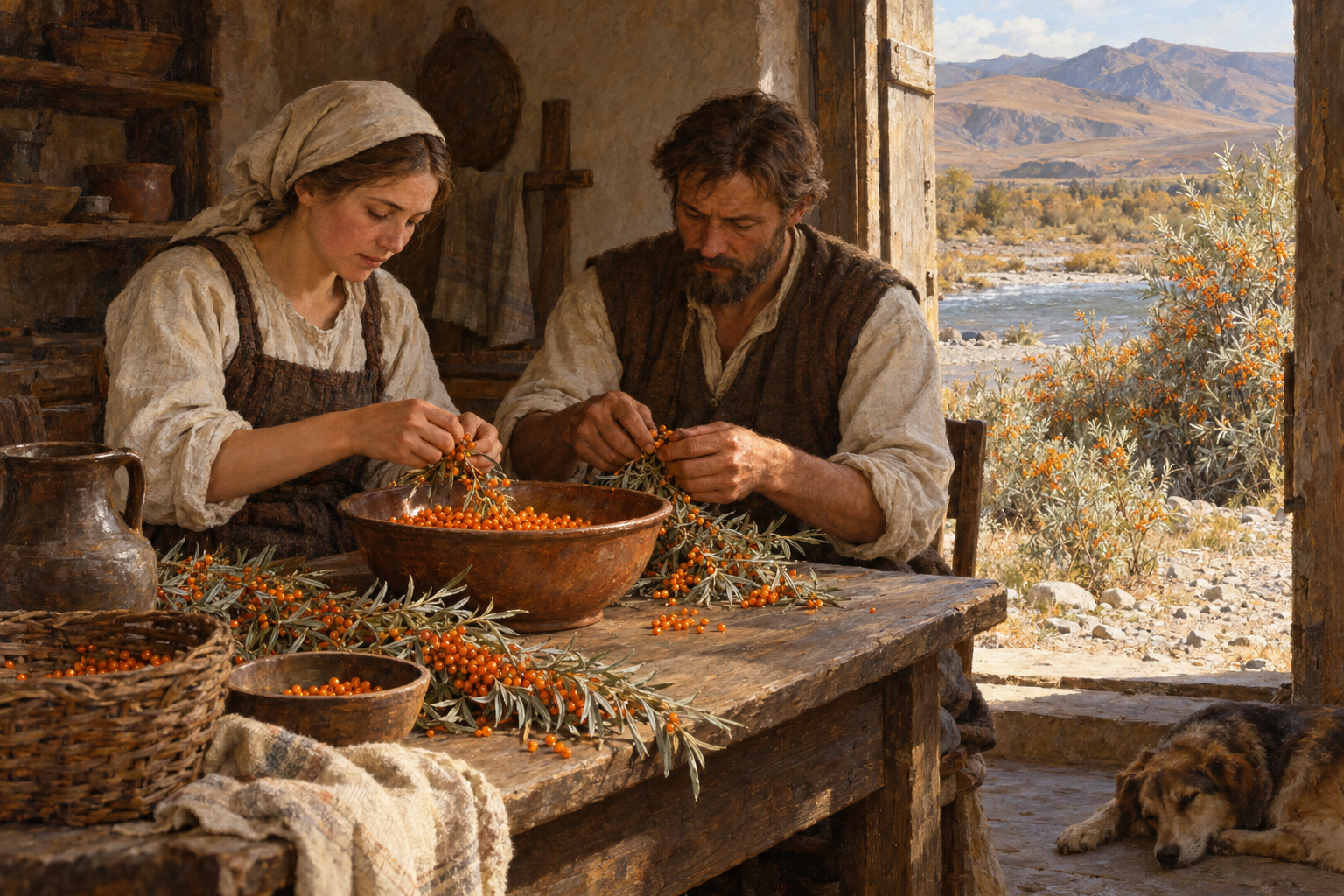
Sea buckthorn, Hippophae rhamnoides, has a wide natural range across Europe and Asia. The species grows in varied environments, from coastal land to gravelly riverbanks and mountain regions. So it is by no means exclusively Nordic, even if it fits neatly into the idea of a Nordic larder. Sunny, open sites are a common thread. Where other plants struggle to establish themselves, sea buckthorn can form dense stands.
In Sweden, wild sea buckthorn is particularly associated with the east coast, including Uppland and the shores of the Gulf of Bothnia. Its distribution is patchy, not a continuous orange ribbon along every beach. The shrub is also planted and can spread from cultivation. A sea buckthorn bush beside a swimming spot or in a coastal park is therefore not necessarily part of a natural stand. If you want to find wild growing sites, an up-to-date flora and local nature guides are better companions than the assumption that every seashore should have sea buckthorn.
The shrub thrives in light and tolerates poor soil. Its roots form a partnership with nitrogen-fixing bacteria of the genus Frankia, helping it establish itself where nitrogen is scarce. It can also send up root suckers. Over time, individual bushes grow into thickets where birds find shelter, while berry pickers must look for a way in without snagging a sleeve.
Sea buckthorn has been used as food and in traditional medicine in parts of its Eurasian range. That does not mean every subsequent health claim is supported by evidence, or that there is a single shared sea buckthorn tradition. In Swedish cooking, the berry is less firmly rooted than lingonberries and bilberries. Today’s interest is also linked to cultivation, improved varieties and a Nordic restaurant scene keen to showcase local, tart ingredients. There is no need to invent a definitive Swedish debut for sea buckthorn jam: its history is broader than a single moment of invention.
Harvest time – and the art of protecting the bush
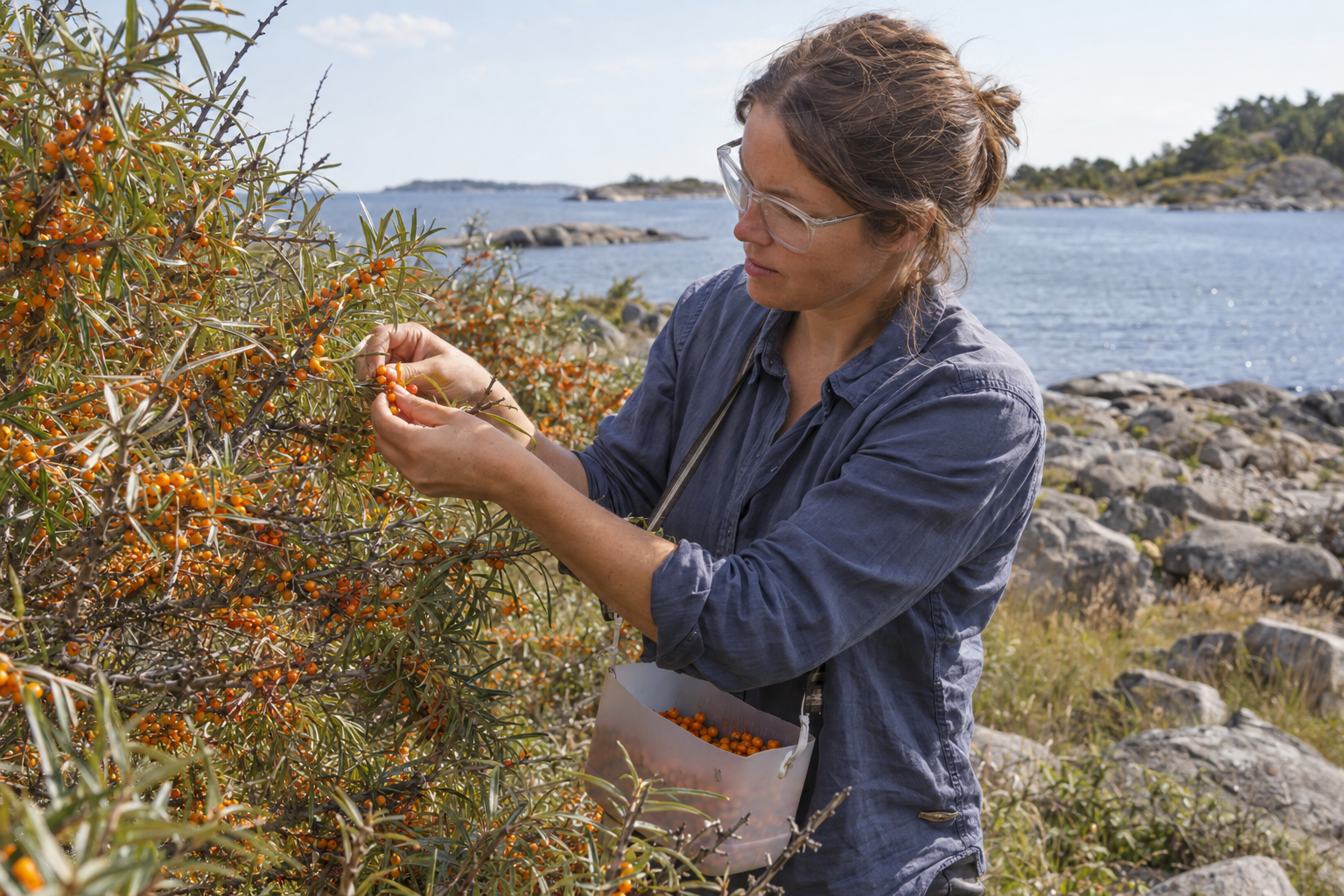
When are the berries ready? In Swedish conditions, the harvest usually falls between late summer and autumn, often sometime from August to October. But this is a guide, not a promise. Variety, growing site, weather and latitude all affect ripening. Early cultivated varieties may be ready while others still need time. Look for berries that have developed their ripe yellow-to-orange colour and taste them cautiously. Colour varies between varieties, so darkest does not automatically mean best.
A ripe sea buckthorn berry should have a fully developed flavour but may still be very sour. Waiting for it to become as sweet as a raspberry may simply leave you with overripe berries that are difficult to pick. Slightly softer fruit is less of a concern for purée and juice, while berries intended to keep their shape need to be picked firmer. There is no need to wait for the first frost, either. Cold can make some handling easier, but it is not an essential signal of ripeness.
Sea buckthorn usually bears male and female flowers on separate plants, and it is the female plants that produce fruit. Pollination happens by wind. Home growers therefore normally need both a suitable male plant and female plants that flower at the same time. Check the varieties’ characteristics at the nursery. A solitary bush that grows well but never produces berries is not necessarily being neglected; it may be male, or lack a nearby source of pollen.
When picking wild berries, patience is your most important tool. Long sleeves, eye protection in dense thorny thickets and a small container that leaves your hands free make the job more comfortable. Pick gently without breaking shoots. Cutting off fruit-bearing branches and freezing them is a harvesting method used in cultivation, but it requires planned pruning and is not something Sweden’s right of public access allows you to do to someone else’s bushes. Wild berries may generally be picked where the right of public access applies; branches may not be cut off. Nature reserves may have special rules.
Choose clean growing sites, too, away from busy roadsides, and leave berries for other people and for wildlife. If harvesting feels too laborious, there is a perfectly sensible shortcut: buy frozen sea buckthorn. That takes you straight to the most enjoyable part, without turning an outing into an endurance test.
Vitamins, acidity and the effects of heat
Sea buckthorn is rich in vitamin C, but the content varies considerably with factors including variety and stage of ripeness. Precise promises about what a particular number of berries will provide are therefore rarely very useful. The berries also contain carotenoids, which contribute to their yellow-orange colour, and oil in both the flesh and the seeds. So it is hardly surprising if a splash of sea buckthorn purée looks a little richer or more separated than other berry juices.
It is tempting to call all this a vitamin powerhouse and leave it there. But a berry is food, not insurance against illness. Among other functions, vitamin C is needed for normal collagen formation and helps the body absorb iron from plant-based foods. That makes sea buckthorn an interesting addition to a varied diet, not a treatment. Its strongest selling point at the table can simply be its utterly distinctive flavour.
Vitamin C is sensitive to heat, oxygen and prolonged storage, among other things. Brief heating and gentle handling are therefore sensible ways to preserve it, but cooked sea buckthorn dishes do not become pointless just because some of the vitamin is lost. Freeze the berries soon after picking if you are not using them straight away. Remove leaves and damaged berries, rinse if necessary and drain. Freezing them in a thin layer makes it easier to take out only what you need later.
When it comes to flavour, the most common mistake is to treat sea buckthorn like a mild dessert berry. Its acidity needs balance. Sweetness rounds it out, fat softens the impression, and apple or pear adds volume without competing too strongly with the flavour. Simply piling in more sugar, however, can produce a heavy, cloyingly sweet-tart sauce. Instead, start with less sea buckthorn and use it as a seasoning. Pass it through a fine-mesh sieve when you want a smooth purée; vigorous blending can crush the seeds and introduce unwanted astringency.
A Nordic berry at today’s table
Today, we encounter sea buckthorn in juices, preserves, ice creams, dessert sauces and the little brightly coloured dollops served in restaurants. But it need not be a special occasion. A spoonful in breakfast yoghurt, a thin drizzle over vanilla ice cream or a little purée in a dressing goes a long way. With smoked or oily fish, its acidity can play a similar role to lemon, though the flavour will be different. With game, sea buckthorn works best with support from something mellower, such as apple.
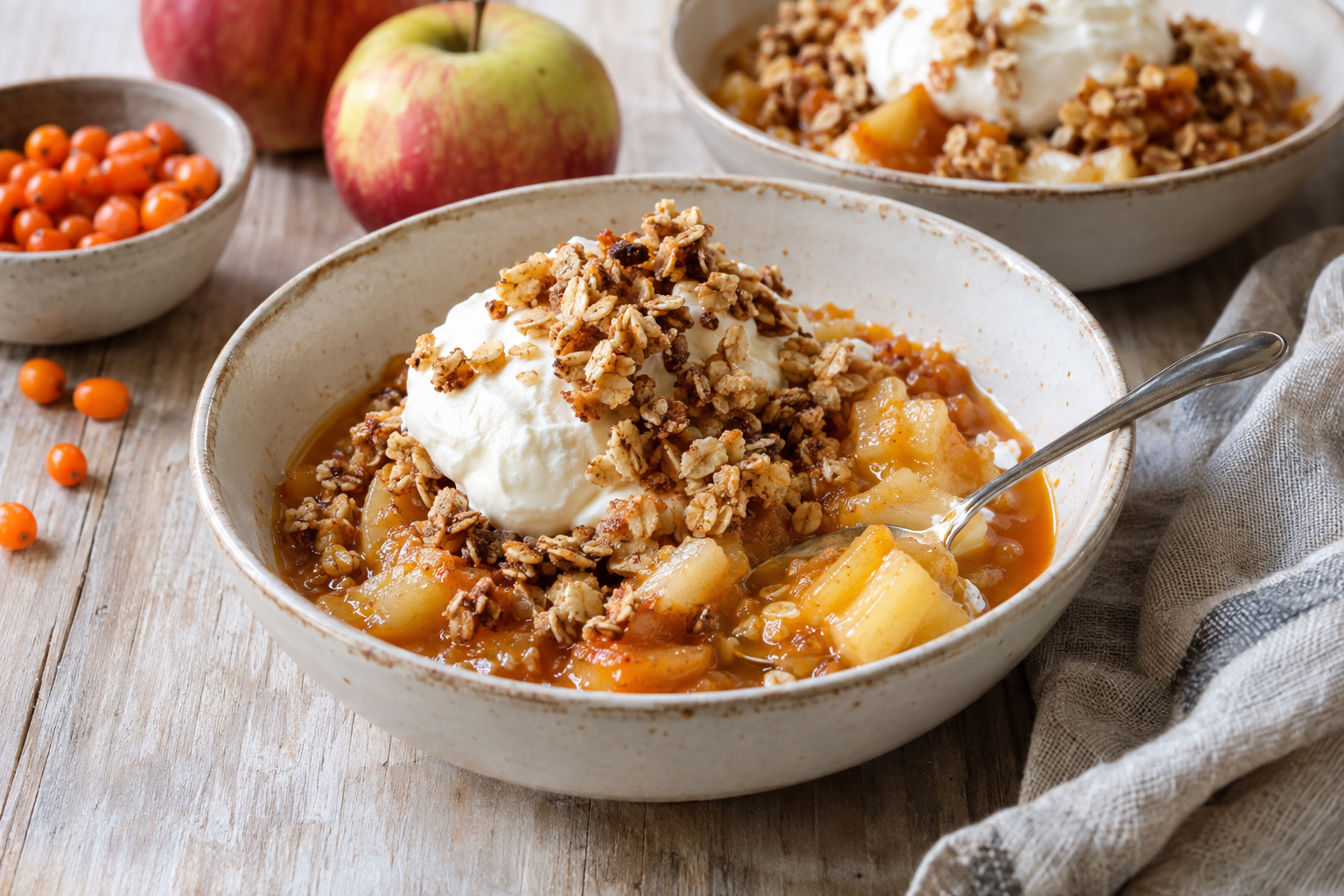
At a Swedish fika table, the combination of apple, oats and cream is particularly easy to love. Apple makes the berry’s flavour approachable, oats bring a toasted note, and cream cushions the acidity. It is also a good way to introduce someone to sea buckthorn: not as a test of who can tolerate the most tartness, but in a dessert where every element supports the others.
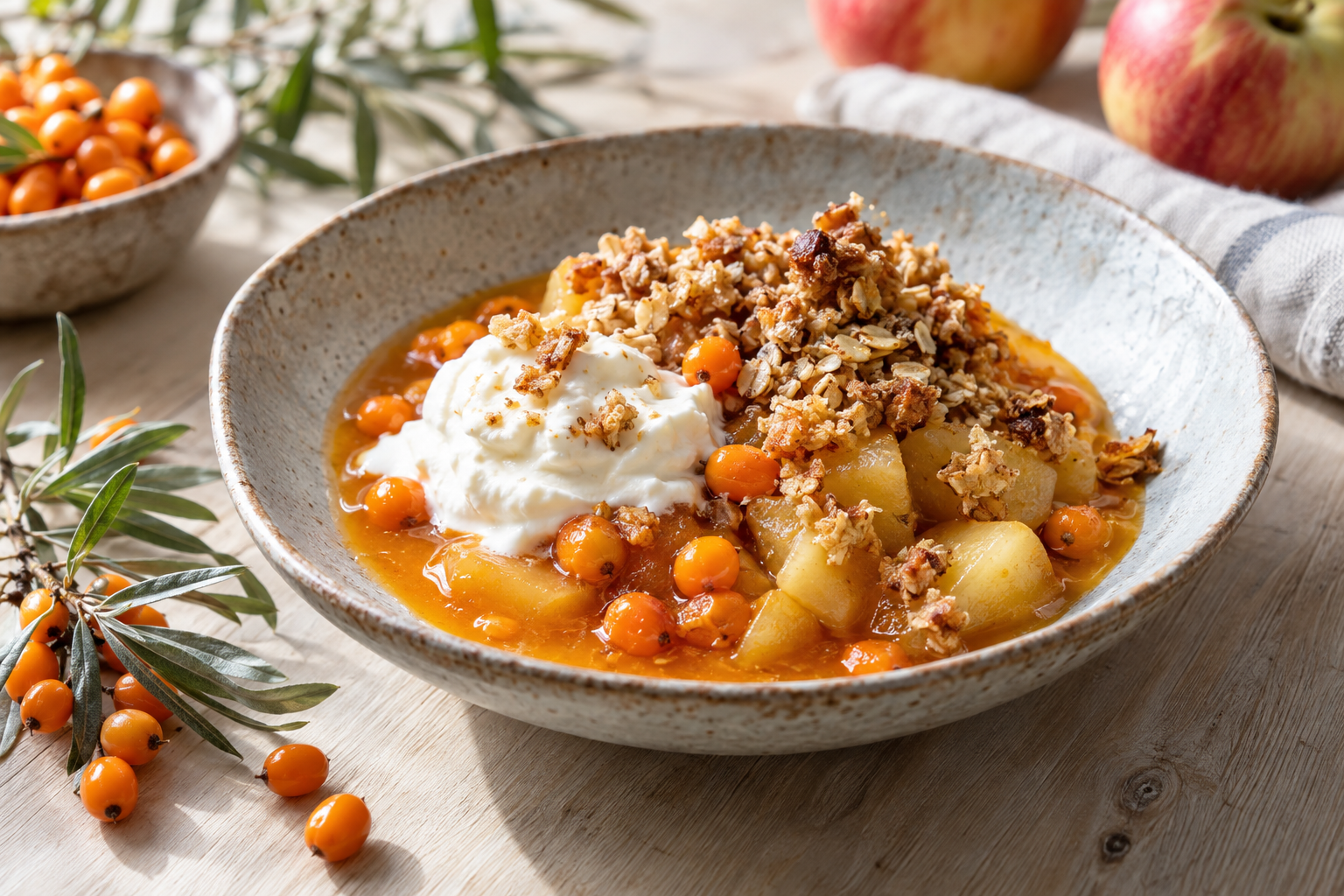
The recipe here is built around just that balance. A soft apple compote gets colour and sharpness from strained sea buckthorn, while crunchy oat crumble and softly whipped cream provide contrast. Frozen berries work beautifully. Use a stainless-steel saucepan, taste once the compote has cooled a little, and adjust to suit your particular berries and apples. Nature’s orange harvest can then be both everyday and extraordinary – without a battle with the thorns to get there.
Apple and Sea Buckthorn Compote with Oat Crumble and Cream
A modern Nordic dessert that pairs the gentle sweetness of apple with sea buckthorn’s sharp acidity. The berries are strained to give the compote a lovely smoothness between the apple pieces. The recipe works with fresh or frozen sea buckthorn.
Ingredients
Method
- 1Preheat the oven to 175 °C, conventional heat. Line a small baking tray with baking paper.
- 2Melt the butter and mix with the oats, flour, 2 tbsp sugar and salt. Scatter over the tray in small, loose crumbs.
- 3Bake on the middle shelf for 12–15 minutes until golden. Stir after about 8 minutes and keep an eye on them towards the end. Leave to cool on the tray; the crumbs will become crunchier as they cool.
- 4Put the sea buckthorn berries in a small stainless-steel saucepan with 2 tbsp water. Cover and heat over a medium-low heat for 3–5 minutes, a little longer if the berries are frozen, until softened and beginning to release their juice.
- 5Gently mash the berries with a spoon. Press the flesh and juice through a fine-mesh sieve into a bowl. Scrape the purée from the underside of the sieve and discard the seeds and remaining skins.
- 6Peel and core the apples. Cut into roughly 1 cm pieces. Put in a saucepan with 0.5 dl water and 0.75 dl sugar.
- 7Cover and simmer the apples over a low heat for 8–12 minutes, stirring occasionally. They should soften but ideally retain a little texture. Remove the lid towards the end if the compote is watery.
- 8Remove the pan from the heat. Stir in the sea buckthorn purée and vanilla sugar. Let a spoonful cool, then taste; add a little extra sugar if needed while the compote is still warm.
- 9Leave the compote to cool until lukewarm or cold. Softly whip the cream and serve in four bowls with the compote and oat crumble. Add the crumble just before serving so it stays crunchy.
- The compote can be made the day before. Cool it quickly, keep covered in the fridge and use within 3–4 days. Store the oat crumble separately in a dry place.
- For a dairy-free dessert, use a plant-based butter alternative and serve with a whippable oat or soya cream.
- If you have unsweetened, seedless sea buckthorn purée, start with about 0.75 dl, then taste and adjust to your preferred level of tartness.
- For longer-term preparation, the compote freezes well. Add the cream and crumble only when serving.
What goes in the glass
- Alcohol-freeSparkling apple juiceThe apple notes echo the compote, while the juice’s sweetness softens the sea buckthorn’s acidity. Choose a full-bodied juice that is not too tart, and serve a small amount well chilled.
- TeaVanilla rooibosIts mellow flavour, without black tea’s pronounced astringency, suits the cream and toasted oat crumble. The vanilla note ties the drink and dessert together.
- WineSweet Riesling, such as BeerenausleseThe dessert needs definite sweetness in the glass, while fresh acidity matches the sea buckthorn. Serve a small glass; a dry wine risks tasting harsh and thin.
Enjoy alcohol in moderation. Alcohol-free options go just as well with the food.
Sources
- Bo Mossberg och Lennart Stenberg, Den nya nordiska floran (2003)
- Royal Botanic Gardens, Kew, Hippophae rhamnoides L. – Plants of the World Online
- Thomas S. C. Li och Thomas H. J. Beveridge, Sea buckthorn products: manufacture and composition (2003)
- Livsmedelsverket, Vitamin C
- Naturvårdsverket, Allemansrätten
Ask questions about "Sea Buckthorn – the Coast’s Tart, Vitamin-Rich Berry". Answers are based on the magazine's own articles.