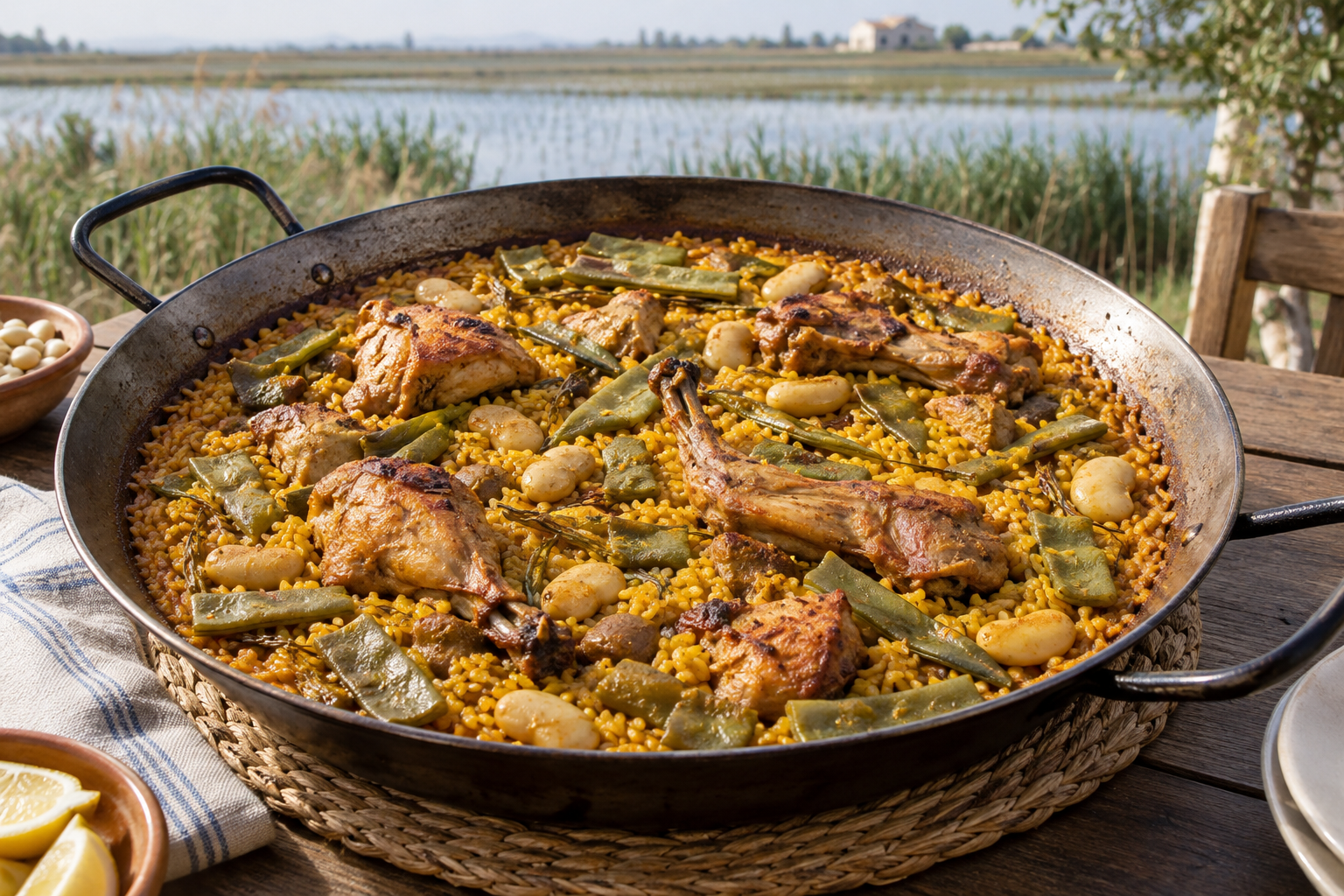
Paella valenciana – a celebration of rice by Albufera
On Sunday fires, big white beans and the art of leaving rice alone.
At Albufera, south of Valencia, rice has shaped both the landscape and the meals. Here, paella means, above all, chicken, rabbit, green beans and garrofó – cooked in a wide pan where the stock evaporates and the flavour stays behind. We follow the dish from working life in the rice fields to today’s Sunday table, and cook it in a Swedish home kitchen.
 By Lina BergFood editor · European and Nordic cuisines – Italy, France, Spain, Greece and Swedish home cooking
Translated from Swedish with AI assistance.
Go to the recipe ↓Where rice fields meet Sunday
First, you hear the oil. A sharp sizzle as the chicken hits the hot pan, then a gentler crackle as the meat begins to brown. The tomato comes later, smelling sweeter by the minute as its water cooks away. Finally, the rice: small, pale grains that will soon carry the flavour of everything that has come before them.
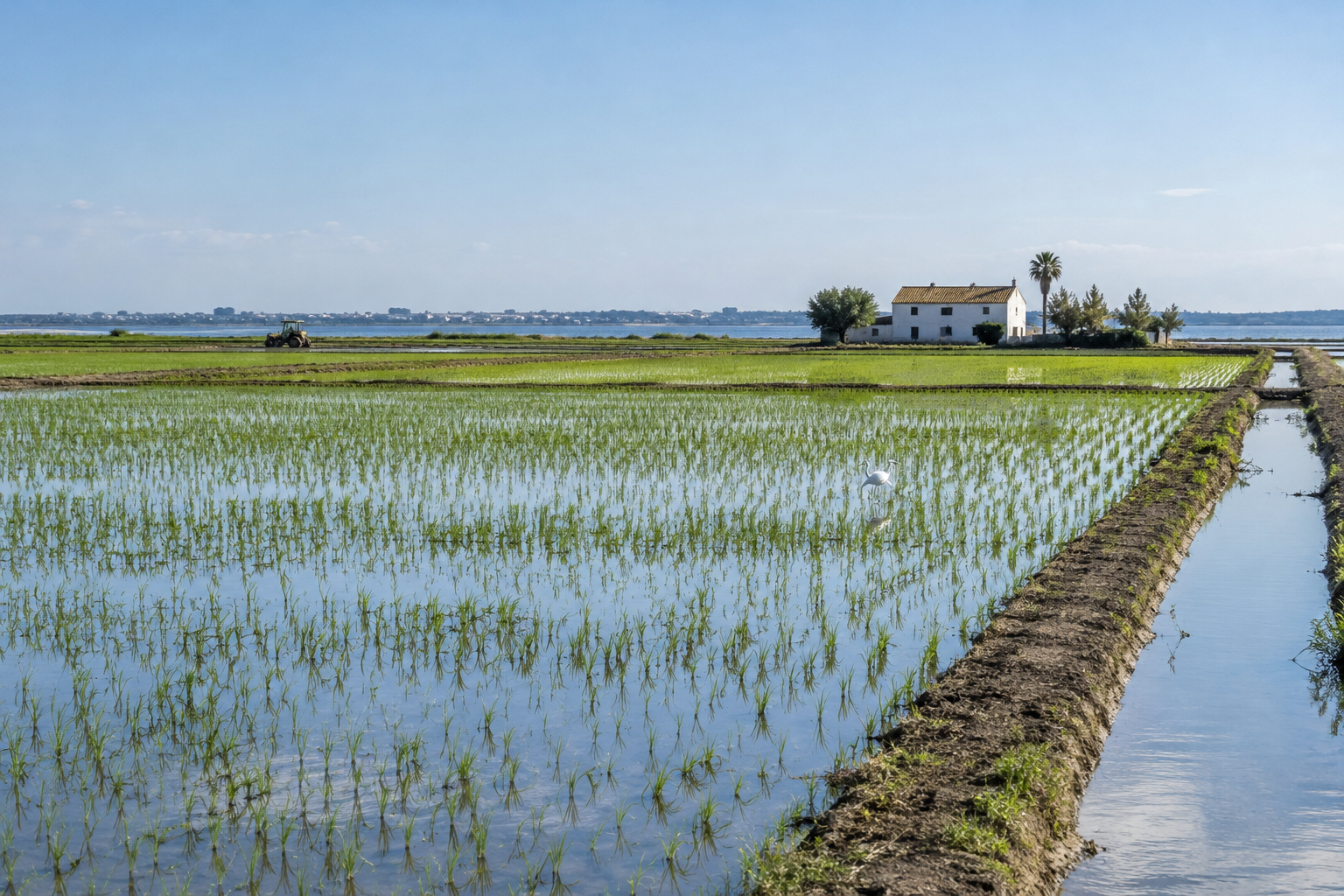
Around Albufera, the lagoon south of Valencia, it is easy to understand why rice has become the centrepiece of the meal. Water, farmland and sea air belong together here. Straight irrigation channels cross a flat landscape where the rice fields change with the seasons: mirrored water, green stands of rice, ripening ears. The vast sky finds room down on the ground, too.
Today, the lagoon and its surroundings are a protected natural area, but this is not nature set apart from people. Fishing, irrigation and farming have long shaped the place. The rice fields are both a working landscape and a habitat for birds. Paella belongs to the human side of that same fabric: making use of what can be grown, reared and cooked together.
A Sunday paella therefore begins long before anyone announces that lunch is ready. Someone cuts beans. Someone tends the fire or checks the gas. Someone peers into the pan and offers an opinion on the water level. One person can cook a good paella, but the meal around it is rarely intended to be a solitary affair.
What eventually reaches the table is not a heap of rice with accompaniments. It is a thin, unbroken landscape of rice, meat and vegetables. The grains should be cooked through yet distinct, the surface relatively dry and the flavour concentrated. At the very bottom may lie the coveted socarrat: rice that has caught against the metal and toasted to a golden or nut-brown crust.
And although the Mediterranean is close by, prawns are not what defines paella valenciana. For this story, we need chicken, rabbit and two kinds of beans instead.
A dish that evolved, rather than being invented
The history of rice on the Iberian Peninsula is considerably older than that of paella. Cultivation and irrigation developed during the period of Muslim rule, and rice gradually became firmly established in the area around Valencia. Yet no straight line can be drawn from a medieval rice field to today’s carefully defined paella valenciana. The history of an ingredient and the history of a dish are two different things.
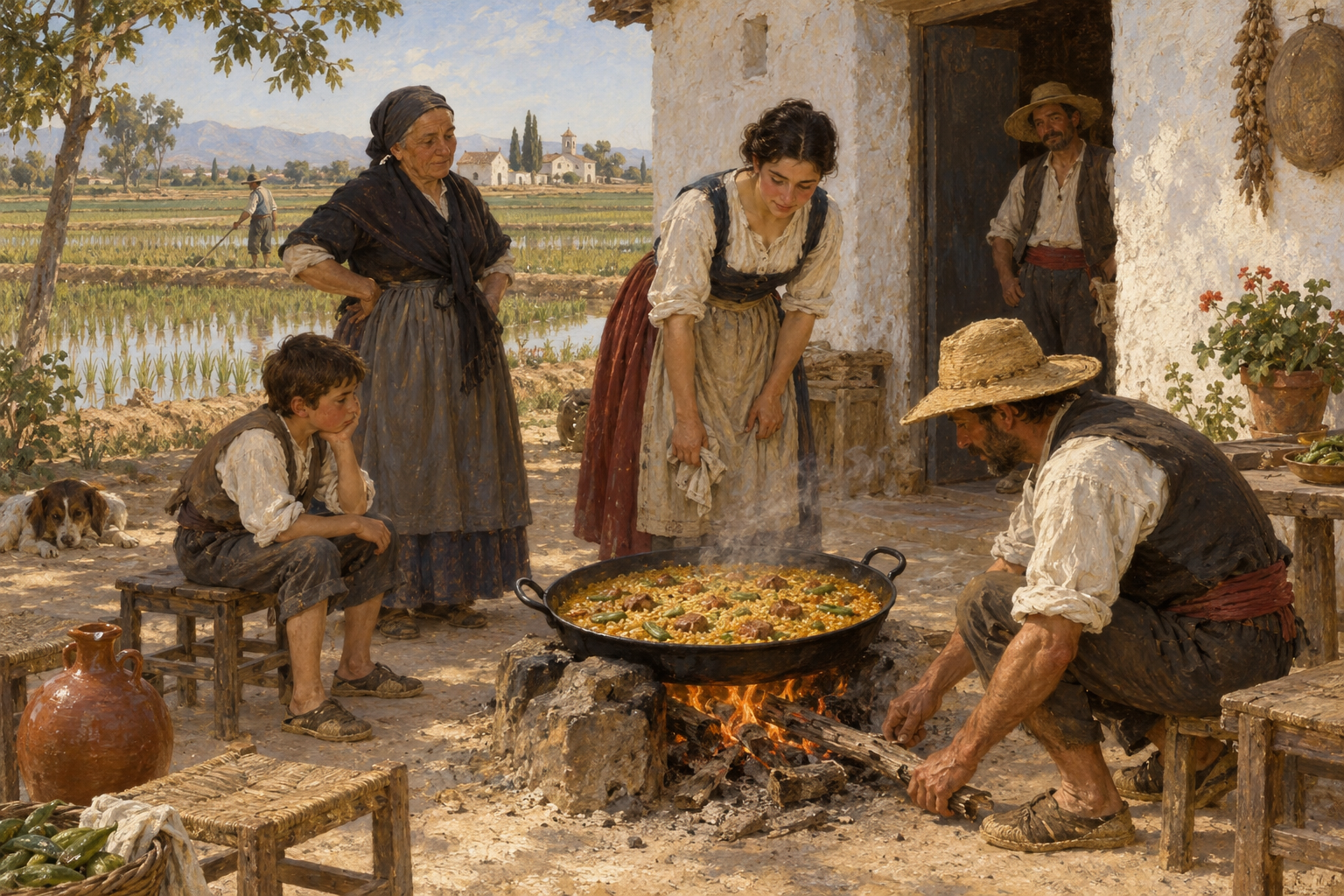
Paella as we know it is generally linked to Valencia’s farming communities and to developments during the 19th century in particular. There is no undisputed inventor, no certain first Sunday and no single original recipe against which every later panful can be measured. It makes more sense to see it as a dish that grew out of local ways of cooking rice in a wide pan over a fire.
The story of farmers’ food does, then, have genuine roots in the setting. But the romantic image of everyone always heading out to the fields with precisely today’s list of ingredients is too simple. Availability, means and season all influenced what went into the meal. Rabbit, snails and vegetables belong to that rural background; the amount of meat and choice of vegetables have varied.
It is also worth distinguishing between food for work and food for celebration. Rice stretched with whatever ingredients are available can feed many people, but a pan generously filled with meat is also something to gather the family around. Paella’s place as Sunday food and a meal to share says at least as much about time and togetherness as it does about an original ingredient list.
The name offers a more tangible clue. In Valencian, paella means frying pan, and the word gave the dish its name. Its Latin root is patella, a word for a shallow vessel. The explanation that the name comes from the Spanish para ella, “for her”, is a popular play on words, not accepted etymology.
As travellers, restaurants and later international tourism made paella famous around the world, its image changed too. For many people outside Spain, it became yellow rice with seafood, preferably served straight from a large pan. That is an understandable image of other paella varieties, but not a fair definition of the Valencian version itself.
Today, the word paella therefore operates on several levels: as the name of a pan, of a family of rice dishes and of a very specific local dish. Many arguments at the table begin when those levels get mixed up.
What actually belongs in the pan?
The accepted core of paella valenciana is fairly clear: rice, water, olive oil, salt, tomato, saffron, chicken, rabbit, green beans and garrofó. This is also the selection highlighted in Valencia’s official tourist information. There is plenty of flavour here without emptying an entire store cupboard into the pan.
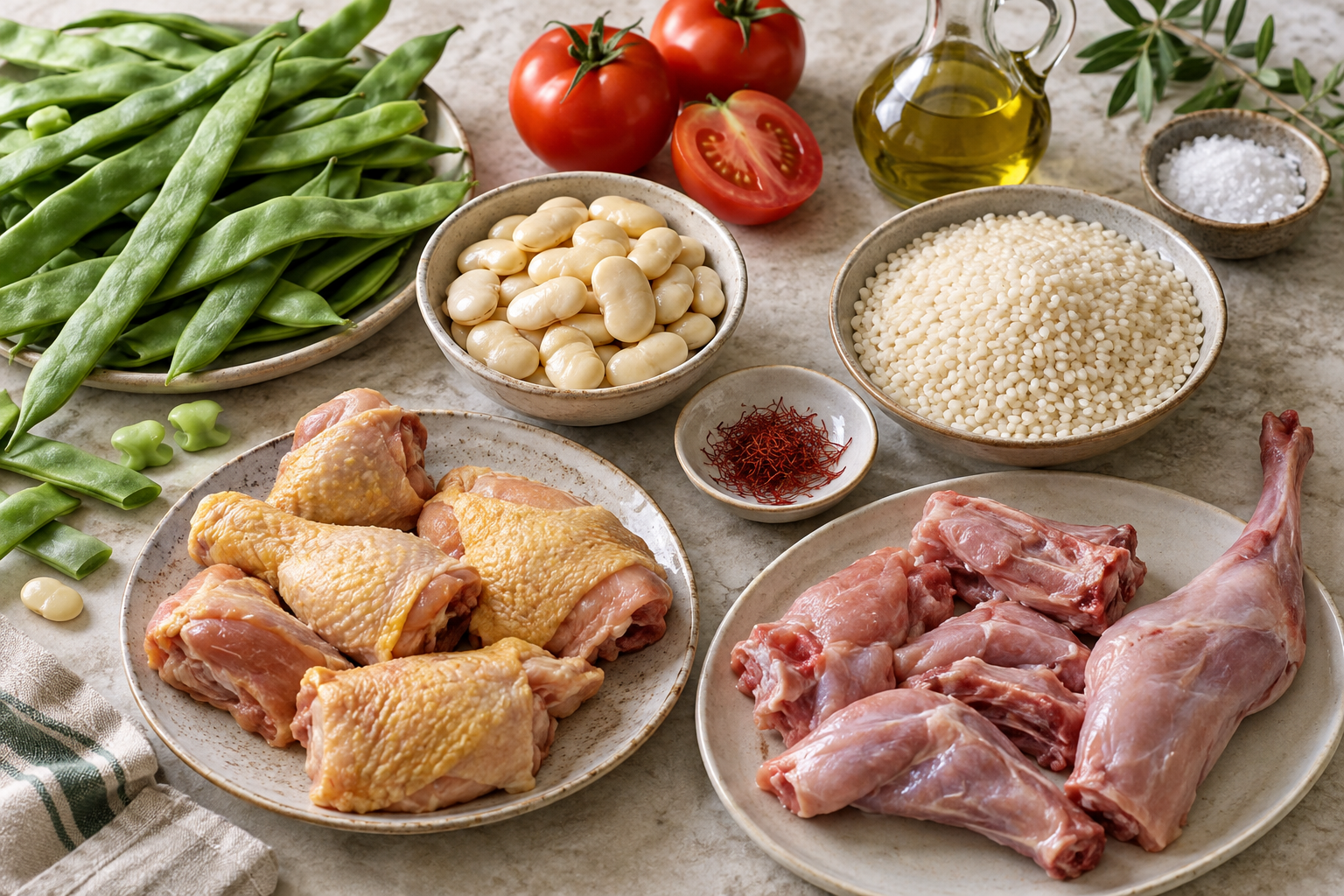
Chicken and rabbit do different jobs. Bone-in chicken provides succulent meat, fat and a rounded stock flavour. Rabbit is leaner, with a mild but distinctive meat flavour that works beautifully with saffron and beans. Both need to be thoroughly browned before the water goes in. A pale version hurriedly simmered together misses much of the dish’s depth.
The green beans are often broad, flat varieties known in Valencia by names including bajoqueta and ferraúra. They should be a vegetable, not a garnish: substantial pieces that fry alongside the meat, then soften in the stock. In Sweden, flat green beans work well. French beans are easier to find and a useful alternative, although their shape and bite are different.
Garrofó are large, flat lima beans with a soft, almost buttery interior. They offer a contrast to the small grains of rice and soak up the flavourful liquid. Fresh or frozen garrofó can be hard to find here, but large cooked lima beans work well. Other large white beans are a practical substitute, rather than exactly the same ingredient.
Then the local variations begin. Snails feature, as do rosemary and, in some versions, artichokes. Differences between towns, families and seasons are part of the tradition. Acknowledging them is not the same as saying that absolutely anything is typically Valencian.
Chorizo, for example, can make delicious rice, but it does not belong in the accepted paella valenciana. The sausage’s smokiness and fat also change the dish’s flavour profile considerably. Prawns, mussels and squid belong in other paellas and rice dishes. This is not a judgement on quality, merely a way of letting different dishes retain their names and character.
This is where food’s identity becomes visible. To a visitor, an extra ingredient may seem harmless. To someone who grew up with the dish, it can suddenly make the food tell the story of somewhere else. We can be accommodating about what home cooks have available while still being clear about what has changed.
Our recipe therefore stays with chicken, rabbit and beans. It also includes a small amount of sweet paprika, which appears in many recipes. It is unsmoked and used sparingly, leaving the browning and the saffron to speak for themselves.
The rice, the water and the wide pan
Paella’s most important ingredient is not its most expensive. It is the rice. Everything else must ultimately flavour the grains, and the result is often judged more by them than by the meat. A delicious chicken thigh cannot rescue a thick layer of sticky, overcooked rice.
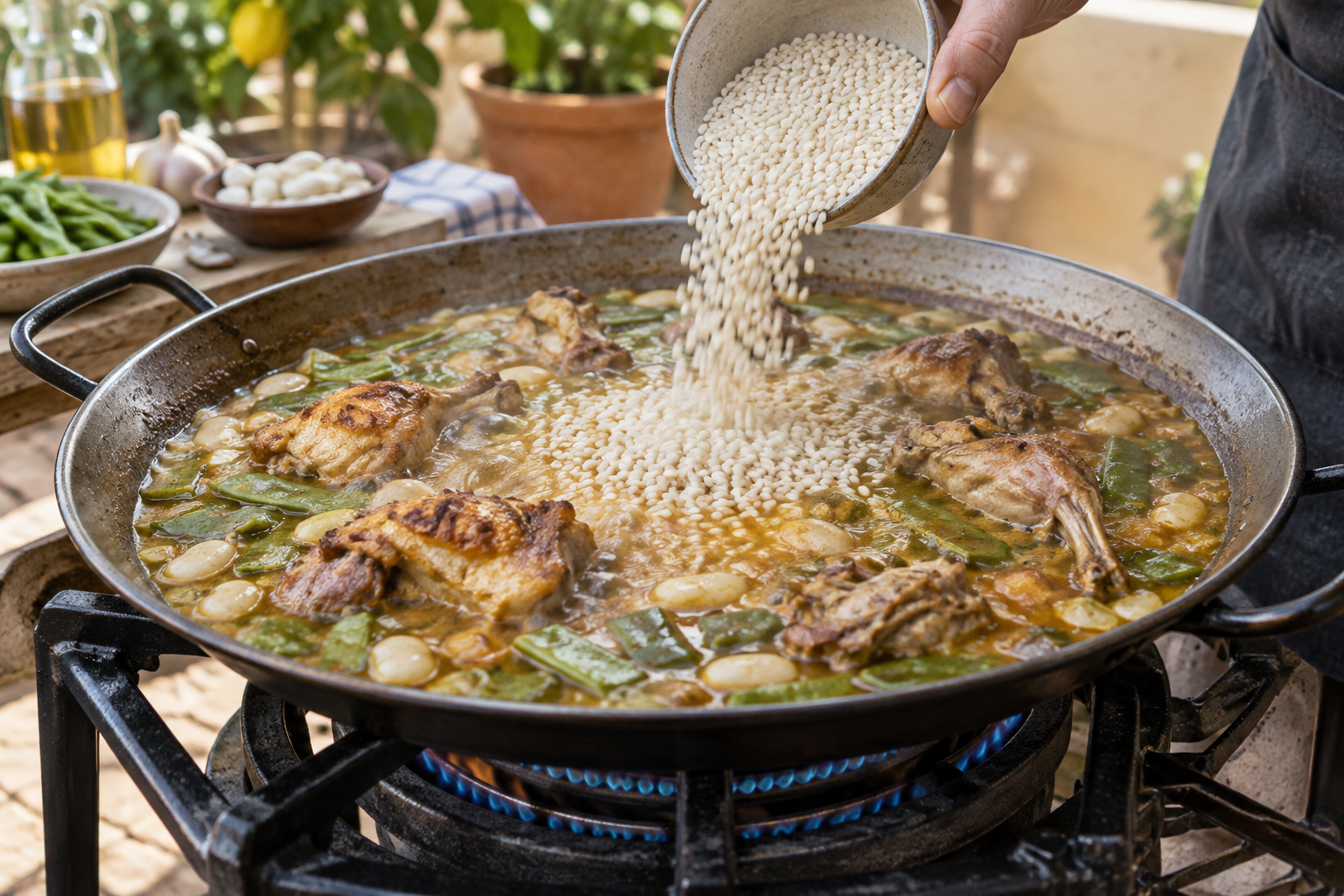
Bomba is a reliable choice for the home cook. It is a short-grain Spanish rice that absorbs liquid well while retaining its structure. But bomba is not the only traditional or suitable rice. The protected designation of origin Arroz de Valencia also includes varieties such as senia and albufera. Each behaves differently, and frequent rice cooks often choose according to both flavour absorption and the bite they want.
For those of us in Sweden, the practical approach is simple: first look for bomba or a Spanish rice clearly intended for paella. Then read the instructions on the packet. Ordinary long-grain rice produces a different dish, while risotto rice can serve in a pinch but needs adjustments and will not give the same result. Pudding rice is not a good shortcut simply because its grains are short too.
Do not rinse paella rice. It goes dry into the flavourful liquid. Once evenly distributed, it should largely be left alone. This is not risotto: we do not want to stir our way to a creamy sauce. We want a cohesive but not sticky layer, with the grains left to cook through where they lie.
The shape of the pan is just as crucial. Its low sides and broad surface allow water to evaporate efficiently. A thin layer of rice also cooks more evenly than a deep one. That is why you cannot double the recipe in the same pan and expect the same result. More guests generally call for a larger cooking surface, not simply more stock.
A traditional steel pan responds quickly to changes in heat, but needs a heat source that reaches reasonably evenly across its base. A large pan on a small hob ring can mean burnt rice in the middle and wet rice around the edges. On an ordinary Swedish cooker, this is often a bigger problem than choosing between two good rice varieties.
Nor is the water an exact mathematical constant. The amount needed depends on the rice variety, the width of the pan, how vigorously it boils and whether wind is blowing across an outdoor fire. A stated liquid ratio is a starting point, not a law of nature. So have hot water ready and learn to read the pan: the bubbles, the surface of the rice and how much liquid remains as the grains approach doneness.
In this paella, the stock develops in the pan itself as the browned meat and vegetables simmer with water. A strong ready-made stock is unnecessary. It may instead make the flavour too salty and overwhelm the work already put into browning.
Saffron’s fragrance and socarrat’s fine line
Saffron does more than colour the rice yellow. Its fragrance is warm and distinctive, with notes that may suggest hay, honey and a slight bitterness. Too much is overpowering; too little gets lost among the meat and tomato. Crumble the threads and steep them in a little warm water to help them spread more evenly through the pan.
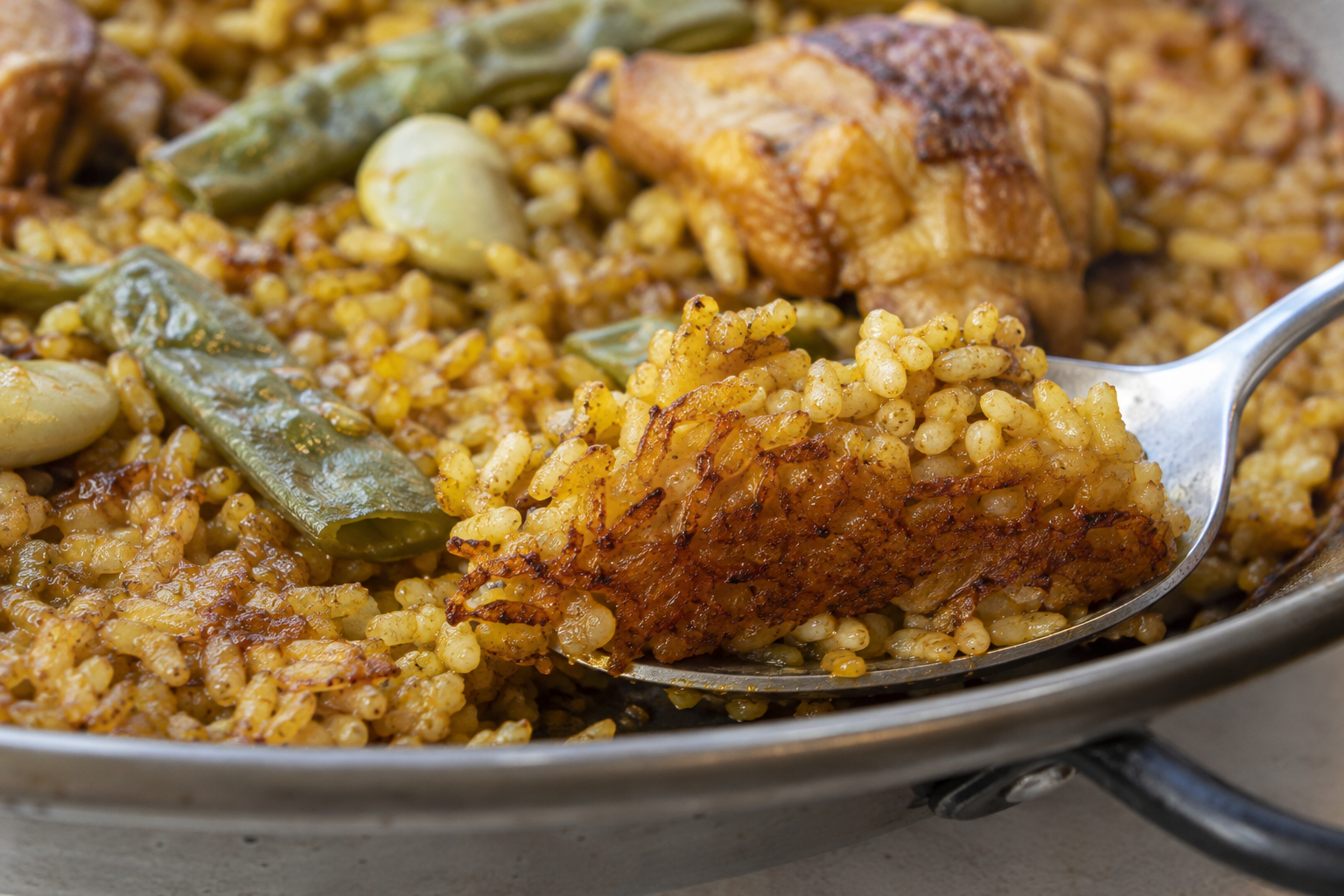
Colour, however, is no reliable measure of a paella. Intensely yellow rice need not taste strongly of saffron, and a well-made panful can have a fairly understated golden hue. It is the fragrance and the overall result we are after, not a particular shade in the photograph.
Tomato, too, should be treated as flavouring rather than sauce. Grate it or finely chop the flesh and let it fry until most of the liquid has gone. As it changes from wet and pale to thicker and darker, its flavour becomes rounder. The paprika gets only a brief moment in the hot pan before water is added; burnt paprika brings a bitterness that is hard to put right.
Traditionally, paella is associated with a wood fire, preferably orange wood where it is available. The fire can provide high heat, a hint of smoke and the option of moving the embers beneath different parts of the pan. But it takes practice. Gas has become a practical alternative, and a controlled hob can produce a better result than an unruly fire.
Socarrat develops only once most of the free water has gone and the rice closest to the base can get hot enough to toast. The sound changes: wet bubbling gives way to a drier crackle. The aroma turns nutty. This is when you need to pay the closest attention.
There is a fine line between toasted and burnt. A thin golden crust is a pleasure; black rice with an acrid smell is a failure, not extra authenticity. You should not have to scrape away a bitter slab of charcoal to claim that the paella turned out right.
A sharp increase in heat at the end is therefore a tool, not a compulsory step. If there is already a dry crackle, the pan may need to come off the heat immediately. If the rice is still hard, it needs a little more hot water and time instead. On your first attempt, well-cooked, flavourful grains are a better goal than the biggest possible crust.
A short rest after cooking lets everything settle. Leave the pan without a tight-fitting lid so the rice does not keep steaming unnecessarily. Then bring it to the table while its fragrance is still rising from the surface.
A pan to gather around
In Valencia, paella is primarily a lunchtime dish, often associated with weekends, outings and larger gatherings. The time it takes is part of the ritual. Browning cannot be rushed, the stock needs time to develop flavour, and once the rice is in, someone must keep watch. There is a before and an after, not simply a quick serving.
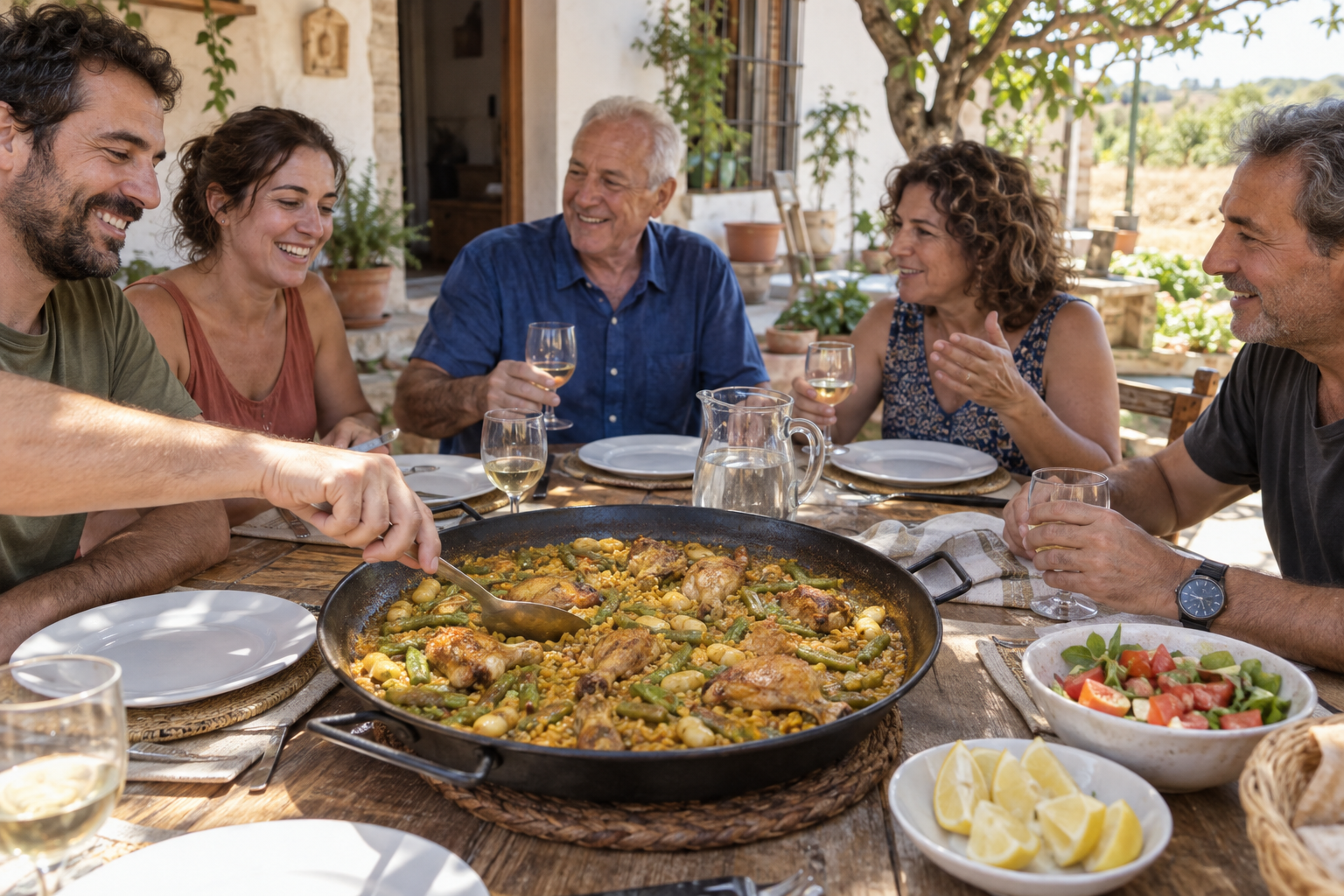
Among family and friends, people sometimes eat straight from the shared pan, traditionally with a spoon. Each person generally keeps to the area in front of them. But this is a living custom, not a universal rule. Plates are, of course, just as appropriate, at home or in a restaurant.
Even so, the shared pan changes the atmosphere at the table. Everyone sees the same food and the same toasted edge. The texture of the rice and the tenderness of the beans can be discussed without anyone having to make a ceremony of the meal. The cook receives both praise and helpful advice, sometimes from the same person in the same breath.
Accompaniments can be kept simple. A salad of tomatoes, leafy greens and onion, served before the paella or alongside it, brings freshness. Bread is an option, but not essential. Lemon wedges often appear at serving time; let everyone decide whether they need the acidity rather than squeezing juice over the whole pan.
In the glass, a dry Spanish white wine with fresh acidity and restrained oak works well, such as a verdejo from Rueda. A dry rosado can complement both the browned meat and the vegetables. It is not that the food demands alcohol, but that the drink should ideally cut through the olive oil and leave room for the saffron.
An alcohol-free white wine with pronounced acidity is one option. Another is chilled, lightly brewed green tea with a small piece of lemon zest. Keep bitterness low and avoid too much sweetness. Plain cold water also works wonderfully when the pan itself has so much to say.
Bringing Valencia into your home kitchen
The Swedish home version starts with the equipment. For four generous servings, you need a wide pan, about 40 centimetres across the rim, and, above all, even heat underneath it. A paella burner is handy. On a hob, two suitably positioned cooking zones can work, provided both hob and pan allow it and the pan sits securely. Rotate carefully if necessary.
If you only have ordinary frying pans, it is better to divide the batch between two pans than to put everything into one deep vessel. Avoid chasing socarrat with extreme heat in a coated pan. Also check that any steel pan you buy really does work on your hob; not all are suitable for induction.
You may need to order rabbit from a well-stocked butcher’s counter or buy it frozen. Ask for help cutting it into evenly sized stew pieces. If you cannot find rabbit, you can replace it with more bone-in chicken. It is an adaptation, but an honest and delicious one. Better to buy good chicken than let the search for one ingredient derail the entire meal.
The beans are easier to sort out. Flat green beans or French beans replace the Valencian green varieties. Large cooked lima beans replace garrofó. If using dried beans, soak and cook them fully in a separate pan according to the packet instructions; the rice’s short cooking time is not enough.
Prepare everything before you start browning. Grate the tomato, measure the rice, prepare the saffron water and set out a jug of hot water. Then you can give your attention to the pan rather than to a cupboard where the measuring spoons have disappeared.
The recipe below gives a clear method for restoring the liquid level after the meat has simmered. This reduces the guesswork, but the rice still has the final say. Taste a few grains towards the end, preferably from more than one spot. They should be firm without a hard centre. Adjust in small steps and resist the urge to stir.
And serve when the paella is ready, not when a starter has finally been cleared away. The guests can wait for the rice. The rice is less happy waiting for the guests.
Paella valenciana with chicken, rabbit and beans
A home version of the Valencian classic, with the stock built directly in the pan. This recipe uses cooked lima beans as an accessible substitute for garrofó. Use a paella pan about 40 cm across with even heat beneath its base, or divide everything between two smaller pans. The liquid quantity is tailored to bomba rice but may need adjusting to suit your pan and heat source.
Ingredients
Method
- 1Prepare the ingredients. Pat the meat dry with kitchen paper and check the cut surfaces for loose bone fragments. Trim the green beans and cut into 4–5 cm lengths. Halve the tomatoes and coarsely grate the cut sides; discard the skins. Crumble the saffron into 0.5 dl warm water taken from the measured quantity.
- 2Heat the oil in the pan over a medium-high heat. Season the meat with about half the salt. Brown the chicken and rabbit thoroughly on all sides for 15–20 minutes. Move the pieces between hotter and cooler parts of the pan so they colour without burning. Brown in batches if the pan is crowded.
- 3Push the meat out towards the sides a little. Add the green beans and fry for 4–5 minutes, turning occasionally. Add the tomato to the centre and fry for 5–7 minutes until thickened and no longer watery.
- 4Stir the paprika into the tomato and fry for about 10 seconds. Immediately pour in the saffron water and another 13.5 dl water, making 14 dl in total. Add the remaining salt. Note the liquid level against the side of the pan, or mark the depth on a clean wooden skewer placed against the base in a clear spot.
- 5Pour in the remaining 6 dl water. Simmer uncovered for about 25 minutes until the meat is almost tender. Then restore the liquid to the noted level: add hot water if it is lower, or boil a little longer if it is higher. Taste the stock; it should be well seasoned but not noticeably salty.
- 6Distribute the cooked lima beans around the pan. Sprinkle in the rice and spread it evenly between the pieces of meat with a large spoon. Check that the rice is submerged in the liquid. Do this now – then do not stir again during cooking.
- 7Cook with steady bubbling across the whole pan for 7–8 minutes. Reduce to a medium-low heat and cook for another 10–12 minutes, or according to the rice packet instructions. Carefully rotate the pan if necessary for even heat. Cook uncovered.
- 8Taste a few grains of rice after about 17 minutes. If they are still hard and the pan is almost dry, add 0.5–1 dl hot water around the edge and over any dry patches. Continue cooking for a few minutes without stirring. The rice should be cooked through with a distinct bite and no hard centre. Also check that the chicken reaches at least 74 °C in the thickest part, without the thermometer touching bone.
- 9When the rice is cooked and the liquid absorbed, listen for a faint, dry crackle. If the bottom has not yet coloured, you can carefully increase the heat for 30–60 seconds to create socarrat. Stop immediately if you notice an acrid or burnt smell. This step can be skipped.
- 10Remove the pan from the heat and leave to rest for 5 minutes without a tight-fitting lid. Serve straight from the pan or on warm plates. Offer lemon wedges for anyone who would like them.
- No rabbit? Replace it with the same weight of bone-in chicken. This is a practical adaptation rather than the full classic combination.
- Use fully cooked beans in this recipe. Dried lima beans need to be soaked and cooked separately according to the packet instructions before being added.
- Bomba and other paella rice varieties absorb different amounts of liquid. Follow the cooking time on your packet and always have hot water ready. Do not double the batch in the same pan.
- Cool any leftovers quickly in shallow containers and refrigerate, ideally at 4 °C. Preferably eat the next day and reheat until piping hot throughout; do not leave the rice sitting out all afternoon.
What goes in the glass
- WineDry verdejo from RuedaFresh acidity and citrus-led fruit cut through the olive oil and complement the beans. Choose a style without pronounced oak to leave room for the saffron and the flavour of the rice.
- WineDry Spanish rosado, preferably made from garnachaBerry fruit and moderate body suit the browned meat, while the acidity keeps the pairing with rice and oil fresh. Avoid the sweetest styles.
- Alcohol-freeAlcohol-free white wine with fresh acidityA light, citrus-led style works with saffron, tomato and chicken. Choose one with little sweetness so the drink does not make the paella’s salty, toasted flavours seem harsh.
- Alcohol-freeChilled green tea with lemon zestLightly brewed green tea brings a gentle vegetal note that complements the beans. A small piece of lemon zest adds fresh fragrance without sweetness; avoid a long steeping time, which makes the tea bitter.
Enjoy alcohol in moderation. Alcohol-free options go just as well with the food.
Sources
- Claudia Roden, The Food of Spain (2011)
- Alan Davidson; tredje upplagan redigerad av Tom Jaine, The Oxford Companion to Food (2014)
- Fundació Visit València, Paella valenciana
- Consejo Regulador de la D.O. Arroz de Valencia, Arroz de Valencia – Denominación de Origen
- Generalitat Valenciana, Parc Natural de l'Albufera
- Antoni Maria Alcover och Francesc de Borja Moll, Diccionari català-valencià-balear, uppslagsord paella
- Livsmedelsverket, Bacillus cereus
Ask questions about "Paella valenciana – a celebration of rice by Albufera". Answers are based on the magazine's own articles.