Schwarzwälder Kirschtorte – the forest’s name, the soul of cherries
Chocolate, cream and kirsch, a disputed inventor, and the art of building a German pâtisserie classic.
The spoon sinks through cream, dark sponge and tart cherries. Schwarzwälder Kirschtorte is both magnificent and surprisingly fresh when the balance is right. But how did it get its name, who baked it first – and what do Germany’s cake guidelines actually say?
 By Lina BergFood editor · European and Nordic cuisines – Italy, France, Spain, Greece and Swedish home cooking
Translated from Swedish with AI assistance.
Go to the recipe ↓An afternoon slice of cake
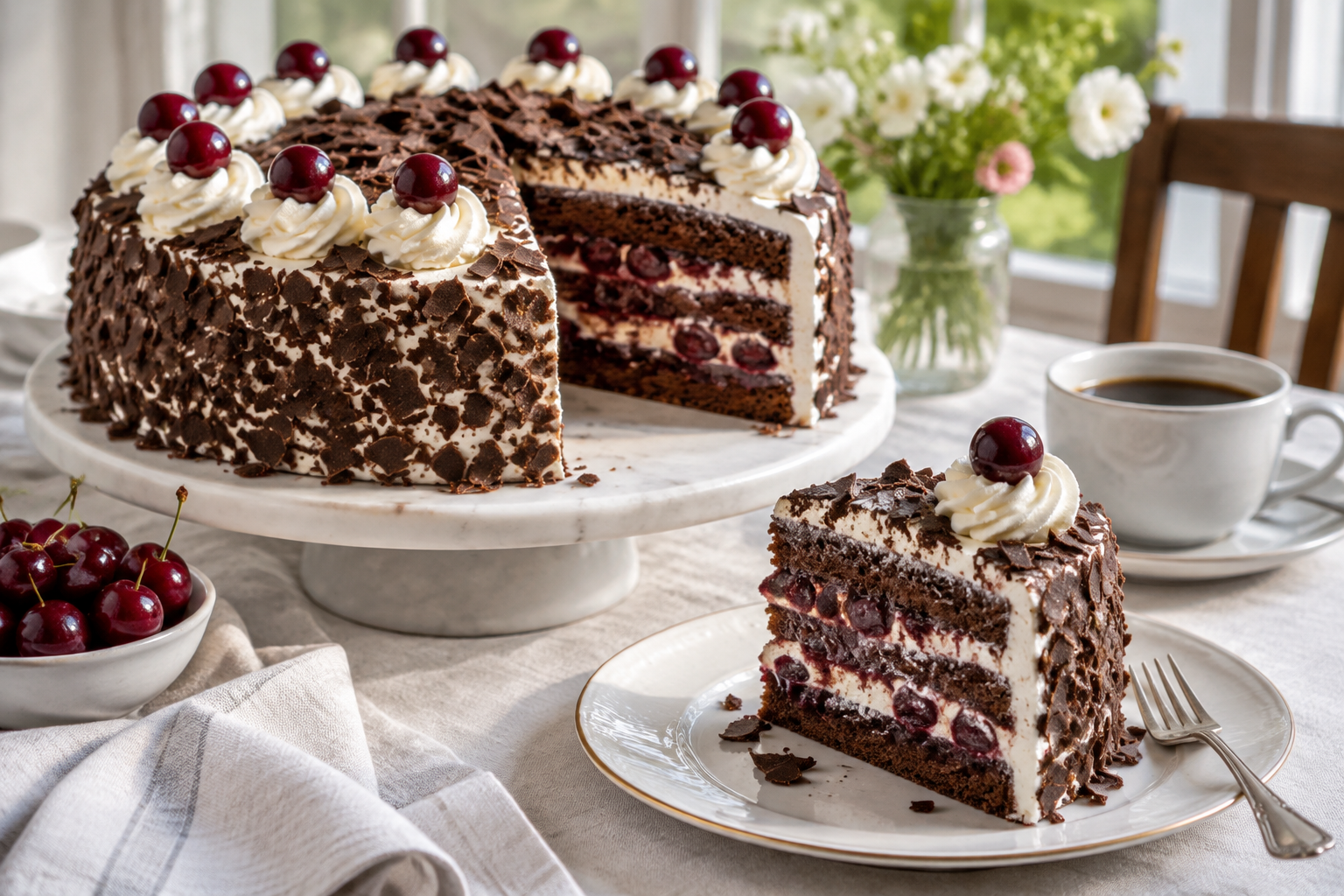
First comes the sound of a spoon against china. Then the cream gives way, followed by dark, moist sponge and a layer of cherries that stains the cut edge burgundy. The coffee smells freshly brewed. In the cake there is chocolate’s gentle bitterness, cream’s mellow sweetness and something that lifts it all: a clear, fruity cherry fragrance with a hint of cherry stone. That is kirsch, the cherry brandy that makes Schwarzwälder Kirschtorte more than a chocolate cake with fruit.
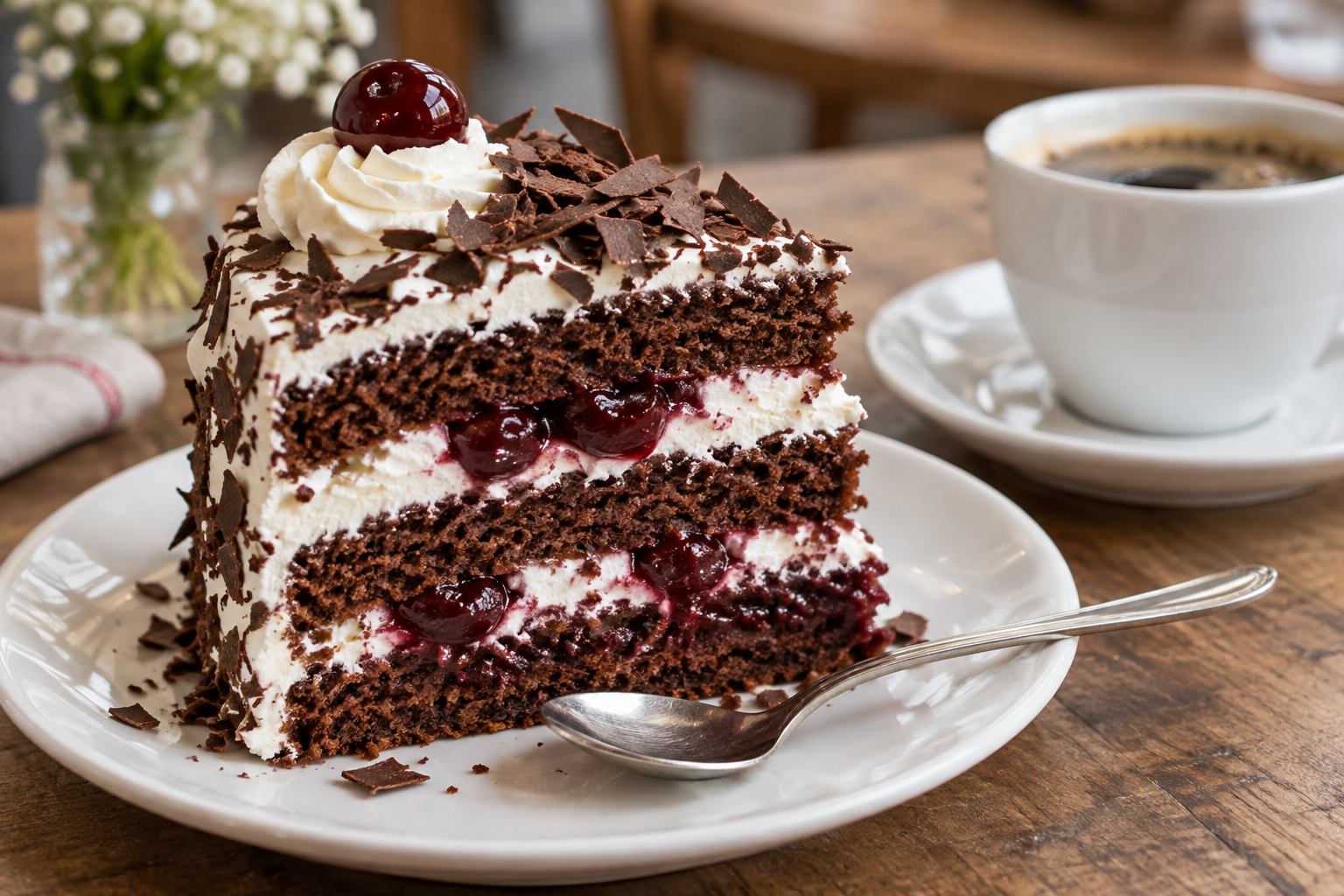
Picture a German pâtisserie on an overcast afternoon. Cakes stand in the display case like miniature buildings, sliced to reveal their layers. Fruit glaze and chocolate gleam behind the glass, but the Black Forest cake is instantly recognisable by its contrast of white, dark brown and red. No one orders it for its subtlety. A generous slice, a cup of coffee, a chair to linger in: that is the whole point.
It can, of course, be too much. Oversweetened cream, thick chocolate, dry sponge or a harsh blast of alcohol make it heavy and clumsy. When it succeeds, the opposite happens. The cherries cut through the cream, the sponge layers hold together without feeling dense, and the aroma of kirsch carries through from the first scent to the last bite. A tall cake really can taste light, even if it is hardly a lightweight.
For Swedish readers, a little clarification is needed at the counter. The Swedish pâtisserie cake usually called schwarzwald often consists of nut meringue, cream and chocolate. It is a well-established interpretation in its own right. German Schwarzwälder Kirschtorte, by contrast, is built from dark sponge, cherries, cream and kirsch. Sharing the forest’s name does not mean they share the same ingredients.
Here we are baking the German cake: tender cocoa sponge, tart cherries, gently sweetened cream and a distinct but restrained note of cherry brandy. It takes a little planning, but no secret pâtisserie equipment. Apart from the cherries, the most important ingredient is really time in the fridge.
A name with roots – but no certain birth certificate
The Black Forest lies in south-western Germany, mainly in Baden-Württemberg. The region is associated with wooded hills, valleys, fruit growing and distilling. Cherry brandy has strong regional roots, which makes the connection between the place and the cake understandable. But a geographical link is not the same as a documented birth certificate.
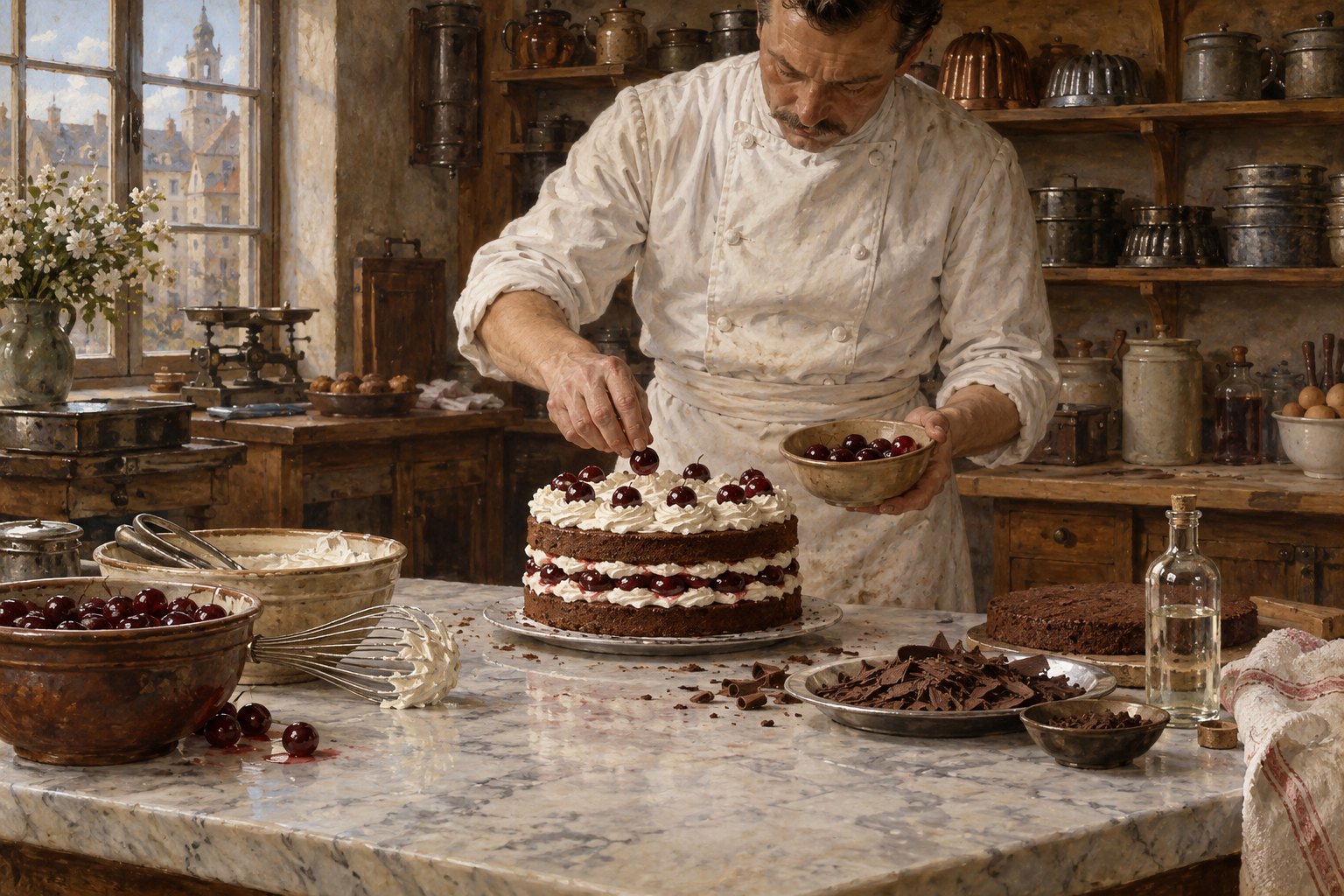
The most widely told origin story centres on pastry chef Josef Keller. According to the story, he created a forerunner of the cake in 1915 at Café Agner in Bad Godesberg, now part of Bonn. That is a long way from the Black Forest. The story plays an important part in the cake’s subsequent history and is often repeated, but the date and the claim should be presented as just that: a claim, not a settled fact.
There is also a competing tradition surrounding pastry chef Erwin Hildenbrand in Tübingen. This, too, points to a setting in which skilled pastry chefs were working with combinations of cream, chocolate and cherries. Such accounts need not be entirely incompatible. An early dessert, a simpler cake and the tall layer cake that later became the norm may have been different stages, developed in different places.
A firmer point of reference is the cake’s appearance in printed pâtisserie literature in the 1930s. Erich Weber’s 1934 book 250 Konditorei-Spezialitäten und wie sie entstehen is often cited as early evidence. A printed recipe shows that the cake existed and could be described at that time. It does not, however, automatically establish who first thought of it, or how long similar cakes had already been baked.
The name has also inspired some lovely explanations. The dark chocolate is said to resemble the forest; the cream and red cherries have been compared to regional costumes and the familiar Bollenhut hat with its red pom-poms. Such associations work beautifully as imagery. They are much weaker as evidence of the name’s origin. The link to cherry brandy is more concrete, but even that does not settle every other question.
It makes most sense, then, to see Schwarzwälder Kirschtorte as a product of the development of modern pâtisserie, rather than an ancient forest cake with a single moment of birth. During the 20th century, it became an internationally known German classic. In other languages, not least as Black Forest cake, it has since taken countless forms: with more chocolate, less alcohol, different kinds of cherries and sometimes no kirsch at all.
What Germany’s cake guidelines actually say
It is often said that Germans have legislated on how Black Forest cake should taste. It is a striking claim, but one that needs qualification. The German food code, Deutsches Lebensmittelbuch, a collection of product descriptions, contains what are known as Leitsätze. For this cake, the relevant guidelines are those for fine bakery products, Leitsätze für Feine Backwaren.
These guidelines are not themselves a law or regulation prescribing a compulsory recipe for home bakers. They describe established composition and what consumers can expect of a product sold under a particular name. They can be relevant when assessing whether a food description is misleading. The distinction may sound legally dry, but it is crucial: an industry product description is not the same as a legally mandated cake formula.
For Schwarzwälder Kirschtorte, the guidelines specify, among other things, dark cake layers, cherries, a cream or buttercream filling, and kirsch. The added cherry brandy must be clearly perceptible in the flavour. In other words, it is not enough for a stray drop to have passed through the mixing bowl. Kirsch is part of the cake’s expected character.
At the same time, there is more room for variation than many people imagine. The familiar whipped-cream version is not the only possibility within the German description. A thin shortcrust pastry base beneath the cake is also used; it can provide support and a crisp contrast. The guidelines should therefore not be read as proof that every pâtisserie must build exactly the same cake in exactly the same proportions.
Nor does the name mean that the cake has to be baked in the Black Forest. The cake’s designation should be distinguished from geographical designations for the spirit itself. A pâtisserie elsewhere can bake a Schwarzwälder Kirschtorte, while rules of origin for a specifically named regional kirsch are a separate matter.
At home, of course, you are free to bake without alcohol, change the decoration and adapt the cake to your guests. What matters is being clear. An alcohol-free, Black Forest-inspired cherry cake can be delicious, but it will not have the same aromatic profile as the original style. And a cake brushed with kirsch after baking still contains alcohol after a night in the fridge. It should never be presented as alcohol-free.
Cherries bring the tang, kirsch brings the fragrance
Start with the cherries, not the decoration. Sour cherries are particularly useful for the filling. Their acidity stands up to both cream and sugar, and their flavour remains distinct even when the fruit is tucked between layers of sponge. Sweet fresh cherries can be wonderful eaten as they are, but in a cake they may offer less contrast than you hope.
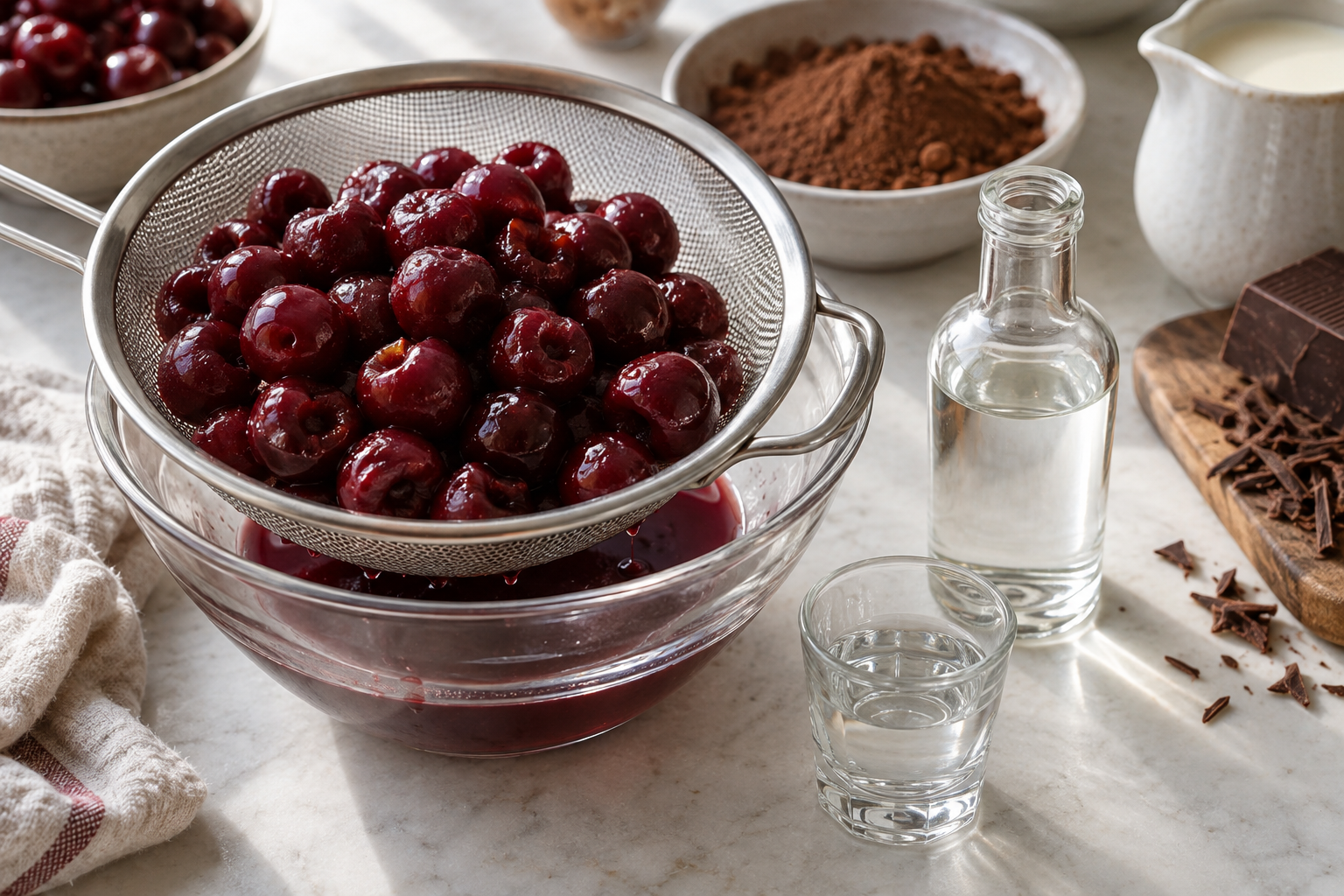
In Sweden, jarred pitted sour cherries are a practical choice. Look for labels such as surkörsbär, Sauerkirschen or Schattenmorellen. They are available in well-stocked food shops and shops carrying Central European products. Read the label: the drained weight of the fruit is different from the jar’s total weight, and the packing liquid can vary in sweetness.
Frozen sour cherries work too, but release liquid as they thaw. Collect the juice and adjust the filling accordingly, rather than pouring away the flavour and then adding water. The recipe card here uses jarred cherries to make the liquid quantity easier to control. Cocktail cherries, on the other hand, are primarily a decoration; their sweetness, texture and aroma make them less suitable as the cake’s main fruit layer.
Kirschwasser is a clear cherry brandy, not a sweet cherry liqueur. That is a crucial distinction when shopping. Liqueur can bring plenty of sugar and other flavours, whereas kirsch adds the spirit’s fragrance without the same sweetness. A good kirsch may have a cherry-stone note, almost reminiscent of almonds, but the cake should still taste of cherries, cream and chocolate – not just alcohol.
For the home baker, it is wiser to distribute a moderate amount evenly than to pour a lot into one spot. A little in the cooled cherry filling and the rest in the liquid brushed over the sponge gives a more even aroma. Adding it once the filling has cooled also preserves more of its fragrance. This is not a way to remove the alcohol – quite the opposite.
Cocoa brings darkness and a dry, gently bitter counterpoint. The sponge layers do not need large quantities of melted chocolate. An airy cocoa sponge absorbs the brushing liquid better than a heavy chocolate cake and leaves room for the filling. Use unsweetened cocoa and sift it carefully; small, dry lumps of cocoa are difficult to work out without also knocking the air from the egg mixture.
The cream should taste fresh and be only lightly sweetened. Swedish whipping cream with around 40 per cent fat works well. The chocolate on the outside can be dark, but not so bitter that it takes over. Thin shavings melt together with the cream. Thick slabs can look beautiful, but sometimes force the guest to break the slice apart before it can be eaten.
Height without heaviness: pâtisserie techniques at home
The height is what looks most impressive. Moisture is what determines the result. A Black Forest cake needs enough liquid to make the sponge moist, but not so much that the layers lose their supporting structure. That is why you brush it on in thin applications. The surface should darken slightly, not glisten with pooled liquid.
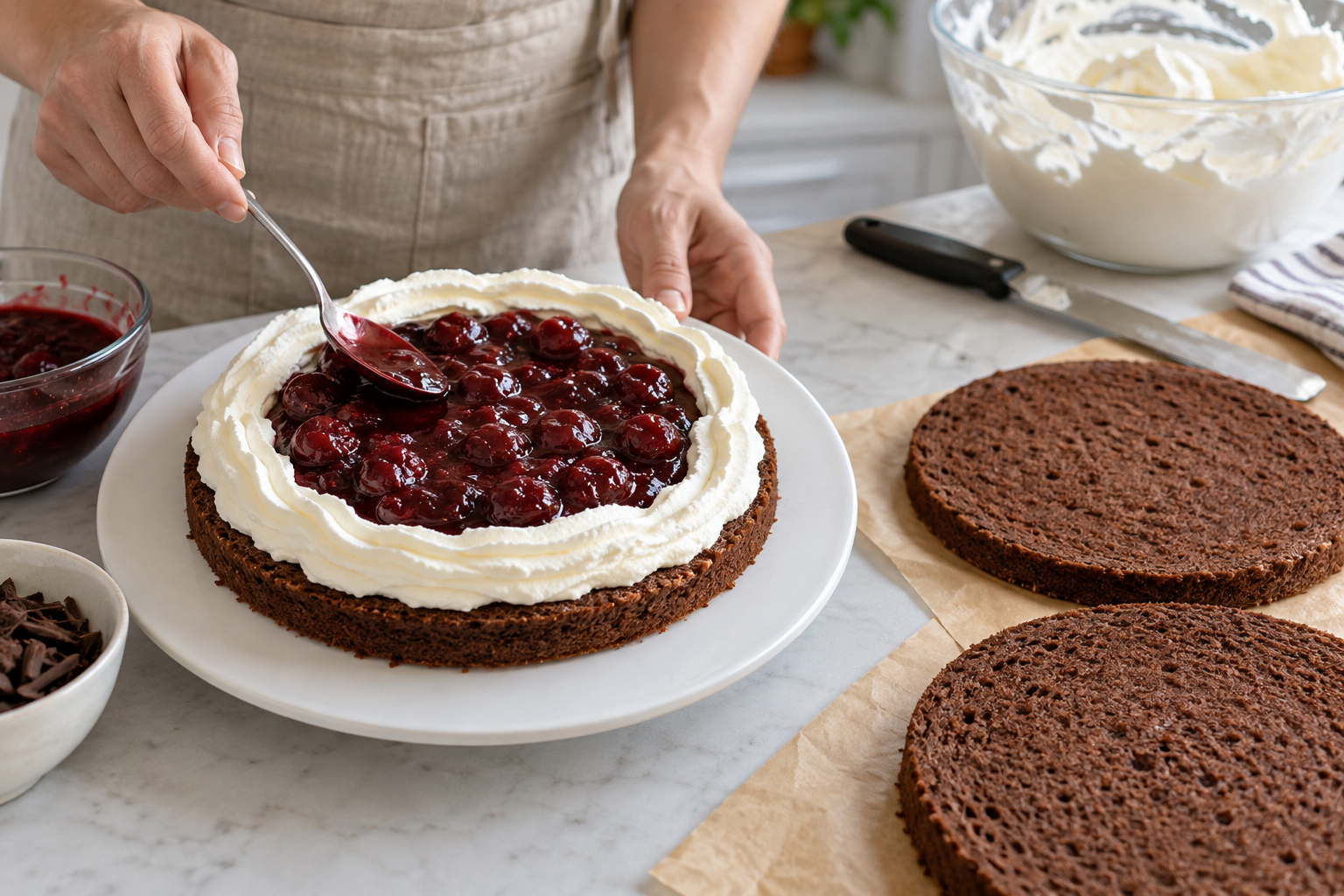
Whisk the eggs and sugar until very airy, leaving a visible ribbon when the whisk is lifted. Then fold in the dry ingredients with broad strokes. This is not a race to finish: scrape along the bottom of the bowl, lift the mixture and turn the bowl. But do not continue longer than necessary. The air you have whisked in provides much of the cake’s structure.
Melted butter can otherwise settle in a heavy pool at the bottom. A simple trick is to stir it into a little of the finished batter first, then fold that mixture back in. This reduces the differences in temperature and consistency. The result is more even, with no sophisticated equipment required.
Never slice the sponge into layers while it is still warm. It is more fragile then and crumbles more readily. Completely cooled, ideally baked the day before and well wrapped, it is much easier to divide. A long serrated knife and a few guide marks around the edge help more than brute force. Let the knife saw through as you turn the cake.
The cherry filling must be cold and spoonable before it meets the cream. A filling that is too runny will squeeze out between the layers, especially when the cake is sliced. Too much starch, on the other hand, produces a stiff, jelly-like mass. Cornflour needs to come properly to the boil to thicken, but prolonged boiling is no improvement. Mix it with cold liquid first to avoid lumps.
Whip the cream cold and stop when it holds defined but still supple peaks. Grainy, overwhipped cream is both harder to spread and less pleasant to eat. It is easy to assume that firmer whipping makes a more stable cake, but stability also comes from cold components, a sensible quantity of filling and resting after assembly.
A cake ring is a great help, but not essential. Without one, build carefully on a flat plate and check after each layer that the cake is level. A piped border of cream around the cherry filling keeps the fruit in place. Chilling the assembled cake then gives the sponge time to absorb a little moisture, turning the layers into a cohesive slice rather than three pieces of cake with filling between them.
Kaffee und Kuchen is a pause, too
Kaffee und Kuchen is more than a pairing of flavours. It is a familiar German way of setting aside a little time in the afternoon: coffee, something baked and time for company. It might be at a relative’s home, in a city pâtisserie or as a break during an outing. Sunday is central to the idea, but the custom is not confined to one day of the week.
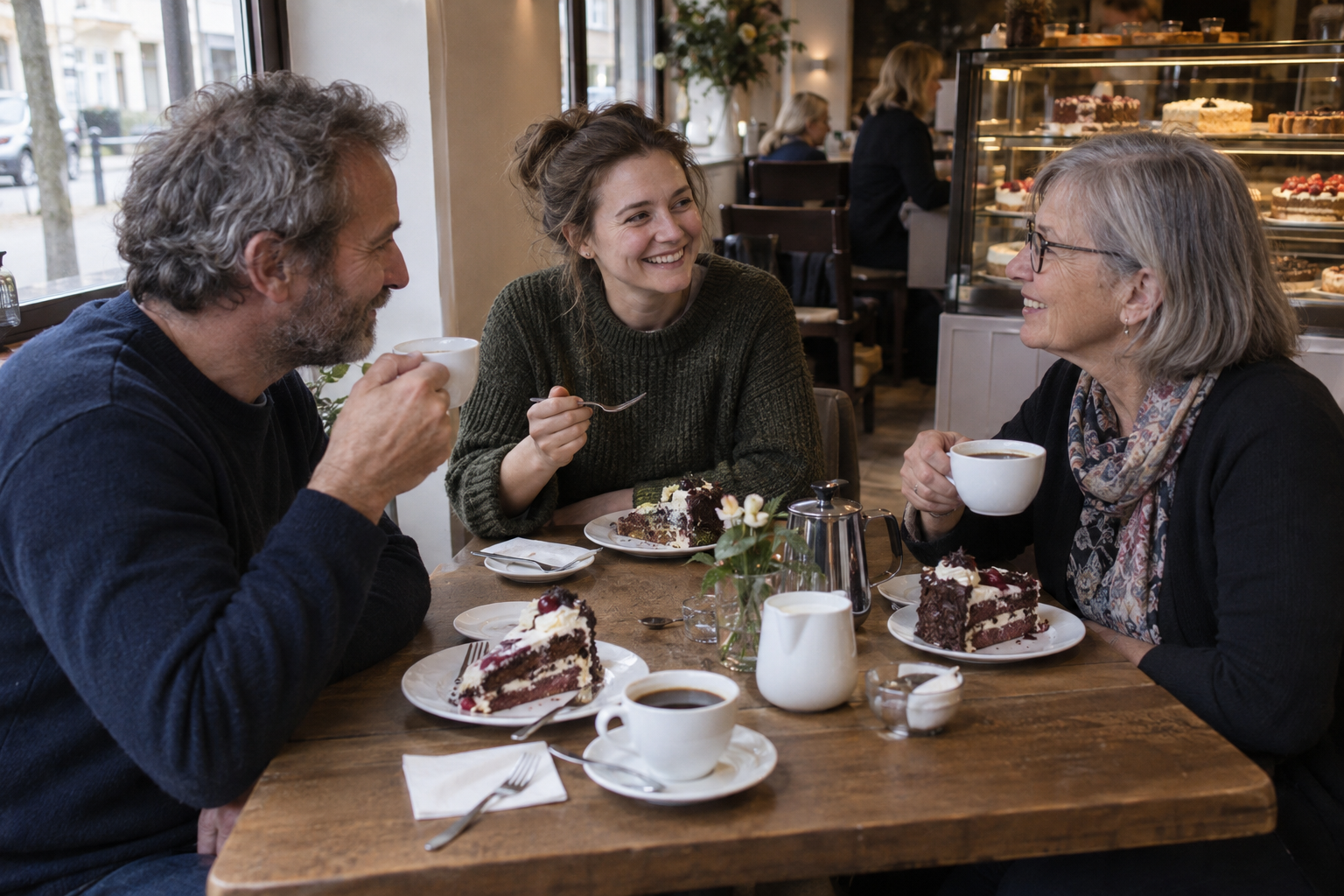
Not every such coffee table bears a splendid cream cake, of course. There are fruit cakes, cheesecakes and simpler bakes too. Schwarzwälder Kirschtorte belongs to the more festive end of the spectrum, the sort of cake that makes you lean forward a little as the plate arrives. The contrast between the careful decoration and the soft interior is part of the pleasure.
Pâtisserie culture also explains why appearance matters. The side of the cake reveals the craftsmanship: even layers, cream that stays put, cherries that have not leaked out. Yet a homemade cake need not be clinically smooth. A few sweeps with a palette knife and a generous scattering of chocolate shavings go a long way. It should look inviting, not like a test waiting to be marked.
Coffee works well thanks to its roasted bitterness and aromas, which complement the cocoa and cut through the cream. A balanced filter coffee is often an easier match for the cake than a harsh, very dark-roasted espresso. Anyone choosing to serve kirsch alongside should keep the measure small. The cake already contains alcohol, and a strong spirit is an optional extra, not something needed to complete the experience.
Alcohol-free choices deserve just as much thought. Coffee and decaffeinated coffee work beautifully, as does a lightly sparkling drink made with sour cherry juice and mineral water. Guests who avoid alcohol also need an alcohol-free cake, not just an alcohol-free drink. Mention the kirsch while planning the occasion, so everyone can enjoy an equally welcoming slice.
How to make it work in a Swedish kitchen
This is a good baking project to spread over more than one day. Make the sponge and cherry filling the day before serving. Let the cake cool completely before wrapping it, and chill the filling, covered. Then assemble the cake in good time to give it at least four hours in the fridge. Overnight is even better, well protected from other fridge odours.
Shop for function rather than the prettiest label. You need tart, pitted cherries, proper whipping cream, unsweetened cocoa and kirschwasser – not cherry liqueur. Check the space in your fridge before you start, too. A cake on a plate takes up more room than the ingredients did, and a cream cake needs to be kept cold, at around 4 degrees.
For an alcohol-free cake, replace the kirsch with cherry packing liquid or juice and adjust the acidity with a little lemon. Do not try to recreate the spirit’s cherry-stone character with large amounts of bitter almond flavouring; that can easily turn it into a different dessert. A well-balanced alcohol-free version is better off tasting brightly of cherries and being honestly presented than offering a pale imitation of the spirit’s flavour.
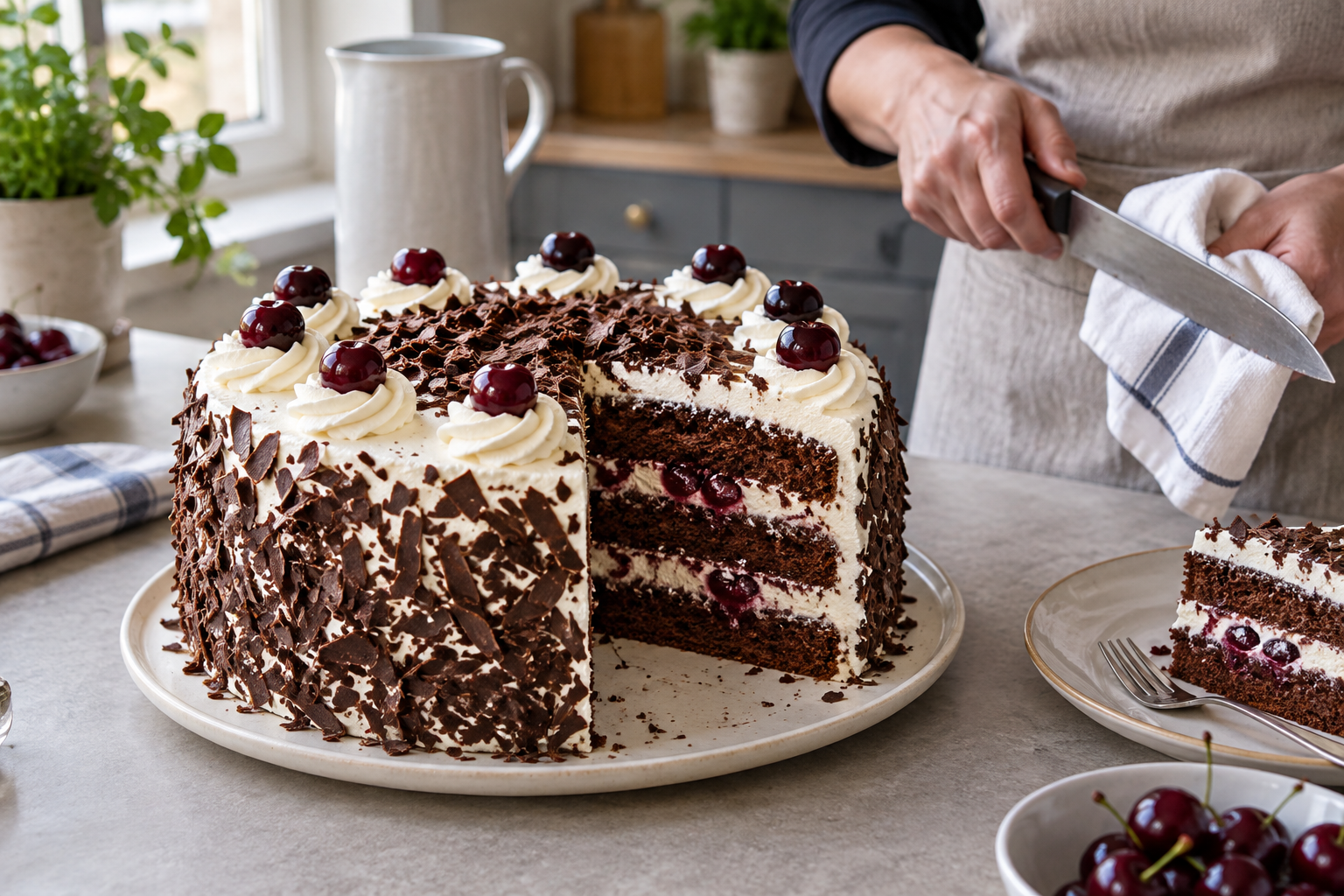
Decorate close to serving if you want the chocolate shavings to look their best. The cherries on top should be well drained and preferably gently blotted with kitchen paper, otherwise red juice will seep into the cream rosettes. For clean slices, use a long knife dipped in warm water and wiped between each cut.
The recipe below makes a tall cake with three sponge layers and two layers of cherries and cream. We leave out the optional shortcrust base to keep the work manageable at home. The aim is not maximum sweetness, maximum alcohol or maximum chocolate. It is a balance in which the cherries come through clearly – and the last spoonful feels just as tempting as the first.
Schwarzwälder Kirschtorte with sour cherries and kirsch
A modern home-baked version of the German pâtisserie classic, with three airy cocoa sponge layers, two cherry layers and lightly sweetened cream. This recipe is not a reconstruction of any individual inventor’s cake. Makes one 24 cm cake, approximately 12 slices. Allow time for cooling in addition to the preparation time, and at least 4 hours in the fridge after assembly. Contains alcohol; see the tips for an alcohol-free adaptation.
Ingredients
Method
- 1Heat the oven to 175 °C, conventional heat. Secure baking paper over the base of a 24 cm springform tin with sides at least 7 cm high. Leave the sides ungreased so the batter can grip them. Melt the butter and let it cool until lukewarm.
- 2Whisk the eggs and caster sugar with an electric whisk for 7–10 minutes until very pale and thick. A ribbon of batter falling from the whisk should remain on the surface for a few seconds. Mix the flour, cocoa, potato starch, baking powder and salt, then sift them into the batter in two batches. Fold together gently with a spatula.
- 3Mix about 1 dl of the batter with the lukewarm butter. Gently fold this back into the bowl. Pour the batter into the tin and bake in the lower part of the oven for 30–35 minutes. A skewer inserted into the centre should come out without any wet batter. Do not open the oven door during the first 25 minutes.
- 4Leave the cake in the tin for 15 minutes. Carefully loosen the edge with a thin knife, remove the tin and leave the cake to cool completely on a wire rack. Remove the baking paper. Cut the cold cake into three even layers with a long serrated knife.
- 5Drain the cherries, reserving the liquid. Set aside 12 good-looking cherries for decoration. Measure out 2.5 dl of liquid for the filling and reserve a further 0.5 dl for brushing. Mix the cornflour with 0.5 dl of the cold filling liquid. Bring the remaining 2 dl to the boil with the sugar. Whisk in the cornflour mixture and let it bubble gently for about 1 minute, stirring.
- 6Fold the cherries, except the 12 reserved ones, into the hot thickened mixture. Transfer to a wide bowl and leave to cool, first briefly on the worktop, then in the fridge. Once the filling is cold, stir in 1 tbsp kirsch. It should be thick and spoonable. Separately, mix the reserved 0.5 dl packing liquid with the remaining 3 tbsp kirsch for brushing.
- 7Whip the cold cream with the icing sugar and vanilla sugar until it holds defined but supple peaks. Put about 2 dl of the whipped cream into a piping bag. Keep all the cream chilled whenever you are not working with it.
- 8Place the bottom sponge layer on a flat cake plate, preferably with a cake ring around it. Brush with one-third of the kirsch mixture. Pipe a narrow border of cream around the outer edge and spread half the cherry filling inside it. Spread about 2.5 dl whipped cream over the filling. Add the next sponge layer and repeat with the brushing liquid, cream border, cherries and cream.
- 9Add the final sponge layer with its most even side facing up and brush with the remaining liquid. Press very lightly to level the cake. If using a cake ring, chill the cake for 30 minutes before removing it. Spread cream over the top and sides, reserving enough for 12 small rosettes. Keep the reserved cream chilled too.
- 10Make chocolate shavings with a vegetable peeler, or coarsely grate the chocolate. Gently press some around the sides of the cake and scatter the rest over the centre. Pipe 12 cream rosettes and place a well-drained, blotted cherry on each. Cover and refrigerate the cake for at least 4 hours, preferably overnight. Slice with a warm, wiped knife and serve cold.
- Alcohol-free: replace the 4 tbsp kirsch with 4 tbsp extra cherry packing liquid or cherry juice. Add 1–2 tsp lemon juice to the brushing liquid to taste. Present it as an alcohol-free, Black Forest-inspired cake.
- Ideally, make the sponge the day before. Once completely cool, wrap well and keep at room temperature until the next day, or freeze for longer storage. The cherry filling can be made the day before and kept in the fridge.
- Jar sizes vary. Check the drained weight and buy enough for both 450 g fruit and 3 dl packing liquid. Check even pitted cherries as you work; an occasional stone may remain.
- Keep the finished cake covered at around 4 °C and preferably eat within 2 days. Take it out only for serving. Kirsch added after baking does not become alcohol-free while the cake chills.
What goes in the glass
- CoffeeBalanced medium-roast filter coffeeCoffee’s roasted notes complement the cocoa and chocolate, while its bitterness cuts through the cream. Avoid an overly harsh roast that could overwhelm the cherries’ freshness. Decaffeinated works just as well.
- SpiritsKirschwasser, a small measure as an optional extraA small glass lets the cherry spirit’s aroma echo the kirsch in the cake. Serve sparingly, with no pressure to refill; the cake already contains alcohol, and coffee is an excellent accompaniment on its own.
- Alcohol-freeSour cherry juice with sparkling mineral waterMix roughly one part juice with two parts water. The acidity and bubbles provide a refreshing contrast to the cream, while the cherry flavour echoes the filling. Choose the alcohol-free cake version too for guests who avoid alcohol.
Enjoy alcohol in moderation. Alcohol-free options go just as well with the food.
Sources
- Deutsche Lebensmittelbuch-Kommission, Leitsätze für Feine Backwaren
- Erich Weber, 250 Konditorei-Spezialitäten und wie sie entstehen (1934)
- Alan Davidson; redigerad av Tom Jaine, The Oxford Companion to Food, tredje upplagan (2014)
- Darra Goldstein, redaktör, The Oxford Companion to Sugar and Sweets (2015)
- Universitätsstadt Tübingen, Stadtmuseum Tübingen
- Duden, Schwarzwälder Kirschtorte
Ask questions about "Schwarzwälder Kirschtorte – the forest’s name, the soul of cherries". Answers are based on the magazine's own articles.