Skånsk kalops – the slow-cooked stew that tastes like home
On allspice, tender carrots and the art of giving a stew time.
A gentle simmer murmurs beneath the lid. The beef softens, the carrots soak up the gravy and the allspice releases its warm, almost Christmassy aroma. Skånsk kalops is traditional Swedish home cooking: modest ingredients, generous flavour, and a dish in which patience matters more than expensive produce.
 By Lina BergFood editor · European and Nordic cuisines – Italy, France, Spain, Greece and Swedish home cooking
Translated from Swedish with AI assistance.
Go to the recipe ↓When the pot begins to speak
First comes the dry sizzle of meat meeting the hot base of the pot. Then the kitchen grows quieter. The onions soften, a splash of water loosens the browned bits from the bottom, and the lid goes on. Soon that familiar sound begins: a low, occasional bubble, more a sigh than a boil. Through the gap rises the scent of beef, bay leaves and allspice. Kalops is on its way, and dinner is suddenly running on a different clock.
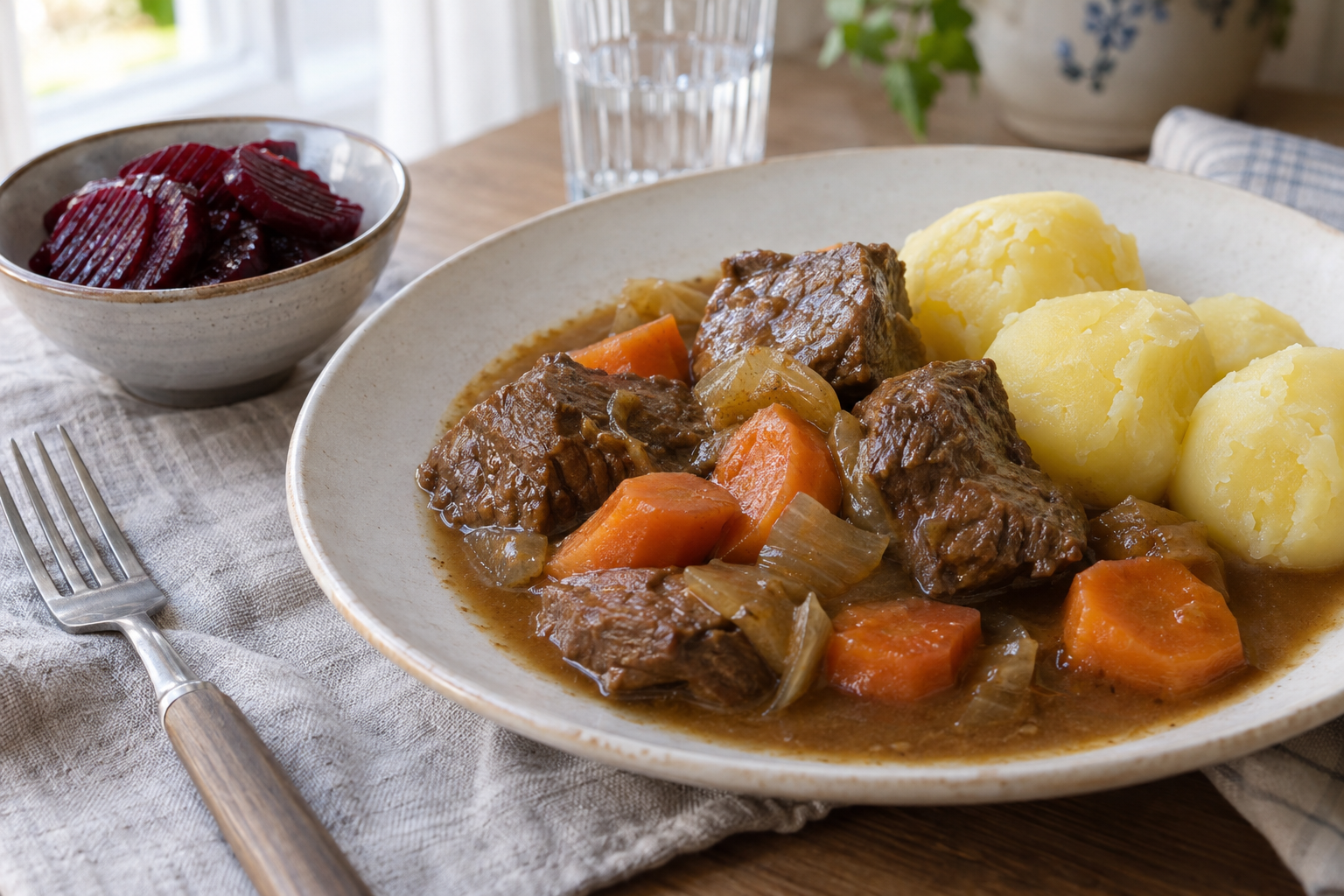
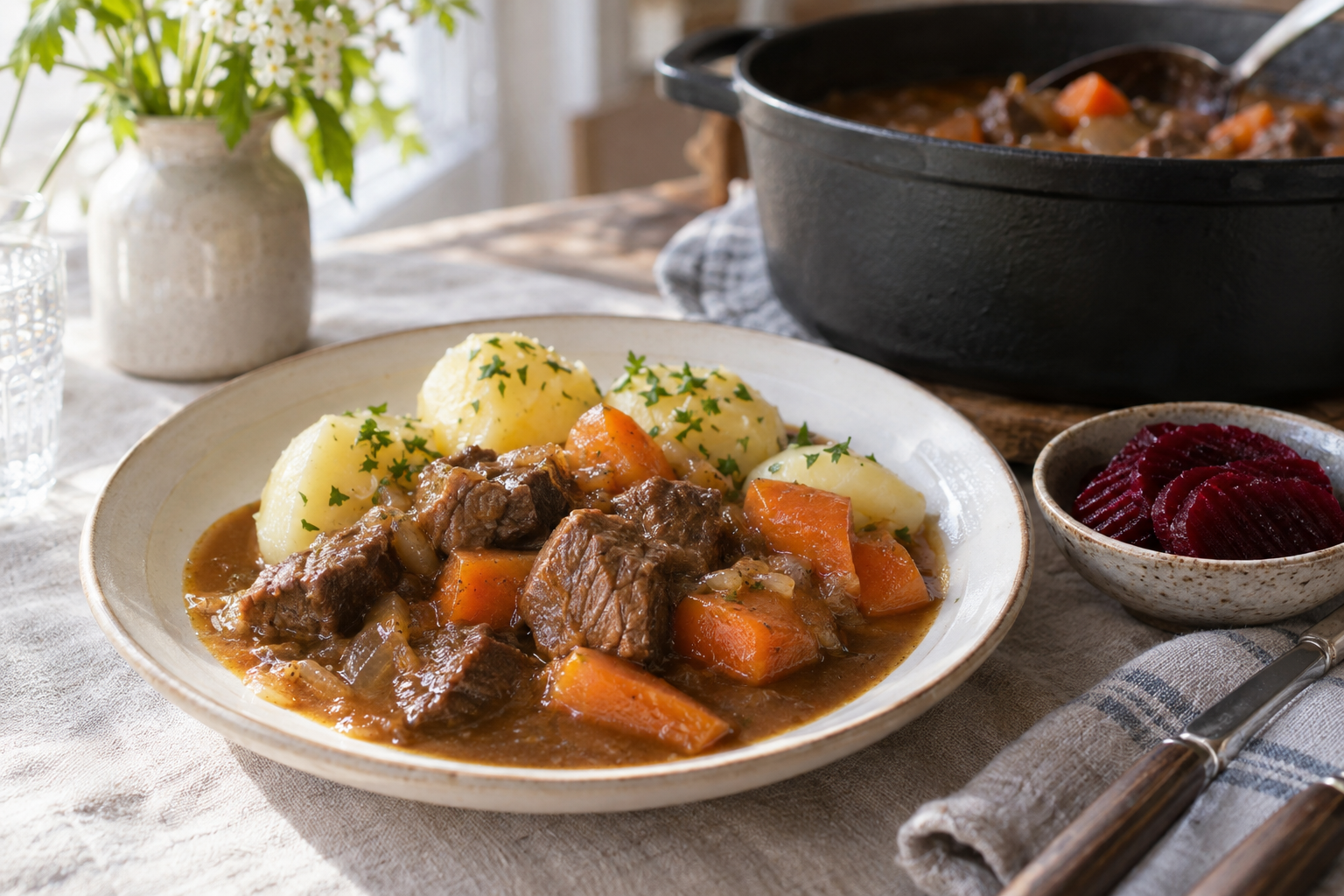
On the plate, skånsk kalops is far from showy. Brown beef, glossy gravy, orange carrots and boiled potatoes that might split a little as the fork goes through. Beside them sits pickled beetroot, deep red and sharply sweet-and-sour. That contrast is a large part of the meal's appeal. The stew is warming, mellow and rich; the beetroot wakes up the palate between mouthfuls.
It is easy to call food like this simple. The ingredient list is short and the techniques few, but that simplicity demands attention. The meat needs browning without burning, the liquid must stay at the right level, and the simmering must continue until the connective tissue has softened. A clock can guide you, but never give you the whole answer. A finished piece of beef should yield to a fork yet still lift out of the pot in one piece.
Kalops belongs to the kind of traditional home cooking that can feel familiar the very first time you eat it. Yet the stew also carries a history of borrowed words, imported spices and a thrifty kitchen in which fairly tough cuts of meat could become a much-anticipated dinner. The Scanian version makes that story a little sweeter and more colourful, chiefly through its carrots.
An old name, but no certain birthplace
Kalops has featured in Swedish cookbooks since at least the 18th century. Cajsa Warg includes the dish under the older spelling calops in her Hjelpreda i hushållningen för unga fruentimber, first published in 1755. That provides a clear historical reference point. A printed cookbook, however, proves neither who first cooked the dish nor in which kitchen it originated.
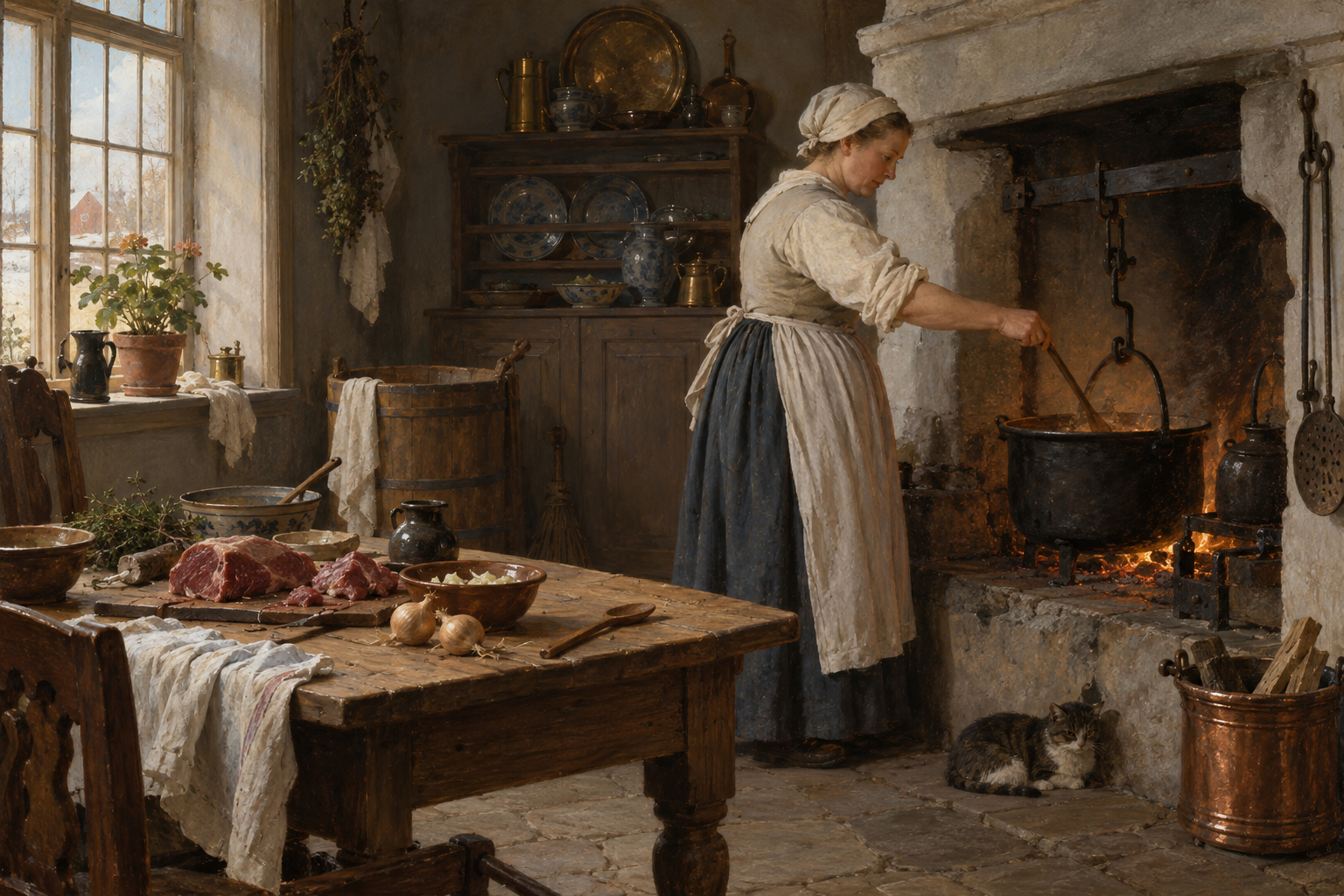
The name is generally traced to the English word collops, used for slices or small pieces of meat. The Swedish Academy Dictionary records the linguistic connection. It is tempting to plot a direct journey from a British stew to a Scanian farmhouse kitchen, but food history rarely lends itself to so straightforward a story. A borrowed word can change its meaning, and a dish can evolve as it encounters new ingredients and eating habits.
Nor is today's kalops an unchanged copy of its 18th-century counterpart. Older recipes must be read in the context of the cuts of meat, kitchen equipment and ways of specifying quantities of their time. Through later cookbooks, kalops acquired increasingly recognisable features: beef, onions, allspice and bay leaves, slow cooking, and a fairly uncomplicated gravy or sauce. It became a fixture of the 20th-century repertoire of Swedish home cooking, including through Tore Wretman's work sharing Sweden's culinary traditions.
So what makes it Scanian? In today's recipes, carrots are the clearest hallmark. They cook alongside the meat, adding both sweetness and colour. But the distinction is not absolute: a stew simply called kalops may contain carrots too. The name is therefore best understood as describing an established variation, rather than a protected formula or reliable proof of the dish's geographical birthplace.
Calling kalops old-fashioned peasant food without qualification is also an oversimplification. Access to fresh beef varied, and cookbooks do not automatically tell us what every social group ate from day to day. The stew became popular across society over time; its place on every kitchen table of the past cannot be taken for granted.
Allspice sets the tone
Start with the meat. Beef chuck is a reliable choice because it contains connective tissue and often a good amount of marbled fat. During gentle, moist cooking, collagen turns to gelatin, helping to make the meat more tender and the gravy fuller-bodied. Boneless shoulder can also work, though the cooking time needs adjusting to suit the cut. Lean, fine-grained meat is not automatically better: an expensive steak can turn dry long before it brings any particular advantage to the stew.
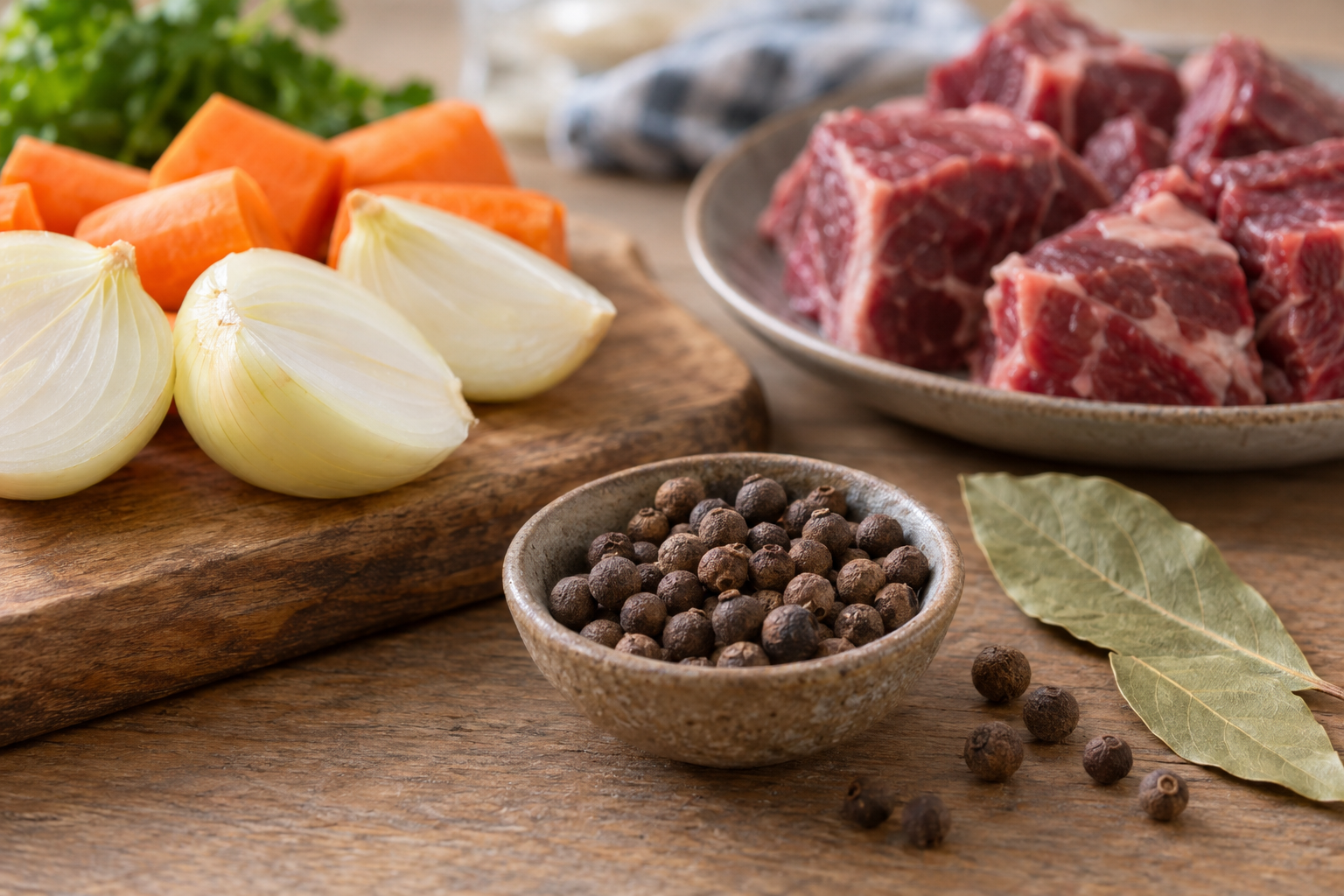
The pieces should be large enough to withstand long cooking. Small cubes can easily turn stringy or fall apart while you wait for the whole pot to be ready. Brown the meat in batches, allowing the pot to heat up again between each one. If the base is covered in meat juices, the beef will boil rather than develop the browned crust that gives the sauce its deep, roasted flavour. The surface should be thoroughly brown, not black; burnt bits should not end up in the gravy.
Allspice is the dish's most distinctive aromatic signature. Despite its Swedish name, which translates as ‘spice pepper’, it is not a type of pepper but the dried berries of Pimenta dioica. Its flavour can recall cloves, cinnamon and nutmeg, yet it has a restrained warmth of its own. Here it is used whole, allowing its flavour to infuse slowly. Bay leaves add a drier, herbal note, while the onions link the savouriness of the beef with the sweetness of the carrots.
The carrots call for a small decision. Added at the start, they become very soft and their flavour melds into the gravy. Added towards the end, they keep a more distinct shape and a juicy centre of their own. Both approaches have their place in home kitchens. In this recipe they go in later: the beef has time to develop, while the carrots remain distinct on the plate, in both appearance and texture.
The sauce should taste of meat and spices, not stock cubes. Water and a modest amount of stock work well, especially when the browning has done its job. A little flour can help the gravy cling to the potatoes, but should not make it heavy. Kalops needs neither cream nor wine to achieve richness. That richness is already there in the beef, the onions and the time.
Potatoes and a tangy companion
At the table, it becomes clear how well balanced the accompaniments are. Boiled potatoes are mild enough to let the allspice speak and substantial enough to carry the sauce. A waxy variety holds its shape neatly, while a slightly flourier potato is pleasant to crush gently with a fork. Both work. What matters is that the potatoes are freshly cooked and have not turned watery while waiting for the stew.
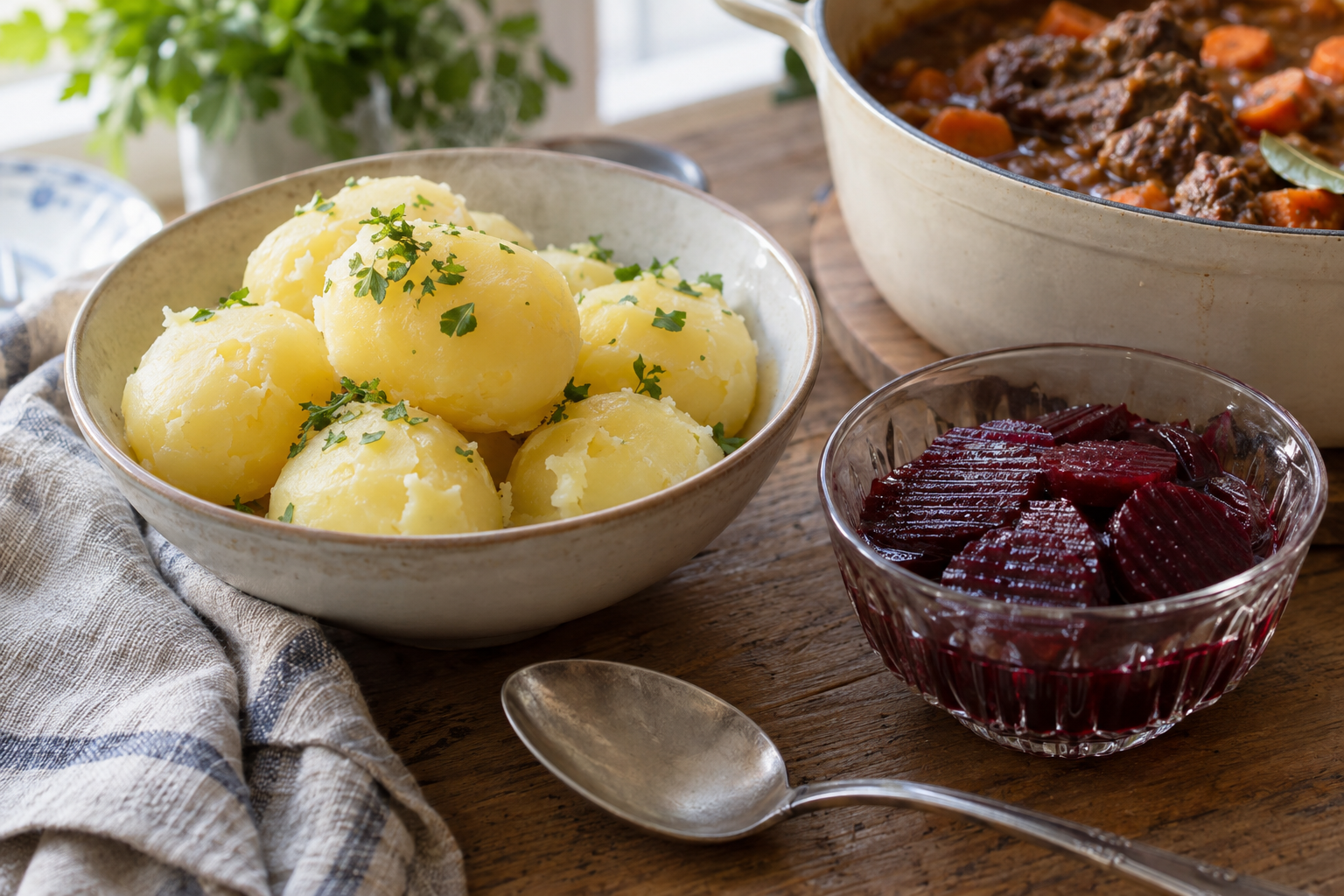
Pickled beetroot is the classic tangy companion. Its sweetness echoes the carrots, while the vinegar cuts through the mellow beef flavour. Serve it in a separate bowl and let everyone help themselves. That way, the whole sauce does not turn red, and anyone who likes can alternate between an unadorned mouthful of kalops and a sharper bite with beetroot.
This is also food that leaves room for company. Once the stew is ready, there is no last-minute frying or delicate assembly. It can go straight into the middle of the table, with the potatoes alongside and a large serving spoon. That is more than enough for an everyday meal; for a leisurely weekend dinner, something fresh and simple, such as apples or berries, might follow.
Today, kalops lives on both as a home-cooked family meal and as part of the traditional fare served in lunchtime restaurants. For some it brings back memories of school dinners, for others a relative's kitchen. Those memories can be powerful, but they need not dictate how the next pot should taste. A little more browning, a gentler simmer and carrots that still hold their shape may be all it takes to rediscover the dish.
Getting it right in a Swedish home kitchen
Choose a heavy-based pot with a well-fitting lid. Adjust the heat so that only the occasional small bubble breaks the surface; vigorous boiling can break up the vegetables and make the liquid evaporate needlessly quickly. It is better to top up with a little hot water as you go than to start with so much that the beef flavour becomes diluted.
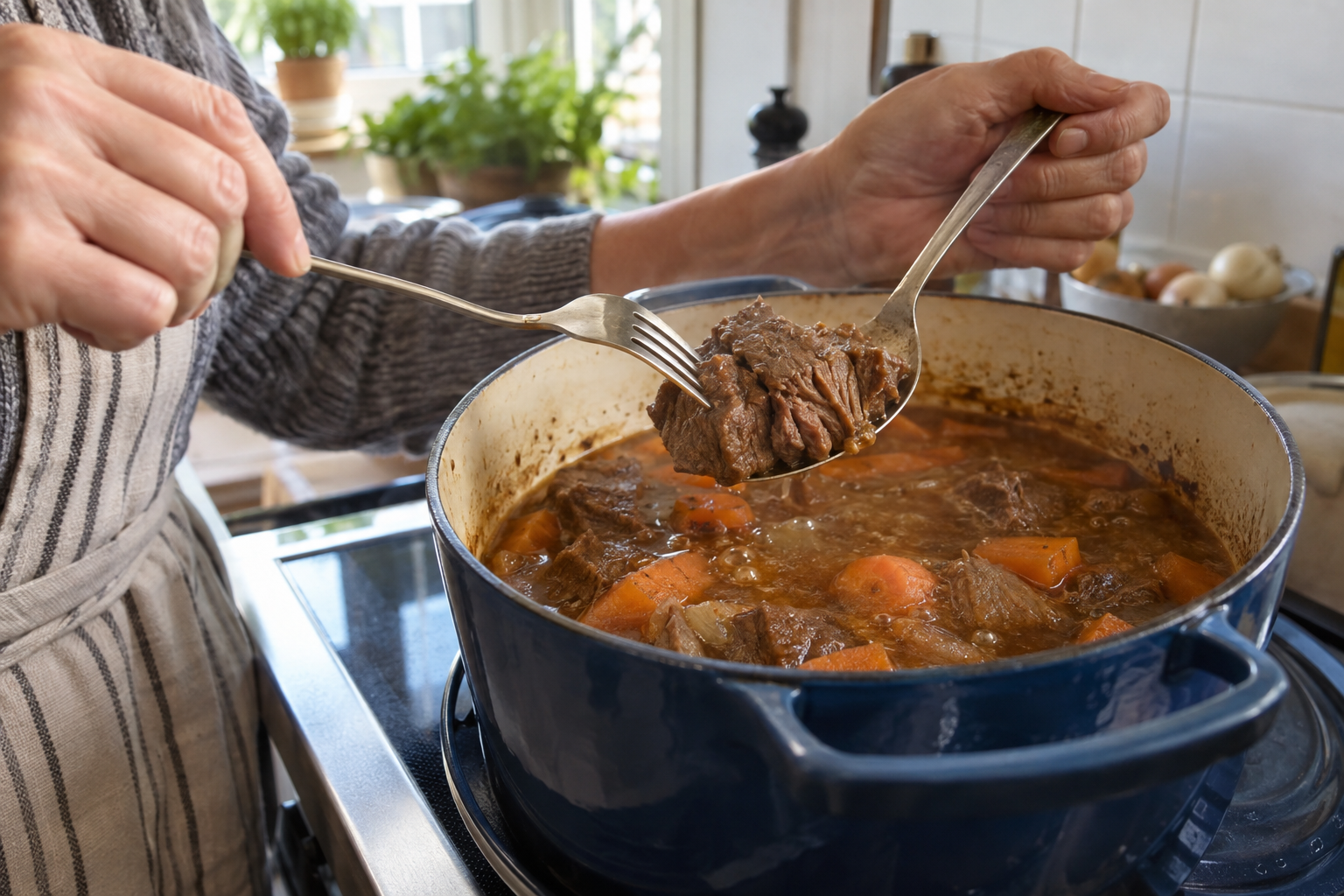
Check the tenderness before deciding when to serve dinner. If the beef still offers clear resistance, it usually needs more time, not more heat. Lift out a piece and test it with a fork. Then taste and adjust the sauce only once it has reduced to the right concentration, since both salt and spices become stronger as liquid evaporates.
Kalops is ideal for making a day ahead. The flavours often seem more harmonious after a rest, and dinner itself becomes easier to organise. Cool leftovers quickly in smaller, shallow containers and refrigerate. Reheat gently but thoroughly, adding a splash of water if the sauce has thickened.
The recipe below is a contemporary home-cooked version of skånsk kalops, not a reconstruction of Warg's stew. It stays true to the dish's defining flavours and lets technique do the work. Good beef chuck, whole allspice and time under a lid: it need not be any more complicated than that.
Skånsk kalops with carrots and boiled potatoes
A contemporary take on traditional Swedish home cooking, with browned beef chuck, whole allspice and carrots added towards the end. Cooking time varies with the meat; let your fork decide when the stew is ready.
Ingredients
Method
- 1Cut the beef chuck into pieces roughly 4 cm across. Trim away tough membranes but leave soft connective tissue and marbled fat. Pat the meat dry with kitchen paper. Peel the onions and cut into thick wedges.
- 2Heat the oil and butter in a heavy-based pot over a medium-high to high heat. Brown the beef in 3 batches, allowing about 4–5 minutes per batch, until well coloured on several sides. Transfer the beef to a plate as you go. Lower the heat if the browned bits in the pot begin to turn black.
- 3Reduce the heat to medium. Add the onions and cook for 3–4 minutes, stirring. Add a splash of the measured water and scrape up the browned bits with a wooden spoon.
- 4Return the beef and any juices to the pot. Sprinkle over the flour and stir. Pour in the remaining water and add the concentrated stock, allspice, bay leaves and 0.5 tsp salt. The liquid should come roughly to the top of the meat; add a little extra water if the shape of the pot calls for it.
- 5Bring to the boil, then lower the heat and cover. Simmer very gently for about 1.5–2 hours. Stir carefully now and then and check that there is still liquid in the pot. Top up with a little hot water if needed.
- 6Peel the carrots and cut into roughly 3 cm pieces. Once the meat has begun to soften but is not yet ready, add the carrots. Simmer for another 30–45 minutes, or until both the beef and carrots are tender. If the beef needs longer, continue simmering and check every 15 minutes.
- 7Peel the potatoes as the stew nears readiness. Boil them in lightly salted water, covered, for about 20–25 minutes, depending on their size. Drain and leave to steam dry.
- 8Test the kalops with a fork: the beef should yield easily. If the sauce is thin, simmer uncovered for 5–10 minutes. If the beef and carrots are already very tender, lift them out while you do this. If the sauce is too thick instead, thin it with a little water.
- 9Taste and adjust the salt. Remove the bay leaves and as many allspice berries as possible. Serve the kalops hot with freshly boiled potatoes and pickled beetroot in a separate bowl.
- Put the allspice in a roomy spice bag intended for cooking if you want to remove all the berries easily.
- For gluten-free kalops, omit the flour and check the stock. If needed, thicken the finished gravy with a little cornflour mixed with cold water, then simmer according to the packet instructions.
- This is a good dish to make a day ahead. Cool quickly in shallow containers, store at around 4°C and eat within 3–4 days. Reheat only the amount you plan to serve.
- Kalops freezes well in individual portions without the potatoes. Thaw in the fridge and reheat gently until hot all the way through.
What goes in the glass
- BeerMalty Vienna-style lagerBready, lightly toasted malt notes complement the browned beef and the sweetness of the carrots. Choose moderate bitterness so the allspice retains its gentle warmth.
- WineFruity Pinot Noir with subtle oakFresh acidity lightens the rich gravy, and moderate tannins work well with the tender beef. The vinegar in the beetroot can make the wine seem harsher; go easy on the beetroot with this particular pairing.
- Alcohol-freeAlcohol-free dark lagerToasty, bready notes suit the browned beef, while the bubbles refresh the palate between mouthfuls. A less sweet version offers a lovely balance to the carrots and beetroot.
Enjoy alcohol in moderation. Alcohol-free options go just as well with the food.
Sources
- Cajsa Warg, Hjelpreda i hushållningen för unga fruentimber (1755)
- Svenska Akademien, Svenska Akademiens ordbok: kalops
- Tore Wretman, Svensk husmanskost (1967)
- Harold McGee, On Food and Cooking: The Science and Lore of the Kitchen (2004)
Ask questions about "Skånsk kalops – the slow-cooked stew that tastes like home". Answers are based on the magazine's own articles.