Smørrebrød – Copenhagen on a Slice of Rye
On dark rugbrød, generous toppings and the art of making lunch a small celebration.
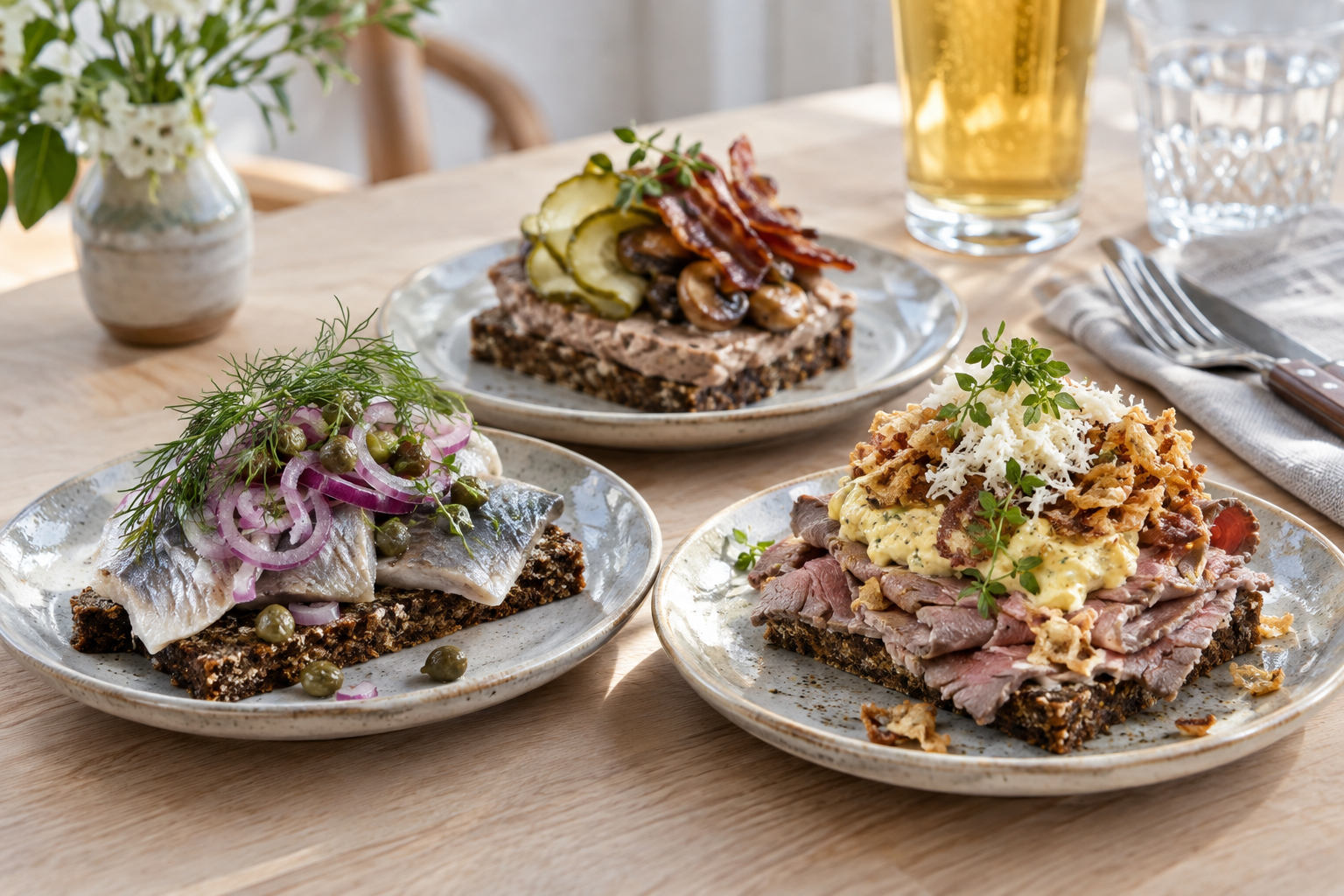
The herring gleams, butter meets the tang of rye, and mushrooms still fragrant from the hot pan sit atop liver pâté. Danish smørrebrød is both everyday food and a carefully honed craft. We follow the open sandwich from packed lunch to frokost table – and set our own table with three classic combinations and an easy rye loaf.
 By Lina BergFood editor · European and Nordic cuisines – Italy, France, Spain, Greece and Swedish home cooking
Translated from Swedish with AI assistance.
Go to the recipes (2) ↓An entire cuisine on a slice of bread
The knife passes through a thin onion ring, on through the glossy herring and into dark bread that yields gently but firmly. First comes acidity, then salt, a little sweetness and finally rye’s deep grain flavour. On the next plate, roast beef falls in folds beneath yellow remoulade and crispy fried onions. From the kitchen comes the sizzle of mushrooms hitting a hot pan. They will land on the liver pâté before they have time to cool.
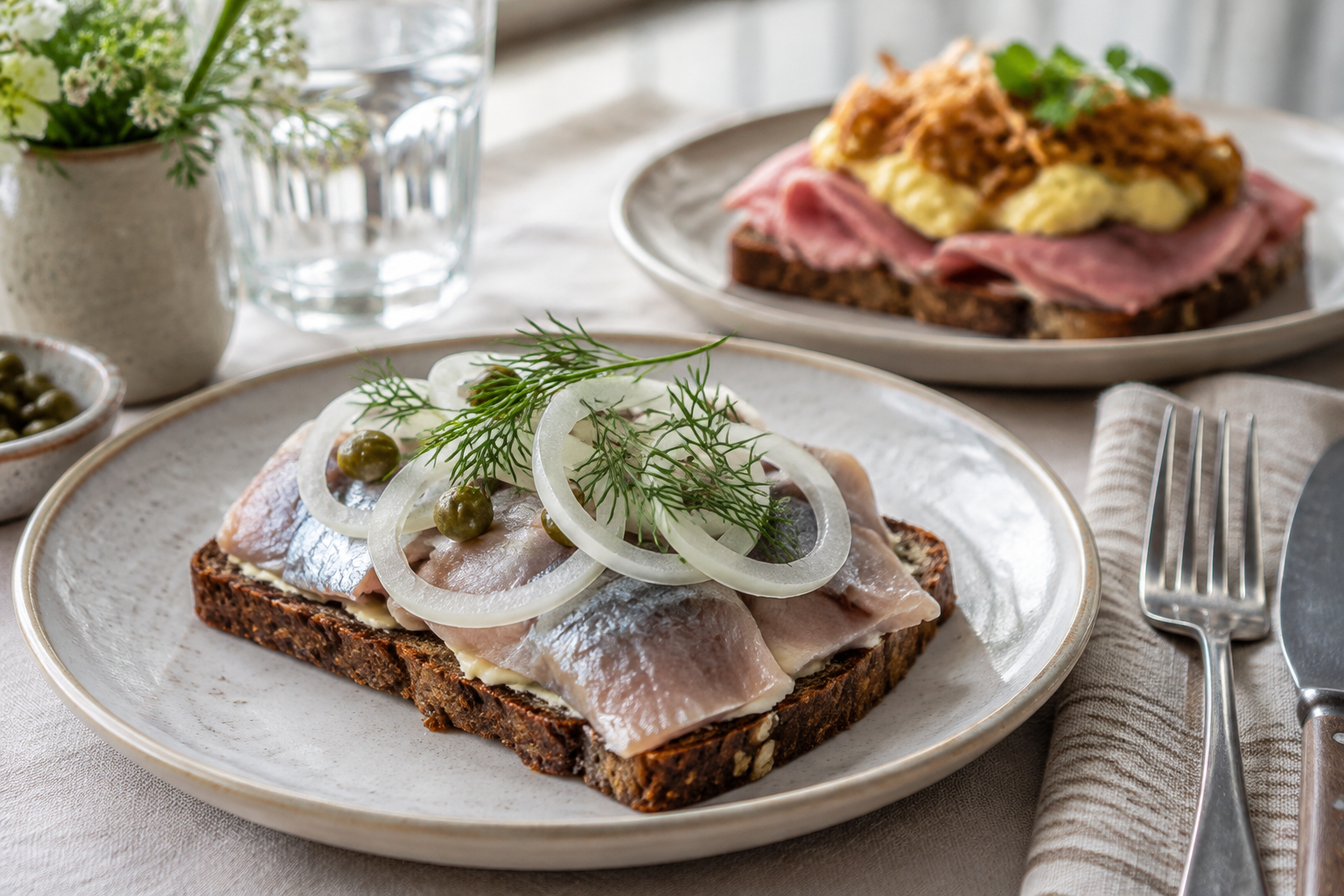
This is how lunch in Copenhagen might begin. Not necessarily with a mountain of food, but with attention to every element: the thickness of the bread, the temperature of the butter, how well the herring has drained and that little sprig of green that should actually taste of something. Good smørrebrød is not a contest in height. It is a thoughtfully composed mouthful that happens to extend across an entire slice of bread.
The Danish word frokost means lunch, not breakfast. The distinction is worth remembering when reading a menu or accepting an invitation to someone’s home. A frokost can be quick and simple, but it can also turn into a leisurely meal with fish, meat, cheese and plenty of conversation between courses. Smørrebrød belongs in both worlds.
That very range is what makes the dish interesting. It is close kin to a packed-lunch sandwich, yet also related to the restaurant’s most carefully composed plates. Beneath all the beauty lies a practical idea: filling bread, a little fat and whatever is available to put on top. Generations of chefs and home cooks have since made that idea both richer and more refined.
From packed lunch to restaurant craft
There is no certain birthday for smørrebrød. Putting food on bread is an old and widespread habit, and the simple buttered slice predates the Danish restaurant speciality we know today. We therefore need to distinguish between smørrebrød in the broad sense and the garnished, composed version with its own name on the menu.
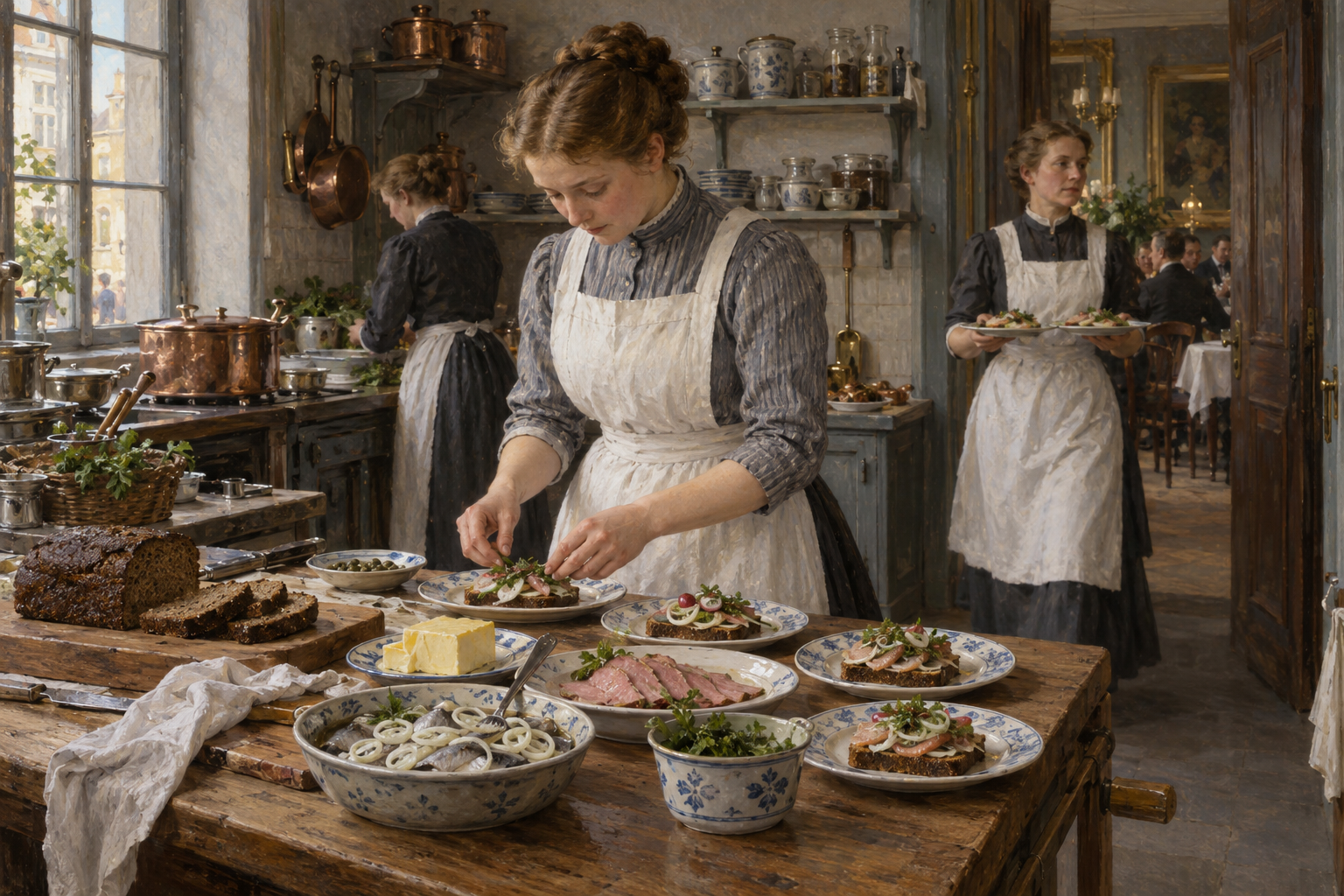
The latter form developed distinctly in Denmark during the second half of the 19th century. Urbanisation and working life outside the home gave packed meals an important role. Bread with toppings was easy to pack, filling and adaptable to a household’s means. In restaurants and taverns, the same basic idea could acquire more expensive ingredients, extra accompaniments and a more elaborate presentation.
It is tempting to tell the story as a straight journey from the worker’s lunch parcel to the white tablecloth. Reality is less tidy. Sandwiches in the home, middle-class cold buffets and restaurant offerings developed side by side. Smørrebrød became both a practical meal and a way to showcase the kitchen’s skills. The simple and the elegant have continued to coexist.
Ida Davidsen’s family is a well-known name in Copenhagen’s smørrebrød history. The family business is usually dated to 1888, but that does not mean the family invented the dish. Rather, they were among those who made restaurant smørrebrød a celebrated institution, with many named combinations and a clear commitment to craftsmanship.
Another word carrying this professional history is smørrebrødsjomfru. It has been used for the skilled woman responsible for preparing and arranging smørrebrød in the cold kitchen. The title reflects the gender divisions of working life in earlier times; the expertise itself is, of course, not gender-specific. The work requires sound knowledge of ingredients, speed and an eye for proportion – as well as the ability to judge what will stay fresh during service.
Here lies an important reason for the dish’s standing. Buttering bread sounds simple. Serving many different smørrebrød, with every component at the right temperature and texture, is a culinary craft. Anyone who has tried to bring fried fish, cold prawns, sauce and freshly toasted bread together at just the right moment knows the difference.
Rugbrød: dark, moist and made for the job
The bread is not simply a base to be hidden. It is a flavourful part of the dish. Danish rugbrød is generally dense and moist, often made with sourdough and sometimes with whole or cracked grains and seeds. There is plenty of variation: rugbrød does not have to be exceptionally coarse or packed with sunflower seeds to be Danish.
Rye’s tangy, slightly earthy flavour is particularly good with oily fish, liver pâté and salty meat. Its firm structure also means that a relatively thin slice can carry a generous topping. An airy wheat loaf behaves differently: it compresses easily, absorbs liquid and can disappear beneath the topping.
In breads with a high proportion of rye, sourdough contributes more than flavour. Its acidity helps create a good structure in dough where rye’s properties matter more than wheat gluten. But that does not mean home cooks have to begin with a week-long sourdough project. A yeasted rye tin loaf with a little wheat flour can be a delicious, reliable route to a frokost table at home. It will not be identical to traditional sourdough rugbrød, and there is no need to pretend otherwise.
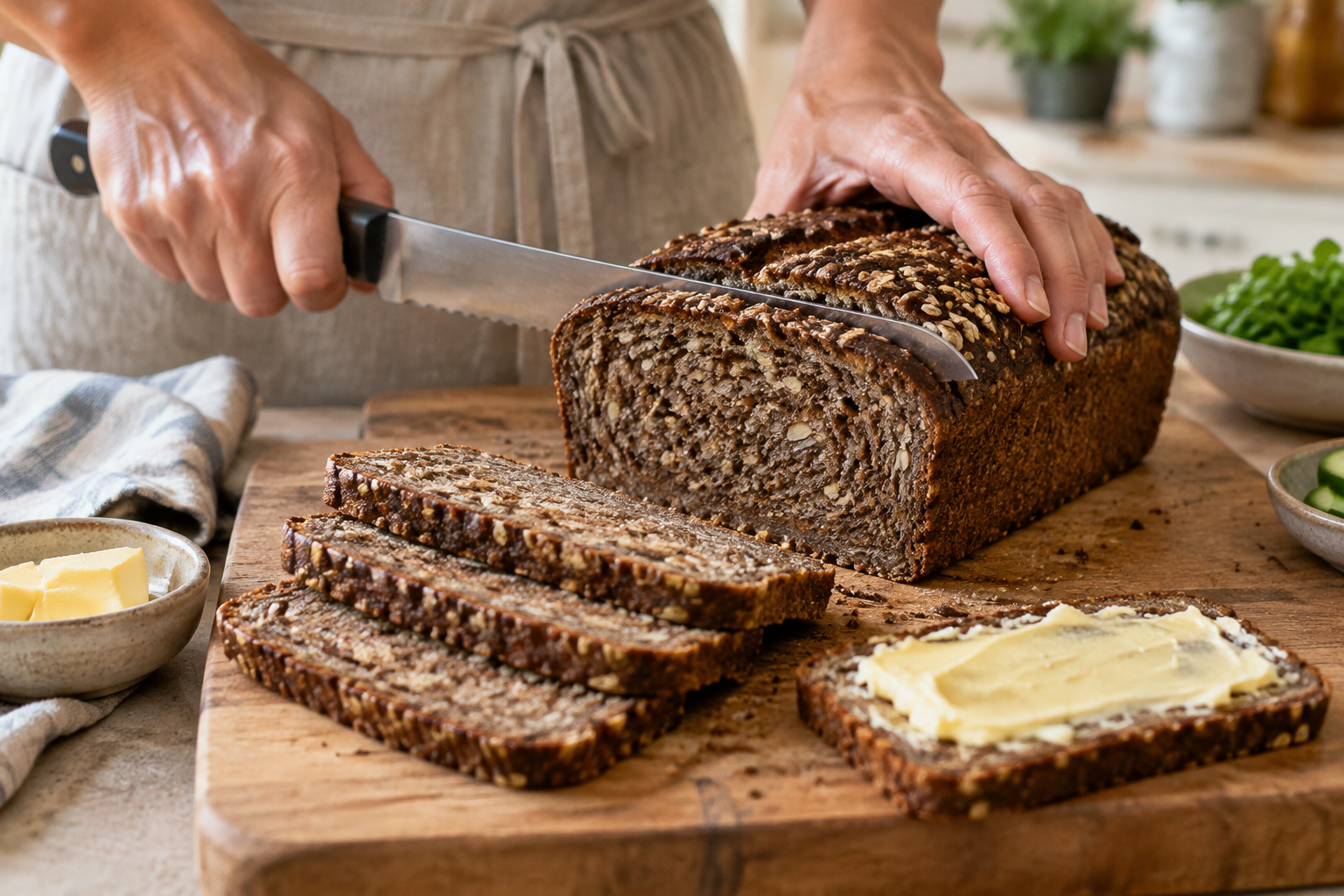
Ideally, cut the bread thinly but not paper-thin, around seven to ten millimetres depending on how sturdy it is. Day-old rye bread is often easier to slice than a freshly baked loaf. Use a sharp serrated knife and long strokes; pressing hard can leave the slice uneven or cause it to split. It should hold together when cut into mouthfuls on the plate.
The butter should be spreadable and reach right to the edges. It adds flavour and helps slow the passage of moisture from the topping, though it does not make the bread waterproof. Some traditional combinations use other fats, such as seasoned lard. Choose the fat to suit the topping, rather than out of habit.
Not all smørrebrød is served on rye. Stjerneskud often comes on toasted white bread, and other fish and shellfish combinations may also have a lighter base. It is a useful reminder: the tradition has clear patterns, but no single law of bread applies everywhere.
The classics and their inner logic
Herring, sild in Danish, is a natural starting point for the frokost table. It may be marinated in a clear, sweet-and-sour pickling liquid or served in a creamy sauce, perhaps with curry. On the bread it needs something to cut through its richness: raw onion, capers, apple or something else sharp and crisp, depending on the combination. Dill adds fresh herbal notes without needing to dominate.
For Swedish home cooks, the distinction between ready-to-eat pickled herring and fish that needs further preparation is particularly important. The recipe uses ready-to-eat pickled herring, not salt herring or raw herring. Swedish pickles vary widely in sweetness. Taste before building the sandwich; sweet herring may benefit more from extra onion and a sharp accompaniment than from another sweet sauce.
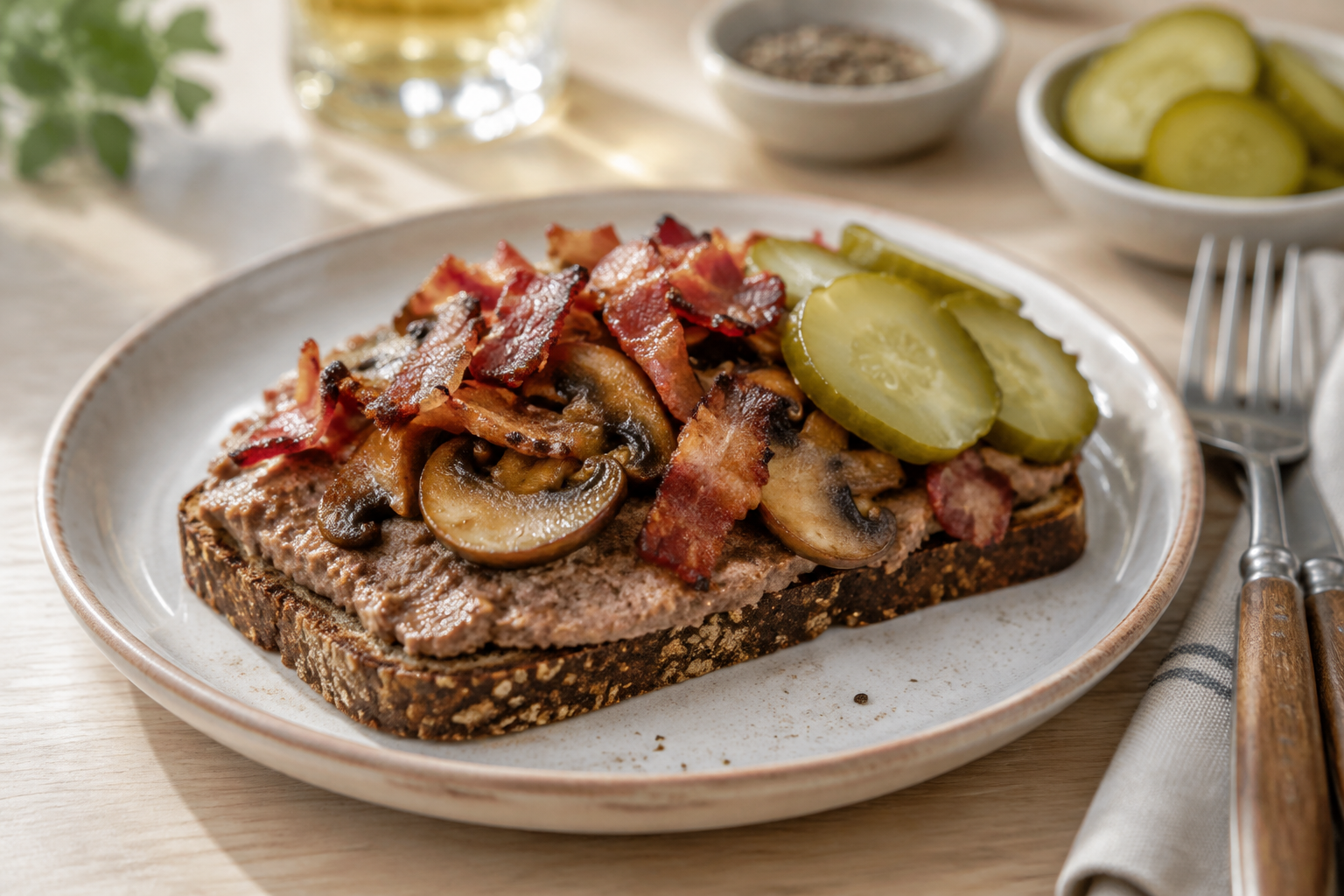
Leverpostej is another cornerstone. The Danish version is usually baked and may be served warm with bacon and mushrooms. Soft pâté, crisp bacon and browned mushrooms provide three quite different textures. Pickled cucumber or beetroot supplies the sharp contrast that makes the next bite as tempting as the first.
Roast beef with remoulade works in much the same way. The meat is mild and juicy, the sauce rich and tangy, the fried onions crisp. Horseradish can add a kick felt more in the nose than on the tongue. Danish remoulade is often yellow and contains finely chopped pickled vegetables; recipes and seasonings vary. A quick homemade version with mayonnaise, pickles, a little mustard and a restrained touch of curry works beautifully, but should not be confused with every other sauce called remoulade.
Rullepølse is salted, seasoned meat that is rolled, cooked and pressed before being sliced thinly. Pork is often used, with pepper, onion and other seasonings adding character. On the bread, it may be paired with jellied meat juices and raw onion. It is a fine example of how older ways of making the most of meat have become a much-loved part of today’s lunch culture.
Dyrlægens natmad, the vet’s late-night snack, is usually built from liver pâté, salt beef, jellied meat juices and onion on rye bread. The name has inspired stories about a vet and his regular order. Such tales belong to restaurant folklore, but should not be treated as firmly documented accounts of the dish’s origins. The combination itself is less elusive: soft pâté, firm meat, cool meat jelly and sharp onion.
Stjerneskud is the more flamboyant relative, often a whole meal in itself. It typically features both breaded, fried fish and steamed or poached fish, prawns and a cold dressing, with accompaniments such as asparagus, lemon and roe. Presentations vary. What matters is the contrast between crisp and gently cooked fish, not piling on as many luxury ingredients as possible.
What the classics share, then, is not excess but contrast. Fat needs acidity. Softness needs something to chew. Salt needs freshness. Garnishes only become meaningful when they contribute to the flavour – a sprig of dill can do that, whereas a large lettuce leaf sometimes simply gets in the way.
The rhythm and hospitality of the frokost table
At a larger traditional frokost table, the meal often begins with herring and other fish, moves on to meat and ends with cheese. This is an established order, not a test guests have to pass. At an ordinary restaurant lunch, you simply choose the smørrebrød you want to eat, sometimes in several rounds so that delicate toppings arrive in the right condition.
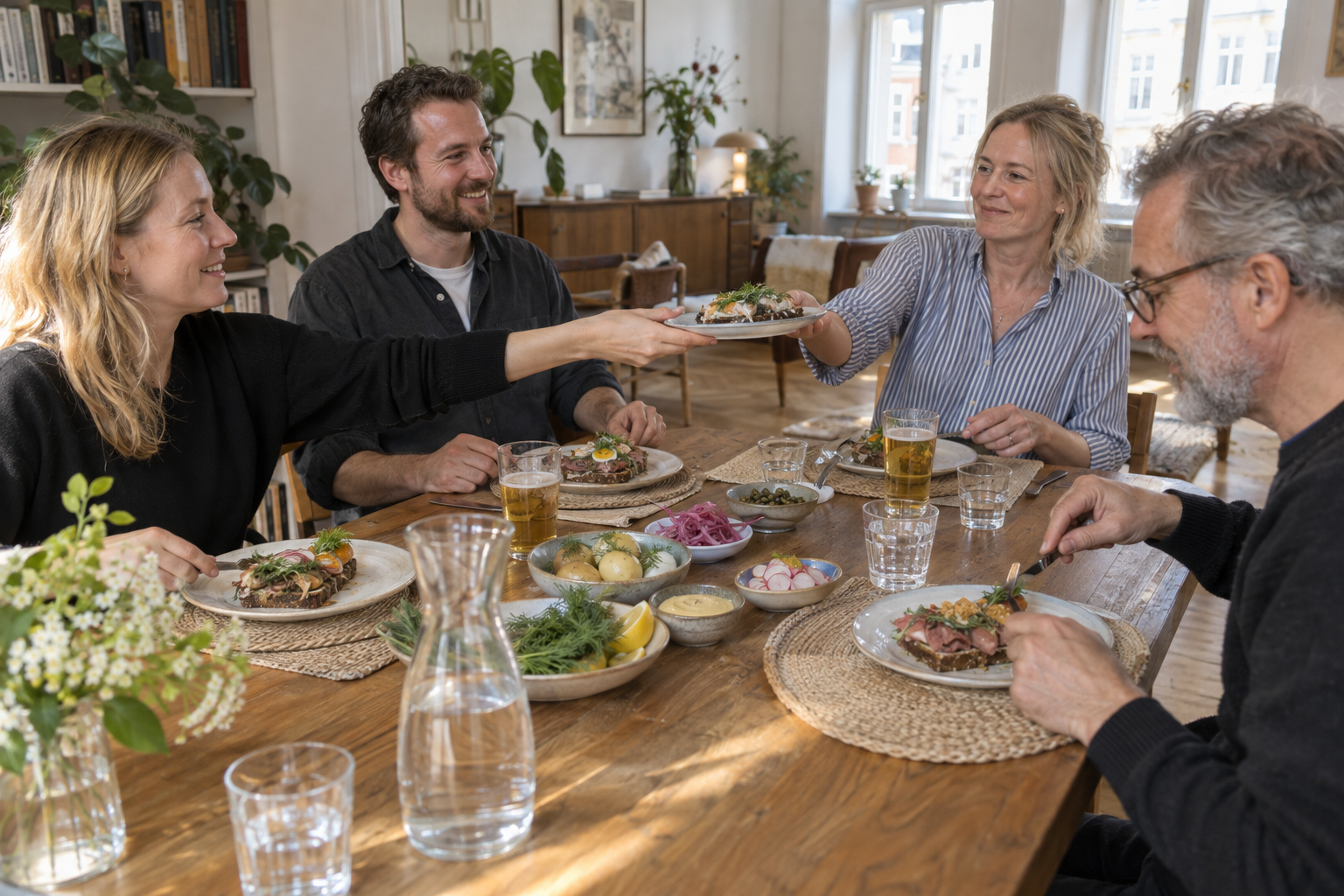
Garnished smørrebrød is usually eaten with a knife and fork. That may sound rather formal for a sandwich, but above all it is practical. Each small bite can include bread, fish and accompaniments without everything landing in your lap. The simpler everyday sandwich naturally follows different rules and can be eaten by hand.
Christmas julefrokost and Easter påskefrokost give the cold buffet extra room to shine. Herring, fish, meat and warm dishes may appear over the course of an unhurried meal. There is room both for the family favourite and for the dish someone insists on making their own way every year. The tradition lies as much in the sequence, the company and the repetition as in an exact list of ingredients.
Beer and snaps have historically belonged at many such tables. The caraway or dill in aquavit can pair beautifully with rye bread, herring and herbs. But spirits are not needed to make the meal feel Danish, and alcohol should never be a condition of joining a toast. Small servings, water on the table and a thoughtfully chosen alcohol-free alternative give guests genuine choice.
A pale alcohol-free lager offers both bubbles and malty notes that suit the bread. A fresh apple-based alcohol-free drink can also work with herring, preferably one with restrained sweetness. Avoid making the drink as sweet as the pickling liquid: the overall effect can easily become heavy rather than refreshing.
At home, the most generous approach is not always to serve everything fully assembled. Put out a few finished smørrebrød to show the idea, then let guests help themselves to more of their favourites. Keep fish and other perishable toppings chilled and replenish them in small batches. That way, the last guest avoids lukewarm herring and the first avoids the feeling of being handed a work of art that must not be touched.
Nordic food today – and the route to your kitchen
The New Nordic Cuisine Manifesto of 2004 highlighted seasonality, the origins of ingredients and regional traditions, among other things. Smørrebrød is much older, but fits neatly into that spirit of curiosity. Rye, fish, cabbage, root vegetables, herbs and preservation techniques already belong to its flavour world. It did not need to be reinvented to feel relevant.
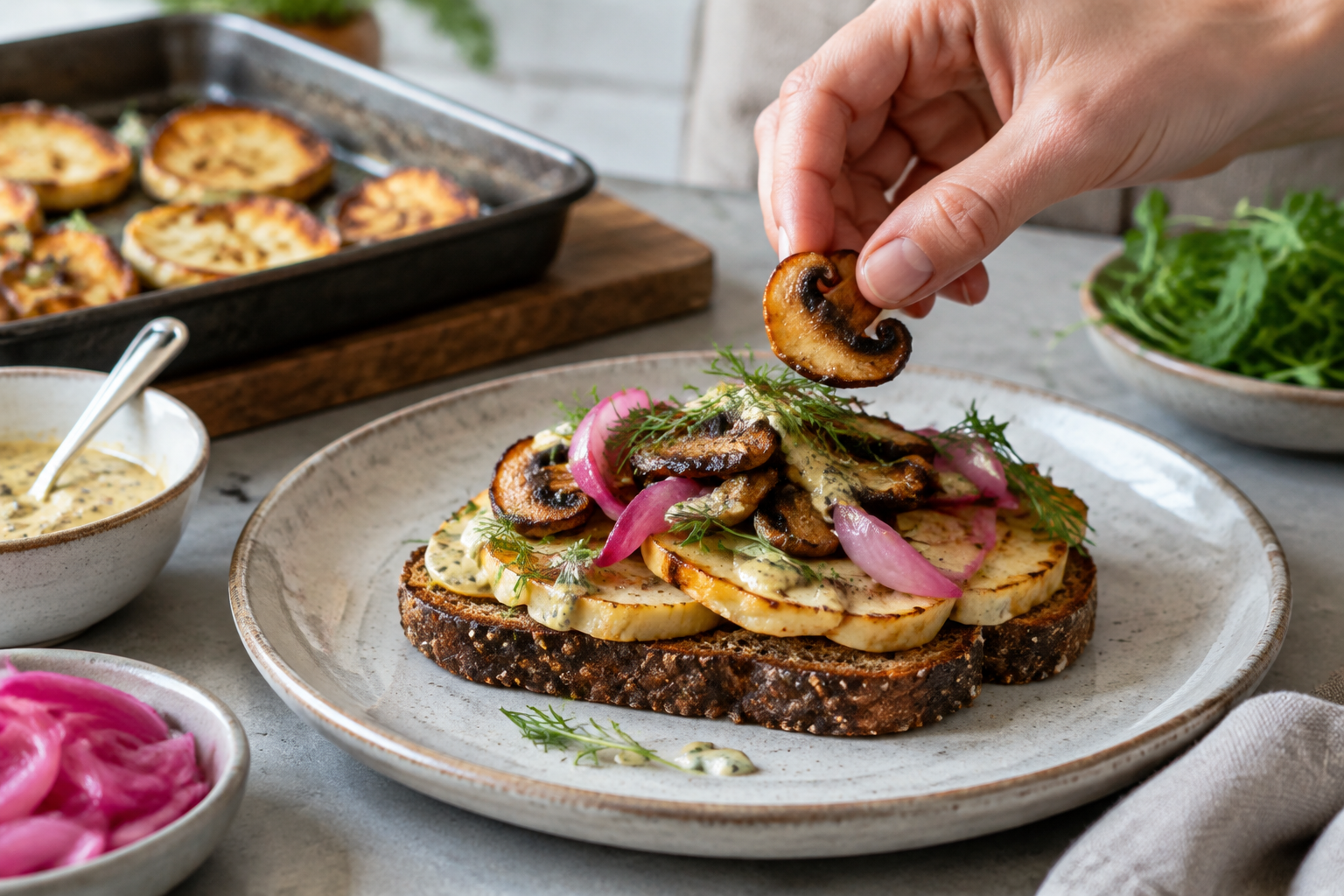
On today’s table, the classics can therefore sit alongside celeriac, potatoes, mushrooms and other vegetable-based toppings. A vegetarian sandwich, however, needs to be built with the same care as one topped with roast beef. Cooked vegetables on bread do not automatically make a well-rounded composition. They need salt, fat, acidity and preferably a roasted or browned note to add depth.
At the same time, there is value in letting a herring sandwich be a herring sandwich. Innovation becomes more interesting when it understands what already works. You can change the garnish with the seasons or make your own remoulade without every plate having to carry a new idea. Sometimes the most modern thing to do is bake good bread and use it down to the very last slice.
In a Swedish kitchen, success begins at the shops. Look for moist Danish rye bread rather than a sweet, airy loaf. Choose a mild baked liver pâté if Danish leverpostej is unavailable. Roast beef from the deli counter is fine, but ask for thin slices that can be folded. For the herring, choose a ready-to-eat pickle you enjoy and let it drain thoroughly.
Then plan around temperature. Ideally, bake the bread the day before. The remoulade can be mixed ahead and refrigerated. Slice the onion and cucumber close to serving time, and cook the bacon and mushrooms last. Plate the herring and roast beef cold; the pâté can be warm. The fact that not everything should be at the same temperature is part of the dish’s charm, but also the reason not to assemble the whole lunch too early.
The most common mistakes are easy to avoid: bread that is too thick, wet toppings, too much sauce and garnishes too large to eat with the rest. Let the main ingredient show. Fold the meat loosely rather than pressing it down, spread the herring across the bread and add the crisp elements on top just before serving.
The recipes below offer three classic flavour combinations and a yeasted rye loaf for the home kitchen. Three smaller smørrebrød per person make a substantial lunch; they work just as well served in rounds. Begin with the herring, continue with the roast beef and let the warm liver pâté come last. After that, all you really need is a sharp knife, something good in your glass and time to linger.
Three classic smørrebrød: herring, roast beef and warm liver pâté
Twelve smaller smørrebrød, four of each kind, for a substantial lunch for four. The combinations are classic, while the quantities and quick remoulade are adapted for a Swedish home kitchen. Use ready-to-eat pickled herring.
Ingredients
Method
- 1Preheat the oven to 150 °C, conventional heat. Mix the mayonnaise, chopped pickles, mustard and curry powder. Add the pickling liquid a little at a time to taste, then refrigerate the remoulade.
- 2Drain the herring in a sieve for about 5 minutes without rinsing. Slice the red onion very thinly. If it is strong, soak it in cold water for 5 minutes, then drain and pat dry.
- 3Slice the mushrooms. Fry the bacon in a frying pan over a medium heat for 5–8 minutes until crisp. Transfer to kitchen paper. Leave about 1 tbsp of bacon fat in the pan.
- 4Put the ready-baked liver pâté in a small ovenproof dish and cover loosely with foil. Warm for about 12–15 minutes, until pleasantly warm. The timing depends on the thickness of the pâté; this is reheating for immediate serving, not cooking raw pâté.
- 5Heat the bacon fat with the butter over a medium-high heat. Fry the mushrooms for 6–8 minutes until the liquid has evaporated and they have browned. Do not stir constantly. Finish with black pepper.
- 6Spread the bread with a thin layer of butter, right to the edges. Set aside four slices for the warm pâté.
- 7Divide the herring between four slices. Top with red onion, capers and dill. Keep chilled if not serving immediately.
- 8Arrange the roast beef in loose folds over four slices. Add remoulade and cucumber. Leave the crispy fried onions and horseradish until just before serving.
- 9Divide the warm liver pâté between the remaining four slices. Top with mushrooms, bacon, pickled cucumber and parsley.
- 10Finish the roast beef sandwiches with crispy fried onions and horseradish. Serve immediately, preferably one variety at a time, with a knife and fork.
- The remoulade can be made the day before and kept covered in the fridge. Assemble the sandwiches close to serving time so the bread does not become soggy.
- Choose a mild baked liver pâté if Danish leverpostej is unavailable. Spreadable pâté sold in a tube has a different texture and is less suitable for warming.
- For a vegetarian version, replace the roast beef with thin slices of roasted celeriac and keep the remoulade, horseradish and crispy fried onions. Check the ingredients in the sauces for any special dietary requirements.
- Only put out as much chilled topping as will be eaten during the meal, and keep the rest in the fridge, ideally at around 4 °C.
Easy rye bread for smørrebrød
A moist, yeasted tin loaf inspired by Danish rugbrød, rather than a recreation of traditional sourdough bread. A little wheat flour makes it more forgiving. Makes one large loaf, about 20–24 slices. Allow 60–90 minutes for rising in addition to the preparation time, and ideally let the bread rest until the next day.
Ingredients
Method
- 1Grease a loaf tin of about 2 litres with the oil. If you like, lay a strip of baking paper along the base and up over the short ends to make the loaf easier to lift out.
- 2Crumble the yeast into a large bowl and dissolve it in the water. Stir in the syrup and vinegar.
- 3Add the rye flour, wheat flour, sunflower seeds and salt. Mix with a sturdy spoon or a stand mixer on a low speed for about 5 minutes. The dough should be very sticky, more like thick porridge than a kneadable wheat dough.
- 4Scrape the dough into the tin and press it firmly into the corners. Smooth the surface with a wet spatula. The tin should be about two-thirds full.
- 5Cover and leave to rise at room temperature for 60–90 minutes, until the dough has risen noticeably, by roughly a third to a half. Do not wait for it to double in volume. Meanwhile, preheat the oven to 200 °C, conventional heat.
- 6Bake in the lower part of the oven for 15 minutes. Reduce the temperature to 175 °C and bake for a further 60–70 minutes. Cover loosely with foil if the top becomes dark. The bread is ready when the internal temperature at the centre is about 98 °C.
- 7Leave the loaf in the tin for 10 minutes. Then lift it out, peel away the paper and leave to cool completely on a wire rack for at least 4 hours.
- 8Wrap the completely cooled loaf in a clean tea towel and place in a bag or bread bin. Ideally, wait until the next day to slice it, once the crumb has set.
- Do not slice the bread while warm: a rye-rich crumb can seem sticky before it has cooled and set.
- The vinegar adds a gentle tang but does not replace sourdough fermentation or its depth of flavour.
- Freeze the bread in slices with separators between them. Thaw only what you need; this is especially handy for a small smørrebrød lunch.
- Ideally, weigh the flour. Adding extra flour to make a kneadable dough will make this loaf unnecessarily heavy and dry.
What goes in the glass
- BeerPale lager with moderate bitternessThe maltiness complements the rye bread, while the bubbles and gentle bitterness provide a refreshing contrast to pâté, bacon and remoulade. Very bitter beer can taste harsh alongside sweet-and-sour herring.
- SpiritsAquavit with caraway or dillThe aromatics echo the rye, herring and herbs. If you choose alcohol, serve a small measure, with water and an equally appealing alcohol-free alternative on the table.
- Alcohol-freePale lager labelled 0.0%Bready malt notes suit the rye, while lively bubbles balance rich toppings. Choose a refreshing style with moderate bitterness.
- Alcohol-freeApple juice spritzer with mineral waterMix roughly equal parts tangy cloudy apple juice and sparkling water. The apple’s acidity suits both herring and liver pâté, while dilution keeps the sweetness in check.
Enjoy alcohol in moderation. Alcohol-free options go just as well with the food.
Sources
- Lex – Danmarks Nationalleksikon, Smørrebrød
- Den Danske Ordbog, Det Danske Sprog- og Litteraturselskab, Smørrebrødsjomfru
- Den Danske Ordbog, Det Danske Sprog- og Litteraturselskab, Frokost
- Magnus Nilsson, The Nordic Cookbook (2015)
- Alan Davidson; tredje upplagan redigerad av Tom Jaine, The Oxford Companion to Food (2014)
- Nordiska ministerrådet, New Nordic Kitchen Manifesto (2004)
- Systembolaget, Mat och dryck
Ask questions about "Smørrebrød – Copenhagen on a Slice of Rye". Answers are based on the magazine's own articles.