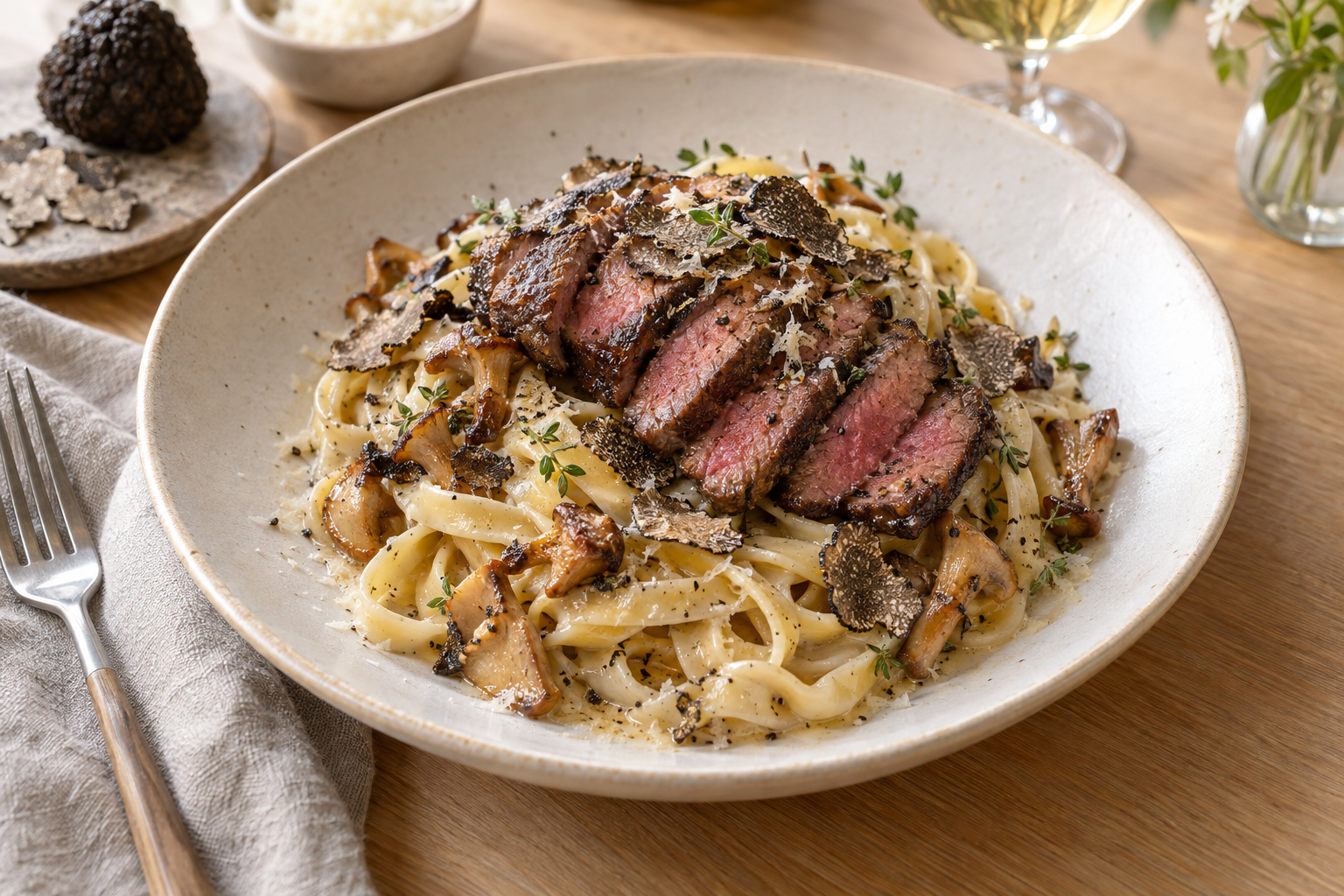
Truffle pasta with sirloin steak – woodland aromas meet the heat of the pan
A modern celebration dinner with Italian roots, buttery pasta and thinly sliced steak.
Truffles need little help, but they do need the right company. Mild mushrooms, parmesan and juicy sirloin give their earthy aroma room to bloom. Here we explore the difference between black and white truffles, what truffle oil really brings to a dish, and how to get everything to the table while it is still hot.
 By Lina BergFood editor · European and Nordic cuisines – Italy, France, Spain, Greece and Swedish home cooking
Translated from Swedish with AI assistance.
Go to the recipe ↓When butter meets the woodland
Butter foams in the saucepan and large, heavy bubbles rise through the pasta water. In the frying pan, the sirloin sizzles: first a sharp crackle, then a steadier hiss as the surface browns. But the truffle waits beside the stove. It should not have to compete with the aromas from the frying pan. Only once the pasta is glossy and the meat has rested does its scent come into its own: earthy, mushroomy, sometimes nutty, with notes that can lean towards garlic or fermented cheese, depending on the variety.
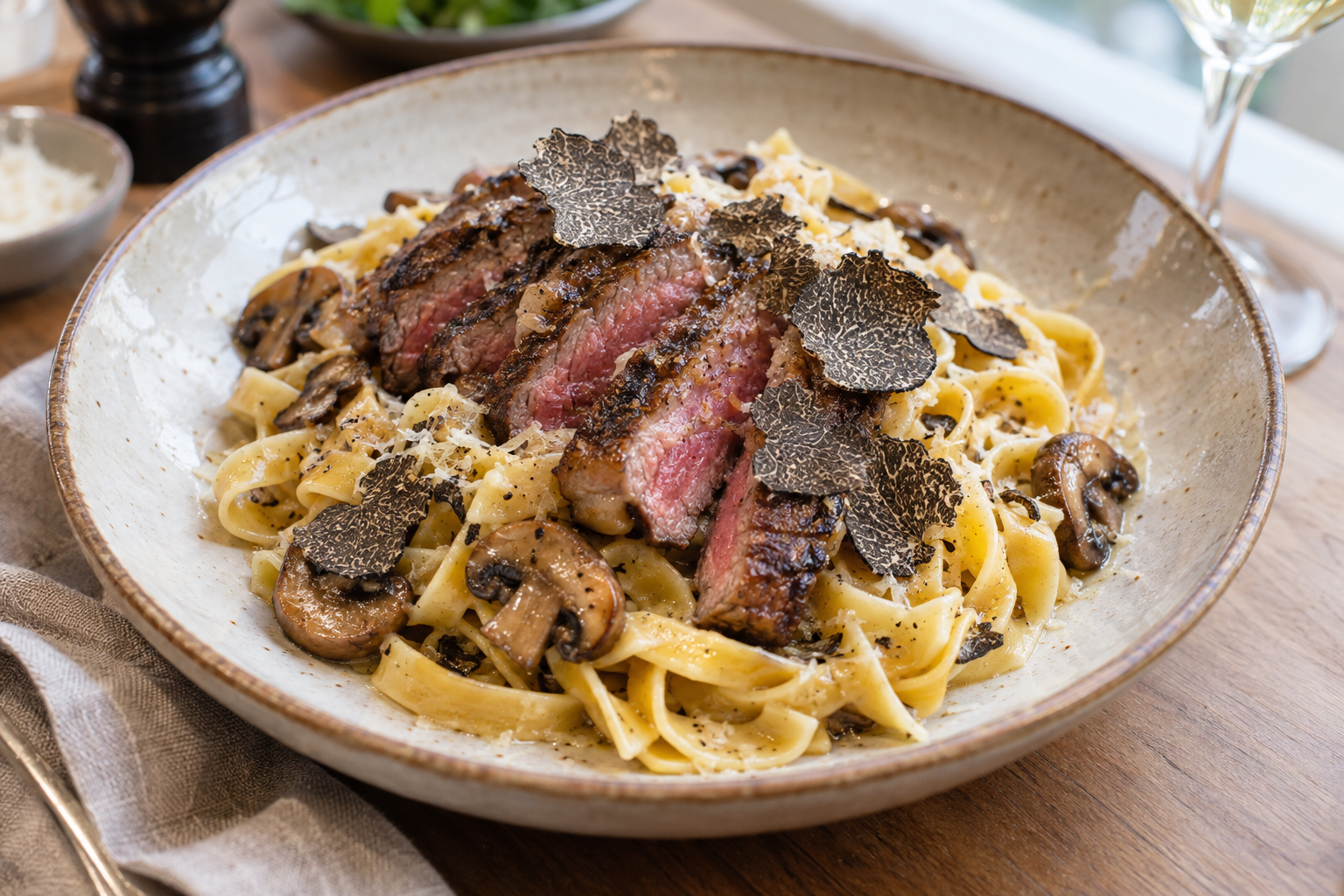
This is a dinner built on contrasts. Soft ribbons of egg pasta against the firm bite of the meat, the richness of butter against the saltiness of parmesan, the roasted flavour of the seared crust against the truffle’s fleeting aromas. It works best when none of these dominates. A heavy cream sauce, plenty of garlic and a generous splash of truffle oil may sound like a shortcut to luxury, but they often make the flavour less nuanced.
Truffle pasta with sirloin is, above all, a modern combination with Italian roots, rather than a clearly defined regional classic with a single original recipe. It borrows its soul from Italian truffle pasta and its substance from a beautifully seared steak. The secret, then, is not to gather as many exclusive ingredients as possible. It is to bring a few flavours together at the right temperature.
From underground fungus to the Italian table
Truffles are fungi whose fruiting bodies develop underground. The most important culinary species belong to the genus Tuber and live in partnership with tree roots, including those of oak and hazel. The tree and fungus exchange nutrients through mycorrhiza. This goes a long way towards explaining why truffles are not grown like button mushrooms in a dark shed: they need living host trees and the right soil conditions.
Truffles were known in antiquity, but the names used in older texts do not always correspond to the species we now associate with European truffle cuisine. It is therefore wiser to speak of a long history of prized underground fungi than to draw a straight line from a Roman meal to today’s plate of tajarin. Modern Italian truffle culture has several strong geographical centres, rather than a single birthplace.
In Piemonte, particularly around Alba, white truffles hold a prominent place. They are often associated with tajarin, narrow ribbons of egg pasta, or with eggs and other mild dishes. Umbrien and Marche are other important truffle regions, where black species play a major role. The boundaries are not clear-cut, however: different species occur across wider areas, and trade names do not always tell the whole story of where a truffle grew.
Truffle hunting is all about scent. Pigs were used historically, while trained dogs are now central to the search in many European regions. The dog’s work helps the hunter locate a ripe truffle underground. Supply is affected by species, weather, soil conditions and season, contributing to considerable differences in price. A high price is therefore no guarantee that a particular truffle is right for your pasta; aroma, ripeness and freshness matter more on the plate.
White, black and summer truffles are different ingredients
White truffles, Tuber magnatum, often have a penetrating, complex aroma with hints of garlic and fermented notes. They are particularly associated with autumn and are usually shaved thinly over a finished, warm dish. Long cooking is ill suited to an ingredient whose fleeting aromas are what you have paid for. With white truffles, I would simplify this dinner further: fewer mushrooms and less parmesan, and preferably the meat served on the side.
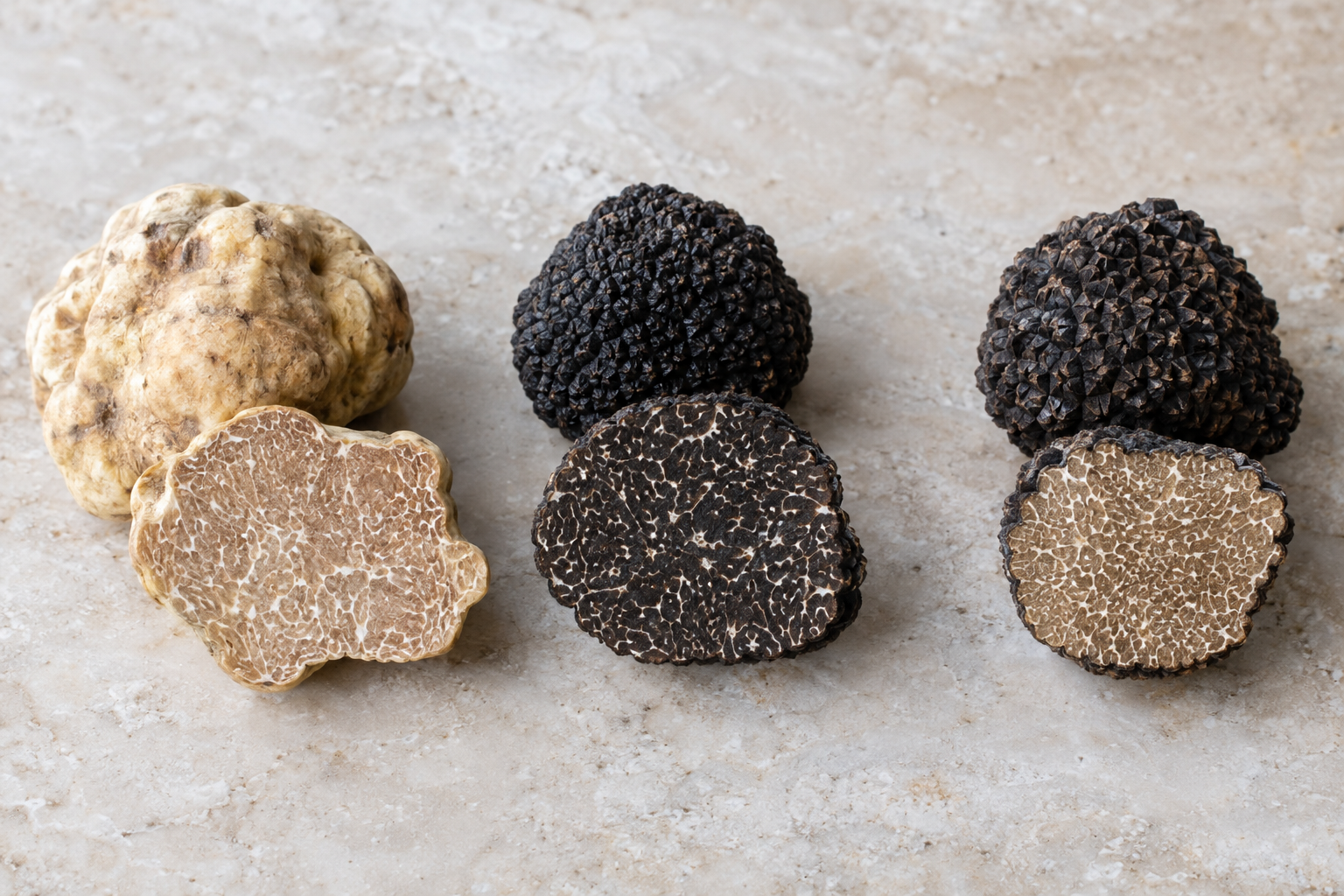
Black winter truffles, Tuber melanosporum, are usually described as earthier and nuttier. They stand up better to gentle heating and can be allowed to develop their flavour in butter or a mild sauce. Summer truffles, Tuber aestivum, are generally much more restrained in aroma. They can be a more affordable purchase, but should not be judged as a cheap imitation of white truffles. They are a different ingredient, with their own character and a need for subtle companions.
In Swedish shops, preserved truffles, truffle paste and flavoured oil are often easier to find than fresh truffles. Read the ingredients list. A jar with truffle in its name may consist largely of button mushrooms, oil and other ingredients, with only a small amount of truffle. That does not necessarily make it a poor product, but it should be chosen and used as a ready-made seasoning, not as though it were a fresh fungus.
Many truffle oils owe much of their distinctive scent to added flavouring. They therefore do not necessarily capture the full aromatic profile of fresh truffles. Use them as a seasoning, a drop at a time, right at the end of cooking. Add too much and the scent can become one-dimensional and perfumed. This recipe is based on fresh black truffles, but a mild truffle paste works as a more everyday alternative. Start cautiously and taste, as both saltiness and aromatic intensity vary greatly between products.
The pasta should gleam, the steak should rest
Tagliatelle suits this dish: the ribbons catch the light sauce without making each mouthful too heavy. Butter, a little pasta water and finely grated parmesan come together in a glossy emulsion. The starch in the cooking water helps the fat and water stay combined. Work in the cheese once the pan has been taken off the direct heat; if the mixture boils vigorously, it can turn grainy and the fat may separate.
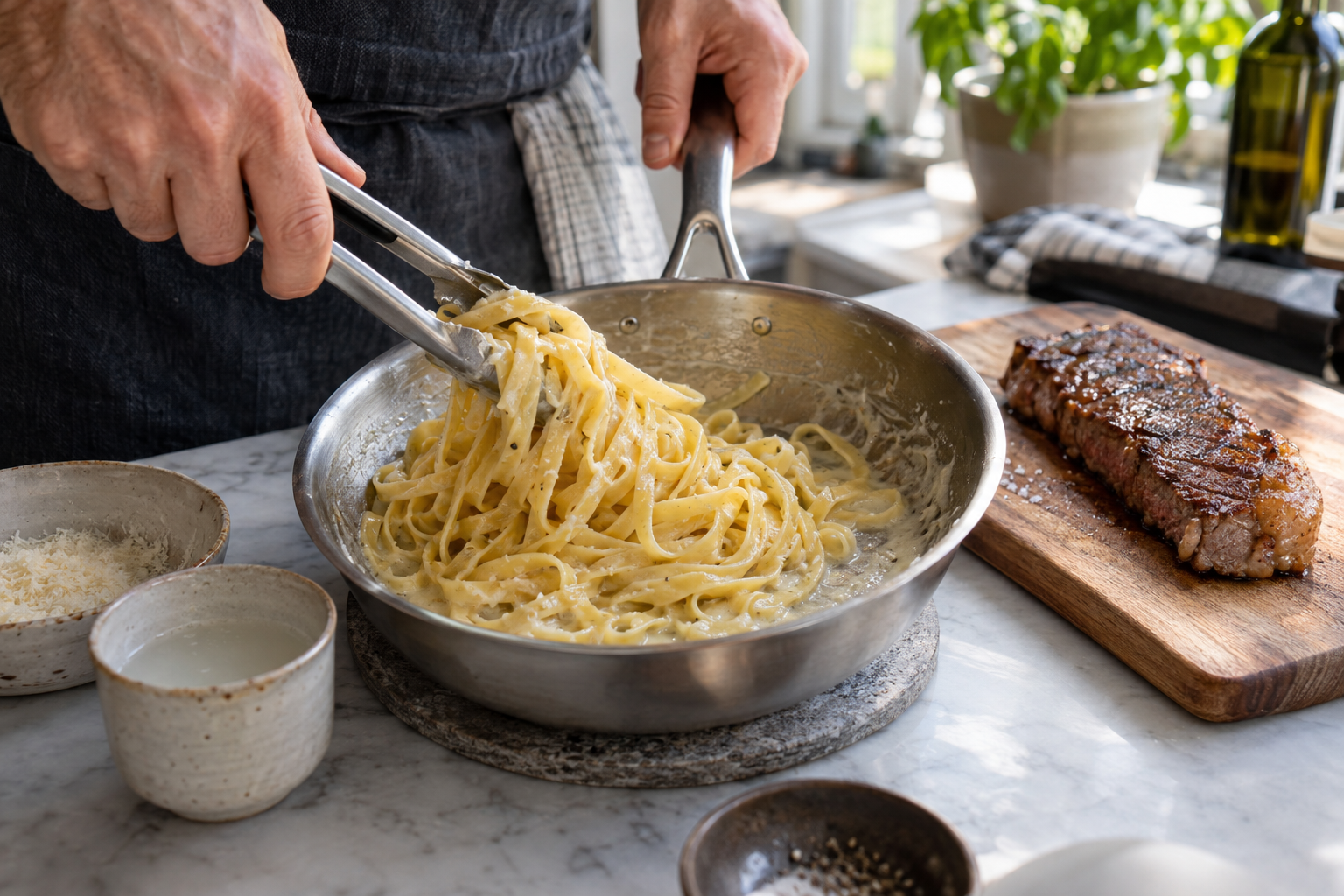
A small quantity of button mushrooms adds body and a gentle mushroom depth. Fry them until their liquid has evaporated and their surfaces begin to colour. If crowded in the pan, they can easily end up boiling in their own liquid. At the same time, they should not be fried so hard that dark, bitter notes take over. Truffle provides the leading aroma, while the button mushrooms build the background. If you want to showcase a particularly fine fresh truffle, you can leave out the button mushrooms altogether.
Sirloin needs a different approach. The surface should be dry and the pan properly hot, so the meat sears rather than simmers. Trim away tough membranes, but feel free to leave a modest strip of fat. Fry whole steaks, let them rest, and only then cut them into thin slices across the grain. This gives a more pleasing bite than allowing small strips of meat to cook through in the pasta sauce.
A thermometer is more reliable than a set number of minutes. For whole, intact steaks, a final temperature of around 56–58°C gives a pink centre; the temperature may rise a little during resting. If you prefer your meat more thoroughly cooked, leave it on the heat longer. Then keep it away from the hot pasta pan. Arrange the slices on the finished pasta to preserve both the meat’s juices and the seared crust you have just worked to achieve.
A celebratory plate, without unnecessary complications
In a traditional Italian meal, pasta is often served as a primo and meat as a secondo. Placing sirloin on top of truffle pasta is therefore more of a modern way to bring the meal together on one plate. There is nothing wrong with that, as long as the combination is not presented as an unchanging Italian original. Italian cooking also encompasses considerable regional and local differences. The aim here is a generous main course that works at a Swedish dinner table.
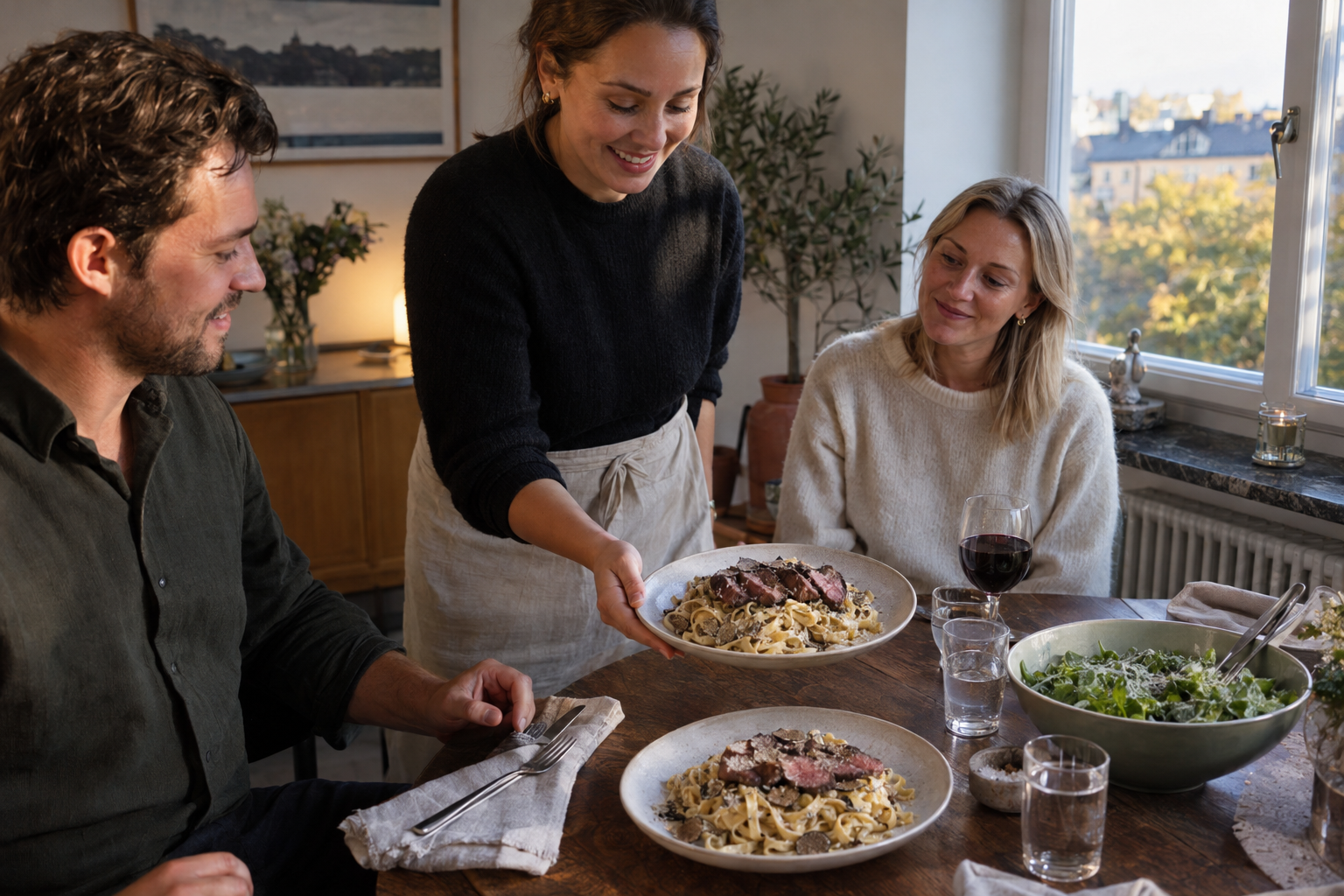
Serve a simple green salad on the side, dressed with lemon or a mild vinaigrette. The acidity refreshes the palate between buttery mouthfuls, without needing to be mixed into the pasta itself. Choose a few well-made accompaniments rather than adding more bold flavours. A soft red wine with freshness can work, as can a light, malty lager. Alcohol-free lager or still water are equally natural choices; the drink should not drown out the truffle.
At home in Sweden, planning matters more than specialist equipment. Finely grate the cheese, warm the plates, slice the mushrooms and have the pasta water coming to the boil before frying the meat. Buy fresh truffles close to the day you plan to serve them and store them briefly in the fridge, wrapped in dry kitchen paper in a sealed container. Replace any damp paper. Brush them clean and rinse only briefly if necessary; dry thoroughly and avoid soaking.
While the steak rests, you have your window for the pasta. Save some cooking water, keep the sauce a little looser than you think necessary, and toss everything together only when the guests are ready. The pasta continues to absorb liquid on the plate. A fine grater will work if you do not have a truffle slicer, though it gives a different result from thin shavings. Finish with the truffle, bring it straight to the table and let the aroma arrive first.
Truffle tagliatelle with sirloin and parmesan
A modern, Italian-inspired main course in which butter and pasta water create a glossy sauce without cream. The recipe is written for fresh black truffles; the tips include an alternative using truffle paste.
Ingredients
Method
- 1Prepare everything: slice the mushrooms, finely chop the shallot and grate the parmesan very finely. Brush the truffle clean; rinse briefly only if necessary and dry thoroughly. Finely grate about half and save the rest for shaving. Put a large saucepan of pasta water on to boil and warm the serving plates.
- 2Fry the mushrooms in 20 g of the pasta butter in a large pan over a medium-high heat for 6–8 minutes, until the liquid has evaporated and the mushrooms have taken on a little colour. Add the shallot and fry for a further 2 minutes over a medium heat. Set aside.
- 3Pat the meat thoroughly dry with kitchen paper and season with salt. Heat a separate frying pan with the rapeseed oil. Fry the steaks over a medium-high to high heat for about 2–3 minutes on each side to develop a good crust.
- 4Lower the heat and add the 15 g butter for the meat. Baste the steaks with the butter and continue cooking, turning them, until they approach your desired internal temperature. For pink meat, you can take them out at around 54–56°C, aiming for 56–58°C after resting. The timing varies with thickness and starting temperature; use a thermometer.
- 5Place the meat on a warm plate, season with pepper and leave to rest for 8–10 minutes, loosely covered. Meanwhile, cook the pasta in salted water for about 1 minute less than the time stated on the packet.
- 6When the pasta is almost ready, reserve 3 dl of cooking water. Warm the mushroom pan over a low heat with the remaining 30 g butter and 1 dl cooking water. Add the finely grated black truffle and warm through for about 30 seconds without boiling vigorously.
- 7Transfer the pasta to the mushroom pan and toss over a medium heat for 30–60 seconds. Add more cooking water if needed; there should be a little liquid left around the pasta.
- 8Take the pan off the heat and wait until it stops bubbling. Stir in the parmesan in batches. Add cooking water a little at a time to make a glossy, flowing sauce. Season to taste with salt.
- 9Cut the sirloin into thin slices across the grain. Divide the pasta between warm plates and arrange the meat on top. Thinly shave the remaining truffle over the dish and serve immediately.
- Without fresh truffles: try 1–2 tsp truffle paste and add more to taste, depending on the product’s strength. Stir it in towards the end. Truffle oil should instead be added drop by drop when serving; it is not an equivalent substitute for fresh truffles.
- Summer truffles are often milder. Consider leaving out the button mushrooms and reducing the parmesan to 40 g to give their aroma more room.
- For a vegetarian version, replace the steak with 400 g extra mushrooms, preferably portobello and oyster mushrooms, and choose a parmesan-style cheese made with vegetarian rennet.
- The pasta is best freshly made. Cool any leftovers quickly and refrigerate; reheat gently with a splash of water the next day. The meat will cook further when reheated.
What goes in the glass
- WinePinot noir with restrained oakFresh acidity lightens the butter, while soft tannins and earthy notes complement the mushrooms and meat without making the truffle compete with heavy oak.
- BeerPale lager with low to moderate bitternessGentle maltiness suits the steak’s seared crust. Lively carbonation cuts through the buttery pasta without too much hop aroma.
- Alcohol-freeAlcohol-free pale lagerLight bready notes and carbonation provide a refreshing counterpoint to the parmesan and meat. Choose a mild style that is not too bitter, to let the truffle shine.
Enjoy alcohol in moderation. Alcohol-free options go just as well with the food.
Sources
- Alan Davidson; tredje upplagan redigerad av Tom Jaine, The Oxford Companion to Food (2014)
- Ian R. Hall, Gordon T. Brown och Alessandra Zambonelli, Taming the Truffle: The History, Lore, and Science of the Ultimate Mushroom (2007)
- Harold McGee, On Food and Cooking: The Science and Lore of the Kitchen (2004)
- Phaidon Press, The Silver Spoon (2005)
Ask questions about "Truffle pasta with sirloin steak – woodland aromas meet the heat of the pan". Answers are based on the magazine's own articles.