Hungarian Goulash Soup – Paprika, Patience and Swedish Beef Chuck
A warming pot with Hungarian roots and ingredients from everyday Swedish supermarkets.
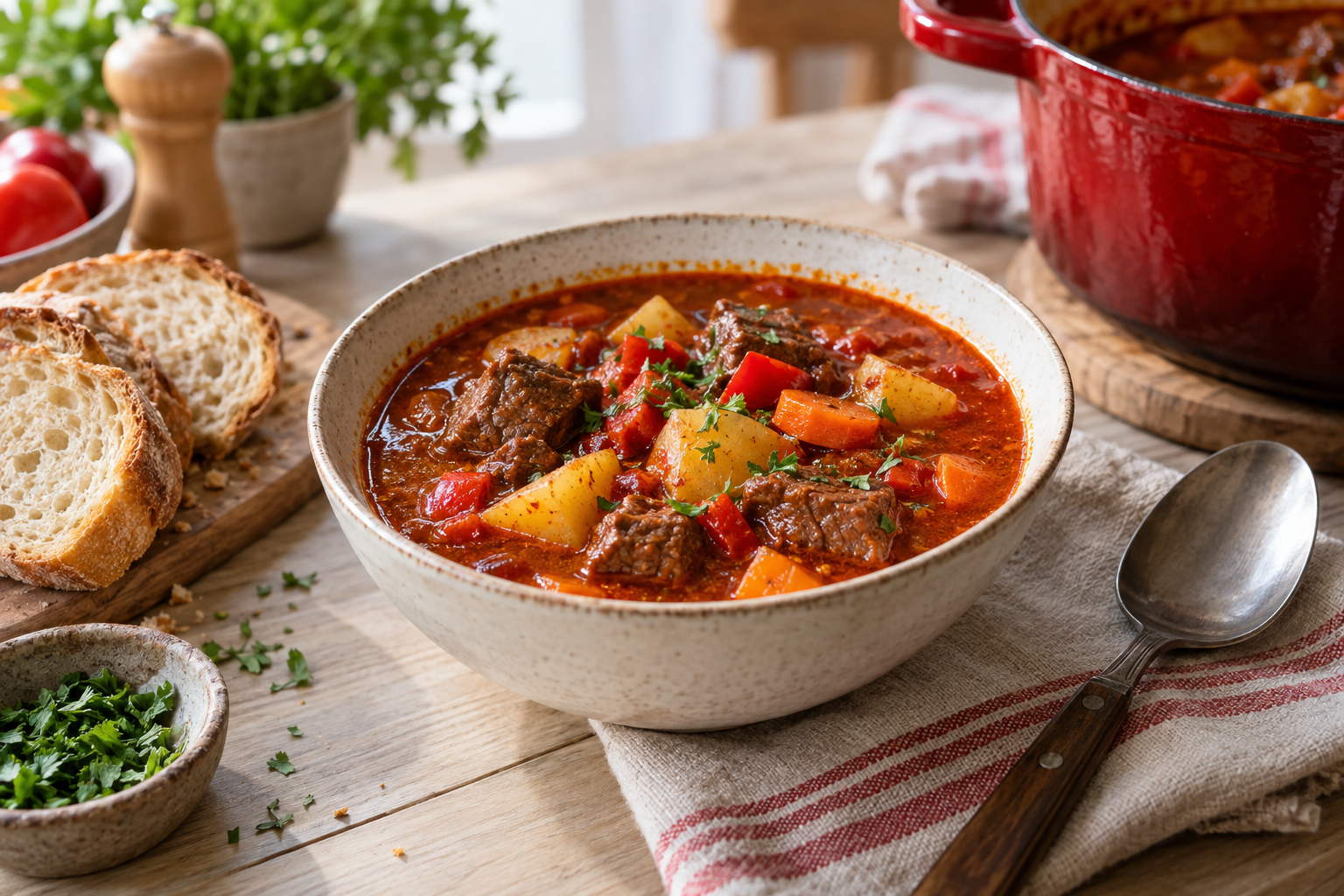
The onions soften, the caraway releases its aroma and the paprika turns the broth brick red. A good Hungarian goulash soup needs neither expensive meat nor a long list of spices – but the right paprika and time on the stove make all the difference.
 By Lina BergFood editor · European and Nordic cuisines – Italy, France, Spain, Greece and Swedish home cooking
Translated from Swedish with AI assistance.
Go to the recipe ↓When paprika meets warm onions
At first, there is only a gentle sizzle. Chopped onions sit at the bottom of a heavy pot, turning from sharp and white to soft and translucent. Then comes the caraway, with its warm, almost bready aroma. The pot is lifted off the heat and the paprika stirred in. In an instant, the fat turns red. As the water goes in, a cloud of steam rises, promising something far greater than the sum of a few everyday ingredients.
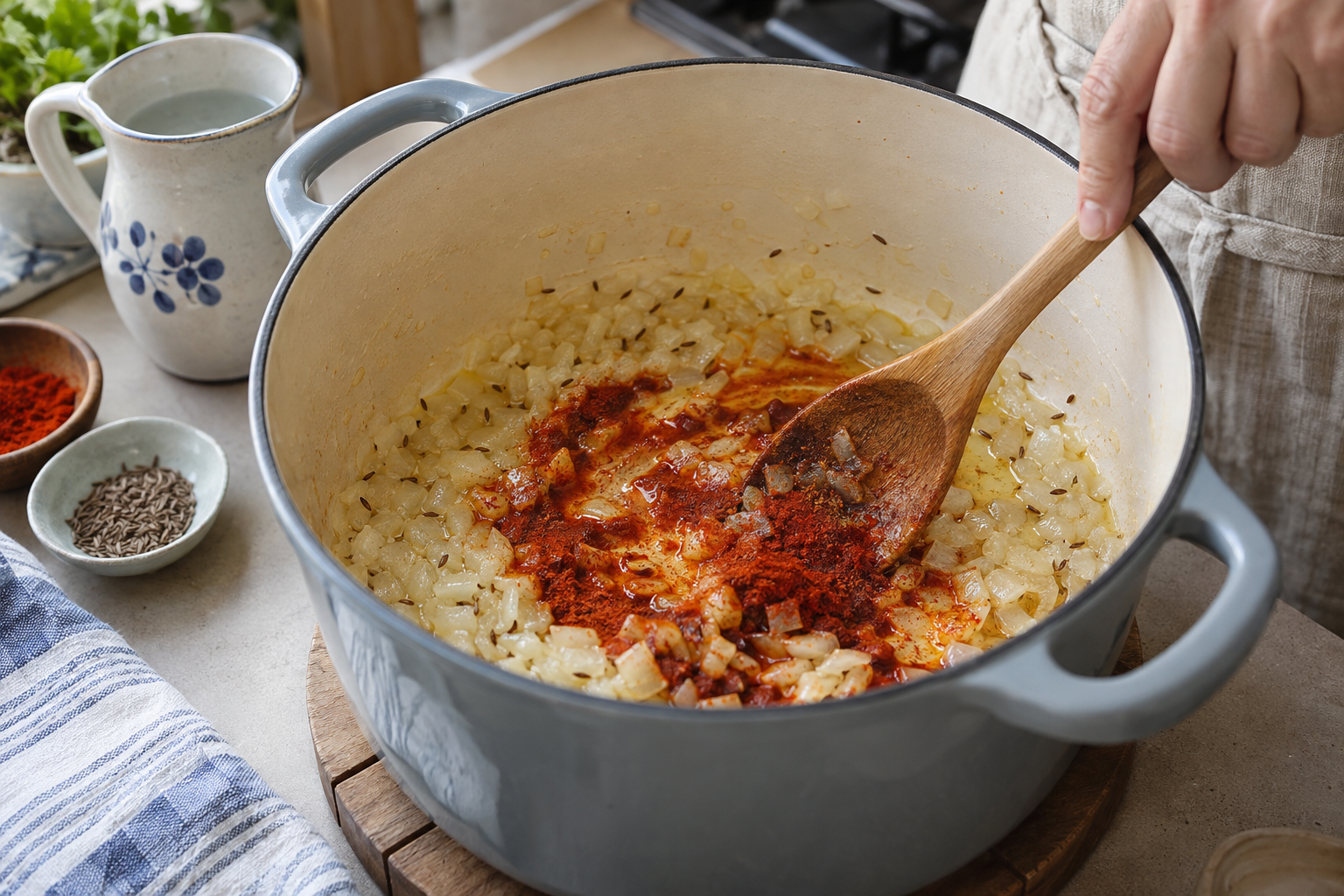
This is where goulash soup begins: not with a splash of cream or a ready-made spice blend, but with the meeting of onions, fat and paprika. Later, the beef will give the broth depth, the potatoes will make it filling and the root vegetables will add sweetness. But the soup should still be just that: soup, with broth flowing freely around the meat and vegetables. It need not be thick to feel generous.
In a Swedish kitchen, it is particularly welcome when the beef chuck at the meat counter looks tempting and potatoes, carrots and celeriac are close at hand. None of those ingredients feels unfamiliar here. Yet the flavour becomes distinctly Hungarian when paprika takes centre stage and caraway is used with a light hand. This is a dish whose shopping list can be modest, while the result tastes of slow cooking and care.
Our version is adapted to Swedish shops, not intended as a definitive recipe for every Hungarian household. It is built on beef, potatoes, root vegetables and mild paprika, with optional heat added at the table. That makes the soup easy to cook for a crowd: anyone who wants more kick can have it, without masking the mild paprika flavour for everyone else.
From cattle herders to national dish
The Hungarian word gulyás means cattle herder. The dish's history is associated with the herders of the Great Hungarian Plain, Alföld, and with food cooked in a cauldron over a fire. Bogrács is the name of the hanging cauldron that remains part of Hungarian outdoor cooking. The link with herding culture is well established, but no single inventor or certain date of birth can be identified for today's goulash soup.
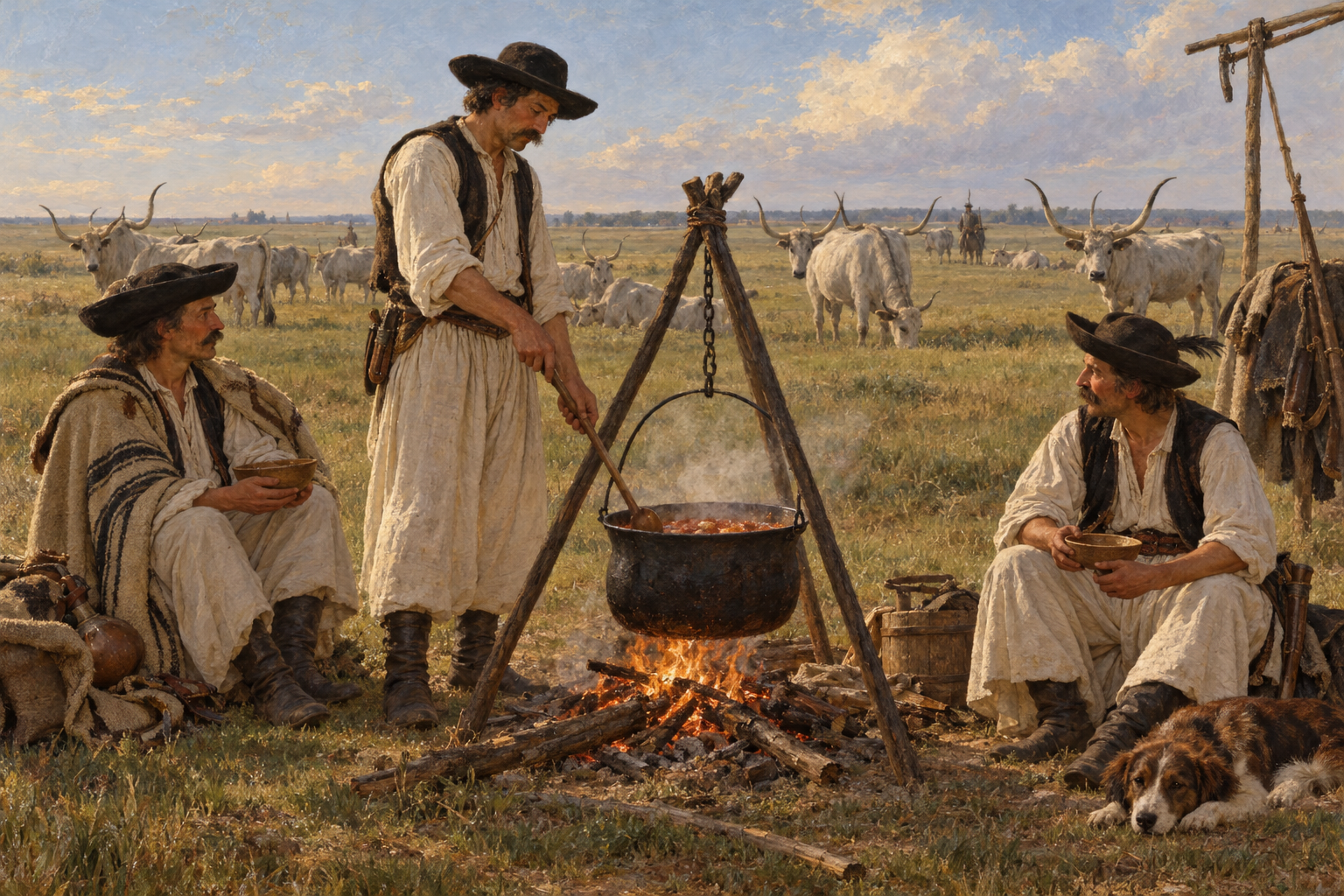
It is also important to distinguish the older tradition of boiling meat in a cauldron from the paprika-red dish we know today. The plants related to paprika peppers originated in the Americas and reached Europe following transatlantic contact from the late 15th century onwards. Paprika therefore could not have seasoned a medieval Hungarian goulash in the way we imagine it now. Its central place in Hungarian cooking developed later.
During the 18th and 19th centuries, paprika grew increasingly important in Hungarian cooking. Gulyás also became associated with Hungarian national identity, and the dish moved from rural settings into middle-class kitchens, cookbooks and restaurants. It was not an unchanging herders' meal simply passed along. Ingredients, proportions and ways of serving evolved as more people began cooking it and different kitchens left their mark on the result.
As it travelled through Central Europe, the word goulash became an umbrella term for several closely related dishes. In Austria and many other places, it tends to suggest a thick meat stew. In Hungarian cooking, however, gulyás is usually a soup-like dish, while pörkölt is closer to what Swedes call a stew. The boundaries in home kitchens are, of course, less tidy than those in a dictionary, but the distinction helps explain what is on the table.
Anyone ordering gulyásleves in Hungary is explicitly ordering goulash soup. Potatoes are common, as are various root vegetables, and sometimes the bowl contains small pinched pieces of dough called csipetke. Recipes vary between families and cookbooks. It is therefore wiser to speak of a distinctive food tradition with variations than of a single approved original recipe.
The flavour lies in the paprika and the order of cooking
Paprika is more than just colour. A good mild powder smells sweet, fruity and slightly earthy, with a richness that carries the whole broth. Hungarian sweet paprika, often labelled édesnemes, is a good choice if you can find it. Otherwise, a fresh, mild paprika from the regular spice aisle works well. An old jar with barely any aroma, on the other hand, will make a flatter-tasting soup, however long the meat simmers.
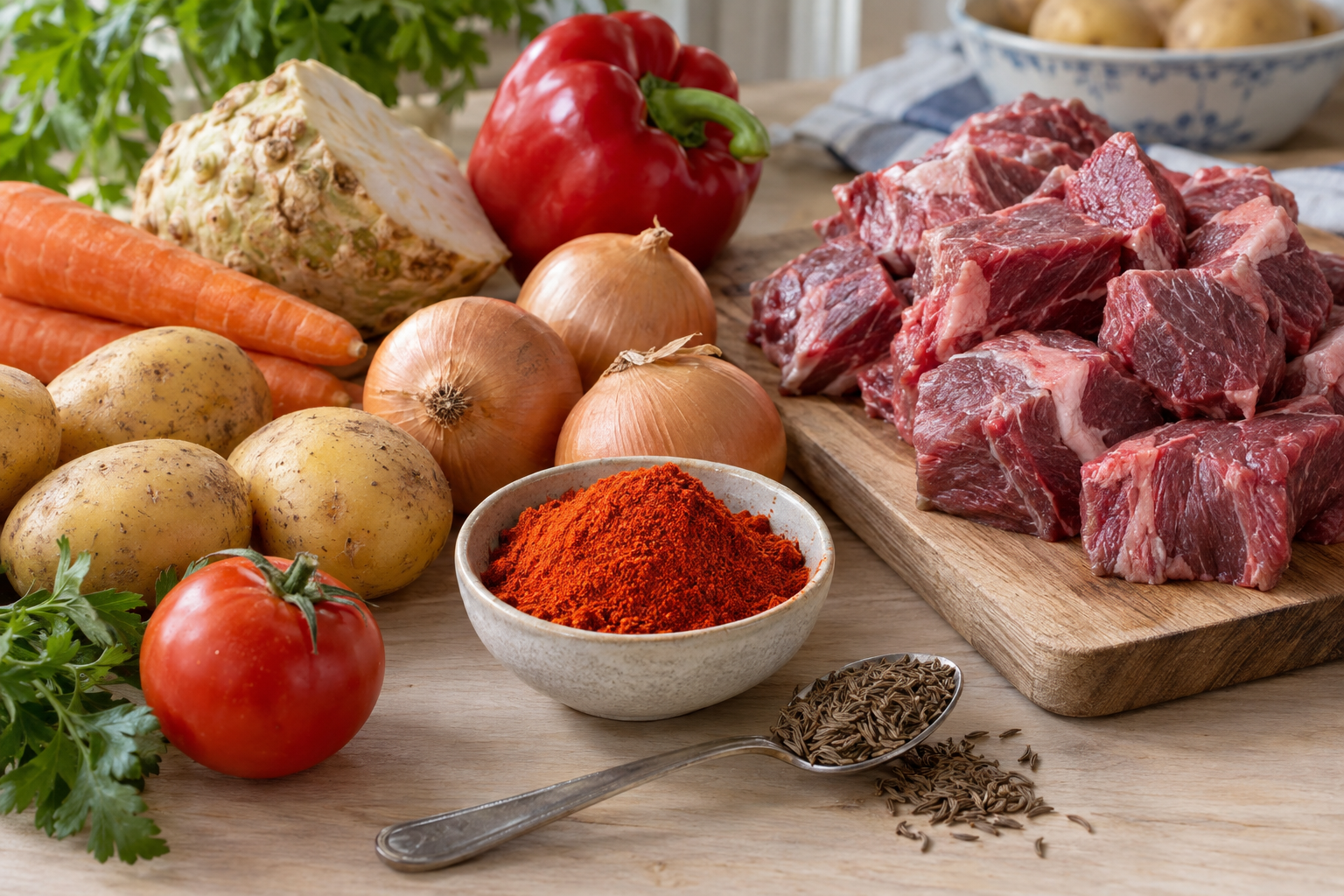
Smoked paprika is delicious in many dishes, but it is not an equivalent substitute here. The smokiness changes the character of the dish and can overshadow both the beef and the caraway. Choose unsmoked paprika as the foundation, then add any heat separately. Likewise, caraway should not be confused with cumin. It is caraway, familiar from rye bread, that gives our soup its classic spice note.
The fat helps distribute the paprika's flavour and colour, but the powder burns easily. This is why the onions are first allowed to soften thoroughly. The pot is then taken off the heat before the paprika is stirred in, with liquid added shortly afterwards. It is a small step that makes a big difference: burnt paprika can turn the entire pot bitter. Trying to rescue it with sugar or cream is less effective than starting the spice base again.
The onions should become soft and sweet without browning deeply. Nor does the meat need the deep seared crust sought in many French stews. Here, we build flavour through the onion base, the paprika and slow simmering. Swedish beef chuck works beautifully because its connective tissue softens during cooking, giving the broth body. Lean cuts intended for quick frying are not better simply because they cost more.
The vegetables have different roles, so they should not go in at the same time as the meat. Carrot brings sweetness, celeriac depth and potatoes substance. Hungarian kitchens also use parsley root; it can replace some of the celeriac if you can find it. Here, we choose ingredients generally available year-round in Sweden. A small amount of tomato and fresh pepper rounds out the flavour without turning the broth into tomato soup.
A bowl to gather around
Goulash soup belongs both at the kitchen table and outdoors around the cauldron. Cooking it over a fire remains a sociable way to prepare food, where the cooking takes its time and the meal begins long before anything is served. The same feeling can develop around a pot on the stove in an ordinary kitchen. Someone slices bread, someone sets the table, and the lid is lifted now and then to check the meat.
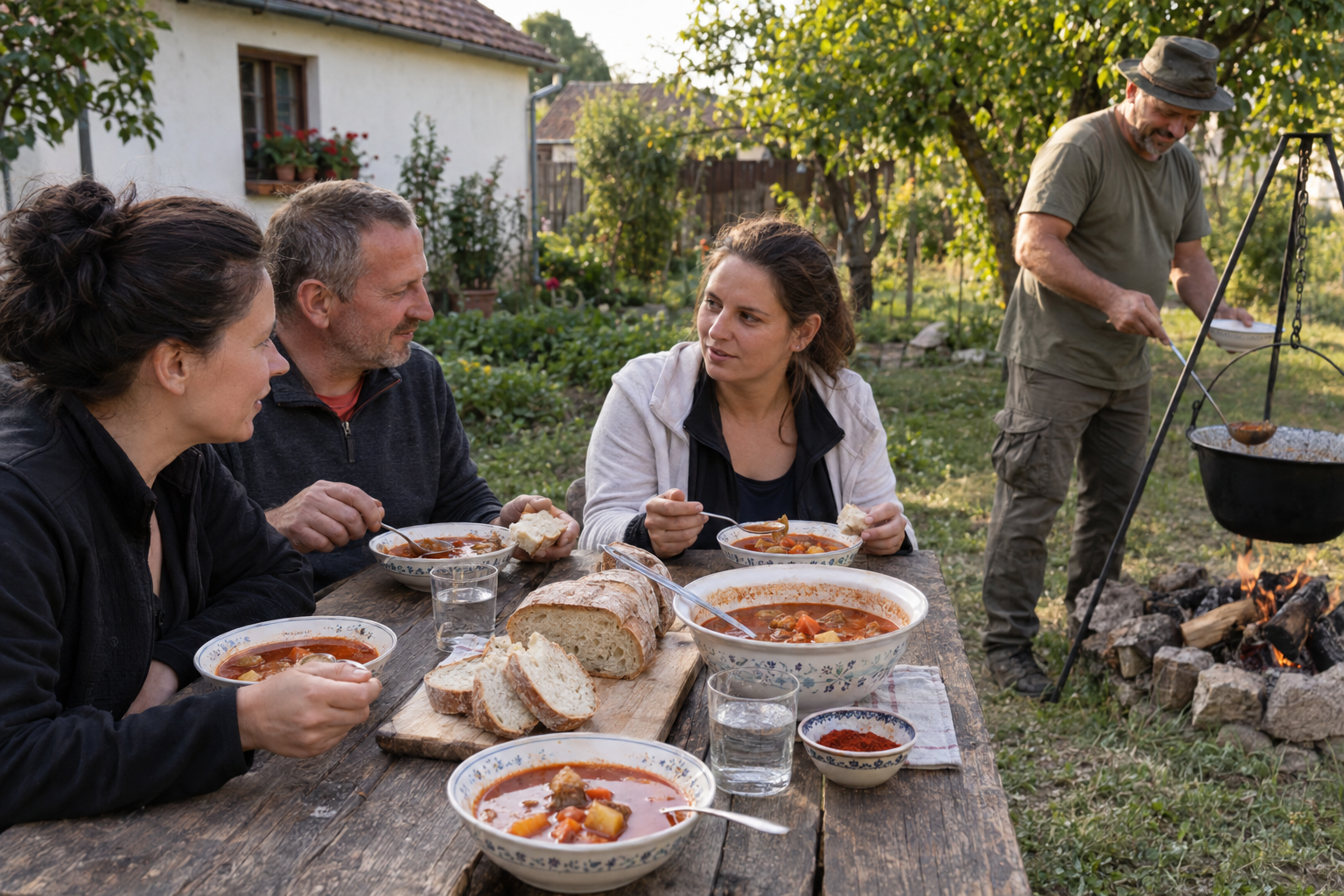
As an everyday dinner, the soup needs little alongside it. The potatoes make it a complete meal, and a slice of bread is enough for anyone wanting to mop up the last of the broth. Csipetke adds further substance in many versions, but we leave it out here to keep the cooking simple. Set out hot paprika or chilli flakes separately. Heat is easier to add to the bowl than to remove from the pot.
In Sweden, goulash soup is often served with a dollop of sour cream or crème fraîche. That can be delicious, but it is not a requirement and should not be presented as a given in all Hungarian gulyás. Try tasting it without first. The fruitiness of the paprika and the beefy flavour of the broth will come through more clearly. If you want the tang and cooling effect of sour cream, a small dollop on the side is better than stirring it into the whole pot.
To drink, a malty lager with moderate bitterness works well, including an alcohol-free version. A lighter red wine with fresh acidity and soft tannins is another option. If the soup is particularly hot, water or alcohol-free beer is often more pleasant than a powerful wine. The drink should leave room for the food, not compete with the paprika for attention.
How to get the slow simmer right at home
Choose a roomy, heavy-based pot and give the meat time before thinking about the potatoes. Beef chuck varies: one batch becomes tender sooner, another needs an extra half-hour. Test it with a fork and taste a piece. The meat should be almost ready when the vegetables go in, otherwise the potatoes may fall apart while the beef is still tough.
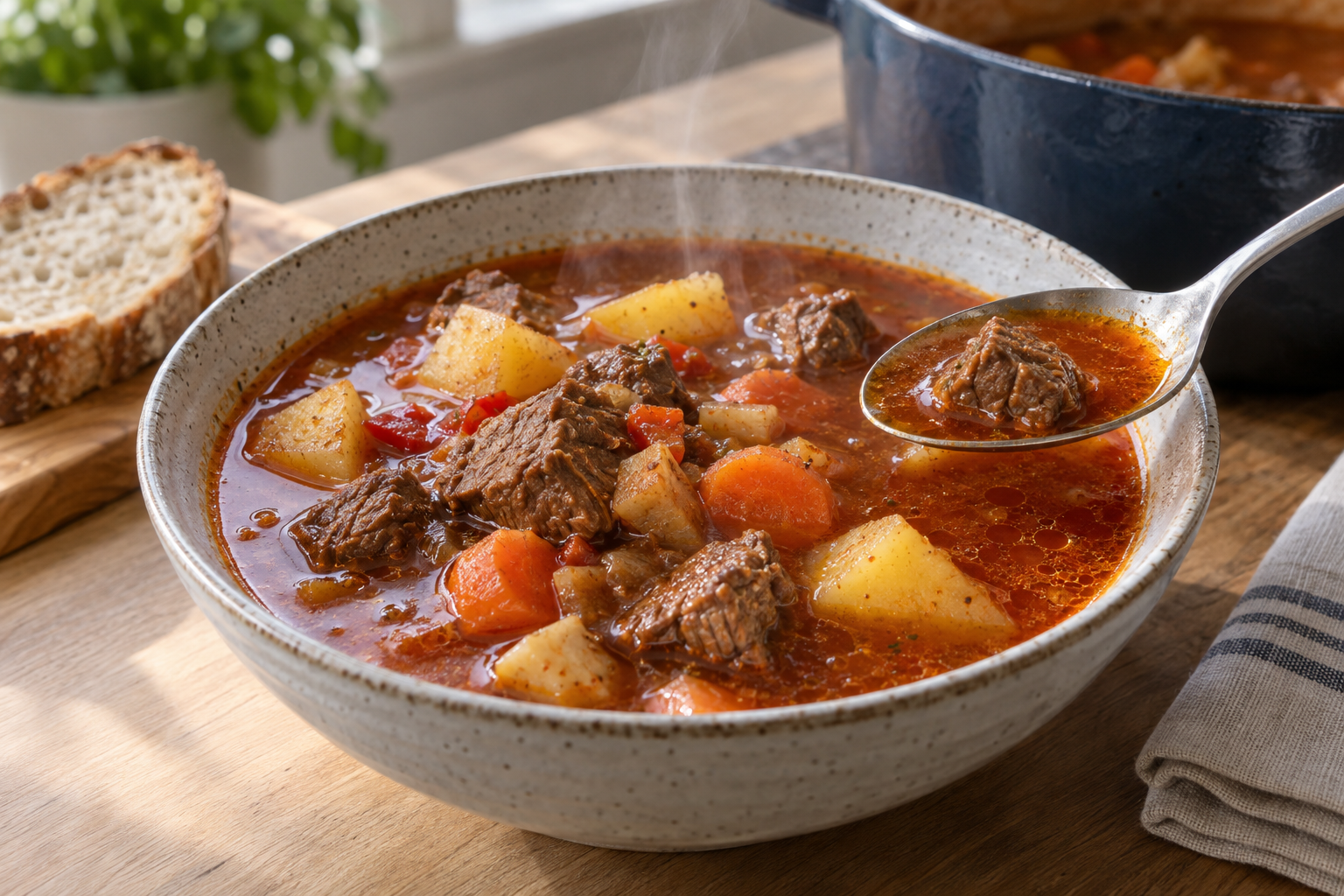
Keep the liquid at a gentle simmer, with small bubbles, rather than a rolling boil. Have hot water ready and top it up if the level drops too far. Ready-made stock is not necessary; the meat and vegetables build flavour as they cook. If you do use stock, choose one that lets you control the saltiness. Make the final salt adjustment only once the soup has the right amount of liquid.
Finally, taste both the broth and a piece of potato. If the soup feels heavy, a little more water and the right amount of salt may lift it more effectively than extra spices. It can easily be made the day before: cool it quickly in smaller containers, then refrigerate. When reheating, the potatoes may have absorbed more liquid, so adjust the consistency again. The recipe below makes four generous portions, with plenty of red broth to spoon up.
Hungarian Goulash Soup with Swedish Beef Chuck
A modern home-cooked version of Hungarian gulyás with beef chuck, potatoes and readily available root vegetables. Mild, unsmoked paprika provides the foundation; the heat is up to you. The tenderness of the meat determines the final cooking time.
Ingredients
Method
- 1Cut the beef chuck into roughly 2 cm cubes. Trim away tough membranes but keep the soft streaks of fat. Chop the onions and garlic. Dice the tomato, then deseed and cut the fresh pepper into small pieces.
- 2Heat the fat in a heavy-based pot with a capacity of about 4 litres. Cook the onions over a medium-low heat for 10–12 minutes until soft and translucent. Stir occasionally; they should not turn dark brown.
- 3Add the garlic and crushed caraway and stir for about 30 seconds. Take the pot off the heat. Stir in the paprika and immediately add 2 dl of the water to prevent the spice from burning.
- 4Add the meat, tomato, fresh pepper and salt. Pour in the remaining 10 dl water and return the pot to the heat. Bring gently to the boil, skimming if necessary.
- 5Lower the heat and simmer with the lid slightly ajar for about 1.5–2 hours. Stir occasionally and top up with hot water if the meat is no longer covered. Start checking for tenderness after 75 minutes. The meat should be almost tender before the root vegetables are added.
- 6Meanwhile, peel the potatoes, carrots and celeriac. Cut the potatoes into roughly 2 cm pieces, the carrots into 1 cm-thick slices and the celeriac into roughly 1 cm cubes.
- 7Add the carrots and celeriac to the pot when the meat is almost tender. Simmer for 10 minutes. Then add the potatoes and simmer for another 20–25 minutes, until the potatoes are cooked through and the meat yields easily to a fork.
- 8Add hot water to achieve a distinctly soupy consistency, usually an extra 2–4 dl depending on evaporation. Heat everything through and season to taste with black pepper, salt and a little hot paprika, if desired.
- 9Leave the soup to stand off the heat for 5 minutes. Serve in deep bowls with bread and extra spice on the side.
- If your paprika has almost no aroma, it is worth buying a fresh jar. Use unsmoked paprika; smoked paprika gives a different flavour profile.
- Parsley root can replace the celeriac weight for weight. Swedish beef chuck and Swedish-grown storage vegetables are good choices.
- Feel free to make this the day before. Cool quickly in smaller containers, store at around 4 °C and eat within 3–4 days. Reheat only the amount you intend to serve, until thoroughly hot throughout.
- If the meat is still tough, keep simmering before adding the vegetables. Beef chuck may need longer than the recipe's suggested time.
What goes in the glass
- WineLight- to medium-bodied kékfrankos red wineFresh acidity and moderate tannins complement the meat and the fruitiness of the paprika. Choose a style without pronounced oak notes and keep the soup's heat mild.
- BeerVienna lager with moderate bitternessBready malt complements the sweetness of the onions and the warm note of caraway, while the carbonation refreshes the palate between spoonfuls.
- Alcohol-freeMalty alcohol-free lagerThe maltiness complements the beef broth and paprika. Moderate bitterness works particularly well if you add chilli.
Enjoy alcohol in moderation. Alcohol-free options go just as well with the food.
Sources
Ask questions about "Hungarian Goulash Soup – Paprika, Patience and Swedish Beef Chuck". Answers are based on the magazine's own articles.