Bicerin – Turin’s Hot Chocolate Secret
A small glass of coffee, chocolate and cream opens the door to 19th-century café life.
In Turin, a memorable coffee break need not come in a large cup. Bicerin brings together dark chocolate, strong coffee and cool cream in a glass best left unstirred. We trace its journey from its predecessor, bavareisa, to today’s layered serving – and make a home version with no secret proportions, far removed from the cafés’ closely guarded recipes.
 By Jonas EkDrinks editor · Wine, beer, spirits, coffee, tea and non-alcoholic drinks – and how to pair them with food
Translated from Swedish with AI assistance.
Go to the recipe ↓A warm glass in a cold city
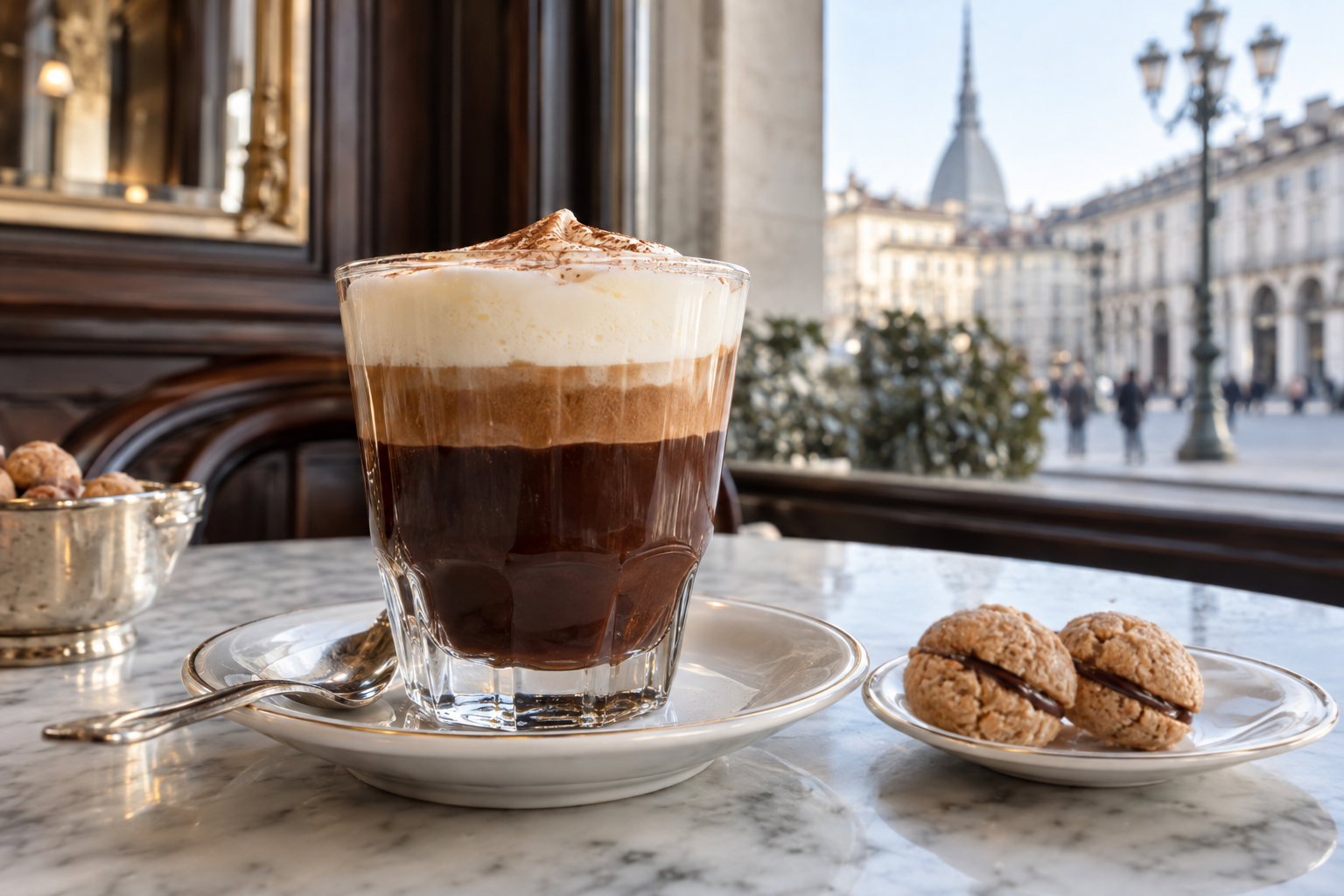
Imagine stepping in from a bitterly cold street in 19th-century Turin. Behind you lie the paving stones and the church square; ahead is a café where china clinks and the aroma of coffee mingles with hot chocolate. A small glass is set on the table. Dark at the bottom, brown in the middle, pale on top. This is an imagined scene, not a recorded historical moment, but the glass belongs here: bicerin, one of the city’s most distinctive drinks.
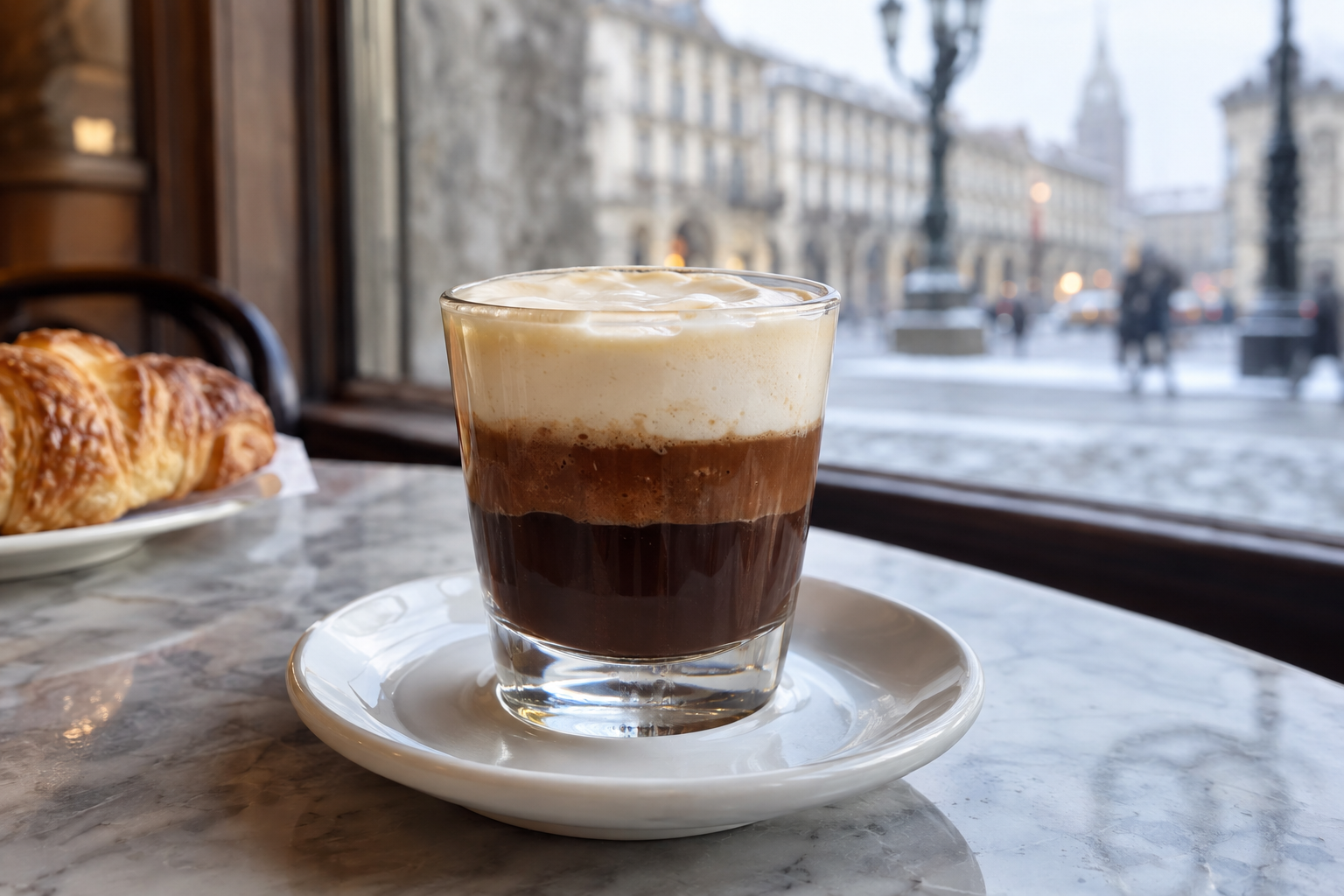
The first sip explains its appeal better than any grand tasting note. Cool cream touches your lips, followed by the bitterness of coffee and the rich, gentle warmth of chocolate. In a well-made serving, the cream does not form a plug that has to be eaten with a spoon. It flows with the drink, softening its edges without immediately turning everything into one sweet mixture.
The name is generally explained as Piedmontese for “little glass”. That tells you something about its scale: this is a concentrated pause, not half a litre of dessert coffee. It is an easy combination to love on a Swedish Advent afternoon. But the Advent connection is our own. Bicerin is a Turin café tradition, not a specifically Italian Christmas drink, and it needs neither gingerbread spices nor a mulled-wine mood to warm you through.
Before the layers came bavareisa
Bicerin has its roots in a city where chocolate has long held a prominent place. Turin was a political and cultural centre under the House of Savoy and, during the 19th century, also became an important city in the unification of Italy. From 1861 to 1865, it was the capital of the new Kingdom of Italy. Cafés offered spaces for conversation, newspaper reading, business and rest, though access and social conventions were, of course, not the same for every social group.
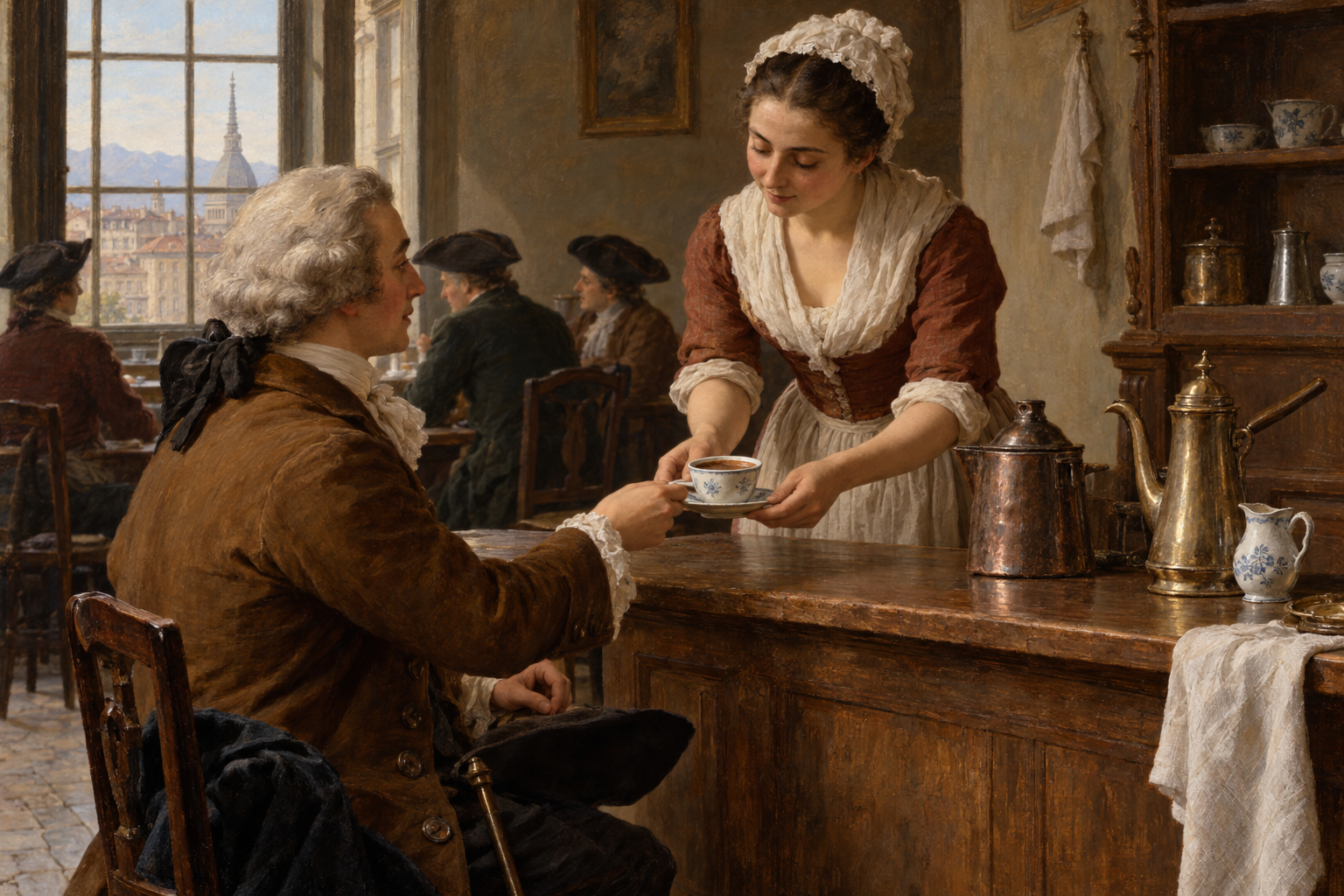
Bavareisa, a drink of coffee, chocolate and dairy cream associated with 18th-century Turin, is usually cited as bicerin’s predecessor. Historical summaries describe it as mixed rather than assembled into today’s clearly layered glass. The family resemblance is strong, then: the same principal flavours, brought together in a different way.
A little historical caution is needed here. The name bavareisa is not, in itself, proof that the drink was invented in Bavaria. Nor should every later description of it be treated as a contemporary recipe. What we can trace with reasonable confidence is a local account of how the combination of coffee, chocolate and cream developed into bicerin. Exact early quantities and serving temperatures are much harder to establish.
We can therefore approach an older serving in terms of flavour, but not recreate it with laboratory precision. Nor should its coffee automatically be equated with modern espresso. Using today’s concentrated coffee at home is a practical choice, not a claim about the equipment in a Turin café around 1800.
One café, many stories
On Piazza della Consolata stands Al Bicerin, the café most closely associated with the drink. The business gives 1763 as its founding year and says that bicerin developed there from bavareisa. The address, the café’s long history and its importance to the drink’s identity are all significant parts of the story. But a café’s own origin story is not the same as independent evidence of who first had the idea.
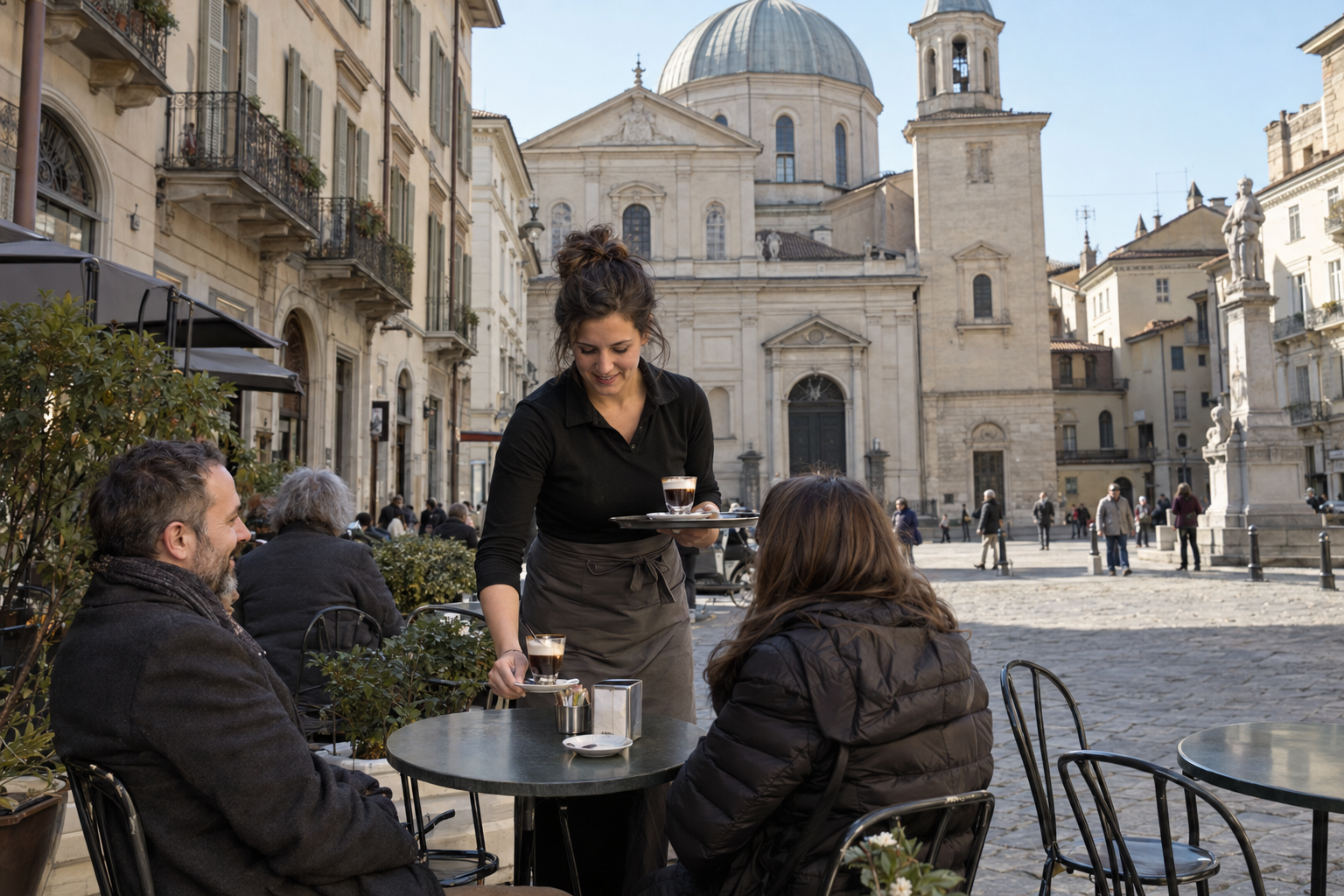
The year 1763 should therefore not be used without qualification as the drink’s birth date. It refers to the café’s founding, according to its own history. Bicerin emerged as a distinct Turin serving and became established during the 19th century; identifying a sole inventor or an exact first day requires better documentation than a well-told café legend.
Al Bicerin’s account also includes older names for different combinations of the components: pur e fiòr, pur e barba and un pòch ëd tut. The last, roughly “a little of everything”, is described as the combination that brought together coffee, chocolate and cream and eventually became the familiar bicerin. These details are valuable as local tradition, but they do not give us a complete, dated recipe card.
The café also highlights the women who have run the business. This is a useful counterweight to café histories in which only famous male guests receive attention. Behind every much-written-about table were people who bought chocolate, warmed pots, washed glasses and took payment. We should, however, be cautious about popular anecdotes concerning exactly what a celebrated visitor ordered. A famous name does not make an unverified story more reliable.
Chocolate gives body, coffee cuts through, cream rounds it off
Bicerin is built on contrasts, not just three ingredients. The chocolate needs to provide body and sweetness, the coffee roasted aromas and a certain bitterness, and the cream a soft, cooler cap. Too much sugar makes the whole thing heavy. Coffee that is too weak disappears. Cream whipped too stiffly turns the first sip into an exercise with a spoon.
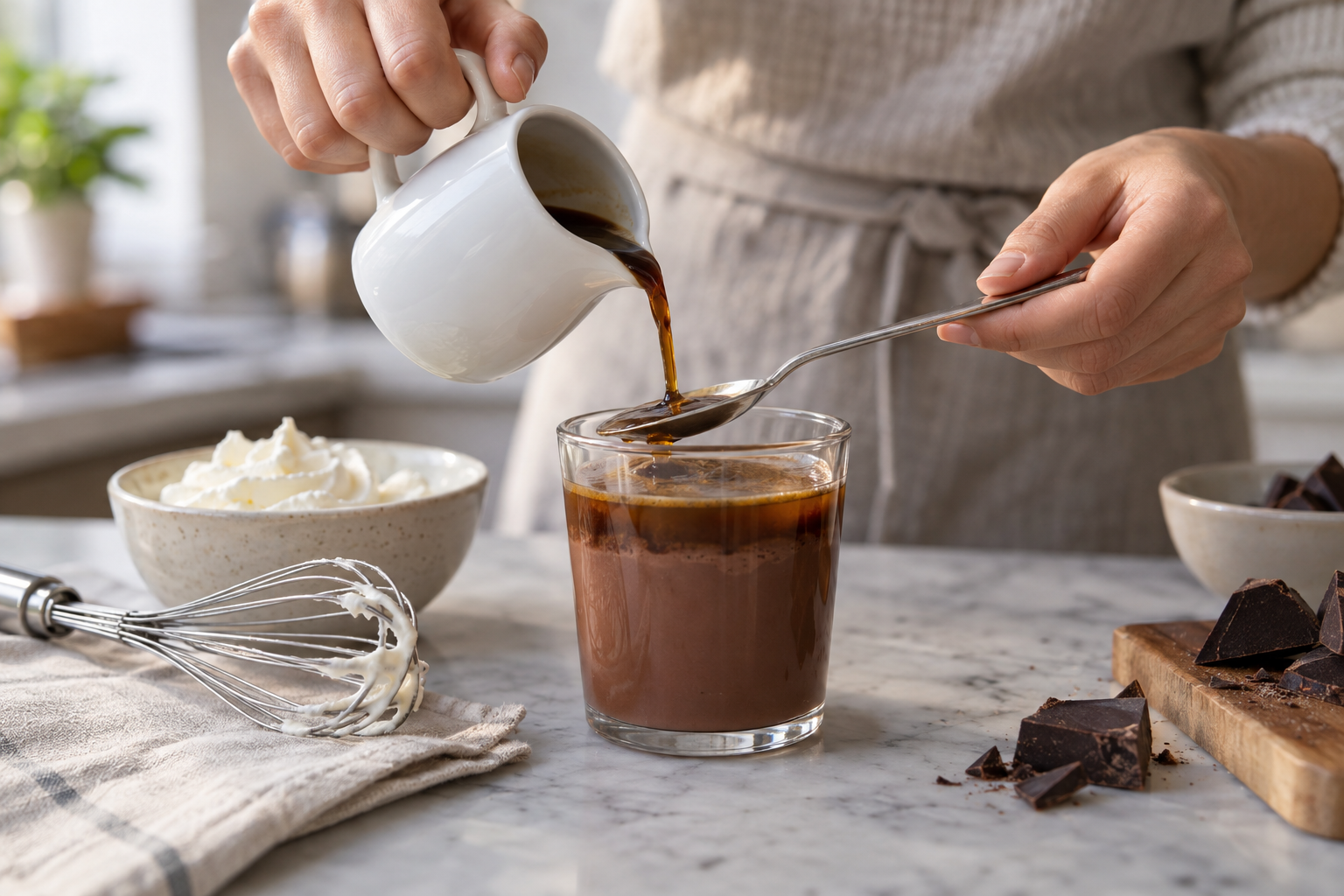
Today’s servings vary between cafés and recipes. The hot chocolate may be thicker or thinner, the coffee more or less concentrated, and the cream whipped to different degrees. A secret house recipe cannot be deduced from a photograph of three layers. Our version therefore uses ordinary dark chocolate, milk, strong coffee and lightly whipped cream, with proportions chosen for the home kitchen.
Aim for chocolate with around 60–70 per cent cocoa. It gives a distinct cocoa flavour without automatically calling for lots of extra sugar. Cocoa content is not a complete description of flavour, however: one chocolate may be fruity, another roasted or distinctly bitter. Taste the chocolate mixture before adding the coffee. It can be a little sweeter than you want the finished drink to be, as the coffee will rein it in.
The layers depend on both consistency and careful pouring. A thick chocolate base helps the coffee stay on top when poured slowly over a spoon. Cold, lightly whipped cream develops tiny air bubbles that make it lighter and easier to float on top. The temperatures in the recipe are practical guidelines for our interpretation, not historically documented café instructions. Some mixing is normal; razor-sharp lines are not a requirement for good flavour.
At the table: a small biscuit, a long pause
Today, bicerin is enjoyed as part of Turin’s living café culture, not simply as a museum piece. The clear glass reveals what china would conceal. There is something ceremonial about the serving, but it need not be stiff: sit down, let the glass cool to a comfortable drinking temperature and begin with a small sip.
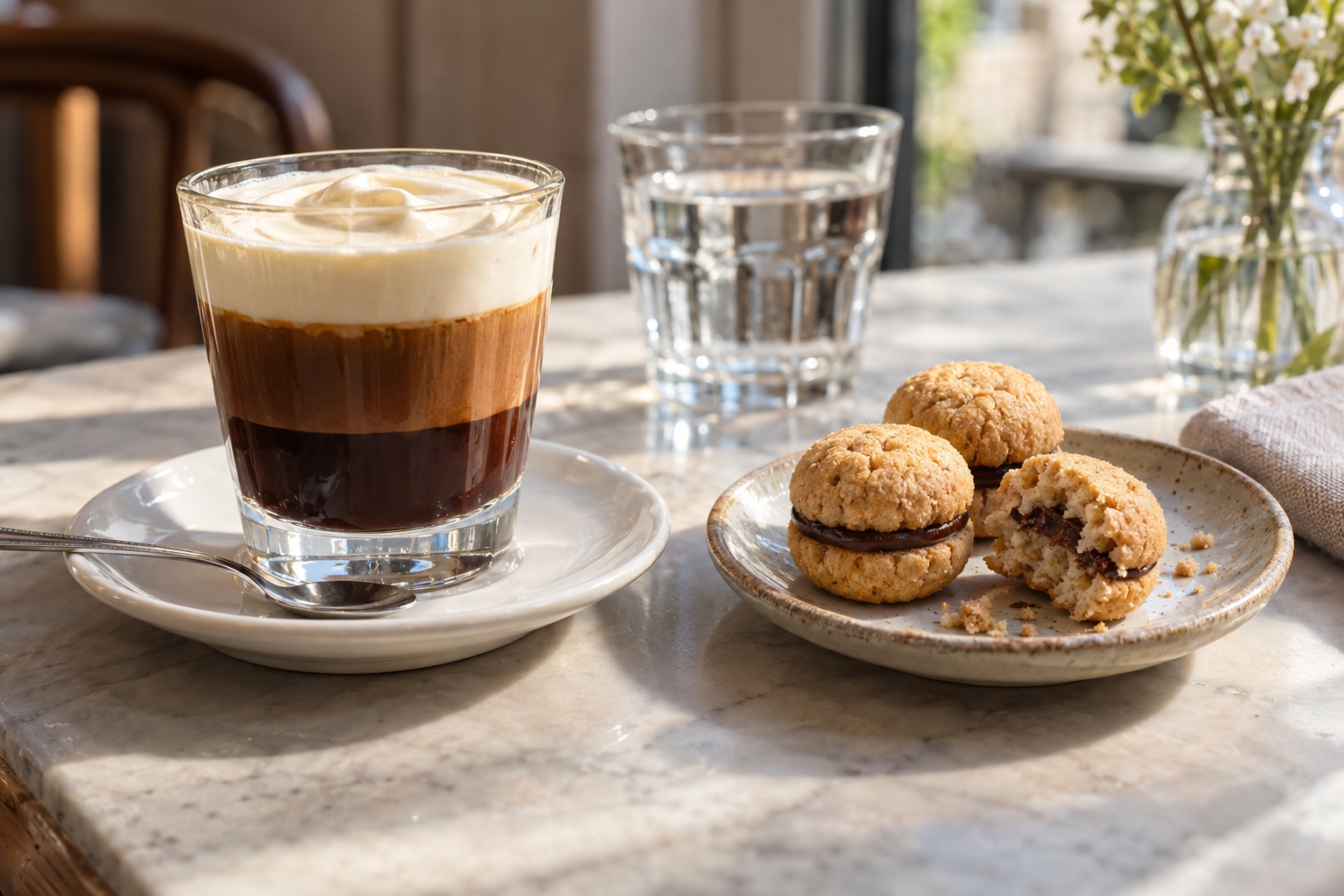
At Al Bicerin, the advice is not to stir. The idea is for the ingredients to meet in the mouth, keeping the coolness of the cream and the warmth of the base part of the experience. It is a serving method with a purpose, not a rule that makes other people’s coffee habits wrong. For our layered home version, it is nevertheless worth trying before reaching for the spoon.
Baci di dama, the little sandwich biscuits with chocolate between two nutty halves, make a fine accompaniment. They are associated with Tortona in Piedmont, not with any documented joint moment of invention alongside bicerin. Hazelnut versions are well known, as are recipes using almonds. The nuts’ roasted notes meet the coffee, while the chocolate filling echoes the drink’s base. One small biscuit goes a long way when the glass is already so rich.
If you prefer less sweetness, a thin, fairly unsweetened nut rusk works too. It is best to avoid a large, very sweet chocolate pastry alongside it: the coffee then loses its role as a counterbalance. The drink is alcohol-free to begin with. No liqueur is needed, and decaffeinated coffee works beautifully. Serve modest portions in small glasses, and put out some water too.
From Turin to a Swedish kitchen
The most important thing at home is to prepare everything before you start pouring. Choose small heatproof glasses, warm them gently and have the cream ready whipped. The chocolate can be made first and kept warm over a low heat; make the coffee last so its aromas do not have time to fade. A moka pot works well, but a strong filter coffee will also do if it tastes concentrated without being burnt.
The recipe card is a contemporary home interpretation of the layered serving, informed by sources. It is neither Al Bicerin’s house recipe nor an exact reconstruction of a documented 19th-century recipe. For anyone who wants to understand its kinship with bavareisa, the card includes a simple comparison tip: the same flavours, mixed rather than layered. Here too, the proportions are ours, not historically established.
For Advent, it is above all the moment that we can borrow: darkness outside, a warm glass between your hands and time to notice how the coffee cuts through the chocolate’s sweetness. Turin need not be dressed up as a Swedish Christmas. A little glass is enough to make a connection.
Layered Bicerin for the Home Kitchen
A contemporary interpretation, informed by sources, of Turin’s combination of coffee, hot chocolate and cream. The proportions are measures to try in a home kitchen, not historically documented quantities or Al Bicerin’s secret house recipe. The tips explain how to compare it with the older, mixed bavareisa; this is an illustration through flavour, not an exact reconstruction.
Ingredients
Method
- 1Set out four heatproof glasses with a capacity of about 1.5–2 dl. Warm them with hot tap water while you prepare the drink. Avoid sudden changes in temperature and do not use thin glasses that are not heatproof.
- 2Finely chop the chocolate. Heat the milk in a small saucepan to about 70–75 °C, until steaming but not boiling.
- 3Remove the saucepan from the heat. Add the chocolate and whisk gently until the mixture is completely smooth, about 1–2 minutes. Taste and add the sugar if needed.
- 4Keep the chocolate warm over a very low heat, at around 65–70 °C. Stir occasionally and do not let it boil. It should be rich but still easy to pour.
- 5Whisk the cold cream by hand until it thickens slightly and the whisk begins to leave soft trails, about 1–2 minutes. It should still flow from a spoon, not form firm peaks. Keep chilled while you make the coffee.
- 6Brew the coffee. Aim for about 75–85 °C when pouring; this is a practical guideline, not a temperature you need to hit exactly. Empty the water from the glasses and dry them.
- 7Divide the chocolate evenly between the glasses. Hold a tablespoon just above the surface of the chocolate and carefully pour 0.4 dl coffee per glass over the back of the spoon. Pour slowly to limit mixing.
- 8Divide the cream between the glasses, letting it slide gently off a spoon close to the surface of the coffee. Expect a soft, pale layer, not necessarily a perfectly sharp boundary.
- 9Serve immediately, but let everyone wait until the drink is comfortably warm to sip. Try it without stirring, so that cool cream and warm coffee-chocolate meet in the same mouthful.
- For a flavour comparison with the older, mixed bavareisa described in historical summaries, use the same quantities but leave the cream unwhipped and stir the components together. This illustrates the difference between mixed and layered; the quantities and method are not documented as an older original recipe.
- If the cream becomes too stiff, stir in a little extra unwhipped cream until it is softly flowing again. Pourable cream matters more than perfectly visible layers.
- The chocolate base can be made the day before, cooled quickly and stored covered in the fridge. Reheat gently, stirring. Prepare the coffee and cream layer just before serving.
- Serve with small baci di dama from an Italian delicatessen, or a simple nut rusk. The drink is alcohol-free; choose decaffeinated coffee if you want to serve it in the evening.
What goes with the glass
- FoodBaci di dama with hazelnuts and chocolateThe hazelnuts’ roasted aromas meet the coffee, while the chocolate filling mirrors the drink’s cocoa base. Choose small biscuits and serve sparingly so that sweetness and richness do not overwhelm the alcohol-free drink.
- FoodThin, lightly sweetened almond or hazelnut ruskThe dry crunch contrasts with the softness of the cream. Restrained sweetness allows the coffee’s bitterness and the chocolate’s aromas to remain distinct.
- FoodA small slice of toasted sourdough with butterA less sweet alternative: the bread’s toasted surface complements the coffee, while gentle acidity and a hint of salt cut through the chocolate’s sweetness. Spread the butter thinly, as the drink already contains cream.
Sources
- Caffè Al Bicerin, Al Bicerin – kaféets presentation och historieskrivning
- Turismo Torino e Provincia, Turismo Torino e Provincia – information om bicerin och Turins historiska kaféer
- Gillian Riley, The Oxford Companion to Italian Food (2007)
- Alan Davidson; tredje upplagan redigerad av Tom Jaine, The Oxford Companion to Food (2014)
Ask questions about "Bicerin – Turin’s Hot Chocolate Secret". Answers are based on the magazine's own articles.