Butter chicken – from Delhi to the world
The heat of the tandoor, the tang of tomato and butter’s soft embrace
Behind what may be the world’s best-loved Indian chicken dish lies a story of Partition in 1947, a restaurant kitchen in Delhi and an invention whose origins are disputed. We follow murgh makhani from Moti Mahal to Swedish kitchens – and make it with deeply browned chicken, fragrant garam masala and naan straight from the pan.
 By Priya NilssonReporter · Indian and South Asian cuisine – spices, regional dishes and street food
Translated from Swedish with AI assistance.
Go to the recipes (2) ↓Where fire meets butter
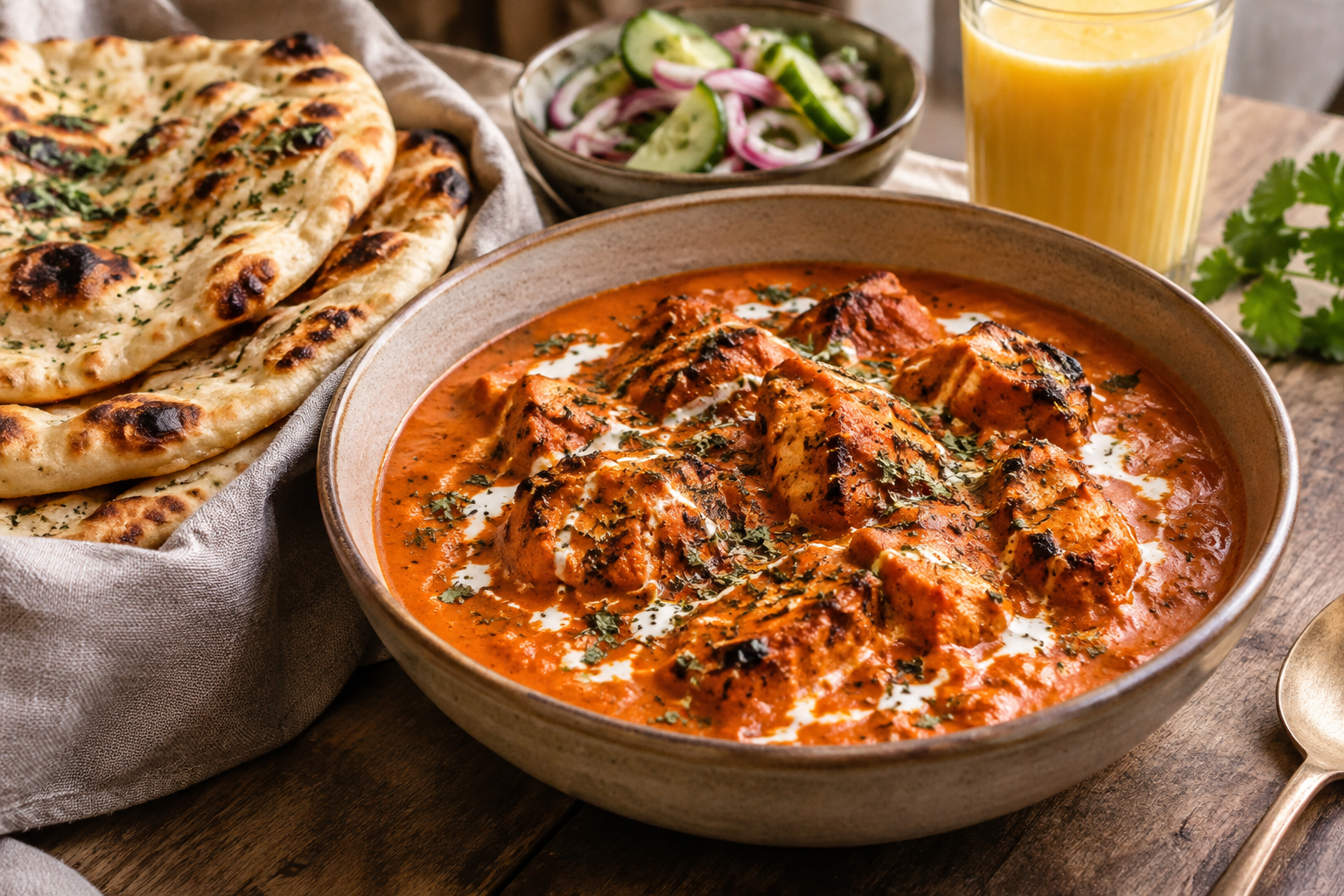
Imagine a restaurant kitchen in Delhi as the evening begins. Chicken is lifted from the vertical heat of the tandoor, its surface darkly mottled, spiced yoghurt baked onto its edges. Nearby, a tomato sauce simmers. As butter is worked in, the colour deepens and the surface turns glossy; a splash of cream softens the sizzling red into warm orange. Finally, dried fenugreek leaves are crumbled between the palms. Their scent is hay-like, slightly bitter and remarkably appetising.
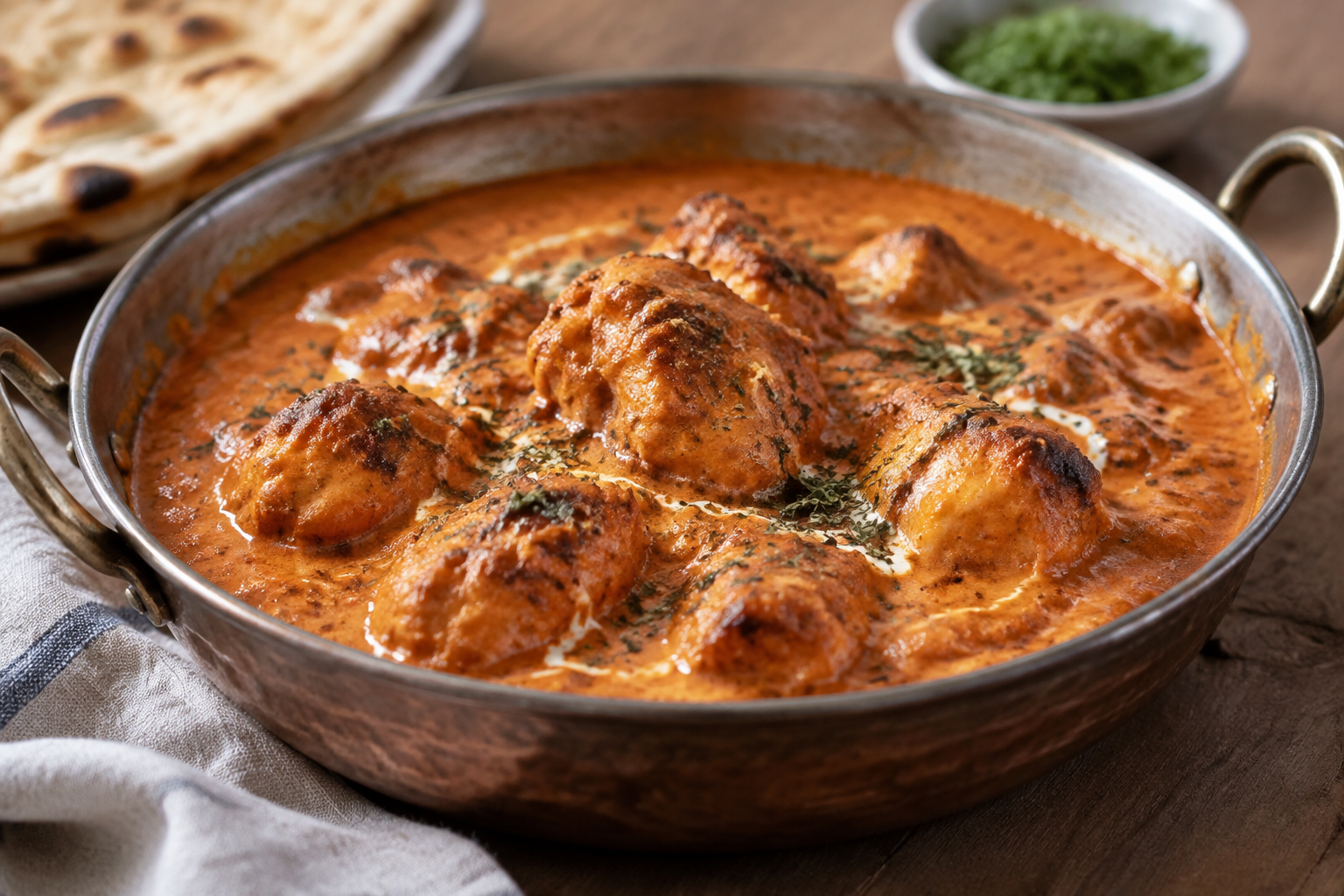
It is where these two cooking methods meet that butter chicken becomes interesting. Not simply chicken in a mild sauce, but fire against softness, a roasted crust against tomato acidity, the sharpness of spice against dairy fat. In Hindi, it is called murgh makhani: chicken prepared in buttery fashion. That tells us something about the dish’s character, but far from everything about its flavour.
I think butter chicken is often described back to front. People start with the cream, the mildness and the accessibility, as though the dish were chiefly a refuge for anyone afraid of chilli. Start instead with the browned chicken. Move on to ginger, garlic and tomatoes cooked until their raw edge has gone. What emerges is a dish with a backbone of its own, not merely a gentle introduction to something hotter.
Its international success has also made it a canvas for different expectations. For some, it means celebration and restaurant luxury; for others, Friday-night takeaway. It can be carefully cooked, drowned in cream, fiery red or almost beige. But to understand why this particular combination became a global dish, we need to begin with people who moved, professional skills that travelled with them and a city transformed at its foundations.
Delhi after 1947 – a story with competing claims
When British India was partitioned in 1947 and India and Pakistan became independent, violence and mass displacement followed. Delhi received many people from areas that became Pakistan, including Hindus and Sikhs from Punjab and the north-west of the subcontinent. With them came languages, food traditions, restaurant expertise and experiences that cannot be reduced to a happy origin story.
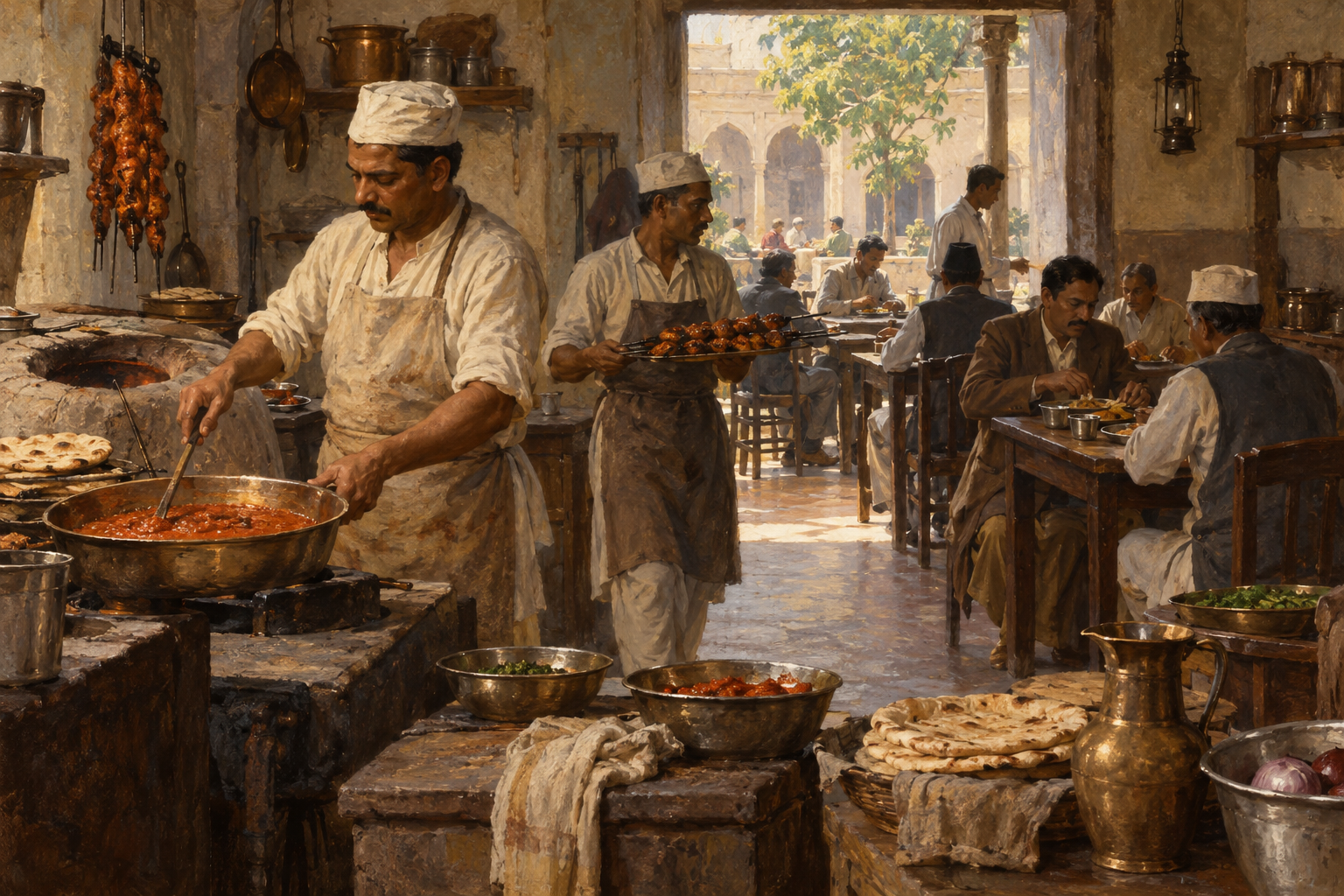
Moti Mahal in Daryaganj, Old Delhi, holds a central place in this story. The restaurant was established around the time of Partition in 1947 and is associated with Kundan Lal Gujral, Kundan Lal Jaggi and Thakur Dass, who had backgrounds in the restaurant trade in Peshawar, in present-day Pakistan. Moti Mahal became an important showcase for tandoor-cooked chicken and the buttery tomato sauce that would become associated with murgh makhani.
The often-repeated explanation is a practical one: cooked tandoori chicken risked drying out while waiting for diners. A sauce of tomatoes, butter and, in various later accounts, cream made the meat succulent and usable again. It is plausible restaurant logic – making more of something already in the kitchen – but the details come largely from retrospective accounts and family traditions. They should not be presented as a record of the very first pot.
Nor does repeating a story many times settle who deserves the credit. Gujral’s and Jaggi’s descendants have put forward competing claims. In January 2024, Reuters reported on a legal dispute in Delhi between restaurant businesses linked to these family histories, centred on the origins of butter chicken and dal makhani. That a dispute was reported is established; it does not automatically make either party’s version of events true.
The defensible account, then, is that butter chicken is strongly associated with Moti Mahal and Delhi’s post-Partition restaurant culture, while the individual inventor and the exact moment of its creation remain disputed. That is less punchy than a lone inventor having a sudden flash of genius, but more accurate.
The story also holds something larger than a dispute over names. It shows how migration changes a city’s tastes. Knowledge from one kitchen can re-emerge in another setting, meet new diners and become a symbol of the place where people have arrived. In that sense, butter chicken is very much Delhi’s dish, but its earlier history does not stop at today’s national borders.
The tandoor: more than an oven for naan
A tandoor is traditionally a clay oven fired to a very high temperature. Bread is pressed against the hot inner wall, while meat can be cooked on skewers lowered through the opening. The intense radiant heat and hot surfaces produce a style of cooking that is difficult to replicate in an ordinary pot. Yoghurt marinade dries and browns on the meat, while cooking can be swift.
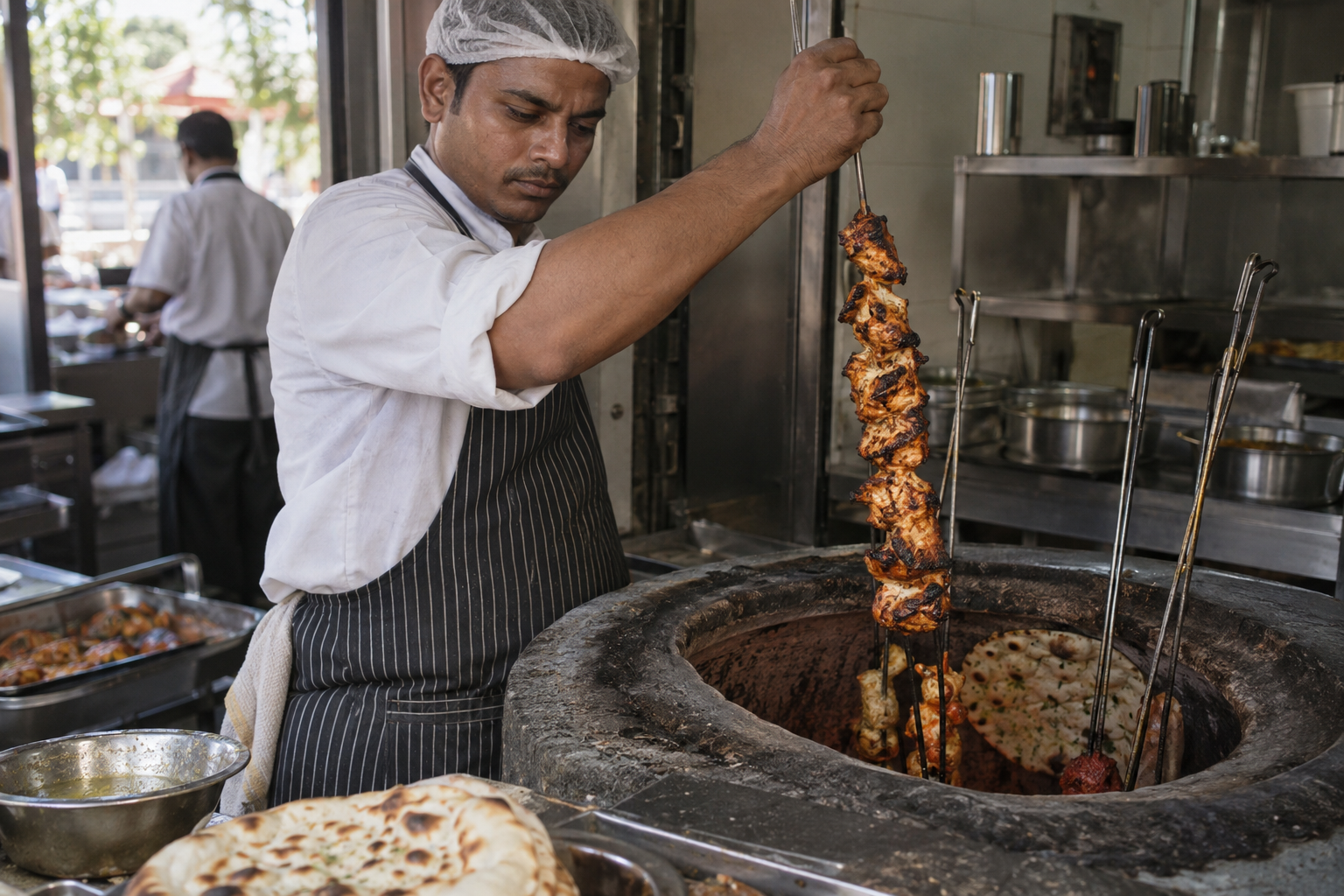
Moti Mahal did not invent the tandoor. It belongs to a much older and wider culinary world stretching across parts of South, Central and West Asia. What Delhi’s restaurants helped do was make certain tandoor dishes a prominent part of the urban restaurant menu and, eventually, of the international image of northern Indian food.
There is an important distinction here between the traditional method and a home version. For butter chicken with real character, the chicken is first cooked over high heat, then brought together with the sauce. Adding raw chicken directly to tomatoes and cream can taste good, but it loses the contrast between the roasted exterior and the velvety sauce.
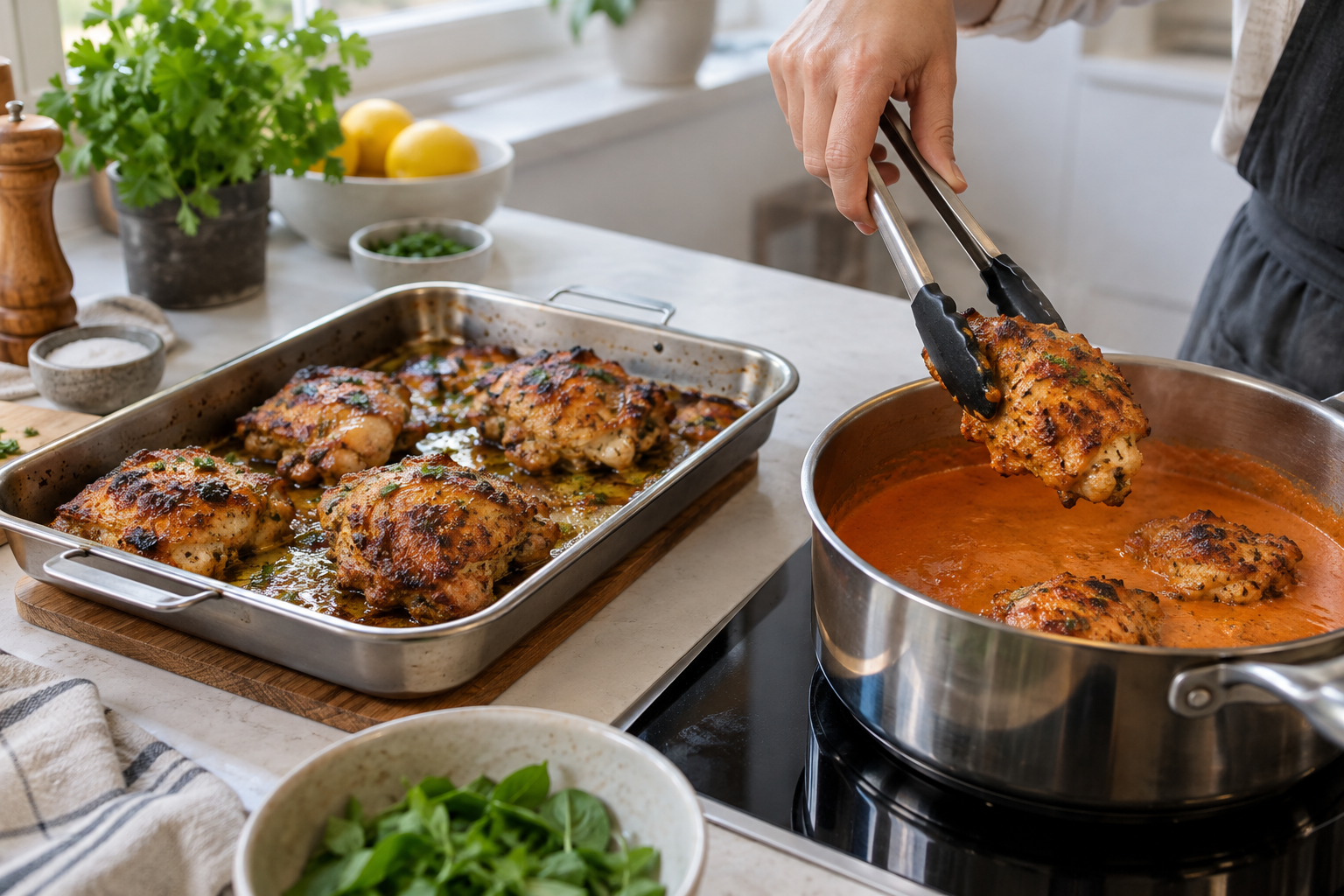
A Swedish oven with a grill setting does a respectable job. The secret is not to crowd the pieces. Chicken packed too closely together releases liquid that pools around the meat, so it steams rather than browns. A thoroughly hot frying pan works too, provided you cook in batches. The aim is deep golden patches and the occasional charred edge, not uniformly blackened marinade.
Yoghurt does more than help the spices stick. Its acidity affects the surface of the meat, and its components contribute colour and flavour when heated. Longer marinating is not always better, though. Small pieces of chicken do not need a full day to take on plenty of flavour, and too much lemon can give the surface an unpleasant texture. A couple of hours in the fridge goes a long way; overnight is convenient, but not essential.
I tend to choose boneless chicken thighs. They withstand the two-stage cooking better than breast meat and stay juicy as the pieces finish in the sauce. That is not a claim that every restaurant uses the same cut, but advice for home cooks who would like a little more room for manoeuvre.
The spices that make the sauce more than cream
A good makhani sauce should taste of tomatoes, not simply be coloured by them. The tomatoes need cooking until their raw, sharp aroma becomes something rounder. Butter carries the aromas and lends richness, while cream softens the whole. But if cream takes centre stage, the tension disappears: everything settles into the same velvety register.
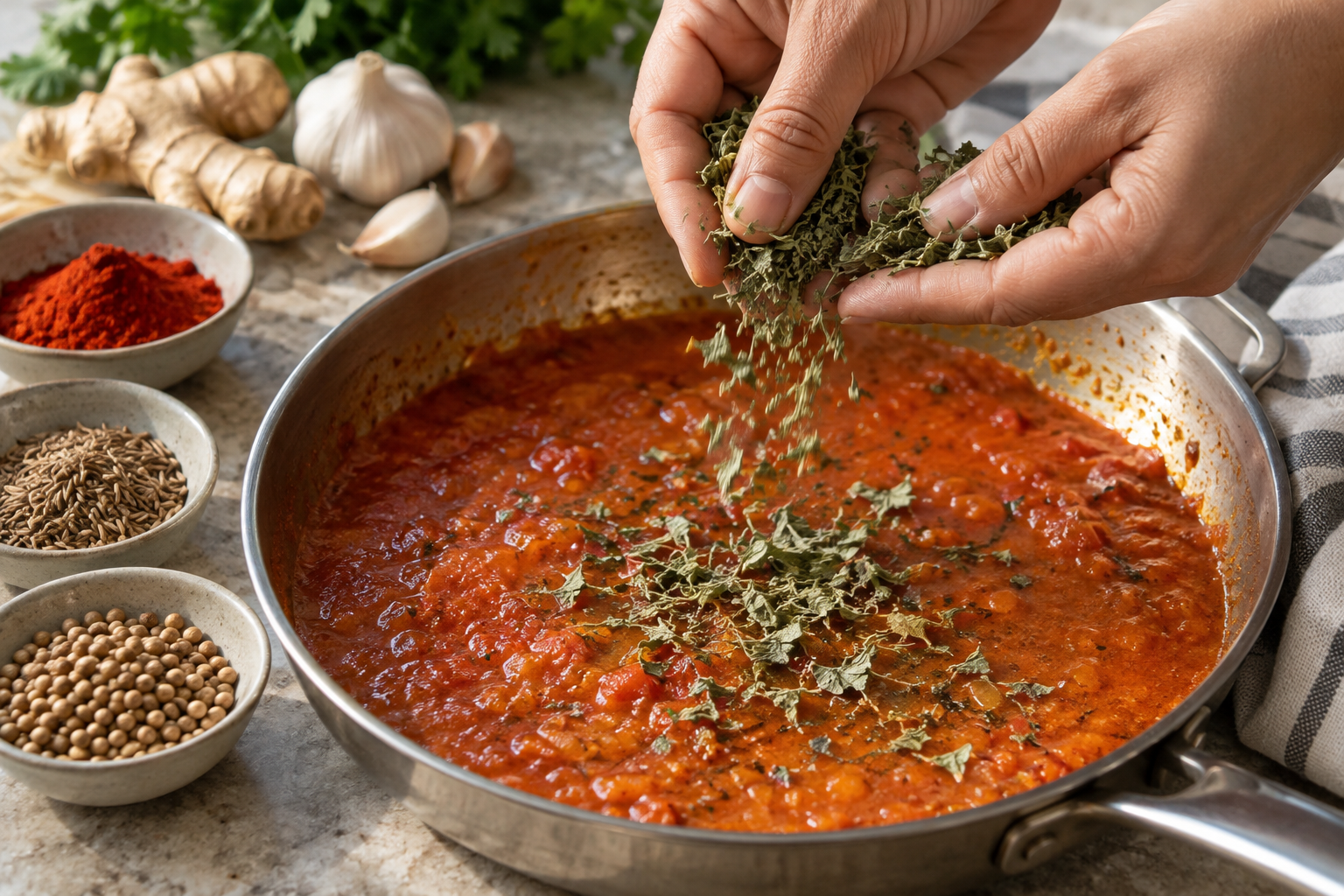
Ginger and garlic provide depth and bite. Cumin and coriander seeds contribute warm, earthy and citrus-like notes respectively. Chilli can supply both colour and heat, but the two do not always go hand in hand. Kashmiri chilli is often sold as a relatively mild, richly coloured powder, although heat levels vary between products. In Sweden, a blend of ordinary sweet paprika and a little cayenne makes a practical substitute. Smoked paprika, however, gives a different flavour profile and would not be my first choice here.
Garam masala is not a single standard blend. The name is usually explained as a warming spice mixture, but warming does not necessarily mean chilli-hot. Cardamom, cinnamon, cloves and black pepper are common ingredients; proportions and other spices vary between families, regions and producers. Two jars bearing the same name can therefore give quite different results.
I use some in the marinade and a smaller amount towards the end of cooking the sauce. This gives the spices both a cooked base note and a fresher aromatic lift. An old jar that barely smells of anything when opened will not spring to life simply because you double the quantity. Buy small packs instead, and keep them airtight in a dark, dry place.
Then comes kasuri methi: dried fenugreek leaves. They give a herbal, hay-like, slightly bitter aroma that many people recognise from restaurant butter chicken without being able to name it. Crumble the leaves just before using them. Start cautiously: the idea is an aromatic echo, not a sauce that tastes of herbal medicine. Fenugreek seeds come from the same plant, but are not a direct substitute; they have a different texture and a more pronounced bitterness.
Onions and cashews feature in some versions, while others put tomatoes, butter and cream more firmly at the centre. There is no reason to call every variation a mistake. In this recipe, I leave out both to keep the flavours clear and the ingredient list manageable. A little sugar can balance very acidic tinned tomatoes, but it should be an adjustment made after tasting, not a way to make the dish sweet.
A Delhi dish is not all of India
Butter chicken’s global fame has helped sustain a persistent idea: that Indian food consists mainly of creamy sauces, naan and rice. That is about as illuminating as describing the food of all Europe through a few French restaurant sauces. India encompasses enormous differences in ingredients, religion, climate, everyday food and celebration dishes.
There is great variety even within northern Indian cooking. Delhi’s restaurant cuisine, with its strong Punjabi influences and many other historical layers, is not the same as the food in every Punjabi home. And a household in Bengal, Tamil Nadu or Gujarat need not see butter chicken as an obvious reference point at all. The dish’s fame tells us much about the spread of restaurants, but less about what everyone eats day to day.
It is often compared with chicken tikka masala. The two are related through their marinated, cooked chicken and tomato-based sauces, but they are not two names for the same clearly defined dish. Chicken tikka masala is strongly associated with British South Asian restaurant culture and has disputed origins of its own. Butter chicken has its clear historical connection to Delhi and Moti Mahal. In practice, restaurant versions sometimes overlap, so the colour on the plate is no reliable proof of identity.
Through restaurants, migration, cookbooks and, later, food media, murgh makhani has become recognisable far beyond Delhi. It travels well: chicken is familiar to many diners, tomatoes and butter have broad appeal, and the heat can be varied. Yet its success has sometimes stripped the dish of its character. A ready-made sauce may carry the name while lacking both the roasted chicken and the layers of spice.
That does not mean a Swedish home version must perfectly copy a particular restaurant kitchen. Food has always changed as people move and use different equipment. The more rewarding question is which qualities we want to preserve. Here is my answer: distinct tomato flavour, just enough buttery richness, genuine spice fragrance and chicken that has met high heat before entering the sauce.
Around the table: bread, contrasts and something to drink
Butter chicken belongs naturally on a sharing table. A bowl of chicken and sauce, warm bread wrapped in a tea towel and perhaps rice alongside make a generous meal without every plate needing to be arranged in the kitchen. Naan scoops up the sauce, but roti or another unsweetened flatbread works beautifully too. There is no requirement to serve both bread and rice.
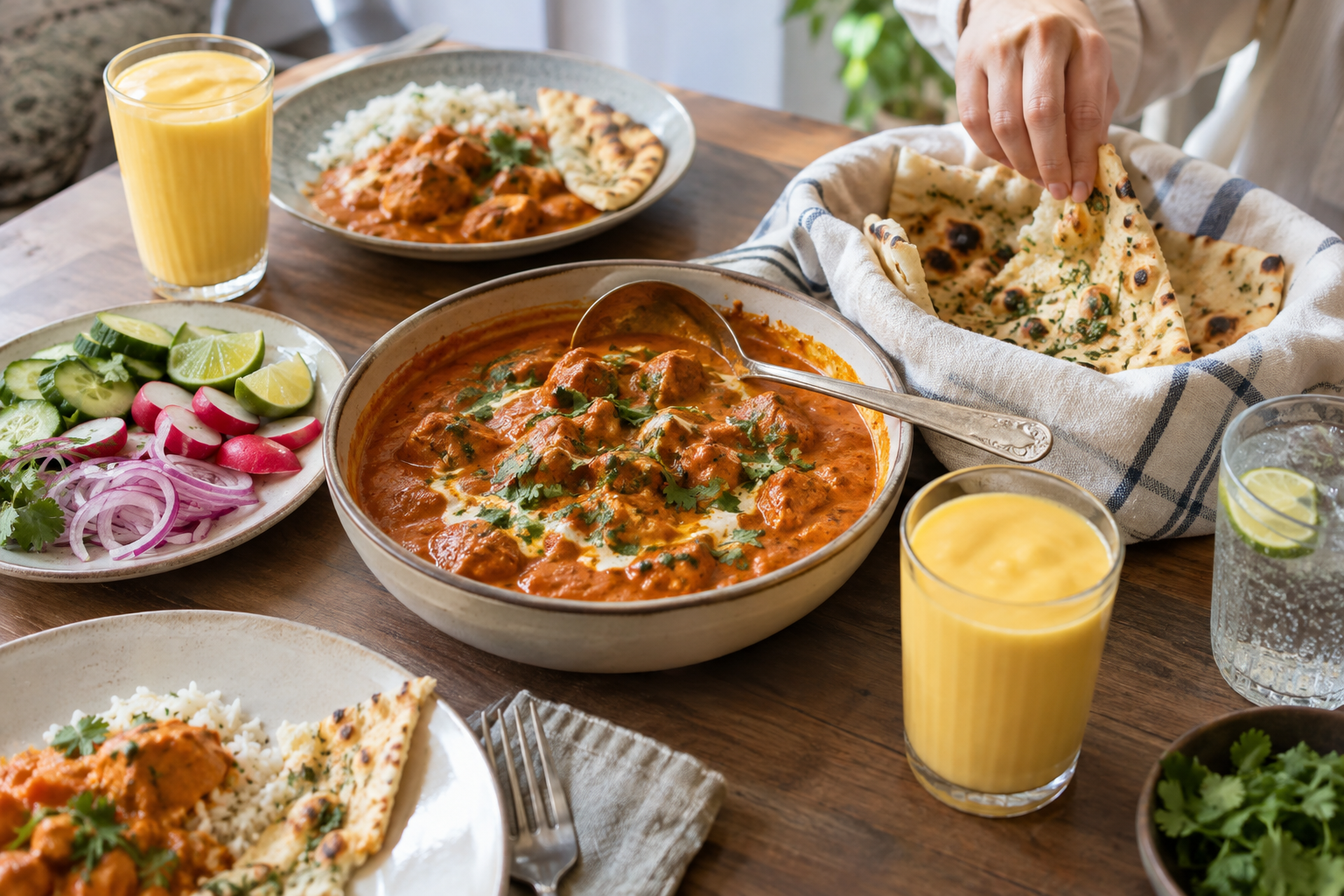
What I most like to add is something contrasting. Cucumber, radishes and thinly sliced red onion with lime bring crunch and freshness. A simple vegetable dish or dal can add variety to the table. Several heavy, creamy dishes are not needed to make the meal feel complete, though. Hospitality can just as easily lie in warm bread coming straight from the pan.
Mango lassi is an alcohol-free option with a clear connection to the Indian restaurant meal. Made with yoghurt and mango, it can range from fresh and pourable to almost dessert-thick. With butter chicken, I prefer less sweetness and a consistency you can actually drink with the food. Use ripe mango or unsweetened purée, and taste before adding any extra sweetener.
Lassi makes the meal rounder rather than lighter. Anyone wanting more contrast can choose sparkling water with lime. It is also worth remembering that a drink need not be elaborate to work well; sometimes its best role is to refresh the palate between mouthfuls.
For those who would like wine, a riesling with fresh acidity and a little residual sweetness is a good direction. The acidity meets the butter and cream, while the sweetness can balance the chilli heat. Look for a style with moderate alcohol and no pronounced oak character. A high-alcohol, tannic red, by contrast, risks tasting harsh alongside chilli and tomatoes. Wine is an optional extra, not a prerequisite for the meal.
Making it work in a Swedish kitchen
Most of the ingredients are available in an ordinary supermarket: boneless chicken thighs, plain yoghurt, passata, butter, cream, ginger and garlic. Kasuri methi and Kashmiri chilli are easiest to find in South Asian food shops or Swedish online shops stocking Indian ingredients. Try searching for both “kasuri methi” and “dried fenugreek leaves”. If you cannot find the leaves, it is better to leave them out than replace them with a large quantity of ground seeds.
Choose a plain yoghurt that is thick but can still be stirred into a marinade. Very low-fat, thin yoghurt releases more liquid onto the tray, while a very firm yoghurt may need loosening with a small splash of water. Use plain passata without added herbs. The acidity of tinned tomatoes varies, so the final balance should be decided with a tasting spoon, not blind faith in a fixed measure of sugar.
The recipe below is a modern home interpretation, not a claimed reconstruction of Moti Mahal’s original recipe. The oven grill replaces the tandoor. The sauce is made separately, and the chicken only simmers in it to finish cooking. Once the cream is added, we keep the heat gentle; a fierce boil will not improve the sauce and may cause the fat to separate.
The naan are made with yeast and yoghurt and cooked in a hot, dry frying pan. They will not have exactly the texture of tandoor-baked bread, but they become soft, bubbly and beautifully mottled. Do not confuse high heat with unlimited preheating: a cast-iron pan is suitable, whereas a non-stick pan should not sit empty over maximum heat. Put the extractor fan to work, and wipe loose flour from the pan between breads so it does not burn.
Plan ahead by marinating the chicken and making the dough first. Make the sauce while the dough rises. Grill the chicken, let it finish simmering and keep the pot gently warm while cooking the breads. That way, everything reaches the table without the chicken having to keep cooking while it waits for the naan. And when the first warm bread folds around a piece of chicken, the sauce should cling in a glossy layer – not a cream soup, but the sum of tomatoes, spices, butter and fire.
Butter chicken with grilled yoghurt-marinated chicken
A modern home version of murgh makhani, with the oven grill standing in for the tandoor. This is not a reconstruction of a secret original recipe: the priorities here are browned chicken, distinct tomato flavour and a balanced, buttery sauce. Preparation time is active time; allow an additional 2–12 hours for marinating in the fridge.
Ingredients
Method
- 1Cut the chicken into pieces about 4–5 cm across. Mix all the marinade ingredients in a bowl, add the chicken and turn to coat, then cover. Marinate in the fridge for 2–12 hours.
- 2Heat the oven to 250 °C on the grill setting, or follow your oven’s instructions for grilling on high heat. Line a metal baking tray with aluminium foil, not baking paper under the grill element. Position an oven shelf about 15 cm from the heat source.
- 3Make the sauce while the oven heats. Melt 30 g of the butter in a wide casserole over medium heat. Gently fry the ginger and garlic for 1–2 minutes without browning. Add the coriander, cumin and chilli and stir for about 20 seconds.
- 4Add the tomatoes and water. Simmer uncovered for 18–25 minutes, stirring regularly. The sauce should thicken and lose its raw tomato smell. Lower the heat if it splatters heavily.
- 5Lift the chicken pieces from the marinade and let any thick excess drip off; do not scrape it all away. Space the pieces out on the tray. Discard the remaining raw marinade. Grill for about 10–15 minutes, turning halfway through. Watch closely: the pieces should take on plenty of colour, but need not be fully cooked yet.
- 6Stir the cream, garam masala and salt into the sauce. Crumble the fenugreek leaves between your palms and add them. Add the chicken straight from the oven.
- 7Simmer gently for 5–10 minutes, until the chicken is cooked through and the thickest piece reaches at least 74 °C. Add a little water if the sauce has become too thick.
- 8Stir in the remaining 20 g butter over low heat. Taste and adjust with more salt and, only if needed, a little sugar. Leave to stand for 3–5 minutes before serving. Serve with warm naan and, if you like, a crisp cucumber and onion salad.
- No Kashmiri chilli? Replace each teaspoon with about 0.75 tsp sweet paprika and a small pinch of cayenne. Adjust to your preferred heat level.
- The sauce can be made the day before. Cool quickly and refrigerate. For the best texture, cook the chicken and combine it with the sauce just before serving.
- Cool leftovers quickly in shallow containers and store at about 4 °C. Eat within 2–3 days or freeze; reheat until piping hot throughout.
- For a vegetarian interpretation, use 500 g paneer with roasted cauliflower. The paneer only needs warming gently in the finished sauce.
Soft pan-cooked naan
Eight small, yeast-raised naan with yoghurt in the dough. A hot cast-iron pan gives lovely bubbles and toasted patches without a tandoor. Preparation time is active time; allow an additional 60–90 minutes for rising and 10 minutes for resting.
Ingredients
Method
- 1Crumble the yeast into a bowl and dissolve it in the water. Stir in the yoghurt, oil and sugar.
- 2Add 450 g flour and the salt. Knead for 8–10 minutes by hand or about 5 minutes in a mixer, until smooth, supple and slightly sticky. Add a teaspoon or so of water if it feels dry.
- 3Cover the bowl and leave to rise at room temperature for 60–90 minutes, until the dough has grown noticeably, roughly doubling in size. A cool dough may need longer.
- 4Divide the dough into eight pieces on a lightly floured surface. Shape into balls, cover with a tea towel and leave to rest for 10 minutes.
- 5Melt the butter gently. If using garlic, stir it in and leave it to infuse in the warm butter while the breads cook.
- 6Heat a dry cast-iron or carbon-steel frying pan over medium-high to high heat for a few minutes. Roll or stretch one dough ball into an oval about 3–4 mm thick. Brush off any loose flour.
- 7Cook one bread at a time for about 1–2 minutes on the first side, until bubbles form on top and the underside has brown patches. Turn and cook for another 1–2 minutes. Lower the heat if the bread blackens before the inside is cooked.
- 8Brush the warm breads lightly with butter and sprinkle with coriander, if using. Stack them in a clean tea towel to keep them soft. Carefully wipe any burnt flour from the pan between batches.
- Do not roll out all the breads far in advance; they may stick to the surface. Shape the next one while the previous one cooks.
- Do not use a non-stick pan on maximum heat. Follow the pan’s heat guidelines and allow for slightly longer cooking.
- Freeze leftover breads once cool. Defrost and warm briefly in a pan, or wrapped in foil in the oven at 175 °C.
What goes in the glass
- Alcohol-freeMango lassi with restrained sweetnessThe freshness of yoghurt and the fruitiness of mango complement the chilli and warming spices. Choose a pourable, not-too-sweet lassi so it does not make an already rich meal unnecessarily heavy.
- WineRiesling with fresh acidity and a little residual sweetnessThe acidity balances the butter and cream, while a little sweetness works well with the chilli heat. Look for moderate alcohol and avoid pronounced oak; check the sweetness, since a designation such as Kabinett does not in itself guarantee an off-dry wine.
- Alcohol-freeSparkling water with limeAn unsweetened, light option that refreshes between mouthfuls and lets the tomatoes, fenugreek and grilled chicken take centre stage.
Enjoy alcohol in moderation. Alcohol-free options go just as well with the food.
Sources
- Aditya Kalra, Reuters, Who invented butter chicken? Indian judge to rule on dispute over global favourite (2024)
- Pushpesh Pant, India: The Cookbook (2010)
- Madhur Jaffrey, Madhur Jaffrey's Indian Cooking (1982)
- Alan Davidson; tredje upplagan redigerad av Tom Jaine, The Oxford Companion to Food (2014)
- Harold McGee, On Food and Cooking: The Science and Lore of the Kitchen (2004)
Ask questions about "Butter chicken – from Delhi to the world". Answers are based on the magazine's own articles.