Glühwein – Christmas Market Warmth, Beyond the Glögg Myths
From 19th-century German cookbooks to steaming mugs in Advent market squares.
Red wine, sugar, citrus and spices: Glühwein has a simple foundation, but its history is easily cast in a romantic glow. We trace warm wine through the 19th-century German kitchen, explore its relationship with glögg and warm up three Advent versions without letting the pan boil.
 By Jonas EkDrinks editor · Wine, beer, spirits, coffee, tea and non-alcoholic drinks – and how to pair them with food
Translated from Swedish with AI assistance.
Go to the recipe ↓When the square smells of cinnamon
You feel the cold in your fingers first. Then comes the aroma: warm citrus, cinnamon and wine, with a hint of clove drifting between the stalls. Gravel crunches underfoot, someone shakes snow from a hat, and potatoes sizzle in fat on a griddle. A mug of Glühwein gives your hands something warm to hold. That first sip should taste of wine and fruit, not just sugar and Christmas spice.

It is a familiar German Advent scene today. But if we travel back to the 19th century, we need to leave some of that postcard image behind. Christmas markets already had a long history in several places, but today's combination of souvenir mugs, large heated urns and almost obligatory warm wine is not a ready-made inheritance from the Middle Ages. The markets and the drink each have their own history, woven together over time.
The most reliable route into 19th-century Glühwein, then, is not a tale about a shivering market visitor. It is the cookbook. There we find warm, sweetened spiced wine as something a household could actually prepare. We can see which ingredients were taken for granted, which flavours were sought and how kitchen knowledge could gradually become part of a wider Advent culture.
The cookbook is more reliable than the origin myth
Wine was being spiced and sweetened long before the 19th century. The Roman recipe collection generally known as Apicius, for example, includes a spiced wine with honey, pepper and other aromatics. This is evidence of an older family of drinks, not a birth certificate for today's Glühwein. Between Roman spiced wine, medieval wine preparations and a mug at a German Christmas market lie many different practices, ingredients and ways of serving.
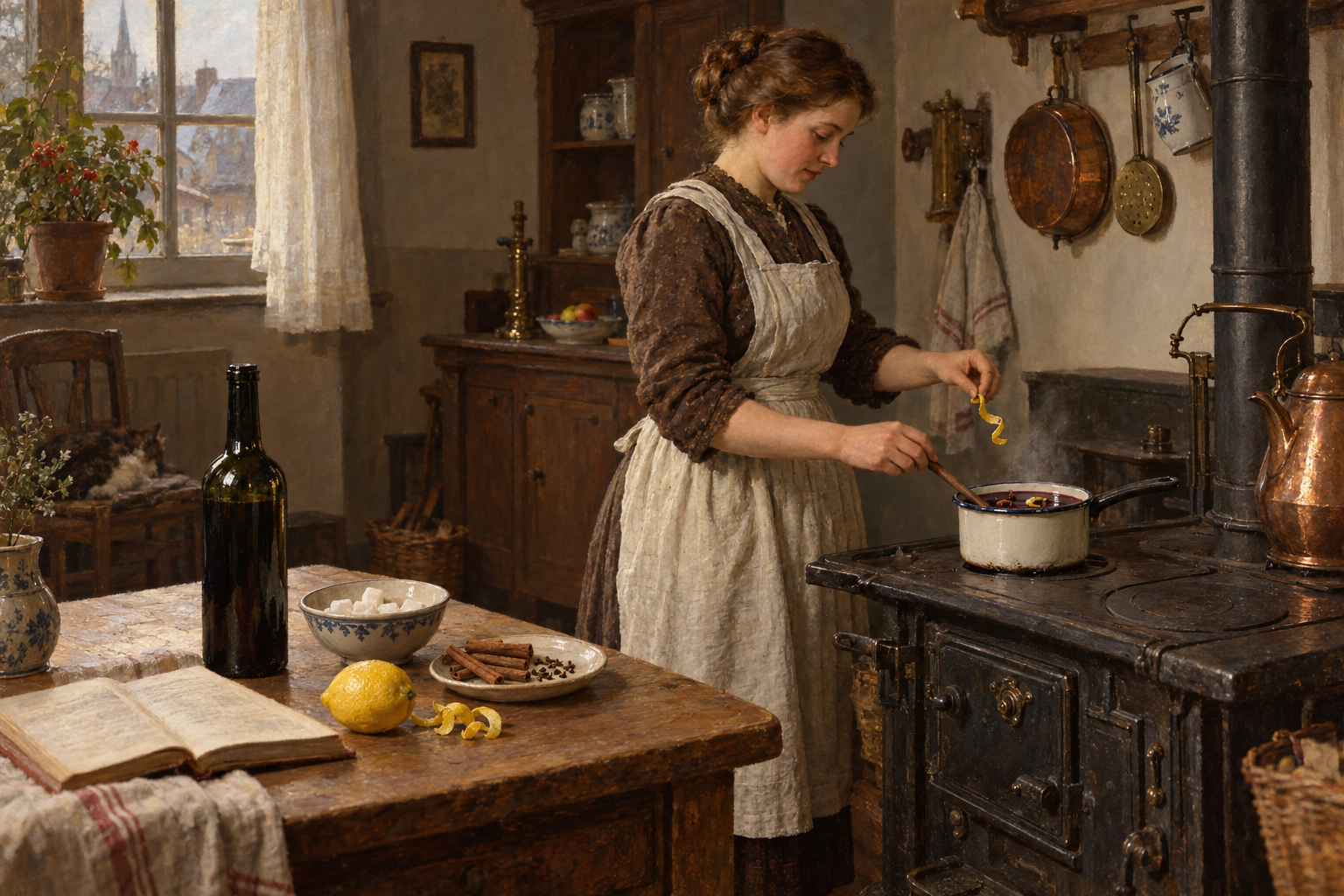
For German home cooking, Henriette Davidis offers a much closer point of reference. Her Praktisches Kochbuch, first published in 1845, became an influential cookbook that was repeatedly revised. Late-19th-century editions include Glühwein among the drinks: red wine sweetened with sugar and scented with cinnamon, cloves and lemon peel. It is the combination that matters historically. It is instantly recognisable, without needing an invented market legend attached to it.
The dating still requires care. A book's first publication in 1845 does not mean that every recipe in a later edition can be dated to that year. Davidis died in 1876, and later editions were revised by others, including Luise Holle. Here, an 1898 edition provides the reference point for the historical flavour profile. The quantities in the recipe card are our kitchen adaptation, not a claim that every German household used the same proportions.
A cookbook also tells us what someone recommended, not how often a drink was consumed or by whom. Wine, sugar and imported spices were traded goods whose price and availability varied. A printed recipe shows that the preparation had a place in middle-class household literature. It is not enough to say that Glühwein was already every worker's customary drink in every December market square. That distinction makes the history less like a fairy tale, but more interesting.
Glühwein and glögg: relatives, not a simple handover
The headline's idea of warmth “before glögg” therefore needs some qualification. German Glühwein cannot simply be described as the origin of Swedish glögg. Sweden, too, has a long history of spiced and heated wines, and the words, recipes and serving customs have changed over time. These are better understood as closely related traditions in a Europe where wine, sugar and spices travelled across borders.
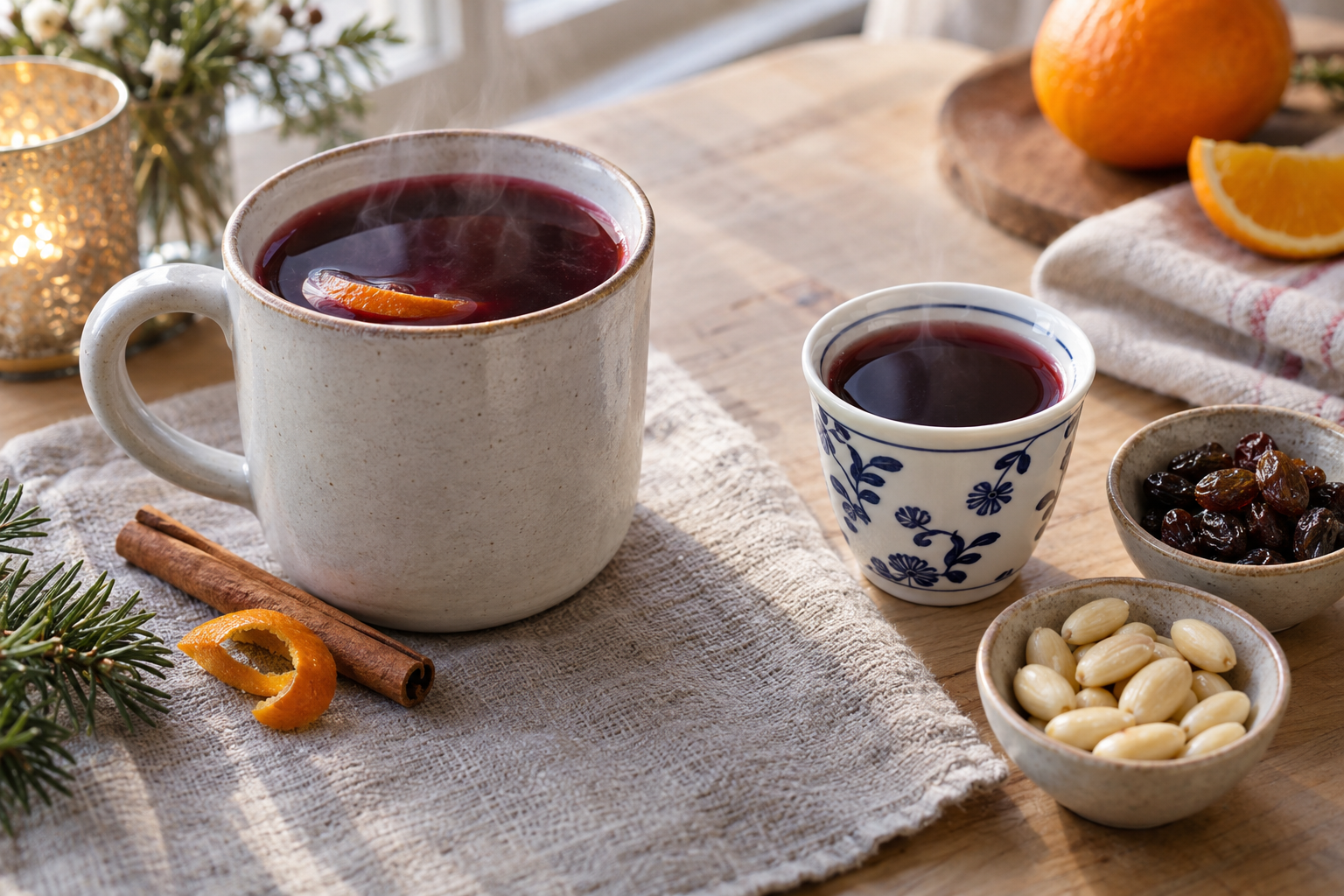
In today's glass, though, the difference is usually easy to taste. A classic red Glühwein is wine-based, sweetened and spiced, often with a pronounced citrus note. Swedish Christmas glögg is often sweeter and may have a more intense spice profile, with cardamom and ginger, for example. Fortified glögg can also be higher in alcohol. But these are typical characteristics, not universal rules: mild glögg and very sweet Glühwein both exist.
The way they are served sets them apart, too. Swedish glögg often comes with raisins and almonds, small cups and something to nibble. At a German Christmas market, Glühwein is more likely to arrive in a generous mug, without the Swedish garnish. An added shot of spirits is often ordered as mit Schuss. It is an optional extra, not an essential part of the basic drink, and is not needed for a full flavour.
There is even a present-day legal distinction between the freedom of traditional home cooking and the names permitted for a commercial product. EU rules describe Glühwein as an aromatised wine-based drink made from red or white wine, flavoured mainly with cinnamon and/or cloves. This tells us something about today's product category, not exactly what every historical recipe looked like. Our alcohol-free version is therefore explicitly called a modern alcohol-free variation, not historical Glühwein.
Warm the wine, don't boil away its character
Start with a wine that is fruity and pleasant to drink on its own. It need not be expensive, but pronounced tannins and heavy oak can be awkward alongside citrus and cloves. A supple red wine with fresh acidity gives you more room to work. Acidity brings the sweetness to life; sugar softens both the wine's tartness and the sharp edges of the spices. Neither should disappear entirely.
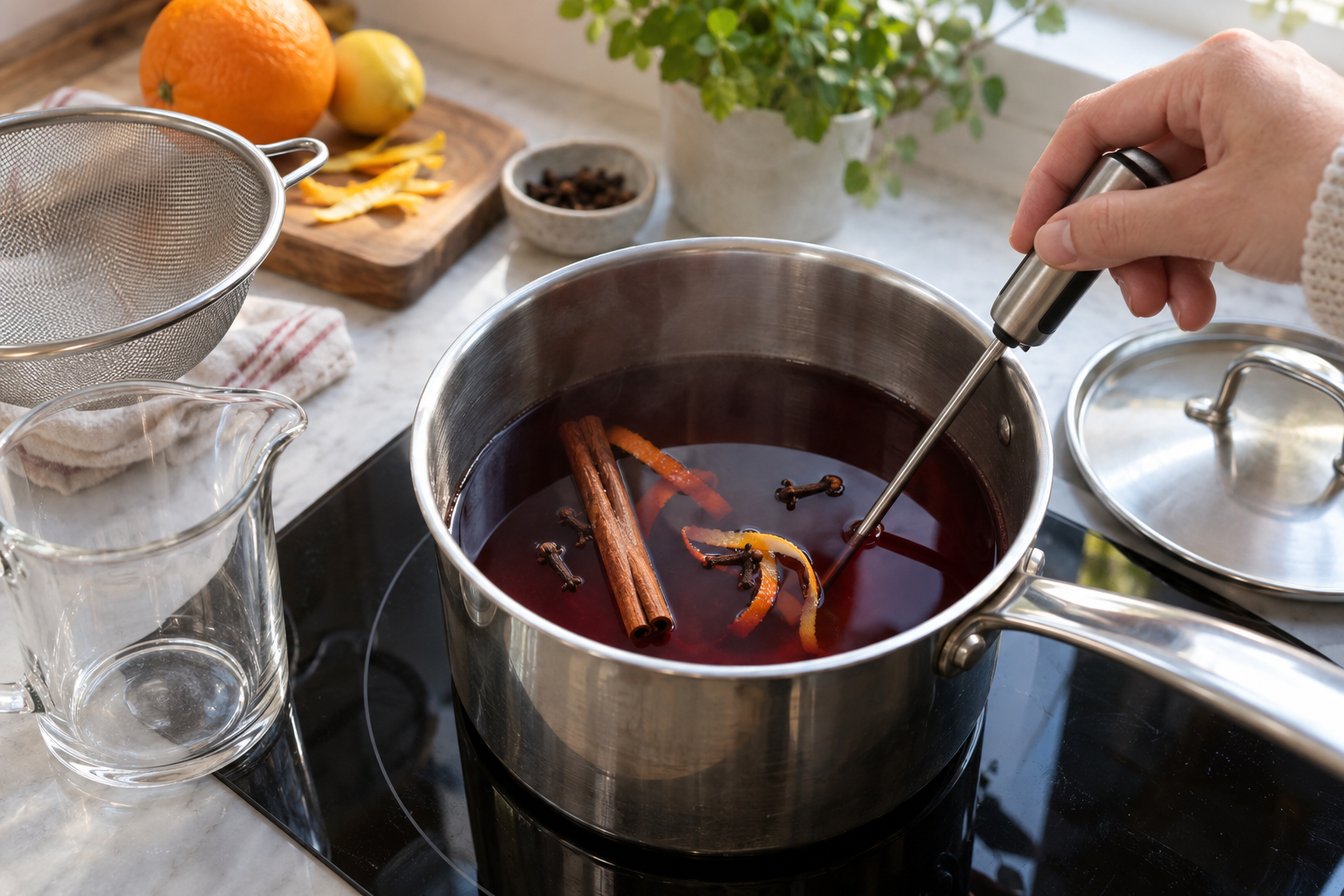
Cinnamon lends a warm, sweet-smelling aroma without actually replacing sugar. Cloves are far more assertive and can quickly take on an almost medicinal character. Use whole spices so they can be strained out easily. Lemon peel contributes bright, volatile aromas, while too much white pith can add bitterness. In the modern red version, orange brings a rounder fruitiness. That is a flavour choice, not a requirement for authenticity.
Nor should historical instructions automatically be treated as the best modern technique. Older recipes may call for bringing the wine to the boil. Here, instead, we keep the drink at around 70–75°C and let it infuse under a lid. That is hot enough for pleasant serving and spice extraction, but gentler on the aromas of the wine and citrus. A kitchen thermometer is far more useful than waiting for bubbles around the edge of the pan.
Longer is not always better. After about 15–20 minutes, taste the drink and, usually, strain out the spices. Keeping it warm with cloves and peel still in it can make it bitter and heavy. Better to warm a smaller amount at a time. And remember: heated wine still contains alcohol. Steam rising from it, or even a spell of boiling, does not make it a reliably alcohol-free alternative.
Something crisp, something spiced, room for everyone
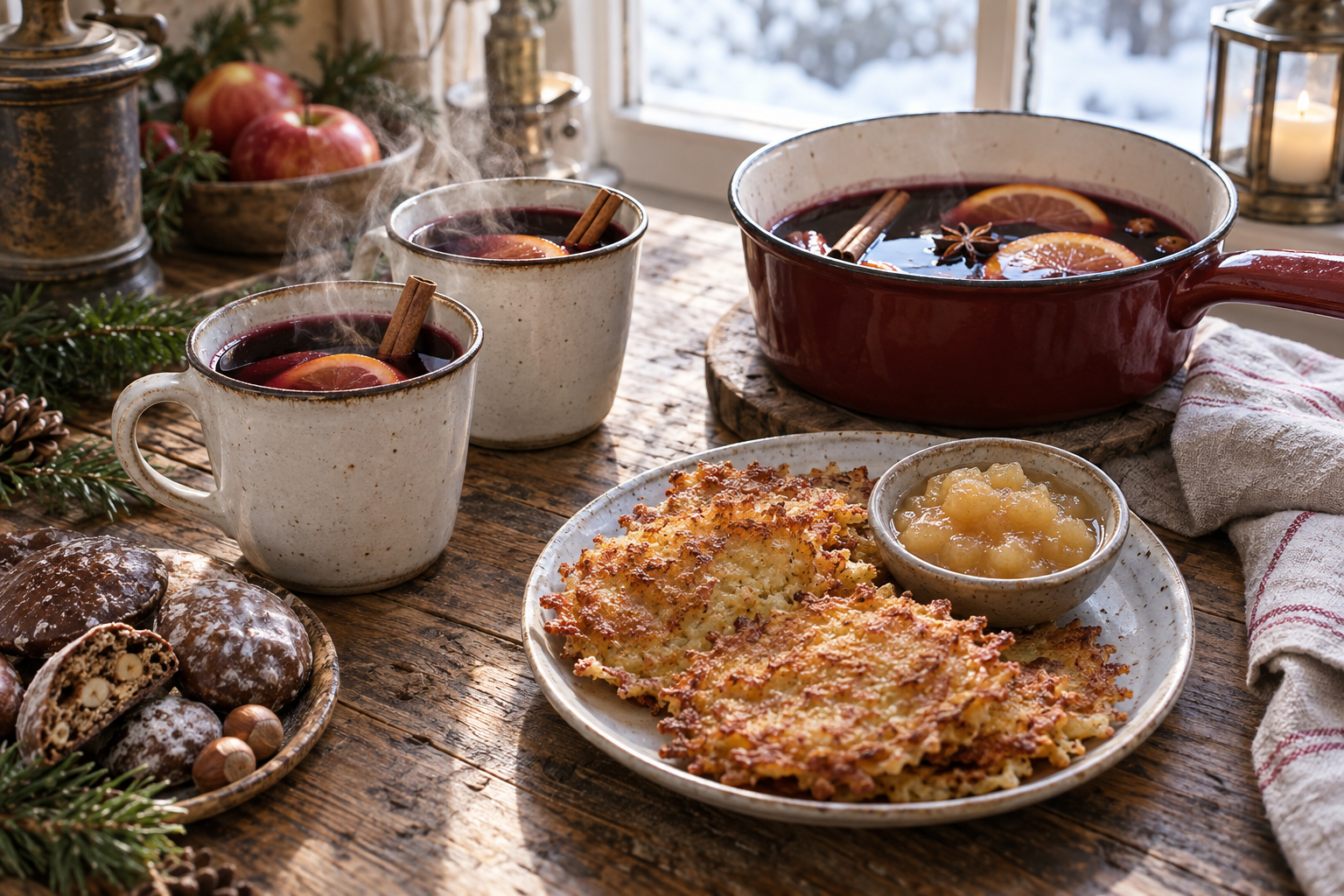
At today's Christmas markets, the sweet drink often meets salt and fat: sausages, fried potatoes and bread. Small potato pancakes, similar to German Kartoffelpuffer or Reibekuchen, are especially appealing. A crisp surface and soft centre provide a contrast to the warm wine. Tart apple sauce connects the potatoes with the citrus and keeps the combination from feeling too heavy. Not all potato pancakes are the same dish, however; regional names and accompaniments vary.
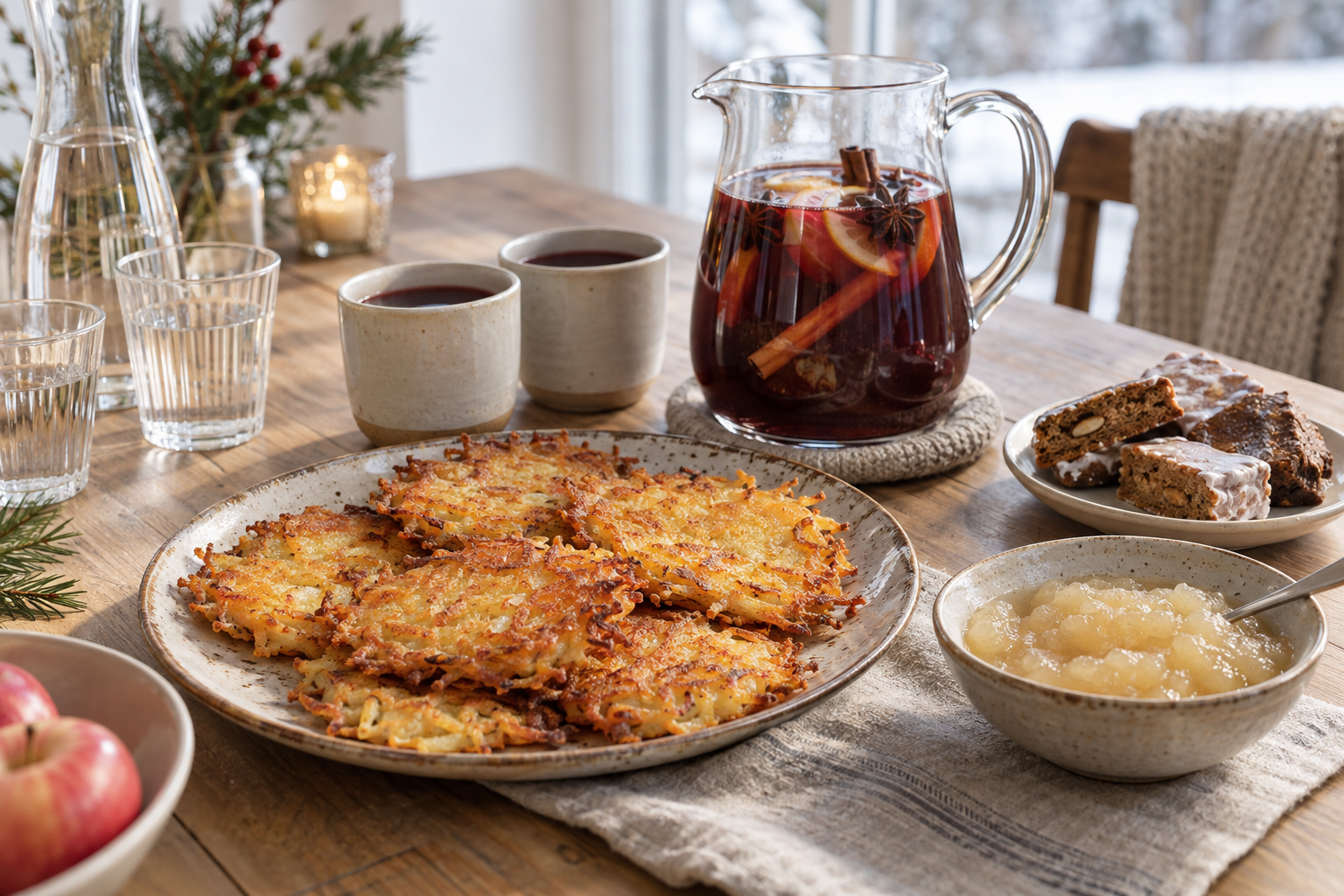
Lebkuchen offers a different kind of pairing. The spices in the bake echo those in the mug, but the sweetness needs balancing. Alongside very sweet, iced biscuits, a lightly sweetened warm wine can seem harsh and thin. Choose a small piece of moderately sweet Lebkuchen instead, preferably with nuts, or serve it with coffee. Nuremberg's famous tradition is important, but Lebkuchen is a broader family than any one city's recipe.
The alcohol-free jug deserves an equally natural place on the table. Dark grape juice brings fruit and body, tart unfiltered apple juice lightens it, and lemon helps if the juice is very sweet. It usually needs no extra sugar. The same gentle heating works here, but the flavour is deliberately juice-based: fresh, spiced and distinctive, rather than an exact imitation of wine.
At home in Sweden, all you need is a saucepan, a strainer and a few everyday supermarket spices. The recipe card brings together a historically inspired reconstruction, a contemporary red version and a clearly alcohol-free alternative. Taste after infusing, adjust the sweetness a little at a time and serve small amounts that can be topped up. Drink alcohol in moderation, offer water and let no one feel they have to explain why the alcohol-free mug suits them best.
Three Advent Jugs: Historically Inspired Glühwein, Modern Red and Alcohol-Free
Choose one of the three ingredient groups; each version makes four small servings. The historical version reconstructs the flavour combination in a late-19th-century edition of Henriette Davidis's cookbook, here the 1898 edition: red wine, sugar, cinnamon, cloves and lemon peel. Quantities, temperature and infusing time are modern kitchen adaptations, not a verbatim reproduction. The other two versions are modern recipes.
Ingredients
Method
- 1Choose A, B or C. Do not combine the three ingredient groups. Use a stainless-steel or enamelled saucepan with a lid, and have a kitchen thermometer to hand.
- 2For A: wash the lemon and thinly pare off the yellow peel. Put the peel, wine, 50 g sugar, cinnamon and cloves in the pan.
- 3For B: wash the orange. Pare off two broad strips of orange peel with very little white pith and squeeze 0.5 dl juice. Put the peel, juice, wine, 40 g sugar and spices in the pan. Save the rest of the orange for another use.
- 4For C: wash the lemon and thinly pare off the yellow peel. Combine the grape juice, apple juice, water, lemon peel and spices in the pan. Leave the lemon juice until later and do not add any sugar.
- 5Slowly heat your chosen mixture to 70–75°C, usually 8–12 minutes. Stir gently to dissolve any sugar. The drink should not simmer or boil.
- 6Cover and leave to infuse for 15 minutes over the lowest heat or with the heat turned off. Check the temperature; heat briefly if needed without exceeding 75°C. Taste and infuse for no more than another 5 minutes if the spicing is too mild.
- 7Strain out the spices and peel. Taste a cooled spoonful: adjust A or B with 5–10 g sugar at a time, within the quantities specified. Adjust C with 1 tsp lemon juice at a time until the fruit tastes fresh and bright. Dilute with a little water if the juice is still too sweet.
- 8If needed, gently reheat to around 70°C and divide between four heatproof mugs. Allow to cool to a comfortable drinking temperature. Clearly label the alcohol-free jug if serving several versions at once.
- A pairs well with small, crisp potato pancakes and tart apple sauce; B with moderately sweet Lebkuchen; C with potato pancakes, salted nuts or mild cheese.
- If dark grape juice is unavailable, red grape juice works well. Choose an alcohol-free unfiltered apple juice with pronounced acidity; sweeter juice may need more lemon.
- Feel free to prepare it earlier the same day: strain after infusing, cool quickly and refrigerate, covered. Reheat only the amount you plan to serve and use within two days.
- Heating does not make wine alcohol-free. Choose C for anyone avoiding alcohol, and serve the alcoholic versions in moderation.
What goes with the glass
- FoodWith the 19th-century version: small potato pancakes with tart apple sauceThe wine's acidity contrasts with the crisp potatoes and frying fat. The fruit in the apple sauce connects with the lemon peel and spices; sweeten the sauce sparingly so the drink does not taste harsh.
- FoodWith contemporary red Glühwein: spiced Lebkuchen with nutsCinnamon and cloves appear in both the bake and the drink, while the nuts provide a toasted counterpoint to the fruit. Choose a moderately sweet Lebkuchen without thick icing, and serve small pieces.
- FoodWith the alcohol-free grape and apple version: potato pancakes with crème fraicheThe juice's fruity sweetness works beautifully with salt, while the acidity of the apple and lemon provides a fresh contrast to fried potatoes and crème fraiche. The savoury accompaniment balances the drink better than a very sweet bake.
Sources
- Henriette Davidis, bearbetad av Luise Holle, Praktisches Kochbuch für die gewöhnliche und feinere Küche, utgåva 1898 (1898)
- Julia Harding, Jancis Robinson och Tara Q. Thomas, red., The Oxford Companion to Wine (2023)
- Alan Davidson; tredje upplagan redigerad av Tom Jaine, The Oxford Companion to Food (2014)
- Christopher Grocock och Sally Grainger, Apicius: A Critical Edition with an Introduction and an English Translation (2006)
- Europaparlamentet och Europeiska unionens råd, Europaparlamentets och rådets förordning (EU) nr 251/2014, bilaga II (2014)
- Svenska Akademiens ordbok, Glögg
Ask questions about "Glühwein – Christmas Market Warmth, Beyond the Glögg Myths". Answers are based on the magazine's own articles.