Heat with a History
Chilli’s journey from the Americas to India’s spice jars – and on to your kitchen
Chilli is not just about heat. It can taste of cherries, grass, citrus and smoke, turn a stew ruby red or make a simple potato dish sing. We follow the fruit that changed the world’s food and learn to control its heat without losing its flavour.
 By Priya NilssonReporter · Indian and South Asian cuisine – spices, regional dishes and street food
Translated from Swedish with AI assistance.
Go to the recipe ↓When chilli hits the pan
The mustard seeds begin to pop. A handful of curry leaves lands in the hot oil with a sizzle, and as the broken dried chillies follow, the kitchen takes on a new scent: nutty, warm, almost fruity. Then the potatoes must go in. Just a few moments separate fragrant spiced oil from blackened chilli that catches in your throat.
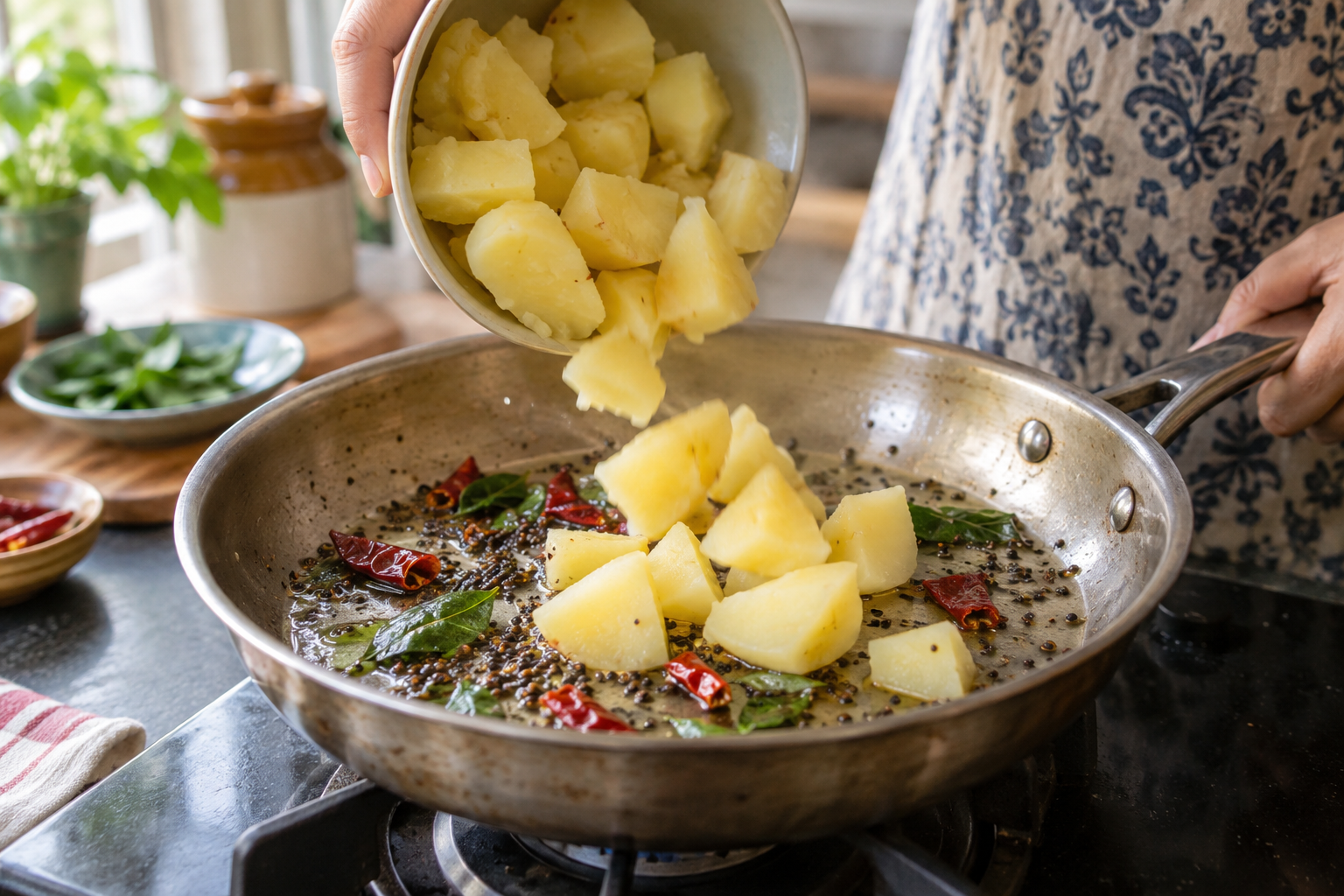
This is where I find chilli most interesting. Not as a challenge, not as a number on a bottle, but as an ingredient whose flavour depends on how we treat it. A green chilli simmered whole gives a different result from the same fruit finely chopped into a chutney. A mild red powder may matter more for its colour than its heat.
Yet we often talk about chilli as though it had just one quality: hot. And about Indian food as though it always had to be hot too. Both ideas sell the cuisine short. India has countless mild dishes, and chilli’s story actually begins on the other side of the globe.
A fruit from the Americas changes the world
All domesticated species in the genus Capsicum originated in the Americas. Chilli was grown and used there long before Europeans arrived. This was not a single discovery in a single place: different species have different cultivation histories in Mexico, Central America and South America, among other places. So describing chilli as an originally Indian spice is wrong, however integral it feels to Indian cooking today.

Following European voyages to the Americas from the late 15th century onwards, chilli was carried across the Atlantic. During the 16th century, Portuguese trading networks in particular helped spread it along the coasts of Africa and onwards to Asia. It reached India through this early modern maritime world, in which Goa became an important Portuguese hub. As for the exact year the first chilli plant took root on Indian soil, I would not pretend to know.
Chilli did not arrive in a flavourless kitchen. Black pepper, long pepper, ginger and mustard already gave food various kinds of pungency. The new fruit offered another sort of heat, but also colour, aroma and the option of using it both fresh and dried. It could also be grown in many warm regions and eventually became an everyday ingredient far beyond the trading cities.
Its spread was neither instant nor uniform. Local growing conditions, trade routes and eating habits shaped its use. Today’s fiery Indian dishes are therefore not evidence of an unchanged, ancient tradition. Rather, they show how skilfully a cuisine can embrace something foreign and make it its own. Similar transformations took place in Thailand, China and Korea, among other countries.
One word, many different flavours
In an Indian grocery shop, the differences can seem confusing at first. The bags are all red, but their contents serve different purposes. Kashmiri chilli is often sold for its vivid colour and relatively mild heat. It is useful when you want a deep red sauce without overwhelming heat. But the name on the bag is no laboratory guarantee: variety, growing conditions and the particular product can all make a noticeable difference.
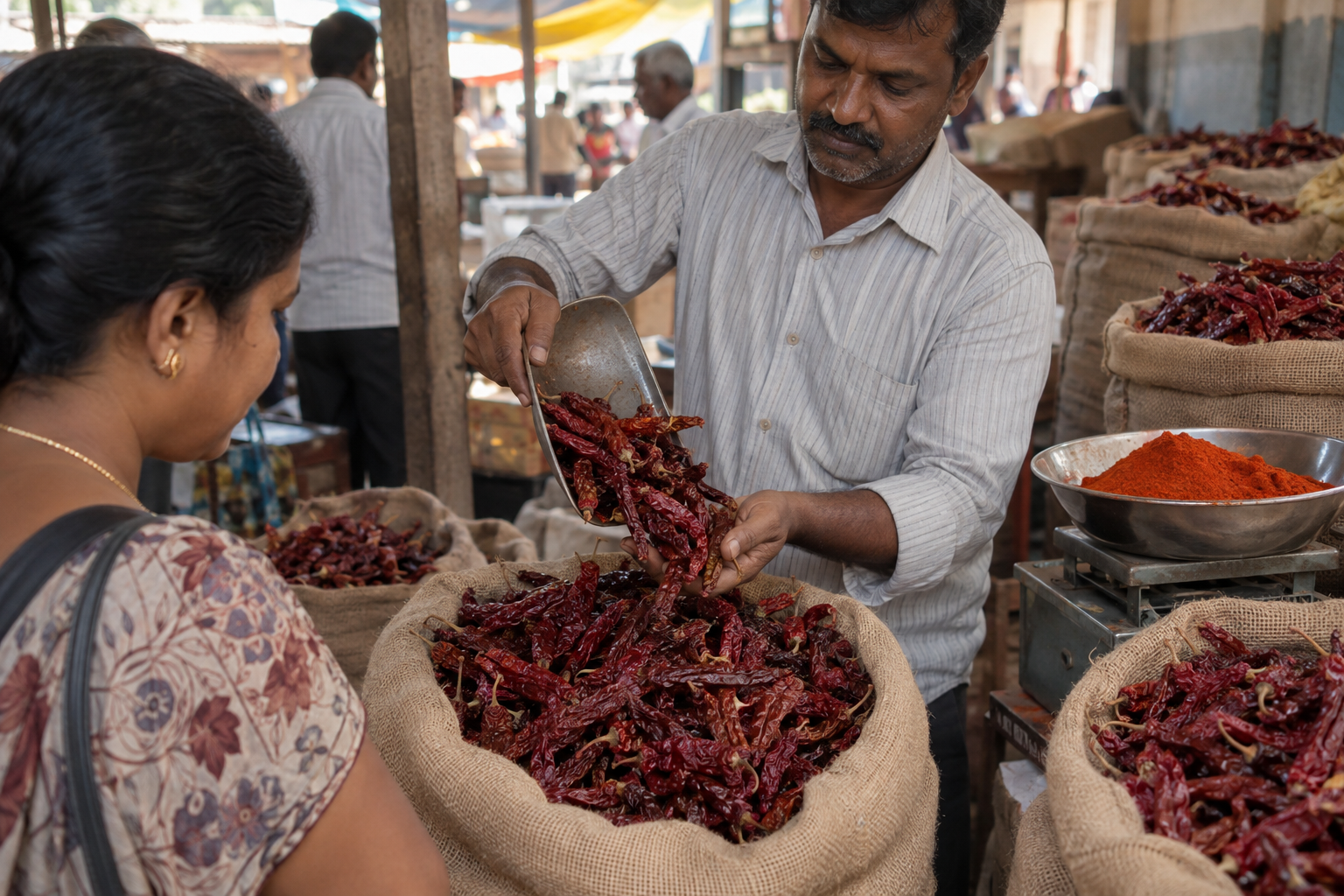
Byadgi, associated with Karnataka, is also prized for colour and aroma and is often relatively mild. Guntur in Andhra Pradesh is an important chilli centre, and several chilli types from there are considerably hotter. Neither Guntur nor the word “Indian”, however, indicates a precise heat level. Read the product description and start cautiously when opening a new bag.
North-eastern India is home to bhut jolokia, among other chillies, known for its extremely high heat. It belongs to regional food traditions, not just online heat challenges. Here it becomes particularly clear why a recipe calling for “two chillies” may not be specific enough. In practice, two mild red chillies and two extremely hot ones amount to very different quantities of an ingredient.
The everyday red chillies in Swedish produce aisles can also vary enormously. Small green chillies often have a fresh, green aroma and can be very hot. Jalapeño is generally fuller-flavoured and grassier, while habanero can have a distinctly fruity fragrance behind its fierce heat. Size alone does not reveal heat level, and colour tells you mainly about variety and ripeness, not how cautious you need to be.
My advice is to build a small flavour store, not a trophy collection: a mild red powder, a moderately hot whole dried chilli and a fresh variety you get to know. That lets you distinguish between colour, aroma and heat as you cook. Smoked chilli is delicious, but the smoke changes a dish’s character and is not a neutral substitute.
Why it burns – and what actually helps
Chilli’s heat comes from capsaicinoids, of which capsaicin is the best known. Among other things, they activate the TRPV1 receptor, which also responds to damaging heat. This is why your mouth can feel as though it is burning even when the food is not particularly hot in temperature. Chilli heat is therefore not a basic taste like sweetness or saltiness, but a chemically triggered sensation.
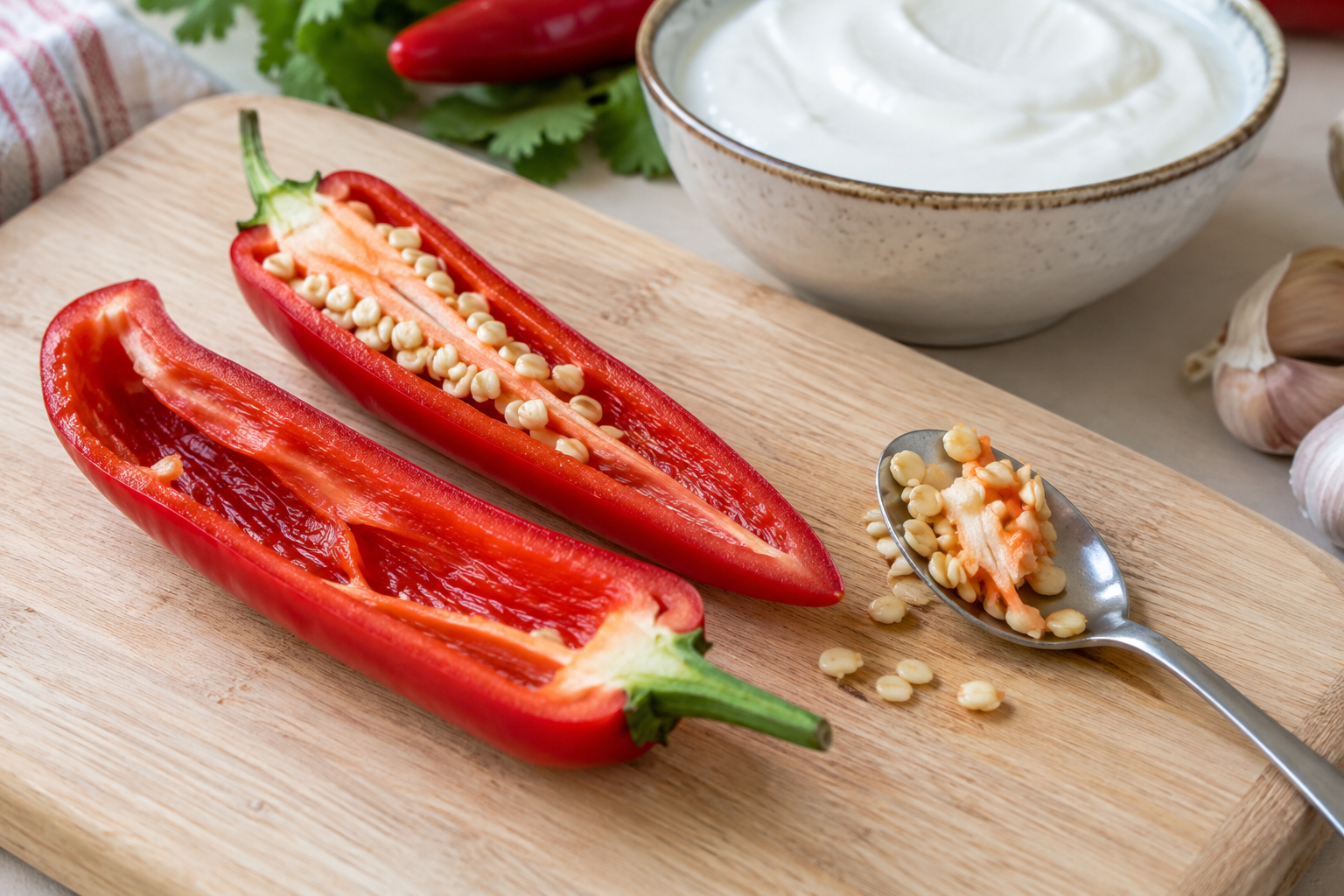
The myth that all the heat is in the seeds is persistent. Capsaicinoids are produced mainly in the tissue to which the seeds are attached: the pale inner parts often called membranes. The seeds can become coated with these compounds. Scraping out both membranes and seeds can therefore reduce the heat, but it will not automatically make an extremely hot chilli mild.
The Scoville scale describes heat, not quality. Wilbur Scoville’s original method, developed in 1912, involved diluting a chilli extract until a tasting panel could no longer detect the heat. Today, capsaicinoids can be measured using instruments and the results expressed in Scoville units. Even so, the figures should be treated as a guide: growing conditions, ripeness and variation between individual fruits affect the content.
If the burning becomes too much, water often does little to help, because capsaicin is fat-soluble and dissolves poorly in water. Milk or yoghurt can offer better relief; both composition and temperature play a part. Plain yoghurt at the table is therefore more than decoration. In the cooking pot itself, the most reliable rescue is to dilute the dish with more of its other ingredients. Sugar and acidity can balance the sensation, but they do not remove the capsaicin.
Heat is also a matter of technique
In many Indian kitchens, spices are added to hot fat to release and distribute their aromas. The technique goes by several regional names, including tadka, and is also known as tempering. Dried chilli may be included alongside mustard seeds, cumin or curry leaves, for example. The fat carries both aroma and heat throughout the food. That is why just a few carefully handled chillies can make their presence felt in a whole pan.
But chilli should not be charred. Whole dried chillies generally need only a brief spell in the oil; powder burns even faster. Lower the heat or move the pan aside before adding the powder, and have the next ingredient ready. Turn on the extractor fan. Smoke from burnt chilli is an irritant, not a sign of successful seasoning.
Fresh chilli, meanwhile, can be left to simmer in a dish, ground into a spice paste or added towards the end for a fresher flavour. A whole, uncut chilli generally releases its heat more slowly than a finely chopped one. Tangy pickles, coconut-based accompaniments and yoghurt offer further ways to work chilli into a meal. The main dish need not carry all the heat.
There is also an important regional distinction here: Indian food is not a single recipe with varying amounts of chilli powder. In parts of the south, chilli often meets curry leaves, mustard seeds and tamarind; elsewhere, it works with yoghurt, nuts or warm, aromatic spices. A meal can be hot, mild, tangy and cooling all at once. Being able to taste everything is more interesting than being able to withstand the most heat.
Finding the balance at home
In Sweden, fresh chillies are available in almost every supermarket, while Indian and other South Asian grocery shops often stock Kashmiri powder, whole dried varieties and frozen curry leaves. Curry leaves come from a particular tree and cannot be replaced with curry powder. If you cannot find them, leave them out rather than substitute at random. Frozen leaves work well; fresh ones should be dry on the surface before they hit hot oil.
Ordinary paprika mixed with a little cayenne can mimic a mild chilli powder’s combination of colour and heat, though not its exact aroma. Check the ingredients list too: a product labelled “chili powder” may be pure ground chilli or a spice blend. Store dried chilli somewhere dark and dry, in an airtight container. Once its aroma has turned dusty, adding more rarely improves the food.
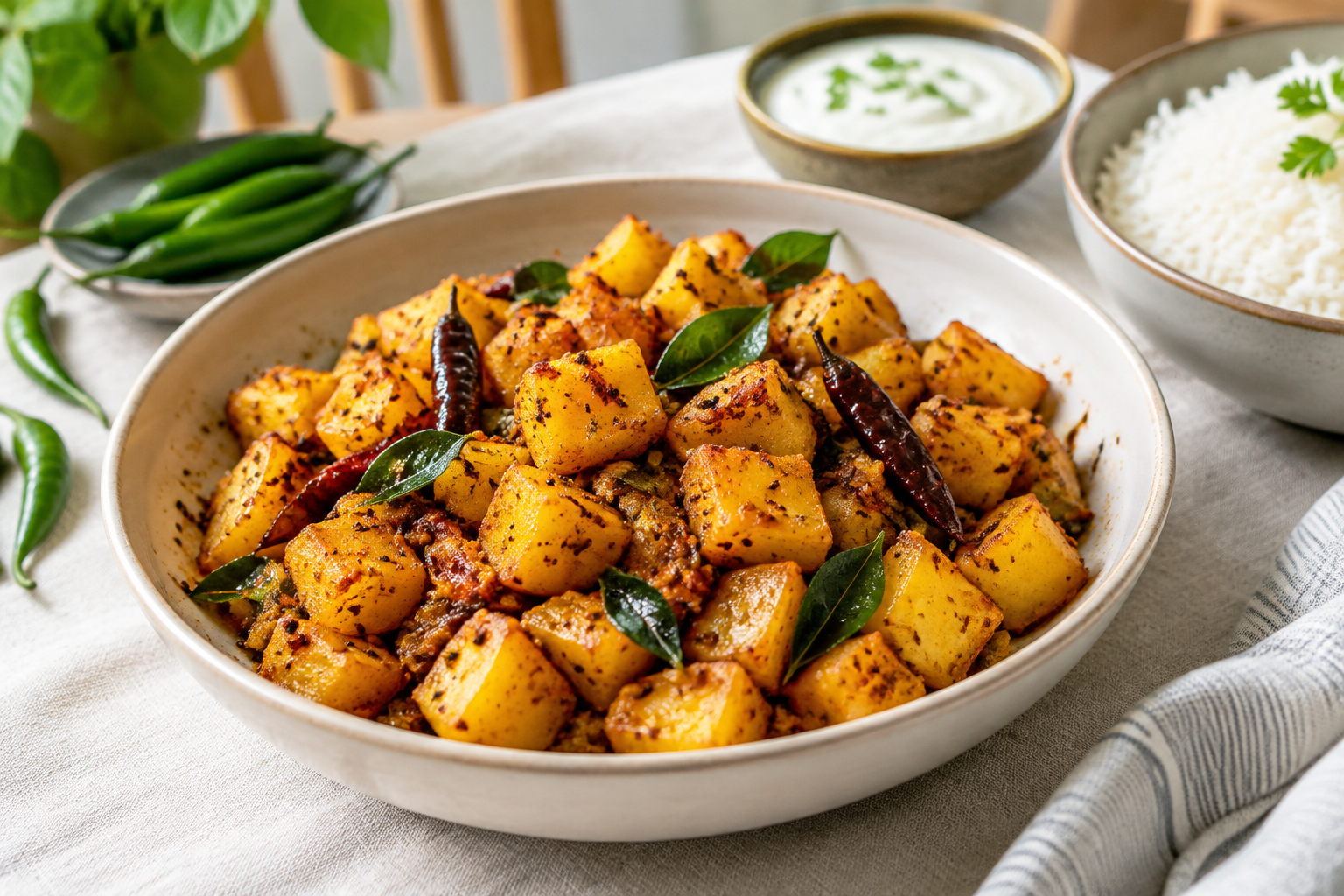
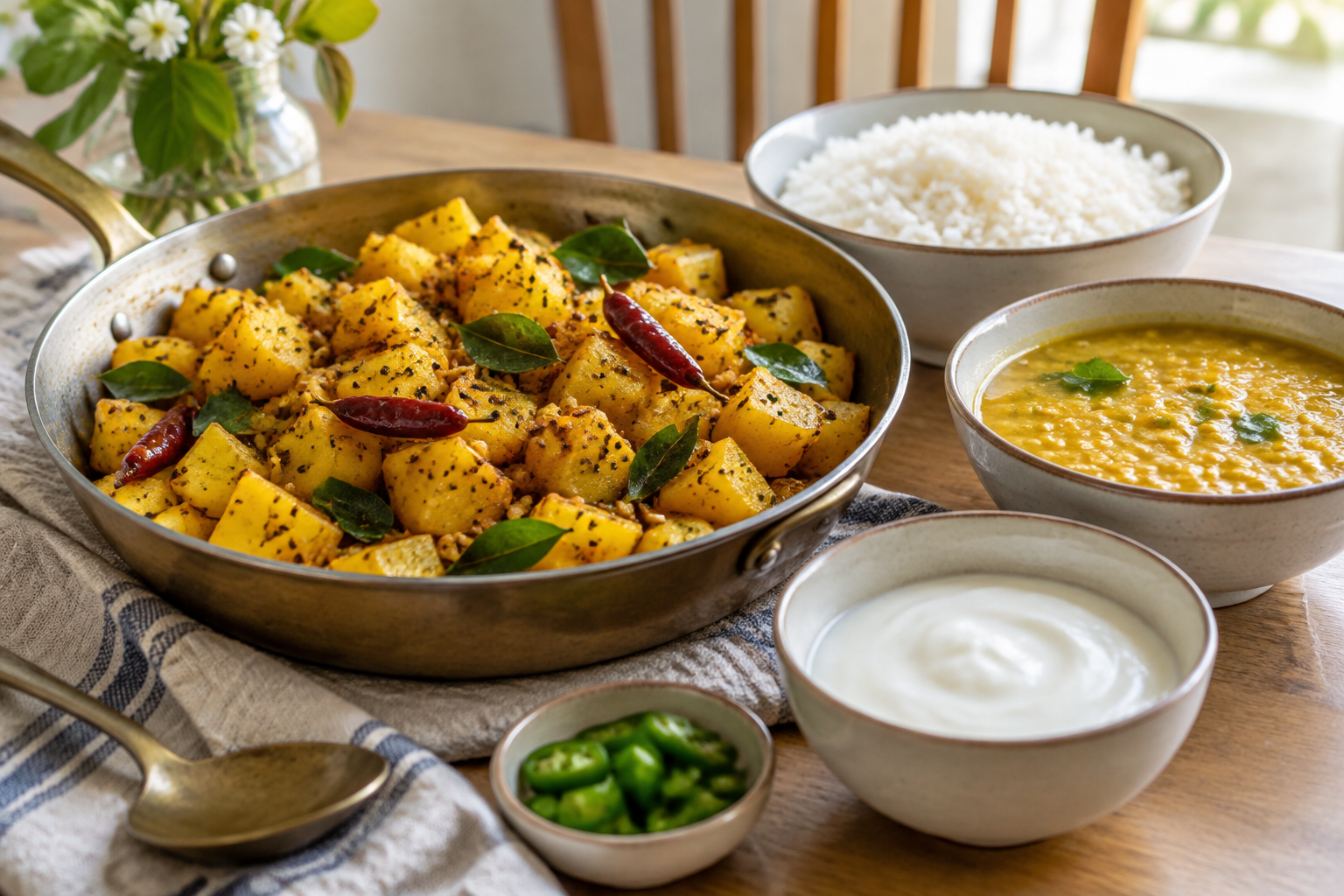
The recipe here is my everyday potato pan-fry with South Indian flavours, not a claim to any single classic regional version. The potatoes’ mildness lets you taste what the chilli actually does. Serve with rice, lentils and yoghurt, and offer extra chilli on the side. Wear gloves when handling very hot varieties and avoid touching your eyes. Hospitality means giving people a choice, not surprising them with maximum heat.
Potatoes with Chilli, Mustard Seeds and Curry Leaves
An everyday potato pan-fry with South Indian flavours. Mild red chilli adds colour, while fresh green chilli lets you adjust the heat. Serves four as part of a meal with rice and lentils.
Ingredients
Method
- 1Peel the potatoes if the skins are thick and cut into roughly 2 cm pieces. Place in a saucepan, cover with water and salt lightly. Bring to the boil and simmer for 8–12 minutes, until almost tender but still holding their shape.
- 2Drain the potatoes and leave to steam-dry for 5 minutes. Meanwhile, cook the rice according to the packet instructions. Warm the lentils separately with a splash of water before serving.
- 3Thinly slice the onion. Finely chop the green chilli; remove the membranes for less heat, or leave it out altogether. Have all the spices ready before you start frying. Make sure the curry leaves have no surface water or loose ice crystals.
- 4Heat the oil over a medium-high heat in a large frying pan. Add the mustard seeds. When they begin to pop, after about 30–60 seconds, add the cumin seeds, curry leaves and dried chilli, broken into two pieces. Fry for 10–20 seconds. Stand back, as the leaves may splutter.
- 5Add the onion and green chilli, if using. Reduce the heat to medium and fry for 6–8 minutes, stirring, until the onion has softened and taken on a little colour.
- 6Take the pan off the heat. Stir in the chilli powder and turmeric, then immediately fold in the potatoes and salt. Return to a medium heat.
- 7Fry for 10–12 minutes. Turn gently a few times, leaving the potatoes undisturbed in between so they develop golden surfaces. If the spices stick before the potatoes have coloured, add 1–2 tbsp water and gently loosen them.
- 8Season to taste with lemon juice and more salt if needed. Scatter over the coriander. Serve with rice, warm lentils and yoghurt. Let everyone know that the large pieces of dried chilli are mainly there for flavour and can be left on the plate.
- Replace 1 tsp Kashmiri chilli powder with 0.75 tsp mild paprika and a small pinch of cayenne. Taste before adding more.
- The potatoes can be boiled the day before. Cool them quickly and refrigerate; cold potatoes may need a few extra minutes in the pan.
- For an entirely plant-based meal, choose unsweetened plant-based yoghurt.
- Choose a larger pan rather than a higher heat. Crowding steams the potatoes, while excessive heat burns the spices.
What goes in the glass
- Alcohol-freeMild plain lassiYoghurt thinned with cold water and a pinch of salt brings cooling freshness and tang to the golden potatoes and spices. Keep it mild rather than adding extra heat.
- Alcohol-freeAlcohol-free pale lager with low bitternessA light maltiness complements the fried potatoes. Choose low bitterness to avoid giving the chilli an unnecessarily sharp companion.
- WineLow-alcohol Riesling with a little residual sweetnessFresh acidity echoes the lemon, while a hint of sweetness balances the sensation of heat. High alcohol, on the other hand, can intensify the burning feeling.
Enjoy alcohol in moderation. Alcohol-free options go just as well with the food.
Sources
- K. T. Achaya, Indian Food: A Historical Companion (1994)
- Jean Andrews, Peppers: The Domesticated Capsicums (1984)
- Harold McGee, On Food and Cooking: The Science and Lore of the Kitchen (2004)
- Paul W. Bosland och Eric J. Votava, Peppers: Vegetable and Spice Capsicums (2012)
- Alan Davidson; tredje upplagan redigerad av Tom Jaine, The Oxford Companion to Food (2014)
Ask questions about "Heat with a History". Answers are based on the magazine's own articles.