Injera and doro wat – Ethiopia’s shared plate
Tangy bread, slow-cooked onions and a chicken stew that brings everyone together
On a bed of soft injera, the heat of berbere meets fragrant spiced butter and onions given time to mellow. Doro wat is celebration food with deep roots in Ethiopia – but the story of the shared plate also embraces the plant-based cooking of fasting days, lovingly offered mouthfuls and the art of coaxing bubbles from a tiny grain.
 By Sofia HaddadReporter · Middle East, Africa and Latin America – mezze, tagine, injera, mole and much more
Translated from Swedish with AI assistance.
Go to the recipes (2) ↓A bread that doubles as a table
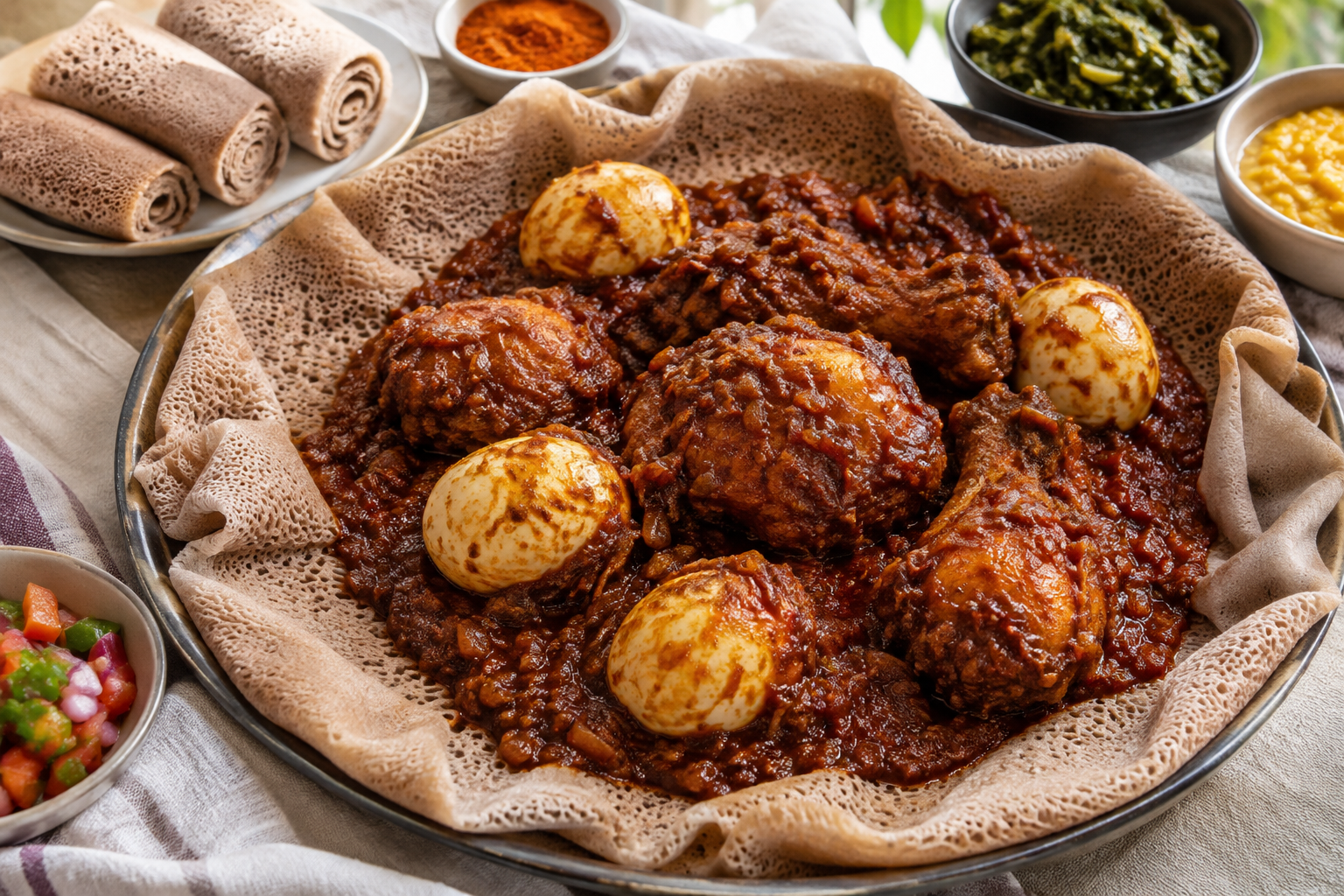
First comes the aroma: onions that have slowly lost their sharpness, warm spiced butter and chilli with an almost fruity sweetness. Then the stew comes into view, deep brick-red and glossy around the edges. A boiled egg sits half-submerged in the sauce. Beneath the chicken lies injera, soft and full of tiny holes, already beginning to soak up everything that makes doro wat so eagerly anticipated.
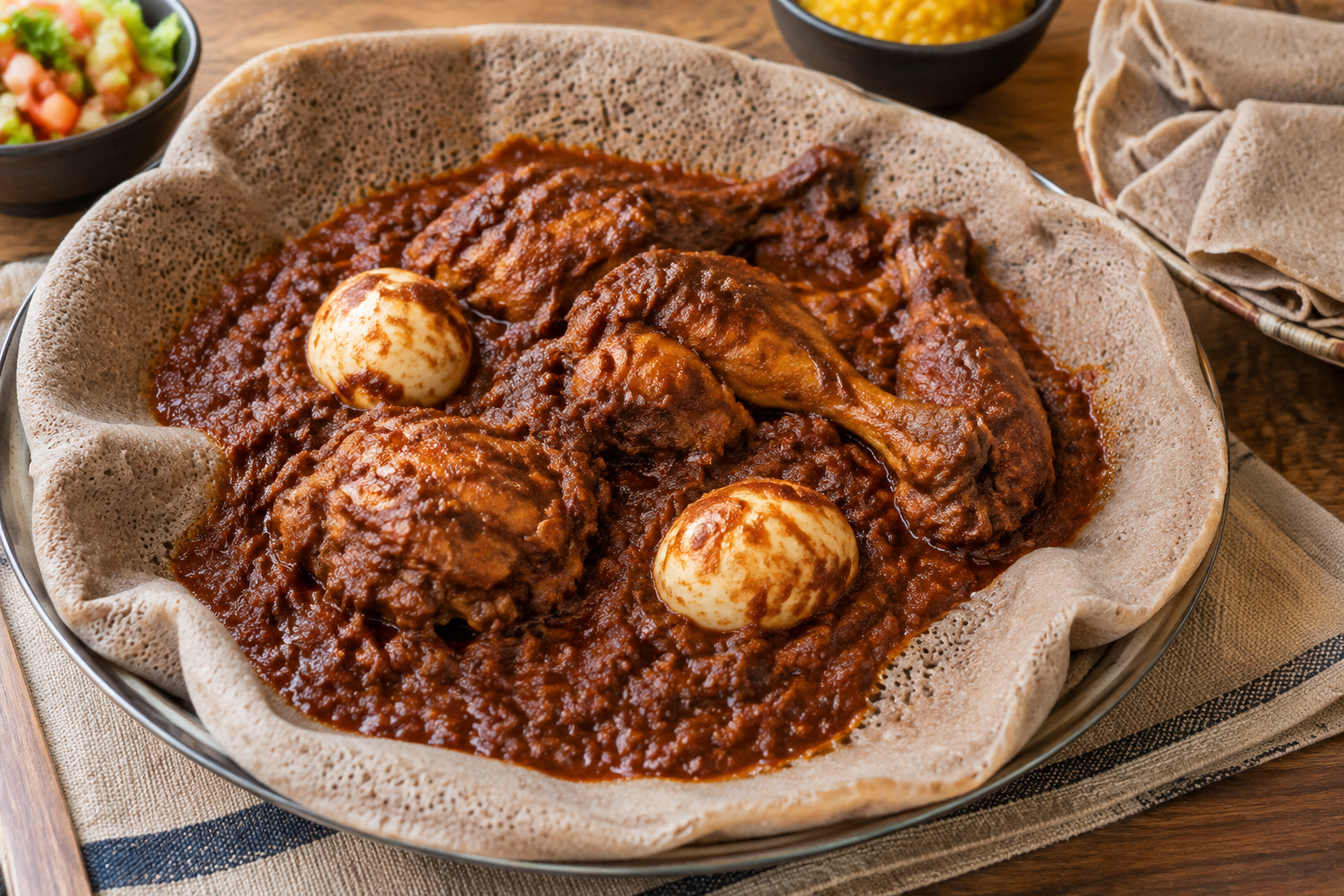
Tear off a piece of bread, fold it around a little sauce and chicken, and lift. The tang comes first, then the sweetness of the onions, the warmth of the spices and the mellow richness of butter. The bread is both accompaniment and utensil, but it is also part of the dish’s balance of flavours. Without its acidity and suppleness, this would be a different meal.
On a shared platter, the boundary between my sauce and yours is less clearly drawn. That does not mean everything is mixed together indiscriminately. People generally eat from the area in front of them, taking manageable mouthfuls. As the meal goes on, the bottom layer of injera becomes increasingly saturated. Here the flavours of the meal gather, and for many, this sauce-soaked bread is a particularly delicious way to finish.
Doro wat, also written doro wot, is a chicken stew closely associated with Ethiopian celebrations and hospitality. It may be presented as a national dish, but it does not sum up everything eaten in the country. Ethiopia encompasses many languages, landscapes, religions and food traditions. A shared platter of injera and stews is central to much of its food culture, without being everyone’s everyday meal.
It is worth holding both ideas in mind: the dish’s great symbolic importance and the cuisine’s remarkable diversity. Then the plate becomes not a simplified portrait of a country, but a way into a deeper understanding.
An ancient grain, a stew without a birth certificate
Teff has long been grown in the Horn of Africa and is particularly associated with Ethiopia and Eritrea. Its seeds are very small; the flour can range from pale grey-beige to brownish, depending on the variety. The flavour is mild yet distinctive, with grainy, nutty and sometimes lightly earthy notes. This is no new ingredient invented for the health-food shelf, but a crop with a long local history of cultivation and cooking.
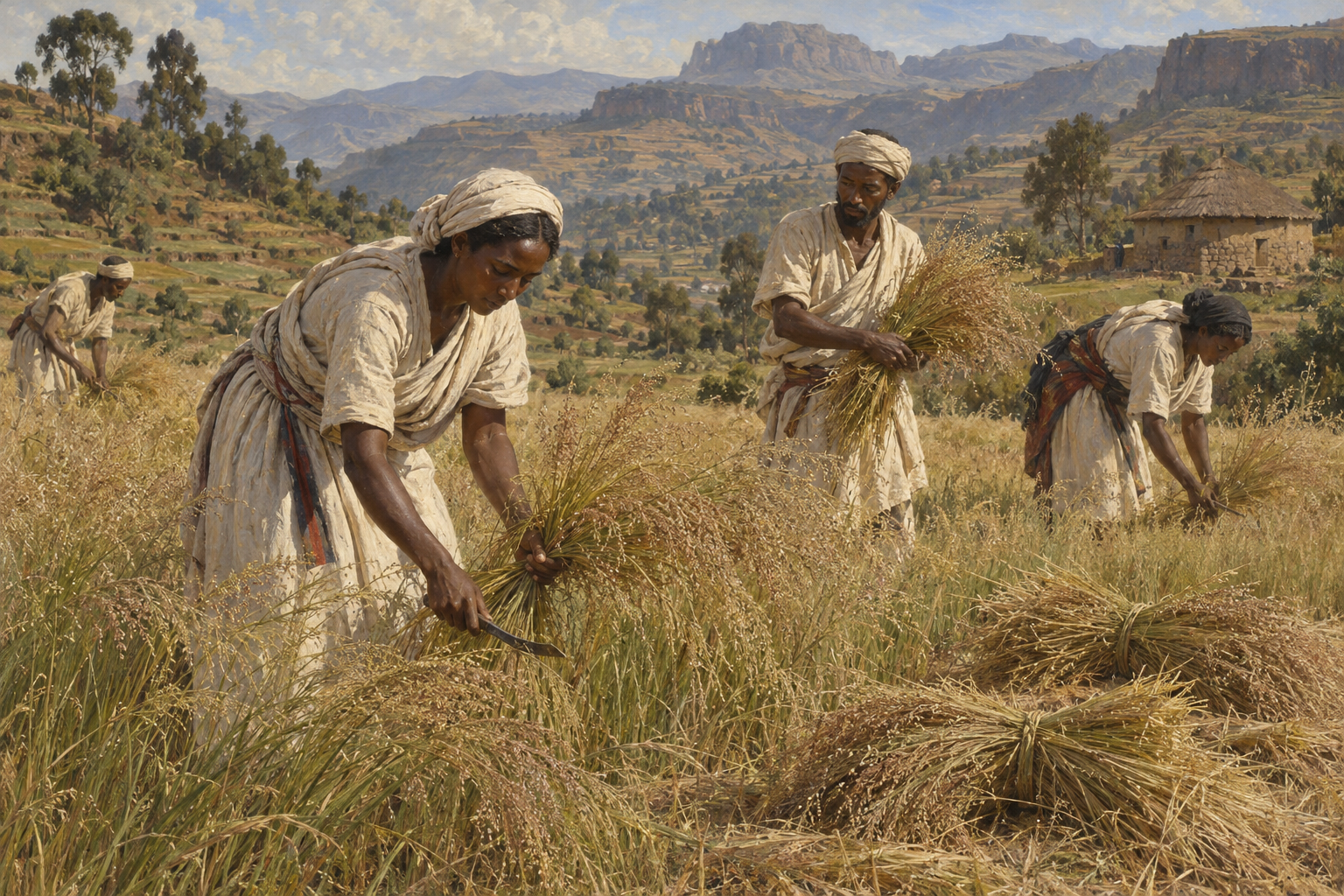
Exactly when teff was first cultivated is harder to establish than many popular accounts suggest. Claims that give very precise dates in antiquity should be treated with caution. It is safer to speak of the crop’s long history in the region and its established importance in highland farming and food culture. Likewise, there is no single year in which today’s injera can be said to have been invented.
Injera belongs to both Ethiopian and Eritrean food traditions. Teff is particularly prized, but the bread is also made with other grains and blends of flours. Availability, price, growing conditions and household preferences all influence the choice of flour. Injera made with barley, sorghum, maize or wheat need not, then, be a recent misunderstanding of a single, unchanging original.
Nor does doro wat have a reliably documented inventor or birthplace that can be pinpointed precisely. It is closely linked to highland food culture and has become widely established as Ethiopian celebration food. The chicken, the spices and the labour-intensive preparation make it well suited to occasions when a meal merits both resources and care.
One important historical detail lies in the stew’s red colour. Chilli originated in the Americas and could only spread to Africa following transatlantic contact from the late 15th century onwards. How and when a particular berbere blend took its present form is another question, and harder to date. But today’s chilli-led doro wat cannot simply be described as unchanged since antiquity.
That does not make the dish any less rooted in tradition. Food culture is rarely a closed archive. Trade routes, new crops and the movement of people change cuisines, while techniques and eating habits endure. The same process continues in Ethiopian diaspora kitchens today: flours are blended according to availability, chicken cuts chosen from what the shop stocks, and an electric griddle may take the place of earlier heat sources.
Injera’s little eyes
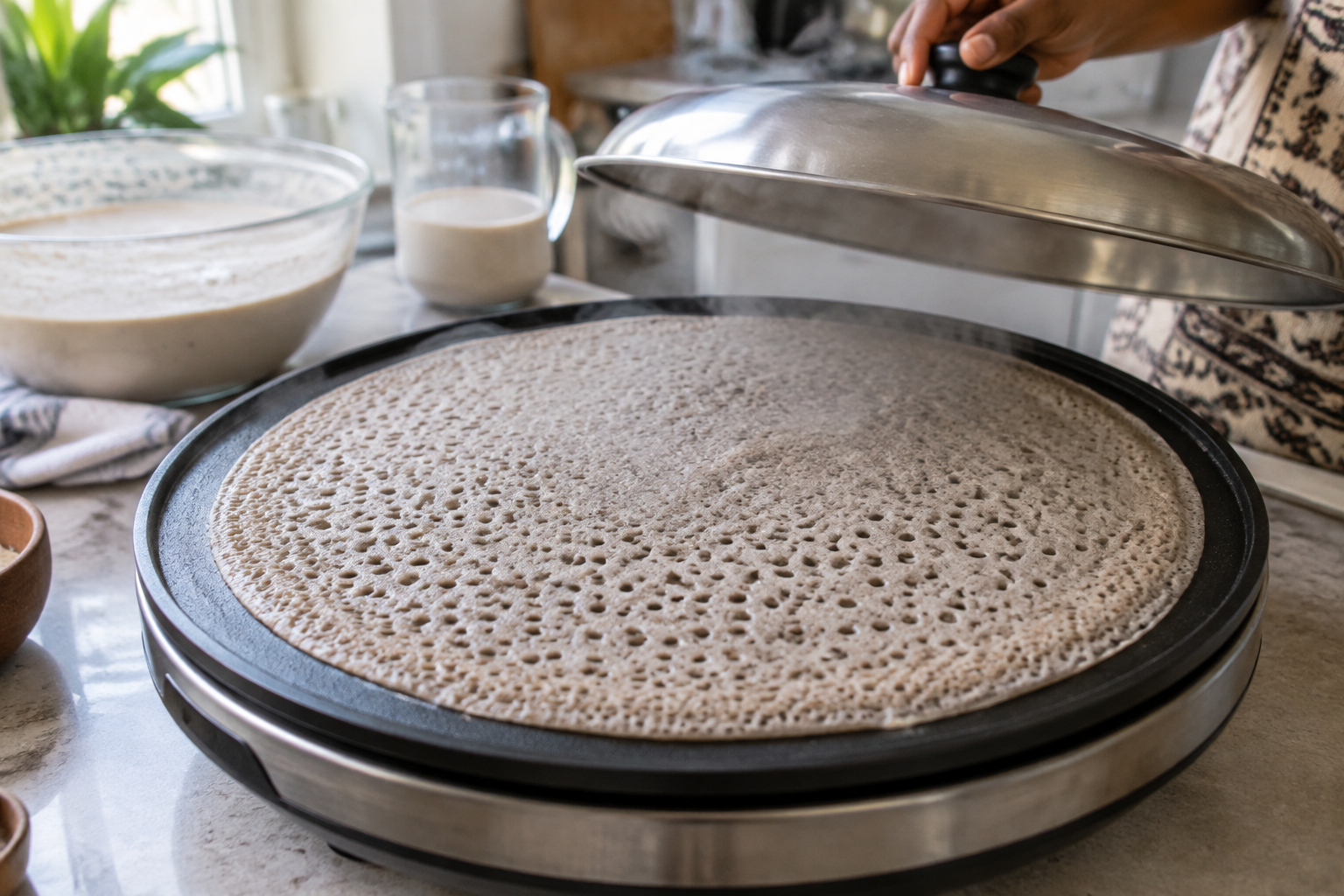
Good injera is neither a thin Swedish pancake nor a fluffy flatbread cooked in a frying pan. It is pliable, moist without being sticky, and covered with tiny pores, often described as the bread’s eyes. The underside should hold together when the bread is lifted, while the top should cook through without needing to be flipped.
In traditional preparation, a flour-and-water batter is fermented by a microbial culture containing both lactic acid bacteria and yeasts. Some of the liquid or culture from a previous batch, known as ersho, is often used. The process varies with temperature, flour, culture and household practice. A set number of hours therefore cannot tell the whole story of when the batter is ready.
Fermentation develops flavour and acidity and contributes to the bread’s structure. It is not simply waiting time that can be omitted without consequence. At the same time, making injera is a craft in which several elements work together. The right acidity will not help if the batter is too thick or the cooking surface too cool.
An important stage in many methods is absit: a small portion of batter is cooked with water into a starch paste, then returned to the main batter once it reaches a suitable temperature. The gelatinised starch helps shape the bread’s texture. The batter is then usually left to ferment further before cooking. Methods differ; not every household follows exactly the same proportions or sequence.
Traditionally, injera is cooked on a mitad, a large round griddle made in various materials and now also available in electric versions. The batter is poured over the hot surface and allowed to form bubbles before a lid helps the top cook through. The bread cooks on one side only. The aim is not a browned pancake surface, but a soft bread that can be torn and folded.
For a home cook in Sweden, it is useful to distinguish between full traditional fermentation and a shortcut. The recipe here uses teff, a little wheat flour and baker’s yeast, with a refrigerated rise and a small amount of vinegar for a more pronounced tang. A cooked portion of batter borrows the principle of absit. The result is a practical, mildly tangy everyday bread, not an exact equivalent of injera developed over several days with an established culture.
The wheat flour makes the bread easier to handle, but also means it contains gluten. Teff itself is gluten-free; that does not automatically make all injera gluten-free. The distinction is especially important when cooking for someone with coeliac disease.
Onions give the stew its body, berbere its direction
Doro means chicken in Amharic. Wat refers to a family of stews, often built on a thoroughly cooked onion base. In doro wat, onions are so central that they should almost be regarded as a sauce ingredient rather than something simply fried before the real cooking begins.
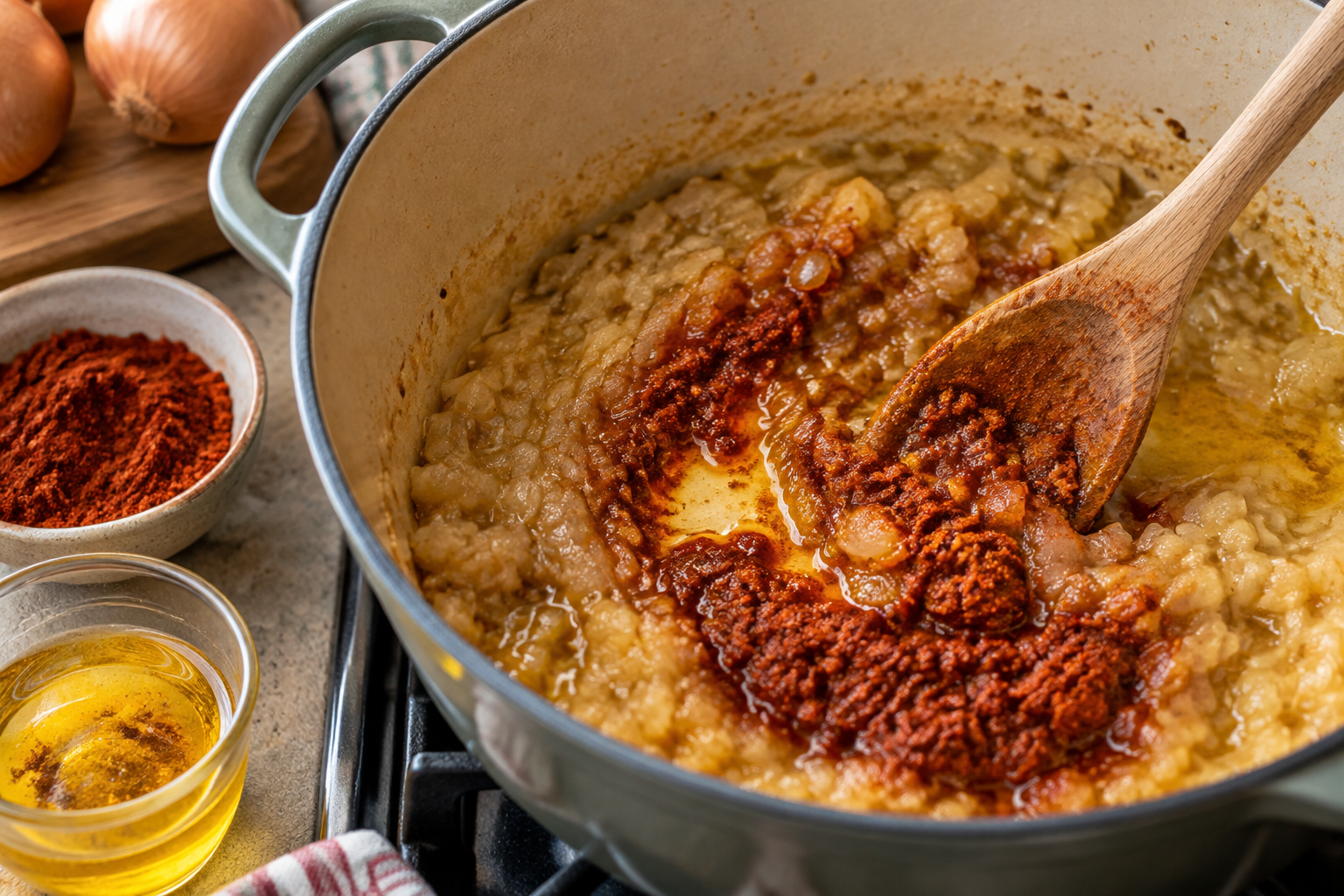
Finely chopped onions are often heated first without added fat. They release liquid, collapse and are then slowly concentrated. This needs attention: moisture-rich onions can be simmering gently one moment and beginning to stick the next. A splash of water and a scrape along the bottom of the pot are better than letting bitter, burnt patches find their way into the sauce.
The aim is not necessarily the same dark caramelisation sought for French onion soup. The goal is a very soft, concentrated mass with none of the raw sharpness left. With fat, spices and further cooking, the onions become the very body of the stew. A blender may be tempting, but completely puréed onions behave differently from finely chopped ones. If using a food processor, short pulses are a good starting point.
Berbere supplies the red colour and much of the aroma. It is a spice blend, not simply another word for chilli powder. Chilli is central, alongside ingredients such as coriander, fenugreek, ginger and aromatic spices including korarima. Proportions and ingredients vary between producers and households. There is no reason to pretend that one list covers every berbere.
Korarima is an aromatic spice from a plant in the ginger family, often called Ethiopian cardamom. It is not the same spice as the green cardamom commonly found in Swedish food shops. Green cardamom can offer a practical, if different, aromatic contribution in a home kitchen. Calling it a substitute is more accurate than claiming the flavour will be identical.
Berbere needs contact with warm fat and moist onions to develop its flavour, but it should not be fried hard and dry. Burnt chilli turns bitter. Let the mixture cook over a moderate heat, adding a little water if the bottom begins to dry out. Taste the spice blend before using it, too: two packets bearing the same name can deliver very different levels of heat, and some contain salt.
Niter kibbeh is spiced clarified butter. Gently heating butter with spices, then straining it away from the milk solids, produces an aromatic fat that carries the stew’s flavours. Ginger, garlic, fenugreek and korarima may be used, along with other spices and herbs. Here, too, there is variation rather than one universal formula.
In the recipe, we make a small, simplified batch using ghee and relatively easy-to-find spices. This saves the step of clarifying ordinary butter. The flavour is rounded and warm, but should not dominate like sweet baking spices. Bone-in chicken then adds both succulence and richness. Finally, hard-boiled eggs sit in the sauce so that their surfaces absorb flavour too.
Chicken for feasting, pulses for fasting
Doro wat often features at holidays and family gatherings, including Christmas and Easter in Ethiopian Orthodox communities. Preparing it can be a way of showing that guests are worth the time spent at the stove. The considerable work of preparing onions, jointing chicken and seasoning makes itself felt in the flavour rather than in decorative presentation.
Some traditional accounts describe jointing the chicken into twelve pieces following an established technique. This shows how much significance the skill itself can hold. But it is not a requirement for a Swedish home cook wishing to approach the dish respectfully. Bone-in chicken thighs give delicious results and are easier to cook evenly than a mixture of pieces of very different sizes.
The celebratory stew is also easier to understand when seen alongside fasting food. The tradition of the Ethiopian Orthodox Tewahedo Church includes recurring fast days and longer fasting periods. During these times, observant believers generally abstain from animal foods such as meat, dairy products and eggs. How the fast is observed varies with factors including health, age and individual religious practice.
Wednesdays and Fridays are common fast days through much of the church year. Precise claims about the total number of fasting days need explaining, however: different categories of believers and different ways of counting produce different figures. What matters at the table is that the fasting tradition has helped foster a rich, established plant-based cuisine, not merely an absence of meat.
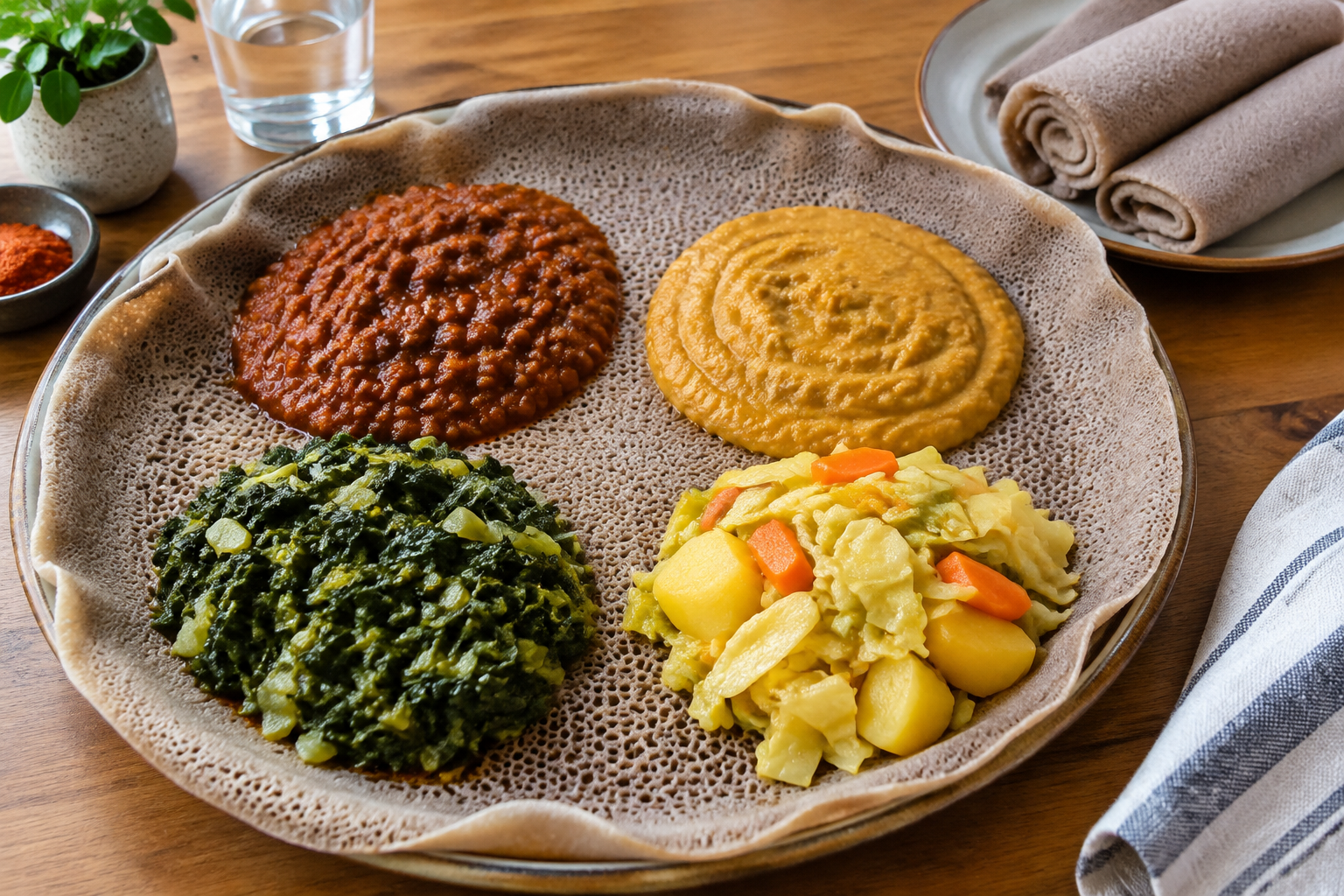
At such a meal, injera may hold lentil-based misir wat, shiro made from ground pulses, kale or other leafy greens, and milder preparations of cabbage, potatoes and carrots. Several small portions served together are commonly described as a beyaynetu, a mixed selection. Heat, mildness, acidity and different textures meet on the same platter.
It is therefore misleading to regard the plant-based dishes as modern replacements for doro wat. They have their own names, techniques and contexts. If a meal is to be entirely plant-based, the cooking fat also needs checking: injera may contain no animal ingredients while a vegetable stew has still been made with spiced butter.
For anyone hosting guests with different dietary needs, this is a lovely starting point. Let the chicken stew be one dish among several, rather than the measure of the whole meal. A carefully cooked lentil stew and tender greens are not fillers. They enrich the table and allow more people to eat together.
Gursha – care in a mouthful
Sharing a platter makes a meal social in a very tangible way. You need to notice one another, pass the bread and make room. Traditionally, the right hand is used when eating with injera. Washing hands before the meal is a natural part of this, and at home it is easy to make it part of the welcome.
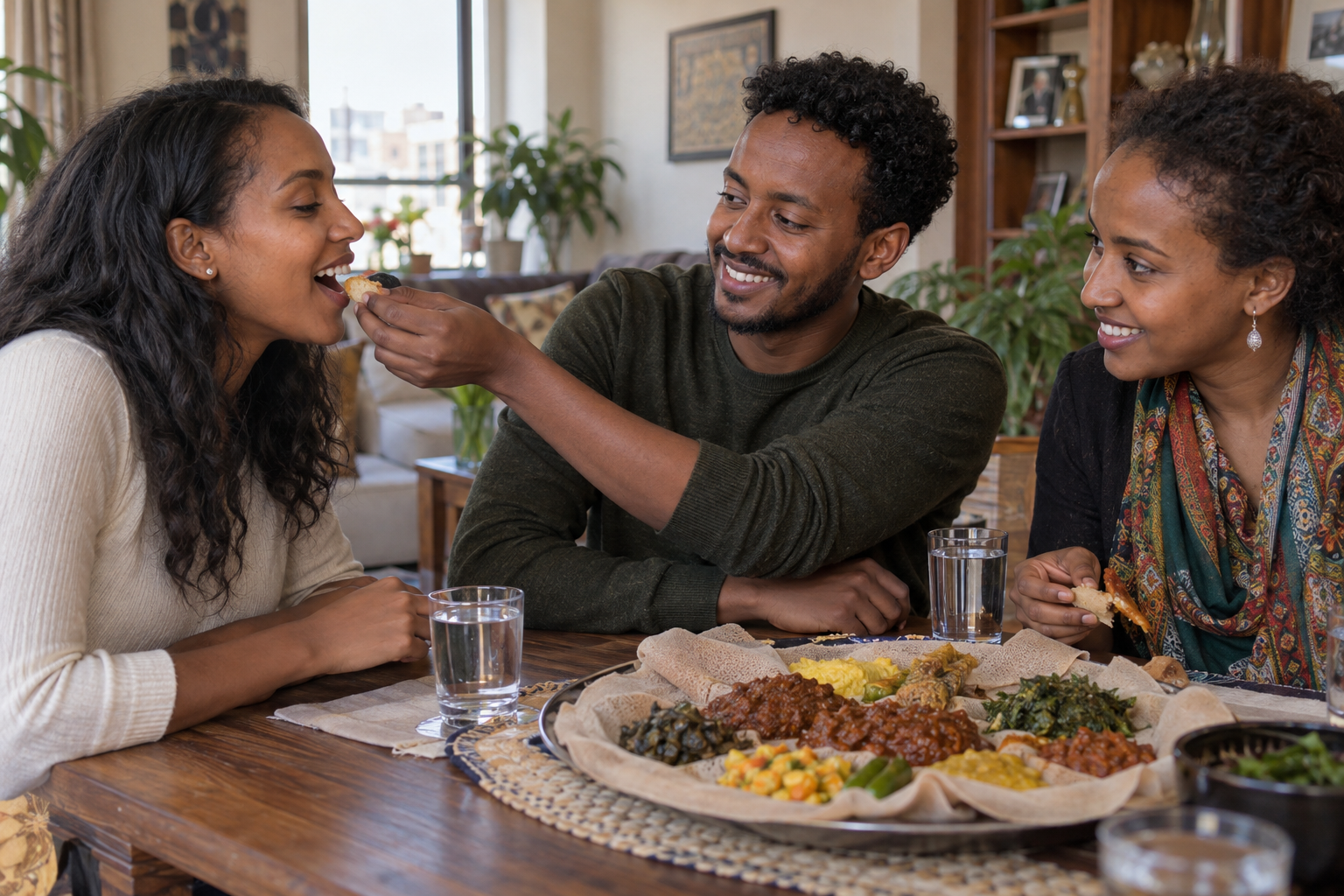
Gursha means offering someone else a mouthful, often food wrapped in injera. The gesture can express affection, friendship, respect or hospitality. It makes care literal: I have chosen a delicious bite for you, and I am offering it to you.
But a living custom is not a compulsory performance. Not everyone does things the same way, and not everyone wants to be fed. At a Swedish dinner table, it is wise to explain the gesture and ask, rather than surprise someone. Considering a guest’s comfort is itself a form of hospitality.
Nor need the shared platter become a rule that overrides practical needs. Separate plates may be the right choice because of allergies, illness or simply personal preference. You can still share the dishes and let the meal unfold at an unhurried pace. Respecting a tradition need not mean making every situation look the same.
A celebratory meal may include tej, an Ethiopian honey wine whose character traditionally owes something to gesho. Gesho is a plant used in Ethiopian drink-making, not a grape variety. Tej can vary in sweetness, acidity and alcohol content, so there is no guarantee that every bottle will pair equally well with a hot stew. If serving alcohol, a small glass is enough, and water and alcohol-free alternatives should have an equally natural place at the table.
Coffee often belongs more comfortably after the meal. The Ethiopian coffee ceremony may include roasting green beans, grinding them and brewing in a jebena, an earthenware pot. The aroma of freshly roasted coffee extends the atmosphere of the meal. Of course, coffee is also enjoyed in more everyday ways. A good freshly brewed coffee after dinner need not be presented as a full ceremony to make a lovely ending.
Bringing the meal together at home
Start with the purchases that make the biggest difference: teff flour and a good berbere. Both are available from many shops stocking Ethiopian or Eritrean foods and from Swedish online retailers. Some larger food shops also sell teff. If you can buy ready-made injera from a producer or shop, it is an excellent option when time is short.
Choose chicken pieces of roughly equal size. Give the onions time, and treat the recipe’s spice quantities as a starting point, since berbere varies so much. For more colour and less heat, some can be replaced with mild paprika. The flavour will change, but it is better to be open about an adaptation than to cook a stew no one at the table can enjoy.
Plan the work over two days. The injera batter can rise in the fridge while you do other things. The spiced butter can also be prepared ahead. Doro wat is well suited to making in advance and reheating gently; if doing so, cool it quickly in smaller containers and keep refrigerated. The breads are best left to cool separately before stacking, otherwise they may stick together.
Cook a small test injera before making larger breads. The first will tell you whether the pan is hot enough, whether the batter spreads and whether you are waiting long enough before lifting it. That is more helpful than reading every failed bubble as a sign that the whole batch is lost.
For serving, you need a spacious platter and extra injera on the side. Do not spoon a heavy stew onto the bread too far ahead, or it will become overly soggy before anyone starts eating. Arrange the chicken and eggs so everyone can reach them, and leave room for a mild vegetable dish or lentils if you can.
What matters most is not that dinner looks like a restaurant photograph. It is that the bread folds easily, the onions have become soft and sweet, and the spices taste woven together rather than raw. When someone reaches for another piece of injera and conversation continues across the platter, the meal has already found its rhythm.
Doro wat with simplified niter kibbeh
A home-cooked version of the Ethiopian celebration stew, with slow-cooked onions, bone-in chicken and eggs. Here the spiced butter is made with ghee and readily available spices; it is a practical adaptation, not the full traditional seasoning. Serve with injera.
Ingredients
Method
- 1Heat the ghee with the sliced ginger, crushed garlic, cardamom, fenugreek and cinnamon over a very low heat for 15–20 minutes. The fat should be hot, but the spices should not brown. Strain through a fine-mesh sieve.
- 2Put the finely chopped onions in a heavy-based pot without any fat. Heat over a medium-low heat, stirring, until the onions release their liquid. Continue for 35–45 minutes, until they have collapsed and become very soft. Add 1–2 tbsp water at a time if they begin to stick.
- 3Add the strained spiced butter, grated garlic and ginger. Cook over a low to medium-low heat for 5 minutes, stirring.
- 4Stir in the berbere and paprika. Cook gently for 5–8 minutes. Add a small splash of the water as needed to keep the spices from burning.
- 5Add the chicken and turn the pieces in the onion and spice mixture. Pour in the remainder of the 4 dl water and add the salt. Bring to the boil, then reduce the heat.
- 6Simmer with the lid ajar for 40–50 minutes. Turn the chicken a couple of times and stir gently along the bottom. The sauce should become thick but still loose enough to spoon over the food; add a little water if it reduces too much.
- 7Meanwhile, boil the eggs separately for 9–10 minutes. Cool in cold water and peel. Make a couple of shallow cuts in the white of each egg.
- 8Check that the chicken is tender and has reached at least 75 °C in the thickest part, without the thermometer touching the bone. Temporarily lift out the chicken if the sauce needs to reduce further.
- 9Add the eggs to the pot and simmer gently for 5 minutes. Season with lemon juice and more salt if needed. Serve with injera, giving each person an egg and an equal share of the chicken.
- For a milder stew, start with 1 tbsp berbere and increase the amount of mild paprika. Heat and salt levels vary considerably between blends.
- Ready-made niter kibbeh can replace the simplified spiced butter; use about 80 g and adjust to taste.
- The stew can be made the day before. Cool quickly in smaller containers, refrigerate at about 4 °C and use within 2–3 days. Reheat until piping hot throughout.
- Do not wash raw chicken: splashes can spread bacteria. Wash hands and utensils after handling it.
Easy injera with teff and an overnight fridge rise
Makes about 8–10 smaller breads for four people. Baker’s yeast, wheat flour and a little vinegar make this a beginner-friendly adaptation, not traditionally sourdough-fermented injera. A cooked portion of batter borrows the principle of absit and helps the texture. In addition to the active preparation time, allow 12–24 hours in the fridge and about 1–2 hours at room temperature.
Ingredients
Method
- 1Dissolve the yeast in a little of the 6 dl cold water. Whisk the teff flour, wheat flour, yeast mixture and remaining water together in a large, clean bowl to make a smooth batter.
- 2Cover the bowl with a lid without sealing it airtight. Refrigerate at about 4 °C for 12–24 hours. Fermentation will be mild; this short method does not develop the deep acidity of traditional injera.
- 3The next day, stir the batter and transfer 1 dl to a small saucepan. Whisk in 1 dl water. Heat, stirring constantly, until the mixture boils and thickens. Simmer for about 1 minute.
- 4Let the cooked mixture cool to below 35 °C. Then whisk it into the main batter along with the vinegar and salt.
- 5Cover and leave at room temperature for 1–2 hours, until small bubbles appear in the batter. It should be runny, roughly like pancake batter. Thin with water if needed, 1 tbsp at a time.
- 6Heat a non-stick frying pan, about 24 cm across, over a medium-high heat. Have a suitable lid ready. If needed, brush the pan with the smallest amount of oil and wipe away the excess.
- 7Cook a small test bread. Then pour about 0.8–1 dl batter into the pan for each larger bread, immediately swirling the pan to form a thin, even layer. Do not add more batter once the surface has begun to set.
- 8Cook uncovered for about 30–60 seconds until holes appear. Put on the lid and cook for another 1–2 minutes, until the top is no longer wet and the edges begin to lift. Do not flip the bread.
- 9Carefully transfer the bread to a clean baking mat or tea towel. Let it cool without stacking it directly on other warm breads. Continue with the remaining batter, adjusting the heat as needed.
- 10Stack the cooled breads and cover to keep them soft. Serve the same day, preferably slightly warm, as both a base and an accompaniment to the stew.
- If the bread cracks, it may be too thick or have dried out in the pan for too long. Thin the batter a little and shorten the cooking time. If the surface is sticky, it needs more time under the lid.
- This recipe contains gluten. Replacing the wheat flour directly with teff requires further adjustments to the batter and technique.
- Keep the cooked, cooled breads well wrapped in the fridge and use within 2 days, or freeze with baking parchment between them. Reheat gently under a lid.
- Discard batter that develops mould, pink or orange discolouration, or a distinctly rotten smell. Do not taste raw batter to assess it.
What goes in the glass
- WineTej, Ethiopian honey wineA style with some residual sweetness and fresh acidity can complement the chilli and sweet onions. Gesho contributes to the drink’s character. Tej varies widely; choose a lighter style and serve a small amount, since a high alcohol content can intensify the heat.
- CoffeeEthiopian coffee after the mealFreshly brewed coffee with fruity or floral notes makes an aromatic finish after the richness of the stew. Serve after the meal rather than as a thirst-quencher alongside the chilli.
- Alcohol-freeLightly sweetened lemon and ginger waterThe fresh acidity of lemon cuts through the spiced butter, while a little sugar softens the chilli heat. Keep the ginger mild so the drink does not become another fiery element. This is a flavour-based suggestion, not a traditional Ethiopian drink.
Enjoy alcohol in moderation. Alcohol-free options go just as well with the food.
Sources
- Yohanis Gebreyesus med Jeff Koehler, Ethiopia: Recipes and Traditions from the Horn of Africa (2018)
- Daniel J. Mesfin, Exotic Ethiopian Cooking (1993)
- Seyfu Ketema, Teff: Eragrostis tef (Zucc.) Trotter (1997)
- Mogessie Ashenafi, The microbiology of Ethiopian foods and beverages: A review (2006)
- Christine Chaillot, The Ethiopian Orthodox Tewahedo Church (2002)
- Alan Davidson; tredje upplagan redigerad av Tom Jaine, The Oxford Companion to Food (2014)
Ask questions about "Injera and doro wat – Ethiopia’s shared plate". Answers are based on the magazine's own articles.