Julmust – the dark bubbles of a Swedish Christmas
From temperance ideals in Örebro to the Christmas table’s most familiar bottle
It smells of malt, spice and anticipation, pairs surprisingly well with mustard and ham, and changes identity when Easter arrives. The story of julmust is about a secret extract – but just as much about how Sweden learnt to give Christmas a flavour of its own.
 By Jonas EkDrinks editor · Wine, beer, spirits, coffee, tea and non-alcoholic drinks – and how to pair them with food
Translated from Swedish with AI assistance.
Go to the recipe ↓A hiss, a head of foam, and Christmas is here
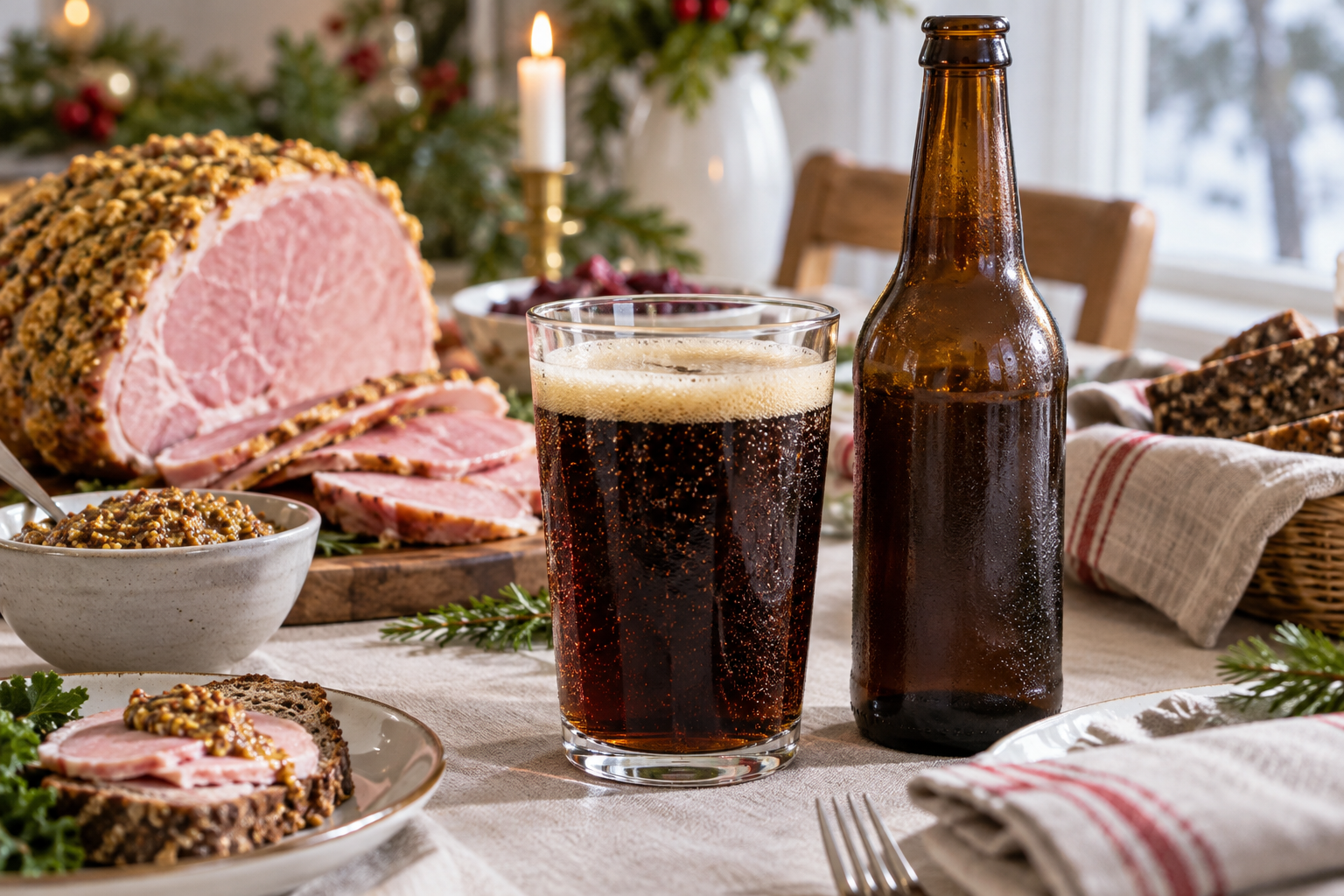
The cap comes off with a brief hiss. In the glass, a pale, dense foam rises above the dark brown drink, with a warm mahogany hue showing at the edges. On the table sits the ham with its baked crust, a bowl of wholegrain mustard and the malt-spiced vörtbröd beneath a tea towel. The first sip is cold, sweet and fizzy. Then comes what makes must unmistakable: the maltiness, a hint of spice and a little bitterness behind all that rounded flavour.
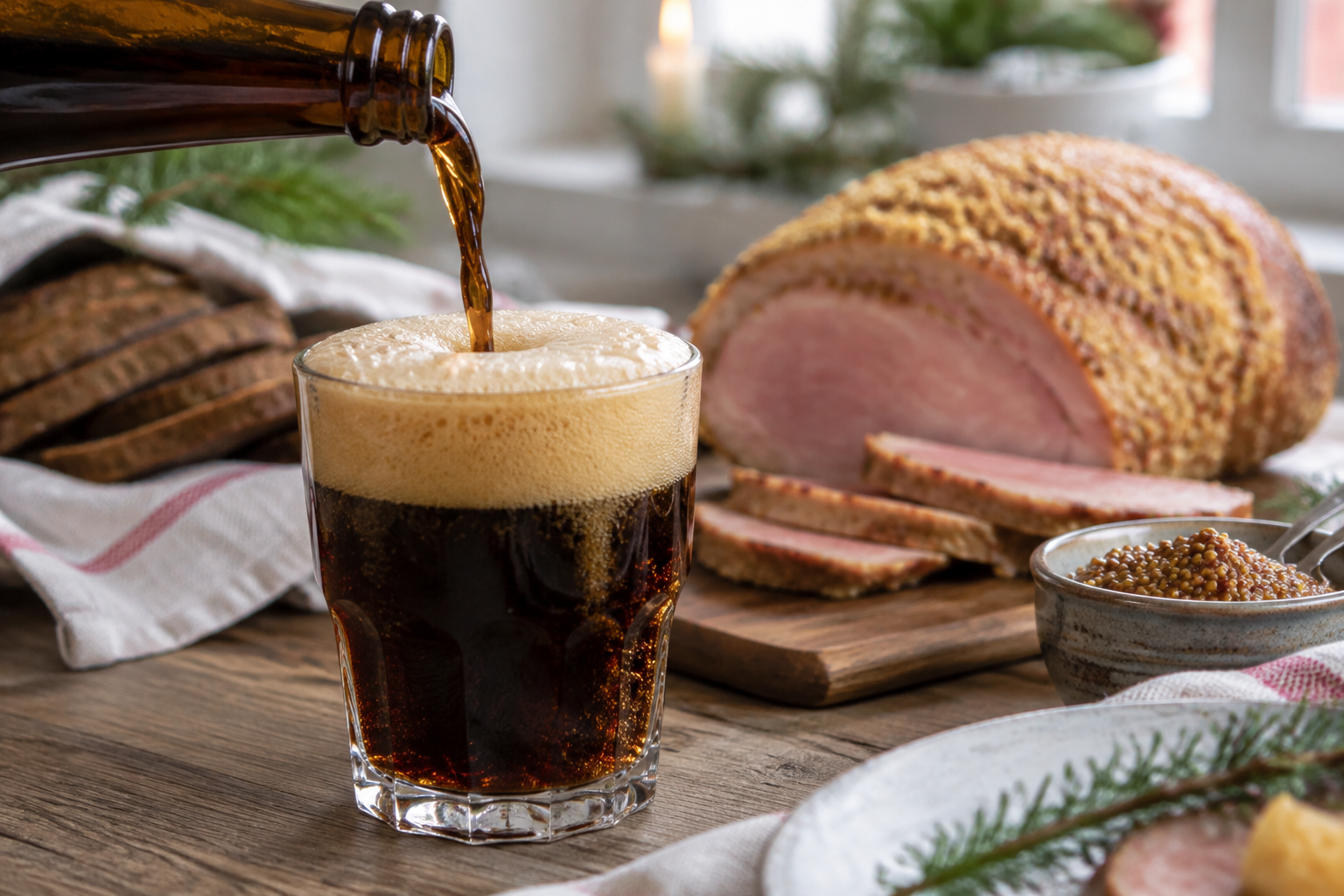
For many Swedes, that is all it takes to turn the page on the calendar. November rain may be falling outside, with the tree and the holidays still a long way off. Yet the flavour instantly feels like Christmas. That is the drink’s real strength: not that it is difficult to understand, but that it is so easy to recognise.
Julmust is also an unusually successful example of an alcohol-free drink that needs no introduction as a compromise. It has its own place, its own world of flavour and an audience unlikely to order it because something else is missing. Children and adults can drink the same thing, while its dark colour and foamy head give it a character quite unlike fruit-flavoured fizzy drinks.
But what seems so natural is actually rather unusual. Why do we drink a sweet, malty soft drink with pickled herring? How can different brands taste different if they use extracts from the same manufacturer? And why do we accept, with barely a murmur, that the drink disappears from the spotlight after Christmas, only to return with a chick on the label?
The answers lie at the meeting point of food chemistry, temperance ideals and a remarkably effective food tradition. We begin in Örebro, long before plastic bottles, sugar-free versions and tastings of barrel-aged must. That was where the foundations were laid for a drink that would become national, but never truly international.
Örebro, 1910: an alternative to beer
The history of julmust is usually traced back to 1910 and the Roberts company in Örebro. Behind the business were Robert Roberts and his son Harry Roberts. According to the company’s own history, Harry had studied chemistry in Germany, with Berlin playing an important part in the story, and worked on developing alcohol-free drinks. His father’s commitment to temperance gave the project a clear direction.
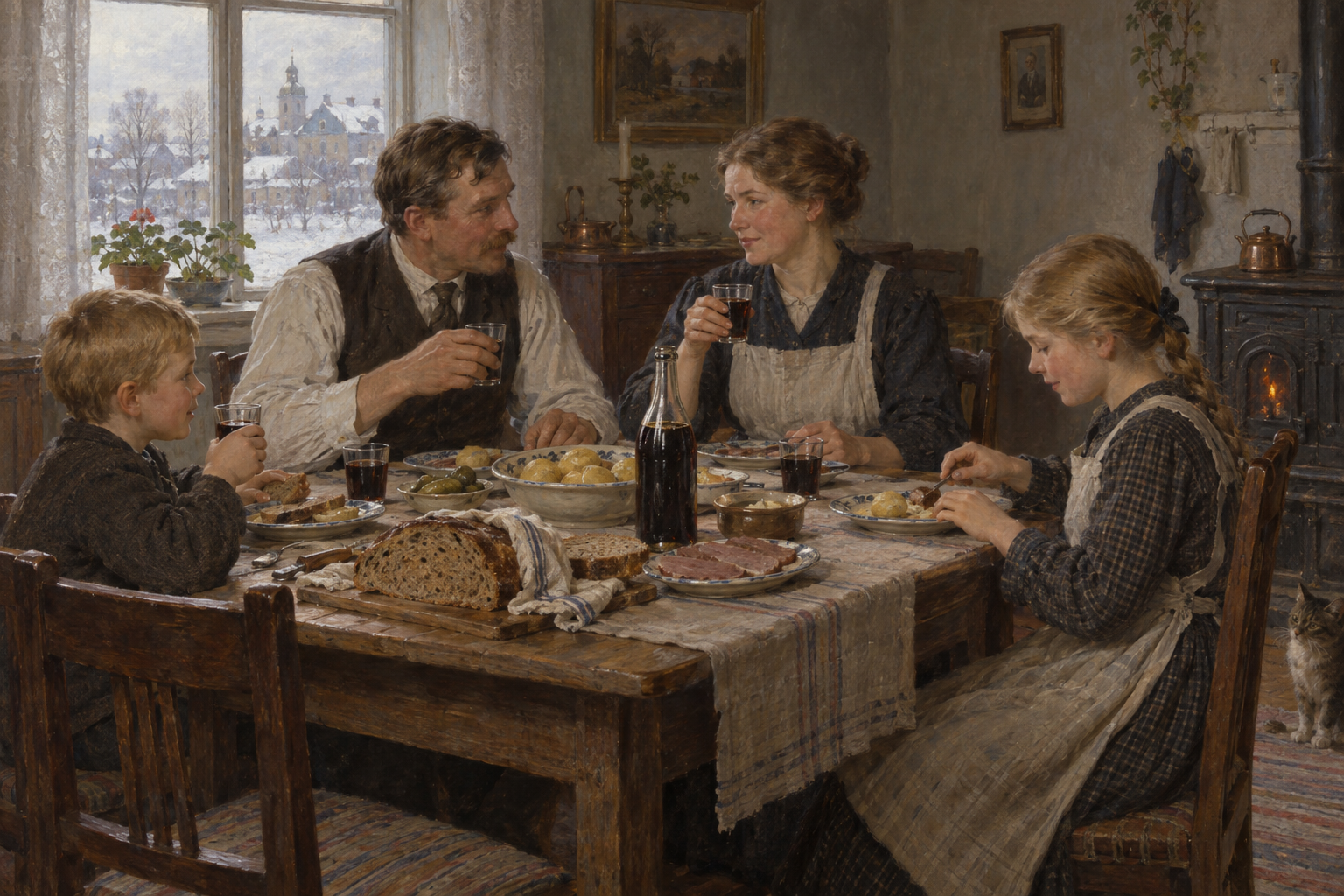
A small but important note on sources is needed here. The company history is central to the story of must’s creation, but it is also the company’s own account of its heritage. Its founding in 1910 and the family’s role are well-established facts. Precise details of the laboratory work, the first blends and when a particular name came into use should not, however, be embroidered into a scene that no one can substantiate.
The ambition was to offer an alcohol-free alternative to beer. That is still apparent in the drink’s make-up: its dark colour, malty character, hints of hops and distinct head of foam. Historical accounts also use the term julöl, or Christmas beer, for the early drink. Today’s julmust, however, should not be understood as ordinary beer with the alcohol removed. It is normally made as a soft drink by blending water, sweeteners, extracts and other ingredients, then carbonating the mixture.
The timing mattered. The temperance movement was a powerful force in society, and questions about alcohol touched on household finances, working life, health and politics. An alcohol-free alternative needed to be more than merely drinkable. It had to work at the table and in social settings where beer would otherwise have had an obvious role.
Must did not immediately become the undisputed star. Champis was among Roberts’ early successes, a reminder that the company worked across a broader world of soft drinks and flavour extracts. Julmust’s position developed over time, through brewery production, retail sales and households buying it again and again.
The prohibition referendum of 1922 and Sweden’s regulated alcohol policy were part of the environment in which alcohol-free alternatives could gain significance. But events occurring at the same time are not proof of a leap in sales. Without comparable sales figures over time, it is wiser to say that must emerged during a period of intense debate about alcohol than to credit a single referendum with its breakthrough. The prohibition proposal was rejected, while alcohol’s place in society continued to be regulated and debated.
The truly lasting result was a drink that eventually ceased to be seen primarily as a substitute for beer. Julmust acquired a cultural value of its own. It was not simply there to make abstaining from alcohol possible. It was there to taste of Christmas.
One secret core, many different bottles
AB Roberts in Örebro still makes extracts for must, and the company’s distinctive position goes a long way towards explaining the drink’s recognisable character. A very large share of the Swedish must market relies on extracts made there. The figure of around 98 per cent recurs in presentations and media reports, but without a clear year and an explanation of how it was calculated, it should be read as an approximate industry figure, not a current, independent market measurement.
The secret recipe naturally makes a good story. According to the company, knowledge of the full composition is confined to a handful of people. That does not mean, however, that everything in the bottle is secret. The ingredients list tells us a great deal about what kind of product it is, even if it does not reveal the proportions of the flavouring blend or every flavouring substance.
A typical julmust contains carbonated water, sugar or sweeteners, malt and hop extracts, flavourings, colouring and acid. Caramel colouring gives it its dark colour, and citric acid is often used to balance the sweetness. Preservatives may also be present. The spiciness may come from the flavouring blend rather than from individually named spices listed on the label. The precise contents vary, so the bottle’s own label is the best source for the particular must you buy.
The extract is a concentrated flavour base, not necessarily a ready-made sweet syrup that simply needs diluting. The brewery makes the finished product. Its choice of extract or extract blend, sweetening, proportions and carbonation can produce different results. A shared foundation therefore does not mean that every brand must be identical, any more than two dishes turn out the same simply because they use the same stock.
Taste two varieties side by side and the differences become clear. One may open with generous sweetness and finish softly. Another may seem drier, with more pronounced bitterness or a longer, spicy aftertaste. The bubbles matter too: more carbonation gives a livelier, sharper first impression, while less can make the sweetness feel more prominent.
Words such as caramel, dried fruit, liquorice and citrus can be useful when describing the aroma. But they are flavour associations, not reliable statements about ingredients. A must that recalls cloves does not necessarily contain cloves. This is one area where it pays to distinguish tasting language from knowledge of the recipe.
And the name? In its usual sense, must means unfermented fruit or berry juice, particularly grape juice. Julmust is an established drink name, but that does not make the drink a fruit must. The linguistic connection tells us less about its contents than we might initially think.
Sweden, the season and the other label
Julmust is most firmly rooted in Sweden. That does not mean it is impossible to buy abroad; Swedish shops, exports and Swedes celebrating Christmas have carried it further afield. But it has not become an everyday soft drink around the world. One reasonable explanation is that its most important ingredient, culturally speaking, is a Swedish festive custom.
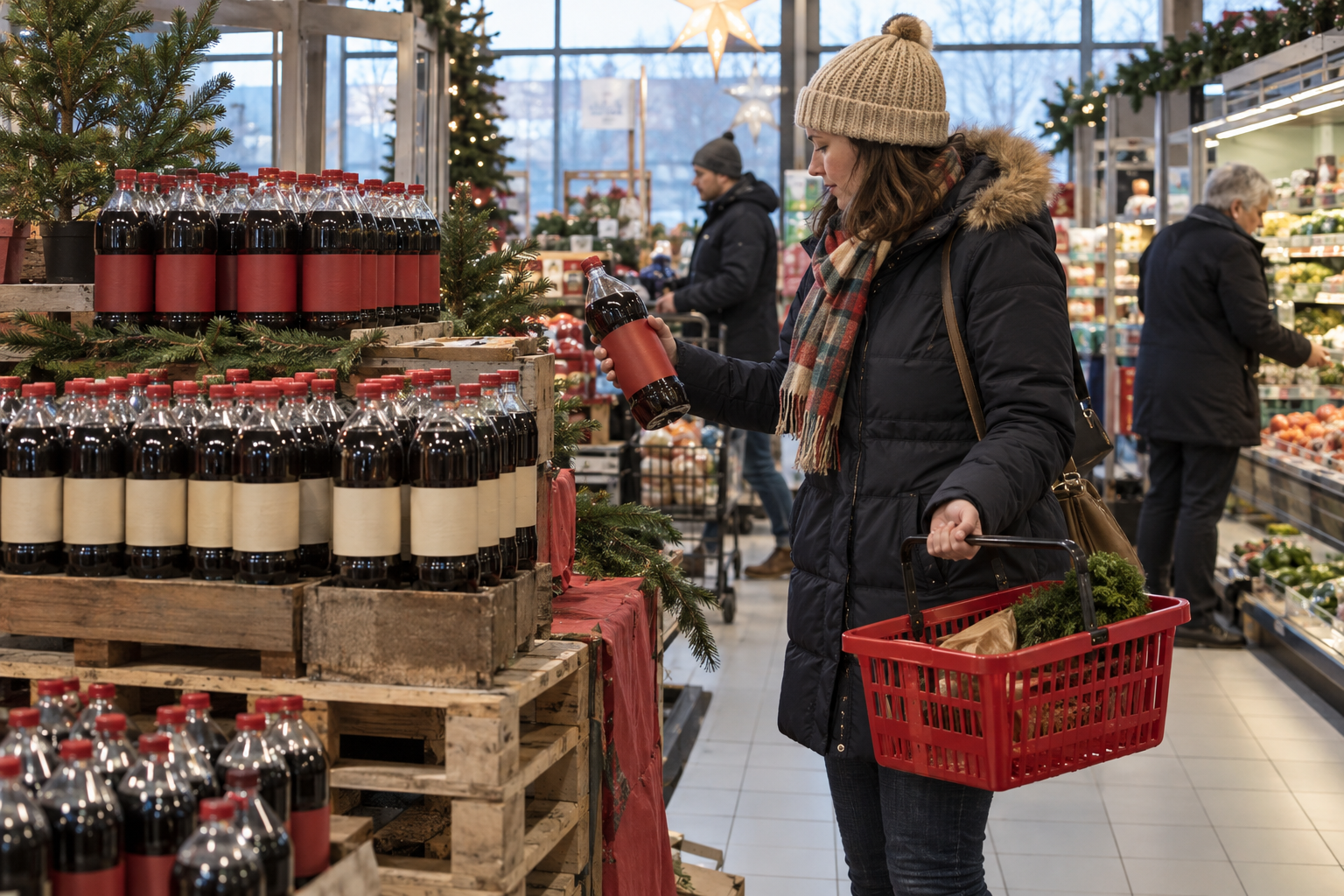
The flavour comes with a context. It belongs with the Christmas buffet’s herring, ham, meatballs and sausages, but also with the next day’s leftovers, a sandwich in front of a Christmas film and the lunch table at work. When the same drink returns year after year, familiarity becomes part of the pleasure. Someone encountering julmust without those memories might just as easily find it an unusually sweet, spicy soft drink.
The temperance legacy helps explain why the drink was developed in the first place. To understand its position today, we also need to consider family tradition, distribution and marketing. Pointing only to a secret extract or limited exports is too simplistic. There is no need for a clearly documented rule prohibiting sales of the extract abroad to explain its Swedish centre of gravity.
Norway has julebrus, but it is not simply julmust under a Norwegian name. Julebrus encompasses various regional soft-drink traditions, including red and brown versions, with flavour profiles that differ from Swedish must. The similarity lies chiefly in its role: a seasonal drink about which people can have very firm opinions.
At Easter, Swedish must appears again. Julmust and påskmust are often the same basic drink, sometimes the same recipe with a different label. It is still wise to say often, not always. Individual producers may offer different products, and special vintages or flavour variations make sweeping generalisations unreliable. Must may also be sold under other names, or without a festive prefix, during the rest of the year.
Production and sales are heavily concentrated around the seasons, but claiming that all breweries bottle must only at Christmas and Easter is too categorical. What matters to consumers is visibility: suddenly the pallets are there, the labels have changed colour and the holiday has claimed its place in the shop. Scarcity does not have to be absolute to build anticipation.
Large volume figures circulate every winter too: around 40–50 million litres, roughly half of soft-drink sales in December, or three-quarters of the year’s must sales around Christmas. The problem is that these reports may refer to different years and periods, and December is sometimes confused with the entire Christmas season. Without dated original statistics, they cannot be stacked together to create a reliable picture of the present. The same caution applies to the story of Coca-Cola’s December slump: must is a strong seasonal competitor, but precise changes require comparable sales data.
Regular, sugar-free or aged?
Classic sugar-sweetened julmust is still the reference point for many people. Sugar provides both sweetness and a certain fullness. At the same time, there are considerable differences between brands and varieties. It is therefore more useful to ask about the balance of sweetness, maltiness, acidity and bitterness than to try to identify a single correct must flavour.
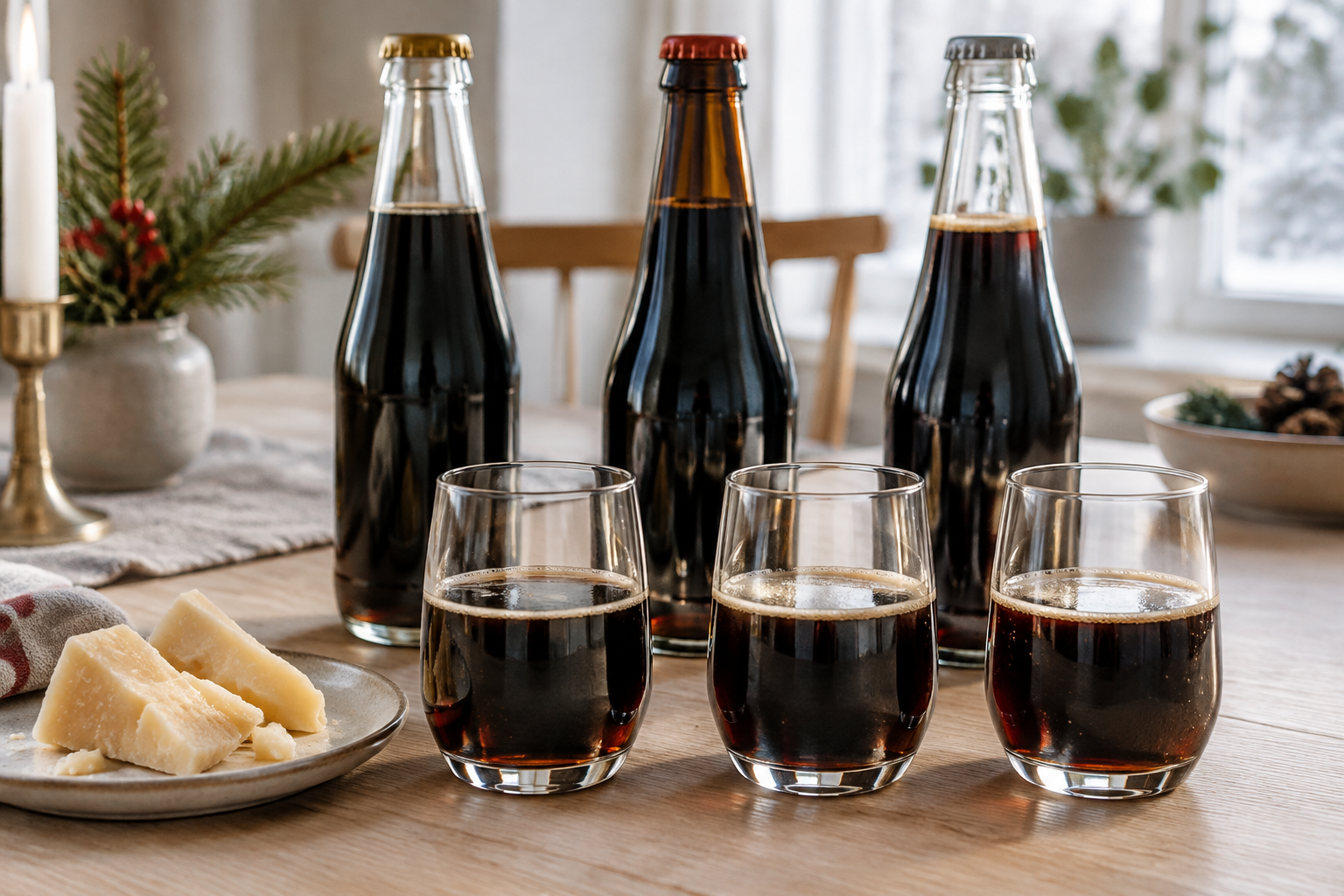
Apotekarnes, Nygårda, Zeunerts and Vasa are examples of established names. They can be a good starting point for a comparative tasting, but ranges and recipes can change. Start with the bottles actually available in the shops and note which version you are tasting. A single brand may encompass several quite different products.
Sugar-free must and light versions use sweeteners in place of all or part of the sugar. They may feel lighter in body, and the way the sweetness unfolds can differ: sometimes it arrives quickly, sometimes it lingers. That is a sensory difference, not an automatic judgement of quality. Read the label if you want to know which sweeteners are used and how much sugar the drink contains.
Ageing is another matter. Some people keep unopened must in glass bottles until the following Christmas and feel that the flavour becomes rounder. Aromas and the perceived balance may change during storage, but the result depends on the product. Must does not necessarily become better simply because time passes. A loss of freshness or weaker carbonation may just as easily be a drawback.
Glass provides a good barrier, but the closure, temperature and length of storage matter too. Follow the producer’s storage advice, keep it somewhere cool and dark, and do not treat a bottle as suitable for ageing unless the manufacturer supports that use. If you want to compare old and new, it is particularly useful to record dates and storage conditions. Otherwise, it is easy to end up comparing the memory of last Christmas with the drink in this year’s glass.
Barrel-aged versions, including some in Nygårda’s range, bring a different kind of change. Contact with wood can contribute notes associated with vanilla, spice or toasted wood. The precise method and type of barrel vary, and should be checked against the producer’s information for the particular bottle. Aged and barrel-aged do not, then, describe the same thing.
Nor is the most expensive or most talked-about option necessarily the best match for the entire Christmas buffet. A must with pronounced woody notes may be intriguing with mature cheese, but feel less at home with a mild herring dish. Think of special versions as more possibilities, not as a hierarchy in which the familiar family bottle must come last.
At the Christmas table: why must works
Julmust’s partnership with Christmas ham is easy to understand. The ham’s saltiness meets the sweetness, the mustard’s sharpness finds a softer setting, and the toasted notes of the crust find an echo in the drink’s malty, caramel-like flavours. The carbonation offers a refreshing contrast between mouthfuls. It does not magically dissolve fat, but it can make the meal feel less heavy.
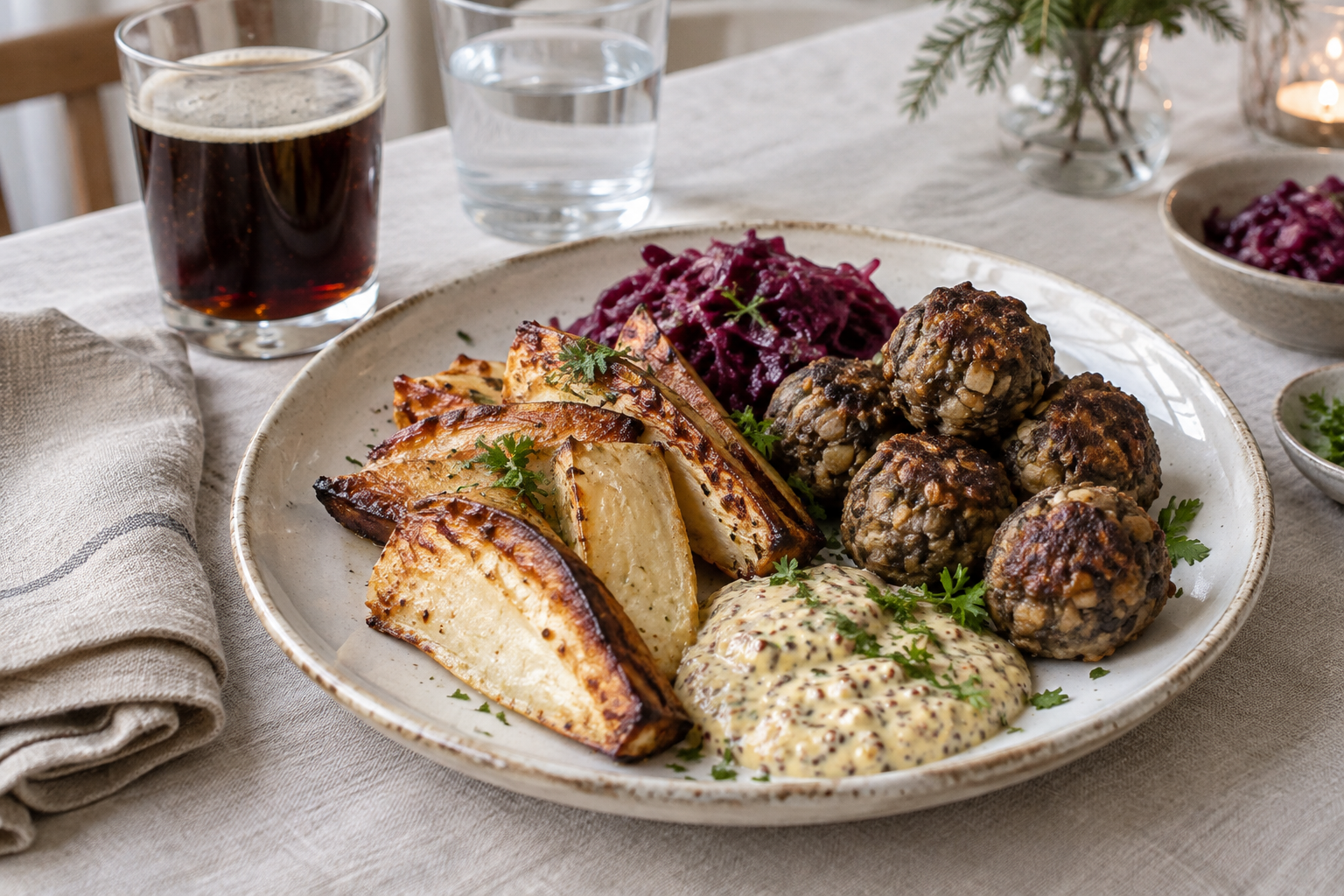
The same principle works with meatballs and prinskorv, the small Swedish sausages. Browned surfaces, gentle spices and saltiness suit the dark sweetness. If the plate also holds red cabbage or mustard, there is acidity to help balance the whole. A must with more pronounced bitterness and slightly less assertive sweetness can be especially useful here, since the food already offers several sweet elements.
Herring is more complicated. A sweet-and-sour pickling liquor, the fish’s umami and sometimes the sharpness of onion mean that each pairing finds its own balance. With mustard herring, must’s sweetness can work beautifully, especially in a small open sandwich with potato or bread. With herring in a very acidic clear pickle, the same must may instead seem overly sweet or create a clash of flavours. Tradition does not guarantee that everything goes equally well together.
Dopp i grytan, bread dipped in cooking broth, offers another kind of encounter. The salty broth and the bread’s spices can make must’s sweetness appealing, but there is no need for large glasses here. The drink is rich in flavour and feels filling. A small serving, with water alongside, makes it easier to enjoy both the food and the must without the entire meal becoming sweet.
At a more plant-focused Christmas table, it pairs well with roasted celeriac and mustard cream, mushroom-based balls or a gratin with a well-browned top. It is the browning, saltiness and seasoning that build the connection, not the meat itself. A very sweet glaze, sweet red cabbage and sweet must together, however, may need something tart or fresh to cut through them.
Julmust is itself an alcohol-free option and can unapologetically be the table’s main drink. Put out water too. For anyone choosing beer, wine or snaps at the same meal, moderation applies; there is no reason to let tradition dictate the quantity. Must, too, is often at its best in a smaller glass, not least because regular must is a sugar-sweetened soft drink.
Hospitality here is less about rules than about offering choices. A classic must, a sugar-free alternative and water go a long way. Anyone who wants a completely unsweetened drink should not have to feel awkward, and anyone who loves their usual julmust should not have to defend it before a solemn tasting panel.
Getting more from the bottle at home
Start with the temperature. Around 8–12°C is a practical guide when you want to appreciate the aromas clearly. Serving it colder can be very refreshing but mutes the aroma; must that is too warm can feel heavy and sweet. This is a tasting suggestion, not an absolute rule. Try the same variety straight from the fridge and again after a little time in the glass.

Pour into a clean glass, leaving a little room above the drink for the aroma to gather. Tilt the glass if the foam rises quickly. Ice works if you want a lighter, colder serving, but dilutes the flavour as it melts. For a comparative tasting, it is simpler to skip the ice and keep the bottles at the same temperature.
Keep the tasting small. Two or three varieties are enough, with about half a decilitre of each per person. Note four things: sweetness, spiciness, bitterness and aftertaste. Taste first without food, then with a piece of ham and mustard or celeriac and mustard cream. Often, your favourite changes once the drink has a context. That is considerably more useful than trying to guess secret ingredients.
A common mistake is to add too much. Must already has a full aromatic profile. Large amounts of orange juice, spiced syrup or lemon juice can muddy the flavour rather than make it more festive. In the recipe below, a little black tea adds a dry edge and apple juice brings a fresh fruit note. This is a modern alcohol-free drink made with julmust, not an attempt to reconstruct Roberts’ secret recipe.
Check the labelling, too, when serving guests with allergies or particular dietary needs. Malt extract may come from barley, and you should not assume that all julmust is gluten-free. Choose a product with suitable labelling for anyone who needs it. Similarly, the product’s own information is better than general assumptions about sugar levels or ingredients.
Finally, be a little sceptical of the very best must stories. The 2013 rumour that the EU was going to ban julmust was false. It is a useful reminder of how easily supposed threats and exaggerations attach themselves to a much-loved tradition. Must’s real history is interesting enough: an alcohol-free project from Örebro that became an essential part of Swedish festive tables.
Chill the bottle, choose something salty and mustard-scented to eat, and pour a modest glass. The secret recipe can stay secret. What matters happens in plain sight anyway: between the glass, the food and the people around the table.
Alcohol-free julmust drink with apple and black tea
A modern serving with a gentle refreshing lift, in which julmust remains the star. Black tea contributes a light astringency and apple adds fruitiness. The recipe makes four small glasses of about 2 dl each before any ice is added. The timing includes quickly chilling the tea.
Ingredients
Method
- 1Bring the water to the boil and pour it over the tea leaves in a heatproof jug. Leave to steep for 3 minutes; steeping for longer may make the tea unnecessarily bitter.
- 2Strain out the leaves and measure out 1 dl of brewed tea. Place the container in a cold-water bath and leave to cool for about 15–20 minutes. The tea should be cold before you mix the drink.
- 3Set out four glasses with a capacity of at least 2.5 dl. Cut four thin apple slices just before serving.
- 4Mix the cold tea with the apple juice. Divide evenly between the glasses, with 0.5 dl in each.
- 5Add a couple of ice cubes to each glass if you like. Slowly pour 1.5 dl of cold julmust into each glass so the foam does not overflow.
- 6Stir very gently once with a spoon. Add the apple slices and serve immediately, while the bubbles are lively.
- The tea can be brewed the day before and kept covered in the fridge. Add the must only when you are ready to serve.
- If you want to avoid caffeine, choose decaffeinated black tea and follow the brewing instructions on the pack.
- Regular and sugar-free must both work. Try it with the variety you usually enjoy; the drink needs no extra sugar syrup.
- Serve with small ham sandwiches with mustard, or roasted celeriac with mustard cream.
What goes with the glass
- FoodChristmas ham with wholegrain mustardMust’s sweetness meets the ham’s saltiness and softens the mustard’s sharpness. Malty, caramel-like notes complement the toasted crust, while the carbonation offers a refreshing contrast.
- FoodMeatballs with mustard and tangy red cabbageBrowned surfaces and gentle seasoning suit must’s dark flavour profile. The acidity of the red cabbage balances both the richness of the food and the sweetness of the drink; choose a must with pronounced bitterness.
- FoodMustard herring with potato on crispbreadThe sweetness can soften the mustard’s sharpness and complement the herring’s saltiness. Potato and crispbread mellow the pairing. Serve small amounts and experiment, as herring pickles vary considerably.
- FoodRoasted celeriac with mustard creamThe celeriac’s browned surface and gentle sweetness echo must’s maltiness. A mustard cream with a little lemon adds acidity and sharpness, keeping the combination from becoming too sweet.
Sources
- AB Roberts, AB Roberts – företagets presentation och historik
- Visit Örebro, Visit Örebro – information om Örebro och julmustens historia
- Wikipedia, svenska, Julmust
- Wikipedia, svenska, 1922 års folkomröstning om rusdrycksförbud
- Svenska Akademien, Must – ordboksartiklar
- Spendrups Bryggeri, Nygårda – produktinformation om julmust och lagrade varianter
- Livsmedelsverket, Gluten
Ask questions about "Julmust – the dark bubbles of a Swedish Christmas". Answers are based on the magazine's own articles.