

Coffee – from Ethiopia’s mountains to Swedish fika
Forest berries, the unhurried pouring of the jebena and a bun’s rightful place beside the cup.
The history of coffee does not run in a straight line from a lone discoverer to our fika table. It winds through Ethiopian forests, Yemeni farms, Ottoman coffee houses and Swedish coffee bans. Join us on a journey in which hospitality, trade and everyday rituals have shaped the flavour – and finish with saucepan coffee and cardamom buns.
 By Jonas EkDrinks editor · Wine, beer, spirits, coffee, tea and non-alcoholic drinks – and how to pair them with food
Translated from Swedish with AI assistance.
Go to the recipe ↓A pot, an aroma and time to linger
First comes the sound: dry coffee beans moving against a hot metal surface. Then the aroma, shifting from green and grassy to roasted, nutty and ever deeper. In an Ethiopian coffee ceremony, the roasting may take place in front of the guests. The beans are ground or pounded, the coffee is prepared, and a round-bellied clay pot with a narrow neck, a jebena, takes its place beside the small cups. It is a scene that helps us understand coffee as something more than a stimulating drink. Someone is working, someone is waiting and someone is being welcomed.
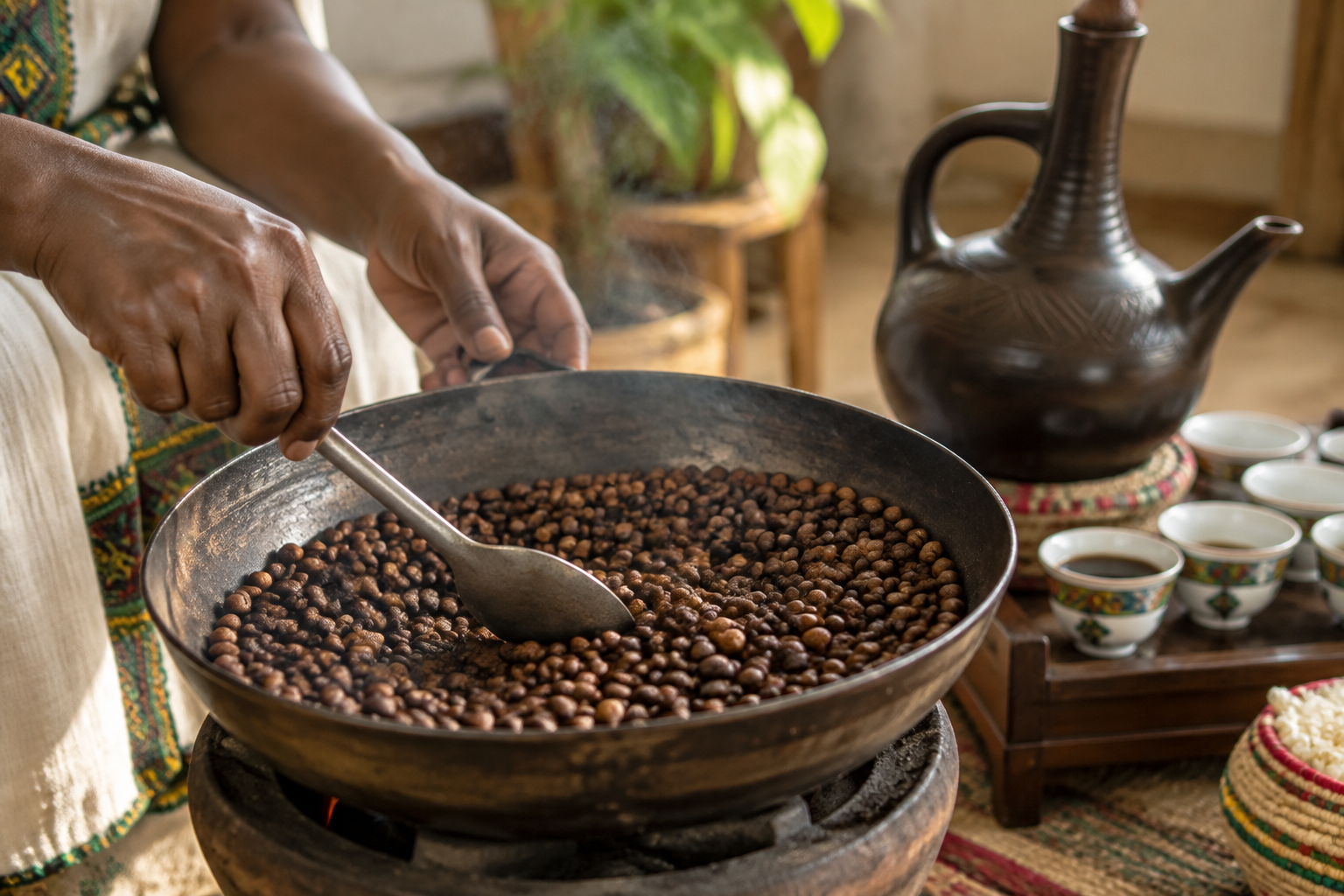
These gatherings vary between regions, households and occasions. There may be incense, or grass laid on the floor or tray. Popcorn and roasted grains may be offered. But the ceremony is not an unchanging performance with a single correct script. It is a living social practice, in cities too, and in Ethiopian homes far from Ethiopia.
Now turn to a Swedish kitchen. The coffee maker clicks on. A bag is opened, a bun is shared, someone asks whether there is more coffee. The differences are considerable, but the kinship is easy to sense: the drink creates an occasion to linger. Swedish fika is not an offshoot of the coffee ceremony, but both show how an ingredient, whether imported or rooted in the local landscape, can acquire a social life all its own.
Between these tables lie centuries of cultivation, seafaring, religious debate, colonial exploitation and trade. There is also a story about dancing goats. Charming though it is, that is not where the documented history begins.
The forests of Kaffa and the goatherd who became a legend
In the humid highlands of south-western Ethiopia, arabica coffee grows in forests. Kaffa is one of the areas most strongly associated with these coffee forests. Beneath the canopy, the coffee plants inhabit a landscape far removed from the image of endless, sun-baked plantations. Shade, rainfall, altitude and abundant plant life are all part of the environment in which wild and managed coffee populations grow.
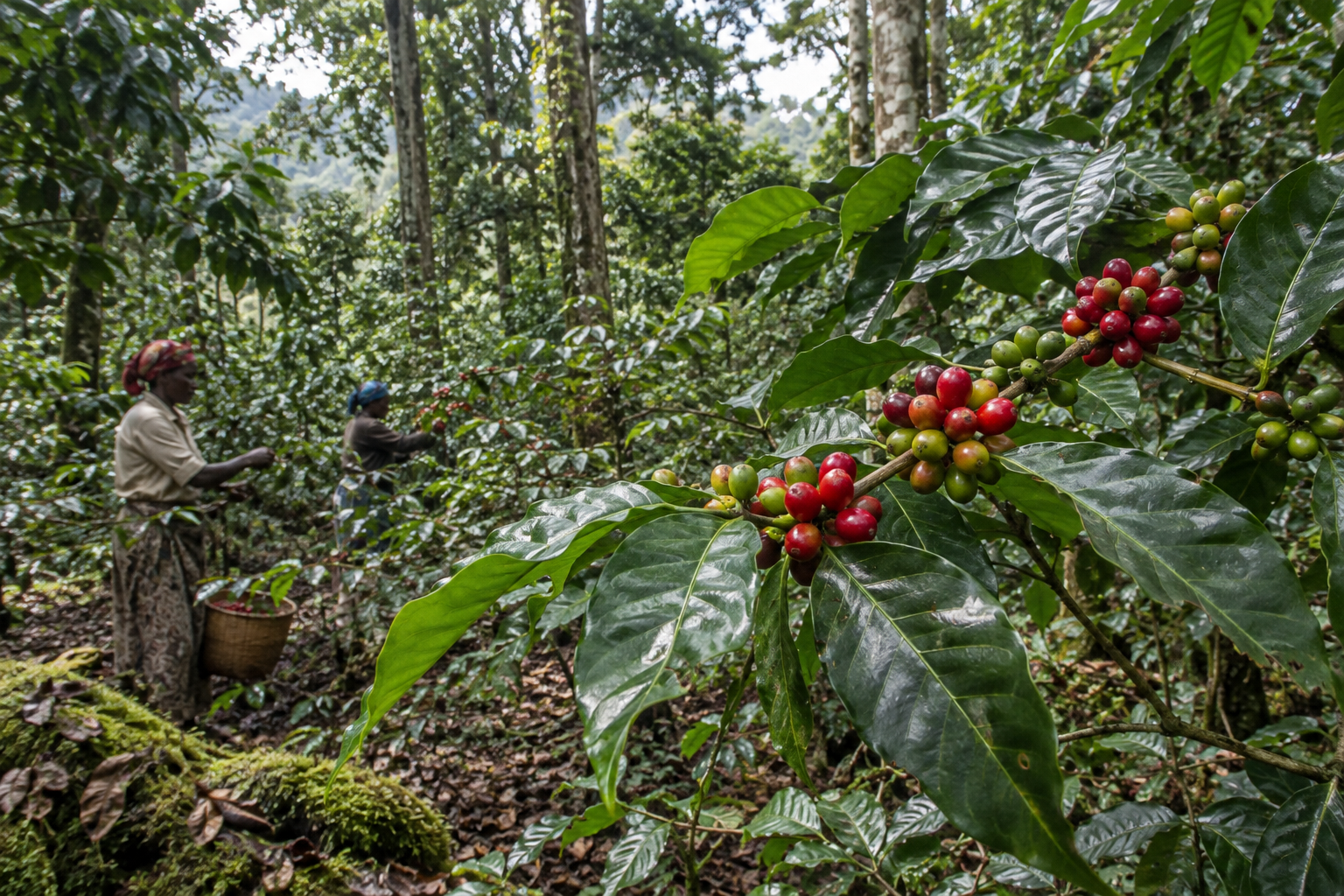
Arabica’s natural origins are associated primarily with the Ethiopian highlands; the species’ native range also includes parts of neighbouring South Sudan. Here we need to distinguish between the origins of the plant and the history of the drink. The fact that coffee grows wild somewhere does not tell us exactly when people began roasting its seeds, boiling them in water and drinking the result in a way we would recognise.
Kaldi, the goatherd who, according to legend, discovered coffee’s effects when his goats became unusually lively after eating red berries, features in one of coffee’s most widely told origin stories. It is often set in the ninth century. The problem is that the story was written down long after the period it supposedly describes. It should be read as a legend, not as a record of a discovery. We do not know the name of any one person who “invented coffee”.
The connection between the name Kaffa and the word coffee also calls for caution. The resemblance is tempting, but the generally accepted linguistic route into European languages runs through the Arabic qahwa and the Turkish kahve. To say that our drink simply takes its name from Kaffa turns an uncertain explanation into an established fact.
What we call a coffee bean is, botanically speaking, a seed. Usually, two seeds sit inside the flesh of the coffee fruit. After harvesting, they must be separated from the fruit and dried before they can be roasted. How this is done has a profound effect on flavour. Coffee dried inside the whole fruit can develop pronounced fruity notes, while washed coffee is often perceived as cleaner and more distinctly acidic. These are tendencies, not guarantees.
Ethiopian coffee, then, has no single flavour. Floral, citrus, berry and tea-like notes all occur, alongside fuller-bodied, spicier and more chocolatey profiles. Region, plant material, processing and roasting all interact. The importance of Kaffa’s forests also goes beyond what tastes good in the cup: they hold genetic diversity that is valuable as coffee growing faces disease and a changing climate.
Through Yemen to the Ottoman coffee house
Clearer historical evidence for coffee as a drink takes us across the Red Sea to Yemen in the fifteenth century. There, coffee is associated with Sufi communities and the need to stay awake during religious gatherings. The historian Ralph S. Hattox has shown how the drink’s early spread must be understood in the context of both religious life and the emergence of new public meeting places.
This does not mean that people in Ethiopia had no earlier ways of using the coffee plant. Such practices are, however, difficult to date precisely. The plant’s African origins and the well-documented development of coffee drinking in Yemen are therefore not competing narratives. They concern different stages of the same long history.
In Yemen, coffee was grown on mountain slopes and terraces. The port city of al-Makha, often called Mocha in European contexts, became an important trading hub. Its name has lived on in the coffee world, but a modern drink called a mocha, made with coffee and chocolate, is not the same thing as historical coffee shipped from Mocha. Words can carry memories of trade routes long after their contents have changed.
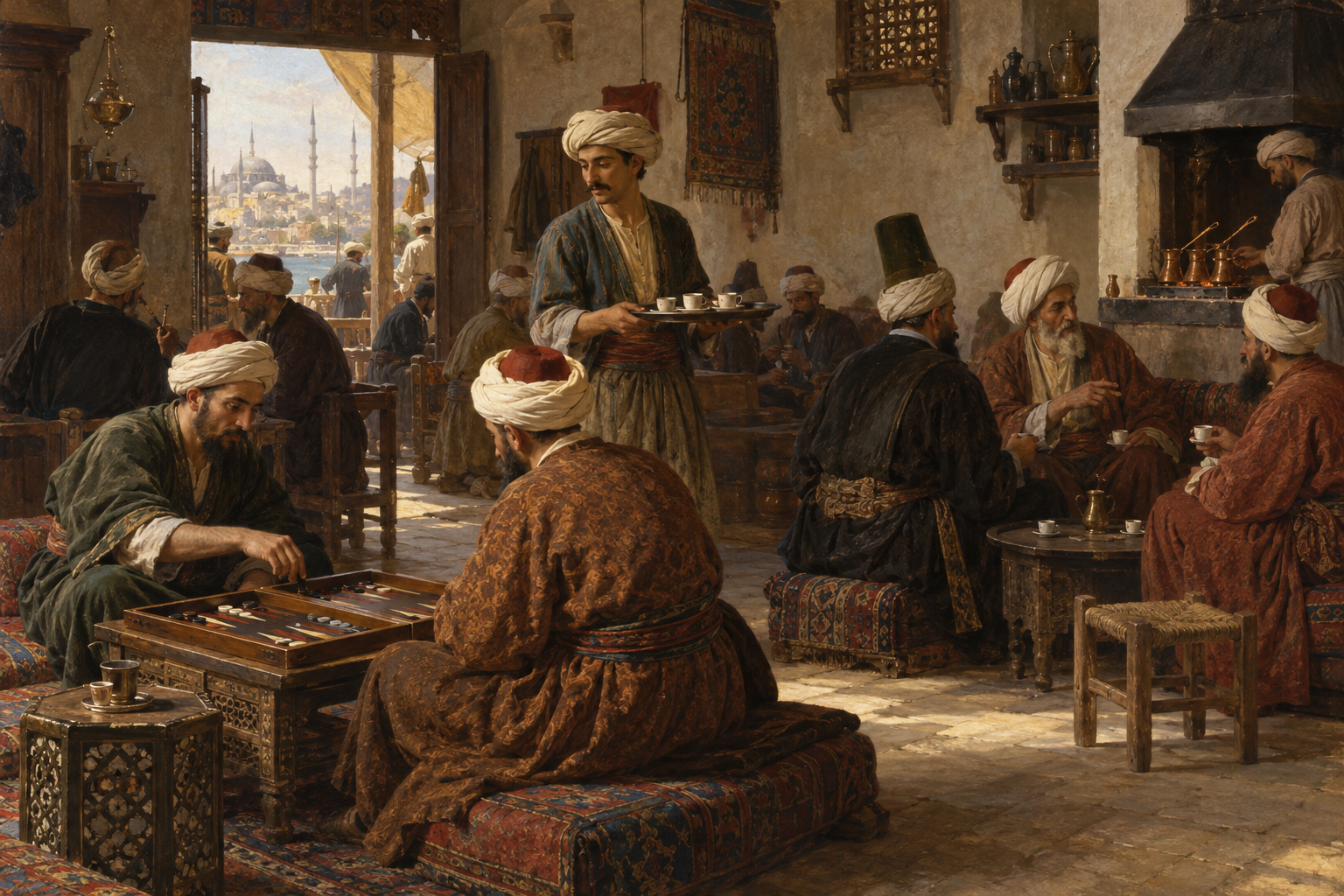
During the sixteenth century, coffee drinking spread to Mecca, Cairo and Istanbul, among other places. In the Ottoman Empire, coffee houses became places for conversation, games, news and socialising. They were often predominantly male spaces and should not be romanticised as equally open to everyone. Even so, they represented something significant: a commercial meeting place where a cup could provide a reason to stay for hours.
That very quality also aroused suspicion. Religious and political authorities debated both whether the drink was permissible and what people were actually doing when they gathered around it. There were attempts at restrictions and bans, but the image of coffee being uniformly and perpetually forbidden is misleading. Rules varied with time, place and those in power.
During the seventeenth century, coffee houses took hold in several parts of Europe. Venice, London and other trading cities became part of a growing network. At the same time, cultivation moved beyond its original region. European colonial powers established coffee production in Asia and the Americas, among other places, and in many areas that expansion relied on enslaved labour or other forms of coercion. This is an essential part of the story of how an exclusive commodity became an everyday international drink.
Sweden: from costly import to forbidden habit
Coffee arrived in Sweden as an unusual and expensive import in the latter part of the seventeenth century. At first, it was drunk in limited circles and surrounded by both curiosity and beliefs about its medicinal properties. During the eighteenth century, it became more visible in wealthy homes and urban life. But the path to the everyday cup of coffee was a winding one.

Karl XII’s stay in the Ottoman Empire is often mentioned in Swedish coffee history. It forms part of Sweden’s contact with an established coffee culture, but the king did not bring coffee to a country where it had been entirely unknown. The drink was already here. Historical developments rarely become easier to understand when given a lone hero.
In 1756, Sweden introduced its first coffee ban. Several further bans followed in the latter part of the eighteenth century and the early nineteenth century. Among the reasons was the economic thinking of the day: imported luxuries were seen as draining money from the country. Coffee thus became not just a matter of taste, but also a question of thrift, trade and how people ought to consume.
The bans did not mean that everyone immediately stopped drinking it. The fact that the state repeatedly returned to the issue suggests, rather, how difficult it was to suppress a habit that had taken root. Tales of secret coffee gatherings and defiant farewells to the drink form part of cultural history, but individual anecdotes need to be examined on their own merits. What is certain is that coffee survived the restrictions and continued to spread.
During the nineteenth century, coffee drinking gradually took root across a broader section of society. Price, availability and living conditions affected how often it could be served and how strongly it was brewed. Looking back, it is easy to imagine a uniform Swedish coffee table, but the differences between town and country, and between rich and poor, were considerable.
Fika’s familiar form grew out of several intertwined habits: coffee gatherings at home, cafés, coffee parties and breaks at work. The word fika itself is usually explained as a reversal of the syllables in kaffi, an older or dialectal form of kaffe. The word is much younger than coffee drinking. Buns and biscuits are part of the picture, but fika can just as easily mean coffee and a sandwich – or something with no coffee at all.
The modern Swedish coffee table encompasses both older traditions of boiled coffee and the strong filter-coffee culture of the twentieth century. Today, espresso machines, pour-over drippers and ordinary coffee makers sit side by side. This is not a shift from wrong to right, but a range of ways to bring out and appreciate flavour.
The jebena and fika: two ways to give each other time
In many Ethiopian homes, the coffee ceremony is a clear expression of hospitality. The work of roasting, grinding and serving makes that care visible. Women have often carried the tradition’s practical work and knowledge, a reminder that a pleasant ritual for the guest demands time and effort from the host.
Coffee may be served in three rounds, often called abol, tona and baraka, with variations in spelling and local usage. Later rounds are usually weaker. But three servings are not a requirement for every Ethiopian coffee gathering. In everyday life, the tradition adapts to the family, the place and the time available.
Sugar is common, while salt, butter and other flavourings feature in some regional and social settings. It is better to describe these variations than to declare any single addition “the Ethiopian way”. In Sweden, too, tastes range from black coffee and coffee with milk to boiled coffee and a cup left lingering on the kitchen table.
The jebena is not simply a beautiful serving vessel. Its shape and use are bound up with the brewing process and with allowing the grounds to settle before pouring. Ethiopian and Eritrean pots and practices can differ. Anyone buying a pot therefore needs to know whether it is intended for direct heat, how to care for it and how to use it. A decorative clay pot is not automatically safe for cooking.
Swedish fika generally has less overt ceremony, but it can still have strong social conventions. You offer, wait for others, refill and make room. At work, the break can be a chance for conversation to move beyond the meeting agenda. At home, a cup set out on the table can signal that a visit need not be rushed.
There is a useful resemblance, then, but no reason to make the traditions identical. Serving Ethiopian coffee with a Swedish cardamom bun is a contemporary meeting of the two, not a recreation of an Ethiopian custom. Respect often begins with that simple distinction: explaining what comes from a tradition and what you have added yourself.
Flavour in the cup – and food alongside
Roasting transforms coffee’s seeds. Heat drives chemical reactions that build aromas, and the structure of the beans changes. Lighter roasts can allow fruitiness and acidity to come through more clearly. Darker roasts often give more roasted bitterness and notes tending towards cocoa or burnt sugar. But light is not automatically better, and dark is not automatically fuller-bodied. The raw ingredient and the brewing method matter too.

In the cup, we need to distinguish between strength and extraction. Put simply, strength is about how concentrated the drink is. Extraction is about how much has been dissolved out of the coffee. More coffee in relation to water usually produces a stronger drink, while grind size, temperature and contact time affect how the flavours are drawn out. A cup can be both strong and unbalanced in its acidity, or thin yet bitter.
For home brewing in Sweden, around 60 grams of coffee per litre of water is a useful starting point, not a law of nature. It is worth weighing your coffee: the amount in a scoop varies with grind and roast. Use fresh, cold water and clean equipment. Old coffee oils in a pot can give a rancid taste that more expensive beans will not cure.
Gently sweet baked treats often work well with floral, fruity coffee. A cardamom bun brings butteriness and spice without needing a coating of sugar. Cardamom’s citrus-like, lightly floral character can echo the coffee’s aromas, while the bread softens the overall impression. Very sweet accompaniments, on the other hand, can make coffee seem more bitter or acidic afterwards.
Popcorn is another lovely companion and is served at Ethiopian coffee gatherings. Lightly salted and without strong flavourings, it provides crispness and a gentle toasted note that does not overpower. Roasted chickpeas or grains can also offer a less sweet alternative. For a more substantial Swedish fika, a cheese sandwich works well, especially with a rounded coffee showing nutty, chocolatey notes.
Coffee is itself an alcohol-free choice; there is no need for an after-dinner spirit to end the meal. Offer water, decaffeinated coffee or caffeine-free rooibos tea for anyone who wishes to avoid caffeine. Drink in moderation and according to your own sensitivity, especially late in the day. The Swedish Food Agency recommends that pregnant women limit their total caffeine intake to no more than 200 milligrams a day; the amount varies between coffees and serving sizes.
At home in Sweden: borrow the technique, acknowledge the adaptation
It is possible to approach an Ethiopian way of making coffee without buying a jebena or starting to roast green coffee at home. A small saucepan, an Ethiopian coffee and time for the grounds to settle are enough for a practical home version. This is not, however, the same as recreating the entire coffee ceremony. The vessel, the roasting, the company and the setting are also part of the tradition.

Choose a medium-roast coffee for your first attempt. A very dark coffee can become harsh when heated, while a very light roast may need more adjustment to achieve balance. Buy coffee ground for boiling if you do not have a grinder, or ask a coffee shop to grind it slightly coarser than ordinary filter coffee. This is a practical choice for the saucepan method below, not a claim about a universal Ethiopian grind size.
Avoid prolonged, vigorous boiling. It drives off volatile aromas and can produce a harsh flavour. Instead, allow the coffee to rise gently, remove the saucepan from the heat and give the grounds time to settle. Pour slowly and leave the last little bit at the bottom. If you prefer less sediment, you can pour it through a paper filter, but this also changes the mouthfeel: the result will be cleaner and less oily.
To go with it, we are baking cardamom buns. Freshly crushed cardamom makes more difference than an extra decoration; its aroma should rise as you break the bun apart. The dough should be soft and a little sticky rather than dry with flour, and the butter should be soft enough to work in. Let the dough rise for as long as the room temperature demands.
The recipe card brings coffee and buns together for a shared fika. The buns can be baked well ahead and frozen, while the coffee is made once the guests are seated. Set out small cups, water and a caffeine-free alternative. Then perhaps the most important ingredient remains, whether in a Swedish kitchen or beside an Ethiopian coffee tray: not getting up again straight away.
Ethiopian-inspired saucepan coffee with Swedish cardamom buns
A shared fika recipe for eight people: eight small cups of coffee and 16 buns. The coffee is a simplified home interpretation of brewing with a jebena, adapted for a saucepan and ready-roasted beans – not a complete coffee ceremony. The buns are a Swedish addition. Allow around 75–105 minutes for rising in addition to the active preparation time; expect a total of roughly 2.5–3 hours.
Ingredients
Method
- 1Crumble the yeast into a mixing bowl. Warm the milk to about 30 °C and stir it into the yeast until dissolved. Add the sugar, cardamom, salt and 450 g flour.
- 2Mix the dough in a stand mixer for about 5 minutes. Add the softened butter a little at a time and mix for another 8–10 minutes, or knead by hand for about 15–20 minutes in total. The dough should become soft and elastic. Add just a little of the extra flour if it is very loose.
- 3Cover the bowl and leave to rise at room temperature for 45–60 minutes, until the dough is noticeably airy and has increased considerably in volume.
- 4Mix together the butter, sugar and cardamom for the filling. Roll out the dough on a lightly floured surface to about 35 × 45 cm. Spread the filling over the entire surface.
- 5Roll up from one long edge and cut into 16 even slices. Place cut-side up in paper bun cases on two baking trays. Cover and leave to rise for 30–45 minutes, until the buns feel airy. Meanwhile, heat the oven to 225 °C, conventional heat.
- 6Whisk together the egg and water and gently brush over the buns. Bake one tray at a time in the centre of the oven for 9–12 minutes, until the buns are nicely golden and baked through. Leave to cool on a wire rack under a clean tea towel.
- 7When it is time for coffee: heat 10 dl water in a saucepan with a capacity of at least 1.5 litres until it just begins to boil. Remove from the heat and wait about 30 seconds.
- 8Gently stir in the coffee. Return to a low to medium heat. Watch closely as it heats, until the surface begins to foam and rise or the first small bubbles appear at the edge, usually after 1–2 minutes. Remove immediately; do not let the coffee boil vigorously.
- 9Leave undisturbed for 4–5 minutes to allow the grounds to settle. Meanwhile, warm a serving pot with hot water, then empty it.
- 10Slowly pour the coffee into the pot without disturbing the grounds at the bottom. Leave the last splash of coffee and the grounds in the saucepan. Serve immediately in small cups with buns, water and sugar on the side if desired.
- Freeze the buns as soon as they have cooled. Thaw and warm gently to serve; it is better to bake ahead than to keep the coffee waiting on the heat.
- If Ethiopian coffee is unavailable, another medium-roast arabica will work. The flavour will change, but the method remains the same.
- For a clearer cup, pour the coffee through a rinsed paper filter. This gives a different, lighter mouthfeel than the unfiltered version.
- Consider making a smaller batch of decaffeinated coffee separately. Rooibos tea is a completely caffeine-free alternative that also pairs well with the cardamom buns.
What goes with the glass
- FoodA gently sweet cardamom bunCardamom’s floral, citrus-like aromas complement a fruity coffee, while the butter and soft bread round out the pairing. Moderate sweetness makes the coffee less likely to seem strikingly bitter after a bite.
- FoodLightly salted popcornPopcorn is served as a snack at Ethiopian coffee gatherings. Its gentle toasted flavour echoes the coffee, while its crispness provides contrast without masking finer aromas.
- FoodA cheese sandwich on mild rye breadA mild to medium-mature cheese brings salt, fat and umami to a rounded, medium-roast coffee. The bread’s toasted grain notes tie the flavours together; avoid overly tangy bread with a coffee that is already very acidic.
Sources
- Ralph S. Hattox, Coffee and Coffeehouses: The Origins of a Social Beverage in the Medieval Near East (1985)
- Mark Pendergrast, Uncommon Grounds: The History of Coffee and How It Transformed Our World (2010)
- James Hoffmann, The World Atlas of Coffee: From Beans to Brewing – Coffees Explored, Explained and Enjoyed (2018)
- UNESCO, Kafa Biosphere Reserve
- Nationalencyklopedin, Kaffe
- Svenska Akademiens ordbok, Fika
- Livsmedelsverket, Koffein
Ask questions about "Coffee – from Ethiopia’s mountains to Swedish fika". Answers are based on the magazine's own articles.