Kimchi – Korea’s Living Larder
From autumn kimjang to a bubbling stew: cabbage that keeps developing flavour.
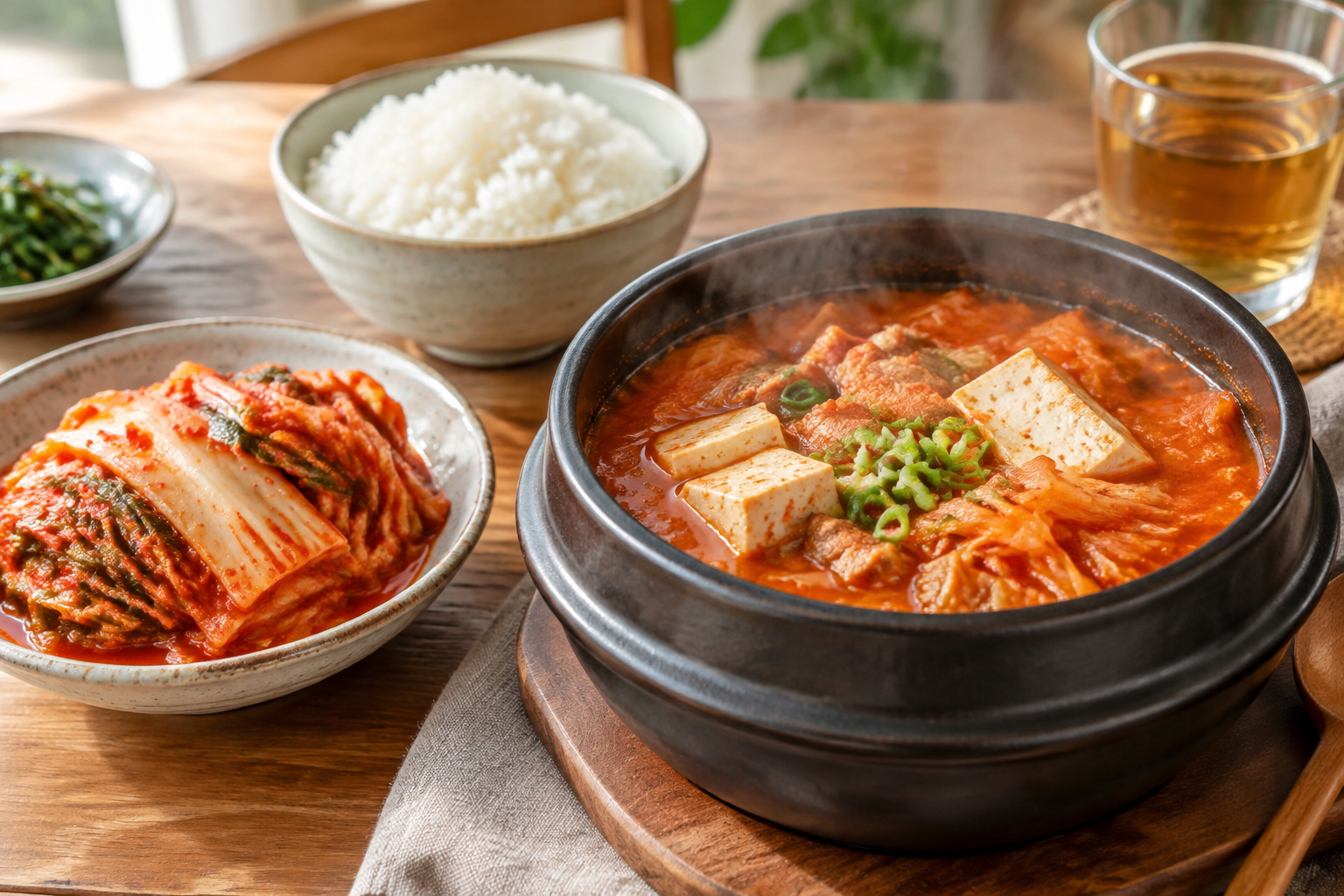
Crisp, tangy and deeply savoury. Kimchi is both the art of preservation and everyday food, a shared endeavour and a deeply personal matter of taste. We follow the cabbage through salting, seasoning and fermentation – and make both baechu-kimchi and kimchi-jjigae in a Swedish home kitchen.
 By Mai LindqvistReporter · East and Southeast Asian cuisine – Thailand, Vietnam, Japan, China and Korea
Translated from Swedish with AI assistance.
Go to the recipes (2) ↓When autumn moves into the kitchen
The cabbage leaves creak as they are pulled apart. In a wide tub lies Chinese leaf cabbage, salt scattered between its thick white ribs. On the worktop, thin matchsticks of radish, spring onions and a red seasoning paste await, fragrant with garlic, ginger and the sea. Gloved hands lift one leaf at a time and spread on the seasoning. Soon each section of cabbage is a tightly wrapped parcel, heavy with juice and the promise of winter meals.
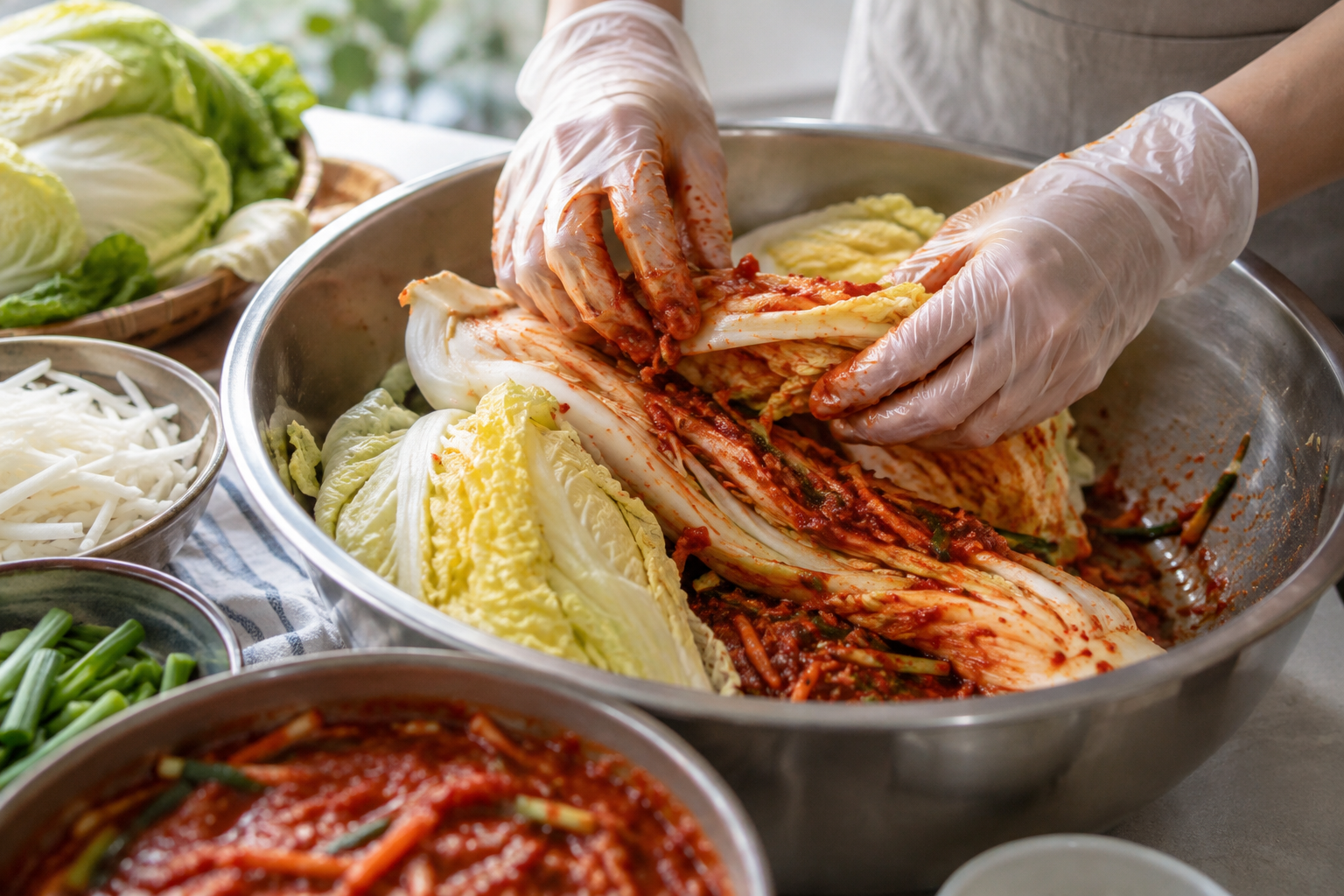
The work involves countless small judgements. Does the rib bend without snapping? Is the cabbage pleasantly salty after rinsing? Does it need more chilli, a little more fish sauce? The recipe may be written down, but experience also lives in the hands and on the tongue.
This is where the story of baechu-kimchi, kimchi made from Chinese leaf cabbage, begins. Internationally, this red cabbage is the best-known member of a much larger family. Kimchi can be made from radish, cucumber, leafy greens or other vegetables. It can be hot or mild, tightly packed or swimming in a refreshing brine. Not all kimchi is red, and not all kimchi needs to taste sharply sour.
What unites it is a Korean food tradition in which vegetables are salted, seasoned and often allowed to develop through lactic acid fermentation. Some varieties are eaten almost immediately. Others stay with a household for a long time, taking on new roles as their flavour changes.
Freshly made cabbage kimchi is juicy, peppery and distinctly sweet with vegetables. In time, acidity develops, sometimes with a light fizz. Later still, the cabbage may soften and its flavour deepen, making it better suited to a stew than to those who want a truly crisp side dish. Kimchi, then, is not simply something you make. It is something you keep an eye on.
A history older than red chilli
Salting and preserving vegetables has a long history on the Korean peninsula. Early written records show that preserved vegetables were part of the diet long before today’s red cabbage kimchi took shape. Pinpointing a single birth year for kimchi, however, is difficult. Ingredients, names and methods have all changed over the centuries.
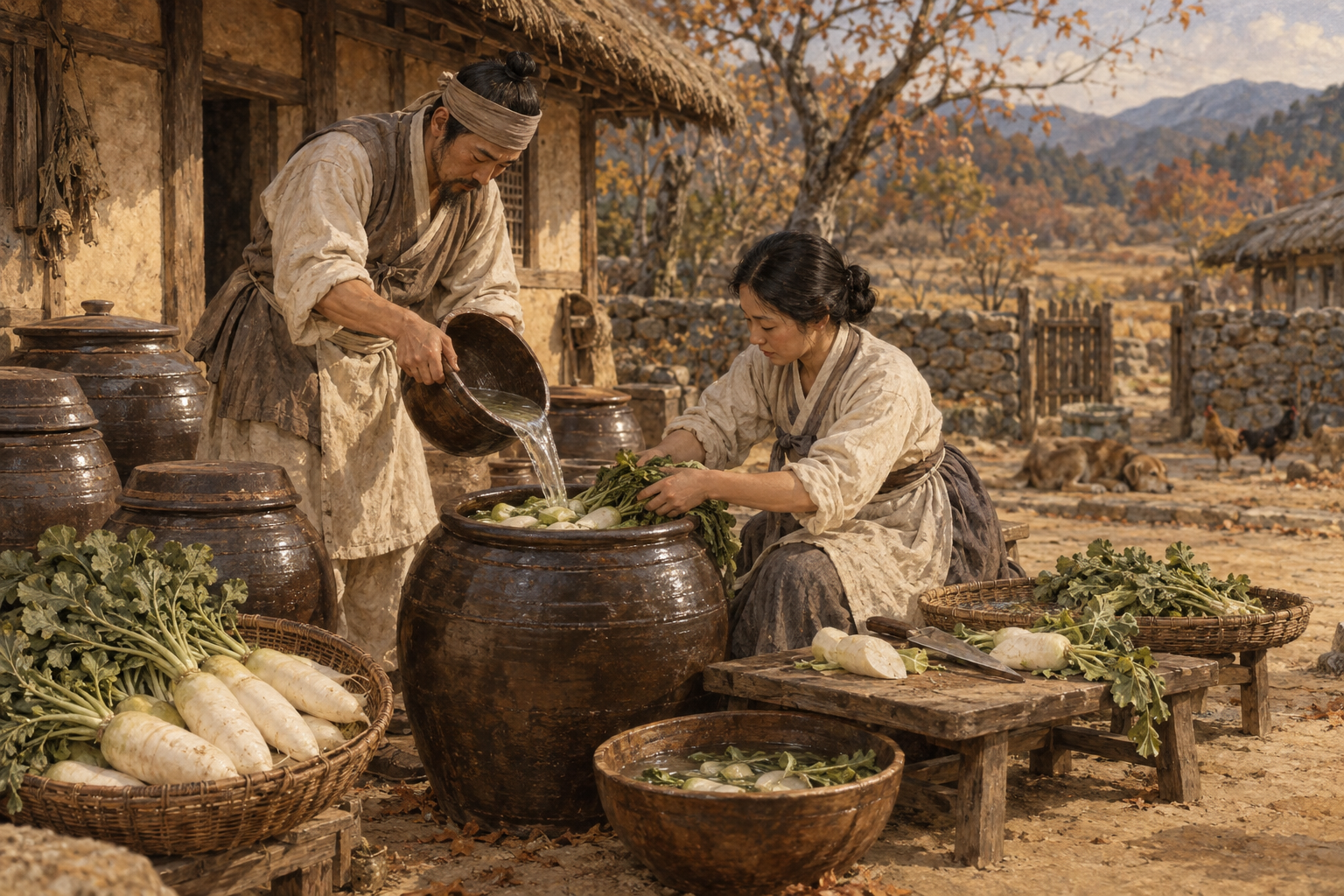
It is also misleading to picture today’s tightly packed heads of Chinese leaf cabbage, generously seasoned with chilli, in every historical account of pickled vegetables. Earlier forms might have used radish and brine, for instance. Cabbage varieties and cultivation evolved, and the familiar red baechu-kimchi took shape gradually.
The history of chilli shows just how fluid a food tradition can be. The plant originated in the Americas and spread around the world following transatlantic contact from the late 15th century onwards. In Korea, written evidence of chilli dates from the early 17th century. Its introduction is usually placed around the turn of the 17th century, often via Japan, but the precise route and timing should not be presented as fully settled.
Nor did everyone immediately start stirring chilli into kimchi. An ingredient being present in a country is one thing; its becoming an essential part of a particular dish is another. Chilli’s place in kimchi developed later. The red colour is therefore the result of historical change, not proof of an unchanging original form.
That makes today’s kimchi no less Korean. On the contrary, it shows how a cuisine can take a new ingredient and create something distinctive with it. Gochugaru, Korean chilli flakes, brings more than heat: fruitiness, colour and sometimes an almost sweet scent of dried peppers.
The story of kimchi as a winter store must also leave room for everyday variation. Climate, access to vegetables, household finances and family size all influenced what was preserved and how much. A larder was not a collection of identical jars. It was a way to plan meals when the growing season could no longer supply fresh produce every day.
Kimjang: sharing knowledge
In 2013, “Kimjang, making and sharing kimchi in the Republic of Korea” was inscribed on UNESCO’s Representative List of the Intangible Cultural Heritage of Humanity. It was not a particular jar or a standard recipe that was recognised, but the tradition of making and sharing kimchi.
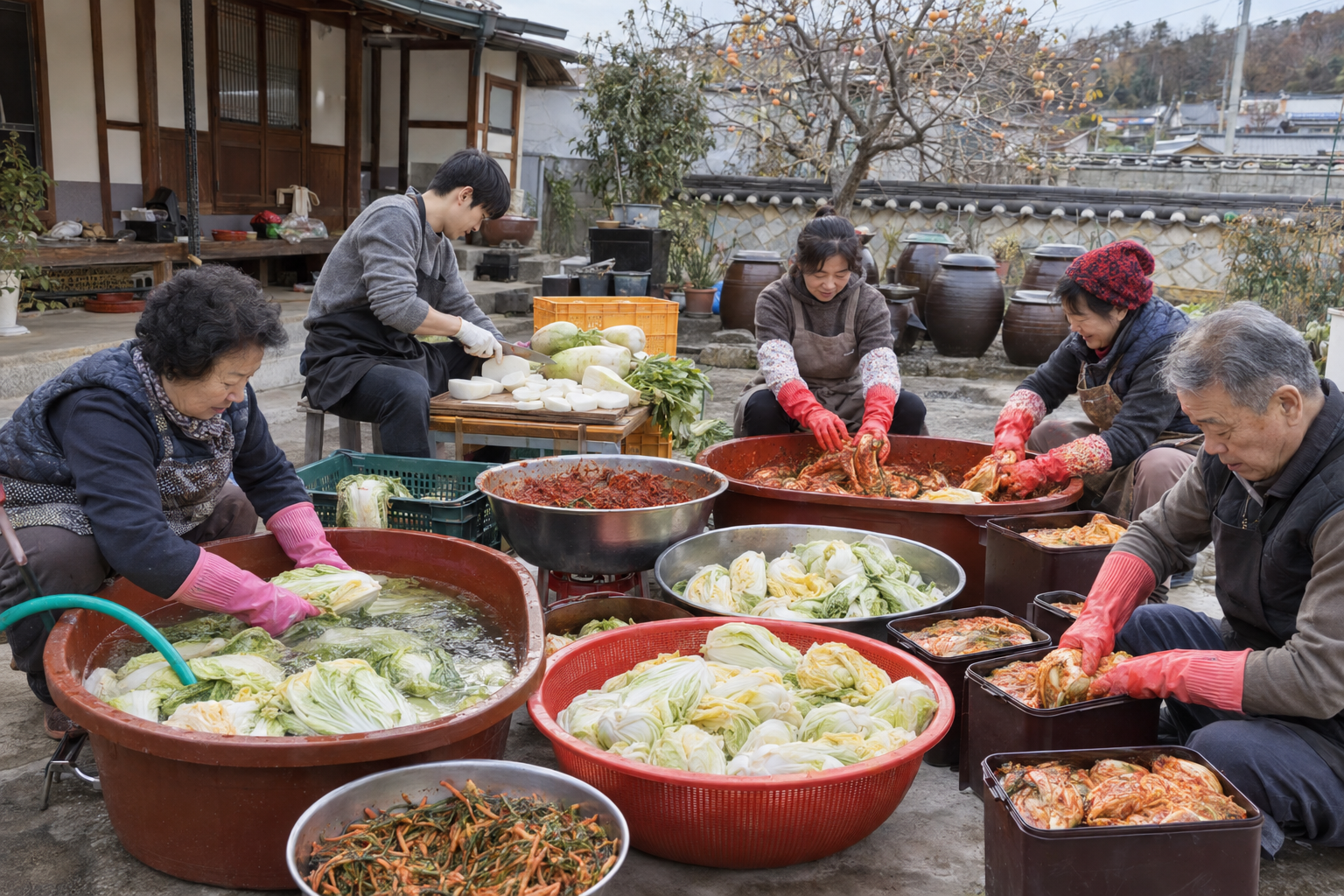
Kimjang is particularly associated with late autumn, when larger quantities are prepared for winter. The work can bring relatives and neighbours together around tubs, chopping boards and containers. Someone rinses cabbage, someone cuts radish, someone mixes the seasoning. Knowledge is passed on through working together: how salted cabbage should feel, how much filling is needed and which flavours the family enjoys.
Sharing is central. Kimchi may travel between households, to elderly relatives or to someone unable to make their own. Giving kimchi means sharing both food and labour. At the same time, the tradition should not be romanticised into a picture of effortless family harmony. Large batches take time, space and hard physical work, historically often done by women.
In Korea today, homemade kimchi sits alongside shop-bought versions. Small households, working hours and living spaces affect what is practical. Some people make a few favourite varieties themselves and buy the rest. Dedicated kimchi fridges offer a steady, low temperature and separate storage; they are a modern solution to an age-old need to control storage conditions.
The traditional image, by contrast, is of onggi, Korean earthenware vessels used for fermented foods, among other things. The material’s properties vary according to the clay, glaze and firing. The shorthand description that a pot “breathes” refers to the ability of some vessels to allow gases through, but onggi is no magical prerequisite for good fermentation.
Pots of winter kimchi have also been buried wholly or partly in the ground to even out the temperature. The point was not simply the vessel, but the interplay between container, season and cool storage. Food-safe glass jars work perfectly well in a Swedish home. We need to understand the function, not reproduce every historical tool.
Salt opens the door to fermentation
When cabbage is salted, water is drawn out of its tissues and the leaves become pliable. Salting also affects which microorganisms can thrive. During the fermentation that follows, lactic acid bacteria convert sugars into lactic acid and other compounds. Different bacteria may dominate at different stages; temperature, salt content and ingredients all influence the process.
It is this acid production that gives kimchi its changing flavour. No vinegar is needed in the recipe here. Instead, acidity builds during fermentation, along with aromas that make the result taste of more than simply sour cabbage. Some microorganisms also produce carbon dioxide. Small bubbles and a gentle hiss can therefore be perfectly normal signs of activity.
But bubbles are neither essential nor proof of safety. Smell and taste alone cannot guarantee that a fermented food is safe. Use sound vegetables, clean hands and utensils, and a tried-and-tested method. Salt should be weighed; different types take up different amounts of space in a measuring cup.
When cabbage is salted and then rinsed, its final salt content cannot be calculated simply by comparing the weight of salt with the cabbage’s original weight. How long the cabbage is salted, how thoroughly it is rinsed and how much water drains away all matter. It is therefore wiser to follow one complete method than to take the salt quantity from one recipe and everything else from another.
Temperature is the next major control. Warmth speeds up the process; cold slows it down but does not stop it entirely. The recipe below begins with a short period at a moderate room temperature and continues in the fridge. Things move faster in a warm summer kitchen than in a cool winter one. Do not leave the jar in sunlight or beside the cooker.
Packing matters too. Press the cabbage down to remove large air pockets and keep the surface moist with seasoning paste and the liquid that forms. Leave room for expansion. Gas must be able to escape during active fermentation; pressure can build up in an ordinary glass jar sealed tightly shut.
Fuzzy mould, distinctly unusual discolouration or a rotten smell are reasons to discard the entire contents, not scrape off the top. Natural acidity and aromas of cabbage, garlic and fish-based seasoning, on the other hand, are part of the flavour profile. The important distinction is between expected development and signs of spoilage.
Flavour between the ribs
Baechu means Chinese leaf cabbage, the elongated cabbage found in many Swedish vegetable aisles. Choose a heavy, fresh head with firm, springy leaves. The thick white ribs provide crunch, while the thinner leaves catch the seasoning paste. Both are needed for that distinctive contrast between juicy bite and tender, spiced leaves.
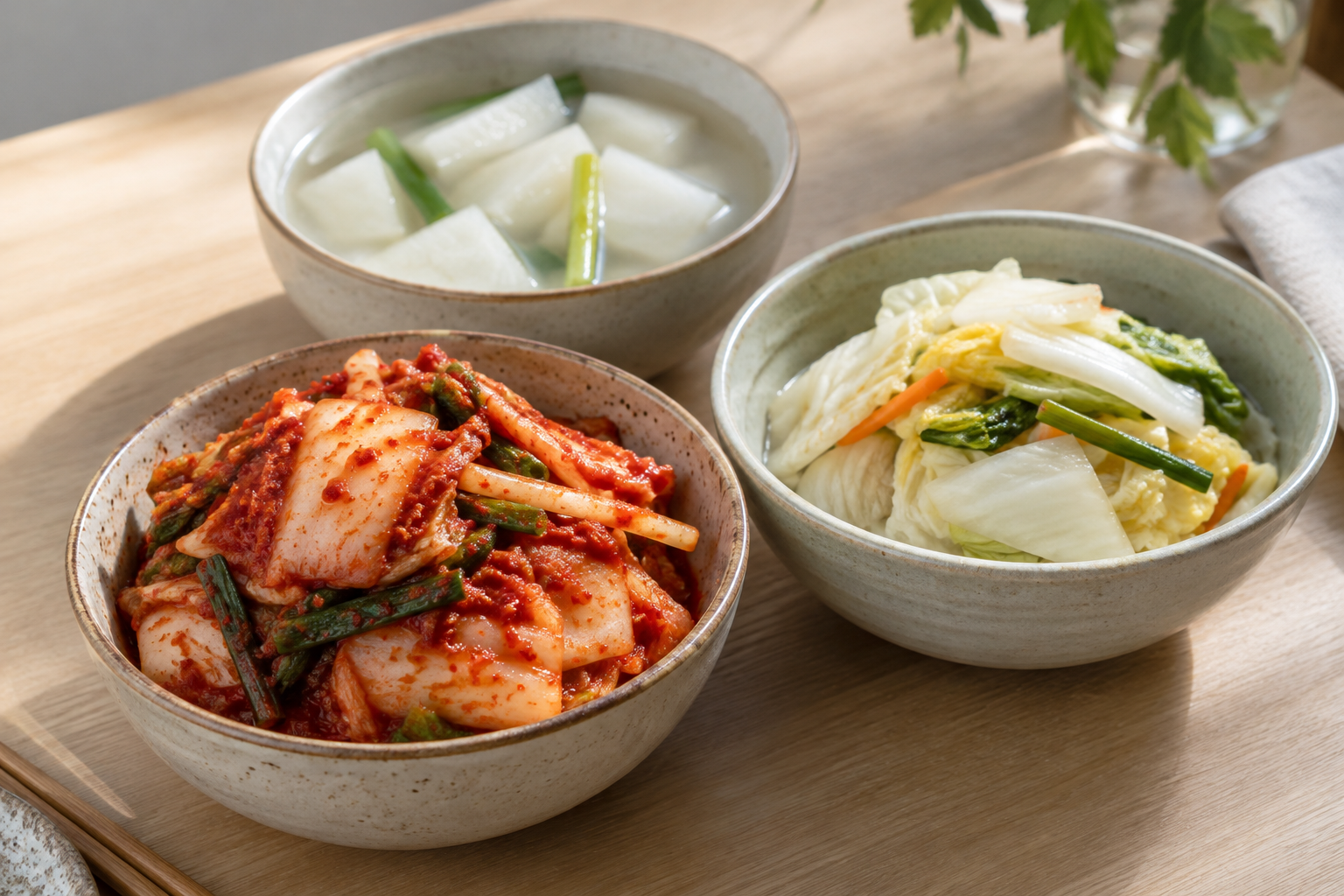
Traditional cabbage kimchi is often made with the heads divided into large sections and the seasoning spread between the leaves. Here we use a chopped everyday version, often called mak-kimchi. It belongs to the baechu-kimchi family but is easier to mix, pack and portion in a small kitchen. This is a practical adaptation, not a claim that every household works in the same way.
Gochugaru is worth a trip to an Asian food shop or an online order. Ideally, choose flakes intended for kimchi rather than a very finely ground powder. Heat levels vary between products. If you are unsure, start at the milder end: kimchi should be something to eat, not merely a test of endurance.
Ordinary chilli flakes are not a direct substitute. They can bring considerably more heat and less fruitiness. A blend of mild paprika and a smaller amount of hot chilli can work in a pinch, but the flavour will be different. Gochujang, the fermented Korean chilli paste, is not interchangeable with gochugaru either; it adds a different balance of saltiness, sweetness and texture.
Radish adds crunch and pepperiness. Korean mu is common in Korean recipes, but daikon or another white radish works well here. Spring onions, garlic and ginger build the aroma. A little sugar can round out the fresh seasoning, but the vegetables already contain sugars that the bacteria can use.
Fish sauce and salted, fermented tiny shrimp, saeujeot, appear in many recipes, adding salt and umami. They are not compulsory in all kimchi. Vegetarian and vegan traditions also exist, including within Korean temple cuisine. Fish sauce is enough for our recipe; an ordinary Southeast Asian fish sauce works when Korean aekjeot is unavailable.
A thin rice-flour porridge helps the seasoning cling. Many households use it, but it is not a universal rule. The same applies to fruit, stock and other additions: there are many sound ways to build a kimchi, not one definitive formula.
Regional differences are often described in relation to climate and access to fish and seafood. Southern versions are often more heavily salted and more generously seasoned with fermented seafood than northern ones. These are useful broad patterns, not boundaries every family observes. Baek-kimchi, white kimchi without red chilli, and dongchimi, radish kimchi in brine, are further reminders of how much broader this world of flavour is than red cabbage alone.
At the table – and into the stew
Kimchi is often served as banchan, one of the small dishes accompanying rice, soup and other foods at a Korean meal. It is not necessarily meant to be eaten alone in large quantities. A piece of cabbage between mouthfuls of rice and meat can change the rhythm of the whole meal: acidity after fat, crunch after softness, chilli after mild broth.
At a kimjang gathering, freshly made kimchi may be paired with boiled pork, often in a serving style associated with bossam. The still-young cabbage brings freshness and spice without much sourness. It is a different experience from eating the same batch several weeks later. Both have their place.
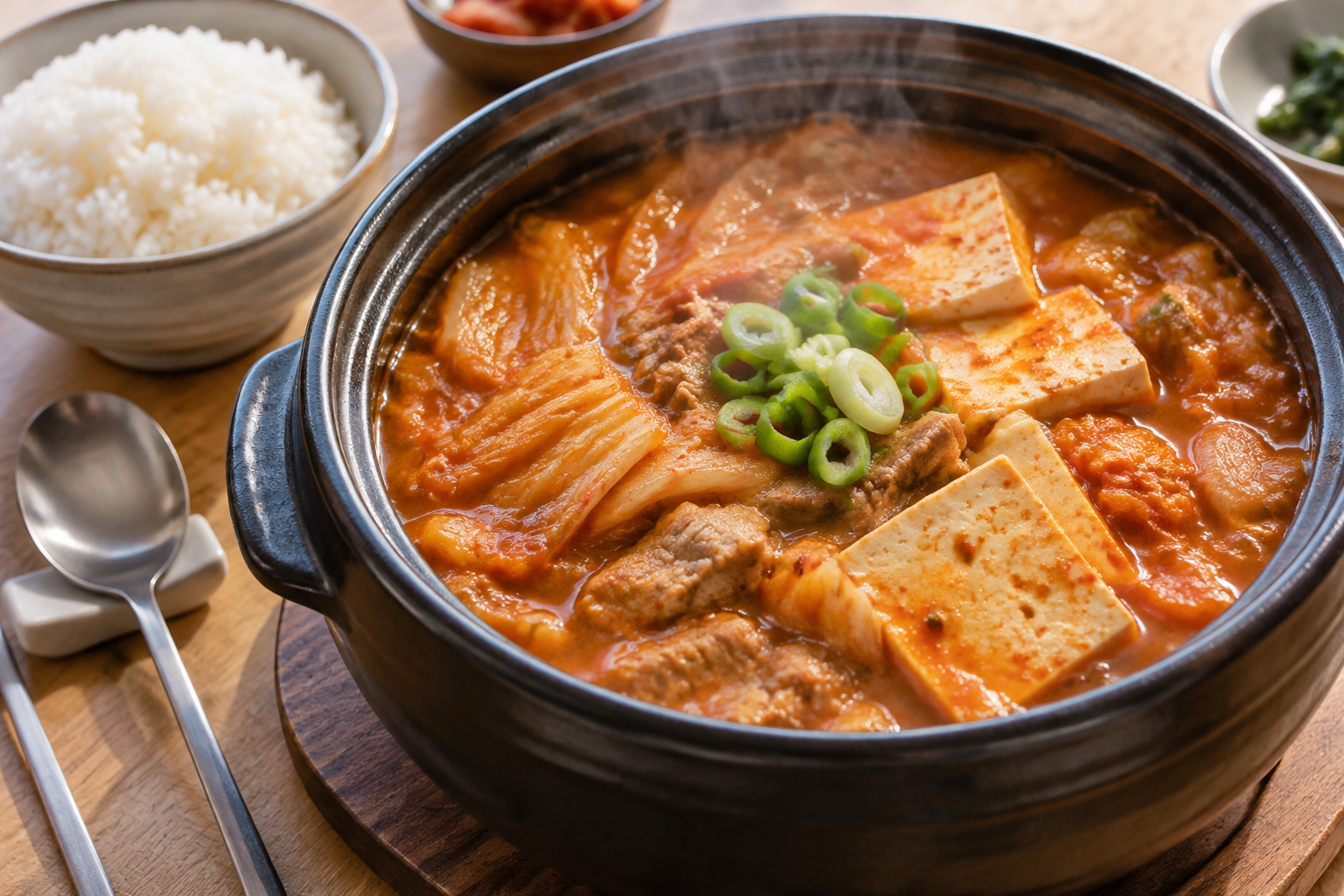
Kimchi’s maturation also creates a kind of kitchen logic. The more sour cabbage can become a pancake filling, a seasoning for fried rice or the base of kimchi-jjigae. Jjigae refers to stews that are generally more concentrated than a thin soup. Kimchi-jjigae is everyday food with many variations: pork, tinned tuna or other ingredients, often alongside tofu.
Here, acidity becomes an asset. Pork fat rounds it out, onion adds sweetness and tofu offers soft, mild pauses. The kimchi is fried before the liquid is added. Its aroma shifts from raw garlic and sour cabbage to something warmer and fuller. The stew should then simmer, not boil fiercely until everything has the same texture.
Choose distinctly sour kimchi that still smells fresh. A newly made batch will not give the same depth. A little kimchi brine adds both acidity and salt, but taste before adding more soy sauce. Shop-bought kimchi varies widely: a mild version may need extra gochugaru, while a salty one needs less soy sauce.
Cooking with mature kimchi does not mean that suspect or mouldy kimchi can be rescued by heating. The stew must be made with an ingredient that is still fit to eat. Maturity is a matter of flavour; spoilage is something else.
Creating a living larder at home
Start with two kilos of cabbage rather than a full-scale kimjang project. That is enough for several jars, a few meals and a chance to follow its development. Label the jars with the date, and consider using a smaller jar first so that the others need not be opened as often. Always take kimchi out with clean utensils.
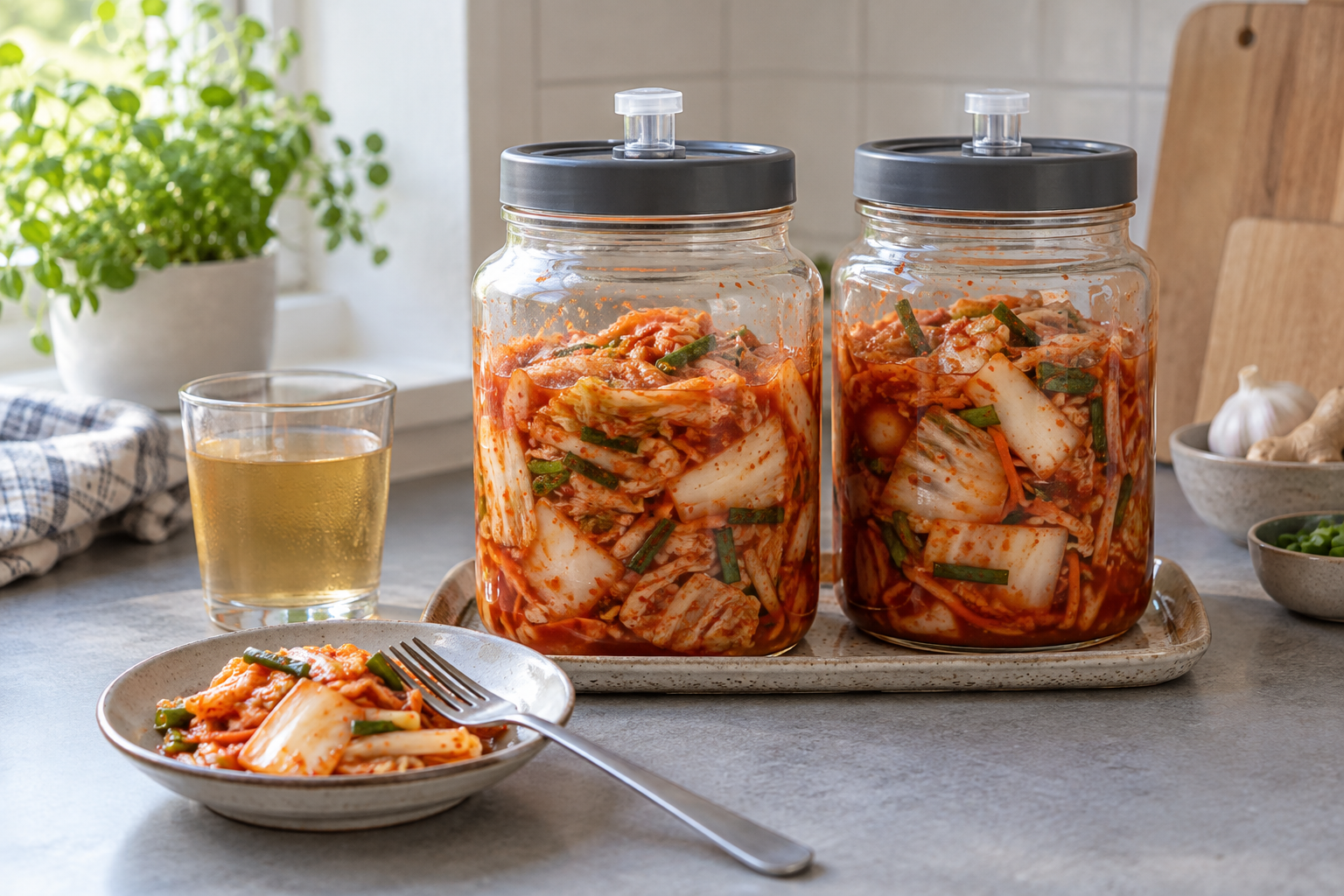
The most useful trick at home is to taste at different stages. Try a small piece when it is freshly mixed, after the first few days in the fridge and later, once the acidity is pronounced. Do not judge every stage against the same ideal. Fresh kimchi should not taste like the ingredient destined for the stew, and mature kimchi need not retain exactly the same crunch.
Stand the jars on a tray at first, as the liquid may rise. Then keep them cold, at around 4°C. A lid designed for fermentation makes it easier for gas to escape; ordinary jars need more attention. The timings in the recipes are a guide to flavour development, not a promise that every batch will behave identically.
Cold Korean barley tea, boricha, works beautifully with the food. The roasted barley gives a mild, nutty flavour without piling more acidity on top of the sourness. It is caffeine-free but not gluten-free. Pale lager is another common companion, while makgeolli, a slightly cloudy fermented rice drink, can meet the chilli with gentle acidity and sometimes a little sweetness. Alcohol is not needed for balance; temperature, roasted notes and restrained sweetness can do the same job.
The recipes below belong together. First you make the cabbage. Then, once some of it has become thoroughly sour, you make the stew. Between the two lies what makes kimchi so useful: one ingredient, several stages of flavour and almost no need to hurry. A larder that never stands still.
Baechu-kimchi – chopped cabbage kimchi for the home kitchen
An easy-to-handle mak-kimchi made with Chinese leaf cabbage, inspired by Korean household methods. Makes about 2–2.5 kg, roughly 20 side-dish portions. In addition to hands-on time, allow 1.5–2 hours for salting, plus draining and fermentation: usually 1–2 days at 18–20°C, followed by further maturation in the fridge.
Ingredients
Method
- 1Thoroughly wash your utensils and food-safe jars. Prepare about 3 litres of jar capacity in total, preferably divided between several jars, leaving room for expansion when filling them later. Trim away the cabbage’s hard base and cut the leaves into 4–5 cm pieces.
- 2Rinse the cabbage and leave it damp. Layer it with the weighed salt in a large bowl. Massage gently and leave for 1.5–2 hours. Turn every 30 minutes. The thick ribs should become flexible but retain some spring; give them another 30 minutes if needed.
- 3Rinse the cabbage thoroughly in three changes of cold water. Taste a thick piece of leaf: it should be pleasantly salty, not harshly so. Rinse once more if necessary. Drain in a colander for 30 minutes without crushing the leaves.
- 4Whisk the water and rice flour together in a small saucepan. Bring to the boil, stirring, then simmer for 2–3 minutes to make a thin porridge. Stir in the sugar. Leave to cool completely.
- 5Cut the radish into thin matchsticks and the spring onions into 3 cm lengths. Finely grate the garlic and ginger. Mix the porridge with the gochugaru, fish sauce, garlic and ginger.
- 6Mix the cabbage, radish and spring onions with the seasoning paste. Wear clean kitchen gloves if your skin is sensitive to chilli. Toss thoroughly until every piece of cabbage is coated.
- 7Pack into the jars, pressing out air pockets with a clean spoon. Divide all the seasoning paste and liquid between the jars. Level the surface and leave 4–5 cm of space at the top. Use fermentation lids according to the manufacturer’s instructions, or ordinary lids that are not screwed airtight during room-temperature fermentation.
- 8Place on a tray at 18–20°C, away from sunlight, usually for 24–48 hours. Check after 24 hours and press the cabbage down with a clean utensil so the surface stays moist with the brine that forms. Taste with a separate clean spoon. Move to the fridge when a slight tang becomes noticeable; do not leave the batch somewhere warm while waiting for bubbles.
- 9Store at about 4°C with lids on. Open carefully, as gas may continue to form even in the fridge. The flavour usually becomes more rounded after 5–7 days and more sour over the following weeks. Use clean utensils, keep the cabbage pressed down and discard the entire batch if there is mould, a rotten smell or any other clear sign of spoilage.
- For a vegan version, replace the fish sauce with the same volume of light soy sauce. The flavour and colour will change; also check that the remaining ingredients suit your diet.
- Gochugaru varies in heat. Choose a milder product for less heat rather than replacing the full amount with ordinary hot chilli flakes.
- Kimchi that has matured for a few weeks in the fridge often works well in kimchi-jjigae. Taste as you go; age alone determines neither flavour nor shelf life.
- If your home is warm, you can let the kimchi mature in the fridge from the start instead. It takes longer, but offers better control than a warm kitchen worktop.
Kimchi-jjigae with pork and tofu
A rich, tangy everyday stew in which mature kimchi takes centre stage. Serve with rice. Choose distinctly sour kimchi that still smells fresh; fresh kimchi gives a different, less deep flavour.
Ingredients
Method
- 1Put the rice on to cook according to the packet instructions. Cut the pork into bite-sized pieces about 5 mm thick. Slice the onion, finely chop the garlic and snip the kimchi into smaller pieces. Reserve the brine.
- 2Heat the oil in a heavy-based pot over a medium-high heat. Fry the pork for 4–5 minutes until some of the fat renders out and the meat is lightly coloured.
- 3Add the onion and kimchi. Fry, stirring, for 5 minutes. Add the garlic and gochugaru and stir for about 30 seconds without burning the chilli.
- 4Pour in the kimchi brine and water or unsalted stock. Bring to the boil, reduce the heat and simmer, covered, for 20 minutes. Stir occasionally and add a little extra water if the stew becomes too concentrated.
- 5Cut the tofu into thick slices and slice the spring onions on the diagonal. Add the tofu to the stew and simmer gently for another 5 minutes, until heated through.
- 6Taste and adjust the seasoning. Add a little of the sugar if the acidity feels too sharp, and soy sauce only if more salt is needed. Scatter over the spring onions and serve the stew hot with the rice alongside.
- For a vegetarian version, use vegan kimchi and replace the pork with 250 g mushrooms. Fry the mushrooms in 1 tbsp oil and use vegetable stock.
- If you have no kimchi brine, replace it with water. Taste at the end; more soy sauce adds saltiness but cannot replace the kimchi’s acidity.
- Cool leftovers quickly in shallow containers, refrigerate and eat within 2–3 days, or freeze. Reheat until piping hot throughout.
What goes in the glass
- WineMakgeolli – Korean fermented rice drinkMakgeolli is often called rice wine, but it is a fermented grain drink, not a grape wine. Its gentle acidity, cloudy richness and sometimes slight sweetness suit the heat of kimchi and the pork in the stew. Choose a less sweet style if possible and serve a small amount chilled.
- BeerKorean pale lager or another light lagerGentle bitterness and light maltiness give the kimchi’s acidity and umami room to shine. Heavily hopped beer can make the chilli feel more aggressive; a simple, light lager is often a better choice.
- Alcohol-freeBoricha – Korean roasted barley teaServe cool or lukewarm. The nutty, roasted flavour complements the rice and softens the contrast between hot chilli and sour cabbage without extra sweetness. Barley tea is caffeine-free but contains gluten.
Enjoy alcohol in moderation. Alcohol-free options go just as well with the food.
Sources
- UNESCO, Kimjang, making and sharing kimchi in the Republic of Korea (2013)
- Michael J. Pettid, Korean Cuisine: An Illustrated History (2008)
- Harold McGee, On Food and Cooking: The Science and Lore of the Kitchen (2004)
- Hyosun, Korean Bapsang, Traditional Napa Cabbage Kimchi
- Hyosun, Korean Bapsang, Kimchi Jjigae (Kimchi Stew)
- Kun-Young Park, Jeong-Kyung Jeong, Young-Eun Lee och James W. Daily III, Health Benefits of Kimchi (Korean Fermented Vegetables) as a Probiotic Food (2014)
Ask questions about "Kimchi – Korea’s Living Larder". Answers are based on the magazine's own articles.