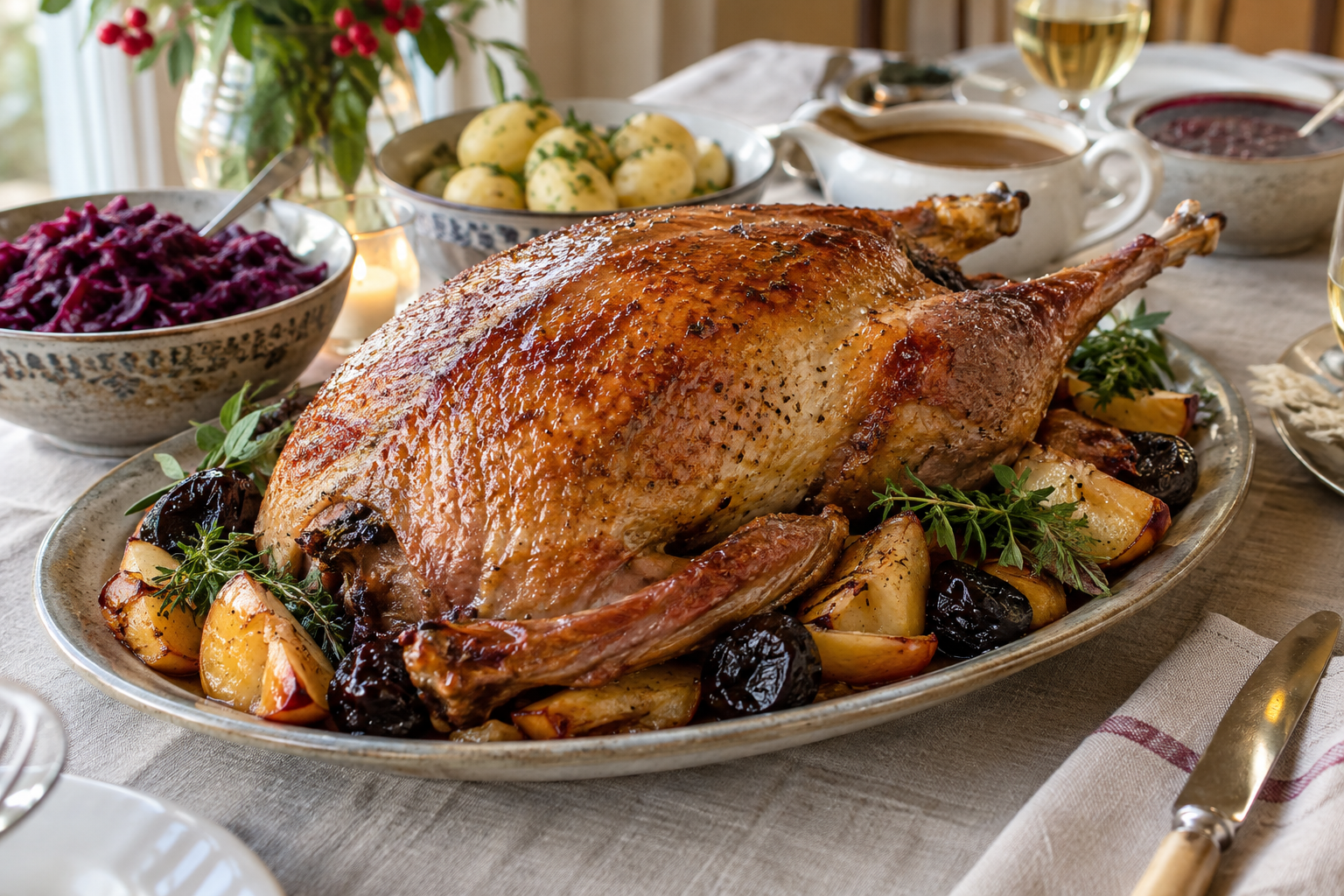
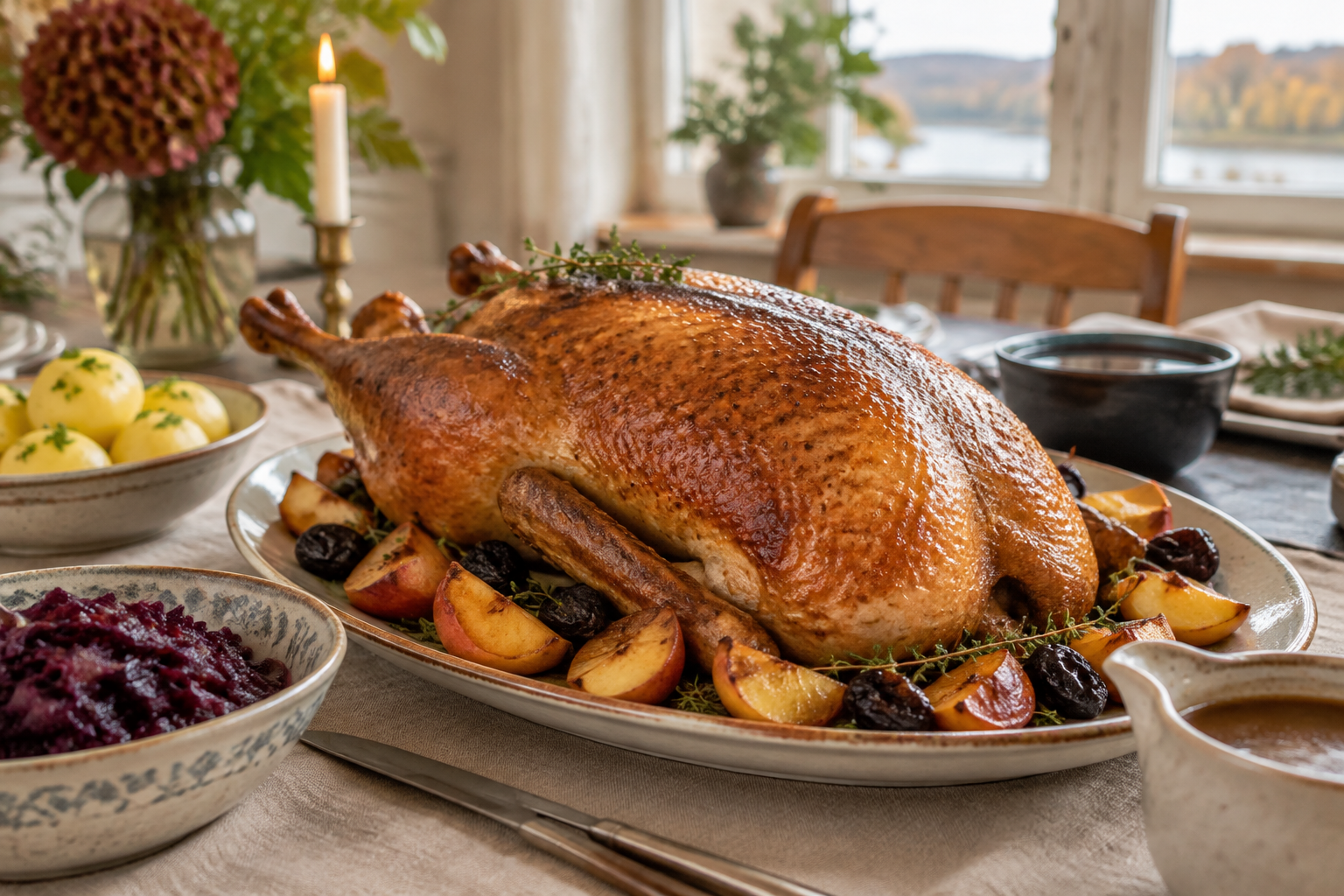
Mårtensgås – from autumn slaughter to a Scanian feast
A European festive bird becomes a Swedish restaurant classic
Behind that crisp goose skin lie autumn markets, saints’ legends and a kitchen that used almost everything. We follow the goose into an imagined Scanian inn kitchen around 1900 – and cook a modern reconstruction of the festive menu, with svartsoppa, apple-stuffed goose and Scanian apple cake.
 By Arvid HolmFood historian · Historic dishes, old cookbooks and eating habits through the ages
Translated from Swedish with AI assistance.
Go to the recipe ↓November comes through the kitchen door
The kitchen is easy to picture: November darkness beyond the windows, damp overcoats in the entrance hall and an oven that has already been hot for hours. Apples lie on the workbench, some with bruises that can be cut away. A saucepan gives off the scent of cloves and pepper. When the oven door opens, there is the gentle sizzle of goose fat dripping into the roasting tin.
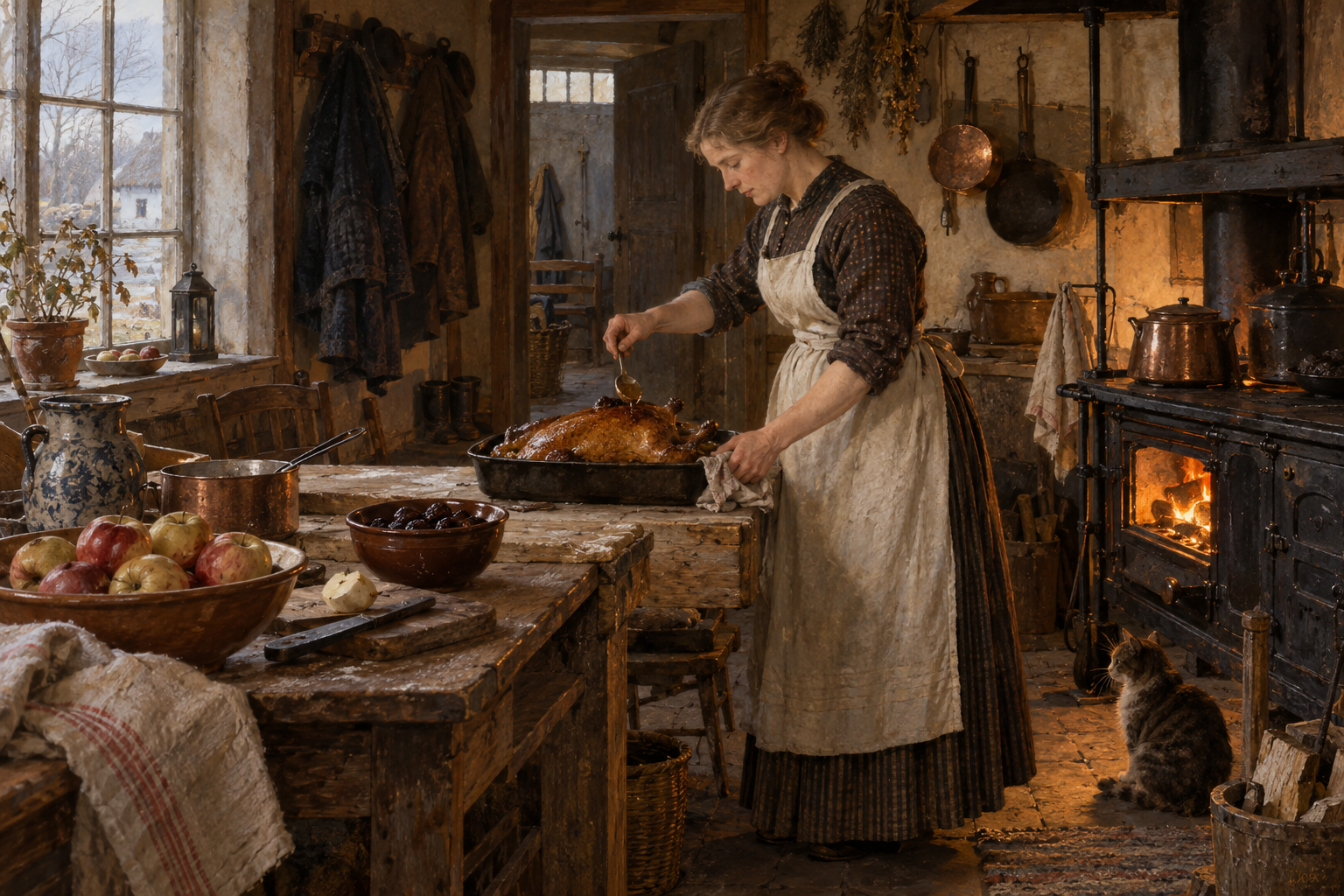
We are in an imagined Scanian inn kitchen around the turn of the 20th century. The scene is a reconstruction, not an eyewitness account. The kitchen work and ingredients are grounded in older cookbooks and descriptions of autumn household provisioning; this particular inn and its guests, however, never existed.
That distinction matters. The goose dinner is surrounded by stories told with all the confidence of someone carving the breast. A saint is said to have hidden among geese. A particular restaurant supposedly invented the whole menu. Scanians, we are told, have always eaten exactly the same three courses on 10 November. Look closely at these stories and the history becomes both less tidy and more interesting.
Yet much on the table is familiar: the dark svartsoppa, or blood soup, the goose with its glossy roasted skin, and an apple cake to finish the meal. But this combination is not an unchanged medieval ritual. It developed through several kinds of kitchen: the festive kitchens of continental Europe, Swedish households that made full use of slaughtered animals, and restaurants that turned a seasonal meal into a recurring event.
It is that journey that makes St Martin’s goose worth cooking. Its flavour is November distilled: fat and acidity, deep spice, ripe apple and crisp bread.
The saint’s day, the geese’s season
St Martin’s Eve falls on 10 November, the day before the feast of St Martin. Martin of Tours was a fourth-century bishop, and his feast day on 11 November became an important date in Christian Europe. In many places, the period around Martinmas also became a practical dividing line in the year, bringing together the rhythms of farm work, financial settlements and winter stores.
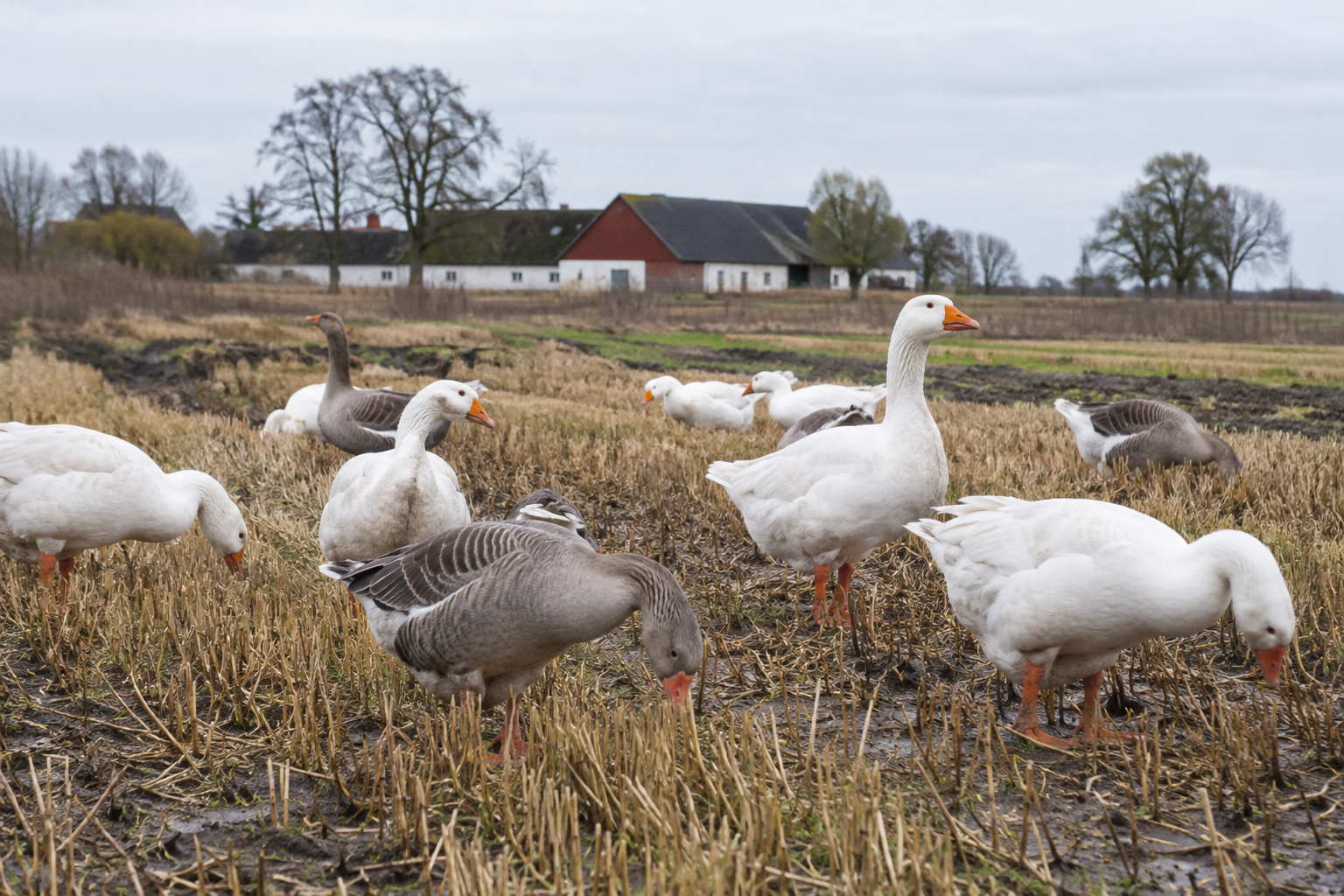
The familiar goose legend tells how Martin hid to avoid becoming a bishop. The geese’s cackling gave him away, and that, supposedly, is why geese later ended up on the festive table. This is a folk tale explaining a custom, not reliable evidence about Martin’s life or the beginnings of eating goose. It can explain how people later understood the tradition; it does not prove why the tradition arose.
The material explanation is less dramatic but more persuasive. Autumn was a natural time for slaughter. The birds had grown, and after the harvest geese in many places could graze and find spilled grain. As winter approached, keeping every animal became costly. Slaughter provided both food for the moment and ingredients to preserve.
Goose eaten around St Martin’s Day is found in several parts of Europe, particularly German-speaking countries. There is a clear family resemblance to today’s Swedish feast: roast goose, fruit, cabbage and filling accompaniments. But a family resemblance is not the same as a simple route of transmission. We cannot point to a single German inn and say that the Scanian dinner began there.
The religious context of the celebration also needs qualification. In some places, St Martin’s Day could mark the threshold of a fasting period before Christmas. Church practices varied, however, across periods and regions. Claiming that all Europeans ate goose as a final meal before the same fast makes the history far too uniform.
The goose was also more than meat. Its fat could be used in cooking, its feathers had value, and parts readily discarded today had a place in the household economy. A whole bird at market was, in effect, several products in one body. This helps us understand why a soup made with blood was not some curious invention, but a sensible part of making full use of the slaughter.
When goose became Scanian – and the menu became a menu
Eating goose at Martinmas was a Swedish custom long before the turn of the 20th century, and the tradition was not always confined to Skåne. Its strong Scanian identity is the result of a development, not proof of its origins. Goose farming, the agricultural landscape and enduring festive customs helped make the province the tradition’s most recognisable Swedish home.
That does not mean every Scanian could put a large roast goose on the table. Festive food often tells us as much about differences in resources as it does about togetherness. A substantial bird required access to the ingredients, fuel, a workable kitchen and time. In prosperous households and at inns, the meal could become a showpiece; others had fewer possibilities.
Meanwhile, restaurant culture developed during the 19th century. Seasonal food could be advertised, booked and served as a complete experience. This gave an already familiar festive bird a new stage. Guests no longer had to raise, slaughter, pluck or tend the goose themselves. The work moved behind a kitchen door and returned as a feast.
Stockholm often enters the story here. Later historical accounts cite Piperska muren and the 1850s as important to the combination of svartsoppa, goose and apple cake. The claim is interesting precisely because it challenges the idea of an entirely local Scanian invention. But it should be presented as an attribution in the history of the tradition, not as a settled patent claim.
Without an identified and dated original menu, we cannot say for certain that a particular serving was the first. Even a printed menu would only show what was offered on that occasion, not what every guest ate or what was served in homes. There is a difference between the earliest surviving evidence and the actual beginning.
For this reconstruction, we therefore use dated cookbooks for the dishes’ techniques and composition, alongside cultural histories of the goose feast. We are not reproducing a particular inn menu from 1900. Charles Emil Hagdahl’s Kok-konsten som vetenskap och konst, published in 1879, provides rich comparative material for goose, soups, sauces and apple dishes in a sophisticated Swedish kitchen. Nils Keyland’s Svensk allmogekost, published in 1919, instead helps us see the household economy behind the festive food.
The sources represent different worlds. Hagdahl cannot be taken as an average picture of what rural people ate, and Keyland’s records do not automatically describe restaurant menus. Together, though, they make the meal understandable: long-established thrift with ingredients meets a more formally organised festive kitchen.
The dark, spiced world of svartsoppa
Anyone who has never tasted svartsoppa might imagine something with a strong iron flavour. A well-balanced soup is more complex: rich stock, warm spice, a hint of sweetness and enough acidity to bring the flavours to life. The blood gives colour, body and a distinctive taste, but should not dominate on its own.
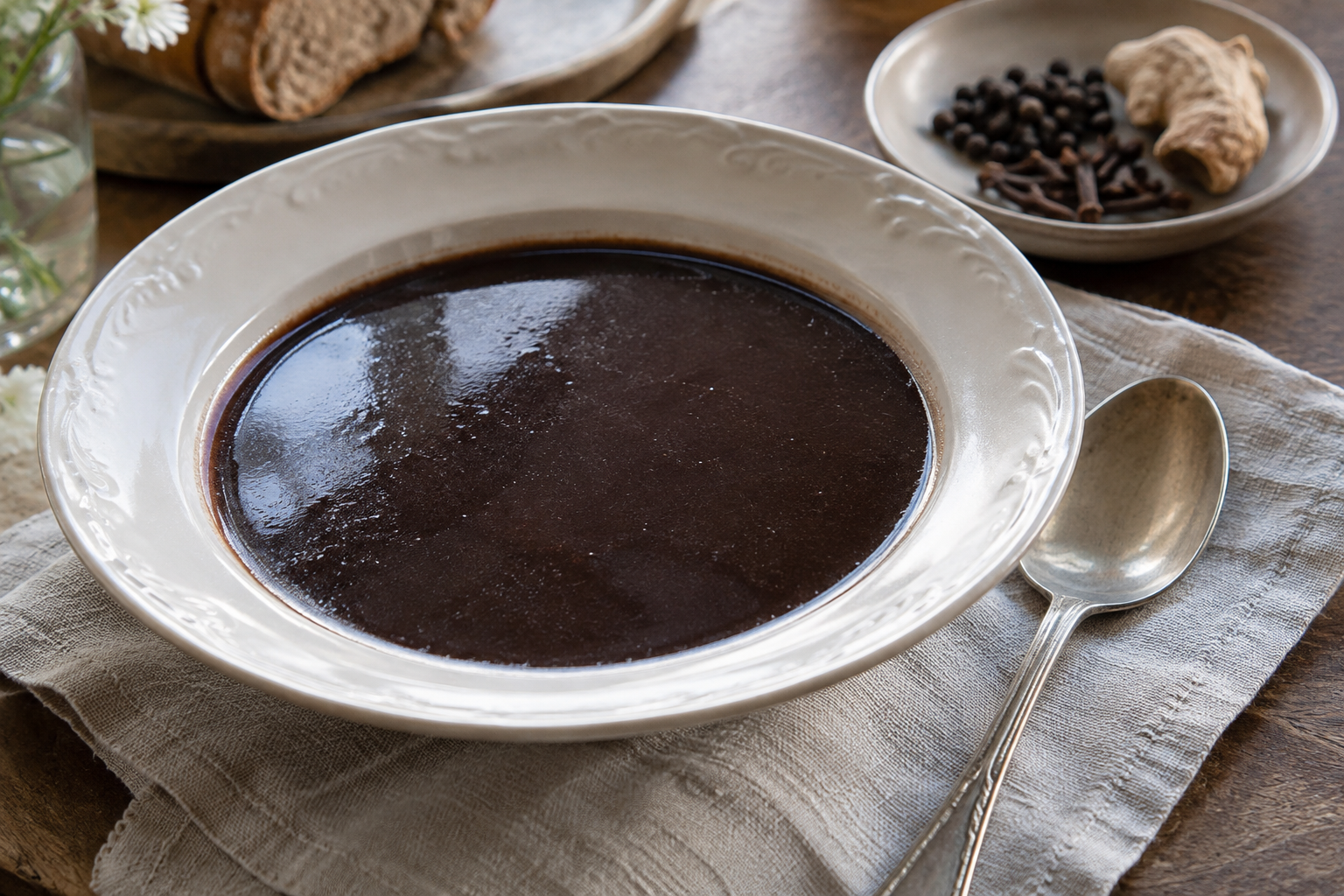
Blood soups and other blood dishes belong to a much broader European tradition than the Scanian goose dinner. In Swedish households, blood was a useful, nutritious ingredient from the slaughter. Making use of it was no more remarkable than making stock from bones. At the same time, seasoning with imported spices and wine could turn such a soup into lavish festive fare.
Svartsoppa has never had one unchanging recipe. Goose blood is closely tied to slaughtering the bird itself, but pig’s blood is used as a substitute. Cloves, ginger and pepper give it a character that feels older than today’s familiar cream sauce. Acidity and sweetness are balanced in different ways. Festive versions may include wine or fortified wine, but neither is necessary for a good soup.
The accompaniments can be extensive, too: giblets, sausage and fruit all belong to the wider tradition. Here, we keep the soup small and relatively simple. That is a deliberate choice in an already generous dinner, not a claim that the accompaniments lack historical importance.
The crucial technique is temperature control. The proteins in blood give the soup body, but can also turn it grainy if heated too fiercely. Warm stock is therefore first worked into the blood mixture, which is then heated gently while stirring. At the same time, the soup must be thoroughly heated through. A thermometer makes it easier to combine safe handling with a pleasing texture.
Only buy blood sold for human consumption by a food business. Ask a butcher in advance; food-grade pig’s blood may be easier to find than goose blood. Follow the packaging instructions for chilling and thawing. Game blood intended for tracking-dog training has no place in the saucepan.
The recipe card also includes a clearly labelled blood-free alternative: a dark mushroom and apple soup with a similar spice profile. This is a modern substitute, not historical svartsoppa, and it does not taste the same. Hospitality need not depend on every guest eating the same ingredient.
The goose, the oven and what collects in the roasting tin
A goose is not simply a larger chicken. It has plenty of fat beneath the skin, darker, more flavourful meat, and a body whose breast and legs do not always finish cooking at the same time. Treat it like a lean bird and you risk both tough legs and a breast that has spent too long in the oven.
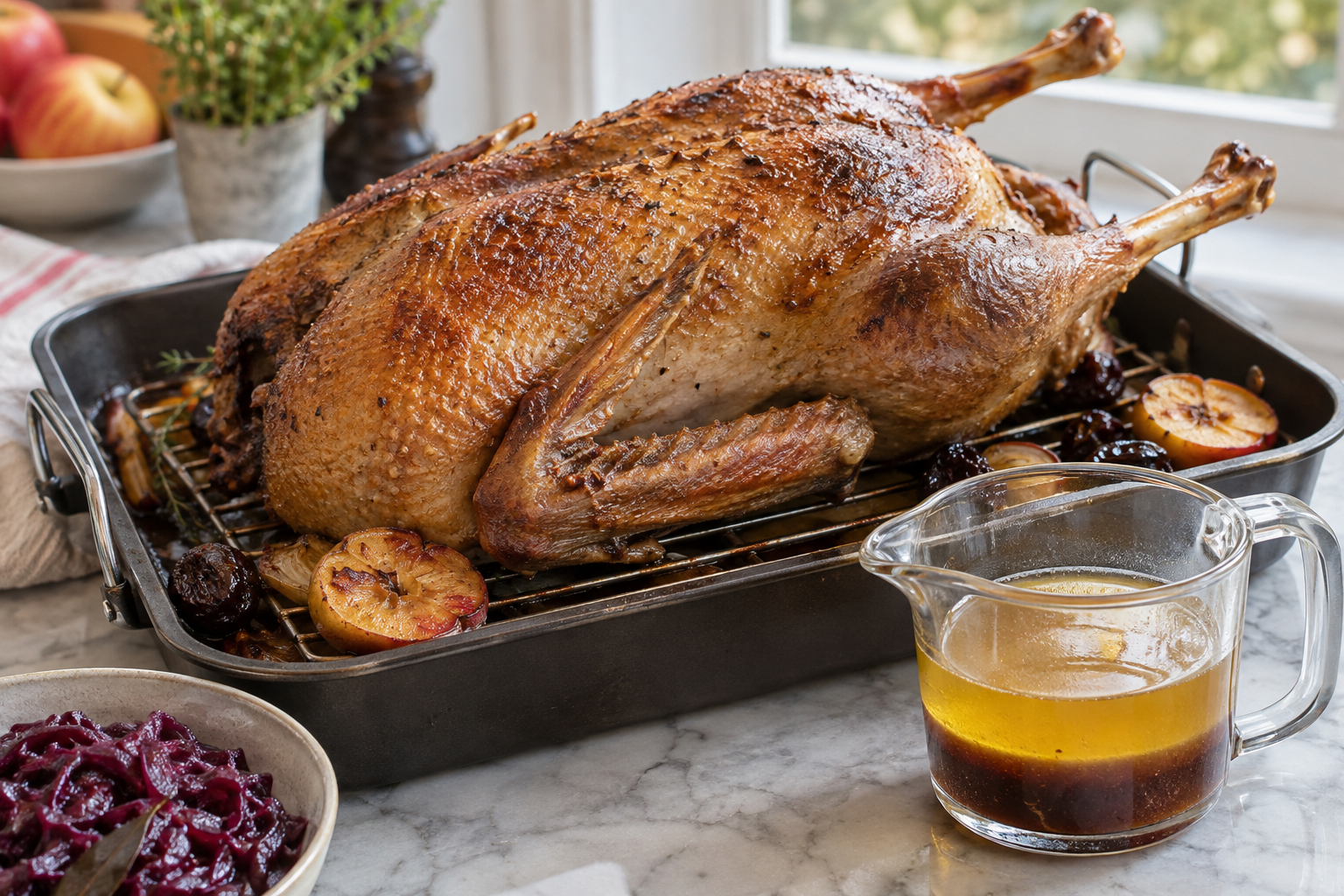
Older cookbooks often rely on the language of experience: a certain oven heat, a roast that is basted, and a bird judged by sight or touch. Those words cannot be translated into a single precise temperature. The wood-fired oven, the size of the bird and the cook’s working rhythm all varied. Our modern reconstruction therefore uses a gentle roasting temperature, a thermometer and a brief finish at a higher heat if the skin needs it.
Apples and prunes make a familiar sweet-tart stuffing. It should be loosely packed. A tightly stuffed bird is harder to heat through, and the fruit is not worth compromising the cooking for. Any extra fruit can roast alongside towards the end instead.
Basting the skin with roasting fat can affect the surface, but it cannot restore moisture to an overcooked breast from within. The most important thing is to monitor the temperature and not let a stated cooking time matter more than the bird in front of you. The recipe uses conservative target temperatures for an ordinary home kitchen, not a low-temperature method requiring special controls.
The roasting tin also holds two distinct riches: fat and meat juices. They should be separated. The fat can be saved for potatoes or cabbage; the juices provide the gravy’s flavour. Whisk everything into a sauce and the result can easily become heavy and oily. Let the tin dry out completely and the flavourful browned deposits can burn.
Red cabbage provides a counterpoint to the goose. It should be tender but still full of character, with apple and vinegar lifting every mouthful. The potatoes need not compete. Boiled potatoes are an excellent choice, and also make oven planning easier when a large bird is taking up space. The precise selection of accompaniments has varied; our combination is a practical whole that stays close to tradition.
Portioning also calls for realism. A goose weighing around five kilos does not mean five kilos of roast meat on the plate. Bones, fat, carcass and cooking losses account for a large share. For six people, with a starter, accompaniments and dessert, that size is a reasonable starting point. Trust the bird’s anatomy rather than generous promises on the packaging.
The apple cake and the long table
By the time the apple cake arrives, the goose has done its job. Now something warm and fruity is called for, ideally with a crisp layer to contrast with the soft apples. Scanian apple cake differs from the soft sponge studded with apple pieces that many people might otherwise picture: here, breadcrumbs or grated bread are an important part of its structure.
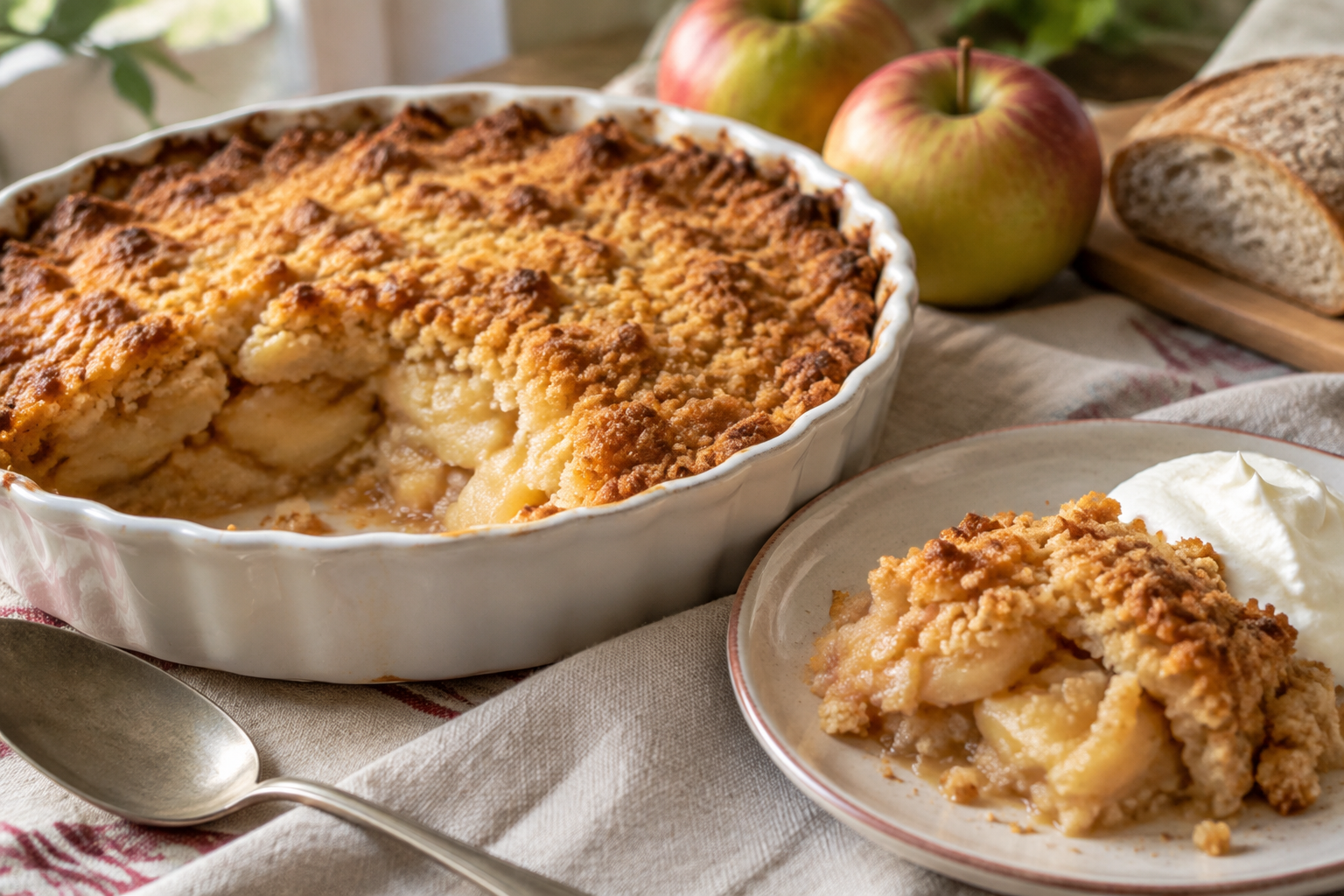
This cake, too, has no single fixed form. The apples may be more or less pulpy, the bread can vary and the seasoning can change. What matters historically is the meeting of everyday thrift and celebration. Bread that was no longer fresh could find new life with fruit; butter and sugar made the dish richer. Economy and abundance were not always opposites.
The cake in this recipe follows that principle. Tart Swedish cooking apples work well, such as Belle de Boskoop or another distinctly acidic variety. If using sweet apples, reduce the sugar. The breadcrumbs are gently browned in butter until they smell toasted, not burnt. A little softly whipped cream is all the accompaniment they need; vanilla custard is another established way to serve it.
Today, the goose dinner is both a home-cooked meal and a restaurant occasion. St Martin’s Eve on 10 November is the focal point, but many restaurants serve goose over a longer period. This makes the tradition more accessible, while showing how a calendar-bound custom can adapt to bookings, working hours and modern lives.
At the table, small portions work best at the beginning. Svartsoppa is an introduction, not an endurance test. Serve the goose on a warmed platter so that guests can have both breast and leg meat. Ask in advance about blood, alcohol and anything else that affects the menu. A host with an interest in history need not turn dinner into a knowledge test.
A pinot noir with fresh acidity, moderate tannins and restrained oak is a good match for goose. Its fruitiness complements the apples and prunes, while its acidity balances the rich meat. A small glass is quite enough for anyone who would like wine. With the sweet apple cake, water, coffee or tea often makes a better finish than the dry red wine.
Alcohol-free dry apple cider works through much of the menu. Choose a distinctly tart version: many alcohol-free cider drinks are considerably sweeter than the word cider suggests. Check the alcohol content and choose 0.0 per cent when completely alcohol-free matters. It is chiefly the apple’s acidity, not the alcohol, that does the work here.
Two days that make the feast possible
A goose dinner is much more enjoyable if the whole story does not have to be squeezed into one afternoon. Order the bird and blood well ahead. A frozen goose normally needs several days to thaw in the fridge; that process comes before the two-day work plan. Place it on a deep tray and follow the supplier’s instructions.
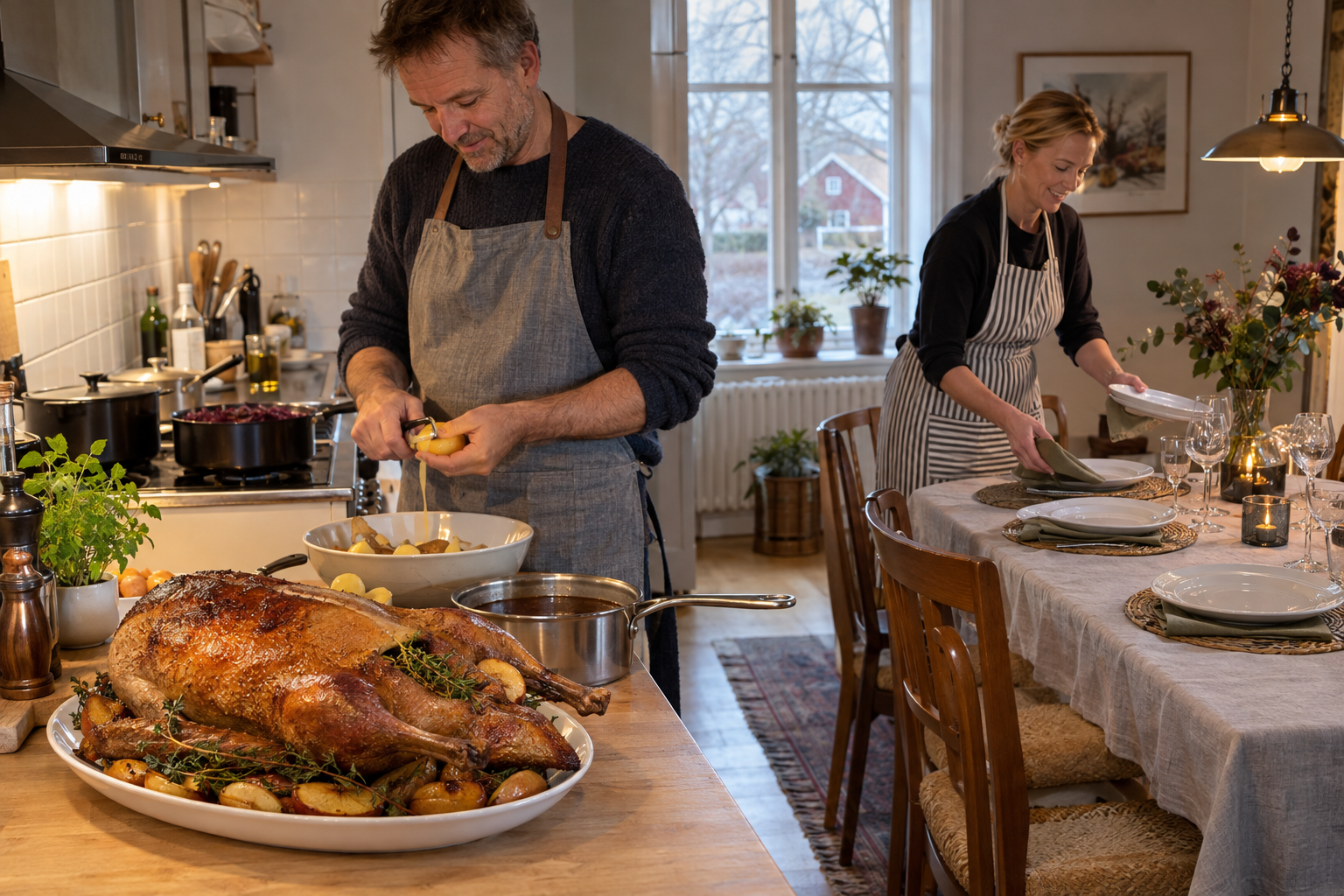
Day one is for the elements that can wait. Cook the red cabbage, make the soup’s spiced stock base without blood, and prepare the apple cake. The cake can be fully baked and reheated the next day. Salt the thawed goose and let its skin dry in the fridge, away from ready-to-eat food. Cool cooked dishes quickly in shallow containers and keep them refrigerated.
Day two lets the goose set the pace. Allow a margin for both roasting and resting. While it roasts, set the table, peel the potatoes and finish the soup. While the goose rests, make the gravy and reheat the accompaniments. The apple cake need not be piping hot; served warm, its apple flavour is clearer and service is calmer.
The complete recipe card below is a modern reconstruction of the menu’s components, not a verbatim transcription of a historical source. Older measures and oven descriptions are replaced with grams, decilitres and temperatures that can be checked. Alcohol has been left out of the cooking, and the blood-free soup is explicitly a contemporary alternative.
What remains is what holds the meal together: the warm spice, the crisp skin, the tangy cabbage and the apple that returns from bird to dessert. In this way, the November feast can continue without our pretending that every detail has always been the same.
A St Martin’s dinner for six – svartsoppa, whole goose and Scanian apple cake
A complete reconstruction that stays close to tradition, using Hagdahl’s 1879 cookbook as a technical reference rather than reproducing a particular historical menu. Modern temperatures and quantities are used. Makes approximately 1.2 litres of soup, a goose dinner for six and six dessert portions. Choose either svartsoppa or the clearly labelled blood-free alternative. Timings cover the whole menu over two days; allow extra time for thawing, and note that several tasks run in parallel.
Ingredients
Method
- 1DAY 1 – checks and goose: The goose must already be completely thawed. Remove any bag of giblets and trim away loose lumps of fat around the opening. Do not rinse the bird. Pat dry with kitchen paper, rub with salt and pepper, and place on a rack over a tray at the bottom of the fridge, ideally at 4°C. Leave for 12–24 hours, separate from other food. Keep the blood chilled according to the packaging; thaw frozen blood in the fridge.
- 2DAY 1 – red cabbage: Shred the cabbage and slice the onion. Core and coarsely grate the apples. Soften the onion in the butter in a large saucepan for 5 minutes. Add the cabbage, apple, apple juice, vinegar, syrup and salt. Cover and simmer for 45–60 minutes, stirring occasionally and adding a little water if it becomes dry. Taste and adjust the seasoning. Cool quickly in shallow containers and refrigerate.
- 3DAY 1 – soup base: Bring the stock, apple juice, vinegar, jelly and spices to the boil. Simmer for 10 minutes. Taste and add salt cautiously; stocks vary in saltiness. Cool quickly and refrigerate. Do not add the blood yet. If choosing the blood-free alternative, use the same base but no blood or flour.
- 4DAY 1 – apple cake: Preheat the oven to 175°C conventional. Peel, core and slice the apples. Cook gently, covered, with the water and half the sugar for 8–12 minutes until softened. Let any excess liquid evaporate. Butter a baking dish with a capacity of about 1.5 litres. Melt the remaining butter and fry the breadcrumbs over a medium heat for 5–8 minutes until lightly golden. Mix with the remaining sugar and the cinnamon. Layer the crumbs and apple in the dish, starting and finishing with crumbs. Bake for 25–30 minutes. Cool, cover and refrigerate.
- 5DAY 2 – start the goose about 5 hours before the main course: Preheat the oven to 150°C conventional. Core the apples and cut into wedges. Place them and the prunes loosely inside the bird; save any fruit that will not fit for the roasting tin towards the end. Secure the opening loosely with metal skewers. Carefully prick the skin around the legs without piercing the meat. Place the goose breast-side up on a rack over a deep roasting tin containing the water. Make sure the tin can hold the fat without overflowing.
- 6Roast the goose: Allow roughly 3.5–4.5 hours, but begin checking earlier and let the temperature decide. Carefully pour off fat as needed, roughly every 45–60 minutes, and add hot water if the tin is drying out. Measure the temperature in the thickest parts of both breasts and legs without touching bone. The breast must reach at least 74°C, and the legs ideally 80–82°C for tenderness. The centre of the stuffing must also reach at least 74°C if it is to be served. Loosely shield the breast with foil if it browns too much. If the skin needs more colour at the end, increase the heat to 225°C for 10–15 minutes, watching carefully.
- 7DAY 2 – SVARTSOPPA, finish shortly before the starter: Strain the blood if necessary and whisk it smooth with the flour. Heat the soup base. Gradually whisk about 2 dl of hot base into the blood mixture, then pour everything back into the saucepan, whisking. Heat gently, stirring constantly, until all the soup has reached at least 75°C. Avoid a rolling boil, which can make it grainy. Taste and adjust with vinegar, jelly and salt. Serve immediately, about 2 dl per person; if holding briefly, keep above 60°C without boiling.
- 8DAY 2 – BLOOD-FREE ALTERNATIVE, do this instead of the previous step: Brown the mushrooms in the butter for 8–10 minutes. Add the shallot and fry for a further 3 minutes. Pour in the prepared soup base and soy sauce and simmer for 10 minutes. Partially blend if you like, for a fuller texture. Mix the cornflour with the cold water, add to the soup and simmer for 2 minutes. Taste and adjust the sweetness, acidity and saltiness. This is a modern mushroom and apple soup, not svartsoppa.
- 9Resting, potatoes and cabbage: When the goose is cooked, transfer it to a large platter or a carving board with a juice groove. Rest for 25–30 minutes, without wrapping tightly in foil, which would soften the skin. Boil the potatoes in salted water for about 20–25 minutes, then drain. Reheat the red cabbage, stirring, until thoroughly hot, at least 74°C. Add a little extra vinegar if it needs more brightness.
- 10Make the gravy while the goose rests: Strain the roasting juices into a jug, let the fat rise and spoon it off, or use a fat separator. Measure out 5 dl of juices, topping up with unsalted stock if necessary. Taste: if the juices are very salty, replace some with water. Cook 2 tbsp goose fat with the flour in a saucepan for 2 minutes. Gradually whisk in the juices and simmer for 8–10 minutes. Add the jelly and vinegar, then taste and adjust the seasoning.
- 11Carve and serve: Remove the legs and divide at the joint. Cut the breast meat away along the breastbone and slice across the grain. Share both breast and leg meat among the guests; aim for roughly 180–220 g of cooked boneless meat per person if the bird yields enough. Serve with the thoroughly heated fruit, gravy, potatoes and red cabbage on warmed platters.
- 12Dessert and leftovers: Reheat the apple cake in a 150°C oven for about 20–25 minutes; cover lightly if the crumbs darken. Serve warm with softly whipped cream. Pick the remaining goose meat from the carcass and cool quickly in shallow containers. Keep leftovers at about 4°C and eat within 2–3 days or freeze. Save clean, strained goose fat separately.
- Thawing is not included in the two-day plan. A whole frozen goose often needs several days in the fridge. Check that the cavity, too, is thawed before cooking begins.
- Use only blood sold for human consumption. Pig’s blood works well when goose blood is unavailable. Always follow the supplier’s storage-life and handling instructions.
- If the breast is ready long before the legs, it can be removed and kept warm while the legs continue cooking. This is more practical than sacrificing a juicy breast for the sake of presenting a whole bird at the table.
- For a vegetarian blood-free starter, use vegetable stock in the soup base. The rest of the menu is not vegetarian. All the food in this recipe is cooked without added alcohol.
What goes in the glass
- WinePinot noir with fresh acidity and restrained oakThe acidity balances the goose fat, while red-berry fruit complements the apples and prunes. Choose a light- to medium-bodied style rather than a powerful, tannic wine. Best suited to the main course.
- Alcohol-freeAlcohol-free dry apple ciderApple acidity and gentle bubbles refresh the palate between bites and echo the stuffing, red cabbage and dessert. Choose a low-sweetness version and check the label; opt for 0.0 per cent when completely alcohol-free is required.
- BeerMalty amber lager with moderate bitternessBready malt complements the roasted skin and warm spices, while the carbonation lightens the rich food. Moderate bitterness works better than pronounced hops with the sweetness of the accompaniments.
Enjoy alcohol in moderation. Alcohol-free options go just as well with the food.
Sources
- Charles Emil Hagdahl, Kok-konsten som vetenskap och konst (1879)
- Nils Keyland, Svensk allmogekost (1919)
- Nordiska museet, Mårtensgås
- Nationalencyklopedin, Mårtensgås
- Nationalencyklopedin, Martin av Tours
- Livsmedelsverket, Tillagning
Ask questions about "Mårtensgås – from autumn slaughter to a Scanian feast". Answers are based on the magazine's own articles.