Mårtensgås – from autumn slaughter to a feast in Skåne
Svartsoppa, crisp goose skin and apples: three courses with a history stretching further back than the restaurant menus of Skåne.
Once the autumn geese were fattened and winter feed had to be made to last, it was time for slaughter, trading and feasting. But the path to today’s goose dinner was far from straight. We follow Martin through European saints’ calendars, Swedish cookbooks and inn kitchens – and cook the entire meal in an ordinary home oven.
 By Arvid HolmFood historian · Historic dishes, old cookbooks and eating habits through the ages
Translated from Swedish with AI assistance.
Go to the recipe ↓A November evening scented with goose fat
Imagine an inn kitchen in Skåne towards the end of the 19th century. Outside, the yard is dark and damp. Inside, a ladle scrapes the bottom of a pot, apples are being peeled at the worktable, and the oven sends out the scent of poultry fat, browned skin and warm fruit. The geese have arrived from local farms or through middlemen. Now one bird must become several dishes: its blood for soup, its body for roasting, its giblets for stock and accompaniments, its fat for cooking meals to come.
This is an imagined scene, not a documented evening. But the ingredients and division of labour belong to a food culture that old household manuals, cookbooks and accounts of everyday life help us understand. The goose dinner did not begin as three plates on a printed menu. It grew out of livestock farming, the seasons and a frugal approach in which a large slaughtered bird had to be put to good use.
In Sweden, 10 November, Martinmas Eve, has become the natural day to gather around a goose. First comes the dark, spiced svartsoppa, followed by roast goose with gravy, potatoes, cabbage and fruit. Apple cake rounds things off. Today, the dinner is often served over a longer period in November, but its place in the calendar remains the same: the evening before the feast day of Martin of Tours on 11 November.
What looks on the table like an unbroken tradition from Skåne is really several histories coming together. There is a European saint’s day, the autumn slaughter, middle-class cookery, restaurants’ ability to shape recurring festive menus, and Skåne’s strong association with the goose. It is precisely this mixture that makes the meal so interesting – and so delicious.
Martin, the geese and the autumn accounts
Martin of Tours lived in the fourth century and became one of Western European Christianity’s most celebrated saints. His feast day acquired significance far beyond the church. In parts of Europe, the period around 11 November marked the completion of agricultural work, payments, markets and the transition to winter. This did not mean that everyone did the same thing on the same date, but the calendar provided a shared point of reference.
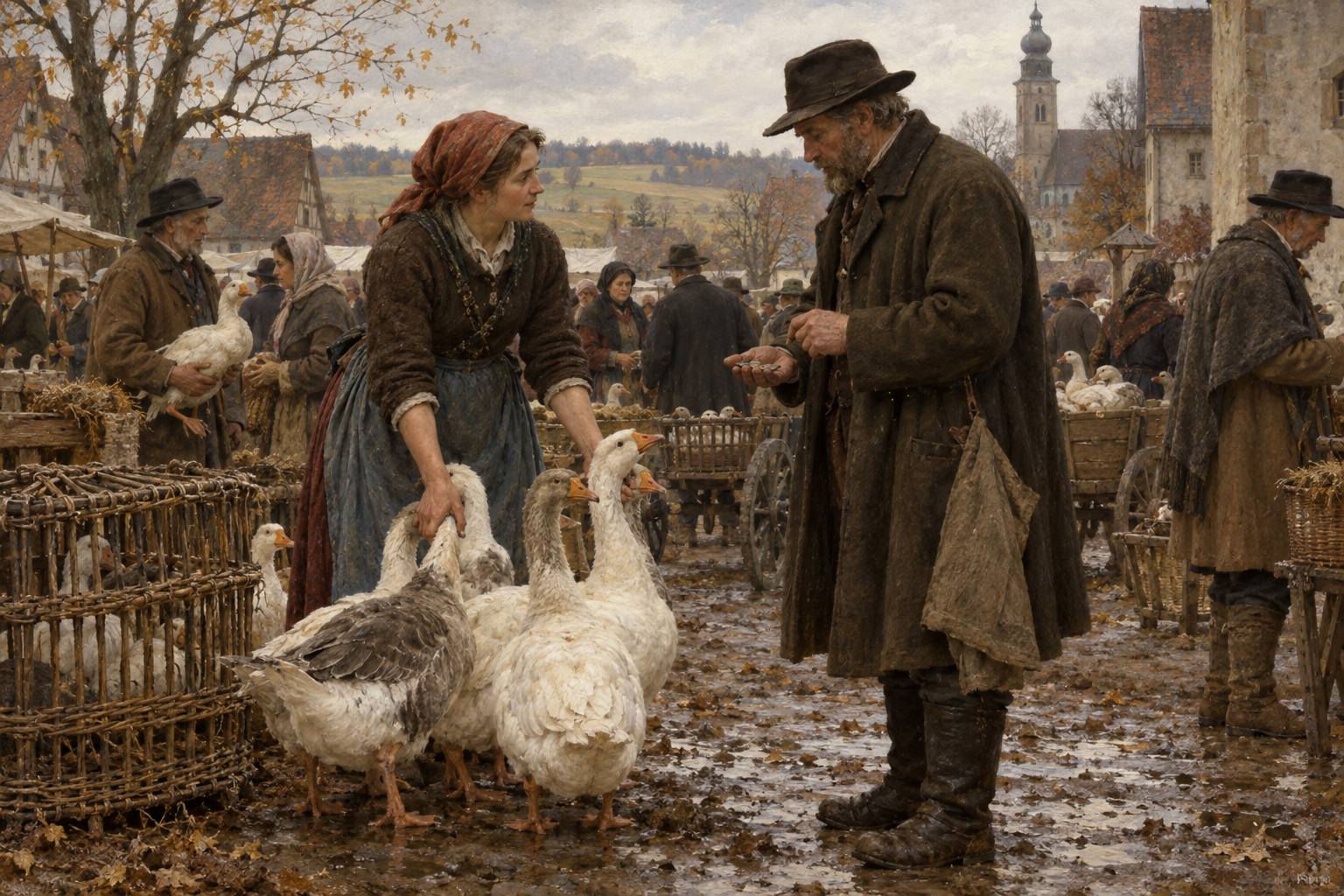
The goose fitted neatly into this pattern. During the warmer months it could graze; after the harvest, extra food was available in many places. Raising livestock and then reducing their numbers before winter made practical sense when every mouth competed for stored feed. A well-fattened goose represented both food and value. It could be eaten at home, sold or, in certain European settings, used to pay dues and other obligations in kind.
Even so, this does not allow us to draw a simple line from autumn slaughter to Mårtensgås. Feast days, economics and eating habits reinforced one another in different ways in different regions. Europe’s Martinmas goose belongs to a wider pattern of seasonal feasts, not to a single cuisine with a firmly established birth date.
The most frequently told explanation concerns Martin himself. According to legend, he hid among geese because he did not want to become a bishop, but the birds’ honking gave him away. That, the story goes, is why they later ended up on the festive table. It is a compelling origin story, but not a reliable account of how the custom arose. A story that explains a tradition does not necessarily document its beginnings.
The Martinmas goose lives on in German-speaking regions, while in Denmark Mortensaften is associated with goose or, very commonly today, duck. The Swedish name Mårten belongs to the same family of names as Martin and Morten. Skåne’s historic connections across the Öresund provide important background, but they do not establish a single route by which the meal itself reached Sweden.
From farmyard geese to the city table
Geese have been kept in many parts of Sweden, not just Skåne. The province’s association with the goose dinner should therefore not be confused with a Swedish monopoly on raising or eating geese. However, the farmland of southern Sweden, its trade and its later restaurant culture became particularly important in shaping the image we know today.
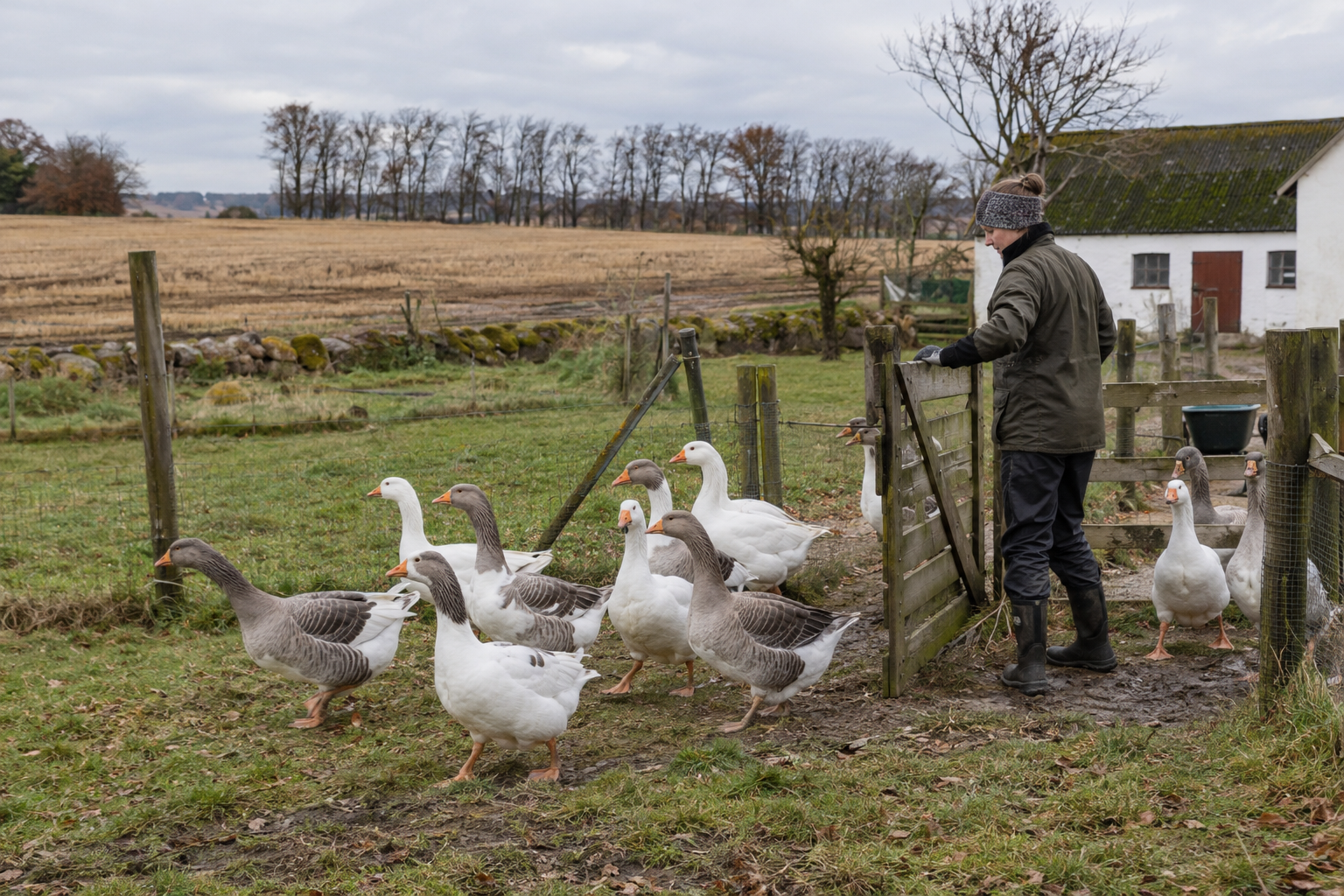
On the farm, the bird was more than a roast. Feathers and down had value. The fat could be saved. The neck, wings and offal offered possibilities for stock, stuffings and separate accompaniments. Dishes made with blood belonged to an older pattern of household economy, in which slaughter brought a brief supply of highly perishable ingredients that had to be used or preserved. Svartsoppa should be understood in that context, not as a curious opening course invented to test restaurant diners’ courage.
But the romantic image of every family in Skåne eating a magnificent goose in November does not stand up to scrutiny. A fattened bird could be an asset that was better sold. Access to meat, sugar, spices, wine and fuel varied between households. The well-appointed middle-class dining room and the small farm kitchen did not have the same resources, even if they followed the same seasons.
The market connected these worlds. There, a farm animal became a town dweller’s feast. Buying a goose meant taking on a great deal of work: the bird had to be plucked and gutted, the giblets dealt with, and the roasting managed in a hearth or oven that did not work like today’s thermostatically controlled cooker. Experience mattered. How fierce was the heat? When should the roast be turned or basted? How much fat needed to be poured off?
During the 19th century, iron stoves and changing kitchen equipment opened up new possibilities, but progress was uneven. Old and new methods existed side by side. That is why an old recipe rarely gives us a complete set of instructions: it assumes techniques, knowledge of ingredients and equipment that contemporary readers already understood.
At an inn, that knowledge could be pooled and put to repeated use. A large bird, a long roasting time and several accompaniments suited a kitchen planning for many guests. This helped turn a seasonal ingredient into a feast that could be booked in advance.
When three courses became a tradition
So how old is the sequence of svartsoppa, goose and apple cake? Here we must distinguish between the existence of the dishes, their being served together, and the combination becoming accepted as the definitive Martinmas menu. These are three different things, requiring different kinds of evidence.
Charles Emil Hagdahl’s Kok-konsten som vetenskap och konst from 1879 and Elisabeth Östman’s Iduns kokbok from 1911 offer reference points for a cookbook world that included blood-based soups, roast goose and apple desserts. They show ingredients, ideals of flavour and methods in print. They do not, in themselves, tell us how often a particular dish was eaten in a particular household in Skåne, nor do they prove that a specific three-course dinner was widespread.
A cookbook is also a prescriptive source: it tells us what someone thought the reader ought to know how to cook. A restaurant menu, by contrast, tells us what an establishment offered or planned to serve on a particular occasion. A record of folk customs may bring us closer to household habits, but it was often written down long after the period it describes. A childhood memory can be valuable without providing an exact date for the beginning of a custom.
Such distinctions are crucial when traditions acquire origin stories. One often-repeated account links the shaping of the classic menu to Piperska muren in Stockholm during the 19th century. It is worth knowing, not least because it challenges the idea of an entirely isolated origin in Skåne. But a claim about who came first requires dated menus and comparisons with other evidence. Here, therefore, the story must remain just that: an often-repeated account, not the meal’s established birth certificate.
It is safer to describe a gradual consolidation. Older dishes could be brought together into a readily recognisable festive dinner. Restaurants benefited from a menu that guests could look forward to, order and recognise year after year. Inns and restaurants in Skåne became important custodians of that format.
This makes the tradition no less authentic. Traditions do not have to remain unchanged since the Middle Ages to be meaningful. The modern goose dinner is historical precisely because it has changed: from the many tasks involved in slaughtering a bird to a meal whose three acts have become part of the experience.
Blood, fat and the tang of apples
Svartsoppa’s dark colour can distract from its flavour. A well-balanced soup is rich, tangy and warmly spiced, rounded out by sweetness. The blood gives it both character and body. Recipes old and new vary in their stock, fruit, spices, wine and amount of sugar. There is no single immutable formula to recover.
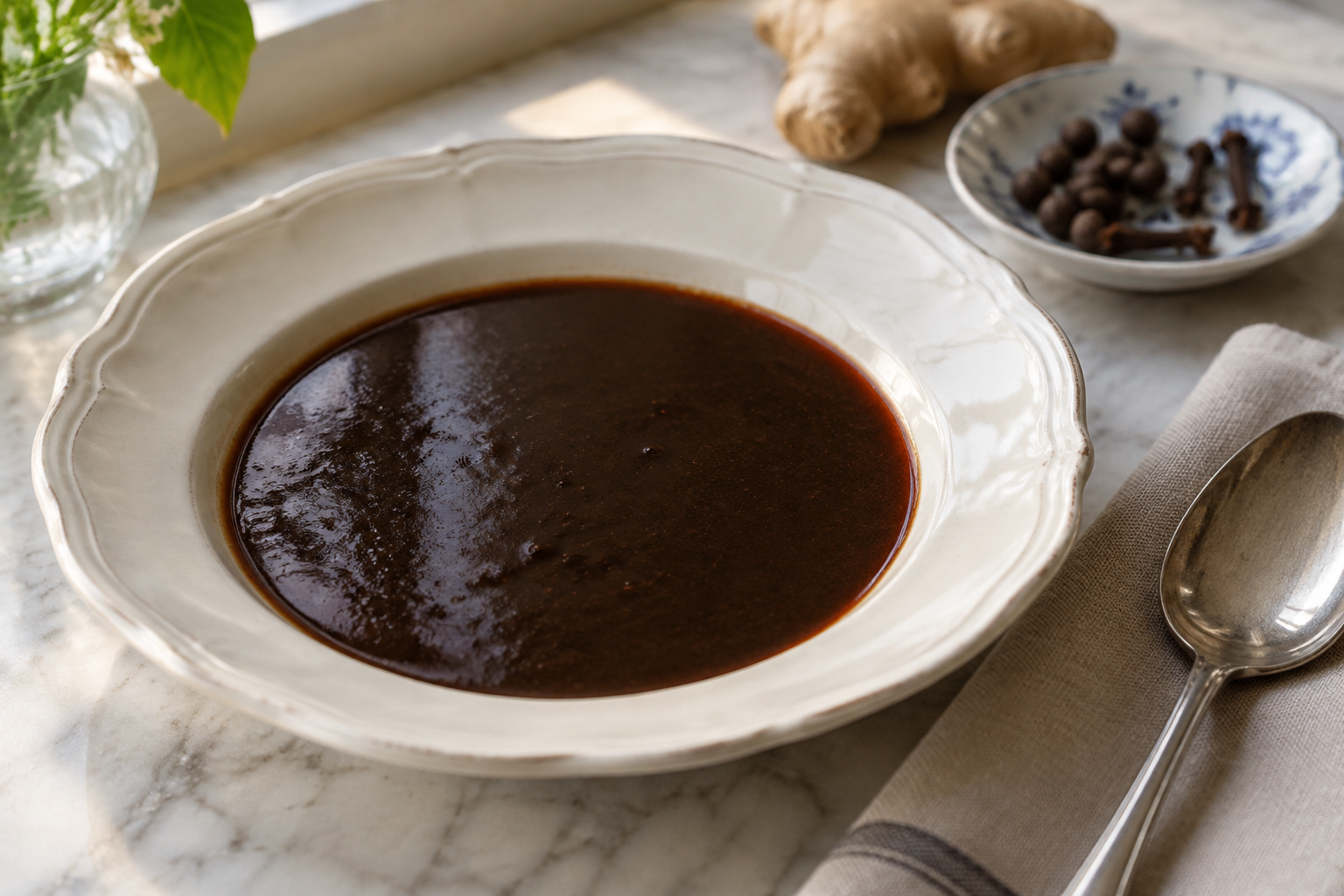
Spices such as cloves, ginger and allspice challenge the notion that food in the past was exclusively local and unseasoned. Festive cookery drew on goods traded over long distances. At the same time, a spiced recipe in a cookbook tells us nothing certain about how much spice a poorer household could afford.
The soup may be accompanied by various giblet dishes, sausages and other extras. These belong to the broader history of making use of the whole bird, but they are not identical at every table. Our home version focuses on the soup itself. Food-grade pig’s blood is a practical substitute when goose blood is unavailable; the flavour will not be exactly the same, but the principle remains unchanged.
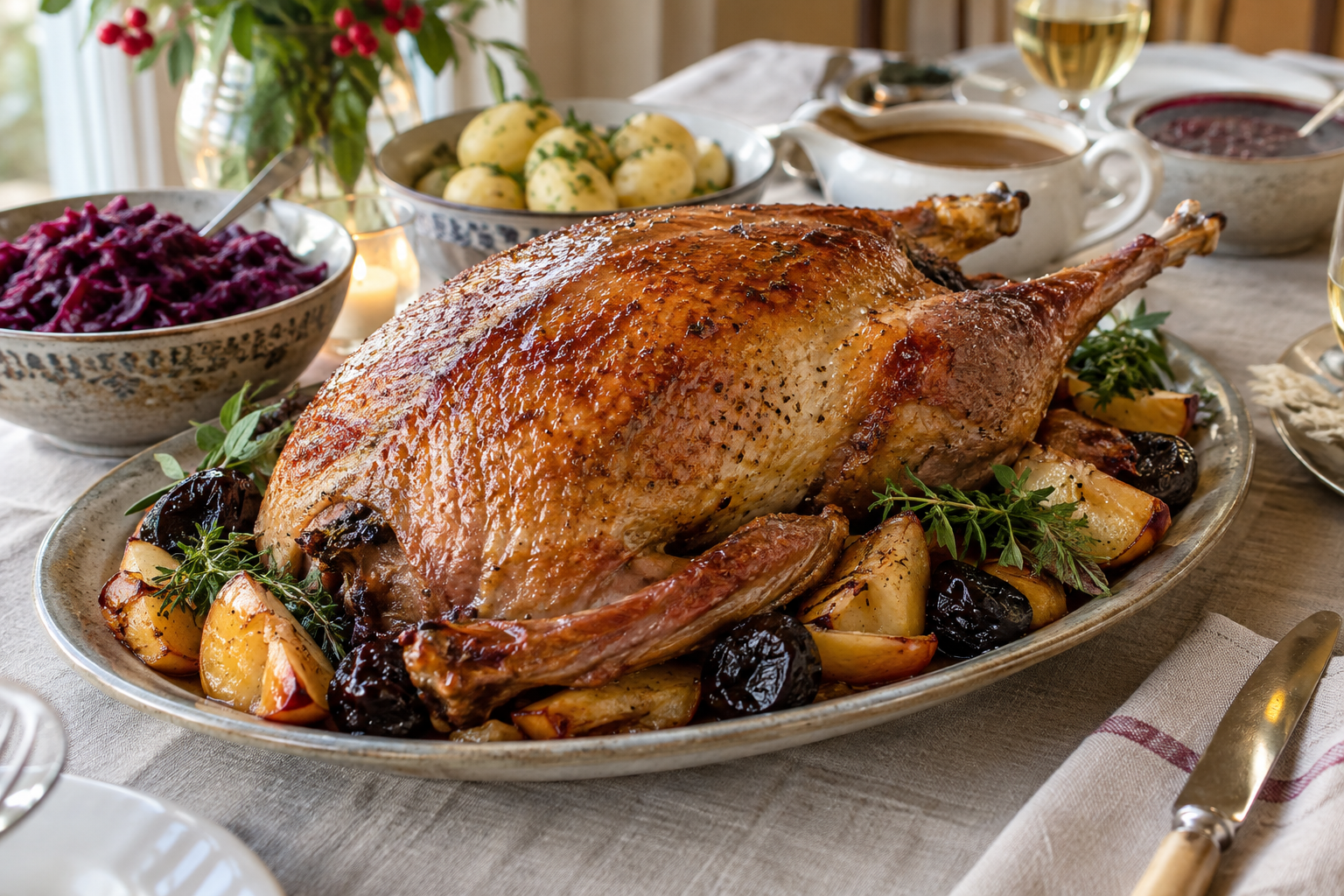
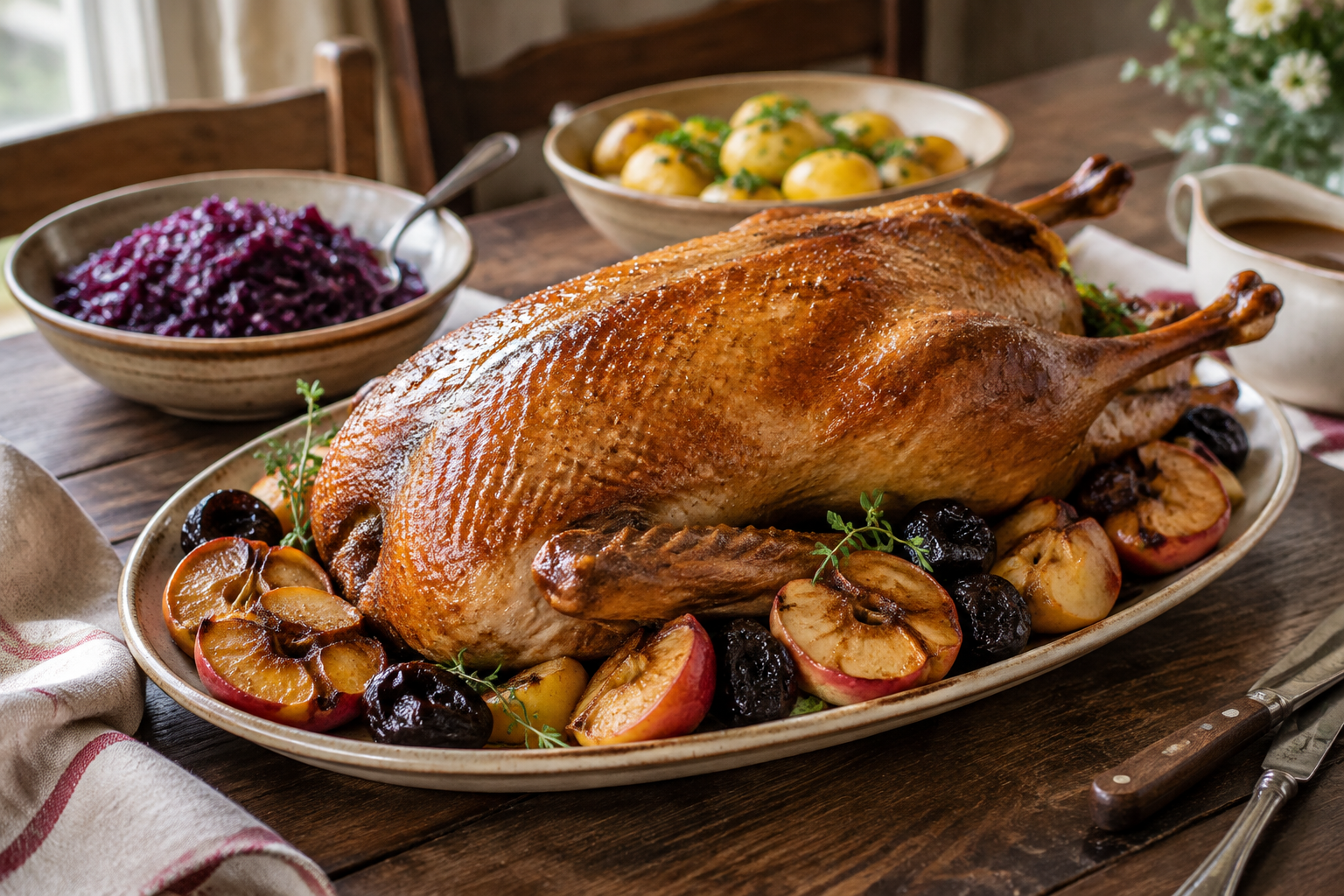
The goose presents different challenges. There is plenty of fat beneath its skin, and it needs time to render. If the bird is exposed to too much heat at the start, the surface may darken before the thighs are cooked. If it sits in water or is constantly moistened from above, crisp skin becomes harder to achieve. A rack over a deep roasting tin allows fat and juices to drain away.
Apples and prunes bring fruitiness to the cavity, but the filling should be loose and limited. A tightly packed bird takes longer to heat through. If you want plenty of fruit for your guests, it is wiser to cook extra separately than to stuff the goose to bursting.
The gravy also calls for judgement. What drips from the bird is not just roasting juices but a great deal of fat. Only once most of that fat has been removed can you assess the saltiness and concentration of the juices. Browned deposits add flavour; blackened ones add bitterness. A little water in the tin protects the drippings, but the goose should not sit submerged in it.
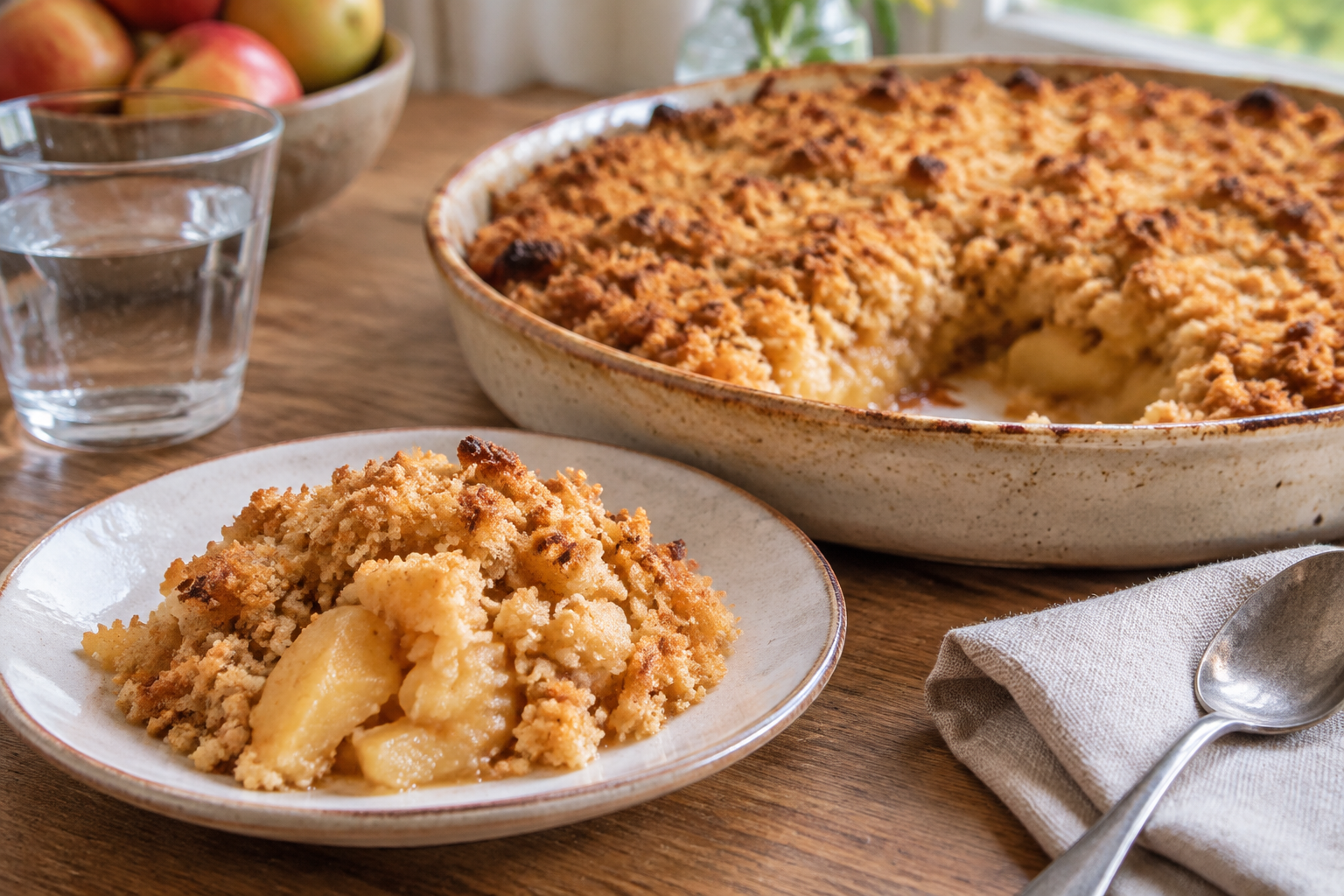
The plate needs counterpoints. The vinegar in the red cabbage, the freshness of the apple and the deep sweetness of the prunes work together to balance the rich meat. The apple cake then finishes the meal with the same fruit in another form: soft and tangy beneath butter-toasted crumbs. Skåne-style apple cake comes in several versions. Those made with bread also remind us how leftovers could become festive food.
The inn’s dinner and today’s guests
A goose dinner is a meal to linger over. The soup is best served in a fairly small portion; it is full of flavour and should whet the appetite, not overwhelm it. The goose follows as the evening’s centrepiece. In the past, carving could be a visible part of the art of service. At home, too, a sharp knife and a warm serving platter are more useful than trying to carve the whole bird at a crowded table.
Today’s restaurant tradition accommodates both anticipation and negotiation. One person looks forward to svartsoppa; another would prefer a different start. There is no reason to turn the meal into a test of cultural orthodoxy. Hospitality means explaining what is being served and allowing guests to choose, especially when blood, offal or alcohol touch on personal, religious or medical considerations.
Nor do the accompaniments have to be identical everywhere. Potatoes may be boiled, browned or roasted, and the sweetness of the cabbage varies from kitchen to kitchen. What is historically interesting is both the recognition and the differences. The established story of three courses has never meant that every cook prepared them in the same way.
A fresh, light- to medium-bodied pinot noir, preferably without heavy oak, works well with the goose. Its acidity balances the fat, while its red fruit echoes the apples and plums. A malty lager offers another equally fitting match: bready notes alongside the browned skin, and carbonation that refreshes between mouthfuls.
A dry alcohol-free apple cider is a fully fledged alternative, not an afterthought. Choose one with clear acidity and restrained sweetness. With the already slightly sweet soup and apple cake, plain water may give the food the most room to shine. Anyone who needs a completely alcohol-free drink should check the label and choose 0.0 per cent.
Two days, one oven and a thermometer
A goose dinner at home becomes much easier once you let go of the idea that everything must be done in a single afternoon. The recipe card below is therefore a complete menu for six, organised over two days. The svartsoppa and goose are source-based adaptations of older cookbook methods, not word-for-word reproductions of any single historical recipe. The apple cake follows the breadcrumb-based tradition. Quantities, temperature checks and the order of work have been adapted for today’s kitchen.
On the first day, finish the apple cake and red cabbage. Prepare and salt the goose. On the second day, the bird has exclusive use of the oven for most of the cooking, while the soup, gravy and potatoes are made on the hob. While the goose rests, there is a short window to warm the cake. This avoids having potatoes, poultry and dessert competing for the same oven heat.
Planning really begins with the shopping. Order the goose well in advance, and check both the space the bird will need and the size of your roasting tin. A frozen goose usually needs several days to thaw in the fridge; follow the supplier’s instructions and do not count thawing as part of the two cooking days. Order the blood too. Use only blood intended and handled for human consumption, keep it chilled and follow the storage guidance on the packaging.
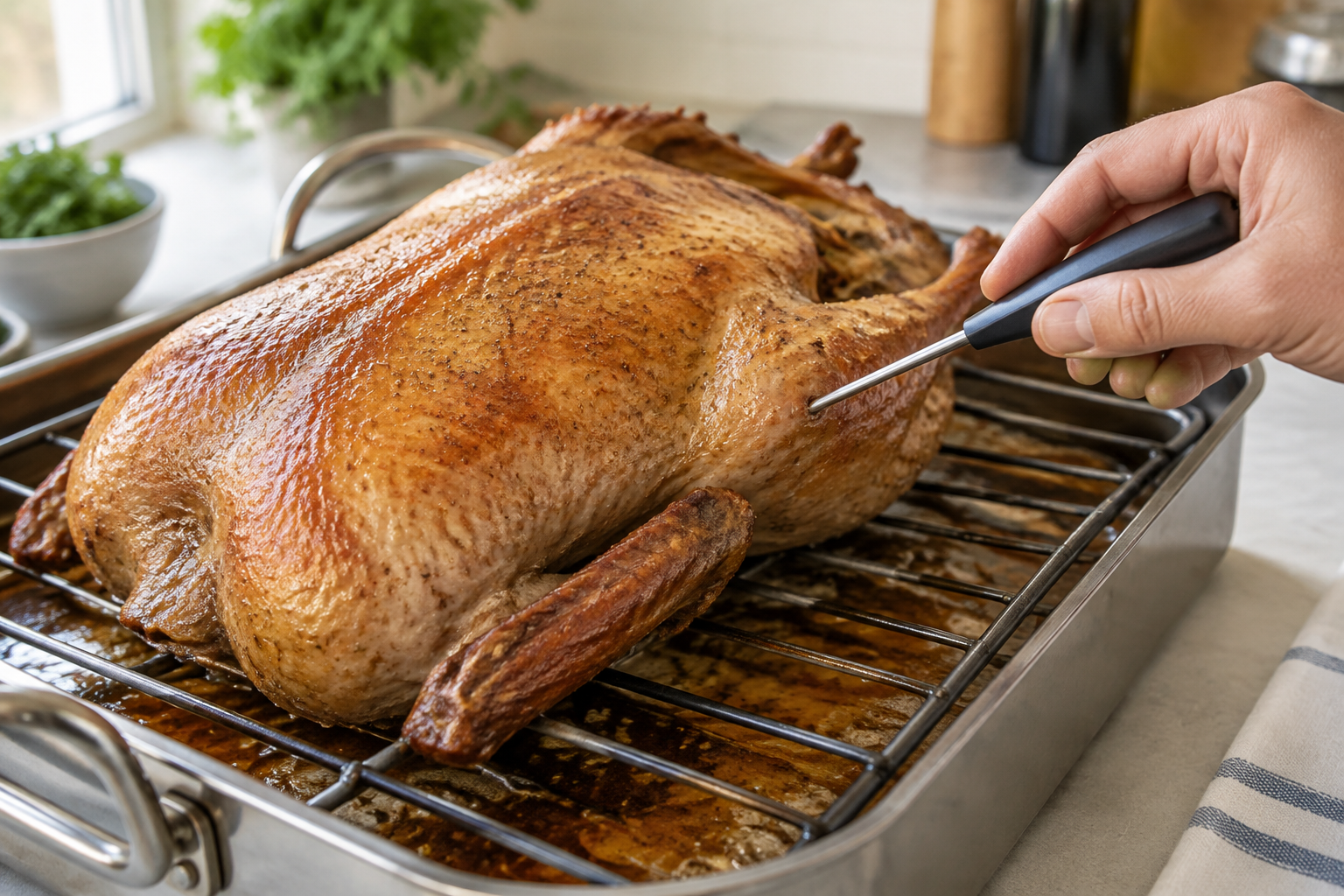
Historical recipes may settle for phrases such as a low fire or roasted until done. Here, such judgements are replaced by a thermometer and clear checkpoints. The goose must reach at least 75°C in both the thickest part of the breast and the innermost thigh meat, without the probe touching bone. Check the fruit in the cavity too. This is a cautious adaptation for the home kitchen, not a claim that earlier cooks worked to the same temperature threshold.
The svartsoppa must be heated thoroughly but not allowed to boil vigorously. The proteins in the blood can turn grainy if the heat is too fierce. Flour helps with the texture, while constant stirring and temperature checks offer more control than simply counting minutes. Heat all the soup to at least 75°C and keep it there for two minutes, stirring continuously.
Finally, you need a plan for after the feast as well. Cool soup, gravy and leftover meat quickly in smaller, shallow containers and store at around 4°C. Save the separated goose fat on its own; it is excellent for frying potatoes another day. This may be the simplest connection with the thinking of kitchens past: the dinner ends, but the value of its ingredients need not.
Martinmas dinner for six – svartsoppa, whole roast goose and Skåne-style apple cake
A complete menu in a single recipe card. The svartsoppa and roast goose are modern, source-based adaptations drawing on the older Swedish cookbook tradition represented by Hagdahl and Iduns kokbok; the proportions are ours, not an exact transcription. Here, apple juice replaces wine in the soup, and the apple cake is a breadcrumb-based version. The work is spread over two days and assumes a fully thawed goose. The cooking time covers the overall cooking period, with several tasks running in parallel; the size of the goose and the performance of your oven will determine the finishing time.
Ingredients
Method
- 1DAY 1 – prepare the goose, about 20 minutes. Check that the bird is fully thawed and remove any bag of giblets. Do not rinse raw poultry. Trim away large loose pieces of fat around the opening and pat the goose dry with kitchen paper. Prick small holes through the skin only in fatty areas around the thighs and lower breast, without piercing the meat. Rub with salt and pepper. Place on a rimmed tray at the bottom of the fridge, at around 4°C, away from ready-to-eat food and preferably loosely covered. Leave for 12–24 hours. Wash utensils and clean the work surface thoroughly.
- 2DAY 1 – cook the red cabbage, about 60 minutes. Finely shred the cabbage and slice the onion. Core and dice the apples. Soften the onion in the butter in a large saucepan for 5 minutes without browning. Add the remaining cabbage ingredients. Cover and simmer over a low heat for 45–60 minutes, stirring occasionally and adding a little water if it becomes dry. The cabbage should be tender but retain some texture. Season with salt and, if needed, more vinegar. Divide between shallow containers, cool quickly, preferably in a cold-water bath, and refrigerate.
- 3DAY 1 – bake the apple cake, about 60 minutes. Heat the oven to 175°C conventional. Grease a roughly 1.5-litre baking dish with 10 g of the butter. Peel, core and slice the apples. Place in a saucepan with the water and 40 g of the sugar, cover and simmer for 8–12 minutes until beginning to soften but not completely mushy. Melt the remaining 90 g butter in a frying pan and gently brown the breadcrumbs for 5–8 minutes. Stir in the remaining sugar and the cinnamon. Layer the crumbs and apples in the dish, starting and finishing with crumbs. Bake for 30–40 minutes. Allow the steam to escape, then cool quickly; cover and refrigerate until the next day.
- 4DAY 2 – start about 5 hours before the main course. Heat the oven to 150°C conventional. Core the three apples for the goose and cut into wedges. Place the apples and prunes loosely in the cavity, leaving space for air, and put any remaining fruit in a separate dish to cook later. Tie the legs together loosely with kitchen string. Place the goose breast-side up on a sturdy rack over a deep roasting tin. Pour 5 dl water into the tin without wetting the bird. Check that the tin can be pulled out safely.
- 5Roast the goose for about 3.5–4.5 hours before any final browning; a larger or very cold bird may take longer. Check the tin roughly every 45 minutes. Add a little hot water if it is drying out. Carefully ladle or spoon off fat into a heatproof container if the level gets high – avoid lifting a full, hot roasting tin unnecessarily. Do not repeatedly baste the skin with water. Start checking the internal temperature after about 3 hours. The thermometer, not the clock, determines when the bird is done.
- 6Make the soup base while the goose roasts, about 15 minutes. Set aside 1 dl of the cold stock. Bring the remaining stock to the boil with the apple juice, vinegar, syrup and spices. Simmer for 10 minutes, then remove the pan from the heat. Keep the blood refrigerated until needed. Check whether the blood already contains salt or acid and adjust the final seasoning accordingly.
- 7When the goose is nearly done: if necessary, raise the oven temperature to 225°C and brown the skin for 10–15 minutes, watching closely. Do not remove the bird until it has reached at least 75°C in the thickest breast meat and the innermost thigh meat, without the probe touching bone. Check both sides, and make sure the fruit in the cavity also reaches at least 75°C. If the skin is already dark, skip the temperature increase and continue at 150°C, shielding dark areas with foil. Transfer the goose to a platter and rest for 30–40 minutes without covering tightly with foil. Fruit in a separate dish can be baked until soft towards the end of roasting.
- 8While the goose rests – prepare the accompaniments. Peel the potatoes and boil in salted water for about 20–25 minutes, until tender. Drain and let the steam escape. Reheat the red cabbage in a saucepan with a splash of water, stirring, to at least 75°C. Lower the oven to 150°C and let it cool a little before putting in the apple cake. Warm the cake for about 20–30 minutes, covering with foil if needed. It can then wait and be served lukewarm. Lightly whip the cream for serving and refrigerate.
- 9Make the gravy while the goose rests, about 15 minutes. Strain the contents of the roasting tin into a heatproof container. Leave for a few minutes and spoon off the fat, or use a fat separator. Reserve 3 tbsp fat for the gravy and measure out 5 dl defatted roasting juices, topping up with stock. Taste the juices: if very salty, use less and dilute with water. Cook the flour in the goose fat for 2 minutes. Gradually whisk in the juices and cream. Simmer for 8–10 minutes. Season with vinegar, pepper and salt if needed. Keep the gravy warm.
- 10Finish the svartsoppa just before the starter, about 15 minutes. Whisk the flour with the reserved cold stock until smooth, then whisk in the blood. Strain the mixture. Gently heat the soup base; remove the pan from the heat and whisk in the blood mixture in a thin stream. Return to a low to medium heat and stir constantly, scraping along the bottom. Heat all the soup to at least 75°C and keep it at or above that temperature for 2 minutes, stirring continuously. Avoid a rolling boil. Thin with a little hot stock if it becomes too thick. Taste and adjust the seasoning only after heating thoroughly, then serve immediately in small, warm bowls.
- 11Carve and serve. Keep the starter course brief so the goose is served after a total resting time of about 30–40 minutes. Remove the legs and wings, cut the breast fillets away along the breastbone and slice across the grain. Arrange on a warm platter with the thoroughly heated fruit. Serve with gravy, potatoes and red cabbage. Finish with lukewarm apple cake and cold, lightly whipped cream.
- 12Deal with the leftovers straight after the meal. Remove the remaining meat from the carcass and divide the meat, soup and gravy between separate, shallow containers. Cool quickly and refrigerate at around 4°C; do not leave the food out all evening. Eat within 2–3 days or freeze. Reheat leftovers to at least 75°C before serving. Strain the reserved goose fat, chill separately and preferably freeze in small portions.
- The schedule at a glance: on day 1, salt the goose, cook the cabbage and bake the cake. On day 2, start the goose about 5 hours before the main course; make the soup on the hob, then fit the gravy, potatoes and reheating into the bird’s resting time. Allow a margin for your oven and avoid lingering too long over the starter.
- Order the blood and goose in advance. Never use blood that is not intended for human consumption. Follow the packaging instructions for thawing and storage. If blood is unavailable, choose a different starter rather than improvising with an unsafe ingredient.
- A frozen goose often needs several days in the fridge before the first cooking day. Also check that the bird, rack and deep roasting tin actually fit in your oven.
- Boiled potatoes have been chosen to simplify cooking with a single oven. If you prefer potatoes fried in goose fat, brown slices of pre-cooked potato in a frying pan while the bird rests.
What goes in the glass
- WineFresh pinot noir with restrained oakThe acidity balances the goose’s fat, while red berry flavours complement the apples and prunes. Choose a light- to medium-bodied wine rather than a powerful, tannic one.
- BeerMalty lager, such as dunkel or Vienna lagerBready, lightly toasted malt notes suit the browned skin and gravy. The carbonation refreshes, while moderate bitterness works well with the fruity accompaniments.
- Alcohol-freeDry alcohol-free apple cider, preferably 0.0%Apple acidity and bubbles provide contrast to the goose’s fat and tie together the meat, cabbage and fruit. Check the sweetness and choose 0.0% if the drink needs to be completely alcohol-free.
Enjoy alcohol in moderation. Alcohol-free options go just as well with the food.
Sources
- Charles Emil Hagdahl, Kok-konsten som vetenskap och konst (1879)
- Elisabeth Östman, Iduns kokbok (1911)
- Nils-Arvid Bringéus, Årets festseder (1976)
- Nordiska museet, Mårtensgås
- Nationalencyklopedin, Mårtensgås
- Encyclopaedia Britannica, Martin of Tours
- Livsmedelsverket, Råd om hygien, tillagning och förvaring av mat
Ask questions about "Mårtensgås – from autumn slaughter to a feast in Skåne". Answers are based on the magazine's own articles.