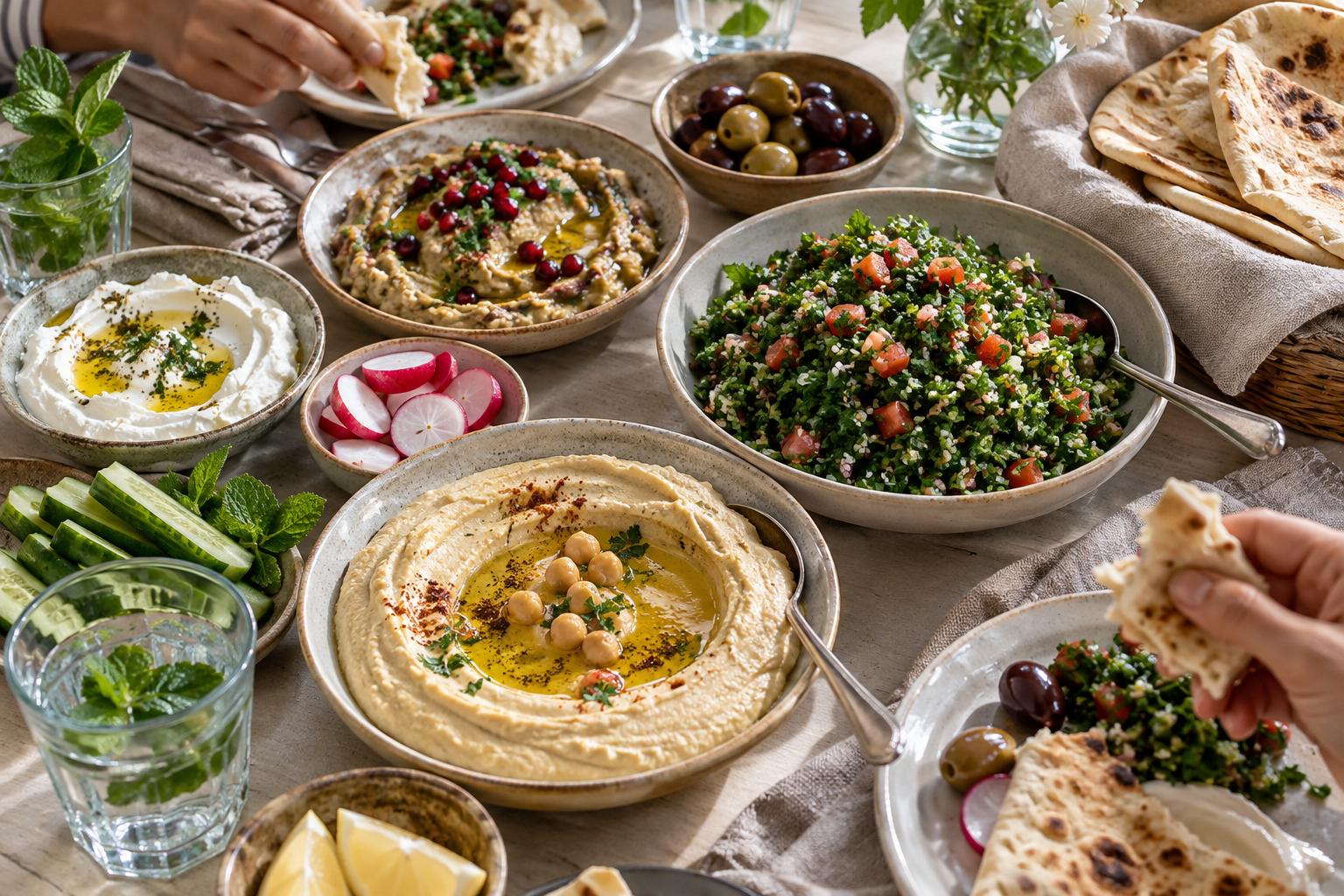
Mezze – the Lebanese table with room for one more dish
On hospitality, lemon-bright salads and the art of taking your time over a meal
A bowl of hummus is only the beginning. At the Lebanese mezze table, parsley, roasted aubergines and warm bread meet conversation that flows between mouthfuls. We trace these small dishes through history, past hummus records and into the home kitchen – with tabbouleh and hummus to gather around.
 By Sofia HaddadReporter · Middle East, Africa and Latin America – mezze, tagine, injera, mole and much more
Translated from Swedish with AI assistance.
Go to the recipes (2) ↓A table that grows as we eat
First comes the bread. It sits beneath a cloth, soft enough to fold around a spoonful of labneh. Then a green salad arrives, so thick with parsley that the bulgur is barely visible. Olive oil pools in the shallow hollow of the hummus. Someone breaks off a piece of bread; someone moves the olives within everyone's reach. From the kitchen comes the sizzle of the next round of warm small plates.
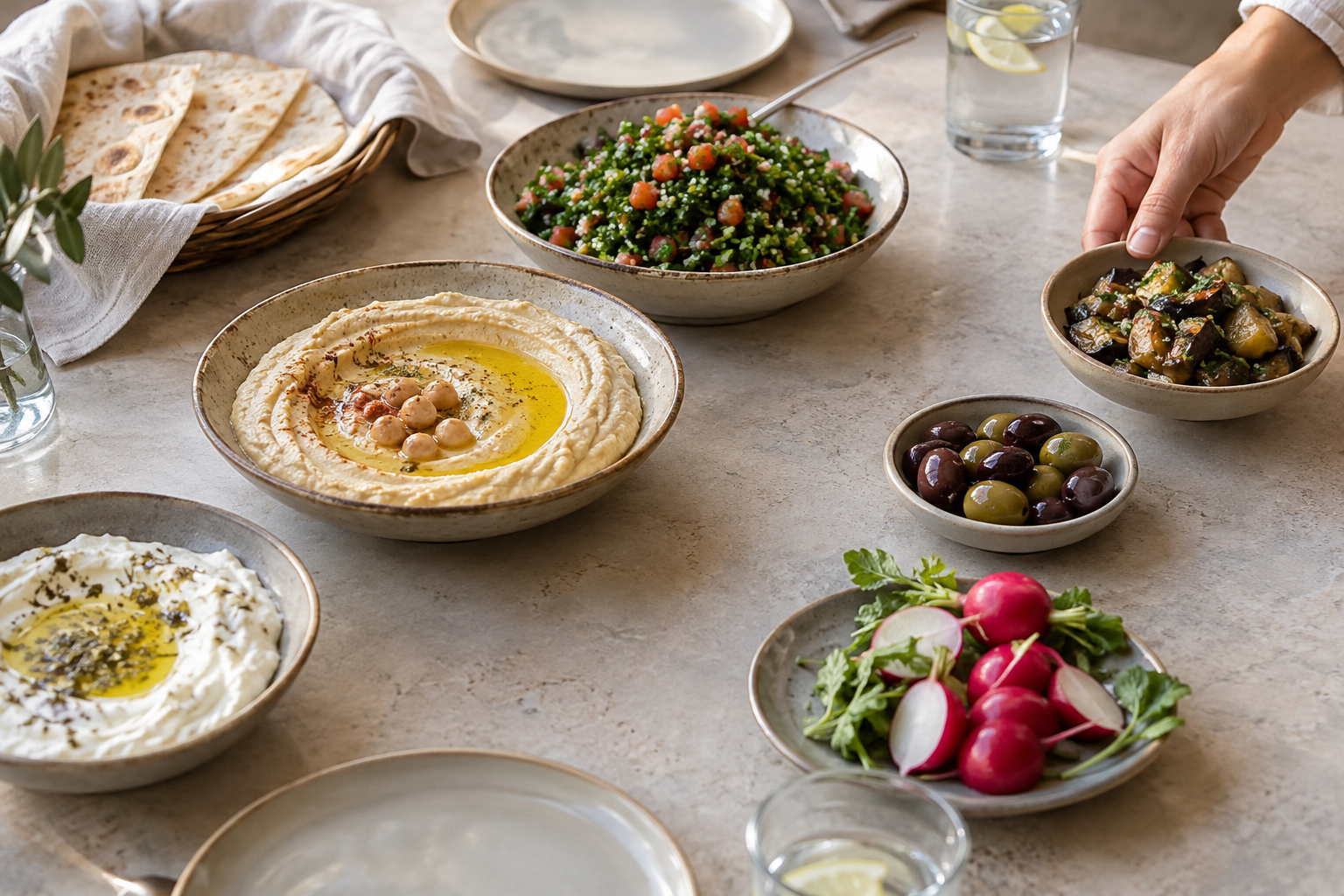
This is how a Lebanese mezze meal might begin: not with a single plate in front of each guest, but with a table that gradually becomes shared. What matters is not that every dish arrives at once. Rather, each new platter offers something different – tangy after creamy, warm after cool, crisp after soft.
A spoonful of hummus meets the peppery bite of a radish. Tabbouleh refreshes the palate with lemon and herbs. Next might come kibbeh, with its browned shell and spiced filling, or a bowl of aubergine dip scented with smoke. Mezze is as much a shifting interplay of flavours as a collection of recipes.
There is no single, compulsory Lebanese mezze spread. An everyday table might be modest, a restaurant meal lavish and a family lunch somewhere in between. Mezze can begin as starters followed by grilled food, or make up the entire meal. The sense of togetherness is not in the number of bowls. It lies in the food placed between us, and in having time to linger.
A shared history, not a single inventor
The word mezze is generally traced to the Persian word for taste, reaching other languages through Turkish, among others. It appears in various forms across a wide area: the Levant, Turkey, Greece and the Balkans. This tells us something about how food travels. Ports, trade, migration and centuries of Ottoman connections have carried both words and eating habits across borders that did not always look like today's.
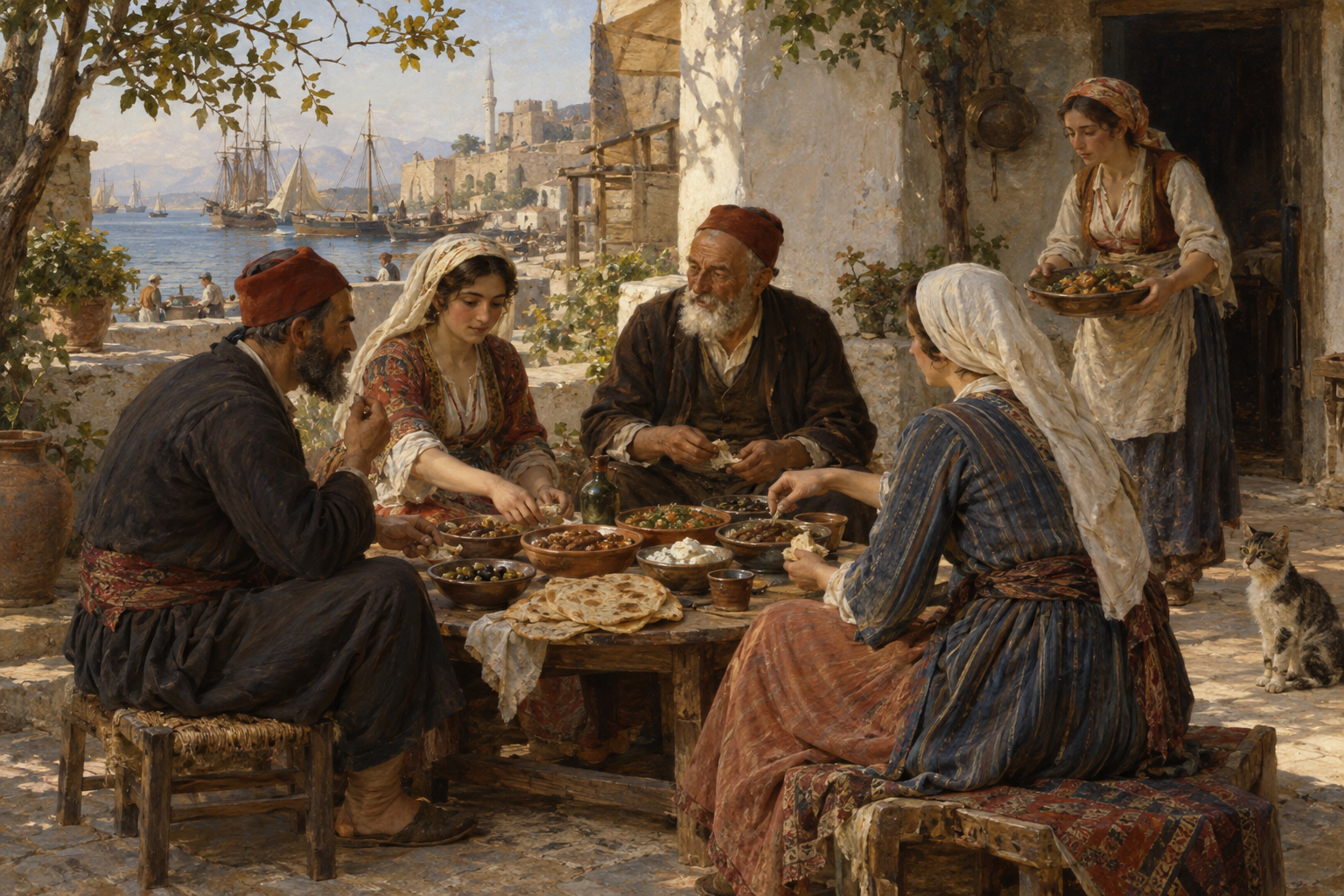
But the word's journey is not a birth certificate for the meal. We cannot point to a particular kitchen and a particular year when someone invented the entire mezze table. Eating several small dishes together has taken many forms throughout history. Modern Lebanese mezze developed within this broader regional food culture, acquiring its distinctive character from local ingredients, households and restaurants.
Lebanon's coast, mountains and agricultural regions also offer different growing conditions. Olive oil, pulses, grains, vegetables, herbs and cultured dairy products recur in its kitchens, but not in the same proportions everywhere. Family finances, the season and religious dietary practices all shape the table. During meat-free fasting periods in several Christian traditions, for example, vegetable and pulse dishes become especially important. This does not make them substitutes; they have fully developed flavours and techniques of their own.
Medieval Arabic-language cookbooks show that the region's cooks worked with considerable sophistication with ingredients including aubergines, pulses, acidic ingredients and nuts. An older chickpea dish should not, however, automatically be described as the same hummus we eat today. Recipes can share ingredients without being identical, and modern names do not always fit historical dishes.
Nor could tabbouleh always have looked like today's tomato-rich version. Tomatoes originated in the Americas and entered Middle Eastern cooking only after transatlantic contact. A tradition can therefore be deeply rooted while also bearing traces of quite substantial change. There is no contradiction in that. Food cultures stay alive because people continue to cook, adapt and value them.
In modern times, restaurants and Lebanese migration have made mezze familiar far beyond the region. In a Swedish supermarket, hummus may now be an everyday purchase, while kibbeh still needs an explanation. This spread creates new contexts, but it can also flatten the meal into something simpler: mezze easily becomes just another word for a few dips. The Lebanese table has far more to offer. It includes salads, pickles, dairy products, vegetables, fish and meat, as well as a carefully judged interplay of temperatures and textures.
Hummus, belonging and the politics of records
Hummus bi tahina essentially means chickpeas with tahini. The name identifies two main ingredients, but it does not tell us how a good bowl should taste. There is also the sharpness of lemon, the bite of garlic and the salt that brings the sesame paste's flavour to life. In many versions, olive oil goes mainly on top, rather than being added in large quantities to the dip itself.
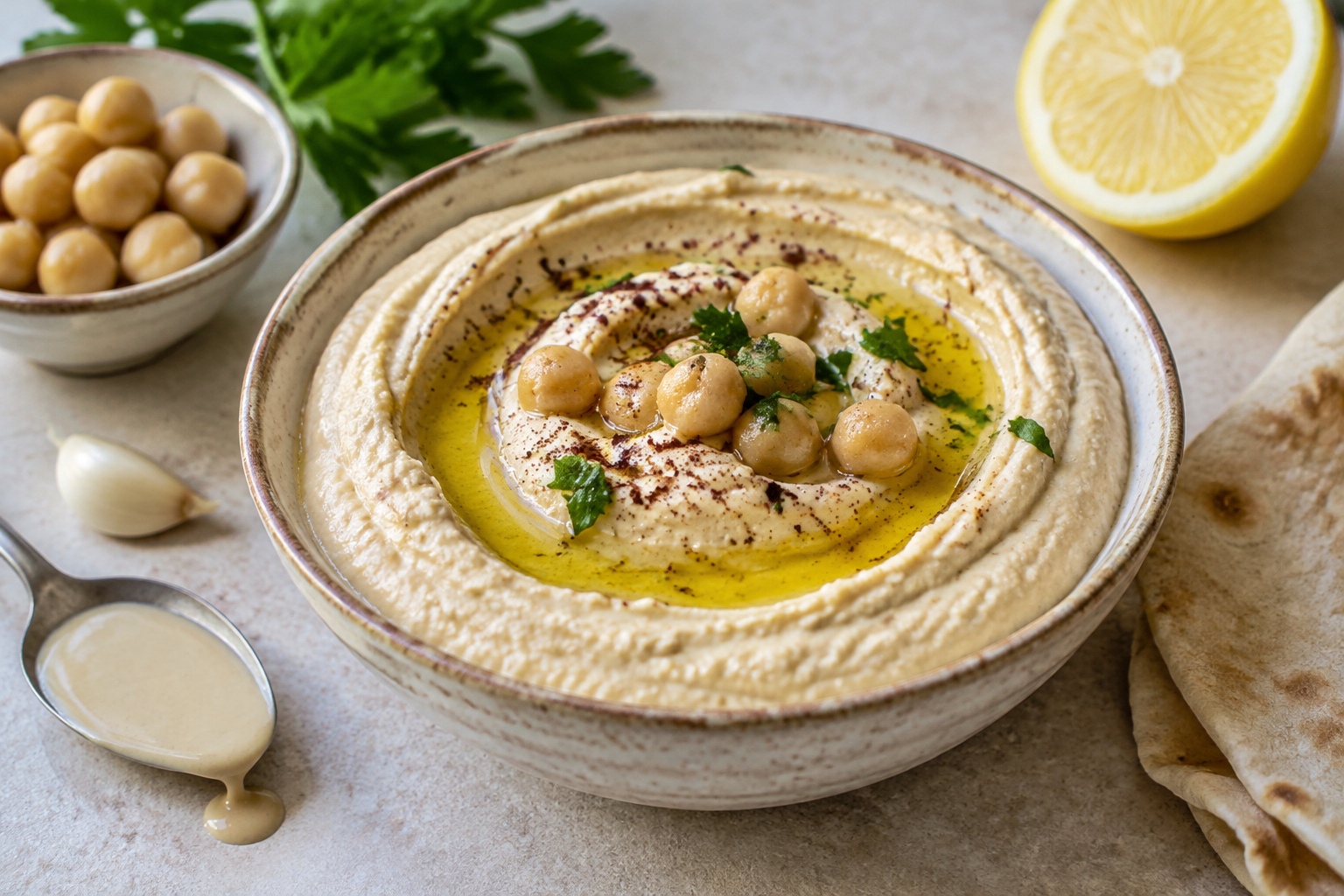
Hummus belongs to a broad Levantine food culture and has an established place in Lebanese, Palestinian and Syrian culinary traditions, among others. It is also firmly established in Israel. Exactly where the modern combination first emerged has not been conclusively determined. Naming a single nation as its inventor would therefore imply more certainty than the sources allow.
This does not mean that questions of belonging are unimportant. When food is marketed as national, people may feel that their history is being recognised – or erased. The hummus debate is therefore not just about chickpeas, but also about recognition, trade and political power. Especially in a region shaped by conflict, not every claim can be described as merely a cheerful kitchen rivalry.
Around 2009–2010, competing Lebanese and Israeli record attempts attracted widespread attention and were often called the “hummus war”. Guinness World Records documents a serving of hummus weighing 10,452 kilos, made in Lebanon on 8 May 2010. That is a verifiable record. It is not, however, proof of where hummus originated, and a contest over weight cannot determine who has a right to a shared or disputed food tradition.
At home, we can do something more useful than try to settle history with a hand blender. We can name the dish thoughtfully, learn its context and be clear about which version we are making. Here, our starting point is a Lebanese hummus with tahini and lemon – not a claim that every Lebanese family prefers exactly the same balance.
Herbs, smoke and crisp bread
Tabbouleh perhaps shows most clearly what happens when a dish is translated too freely. At many Swedish lunch counters, it is a grain salad with a little greenery. On a Lebanese table, it is usually the reverse: a parsley salad in which fine bulgur plays a smaller, but important, part. Mint brings coolness, tomato brings juiciness and lemon provides a distinctly tangy note.
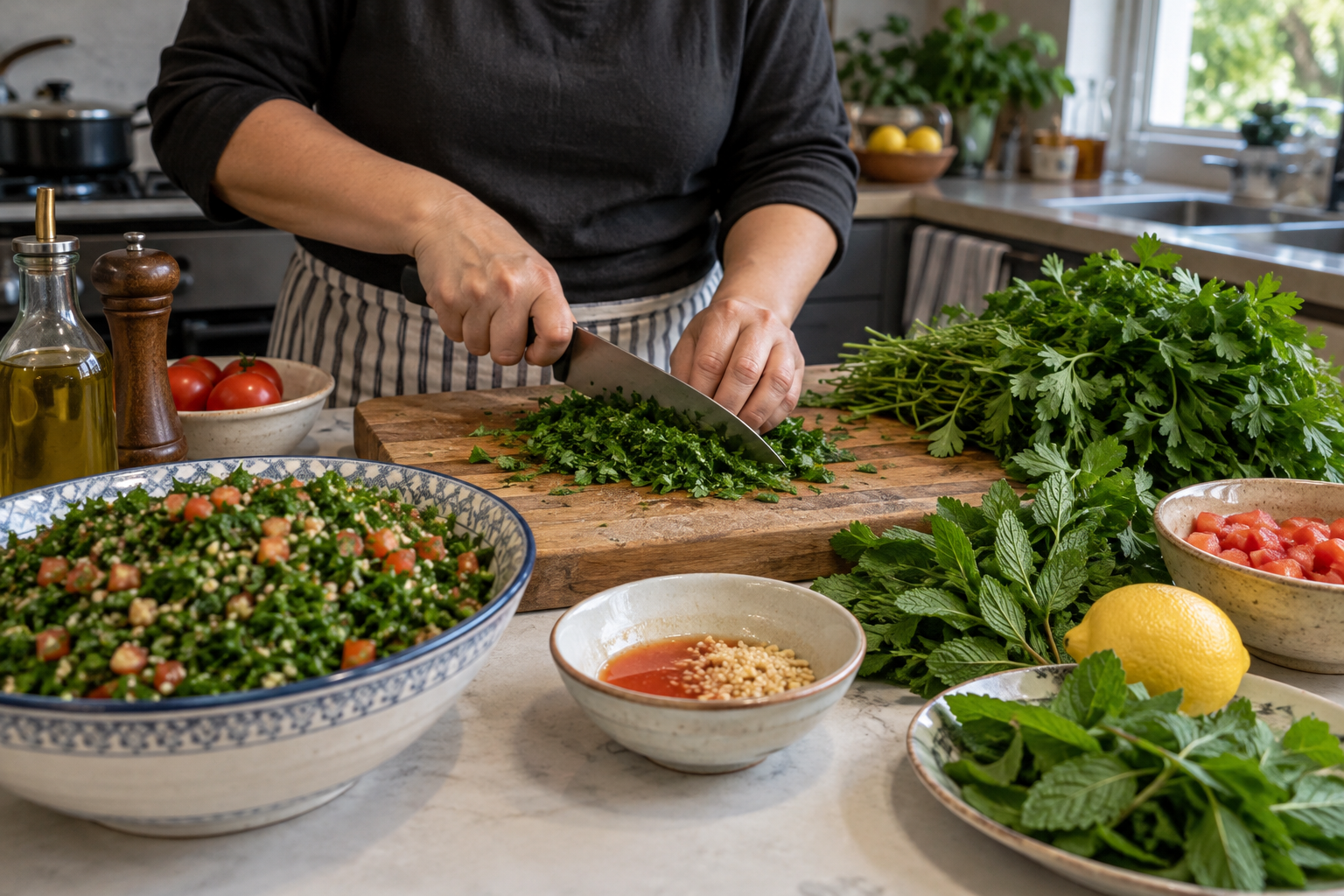
The parsley needs to be dry before it is chopped. Water clinging to the leaves dilutes the dressing, while a blunt knife or prolonged processing can turn the herbs mushy. A sharp knife produces small, clean pieces that retain their freshness and bite. It takes a little time, but it is also the difference between a lively salad and a green mush. Remove the coarsest stalks; tender ones can stay.
Fine bulgur should not be treated like coarse bulgur. It only needs to soften, not be cooked into a porridge. Families use different methods: some moisten it separately, while others let it absorb tomato juices and dressing. The shared aim is for the grains to be small and tender without dominating. The recipe below uses fine bulgur soaked in tomato and lemon, with a little water if that particular variety needs it.
Fattoush offers a different kind of salad. Here, vegetables and herbs meet pieces of toasted or fried thin flatbread. Sumac brings a fruity, slightly astringent tang. Made from the ground fruits of the sumac shrub, this spice is worth seeking out in a well-stocked supermarket or Middle Eastern shop. Lemon can boost the acidity if sumac is unavailable, but it cannot quite replace its flavour. Some dressings also include pomegranate molasses. Add the bread just before serving: a little softening is delicious; complete disintegration less so.
The aubergine dip often sold as baba ganoush calls for a different kind of attention. Names vary between countries, families and restaurants. A dip containing tahini is often called moutabbal, while elsewhere baba ganoush may refer to a more vegetable-focused aubergine dish. It is wiser to describe what is in it than to insist that only one name is always correct.
For a distinctly smoky flavour, the skin needs to char well on a barbecue or under a hot grill. The flesh should become completely soft. It is then left to drain so that the dip does not turn watery. Oven-baked aubergine is delicious too, but milder; smoke flavour does not develop simply because the aubergine is thoroughly cooked. A small difference in taste can reveal an entire technique.
Labneh brings coolness and tang to the table through strained yoghurt. It can be served with olive oil and zaatar, a spice blend that often contains herbs, sumac and sesame. Zaatar is also the name of herbs in the region, not just the blend. Ingredients vary, so taste before adding salt. When making labneh at home, drain the yoghurt in the fridge. Thick Turkish or Greek yoghurt can be a quick shortcut, but it does not always have labneh's density or tang.
Kibbeh and the art of balancing a meal
Kibbeh is not just a small fried ball, although that form is well known. It is a family of dishes in which bulgur is often worked together with finely processed meat. Its forms include stuffed, fried shells, baked layers and raw kibbeh nayyeh. There are also meat-free versions, including ones made with pumpkin or potato. The shape and ingredients vary with place, occasion and tradition.
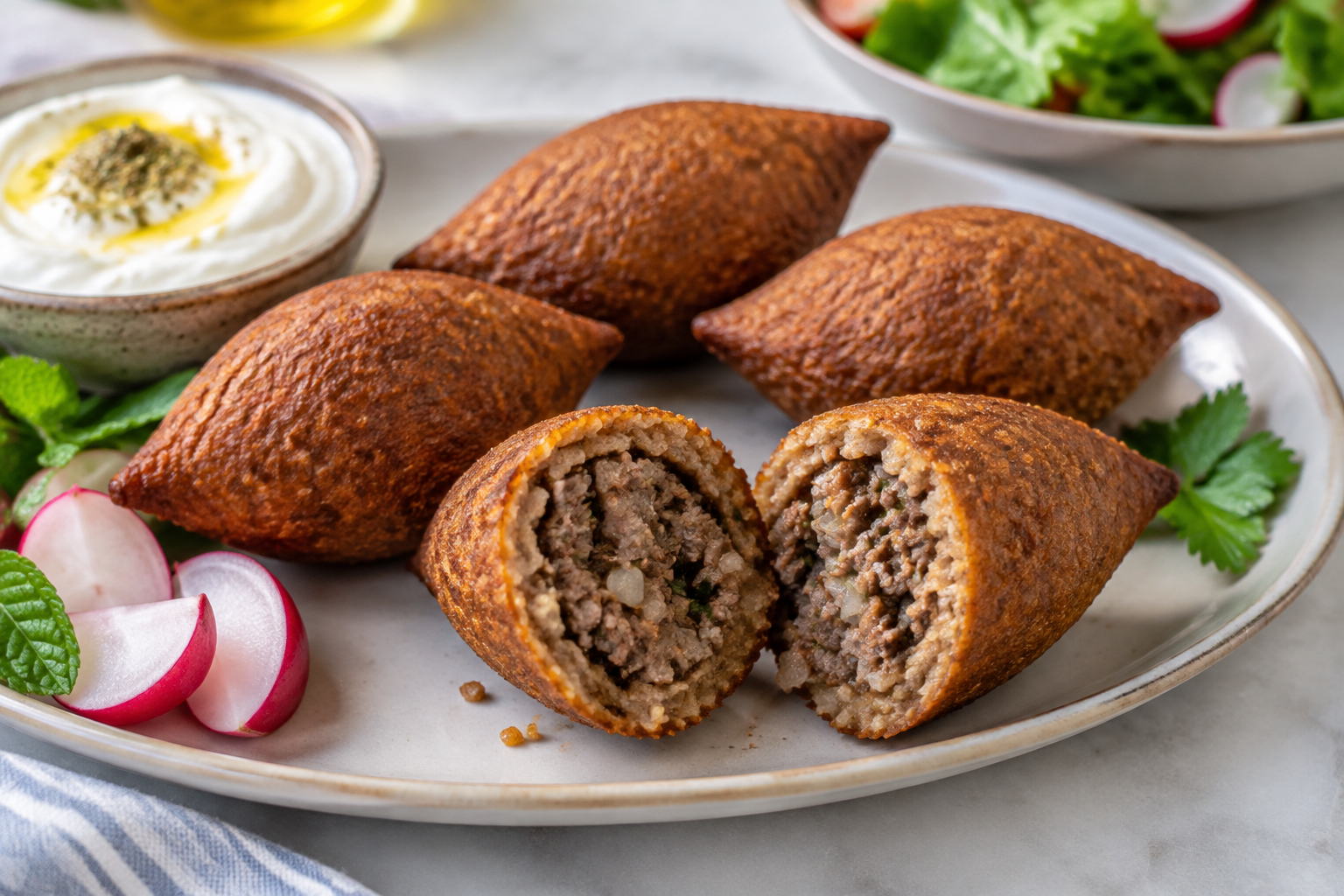
In the stuffed, fried version, the contrast between outside and inside is crucial: a thin shell, a juicy filling, onion and spices. Blends sold as Lebanese seven spice may contain allspice, black pepper, cinnamon and other warming spices, but there is no single universal formula. They should smell warm and aromatic, without necessarily delivering the heat of chilli.
Kibbeh nayyeh is part of Lebanese food culture, but like other raw meat dishes it carries a food safety risk. Meat that looks good or has been freshly minced is not risk-free. For a mezze meal at home, fully cooked kibbeh is a safer choice, especially when serving children, pregnant people, older people or anyone with a weakened immune system. You do not have to recreate every traditional dish to take a tradition seriously.
A well-balanced mezze table need not contain any meat at all. Hummus and labneh bring richness, salads bring acidity and freshness, and bread provides substance. Pickled vegetables, olives and radishes offer a counterpoint. A warm vegetable dish or a few falafel can add another contrast. The point is not for everything to taste of different spices, but for each dish to offer something the others lack.
This is also why three large bowls of similar dips are rarely as interesting as a smaller, more varied spread. Think soft and crunchy, mild and sharp, fresh and roasted. And consider the amount of lemon across the whole table. Each dish needs its own balance; if everything is intensely sour, there is soon nothing left to contrast with it.
Hospitality, arak and time for a cup of tea
Hospitality is central to many Lebanese accounts of sharing a meal. Generosity can be seen in the care taken over a guest's plate, in the bread being replenished and in the desire to offer one more delicious thing. At the same time, it is important not to cast every family as a picture of boundless abundance. Time, money, habit and personal preferences shape meals here as they do everywhere.
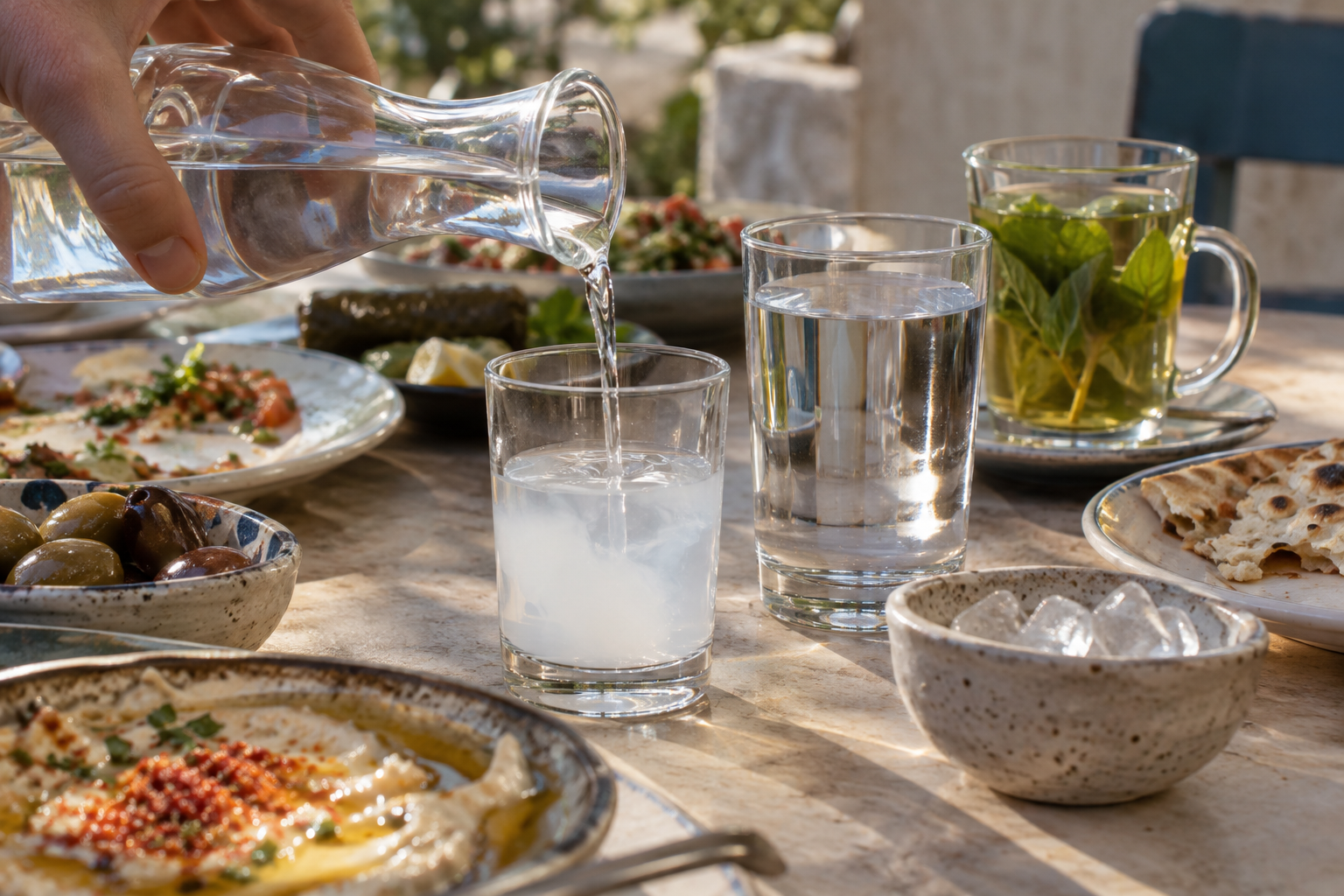
A shared table allows people to eat at their own pace and explore. Bread can be used to pick up food, while serving utensils make it easy to share hygienically. For a host at home, clearly identifying sesame, dairy, nuts and gluten is just as genuine an act of care as another platter. Ask what your guests eat before you plan, and never make anyone explain why their glass remains empty.
With mezze, Lebanon is often associated with arak, an anise-scented spirit usually made from grape-based alcohol. It is traditionally diluted with water and often served with ice. When water is added, the drink turns milky and cloudy: aromatic oils that were dissolved in the alcohol form tiny droplets as the alcohol concentration falls. The water is usually added before the ice.
The anise notes can work beautifully with herbs, tangy salads and salty small dishes, but arak is a strong alcoholic drink even when served diluted. Small servings with water alongside are sensible, and alcohol is, of course, no prerequisite for a Lebanese meal. Many people choose not to drink it for religious, personal or other reasons.
The Bekaa Valley is Lebanon's most important wine region, known for its high-altitude vineyards between the mountain ranges. The country has a long history of winegrowing, but today's bottles should not be described as unchanged relics of antiquity. Modern growing methods, grape choices and producers' work shape the wines. For hummus and tabbouleh in particular, a fresh white wine or dry rosé is often easier to pair than a powerful, tannic red. Meatier mezze can give red wine a different role.
Alcohol-free drinks deserve thought from the outset. Cold water with mint and a little lemon is refreshing without competing with the food. A mild mint tea, warm or cooled, echoes the herbs and is lovely as the meal gives way to conversation. Avoid making the drink as sour as the salad or so sweet that it takes over. Sometimes the best companion is simply cool water.
Making mezze work at home
Start smaller than you think. The hummus and tabbouleh below, alongside good Lebanese flatbread, olives, radishes and cucumber, make a generous light spread for four. For a larger dinner, add labneh and a warm dish. You do not need an entire restaurant menu, and every extra dish also means more work at the kitchen sink.
Buy herbs as a main ingredient, not a garnish. Large bunches of flat-leaf parsley from a greengrocer are often both better suited and better value than small pots. Fine bulgur, sometimes labelled number 1 or köftelik, is available in many Middle Eastern shops. Read the packaging, as labels and grain sizes vary. Coarse bulgur makes a different salad and needs different preparation.
Tahini makes a big difference to hummus. Look for a light sesame paste and stir the jar thoroughly to combine the oil and solids. Taste a little: a slight sesame bitterness is natural, but a distinctly rancid flavour cannot be magicked away with lemon. Tahini may initially thicken when it meets liquid. Keep processing and add more water a little at a time, and the mixture will become smoother and paler.
Tinned chickpeas are a good everyday option. An extra simmer softens them and makes them easier to blend until truly smooth. Dried chickpeas offer greater control over cooking, but need soaking and more time. Whichever route you take, undercooked chickpeas are a more common obstacle than an underpowered blender. Hummus should not need large amounts of oil to become silky.
You can make the hummus earlier the same day and keep it chilled. Take it out shortly before serving so that it is not fridge-cold, but do not leave perishable dishes out all evening. The parsley can be washed and dried in advance; chop and mix the tabbouleh closer to the meal. Warm the bread last and keep it under a clean cloth.
Then arrange the food within everyone's reach, ideally with a spoon in each bowl and a little space left clear. That space is practical when the next platter arrives, but it also says something about the meal: the table does not have to be complete before we sit down. Start with the bread, the lemon and the two bowls. The rest can take its time.
Lebanese tabbouleh with plenty of parsley
An herb salad with fine bulgur, not a bulgur salad with herbs. Here, the grains soften in tomato juice and lemon. The recipe serves four as part of a mezze spread; the timing includes around 25 minutes of soaking.
Ingredients
Method
- 1Wash the parsley and mint thoroughly in cold water. Spin dry and spread out on a clean tea towel. The leaves should be thoroughly dry before chopping.
- 2Finely chop the tomatoes, reserving all their juice. Put the bulgur in a bowl and add the tomatoes, tomato juice and 3 tbsp lemon juice.
- 3Leave for 20–30 minutes, stirring a couple of times. Taste the grains: they should be tender with a slight bite, not hard. If the mixture is dry and the grains are still hard, add cold water 1 tbsp at a time and leave for another 10 minutes. Follow the packet instructions if your bulgur requires separate soaking.
- 4Gather the parsley into small bunches and finely chop with a sharp knife. Chop the mint and slice the spring onions very thinly. Avoid using a food processor, which can easily turn the herbs mushy.
- 5Fold the parsley, mint and spring onions into the tomato mixture. Add the olive oil, salt and pepper, and mix gently but thoroughly.
- 6Taste and add more lemon or salt as needed. The salad should be distinctly fresh and juicy, but not swimming in dressing. Serve soon after mixing, with romaine leaves for scooping.
- Weigh the parsley after trimming. Buy more than 150 g, as the coarse stalks will be discarded.
- Keep washed, dried herbs in the fridge, but ideally chop and mix close to serving. Leftovers will keep in the fridge until the next day, but will lose their fresh texture.
- For a gluten-free adaptation, replace the bulgur with 1 dl cooked, cold, well-drained quinoa. This is an adaptation, not the traditional grain base.
Silky hummus with tahini and lemon
A Lebanese-inspired basic version made with tinned chickpeas simmered until extra soft. Olive oil goes on top, while tahini and cold water give the dip its creaminess. Makes four generous mezze portions.
Ingredients
Method
- 1Rinse the chickpeas and put them in a saucepan. Cover with water and simmer for 15–20 minutes, until they can easily be mashed between a fork and a plate. Older or firmer tinned chickpeas may need longer.
- 2Drain thoroughly and leave to steam-dry for about 5 minutes. Set aside 2 tbsp chickpeas for garnish if you like. There is no need to peel the rest.
- 3Finely grate the garlic. Blend the tahini, lemon juice, garlic and salt in a food processor for about 1 minute. Scrape down the sides. The mixture may thicken at first; this is normal.
- 4With the motor running, gradually add 0.5 dl of the ice-cold water. Blend until the tahini mixture is pale and creamy.
- 5Add the lukewarm chickpeas and blend for 3–5 minutes. Stop a couple of times to scrape down the sides. Add the remaining water a little at a time until the hummus is soft and spreadable. The exact amount will depend on the chickpeas and tahini.
- 6Taste and adjust with lemon and salt. Blend for another 30 seconds. Make the hummus slightly looser than your desired final consistency, as it thickens as it cools.
- 7Spread into a shallow bowl and make a groove with the back of a spoon. Drizzle with olive oil and top with the reserved chickpeas and cumin or paprika, if using.
- 8Warm the bread in a 150°C oven for about 3–5 minutes, preferably wrapped in foil to prevent it drying out. Serve immediately. If making the hummus ahead, chill it and leave the garnish until serving.
- If using dried chickpeas, you will need about 200 g. Soak for 8–12 hours in the fridge, drain and cook in fresh water until completely tender, often 60–90 minutes or longer. Weigh out 460 g cooked chickpeas.
- For a milder garlic flavour, start with half a small clove. Raw garlic can become more pronounced as the hummus sits.
- Keep covered in the fridge and eat within 3–4 days. Thin with a little water before serving if needed. Tahini contains sesame.
What goes in the glass
- SpiritsLebanese arak, diluted with waterThe herbal character of anise complements parsley, mint, tahini and salty accompaniments. Dilute to taste, ideally around one part arak to two–three parts water, and add ice after the water. Serve small amounts and keep plain water on the table; dilution does not reduce the amount of alcohol in the measure of spirit poured.
- WineFresh white wine or dry rosé from the Bekaa ValleyFresh acidity meets the lemon and lightens the richness of tahini. Look for a style without pronounced oak; firm tannins and heavily toasted oak are less accommodating with raw herbs and tangy salad.
- Alcohol-freeMild mint tea, warm or chilledMint echoes the tabbouleh without competing with the tahini. Steep fresh mint in hot water and serve unsweetened or very lightly sweetened. Cool quickly and refrigerate if serving the tea cold.
- Alcohol-freeSparkling water with mint and a thin slice of lemonThe bubbles and delicate citrus aroma offer a refreshing contrast to the creamy dips. Keep the lemon to a minimum so the drink does not amplify the acidity of the whole meal too much.
Enjoy alcohol in moderation. Alcohol-free options go just as well with the food.
Sources
- Claudia Roden, The New Book of Middle Eastern Food (2000)
- Claudia Roden, Arabesque: A Taste of Morocco, Turkey and Lebanon (2005)
- Salma Hage, The Lebanese Kitchen (2012)
- Kamal Mouzawak, Lebanese Home Cooking (2015)
- Alan Davidson; tredje upplagan redigerad av Tom Jaine, The Oxford Companion to Food (2014)
- Guinness World Records, Largest serving of hummus (2010)
- Julia Harding, Jancis Robinson och Tara Q. Thomas, redaktörer, The Oxford Companion to Wine (2023)
Ask questions about "Mezze – the Lebanese table with room for one more dish". Answers are based on the magazine's own articles.