Mole poblano – far more than the convent’s chocolate sauce
From Puebla’s colonial kitchens to today’s celebrations
Dried chillies, toasted seeds, spices and a little chocolate: mole poblano builds its grandeur layer by layer. Legend places its birth in a convent in Puebla, but the sauce’s history begins much earlier – telling a story of shared knowledge, colonial power and meals that bring people together.
 By Sofia HaddadReporter · Middle East, Africa and Latin America – mezze, tagine, injera, mole and much more
Translated from Swedish with AI assistance.
Go to the recipe ↓A kitchen where aromas arrive in waves
First comes the scent of warm chillies: dark fruit, dry hay, something reminiscent of raisins. Then the sesame seeds begin to crackle in the pan. As the spices warm, the air changes again. Cinnamon softens, cloves come to the fore, and somewhere further along in the process, chocolate awaits. It is not there to take over. It is there to bring everything together.
This is one way to approach a kitchen in colonial Puebla, without pretending to know what happened on a particular evening behind a particular convent wall. Dried chillies, bread, seeds and spices lie on the work surface. A metate, the sloping grinding stone, turns the ingredients into a paste through hands, weight and persistence. Stock waits in the pot. What will become a sauce is still a collection of separate aromas.
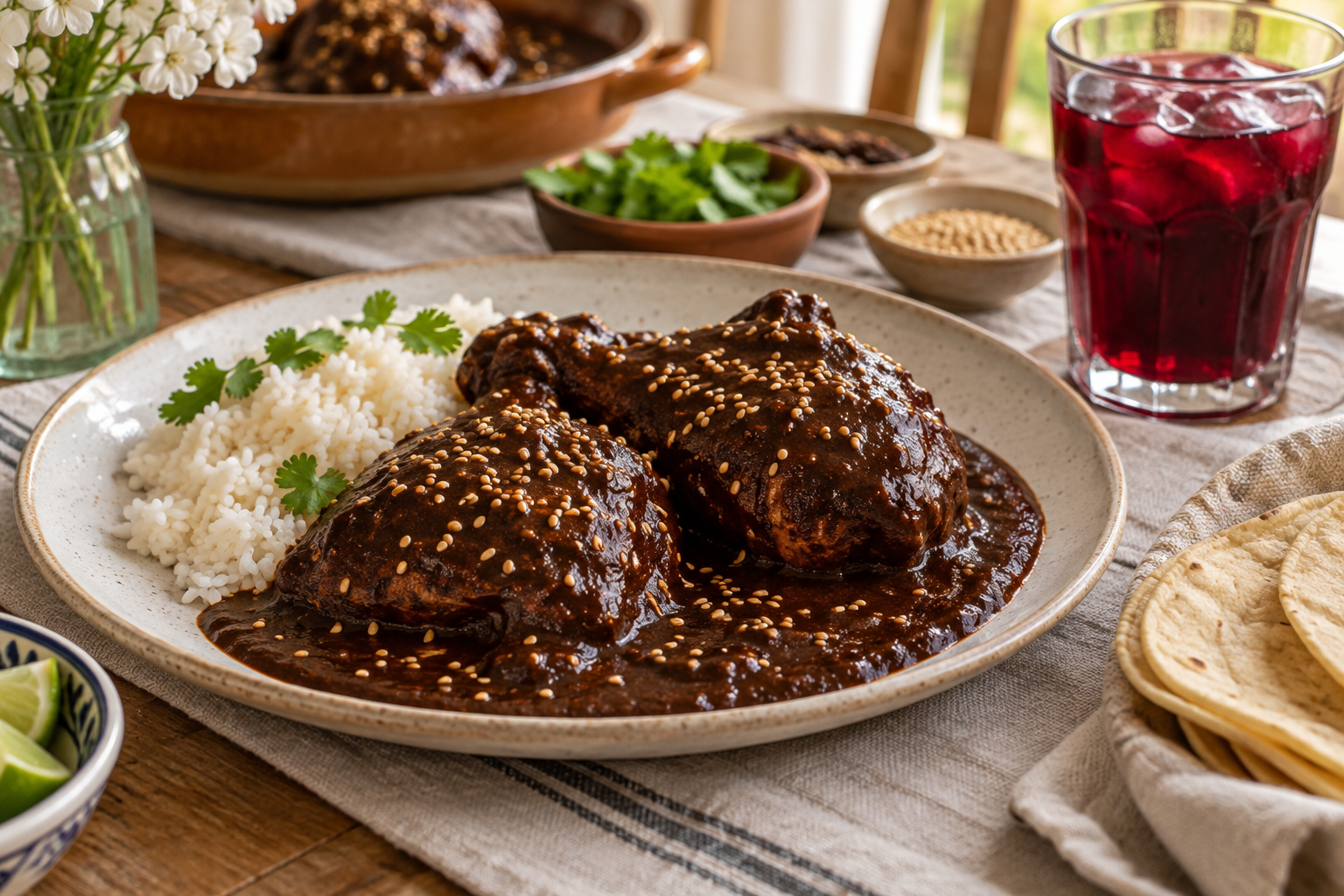
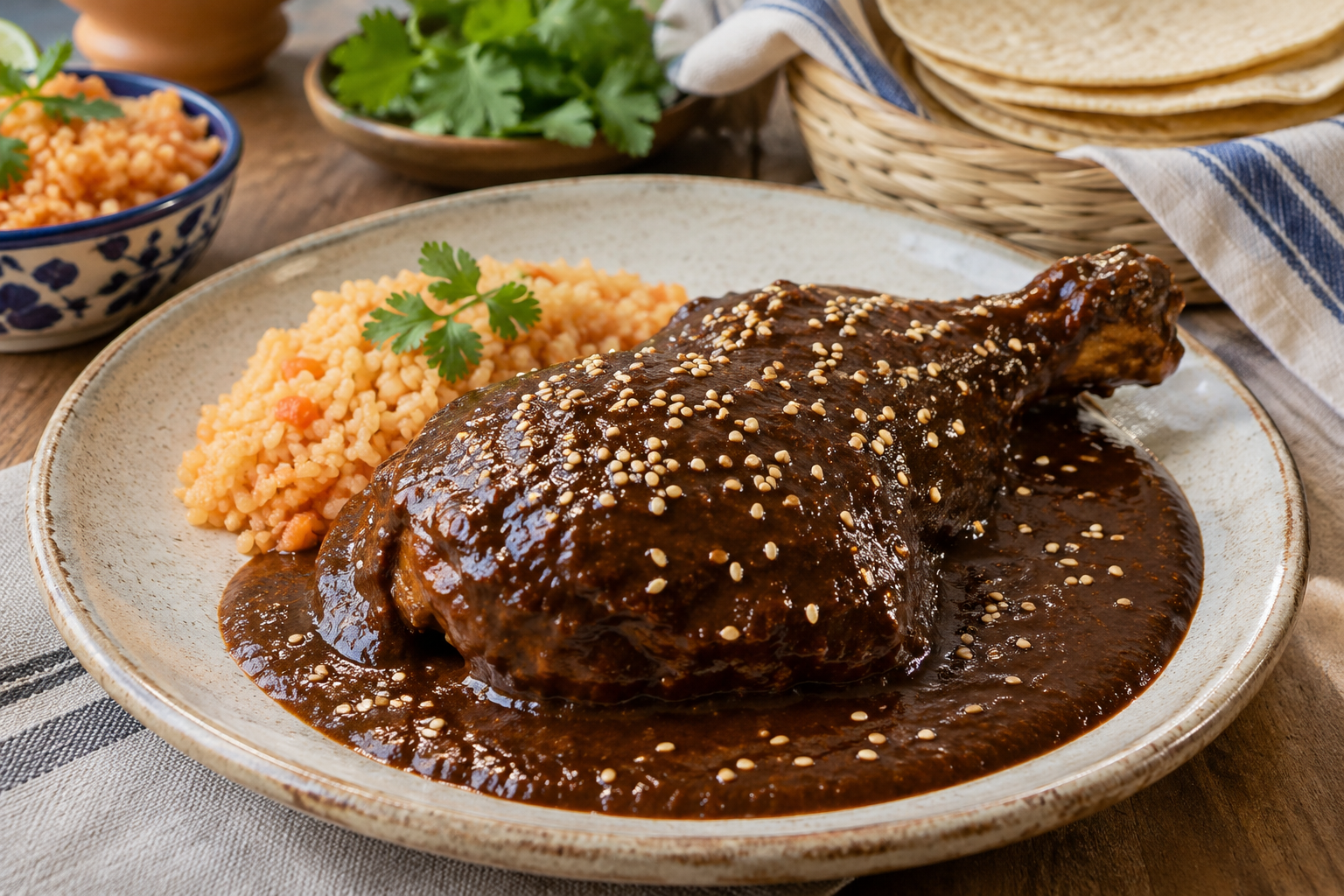
Mole poblano is one of Mexico’s best-known celebration dishes: a deep brown, complex sauce often served over turkey or chicken and finished with sesame seeds. But describing it as “chicken in chocolate sauce” gives the wrong impression. Chillies are its backbone. Chocolate is one of several voices in a much larger conversation.
There is a rhythm to the work here, too, quite unlike a quick everyday dinner. Ingredients are heated separately, ground together, then transformed once more as the paste is fried and thinned. No single action is particularly remarkable. What makes the difference is the care taken between stages: stopping at just the right degree of toasting, scraping along the bottom of the pot, tasting before the next addition.
The sauce takes its name from Puebla, the city south-east of Mexico City founded by the Spanish in 1531. During the colonial period, it became an important centre for trade, crafts and religious institutions. Its food tells of ingredients and people travelling great distances – but also of knowledge already rooted there, which did not begin with the Europeans’ arrival.
Santa Rosa and the story that endured
The most widespread origin legend places mole poblano at the Dominican convent of Santa Rosa in Puebla. In its various versions, the nuns are said to have needed to prepare an exceptional meal for a high-ranking church or colonial visitor. They gather what the kitchen has to offer, toast and grind it, and create a sauce so magnificent that it becomes famous.
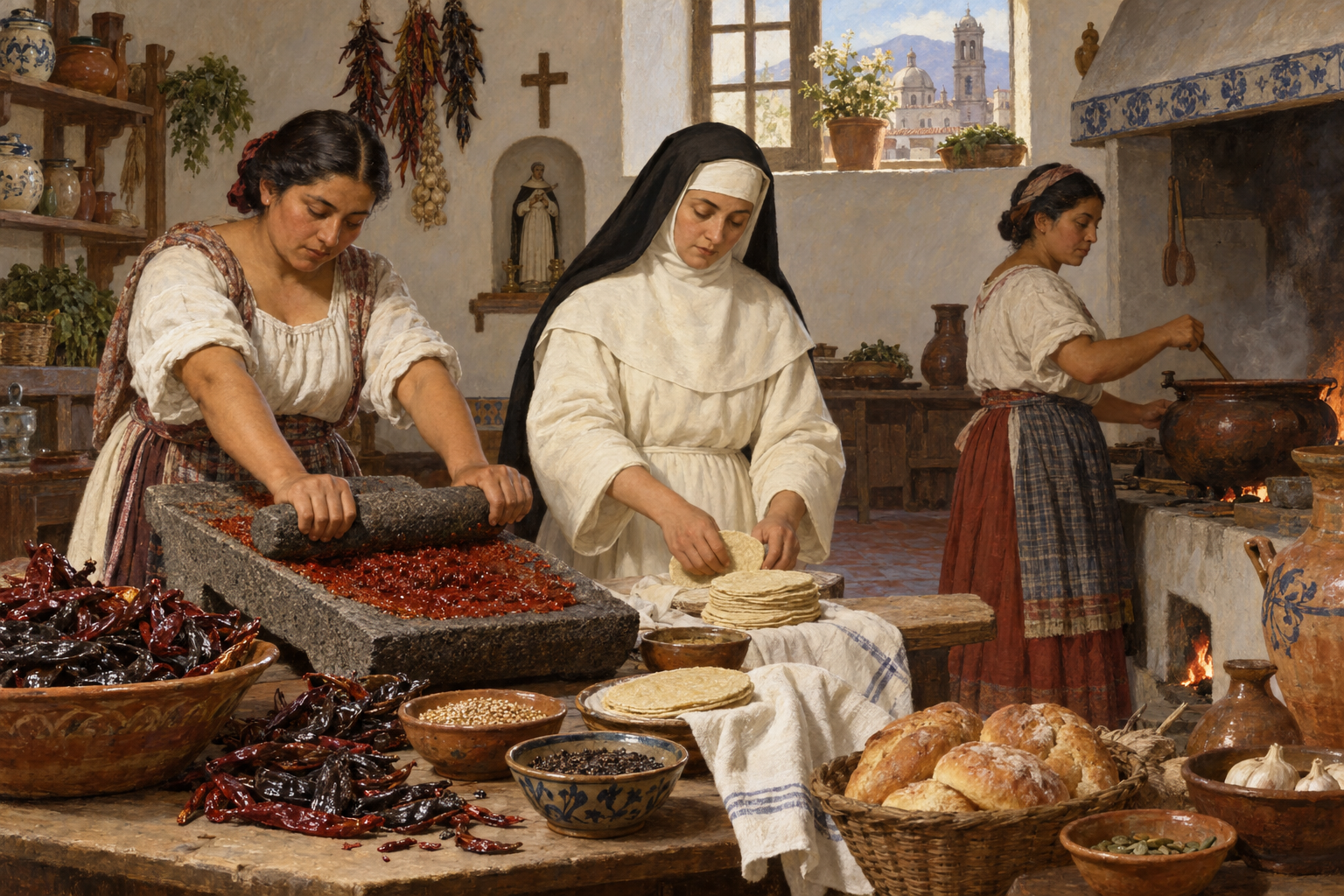
It is an alluring story. An enclosed kitchen opens out into the world; hands usually working beyond history’s spotlight become its creative protagonists. In some accounts, the invention is the result of inspiration; in others, almost a happy accident. The stories also vary in their names, dates and the identity of the guest.
That very variation is reason for caution. There is not enough evidence to treat a particular nun’s cooking for a particular visit as the certain moment of mole poblano’s birth. Santa Rosa is central to the dish’s cultural history, but the legend is not the same as a documented original recipe. Other convent and kitchen stories have also been linked to the sauce’s creation.
Puebla’s convents did, however, have genuine significance as culinary settings. Food supplies, gifts, religious festivals and extensive domestic labour could converge there. Such kitchens offered scope for elaborate confectionery and festive food, although resources and conditions varied. The fact that convents contributed to the city’s culinary reputation does not mean that every famous dish was invented there from scratch.
We should also look beyond the legend’s named nun. Colonial households and institutions depended on growing, deliveries, grinding, tending fires, washing up and cooking. Indigenous knowledge of chillies, maize, seeds and grinding stones was fundamental to what these kitchens could achieve. A story that credits only the Spanish convent risks making the people who held that knowledge invisible.
The historically plausible picture is therefore less dramatic but richer: mole poblano emerged through the long development of sauces, techniques and celebratory meals. Convents may have played an important part in that development. They were not a world cut off from markets, agriculture or the people whose work made those meals possible.
Before the convent, there was mulli
The word mole derives from the Nahuatl molli, often rendered as mulli, meaning sauce or cooked mixture. It is not the name of a single original recipe. Rather, the word opens the door to a whole family of ways of cooking and eating.
The Florentine Codex, compiled during the 16th century by Bernardino de Sahagún with Nahuatl-speaking collaborators, describes, among other things, foods and sauces in which chillies play a prominent role. The source was written after the conquest and must be read with that circumstance in mind. Even so, it clearly shows that complex chilli preparations did not begin in Puebla’s colonial convent kitchens.
Pre-Hispanic kitchens had a wide variety of chillies, as well as maize, tomatoes, tomatillos, pumpkin seeds and turkey. Cacao also had a long history, particularly in drinks and in social and ritual settings. But we cannot conclude from this that today’s mole poblano already existed as an unchanged dish. The presence of an ingredient does not prove that it was used in the particular combination we know now.
After the Spanish conquest, conditions changed. European colonial networks introduced wheat, almonds, raisins and new domesticated animals, among other things. Sesame and spices originating in other parts of the world reached New Spain and became established in its cooking. Cinnamon and cloves, in turn, speak of trade routes stretching beyond both Mexico and Europe.
It is tempting to call this a meeting of two worlds. The phrase is useful, but it simplifies matters. Many societies and traditions of knowledge met here, and they did so on unequal terms: conquest, coercion and immense social upheaval. At the same time, people continued to cook, adapt their methods and create something that cannot easily be divided into a European and an Indigenous half.
In mole poblano, this history becomes tangible. An Indigenous foundation of chillies and grinding can be combined with wheat bread, almonds, sesame and imported spices. The recipes eventually documented and circulated are not all alike, either. In later centuries, printed cookbooks, restaurants, migration and the construction of national identity helped make certain versions particularly well known.
It is therefore more accurate to think of mole as a living family than as a single invented object. Mole poblano is one famous branch. Oaxaca’s various moles, green sauces and seed-based preparations show how much larger the family is. Not all contain chocolate, and not all are brown.
Three chillies and a carefully judged piece of chocolate
Ancho, mulato and pasilla recur in many mole poblano recipes. They offer not three versions of the same heat, but different aromatic building blocks. Their names are therefore worth getting to know before worrying about how many ingredients need to be lined up on the kitchen counter.
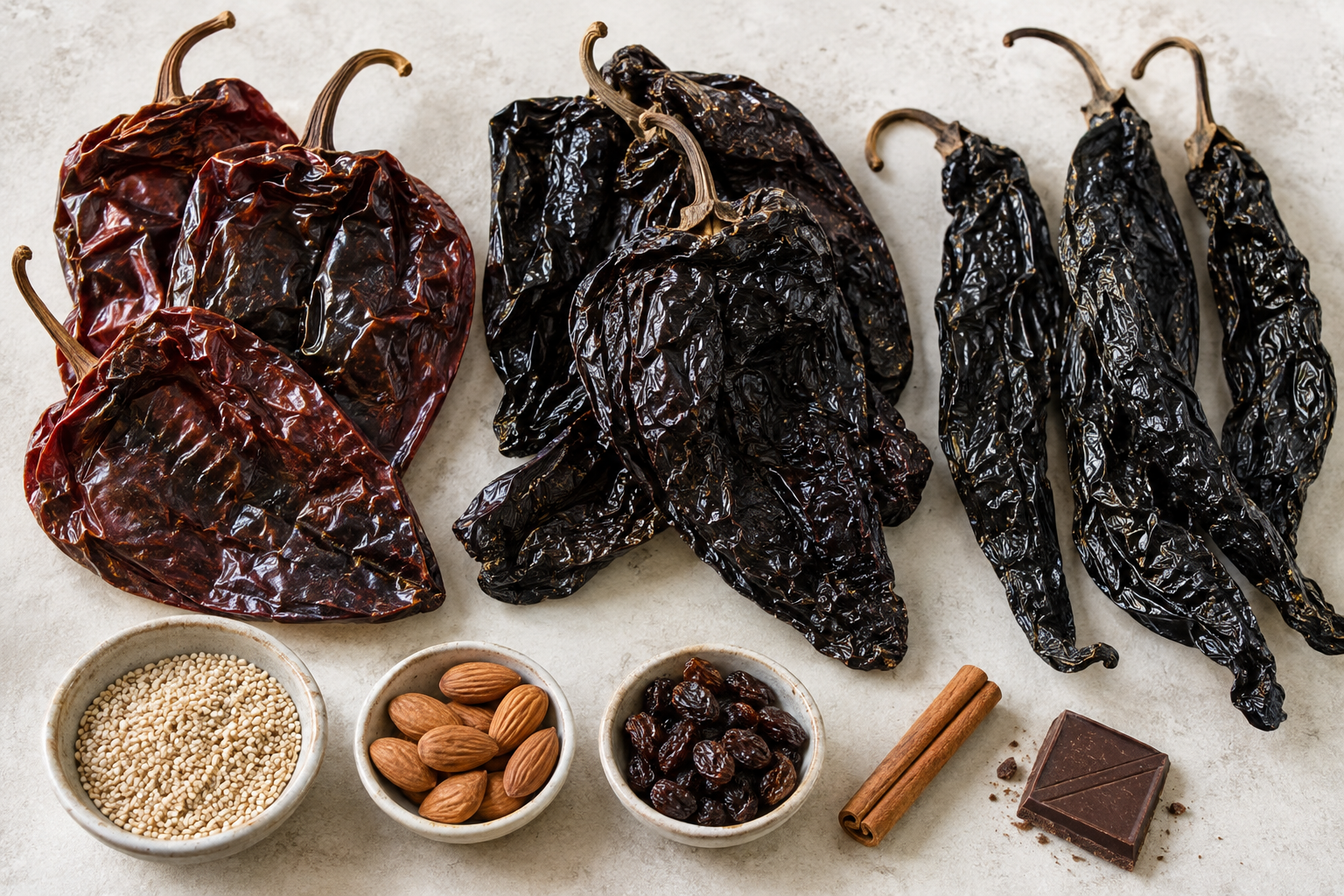
Ancho is dried poblano chilli. Broad and often reddish-brown, it brings a sweet fruitiness that can recall raisins and plums. Mulato is closely related to ancho but usually darker, with notes often described as cocoa, liquorice or dried fruit. Pasilla is the dried chilaca chilli: long, slender, dark and often earthier, with a fruitiness of its own.
Heat varies between harvests and products. It is therefore wiser to taste than to assume a variety is always mild. The seeds and, above all, the pale membranes are usually removed here to create a pleasant texture and control the heat. Consider wearing gloves, and avoid touching your eyes as you work.
Dried chillies should smell fragrant when you open the packet. Ideally, they will be leathery and slightly pliable rather than so old that they crumble to dust. In Sweden, these varieties are available from Latin American food shops and online retailers. They are worth seeking out: ordinary chilli powder can provide heat, but it cannot reproduce the depth of this combination.
The chocolate comes later. Mexican table chocolate may contain both sugar and cinnamon, which affects how the rest of the sauce needs to be seasoned. In our recipe, we use dark chocolate with a specified cocoa content instead. It is a practical choice for a Swedish kitchen, not a claim about what a particular nun had in her pot.
The quantity matters, too. Too much chocolate makes the sauce heavy and can blur the nuances of the chillies. Overly bitter chocolate, heavily toasted ingredients and too many cloves can together create a harshness that is difficult to correct. The aim is for the chocolate to register as added depth rather than a dessert flavour.
Around the chillies sits the rest of the sauce’s structure: sesame and almonds provide fat and body, raisins contribute a gentle sweetness, and bread or tortilla can help bind it. Tomatoes, onion and garlic bring another kind of sweetness and freshness. The ingredient list may be long, but each component need not be large. It is the proportions, not the number of ingredients, that make the sauce convincing.
Toast, grind, fry – and listen to the pot
Mole is as much about technique as ingredients. That becomes clear the moment the chillies meet the hot pan. A few seconds can awaken their aromas; too long can burn them. Their dark colour is no reliable indication that all is well. The scent should be warm and fruity, not acrid and smoky.
Different kitchens work in different ways. Ingredients may be dry-toasted, fried in fat or treated using several methods. Our recipe uses gentle dry-toasting for the chillies, with the seeds, almonds and spices toasted separately. This makes the process easier to control in an ordinary Swedish frying pan.
Keeping the stages separate is not needless fuss. Sesame seeds can go from golden to burnt while a thick piece of onion is still pale. Raisins behave differently from almonds, and cloves do not need the same treatment as tomatoes. Sharing a pan does not mean everything should go in at once.
After heating, the chillies are softened in hot water. The soaking water may be flavourful, but it can also be bitter. It is not automatically a treasure that must be saved. Taste it if you want to use it; in our recipe, mild stock takes its place for a more predictable result.
Grinding is the next crucial step. A metate offers great control but requires skill and effort. A powerful blender is the most practical alternative at home. Blend thoroughly, in batches if necessary, with enough liquid to keep the ingredients moving. A grainy paste will rarely become completely smooth simply by cooking it longer. Passing it through a sieve can be time well spent.
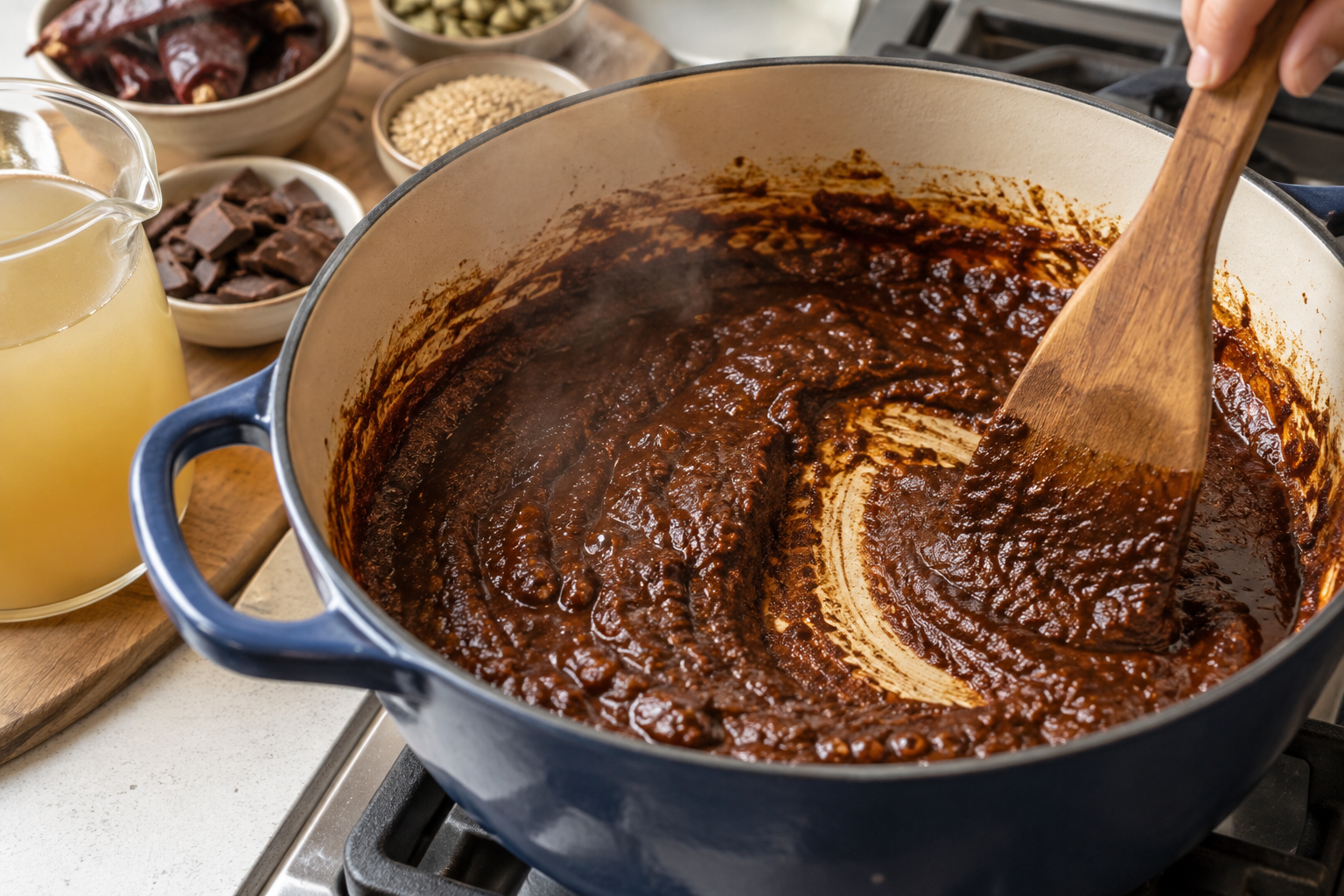
The paste must then be fried. Here the sauce takes on another dimension: raw, separate impressions begin to come together, and the flavour grows rounder. But a thick mixture splatters and readily catches on the bottom. Use a roomy, heavy-based pot and stir with a utensil that reaches the entire base. The sound should be a controlled sizzle, not violent spitting.
Once the stock is added, the final, gentler work begins. The sauce should simmer and be stirred, not boil furiously and be left alone. The finished consistency is full-bodied but pourable: it should coat the meat and spread slowly across the plate. If it becomes too thick, it needs more liquid, not necessarily more fat.
Taste only once the sauce has had time to develop. Salt can lift its fruitiness, a little sugar can smooth sharp edges, and more stock can bring an overconcentrated sauce back into balance. Genuinely burnt ingredients, however, cannot be magicked away with chocolate. That is why care at the beginning matters more than rescue attempts at the end.
Celebration food that calls for more than one pair of hands
Mole poblano still belongs at major occasions: weddings, family celebrations and religious festivals are recurring settings, although customs vary between families and places. It is not simply a dish to order. It can be something people plan for, gather ingredients for and help one another prepare.
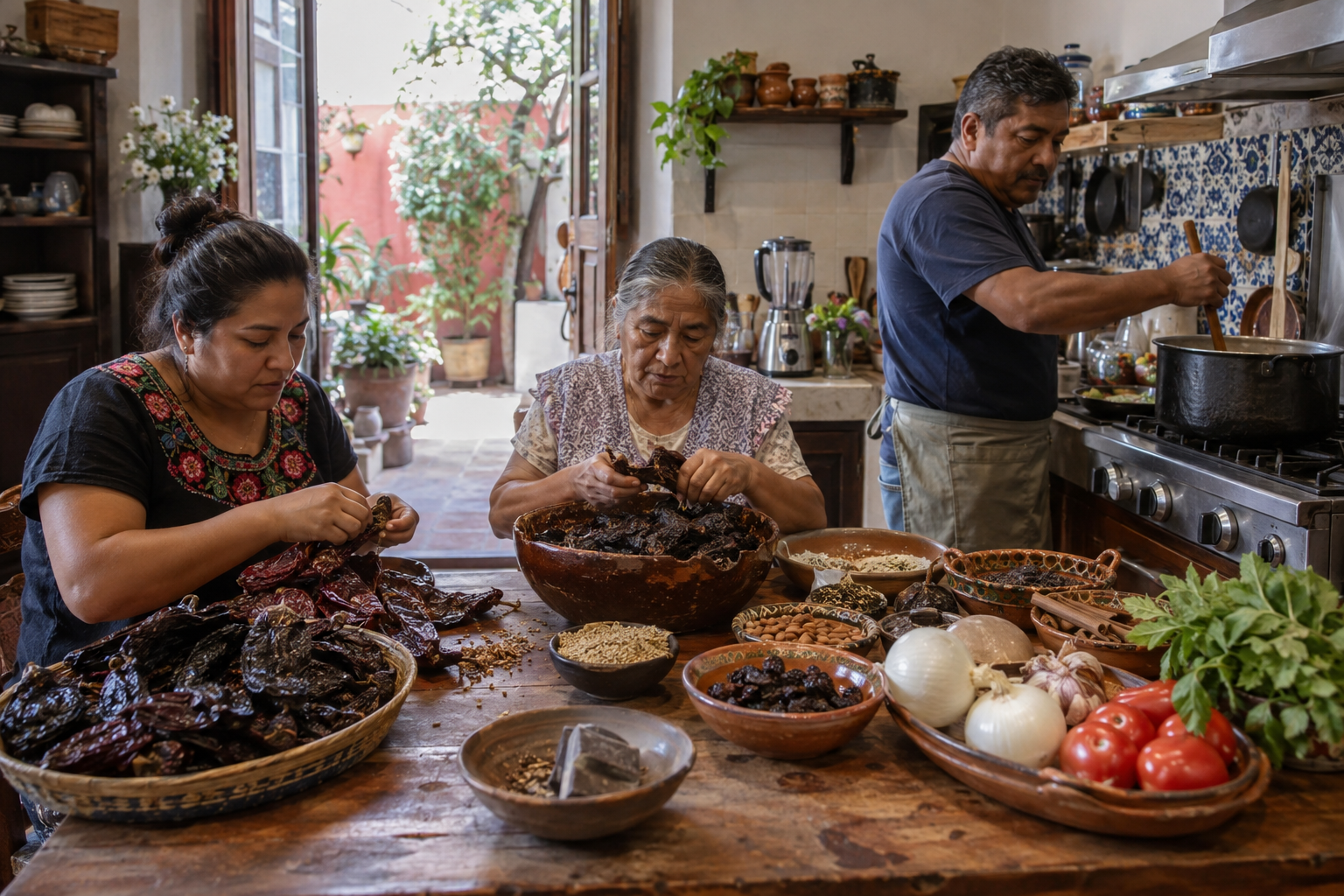
The amount of work partly explains its festive character. If chillies need preparing, ingredients toasting and everything grinding, extra hands are an advantage. But the work is also a way of passing on knowledge. One person knows what the right aroma should be; another knows how much liquid is needed. Such things are difficult to capture in an ingredient list alone.
At the same time, we should not romanticise time-consuming domestic labour. Celebration food has often demanded considerable effort from women, and a long cooking session is not automatically a leisurely or equitable one. Buying a well-made mole paste is therefore not the opposite of culinary tradition. Ready-made pastes and local mills that grind ingredients can make it possible to keep the tradition alive without every household carrying out every stage itself.
Turkey has a long history in Mexico and is closely associated with festive servings of mole. Today, chicken is a common and more readily available alternative. On the plate, the meat can be fairly mild: it leaves room for the sauce’s complexity rather than competing with another powerful marinade.
Rice and warm corn tortillas help complete the meal. The rice catches the sauce, and the tortilla lets you savour the last of it. A light scattering of sesame seeds adds both aroma and a little bite. A whole array of fiery salsas on top is rarely needed, though; mole already has plenty to say.
For drinks, a crisp Mexican lager or a slightly maltier Vienna-style lager works well. Toasted malt meets the sauce’s nuttiness, while moderate bitterness leaves the chillies undisturbed. For those choosing mezcal, a small serving is more suitable than a large glass; high alcohol content can heighten the sensation of heat. The alcohol-free option is just as natural: cool agua de jamaica, whose hibiscus tartness offers a bright contrast to the rich sauce.
From a colonial story to a Swedish kitchen
The recipe below is a modern reconstruction informed by historical sources of the colonial flavour tradition associated with mole poblano, not a transcription of a verified Santa Rosa recipe. The ingredients and method closely follow later documented mole poblano recipes, but the quantities, equipment and serving suggestions have been adapted for four people in a present-day home kitchen.
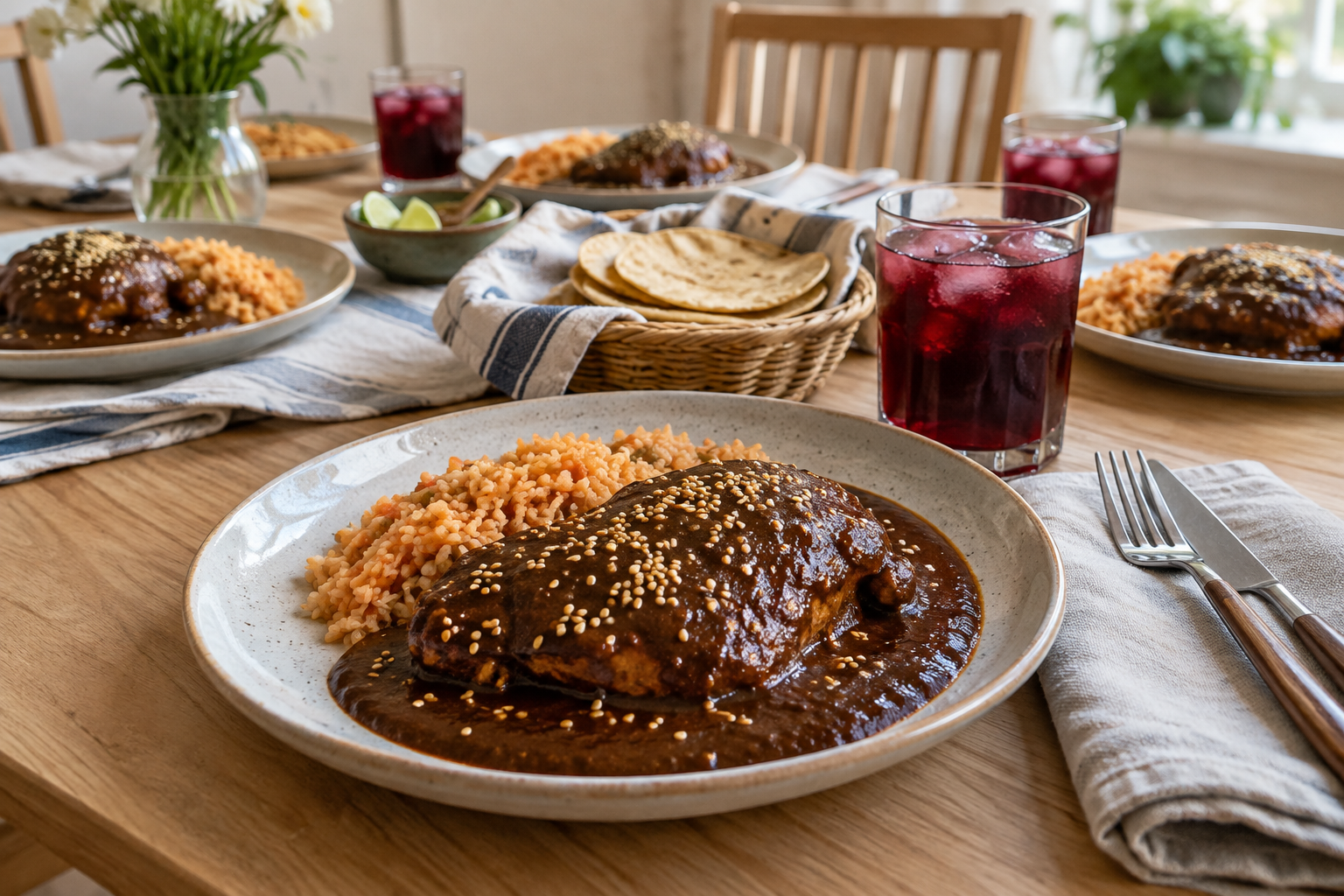
We use chicken thighs because they stand up to gentle cooking and reheating better than lean breast meat. The chicken’s cooking liquid can be used for the sauce, provided it is lightly salted. Shop-bought stock works too, but choose a low-salt version if possible: as the sauce concentrates, so does the salt.
The chillies are the most important ingredients to seek out. If mulato is unavailable, you can use more ancho, but the result will not be exactly the same. Pasilla can also be replaced with ancho as a last resort. Avoid trying to imitate the difference with large amounts of smoked paprika; smokiness is not what defines mole poblano.
It helps to organise the kitchen counter with small bowls before you begin. Keep the prepared chillies separate, the seeds and nuts together, and the spices in their own bowl. That way, you will not be hunting for cinnamon while the sesame seeds darken in the pan. This is a recipe in which preparation buys you calm at the stove.
The easiest approach of all is to make the sauce the day before. It thickens in the fridge and needs thinning carefully when reheated. Cool it quickly in smaller containers, keep it refrigerated and reheat only the amount you plan to serve. It is also an excellent way to make a celebration dinner less demanding once the guests arrive.
When the plates finally reach the table, no one needs to give a lecture on every spice. Let the dark sauce gleam over the chicken, pass the tortillas around and let conversation find its rhythm. But the story is welcome at the table too: not as a certain tale of a single convent miracle, but as a reminder of how many hands, places and generations fit into one spoonful.
Mole poblano with chicken
A modern reconstruction informed by historical sources of mole poblano’s colonial flavour tradition, drawing on later documented recipes – not an authenticated original from Santa Rosa. Three kinds of dried chilli provide the foundation, while seeds, almonds, spices and a little chocolate build body. This recipe makes a generous amount of sauce.
Ingredients
Method
- 1Place the chicken, onion, garlic and salt in a saucepan. Add just enough water to cover the chicken. Bring to the boil, skim and simmer gently, covered, for about 35–45 minutes. Check that the meat reaches at least 74 °C next to the bone, without the thermometer touching the bone. Remove the pan from the heat.
- 2Meanwhile, prepare the chillies: cut them open with scissors and remove the stems, seeds and larger pale membranes. Heat a dry frying pan over a medium heat. Working in batches, press the chillies against the pan with a spatula for around 5–10 seconds per side. Remove as soon as they smell fragrant; they must not blacken or smoke. Place in a bowl, cover with hot water and leave to soften for 20 minutes.
- 3Toast the sesame seeds for both the sauce and serving together in a dry pan for 2–3 minutes, stirring. Set aside 1 tbsp for serving. Toast the almonds separately for 3–5 minutes. Warm the cloves, peppercorns and anise seeds for about 30 seconds, then grind finely in a mortar.
- 4Toast the tortilla and bread in a dry pan until dry and lightly golden, about 2–4 minutes; break into pieces. Heat 1 tbsp of the fat and fry the raisins for 30–60 seconds, just until they swell slightly. Set aside with the bread.
- 5Add another 1 tbsp of fat to the pan. Fry the sliced onion over a medium heat for 7–8 minutes. Add the garlic and fry for 1 minute. Add the tomatoes and simmer for 8–10 minutes, until softened and some of the liquid has evaporated.
- 6Lift out the chicken and strain the cooking liquid. Drain the chillies, discarding their soaking water. Blend the chillies with the tomato mixture, sesame seeds, almonds, raisins, bread, tortilla, ground spices, cinnamon and about 5 dl of the cooking liquid. Work in batches until very smooth, for a total of about 3–5 minutes depending on your blender. Allow hot ingredients to cool slightly and follow the blender’s instructions for hot liquids. Pass through a fine-mesh sieve if the paste is grainy.
- 7Heat the remaining 1 tbsp of fat in a roomy, heavy-based pot over a medium heat. Carefully add the paste, as it may splatter. Fry for 8–10 minutes, stirring almost constantly. Lower the heat if it catches; the aroma should become rounder without the paste burning.
- 8Stir in the remaining 3 dl of cooking liquid a little at a time. Simmer the sauce over a low heat for 25–35 minutes with the lid ajar. Stir frequently, scraping along the bottom. Add the chocolate during the final 10 minutes. Thin with more cooking liquid or water until the sauce is full-bodied but pourable. Season to taste with salt and, if needed, the sugar.
- 9Cook the rice according to the packet instructions. Remove the chicken skin if you wish, then place the meat in the sauce. Heat gently for 10–15 minutes until the chicken is thoroughly hot throughout; if it has cooled, check that it reaches 74 °C again. Stir gently so the meat does not fall apart.
- 10Warm the tortillas in a dry pan for about 20–30 seconds per side and keep warm in a clean tea towel. Serve the chicken with plenty of mole, a scattering of toasted sesame seeds, rice and tortillas.
- If mulato is unavailable, use the same weight of ancho. The flavour will be slightly different. Do not replace all the dried chillies with ordinary chilli powder or fresh chillies.
- Consider making the sauce the day before. Cool quickly in smaller containers and refrigerate at around 4 °C for 3–4 days, or freeze for up to 3 months. Thin when reheating.
- For a plant-based version, use vegetable stock and rapeseed oil, and serve the sauce with oven-roasted cauliflower and cooked beans. This is a modern variation, not the same historical way of serving it.
- The sauce contains sesame, almonds and gluten. For a gluten-free version, replace the wheat bread with the same amount of gluten-free corn tortilla; check the stock and chocolate too.
What goes in the glass
- BeerMexican lager or Vienna-style lagerA crisp lager contrasts with the sauce’s richness. A slightly maltier Vienna-style lager complements the toasted seeds and nuts. Choose moderate bitterness so the chillies do not seem overly sharp.
- SpiritsMezcal joven with restrained smokinessHerbal agave notes and a lightly roasted character can complement the sauce’s spices. For those who drink alcohol, a small serving to sip is enough, with water alongside. High alcohol content can intensify the chilli heat.
- Alcohol-freeAgua de jamaica – chilled hibiscus waterThe bright tartness and berry-like notes of hibiscus cut through the rich sauce. Light sweetening rounds out the acidity without making the drink heavy; serve it cool rather than very sweet.
Enjoy alcohol in moderation. Alcohol-free options go just as well with the food.
Sources
- Diana Kennedy, The Cuisines of Mexico (1972)
- Maricel E. Presilla, Gran Cocina Latina: The Food of Latin America (2012)
- Sophie D. Coe och Michael D. Coe, The True History of Chocolate (1996)
- Jeffrey M. Pilcher, ¡Que vivan los tamales! Food and the Making of Mexican Identity (1998)
- Bernardino de Sahagún och nahuaspråkiga medarbetare, Florentine Codex: General History of the Things of New Spain (1577)
- Sophie D. Coe, America's First Cuisines (1994)
Ask questions about "Mole poblano – far more than the convent’s chocolate sauce". Answers are based on the magazine's own articles.