Moussaka – Greece, Layer by Layer
Aubergine, spiced meat sauce and a golden topping that tells the story of both the eastern Mediterranean and modern Greece.
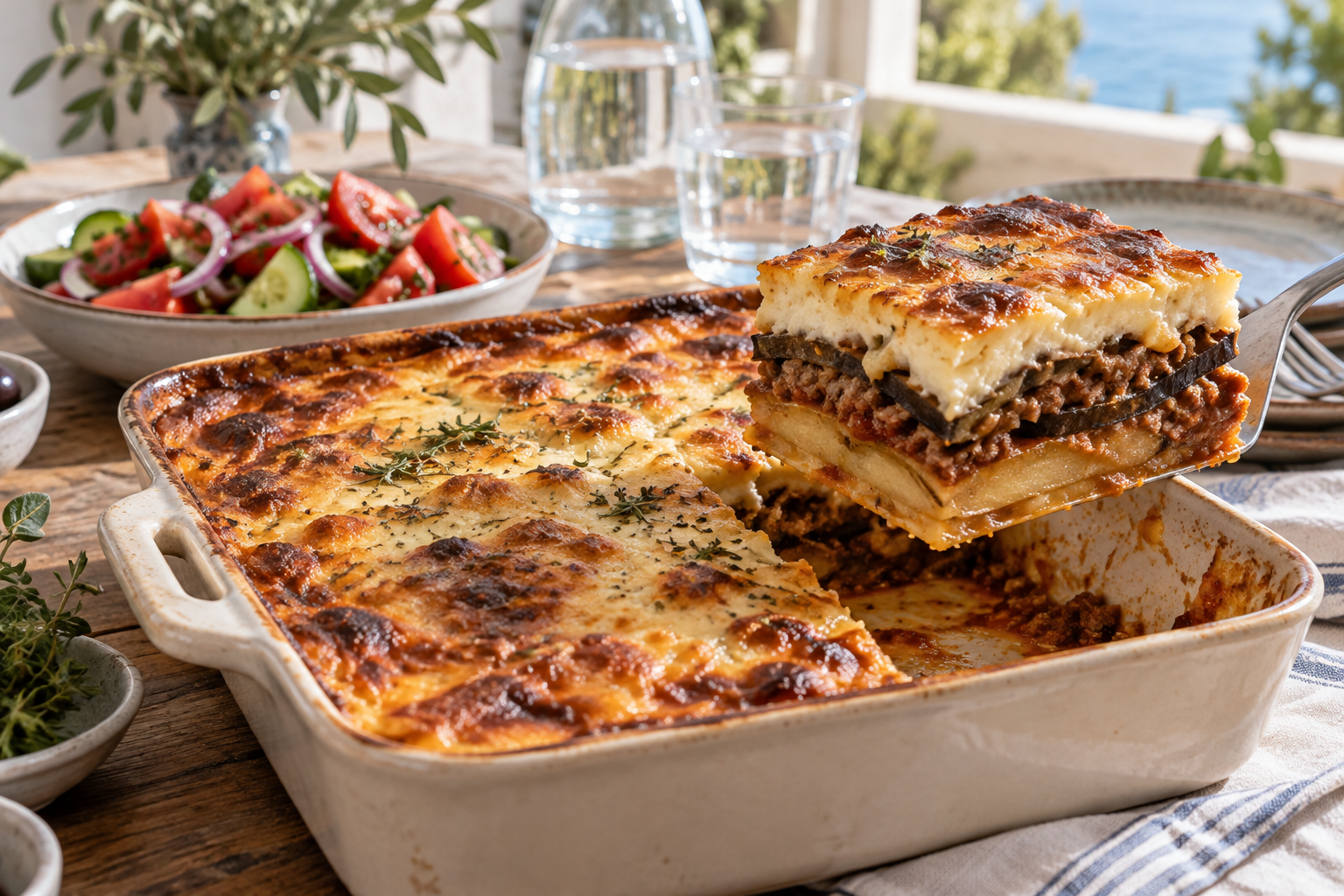
The spoon breaks through the golden crust. Beneath it lie silky béchamel, rich minced lamb and aubergine that almost melts. Moussaka has older eastern relatives and a distinctly modern Greek form – and the secret to making it at home is to give the vegetables, the sauce and the finished dish time.
 By Lina BergFood editor · European and Nordic cuisines – Italy, France, Spain, Greece and Swedish home cooking
Translated from Swedish with AI assistance.
Go to the recipe ↓When the dish comes to the table
First comes the faint sizzling around the edges. Little bubbles of tomato and meat juices push their way up where the pale sauce topping meets the dish. The surface is chestnut brown in places, and the kitchen smells of roasted aubergine, warm milk and a hint of cinnamon. The moussaka looks ready. Yet one of the most important steps remains: leaving it alone.
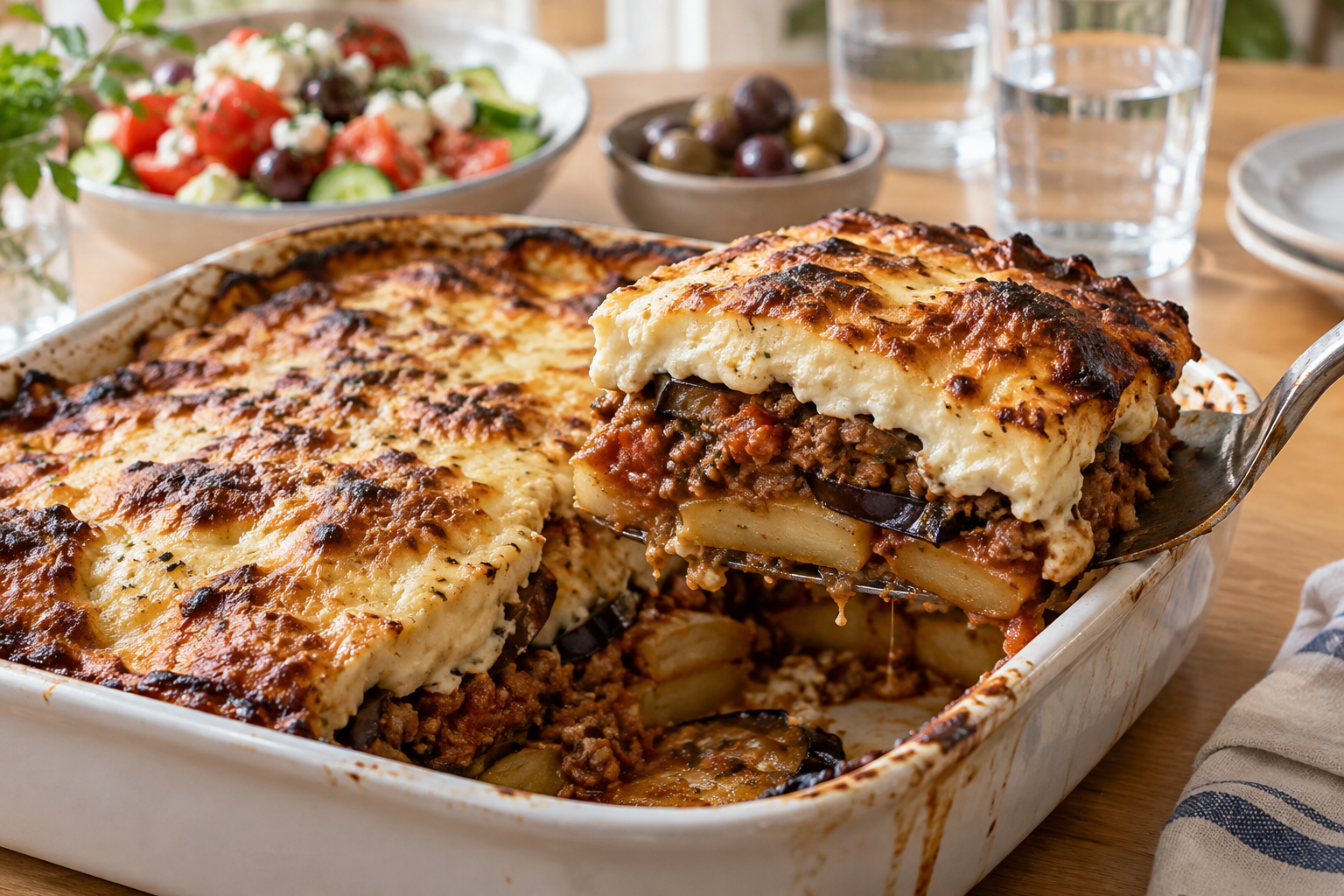
There might be tomatoes, cucumber and a plate of olives on the table. Someone slices bread; someone fetches water. Meanwhile, the dish rests, and what was just a bubbling landscape begins to hold together. When the serving spatula finally cuts down through the layers, a generous portion comes away: creamy and pale on top, reddish-brown meat sauce in the middle, dark-skinned aubergine and perhaps potato at the bottom.
It is easy to see why this particular image has become an international symbol of Greek food. Here are olive oil and vegetables, meat stretched to feed a crowd, and a golden crust that promises Sunday lunch. But the image also simplifies things. Moussaka is not an unchanging inheritance from ancient Greece, and not every dish bearing the name looks like this.
The tall, oven-baked moussaka with its unbroken blanket of béchamel is one of modern Greek cuisine’s most recognisable creations. Beneath that topping lies a wider history, with aubergine dishes and names that have travelled between languages and kitchens across the eastern Mediterranean and the Balkans.
This is where the story becomes truly delicious: not in the search for a single inventor, but in the meeting of a vegetable, a family of dishes and a cook who wanted to change how Greece cooked.
Older than its white topping
Aubergine was first cultivated in Asia and reached Mediterranean kitchens through longstanding connections with the East. It was established in Arab cooking long before today’s Greek moussaka took shape. Medieval Arabic cookbooks reveal a rich repertoire of aubergine dishes, including combinations with meat. That tells us something important about the dish’s culinary background, but it is not the same as evidence for our modern layered bake.
The name moussaka is generally traced back to the Arabic musaqqaʿa, by way of the Turkish musakka, among other languages. The Arabic word is associated with something chilled or served cool. Spellings and explanations vary between languages and reference works. The etymology offers a clue to the history of this family of dishes, not a complete recipe or an exact birthplace.
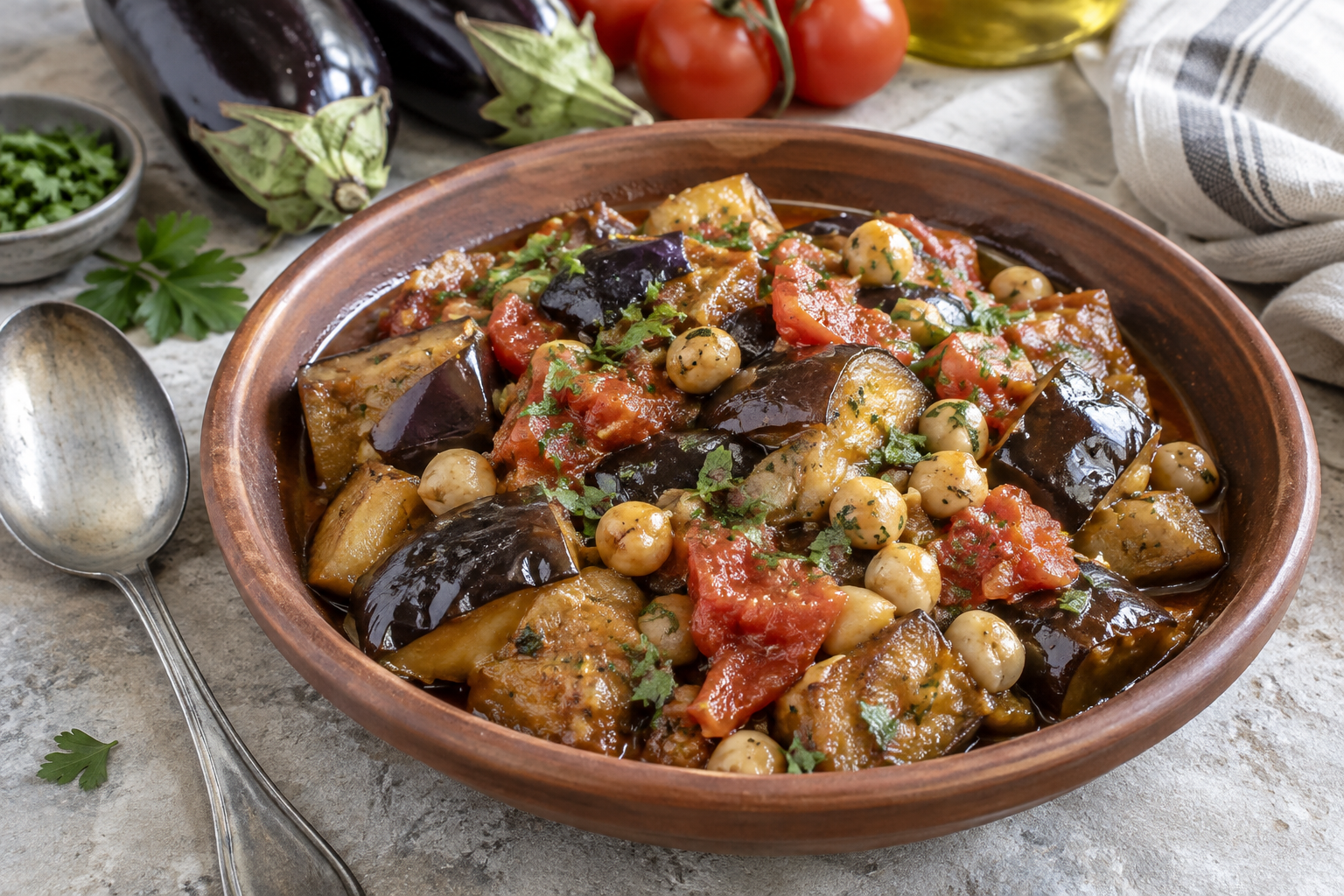
Several eastern Mediterranean cuisines have closely related names for aubergine dishes without béchamel. Levantine versions may consist of aubergine, tomato and chickpeas, sometimes served at room temperature. Turkish musakka is often a dish of aubergine and minced meat cooked without the thick white topping. In the Balkans, there are moussakas in which potato takes the leading role, sometimes finished with an egg and yoghurt mixture.
These are not incomplete versions of a Greek standard. They are dishes in their own right, with traditions of their own. Shared names and ingredients tell a story of proximity, trade, migration and the Ottoman Empire’s long presence in the region. They do not, however, prove that every version can be placed along a single, straight line of development.
That is precisely why we should be wary of accounts claiming that a particular medieval recipe is moussaka’s undisputed original. Similarities exist, but the route from an older aubergine dish to today’s Greek oven bake is not documented at every stage. What is certain is the broader kinship: aubergine, meat or pulses, tomato in later versions, and a name found far beyond Greece’s borders.
The tomato is another reminder that traditions have a timeline. It reached Europe only after contact with the Americas and became an important ingredient in many Mediterranean cuisines considerably later. Not even the reddest, most seemingly inevitable tomato sauce is timeless. Moussaka has emerged through change, not by standing still.
Tselementes and modern moussaka
When Nikolaos Tselementes enters the story, we are in the early 20th century. The Greek chef and cookbook author had experience of international hotel and restaurant cooking and became a hugely influential advocate of a more structured, middle-class cuisine. In 1910, he began publishing the food periodical Odigos Mageirikis, roughly translated as Cooking Guide.
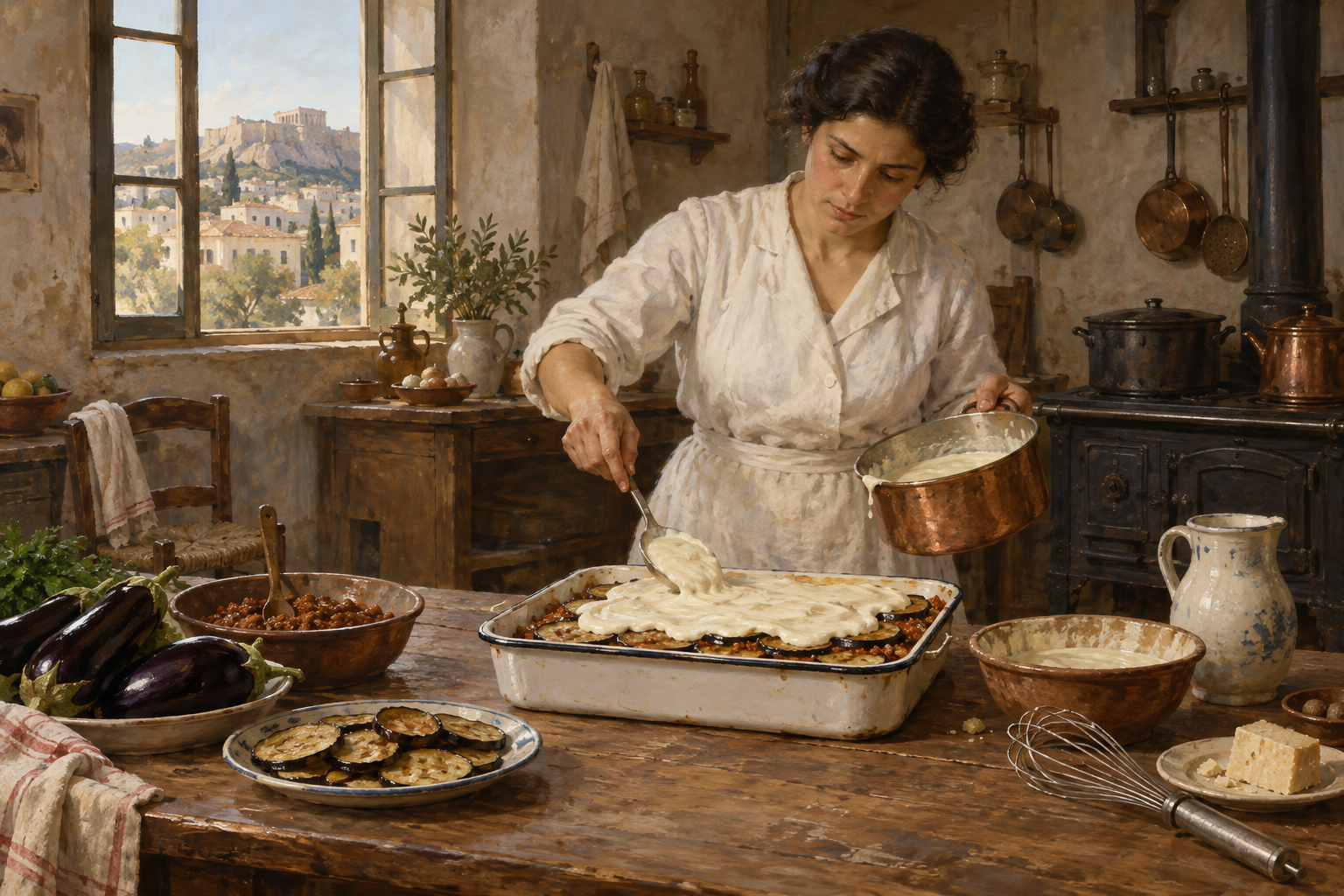
His name became so closely associated with recipes and home cooking that in Greece it has also been used as an everyday word for a cookbook. That is a measure of his influence, but it does not, of course, mean that he single-handedly created Greek home cooking. It already existed, in many regional and social forms.
Tselementes looked to French and other western European techniques as models. Thickened sauces, more precise recipe instructions and a certain restaurant-style order all had a place in his ideal. In retrospect, this has also been criticised for favouring European prestige over parts of Greece’s eastern and Ottoman culinary heritage.
It is above all with him that the establishment of béchamel-topped moussaka is usually associated. During the first decades of the 20th century, with the 1910s and 1920s central to his early influence, such international techniques became part of a new Greek cookbook repertoire. But the exact year in which he first put béchamel on moussaka is less firmly documented than the simplified inventor story often suggests.
The reasonable way to put it, then, is that Tselementes is generally credited with a decisive role in shaping and popularising the modern Greek version. He invented neither the pairing of aubergine and meat nor the entire family of dishes. The innovation lay in how an already familiar kind of food was reworked and given authority through modern cookbook cooking.
And the béchamel really did make a difference. It added height, mildness and a surface that could brown in the oven. Against the aubergine’s oil-rich tenderness and the concentrated meat sauce came the sweetness of milk and the saltiness of cheese. When the sauce is also enriched with eggs, as in many Greek recipes, it gains a firmness that allows the moussaka to be cut into generous portions.
Today, it is almost impossible to imagine the dish’s international identity without that topping. What was once a modernisation has become a tradition.
The aubergine needs to be tender, not just brown
A really good moussaka does not begin with the mince. It begins with the aubergine. The slices should be cooked so thoroughly that the flesh yields without resistance, while still holding together as the dish is assembled. A lovely browned surface around a firm, almost spongy centre is not enough. The aubergine should not need rescuing by its time beneath the béchamel.
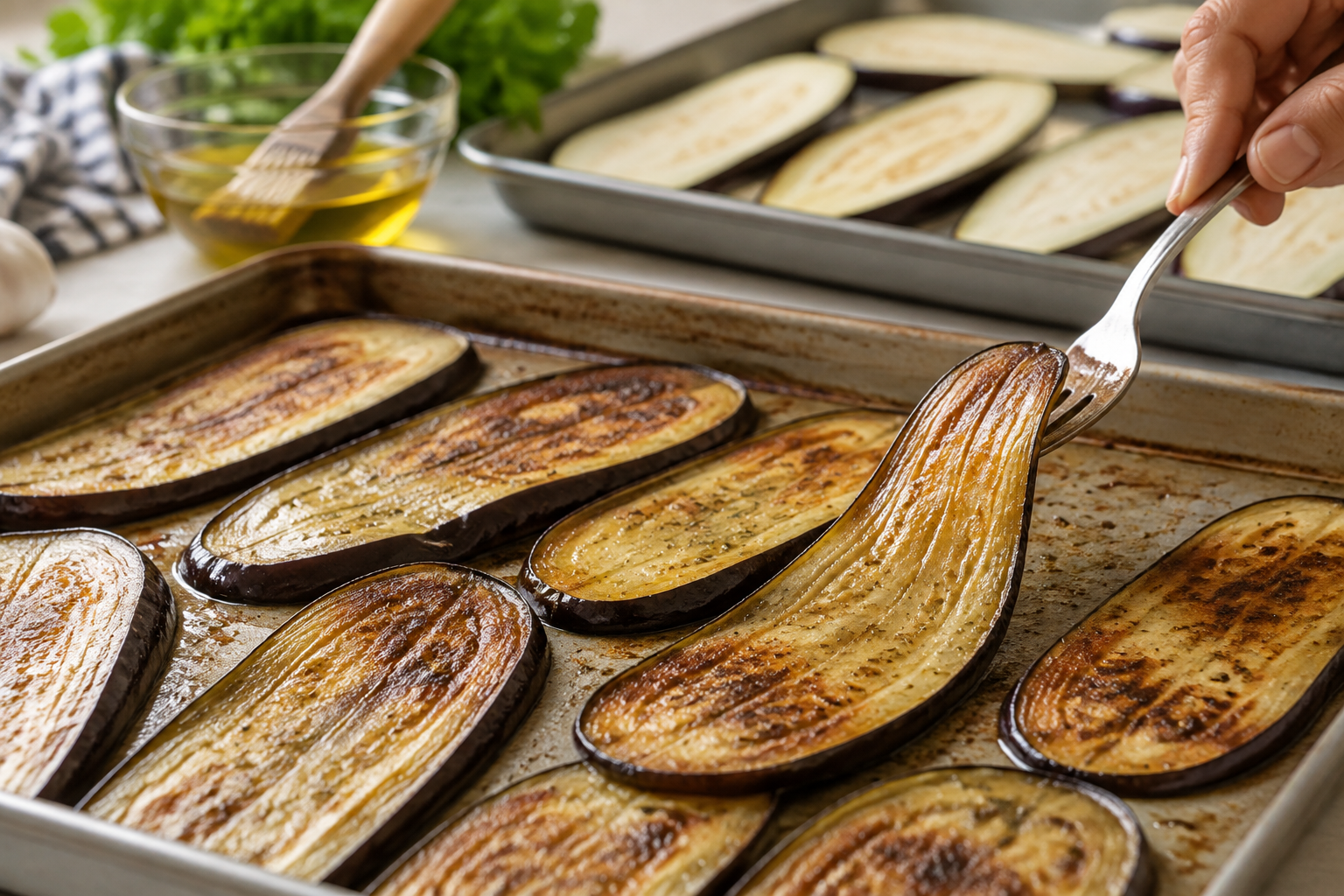
Traditionally, it is often fried in oil. This gives it plenty of flavour and a rich, almost silky texture, but aubergine can absorb a surprising amount of fat. At home, oven-roasting is a reliable alternative. Brush the slices on both sides, spread them out with room around them and roast until tender and well browned. This is a practical adaptation, not a claim that every Greek kitchen does it the same way.
Choose aubergines that feel firm and relatively heavy, with taut skins. Slice them evenly; uneven slices mean both dry edges and undercooked patches on the same tray. If the tray is too crowded, the result will be more steamed than roasted. Two trays are better than a thick heap, and in a fan oven they often need swapping around for even browning.
Salting before cooking is a much-debated step. Modern aubergines are generally not bitter enough to require salting for that reason. Salt can, however, draw out some moisture and affect the texture. In this recipe, we skip a separate salting stage and focus instead on even slices, a controlled amount of oil and sufficient roasting. If you usually salt your slices, you can continue to do so, but dry them thoroughly before cooking.
Potato also divides the moussaka camp. Many Greek versions have a bottom layer of it; others let aubergine stand alone. Potato provides structure and a mild base that absorbs meat juices and spices. It also makes the dish go further without feeling like filler. Here, it earns its place, thinly sliced and pre-baked so that no hard centre lurks at the bottom of the dish.
There are also Greek versions with courgette or a mixture of vegetables. Differences run between regions, households and seasons; it is wiser to ask how a particular family makes it than to speak of a single correct Greek construction. The common aim is balance. The vegetables should underpin the dish, not disappear beneath meat and sauce.
The depth of the meat sauce and the calm of béchamel
Minced lamb gives moussaka a distinctive, warm meatiness that goes especially well with aubergine. But minced beef is also common in Greek recipes. Lamb is a delicious choice, then, not a test of authenticity. For anyone who finds lamb overpowering, a mixture of lamb and beef can be a good middle ground.
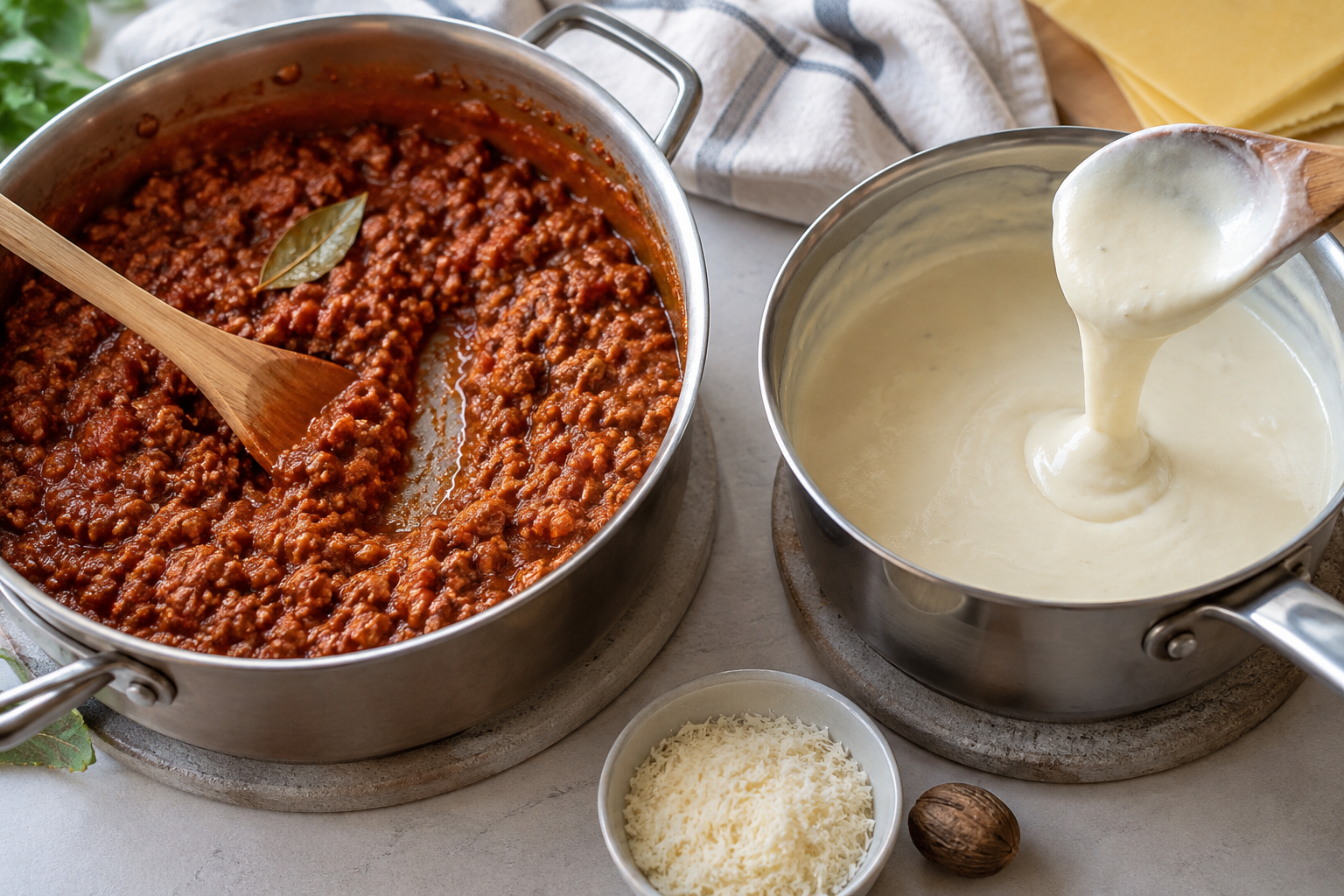
Brown the mince so that it genuinely takes on colour. An overcrowded pan cools down, the meat releases its juices and the mince boils grey. Better to work in batches. As the onion then softens and the tomato purée cooks, the aroma changes: first sweet onion, then deeper tomato notes and finally the warmth of the spices.
Cinnamon belongs in many moussaka recipes, but the quantity matters. It should not make dinner smell like a cinnamon bun. Think of a low, warm note behind the tomato and meat. Allspice also appears, as do bay leaves, while other households keep the seasoning simpler. Here, cinnamon, bay and black pepper are enough; the nutmeg in the béchamel has a little space of its own.
The tomato should bring acidity and pull everything together, not turn the meat layer into soup. Let the sauce simmer uncovered until noticeably concentrated. When you draw a spoon through it, the trail should remain visible for a moment, with no thin liquid immediately gathering around the edges. A wet meat sauce is one of the most common reasons a moussaka falls apart.
The béchamel has the opposite role. It should be mild, smooth and thick enough to sit like a blanket. First cook the butter and flour together, then whisk in the milk gradually. The important thing is not to work quickly but to make each addition smooth before adding the next. The sauce also needs to simmer for a while, otherwise a floury taste may linger.
Strictly speaking, a plain béchamel is a sauce of butter, flour and milk. With cheese and eggs added, this becomes an enriched version, adapted for moussaka’s browned topping. Take the pan off the heat and let the sauce cool slightly before stirring in the eggs. This reduces the risk of them setting into little strands rather than blending in evenly.
Kefalotyri brings a fitting saltiness and mature flavour. It can sometimes be found in Greek shops or well-stocked delicatessens. In an everyday Swedish kitchen, parmesan, or a mixture of parmesan and mature prästost, makes a good substitute. The flavour will not be identical, but the purpose is the same: saltiness, richness and a surface that browns. Taste the sauce after adding the cheese before adding more salt.
Family food worth making room for
In many places, moussaka is both home cooking and taverna food. It can be served as a generous lunch or dinner, often with salad rather than additional hot side dishes. It is also more labour-intensive than its reputation as a simple bake suggests. Vegetables, meat sauce and béchamel must each be cooked separately before they meet in the oven.
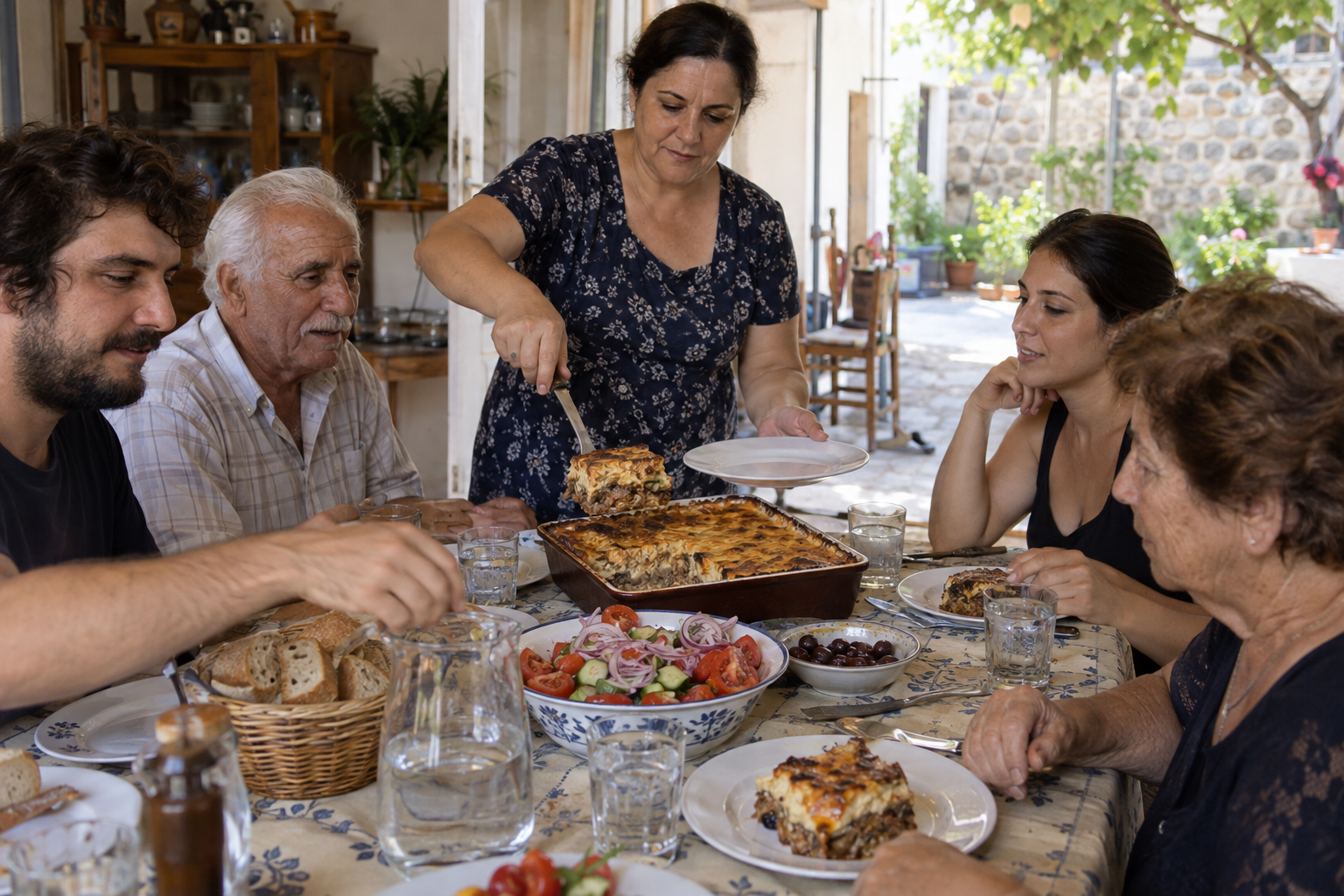
This makes it especially suited to days when there are several people to feed and the work can be shared. One person slices vegetables, another stirs the saucepan, and the dish can be prepared in stages. Family food does not necessarily mean fast food. Sometimes it means a substantial effort that provides dinner for a crowd and delicious leftovers for the next day.
Serving temperature is part of the experience. Straight from the oven, the sauce is looser and the heat can obscure the subtler flavours. After half an hour’s rest, the moussaka is still warm, but the aubergine, cinnamon and milk sauce are easier to distinguish. A firm portion is therefore about both appearance and flavour. That said, the resting time should not turn into several hours sitting on the kitchen counter.
Something fresh and crisp is welcome alongside this soft, rich food. Tomato, cucumber and thinly sliced red onion with olive oil and vinegar go a long way. There is no need for a large helping of feta on the side when the main dish already has a cheese-flavoured topping. Let the salad provide that bright contrast.
For wine drinkers, Agiorgitiko, particularly from Nemea in the Peloponnese, is a natural direction to take. Look for a fruity style with restrained oak: the fruit meets the tomato, and the gentle spice works with the cinnamon. Xinomavro often offers more acidity and tannin. A mature, less austere style may suit the dish’s roasted, meaty flavours better than a very young, astringent one.
Alcohol-free drinks do not need to imitate wine. Pomegranate with sparkling water and a small splash of lemon provides acidity and fruit without heaviness, especially if the juice is unsweetened and well diluted. Plain cool water is also excellent with a dish that already offers so many layers.
Making it work at home
In a Swedish home kitchen, the best strategy is to divide the work into stages. The meat sauce can be made the day before, and the vegetables can be roasted ahead of time. If so, cool the components quickly in shallow containers and keep them covered in the fridge. Béchamel is easiest to spread when freshly made and still warm.
Choose a dish with enough depth. One that is too wide produces thin layers and risks drying out the food; one that is too small may overflow before the centre is properly hot. The dimensions in the recipe are therefore a practical guide, not a detail to skip. It is a good idea to put the dish on a baking tray to catch any drips.
Three checks make more difference than a long list of refinements. The aubergine should already be tender before it goes into the dish. The meat sauce should be concentrated, with no excess liquid. The béchamel should be thick but spreadable. When those three components are properly cooked, the oven’s main job is to bring them together, heat them through and brown the top.
Do not rely on the colour of the top alone. If the dish is assembled with fridge-cold components, the surface may brown before the centre is hot. In that case, cover loosely with foil and continue baking. Finally, give the moussaka its rest. Put out the salad, fill the water glasses and let the kitchen smell wonderful a little longer. The reward is not just neater layers, but a dish in which every element has a voice without drowning out the others.
Moussaka with minced lamb, aubergine and béchamel
A modern Greek moussaka with a potato base, oven-roasted aubergine and an egg-enriched cheese béchamel. This recipe is adapted for the home kitchen, not a reconstruction of Tselementes’ original. Makes four generous portions. The cooking time allows for working in batches and on several components at once; allow an additional 30 minutes of resting time after baking.
Ingredients
Method
- 1Heat the oven to 220 °C fan. Have ready an ovenproof dish approximately 20 × 28 cm and at least 6 cm deep. Slice the aubergine lengthways into slices about 8 mm thick. Peel the potatoes and cut into slices 4–5 mm thick.
- 2Arrange the aubergine on two baking trays lined with baking paper. Brush both sides with 3 tbsp olive oil and sprinkle with 0.5 tsp salt. Roast for 25–30 minutes, until tender and browned. Turn the slices and swap the trays halfway through. Set aside.
- 3Toss the potatoes with the remaining 1 tbsp olive oil and 0.25 tsp salt. Spread out on a baking tray and roast at the same temperature for 15–20 minutes, until almost completely tender. Then reduce the oven to 190 °C conventional heat.
- 4Make the meat sauce while the vegetables roast. Heat a large frying pan and brown the mince in two batches, about 4–5 minutes per batch. Use a little of the oil for the sauce if needed. Transfer the mince to a plate. Leave a little fat in the pan, but spoon off any substantial excess.
- 5Add the remaining oil for the sauce and cook the onion over a medium heat for 6–8 minutes. Add the garlic and tomato purée and cook for another 1–2 minutes. Return the mince to the pan and add the tomatoes, water, cinnamon, bay leaf, salt and pepper.
- 6Simmer the meat sauce uncovered for 25–35 minutes, stirring occasionally. It should become thick and leave no pool of liquid when pushed to one side. Remove the bay leaf, taste and adjust the seasoning, then set aside.
- 7For the béchamel, melt the butter in a saucepan over a medium heat. Whisk in the flour and cook for 1–2 minutes without letting it colour. Add the milk a little at a time, whisking as you go. Simmer gently for 5–7 minutes, stirring, until smooth and thick.
- 8Take the pan off the heat. Stir in 50 g of the cheese, the nutmeg and pepper. Leave to cool for about 5 minutes. Beat the eggs in a bowl, mix them with a couple of spoonfuls of warm sauce, then whisk the mixture into the saucepan. Season to taste with salt. Do not boil the sauce after adding the eggs.
- 9Arrange the potatoes in the bottom of the dish, overlapping them slightly. Cover with half the aubergine, spread over all the meat sauce and add the remaining aubergine. Spread the béchamel evenly over the top and sprinkle with the remaining 25 g cheese.
- 10Bake in the lower part of the oven for 40–50 minutes, until golden brown on top and bubbling around the edges. The centre should be thoroughly hot. Cover loosely with foil if the top browns too quickly; fridge-cold components may need longer.
- 11Let the moussaka rest for 30 minutes before serving. Cut into four portions and lift out with a wide spatula. Serve with a fresh tomato and cucumber salad, if you like.
- Without a fan oven: roast the vegetables at 225 °C conventional heat, preferably one tray at a time. This will extend the cooking time.
- Prepare the meat sauce and roasted vegetables the day before. Cool quickly in shallow containers and store covered at about 4 °C. Ideally, make the béchamel when assembling the dish.
- Vegetarian alternative: replace the mince with 400 g finely chopped mushrooms and 300 g cooked, well-drained green lentils. First cook off the moisture from the mushrooms, then reduce the sauce until as concentrated as the meat version.
- Divide leftovers into smaller portions and cool quickly. Store in the fridge for 3–4 days or freeze. Reheat until thoroughly hot, including in the centre.
What goes in the glass
- WineAgiorgitiko from NemeaA fruity, medium-bodied style with restrained oak complements the minced lamb and tomato without overwhelming the aubergine. The wine’s gentle spice suits the dish’s subtle cinnamon.
- WineXinomavro with some bottle ageThe grape’s often pronounced acidity provides a contrast to the béchamel and olive oil. Choose a mature, less austere style so the tannins do not overwhelm the mild vegetable flavours.
- Alcohol-freePomegranate spritz with lemonMix one part unsweetened pomegranate juice with two to three parts sparkling water and a little lemon. Fruit and acidity lighten the rich food without making the drink too sweet.
Enjoy alcohol in moderation. Alcohol-free options go just as well with the food.
Sources
- Alan Davidson; redigerad av Tom Jaine, The Oxford Companion to Food, tredje upplagan (2014)
- Aglaia Kremezi, The Foods of Greece (1993)
- Vefa Alexiadou, Vefa's Kitchen (2009)
- Maxime Rodinson, A. J. Arberry och Charles Perry, Medieval Arab Cookery (2001)
Ask questions about "Moussaka – Greece, Layer by Layer". Answers are based on the magazine's own articles.