The Nobel Dinner of 1901 – a Table for Gentlemen Only
At Grand Hôtel, a tradition was born, with a French accent, ceremonial toasts and a clear boundary around who could take part.
On 10 December 1901, 113 men gathered for the first Nobel banquet in Stockholm. It was smaller than today’s lavish celebration, but far from modest. We step into a world where dinner expressed both science’s faith in the future and the social order of the day – and borrow a classic clear broth for our own table.
 By Arvid HolmFood historian · Historic dishes, old cookbooks and eating habits through the ages
Translated from Swedish with AI assistance.
Go to the recipe ↓A brightly lit hotel in the December darkness
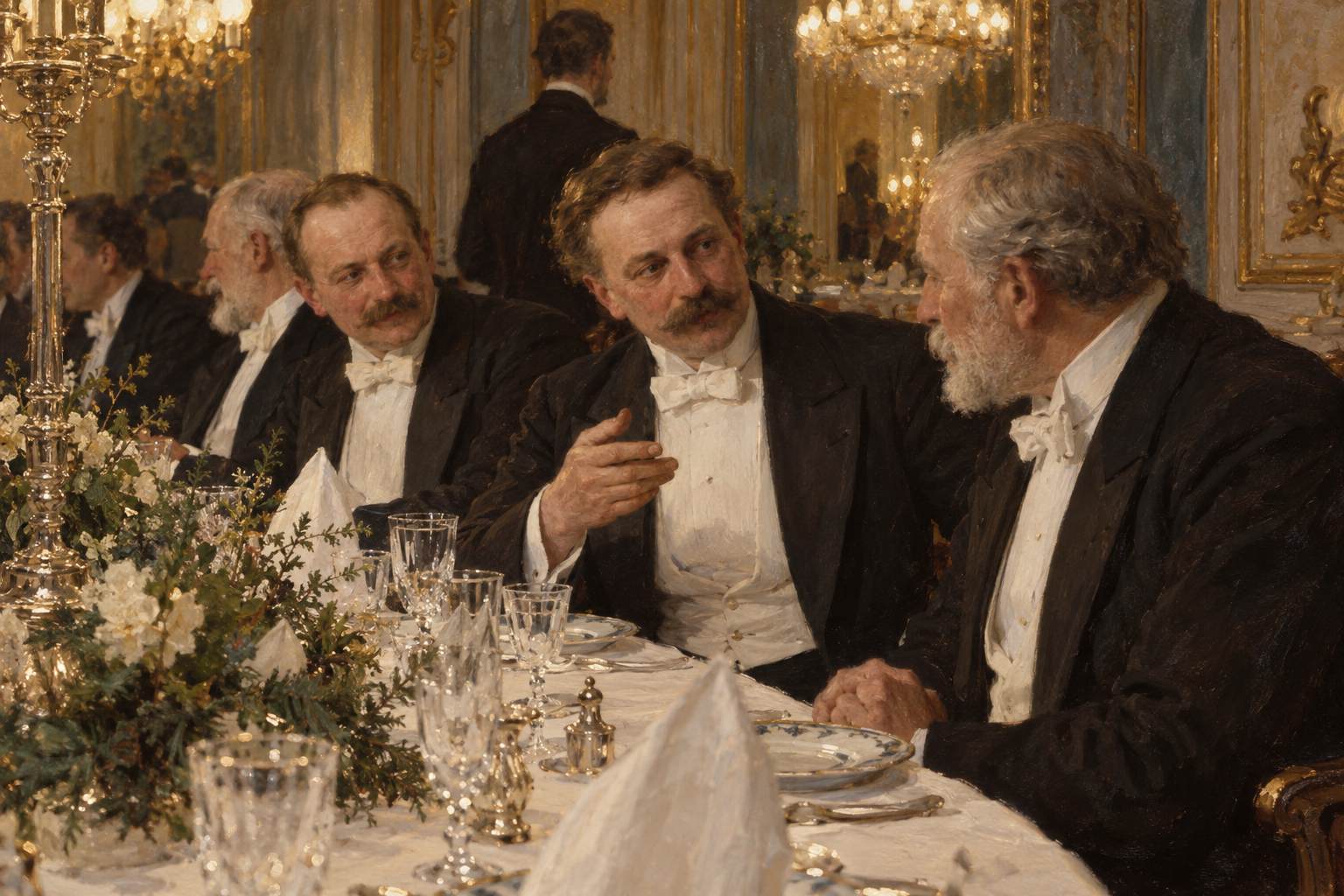
Outside Grand Hôtel, the December evening settles over Stockholm’s central waterway. Inside, a banquet table awaits: glasses catching the light, cutlery in neat rows and napkins not yet unfolded. Imagine the murmur as guests find their places, chairs are drawn back and the waiting staff begin moving between the tables. On 10 December 1901, the first Nobel banquet takes place. According to the Nobel organisation’s historical account, 113 guests attend, all of them men.
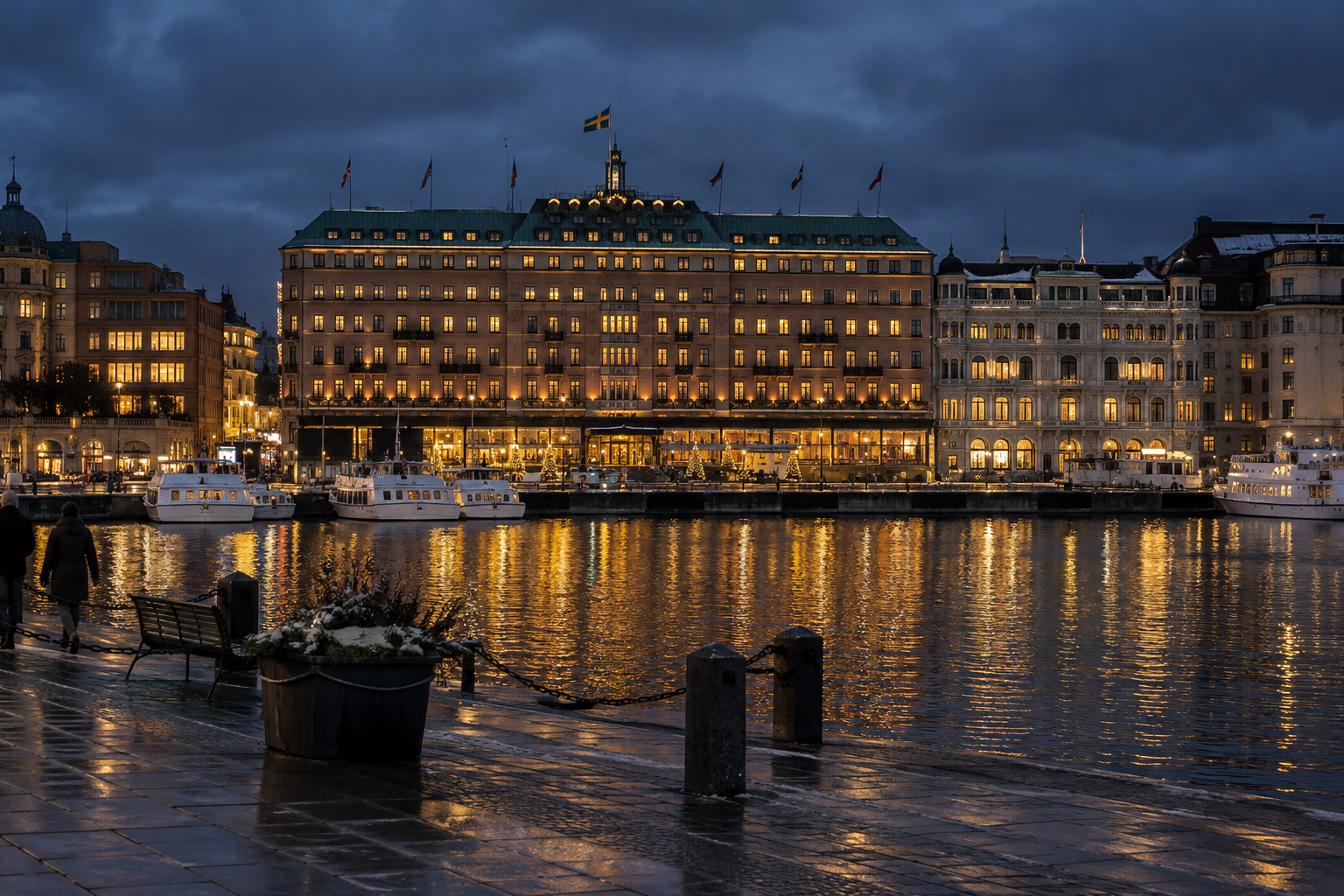
This is a scene to imagine, not a reproduced eyewitness account. The date, the hotel, the number of guests and the all-male gathering, however, are documented. That distinction matters: a historical dinner table can be brought to life without inventing what someone said or how a particular sauce smelled.
There is as yet no long Nobel tradition to draw on. No memories of earlier banquets, no decades of televised desserts. The guests are taking part in something new, but the format is familiar: the formal European gentlemen’s dinner, where food, speeches and hierarchy together give the evening its significance. The international prestige of science and literature finds expression in a language Stockholm’s hotel world already knows well.
And absence speaks as clearly as presence. Women contribute to intellectual life, literature and the working world. But at this particular banquet table, they have no place as guests.
A new prize in an old social setting
In his will of 1895, Alfred Nobel had set aside most of his fortune for prizes recognising achievements that had benefited humanity. He died on 10 December 1896. Five years later, the first prizes were awarded on the anniversary of his death. Getting there had required legal and organisational work; the Nobel Foundation was established in 1900. The dinner was therefore not the beginning of the idea, but a public expression of the fact that it had now become reality.
The first prize categories were physics, chemistry, physiology or medicine, literature and peace. The economics prize belongs to a much later chapter and did not exist when this table was first set. From the outset, the Peace Prize was awarded in Norway, while the other prize ceremonies took place in Stockholm. The Nobel tradition thus had two geographical centres, something easily overlooked when the whole story is focused on a single magnificent dinner.
Grand Hôtel was a natural setting for the Swedish celebration: a grand, internationally minded hotel where official entertaining was part of the business. Eating together was not merely a decorative finale once the important business was done. The banquet gave the awards a visible place in society. A prize could be described in a document; at dinner, it took tangible form through attendance, seating arrangements, service and ceremonial speeches.
Yet the international ideal operated within a restricted social framework. Here, the notion of human progress met a culture of official entertaining in which men were treated as the natural representatives of institutions and public authority. This does not diminish the significance of the prizes. It does, however, make the dinner more interesting than simply a beautiful picture of how it all began.
Gentlemen only – but not the whole story of women
The statement that all 113 guests were men needs to be read carefully. It describes the guest party. It does not say that everyone working on the dinner was a man, nor does it give us licence to invent which women might have been working in the hotel’s kitchens, laundry or dining rooms that evening. The guest list and the workforce are different historical questions, requiring different sources.
It is also risky to explain everything through a single explicit rule. An all-male dinner could result from invitation practices, the make-up of institutions and the social conventions of the time. Without specific evidence, we should not turn the outcome into a claim that there was a formal, general Nobel rule excluding women. What we can say with certainty is that the first banquet’s circle of honoured guests was male.
The contrast with Alfred Nobel’s will is worth considering. It states that the laureates’ nationality should not determine the choice. There is no corresponding requirement that the recipient be a man. As early as 1903, Marie Curie became the first female Nobel laureate when she shared the Physics Prize with Pierre Curie and Henri Becquerel. That does not mean women suddenly enjoyed equal access to research or academic power, only that the history of the prize soon extended beyond the company at its inaugural dinner.
For anyone reading about meals of the past, this is a useful reminder: do not ask only what was on the plate. Ask who was allowed to sit down, who could speak and whose work made the celebration possible. A banquet tells us as much through its seating plan as through its menu.
French taste as an international language
At formal European dining tables around the turn of the century, French cuisine held a powerful position. French dish names and culinary terminology served as a shared language in ambitious hotels, including those outside France. This did not necessarily mean that all the ingredients were French. Rather, local and imported ingredients were organised within a prestigious system of sauces, stocks, garnishes and sequences of courses.
The 1901 menu published by the Nobel organisation is the relevant primary source for what was actually listed for the inaugural banquet. But a printed menu is not a complete kitchen record. It does not automatically tell us what proportions the chef used, how hot the food was when it reached the guest or how much each person ate. We should therefore not pretend that a modern recipe becomes the original simply because it is given a French name.
To understand the technical world of the kitchen, we can turn to Auguste Escoffier’s Le Guide culinaire, published in 1903. Close in date to the banquet, it sets out much of the system behind classical restaurant cooking. It does not, however, prove how Grand Hôtel’s chefs cooked two years earlier. The distinction between period context and direct evidence may look small on paper, but it is crucial when writing history.
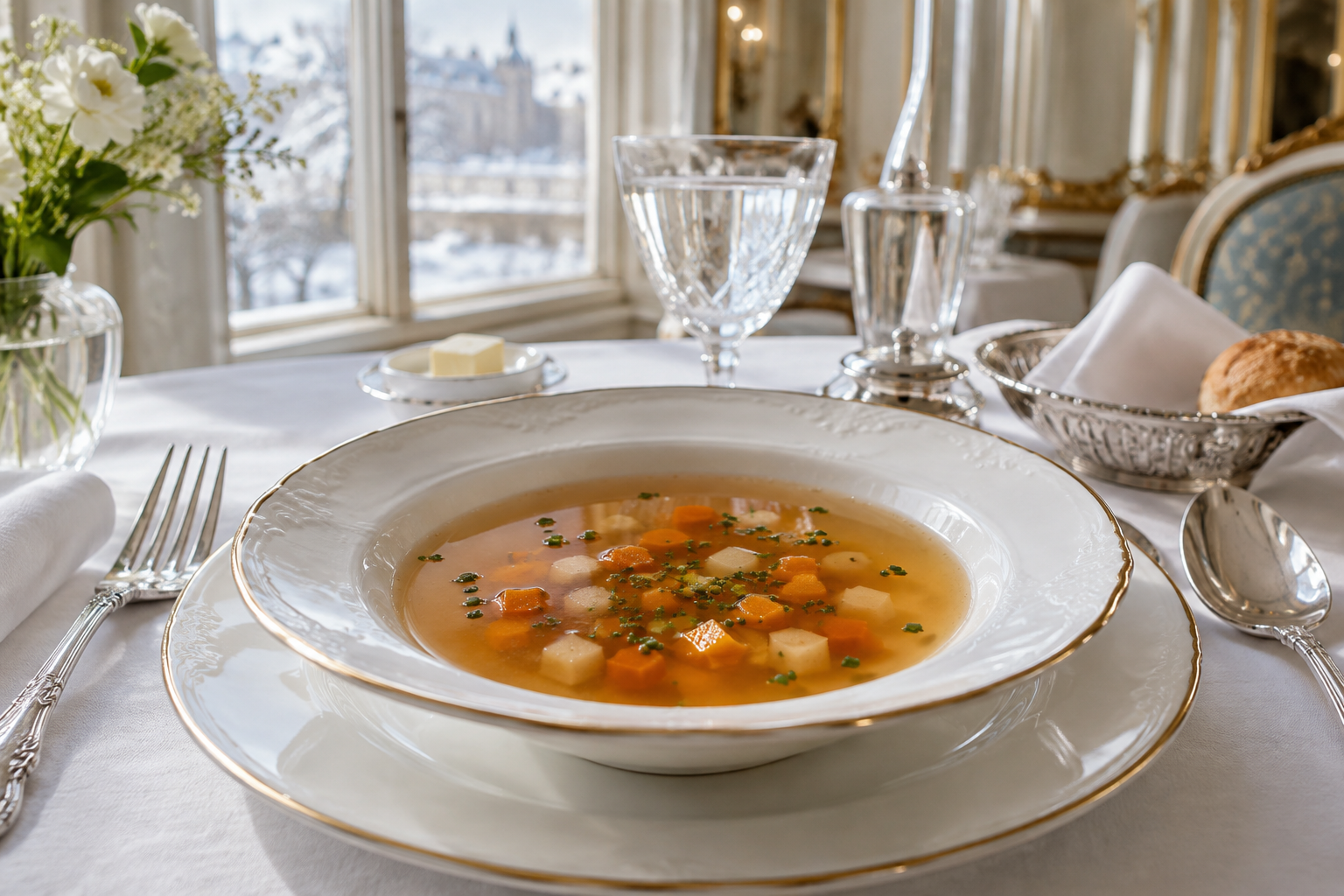
A clear consommé is a good way to encounter this world of flavour at home. It looks almost restrained: a transparent broth, perhaps with a small, meticulously cut garnish. Yet both ingredients and effort lie behind it. The flavour should be deep without becoming heavy, the liquid clear without being thin. Where a rustic stew readily shows its component parts, consommé demonstrates how the kitchen can concentrate and refine them.
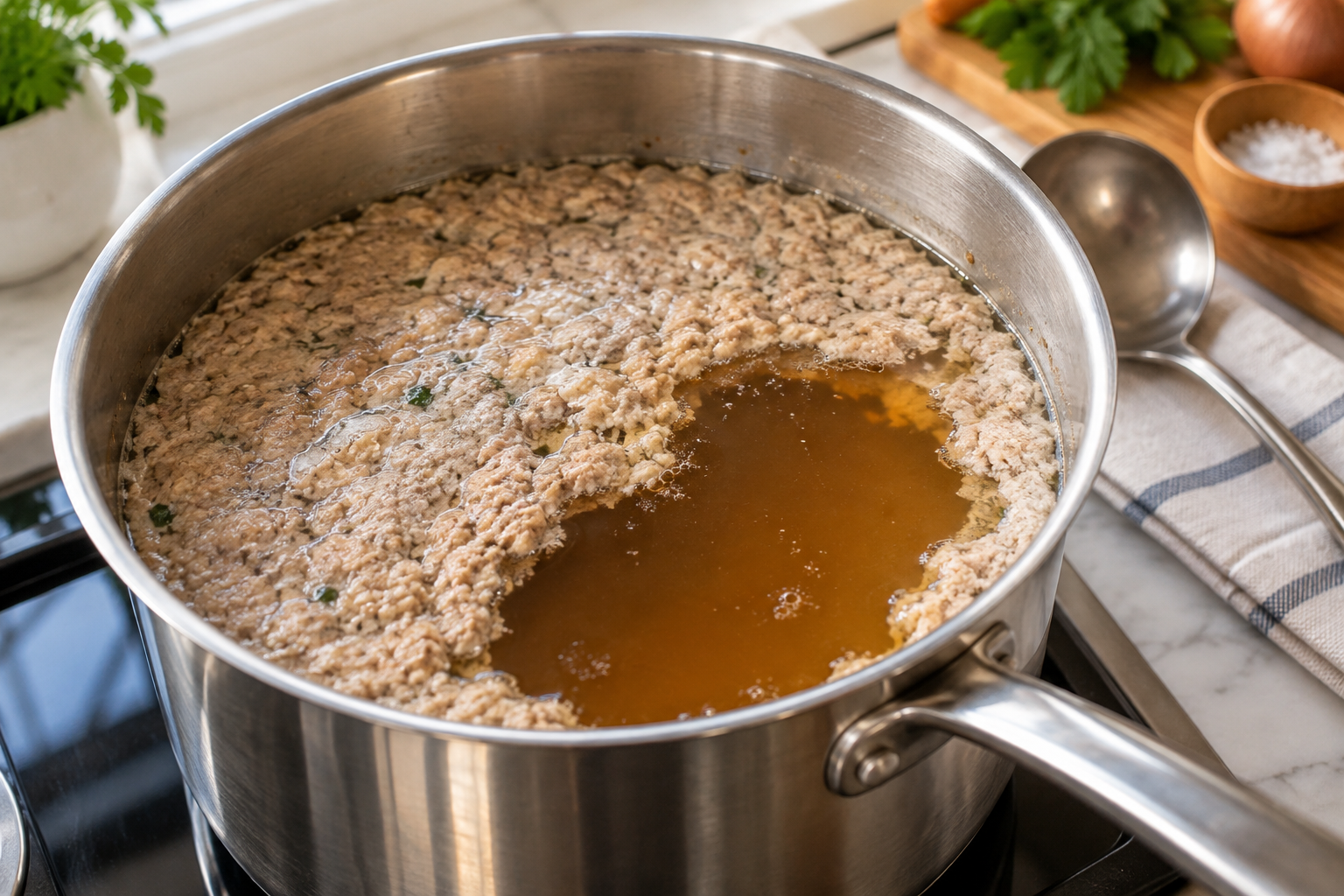
Clarification is where the transformation happens. Egg white and lean meat are mixed with cold stock and heated gently. The proteins coagulate, helping to gather particles into a cohesive raft. If the pan boils vigorously, the raft can break apart and the liquid turn cloudy again. You can almost hear when something goes wrong: the quiet simmer becomes a noisy boil. Here, patience is a more useful tool than force.
From a gentlemen’s banquet to our own table
The Nobel banquet has since changed in both scale and who attends. Today, the Stockholm dinner is associated with City Hall, around 1,300 guests and an audience following the festivities from afar. Grand Hôtel belongs to the origin story, rather than the current annual setting. Placing the two venues side by side shows how a tradition can feel old and unbroken even as its practical forms have changed dramatically.
The meal’s public presence is different too. Today, the food becomes part of the story for people who will never get anywhere near the head table. Ingredients, chefs and presentation receive attention alongside the laureates. The inaugural event in 1901 took place on a different scale and in a different media world. There is no reason to imagine it as today’s banquet, only in older clothes.
At home, we need neither recreate the entire ceremony nor imitate its exclusions. The most rewarding approach is to borrow a technique and explore what it does to flavour. The recipe here is therefore a period-inspired consommé with finely diced vegetables, based on the classical method described by Escoffier. It is explicitly not a reconstruction of a documented dish from the 1901 Nobel menu.
In a Swedish home kitchen, good ready-made beef stock that is not too salty is a sensible shortcut. If possible, choose one that turns jelly-like in the fridge; this usually gives it a pleasing body when warmed. If using concentrated stock, start with a weaker dilution than the strongest recommended on the packaging, and judge the saltiness only after simmering. Clarification does not remove salt.
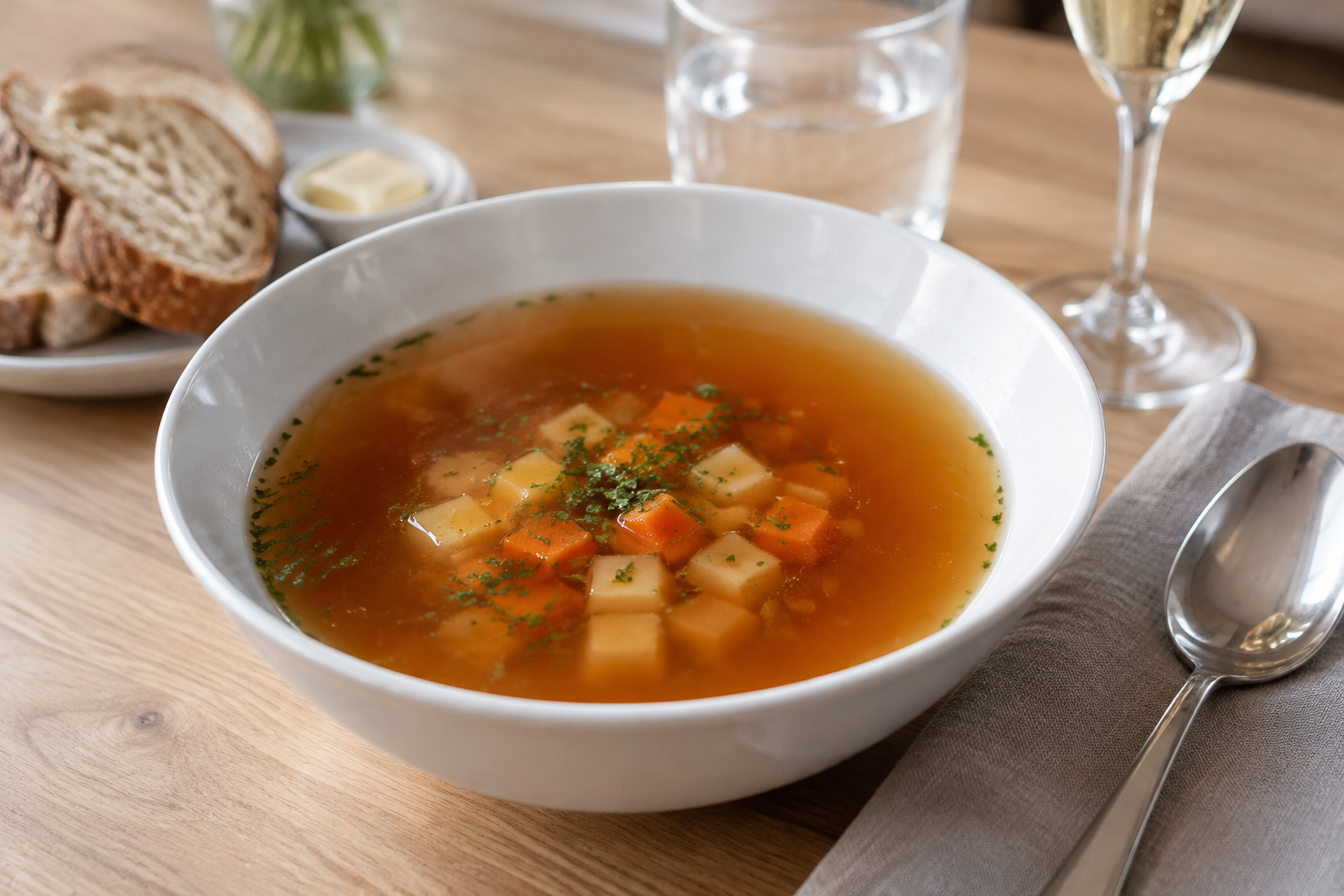
Serve in small, warmed bowls, letting the tender diced vegetables provide a little bite. A dry sparkling wine can work well, but a low-sweetness alcohol-free sparkling alternative, or simply water, is just as thoughtful a choice. The real luxury is the care you take: hot broth, clean flavours and time to linger at the table. And unlike the inaugural dinner of 1901, a host’s pride can lie in a table that truly welcomes everyone.
Clear consommé with finely diced vegetables
A modern home version of classic French consommé, inspired by the clarification technique in Escoffier’s Le Guide culinaire of 1903. The recipe reflects restaurant cooking of the period but does not claim to reproduce a specific dish from the Nobel dinner of 1901. Makes four small starter portions.
Ingredients
Method
- 1Check that the stock is cold and remove any solidified fat from the surface. Taste it: it should be slightly less salty than you want the finished soup to be.
- 2Combine the beef mince, egg whites and finely chopped vegetables for the clarification in a large saucepan. Stir in the stock a little at a time and add the peppercorns.
- 3Heat slowly over a medium-low heat, stirring gently along the bottom of the pan, for about 15–20 minutes. When greyish-white clumps of protein begin to gather into a raft on the surface, stop stirring.
- 4Reduce the heat and carefully make a small hole in the raft with a spoon. Let the stock simmer very gently, at around 85–95°C, for 35–40 minutes, uncovered. Do not let it boil vigorously. Do not stir or break up the raft.
- 5Meanwhile, peel the carrot and celeriac for the garnish and cut into roughly 3 mm dice. Cook in a separate saucepan of lightly salted water for 3–5 minutes, until just tender. Drain.
- 6Dampen a clean, fine-weave straining cloth with no detergent scent and place it in a fine-mesh sieve over a clean saucepan. Ladle the stock through the opening in the raft and let it drain through the cloth. Do not press on the clarification mixture or tip the whole pan into the sieve.
- 7Gently reheat the strained stock and season to taste with salt. If there are small droplets of fat on the surface, skim them off with a spoon. You should have around 10–12 dl; the amount will vary with evaporation and straining.
- 8Divide the diced vegetables between four warmed starter bowls. Pour over the hot consommé, sprinkle with a little chives and serve immediately.
- The consommé can be made the day before. Cool quickly in a cold-water bath, refrigerate and lift off any solidified fat before reheating. Use within 2–3 days.
- The celeriac can be replaced with parsnip, which gives a slightly sweeter flavour.
- Clarification can improve clarity, but it will not rescue a flavourless or overly salty stock. Choose your base carefully.
- For a vegetarian dish, serve a well-strained mushroom broth with the same garnish. This makes a different dish, rather than a direct substitution in this clarification recipe.
What goes in the glass
- WineDry sparkling wine, brutFresh acidity and subtle bready notes suit the concentrated broth. Choose a lighter style and serve a small glass so the wine does not overwhelm this delicate starter.
- Alcohol-freeAlcohol-free sparkling wine with low sweetnessA fresh, subtly fruity style provides a contrast to the richness of the broth. Avoid distinctly sweet versions, which can easily dominate the soup.
- Alcohol-freeStill waterThis neutral option lets the meatiness of the broth and the gentle sweetness of the root vegetables take centre stage.
Enjoy alcohol in moderation. Alcohol-free options go just as well with the food.
Sources
- Nobel Prize Outreach, The Nobel Banquet
- Nobel Prize Outreach, Nobel Banquet menu 1901 (1901)
- Alfred Nobel; publicerat av Nobel Prize Outreach, Full text of Alfred Nobel’s will (1895)
- Nobel Prize Outreach, Marie Curie – Facts
- Auguste Escoffier, med Philéas Gilbert och Émile Fétu, Le Guide culinaire (1903)
- Rebecca L. Spang, The Invention of the Restaurant: Paris and Modern Gastronomic Culture (2000)
Ask questions about "The Nobel Dinner of 1901 – a Table for Gentlemen Only". Answers are based on the magazine's own articles.