Peking Duck – The Emperors’ Crisp-Skinned Bird
From Nanjing’s imperial kitchens to Beijing’s duck ovens and on to the home kitchen: the story of skin that should sing between your teeth.
The glory of Peking duck lies in its contrasts: thin, crisp skin, succulent meat and a soft pancake with fresh spring onion and sweet bean sauce. Yet behind the famous way of serving it lies not one unbroken imperial legend, but a history of shifting capitals, rival ovens and skilled cooks.
 By Mai LindqvistReporter · East and Southeast Asian cuisine – Thailand, Vietnam, Japan, China and Korea
Translated from Swedish with AI assistance.
Go to the recipe ↓A crackle at the table
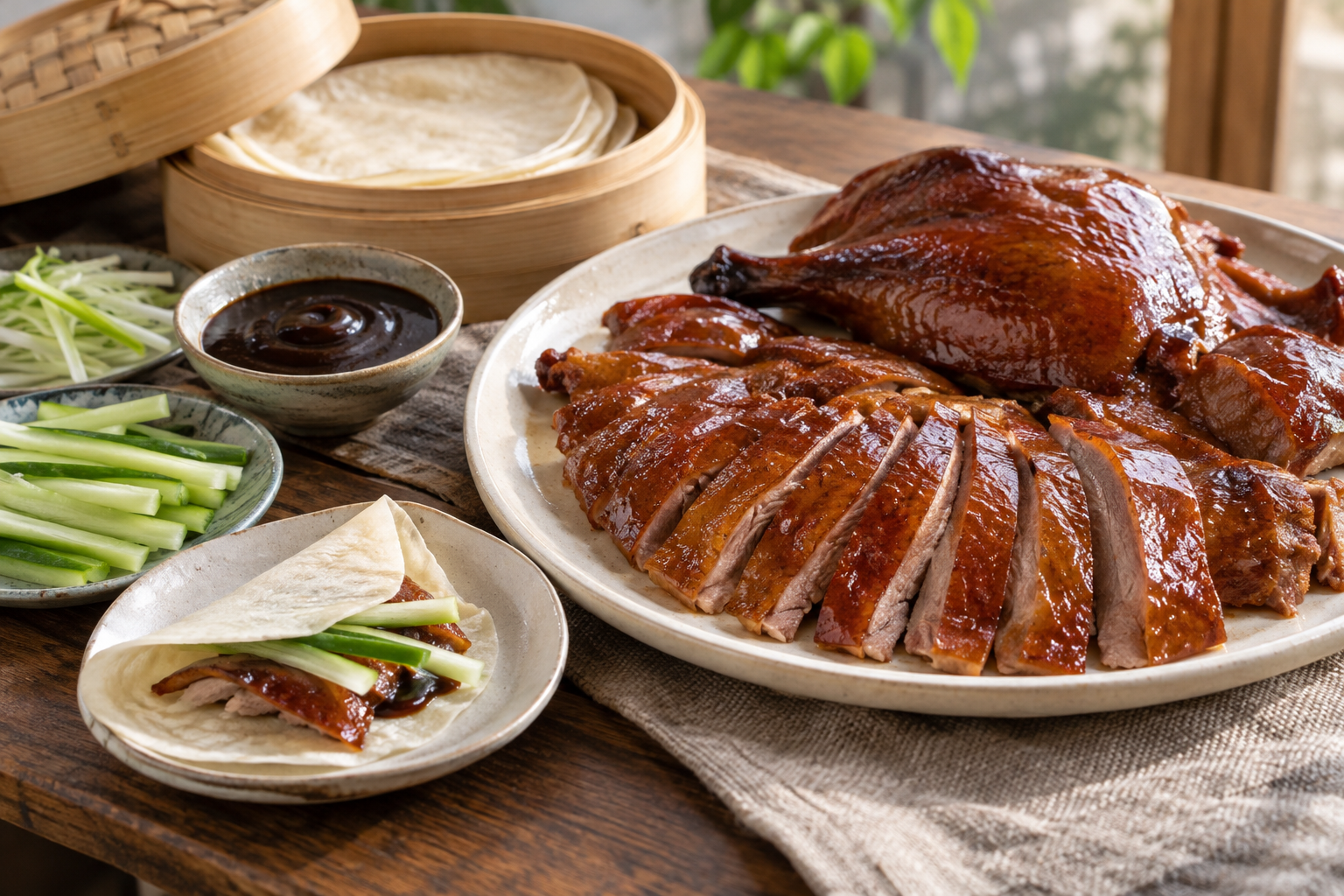
The knife meets the duck with a dry, almost papery sound. The skin is glossy mahogany, with amber edges where the light shines through. Beneath it lies a thin layer of fat and warm meat. On the table, pancakes wait in a covered basket alongside fine shreds of spring onion and a dark sauce with a sweet, fermented aroma.
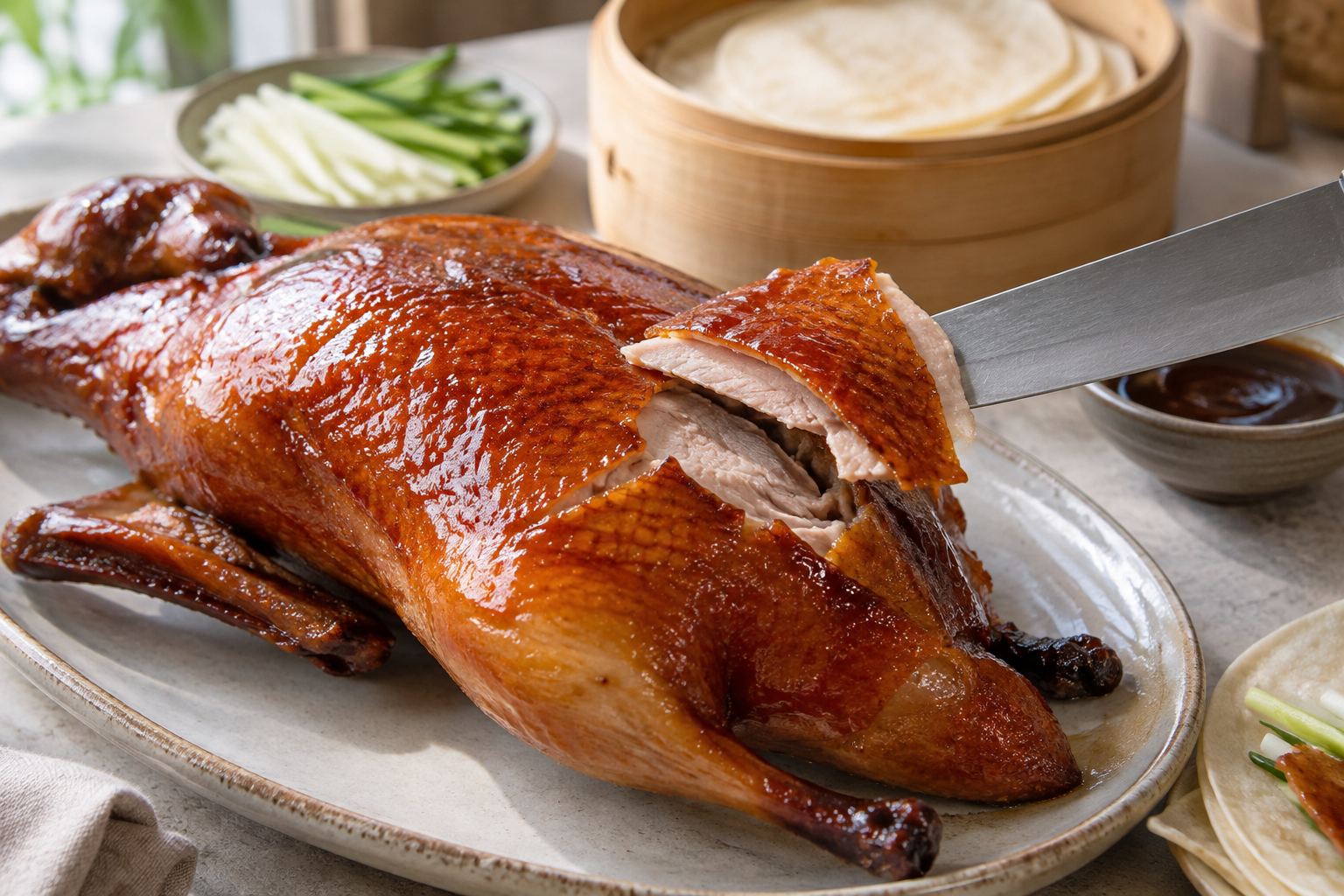
It is easy to focus entirely on the bird. But Peking duck only comes together in your hand: a thin pancake, a little sauce, a few shreds of spring onion, a slice of duck with its skin. Fold the bottom edge over the filling, tuck in the sides and bite. First comes softness, then crispness, followed by the onion cutting through the fat. The sweetness brings everything together without needing to dominate.
This is how a meal in Beijing today might begin. It is not, however, a scene we can simply transplant to the early years of the Ming dynasty. The modern restaurant ritual, the type of bird and the precise combination of accompaniments developed over a long period. Historical Peking duck and today’s version are related, but not identical.
The name essentially means roast duck from Beijing: Beijing kaoya. In Sweden, the dish is still often called pekinganka, while the Chinese capital is generally known internationally as Beijing. The dish is both a local craft and a global symbol. It might take centre stage at a family celebration, anchor a business dinner or become the restaurant highlight of a trip.
Calling it “the emperors’ bird” is therefore tempting and partly justified. Imperial courts belong in the story. But anyone who speaks only of emperors overlooks the restaurateurs, fire tenders, duck farmers and cooks who turned a magnificent roast into a culinary language of its own.
From Nanjing to a new capital
Roast duck in China predates the two restaurant names that dominate its history today. Early court and dietary texts show that duck was part of elite dining long before modern Peking duck rose to prominence. That does not mean every earlier duck dish was Peking duck. A species of bird, a cooking method and a fully developed restaurant tradition are three different things.
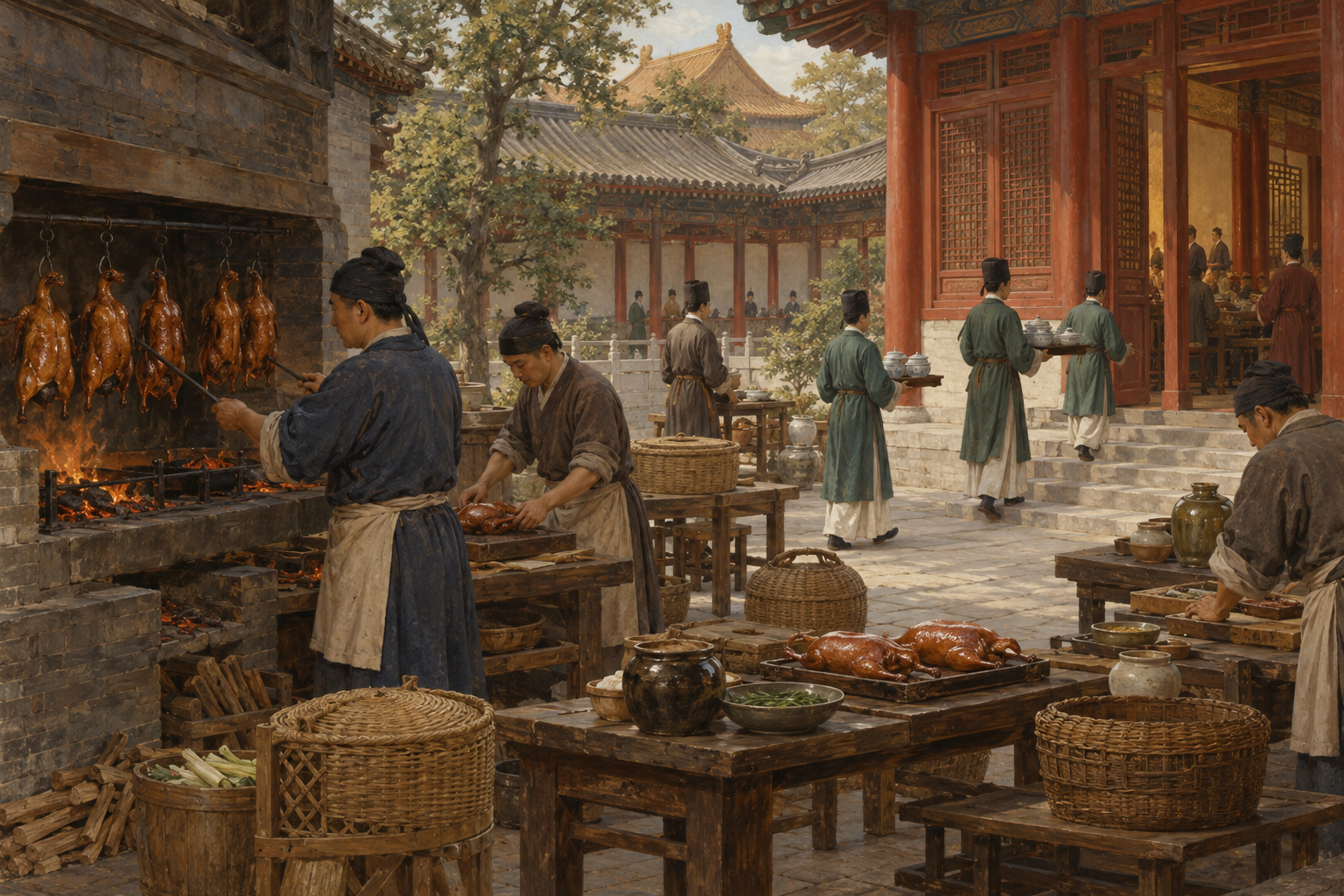
Nanjing is the important southern stop in the story. The city was the Ming dynasty’s first capital and has a rich, varied duck-eating culture. Salted duck and roasted versions are both found here. The fact that modern Nanjing is known for several duck dishes helps us understand the setting, but does not in itself prove the year any particular recipe was born.
When the Yongle Emperor made Beijing the capital in 1421, the empire’s political centre of gravity shifted north. The court’s needs drew people, ingredients, expertise and administrative networks along with it. In the usual account of Peking duck’s origins, duck roasting followed the same route from Nanjing to Beijing.
This is a plausible and established broad outline, but it should not be turned into an overly precise itinerary. We cannot point to a named cook who carried the finished dish through the city gates on a particular day. Food rarely travels so neatly. Techniques can travel with several groups, change in new kitchens and acquire a new name much later.
Northern China’s strong tradition of wheat-based foods also gave the dish a natural home. Thin pancakes made the duck easy to share and balanced its fat with a mild, soft wrapper. Spring onion and fermented sauces created a contrast far more considered than “meat with something sweet”.
The Ming dynasty is therefore an important historical framework, not a guarantee that today’s complete presentation already existed in the 15th century. The Peking duck we know continued to take shape during the Qing dynasty and within the city’s commercial restaurant culture. Imperial life is part of its origins; urban life is an equally important part of its development.
Two restaurant names, two kinds of fire
Bianyifang and Quanjude are the great names in the story of Peking duck. They also represent two different ways of drying the bird’s surface, rendering its fat and crisping its skin.
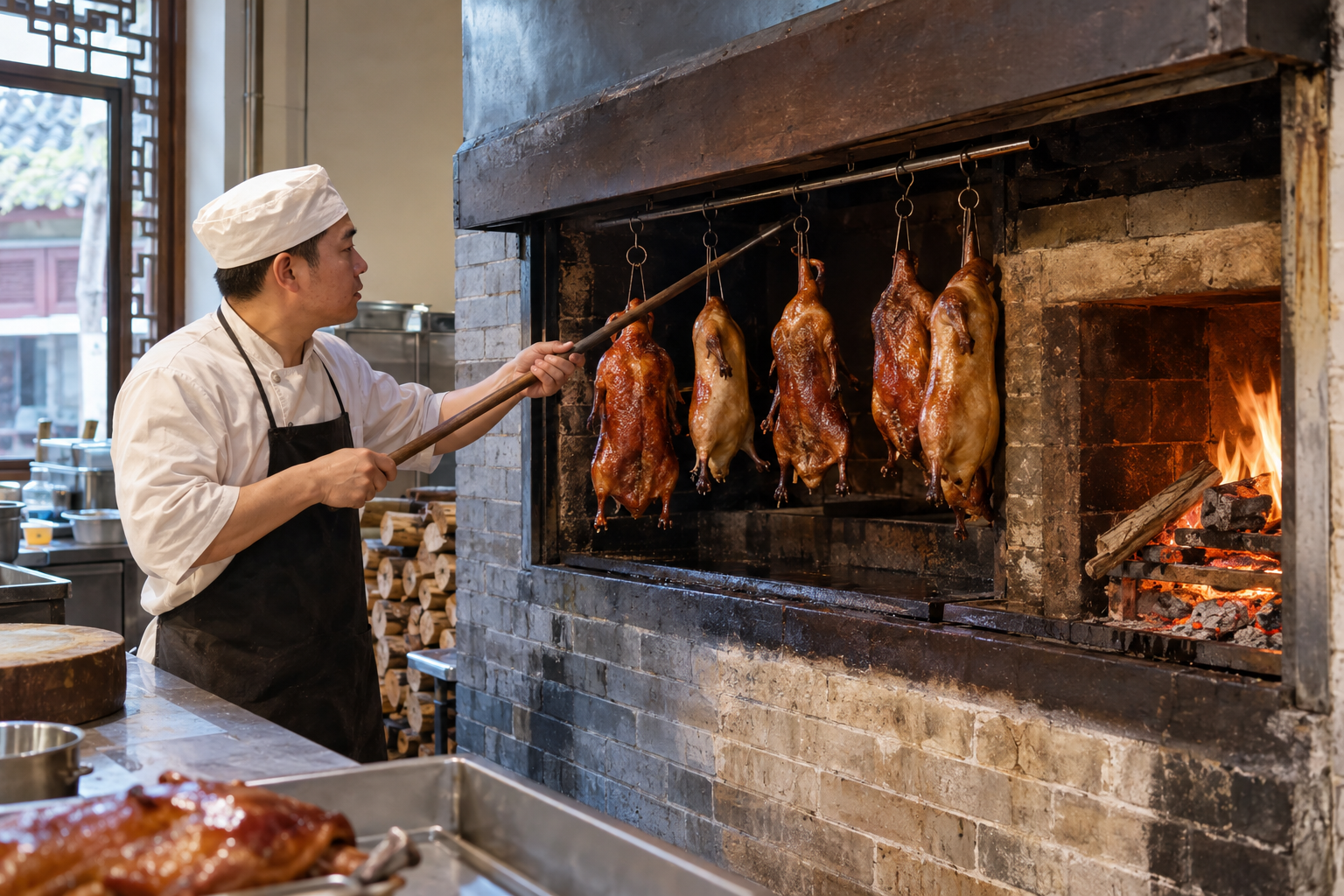
Bianyifang’s tradition is usually dated to 1416. The year recurs in accounts of the restaurant’s and Beijing’s history, but should be read as a claim to historical heritage and founding, not as proof that exactly the same business has operated continuously on the same premises ever since. Names, businesses and ownership have changed over the centuries.
Here, the duck is associated with menlu, a closed oven. In the traditional method, the oven chamber is heated first, then the bird cooks in the stored heat without being exposed to a fire burning beside it. “Closed” therefore means something more precise than an ordinary oven door simply being shut. It concerns the fire’s relationship to the food and how the heat has been built up.
Quanjude was founded in 1864, during the Qing dynasty, and is associated with gualu: an oven in which ducks hang while the wood burns. Fruitwood, including jujube and pear, is part of the well-known tradition. The cook moves and turns the birds to control how the skin meets the radiant heat.
This is not a contest between a primitive method and an advanced one. Both demand experience. In the closed oven, stored heat and timing must be right. In the hanging oven, the cook needs to read the fire, distance and colour. A glossy duck reveals a great deal to someone who knows what to look for.
Nor does wood firing automatically make Peking duck a smoked duck. The aim is roasted flavour and controlled browning, not a thick cloud of smoke that masks the bird’s taste. Clean combustion and skilful heat control are crucial.
The differences between the restaurants extend beyond the oven itself: handling the bird, drying, glazing, roasting and carving all play a part. It is therefore simplistic to say that one oven type always produces the juiciest meat or crispest skin. At home, we borrow principles from the craft, but an electric domestic oven becomes neither a historic Bianyifang oven nor Quanjude’s hanging oven.
The skin is a technical masterpiece
Peking duck begins with a bird suited to the task. The white Pekin duck, which has also played a major role in duck breeding internationally, is associated with the dish. The fat beneath the skin matters: it contributes flavour and helps the skin during roasting. But fat alone does not create crispness. Wet, thick skin will not turn crisp simply because the oven is hot.
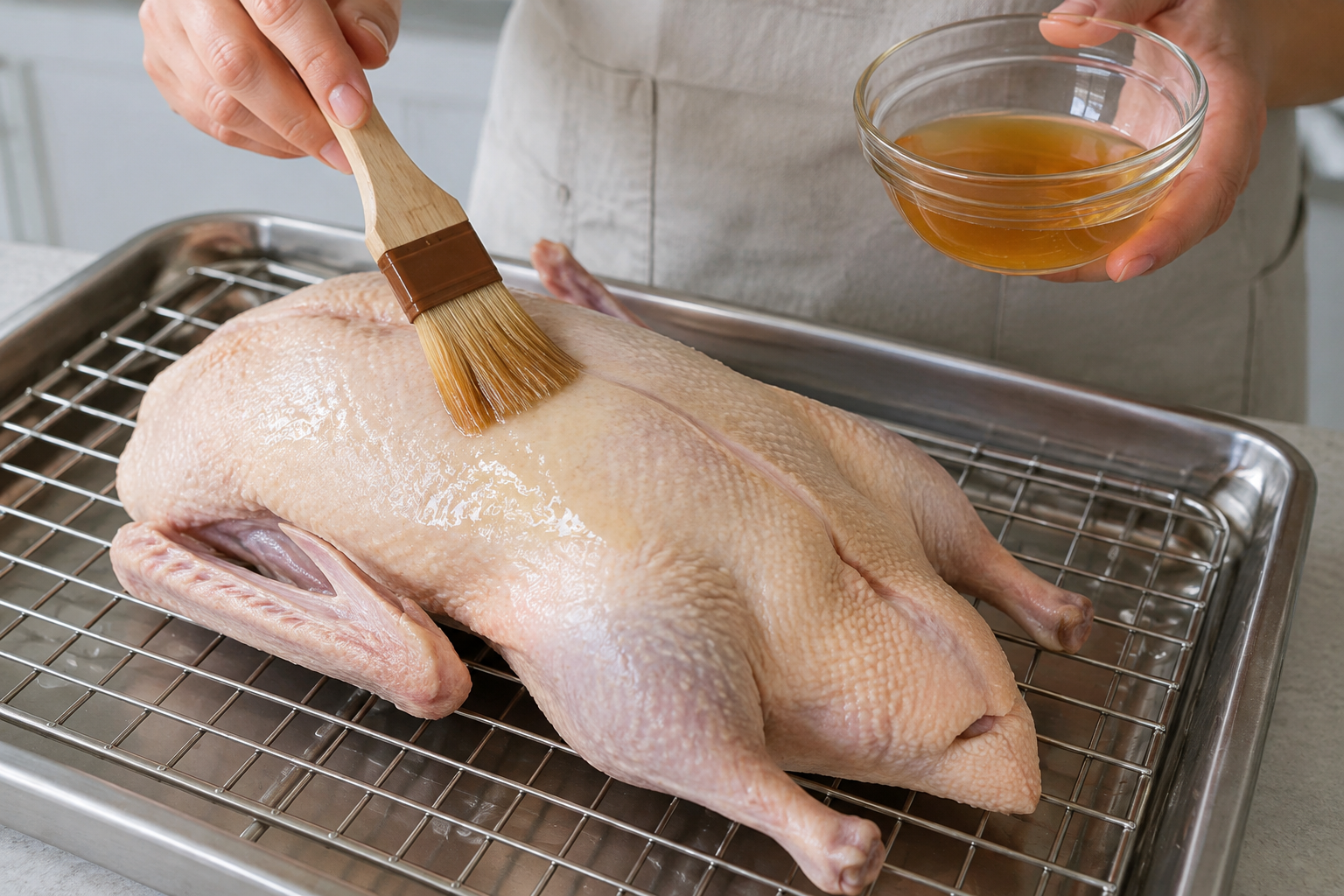
In professional preparation, air is used to separate the skin gently from the meat. This creates space for more even drying and for the fat to render. The bird is also scalded, coated with a thin sugary liquid and left to dry thoroughly before roasting.
It is easy to describe this as a single secret: “inflate the skin”, “use maltose”, “hang the duck overnight”. In reality, it is a chain of steps. If the surface is still wet, the oven’s energy must first drive off the water. If the glaze is too thick, the sugar may burn before the skin is ready. If the bird sits in its own fat, its underside is being bathed rather than roasted.
Maltose is traditionally important in many glazes. This thick syrup is available in Asian grocery shops and dissolves more easily in warm water. A thin film helps develop colour and finish. Honey works in a home version, but brings a different flavour and can darken quickly. Brush it on sparingly: the duck needs a lacquer, not a coating of confectionery.
Many recipes outside China then pile on five-spice, soy sauce, garlic and orange. That can make excellent duck, but Peking duck’s distinctive character does not lie in a heavy marinade. Here, the roasted bird should shine through. The sauce and spring onion build the rest of the flavour at the table.
The biggest advantage at home is therefore less romantic than a secret measure of spice: space in the fridge. A patted-dry bird on a rack, uncovered but protected from contact with other food, develops a much drier surface. The fridge should be at around 4°C, with the bird on the bottom shelf over a deep tray. Always observe the use-by date on the packaging.
Do not leave a raw duck hanging overnight in a warm kitchen. Traditional restaurant processes should not be copied without control over temperature and hygiene. Skip improvised pumping arrangements, too. Blowing air in by mouth or using equipment that is not food-safe is not a shortcut worth taking.
The pancake, the spring onion and the dark sauce
The pancakes are often called heye bing, lotus-leaf pancakes. They should be thin and pliable, neither fluffy like American pancakes nor eggy like Swedish ones. Hot water in the dough changes the flour’s properties, making it easier to roll out a soft, supple pancake.
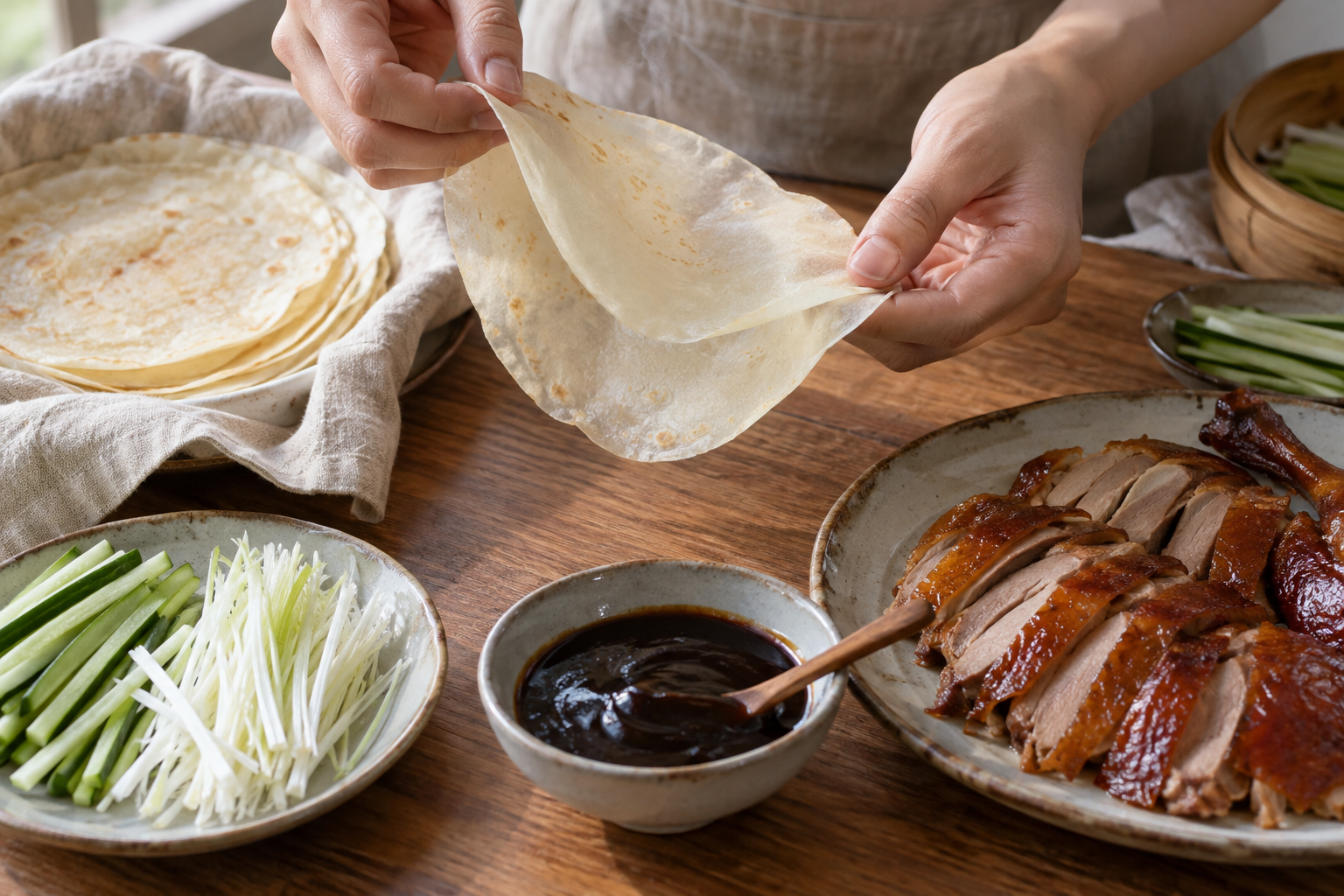
One practical method is to roll two small pieces of dough together with a thin layer of oil between them. After a brief spell in a dry frying pan, they are peeled apart into two thin pancakes. That moment has its own little drama: warm steam rises, the surfaces release and one thicker pancake becomes two almost translucent sheets.
They should not be cooked hard into crisp flatbreads. That would rob them of their most important function: holding the filling together without competing with the duck’s crackle. Keep them covered as soon as they are cooked, and ideally reheat them with steam just before serving.
Fine shreds of Chinese spring onion, cong, are often used. These can be more substantial than the slender spring onions sold in Swedish shops. The white and pale green parts of ordinary spring onions work well here. Very finely sliced leek is an accessible alternative, though its flavour and texture are not quite the same. Rinse thoroughly between the layers and let the shreds drain.
Cucumber is common on serving platters today. It brings coolness and a juicy crunch quite different from the skin’s dry crispness. Neither the spring onion nor the cucumber should be wet when placed in the pancake.
The sauce also calls for a little clarification. Hoisin is familiar in Sweden and useful at home, but it is not synonymous with the classic sauce for Peking duck. Often, tianmianjiang, a sweet fermented wheat sauce, is used, sometimes warmed and seasoned before serving. The name “sweet bean sauce” appears in both Swedish and English even when wheat is a key ingredient, so read the ingredients list.
Hoisin generally has a different, more spiced flavour profile and is often based on soya beans. By all means use it if that is what the shop offers, but call it what it is: a substitute, not the same product. Both can be quite salty and sweet. A little goes a long way; a flood of sauce should not drown out months of rearing and two days of care in the kitchen.
In some restaurants, portions of the skin are served separately, sometimes with sugar. This highlights the pure contrast between fat, crispness and sweetness. It is an option, not an obligatory part of every historical or contemporary duck meal.
A bird to gather around
Peking duck is rarely food for someone who wants to eat standing up and finish quickly. The whole bird, the carving and the pancakes create a shared rhythm. Someone passes the spring onion, someone opens the steamer basket, someone tries to squeeze in an extra piece of skin without splitting the roll.
It is also a dish that makes hospitality visible. Ordering a duck in a restaurant often signals that the meal deserves time and a little extra care. Yet it should not be described solely as celebration food: in Beijing today, it comes at many prices, in many forms and for many occasions.
When the cook carves the bird in front of the guests, professional skill becomes part of the meal. The proportions of the slices affect the experience. Too much meat without skin makes the pancake less lively; nothing but fat and skin can feel heavy. Famous claims about exactly how many pieces a duck should be cut into vary between restaurants and should not be treated as a universal rule.
The rest of the bird can be used in several ways. In some places, the carcass becomes the basis of a soup; elsewhere, other preparations are offered. There is no reason to declare any one version the only proper ending. At home, though, the bones are an excellent reason to put on a small pot of stock the next day.
The drink should ready the palate for the next bite. A moderately brewed jasmine tea offers floral fragrance and light astringency without adding sweetness. A pale lager, Chinese if you want to echo the restaurant experience, brings freshness and fizz. For balance, the country on the label matters less than choosing a beer that is refreshing and not too bitter.
For wine drinkers, a fresh Pinot Noir with restrained oak works better than a heavy, tannic red. Serve it slightly cool. But alcohol is no prerequisite for the meal: sparkling water or a lightly brewed, cooled jasmine tea lets the duck speak just as clearly.
Making it work in a Swedish kitchen
Our recipe is a modern home interpretation of Peking duck technique, not a literal reconstruction of a Ming recipe. We keep the thin glaze, fridge drying, rack and assembled serving. We leave out inflation, the specialist oven and steps that are difficult to carry out safely in an ordinary kitchen.
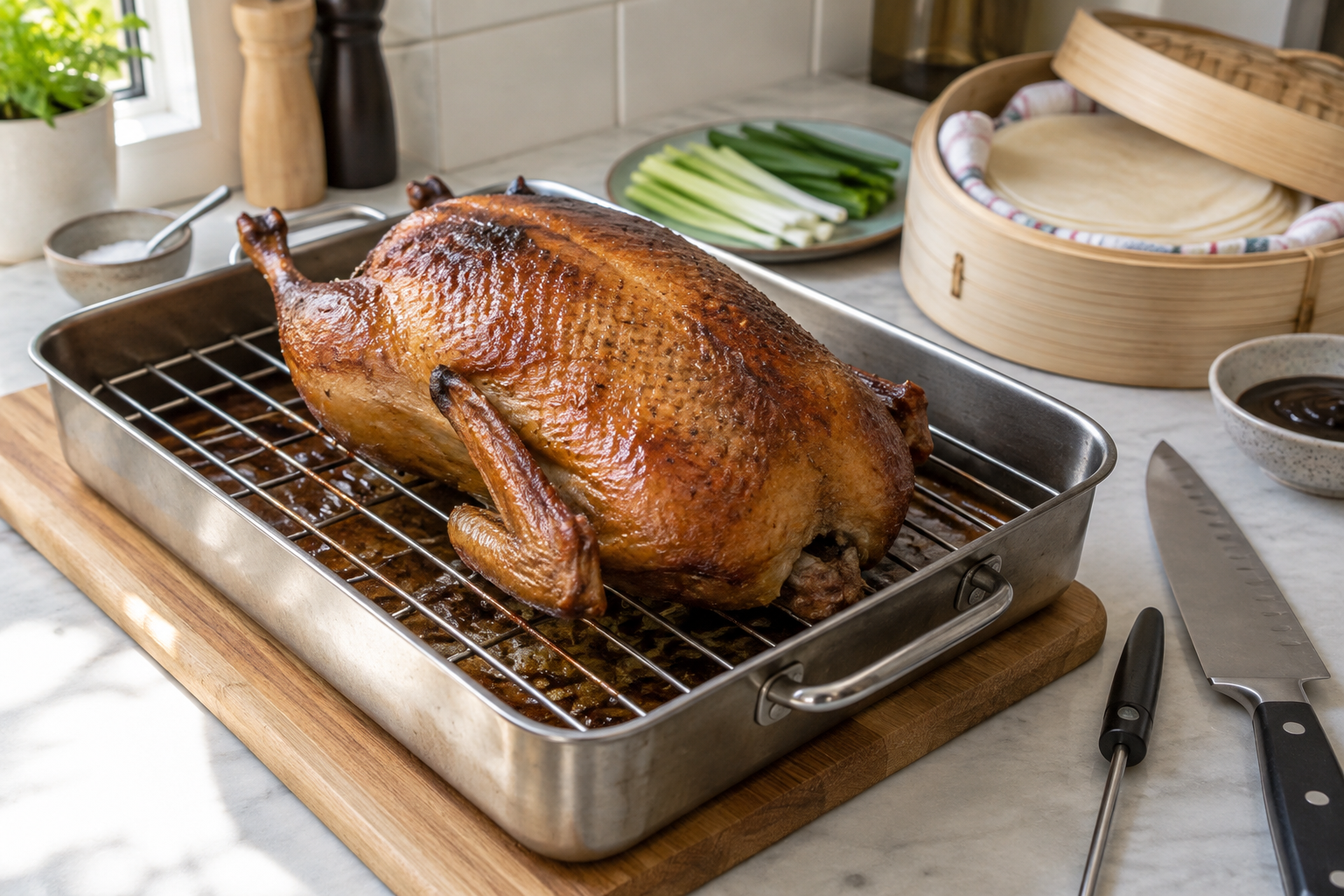
Ideally, buy a whole, unseasoned duck weighing about two and a half kilos. A frozen bird needs to thaw completely in the fridge; allow around two days, sometimes longer. Then it needs time to dry. Plan backwards from dinner, not from when you want to turn on the oven.
Get out a roasting tin with a rack, a thermometer and a sharp knife. The rack is more useful than another jar of spice. The thermometer is more useful than a promise that all ducks will be ready at exactly the same minute. Size, starting temperature and the oven’s actual heat all vary.
Roasting begins at a moderate temperature to give the fat time to render, then finishes hotter to crisp the surface. The tin beneath the bird must not boil dry and start smoking with fat, but do not fill the oven with unnecessary steam either. A little hot water in the bottom as needed is better than a large water bath.
The pancakes and vegetables can be prepared while the duck dries. That takes the pressure off the one truly urgent moment: when the bird is ready. Let it rest briefly without foil, carve and serve straight away. A tightly sealed foil tent traps steam and softens that precious skin.
Do not expect an exact copy of a restaurant duck from a purpose-built oven. Expect something delicious: the aroma of roasting in the kitchen, glossy skin beneath the knife and little warm parcels travelling from hand to mouth. It is a respectful way into the tradition, with the home kitchen’s limitations openly acknowledged.
Home-Style Peking Duck with Thin Pancakes
A simplified home version inspired by Peking duck’s traditional drying, glazing and serving methods, not an exact reconstruction from the Ming dynasty. No inflation or specialist oven is needed. Start a day before serving; fridge drying and any thawing time are additional to the preparation and cooking times. Makes four generous portions with 16 small pancakes.
Ingredients
Method
- 1The day before: remove any bag of giblets and loose fat around the duck’s cavity opening. Snip off the wing tips if they stick out and save them for stock. Dry the bird very thoroughly inside and out with kitchen paper; do not rinse it. Rub the salt inside the cavity.
- 2Dissolve the maltose or honey in 2 tbsp hot water and add the rice vinegar. Brush a very thin layer over all the skin. Place the duck breast-side up on a rack over a deep tray. Leave uncovered in the fridge at around 4°C for 18–24 hours, on the bottom shelf and away from contact with other food. Keep within the use-by date.
- 3On the day of cooking: heat the oven to 160°C, conventional setting. Transfer the duck to an oven rack over a sturdy roasting tray, or use a rack that fits inside a roomy roasting tin. Keep the bird breast-side up. Place just below the centre of the oven.
- 4Roast initially for 100 minutes. After about 60 minutes, check that the fat in the tin is not burning; if needed, add a little of the hot water to the bottom of the tin, not over the bird. If a lot of fat collects, carefully remove the tin and spoon some into a heatproof container. Do not brush or baste the duck itself during roasting.
- 5Check the temperature in both the thickest part of the thigh and the breast, without touching bone. When the bird approaches 70°C, increase the oven temperature to 220°C and roast for about another 15–25 minutes, until the skin is well browned. If it has not yet reached around 70°C after the initial roasting period, continue at 160°C and check at 10–15-minute intervals. The finished bird should reach at least 74°C in both thigh and breast. Loosely cover only individual dark patches if they are at risk of burning.
- 6Meanwhile, make the pancake dough: put the flour in a bowl and stir in the just-boiled water with a sturdy spoon. Once the dough is cool enough to handle, knead for 5–7 minutes until smooth. Adjust if necessary with a teaspoon or so of water or a little flour. Cover and leave to rest for 30 minutes.
- 7Divide the dough into 16 equal pieces and roll into balls. Flatten them. Brush the tops of eight pieces very lightly with oil and place an unoiled piece on top of each. On a lightly floured work surface, roll each pair into a round pancake about 17–18 cm in diameter.
- 8Heat a dry frying pan over a medium heat. Cook one double pancake at a time for about 45–60 seconds on each side, until it develops a few pale brown spots and begins to puff up. Carefully peel the two pancakes apart while still warm; watch your fingers around the steam. Place straight under a clean tea towel and keep covered so they stay soft.
- 9Cut the spring onions into very fine shreds, 5–6 cm long. Halve the cucumber lengthways, scrape out the wettest seeds and cut the rest into slim batons. Put the sauce in a bowl; if it is difficult to spread, thin it with up to 1 tbsp water.
- 10Rest the cooked duck without foil for 10–15 minutes. Meanwhile, warm the pancakes in a covered steamer for 3–5 minutes. Place them on baking paper pierced with a few holes to prevent sticking and let the steam through.
- 11Remove the legs and breast meat from the carcass. Slice the breasts crossways and cut the leg meat into smaller pieces, trying to keep skin on as many pieces as possible. Serve immediately. Let everyone fill their pancakes with a little sauce, spring onion, cucumber and duck, then fold into small parcels.
- Ready-made frozen duck pancakes are available in many Asian shops. Heat according to the packet instructions; they save around 40 minutes of active work.
- Replace the spring onions with about 100 g of the white part of a leek, very finely shredded and well drained. Hoisin is a practical substitute for tianmianjiang but gives a more spiced flavour.
- The cooking time is a guide: start checking the temperature well in advance. Honey darkens easily, so keep a particularly close eye on the duck during the hot finishing stage.
- Cool leftovers quickly and store covered in the fridge; use within 2–3 days or freeze. Reheat the duck thoroughly on a rack in the oven. The skin is rarely as crisp as it was when first served.
What goes in the glass
- TeaJasmine teaThe floral fragrance lifts the roast duck, while light astringency balances the fat. Brew according to the tea’s instructions and avoid prolonged steeping, which adds unnecessary bitterness.
- BeerPale Chinese lagerRefreshing fizz and moderate bitterness suit the duck fat and sweet sauce. Choose a light, clean lager rather than a heavily hopped beer.
- WinePinot Noir with fresh acidity and restrained oakRed berries and gently earthy notes complement the roast meat without the tannins taking over. Serve at around 14–16°C and use the sauce sparingly; lots of sweet sauce can make a dry wine seem harsher.
- Alcohol-freeSparkling water with cucumberBubbles and a cool cucumber aroma offer a clean, refreshing pause between bites without adding sweetness or competing with the duck’s roasted flavours.
Enjoy alcohol in moderation. Alcohol-free options go just as well with the food.
Sources
- K. C. Chang, red., Food in Chinese Culture: Anthropological and Historical Perspectives (1977)
- E. N. Anderson, The Food of China (1988)
- Fuchsia Dunlop, Invitation to a Banquet: The Story of Chinese Food (2023)
- Encyclopaedia Britannica, Peking duck
- China Quanjude Group, Quanjude – företagets historia och restaurangtradition
- Bianyifang, Bianyifang – företagets historia och ugnstradition
- FoodSafety.gov, Safe Minimum Internal Temperature Chart
Ask questions about "Peking Duck – The Emperors’ Crisp-Skinned Bird". Answers are based on the magazine's own articles.