Rendang – the Minangkabau stew that rewards patience
From West Sumatra comes a celebratory dish that lets coconut milk, meat and spices transform over gentle heat.
First, the meat simmers in a fragrant coconut broth. Then the liquid disappears, the oil emerges and the spices darken into a dense, almost caramelised coating. Rendang is the Minangkabau’s great exercise in patience – a dish for celebrations, hospitality and people on the move.
 By Mai LindqvistReporter · East and Southeast Asian cuisine – Thailand, Vietnam, Japan, China and Korea
Translated from Swedish with AI assistance.
Go to the recipe ↓When bubbling turns to a sizzle
It begins with the sound of liquid. Coconut milk bubbles thickly around pieces of beef, while lemongrass and lime leaves release a fragrance both green and warm. In the pot is a spice paste of shallots, chilli, ginger and galangal. For now, it looks like a generous stew with plenty of sauce. But rendang still has a long way to go.
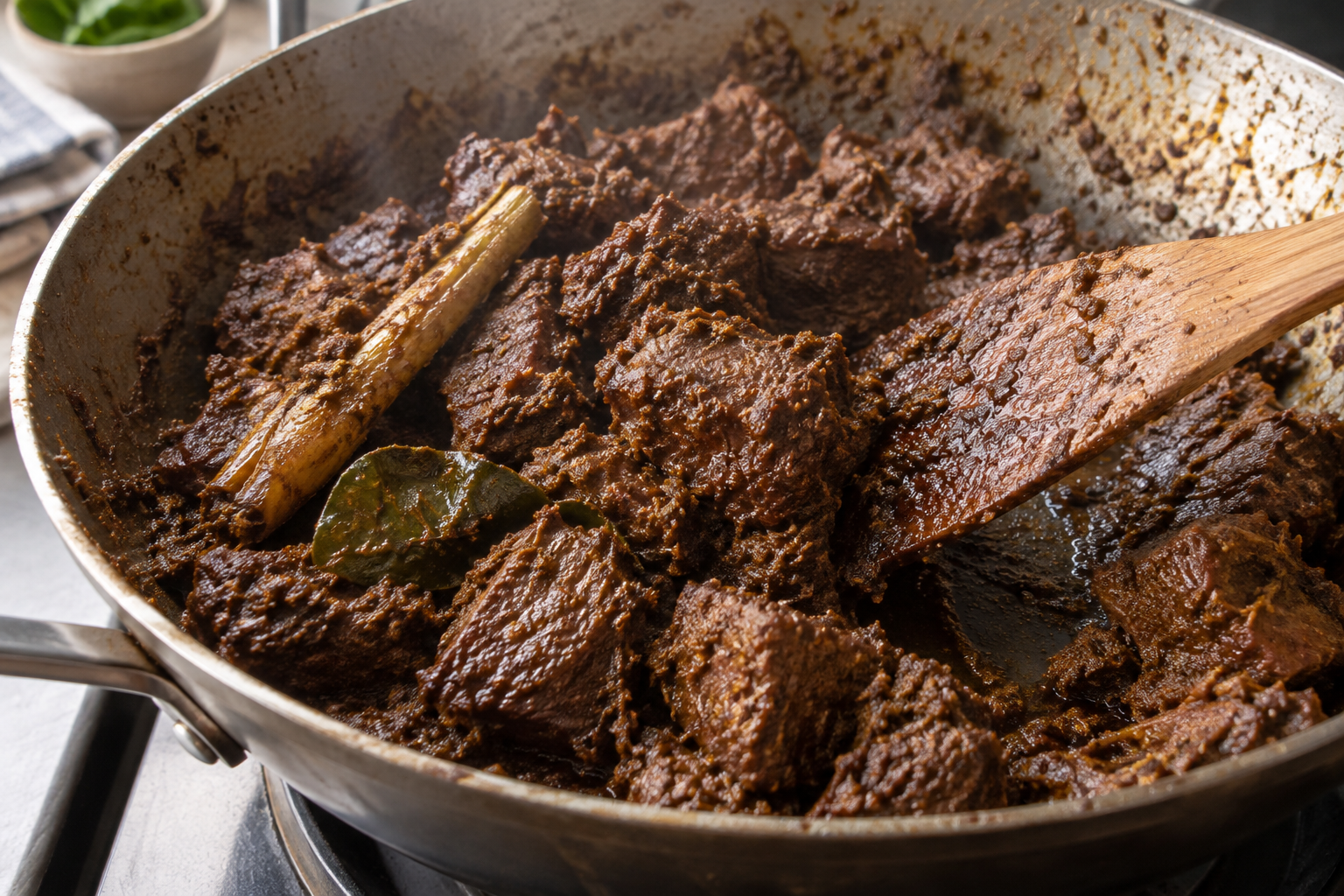
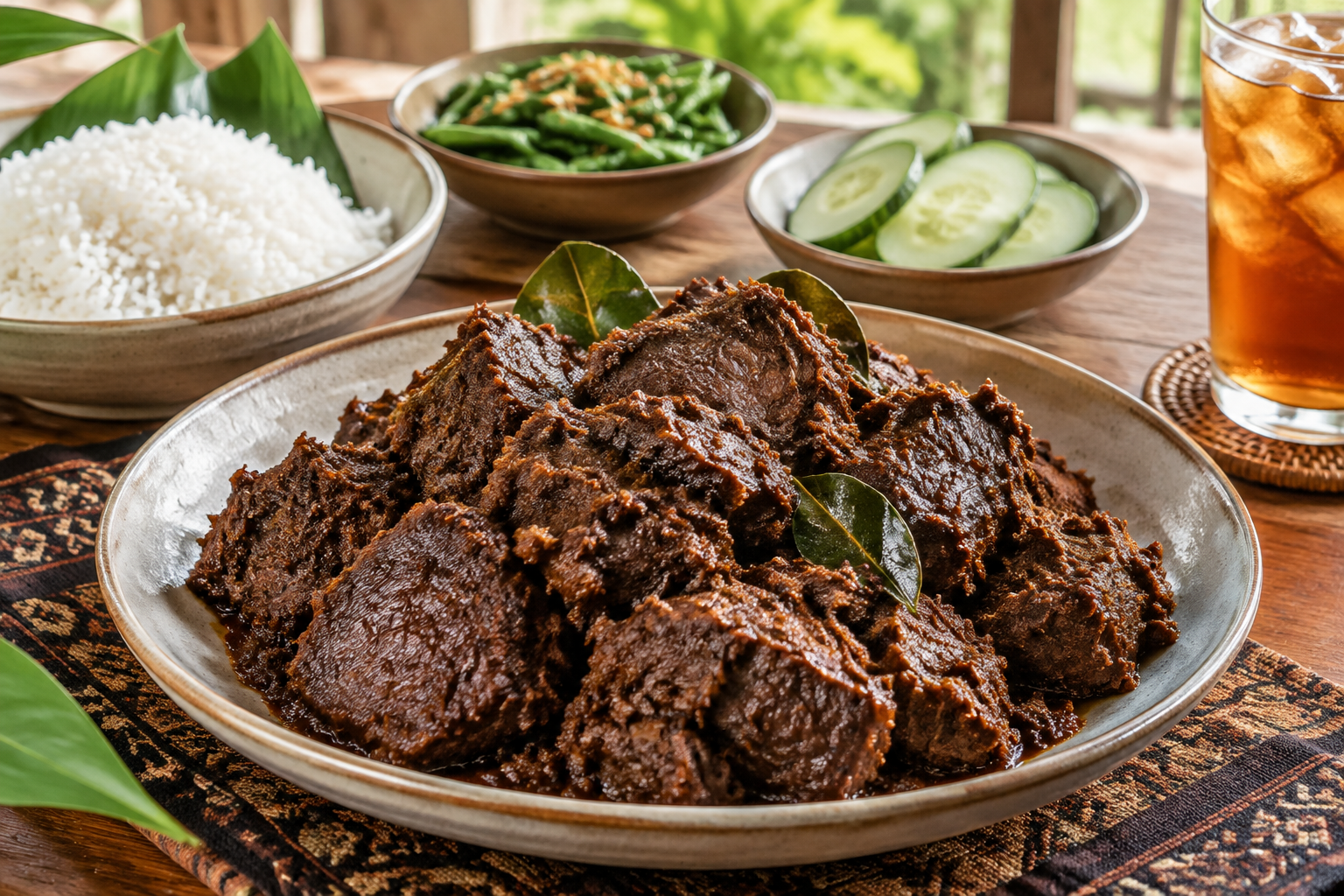
After a few hours, everything changes. The steam thins. A glossy edge of coconut oil appears between the pieces of meat. The work of the spoon becomes more important: now the base must be scraped gently and the meat turned without falling apart. The wet bubbling gradually gives way to a low sizzle. The sauce reduces to a spice mixture that clings to the meat, darkens and smells toasted. This is where patience becomes an ingredient, even if it cannot be weighed out.
Rendang is associated above all with the Minangkabau, whose cultural heartland lies in the highlands of West Sumatra. It is one of Indonesia’s best-known dishes, but its international fame can blur its origins. Rendang is not simply another name for a spicy meat stew with coconut milk. It has a special place in Minangkabau food traditions and relies on a cooking process that allows almost all the liquid to leave the pot.
The flavour is accordingly concentrated rather than saucy. The chilli heat is woven into the coconut fat, the sweetness of the onions and the depth of the meat. Galangal adds a peppery, almost resinous freshness. Lemongrass and makrut lime leaves lift the aroma. A little sour fruit can provide a counterpoint to the richness, but rendang should not taste like a sour curry. The balance lies in the whole, and in how far the cooking is taken.
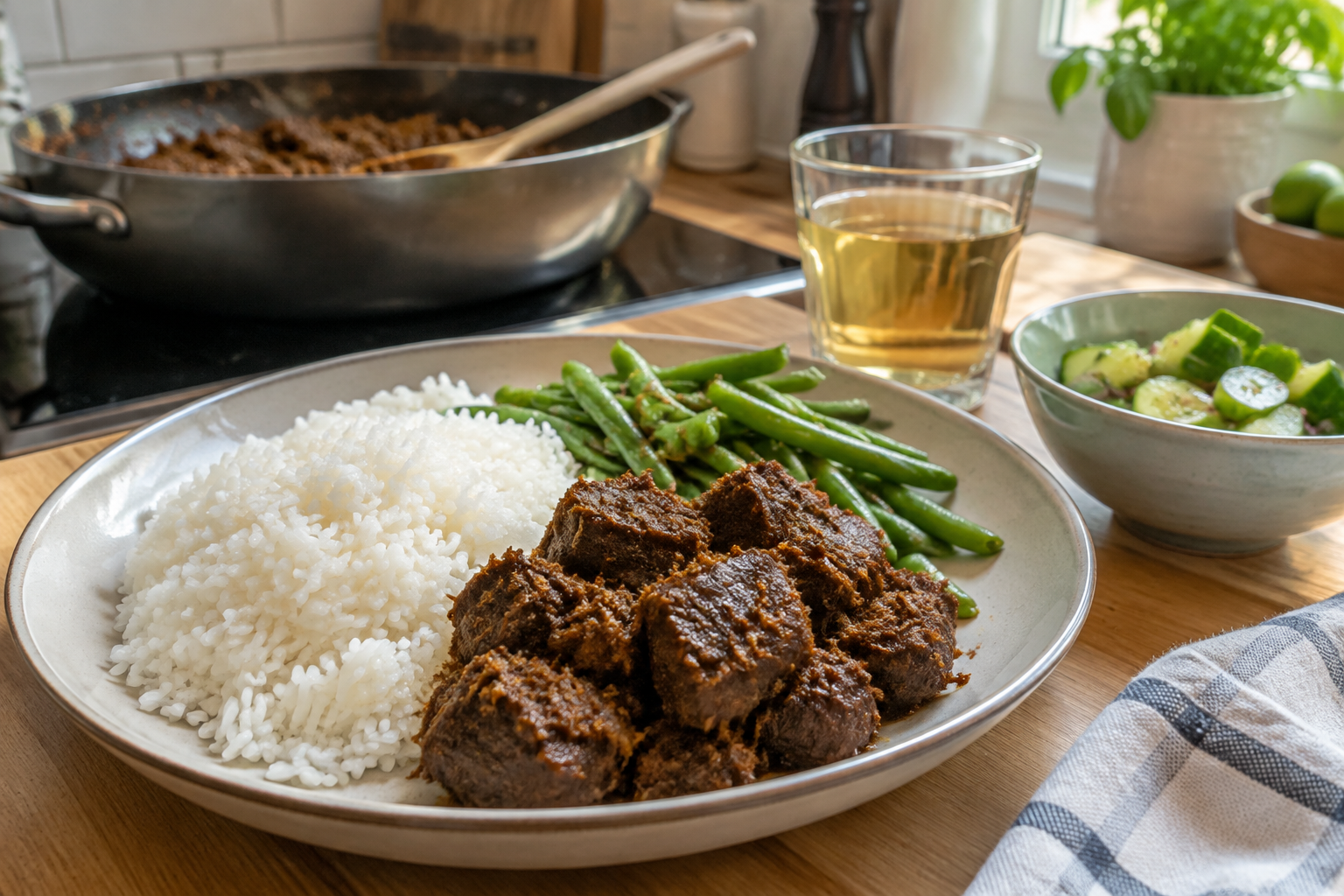
On the plate, there is no need for an elaborate arrangement. White rice, something green, perhaps a refreshing cucumber salad. A small piece of rendang can carry a lot of rice. That is also a good way to understand the dish: it is the concentrated centrepiece of the meal, not a stew that needs to flood the whole plate with sauce.
At home in West Sumatra, known far beyond
Placing rendang within Minangkabau food culture is well founded. Assigning it an exact year of birth is not. The dish developed within a cooking tradition in which recipes and skills have long been passed on through practice, between people and generations. There is no widely accepted, unequivocal first preparation to point to, and stories of a lone inventor do little to help us understand it.
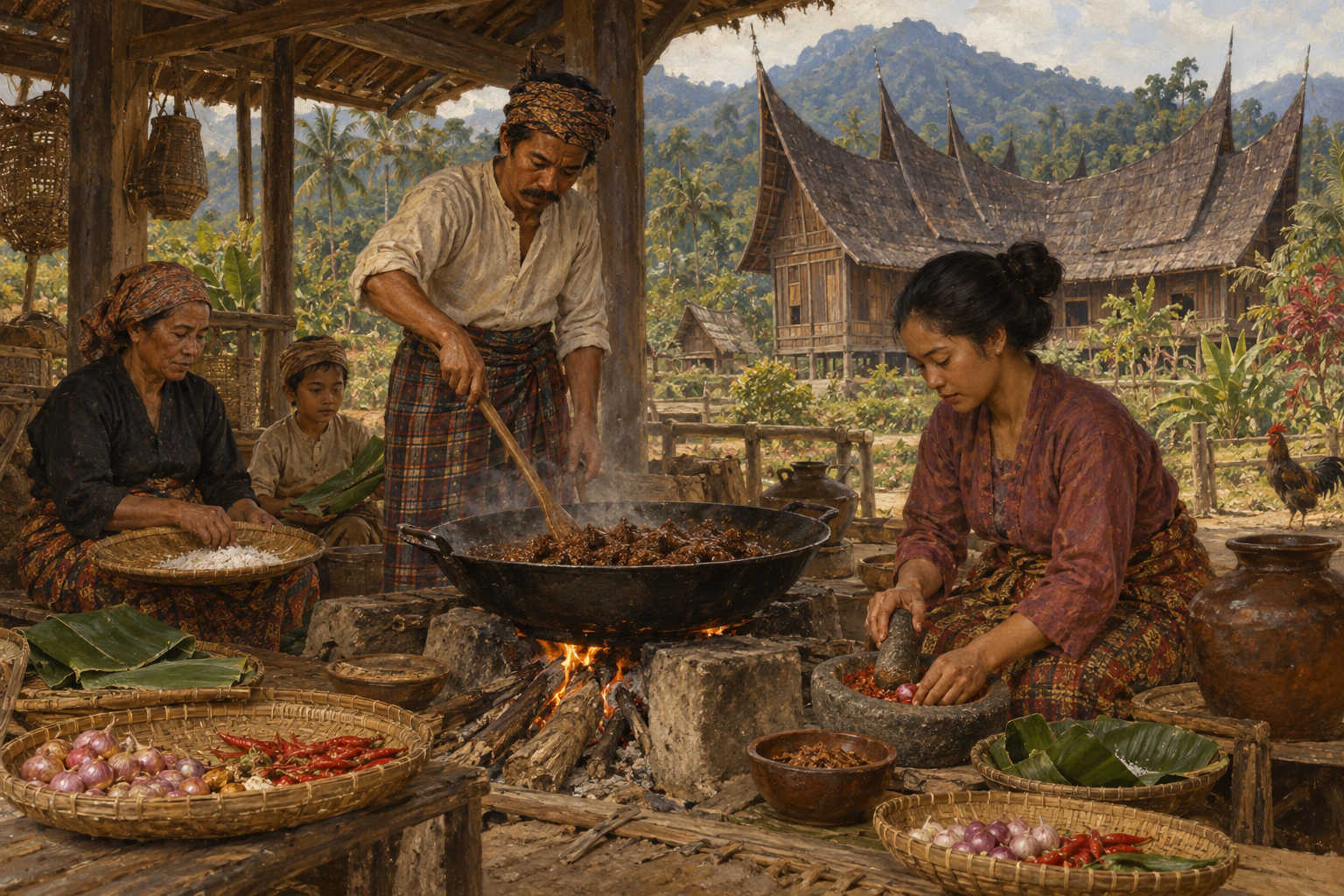
Minangkabau society is known for its matrilineal kinship system: lineage and certain property are passed down through the female line. This does not mean that women make every everyday decision or that kitchen work follows a simple rule. But it provides important background to a society in which ancestral houses, family ties and communal ceremonies carry great significance. Rendang belongs in precisely these social settings, not just in a cookbook’s list of main courses.
Both beef and buffalo meat have been used in the tradition. Large animals, valuable ingredients and labour-intensive cooking help explain why the dish has come to play a prominent role on important occasions. Weddings, religious festivals and ceremonies associated with adat, the local customary law and tradition, are settings in which rendang may appear. Exactly what is served, by whom and in what way varies between places and families.
The dish has also changed over time. Chilli, which now seems integral to many versions, originated in the Americas and reached Asia through the global trading networks that followed Columbus. Claims of a very ancient, unchanged rendang recipe should therefore be treated with caution. A dish can have deep roots while still bearing traces of later exchanges of ingredients. Tradition is not the same as standing still.
Today, rendang is found in several parts of Indonesia, as well as in Malaysia and Singapore, among other places, with local traditions and family recipes of their own. Its spread does not make every version identical. The meat, seasoning, colour and moisture level vary. Recognising the central importance of the Minangkabau need not mean dismissing other people’s rendang. It is more useful to ask which place, household and occasion a particular version belongs to.
Merantau – food follows those who leave
An important part of the story is merantau: the tradition of leaving one’s home region to seek education, work, trade and experience elsewhere. It has long been significant among the Minangkabau, historically especially for men, although mobility today cannot be described by a single rule about gender. Leaving does not necessarily mean cutting ties with home. On the contrary, family and hometown can remain powerful points of reference.
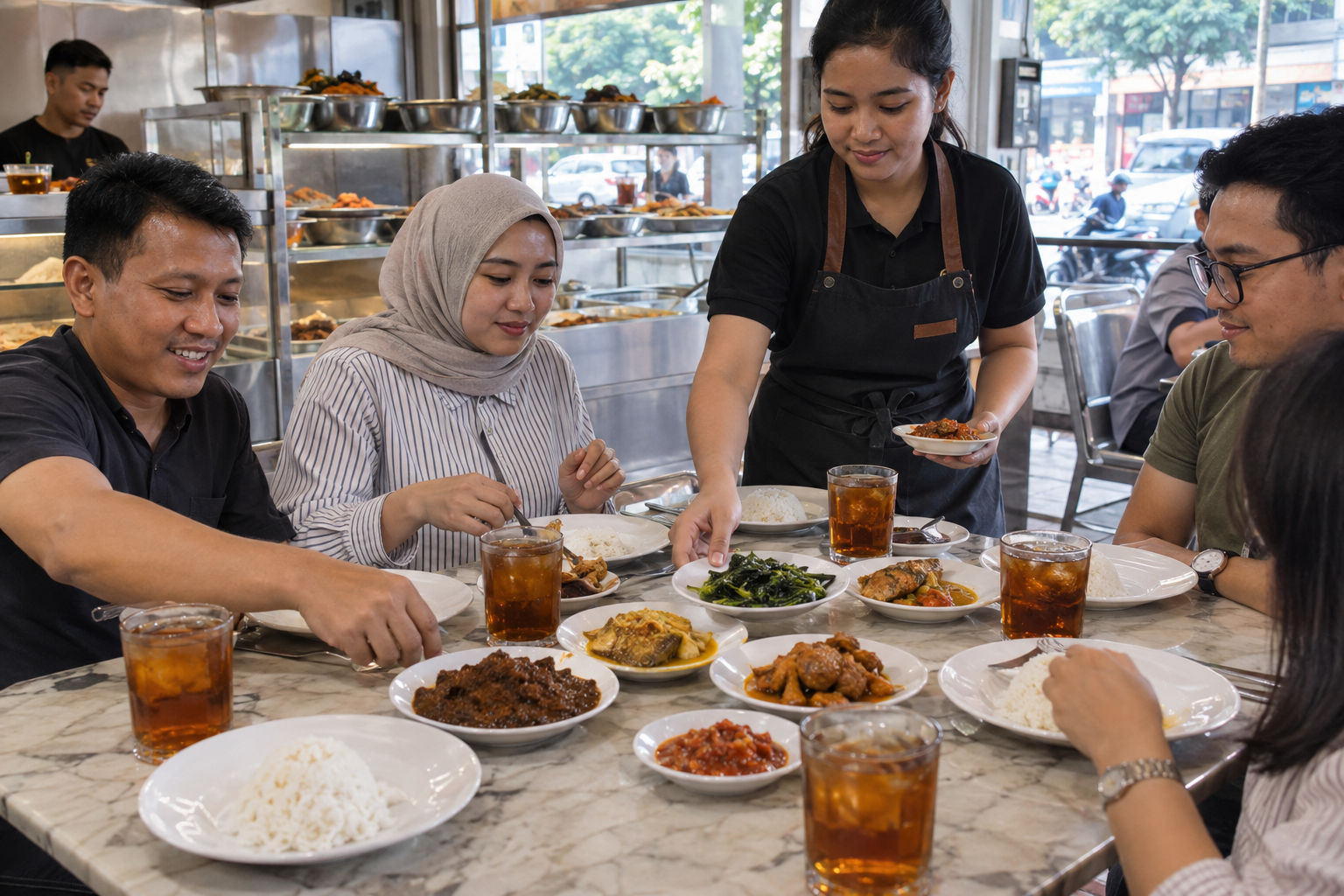
Culinary knowledge travels with people. The Minangkabau restaurant tradition has made rendang well known far beyond West Sumatra. Signs often say Padang, the name of the province’s coastal city and capital, which has become a broad label for this restaurant food. It is a convenient geographical shorthand, but not the whole story: the cuisine’s roots extend well beyond the city itself.
In the style of service generally known as hidang, several small dishes are placed on the table for diners to choose from. Rendang may sit alongside fish, chicken, vegetables, sambal and coconut-rich stews. Elsewhere, customers point out their choices at the counter or have them packed with rice to take away. It is both restaurant culture and everyday practicality, food that works for those with time to spare and those on the move.
The prolonged reduction is relevant here. Removing much of the water makes the food less perishable than a comparable meat stew with more liquid. Rendang has therefore often been associated with the ability to store and transport cooked food. Yet it is too simplistic to state that the dish was invented specifically as travel provisions. A useful quality is not automatically a documented origin story.
And historical keeping qualities should not become modern storage advice. Homemade rendang is not a sterilised preserve, and different batches contain different amounts of residual water. In a Swedish kitchen, it should be cooled quickly, refrigerated and frozen if it will not be eaten soon. We can appreciate the practical strengths of the old technique without leaving meat at room temperature for days.
Perhaps what travels best of all, though, is the sense of recognition. The aroma of coconut turning from milky to toasted, together with galangal and citrus leaves, can create a clear connection between home and a restaurant far away. Rendang’s international life is therefore as much about families and livelihoods as it is about the popularity of a single dish.
Kalio and rendang – the same pot, different finishing points
For the home cook, the distinction between kalio and rendang is key. In Minangkabau contexts, kalio refers to a closely related, wetter preparation in which the meat is still surrounded by plenty of concentrated coconut sauce. It is usually lighter in colour than a long-cooked rendang. Kalio is good food with a name of its own, not a failure that needs an apology.
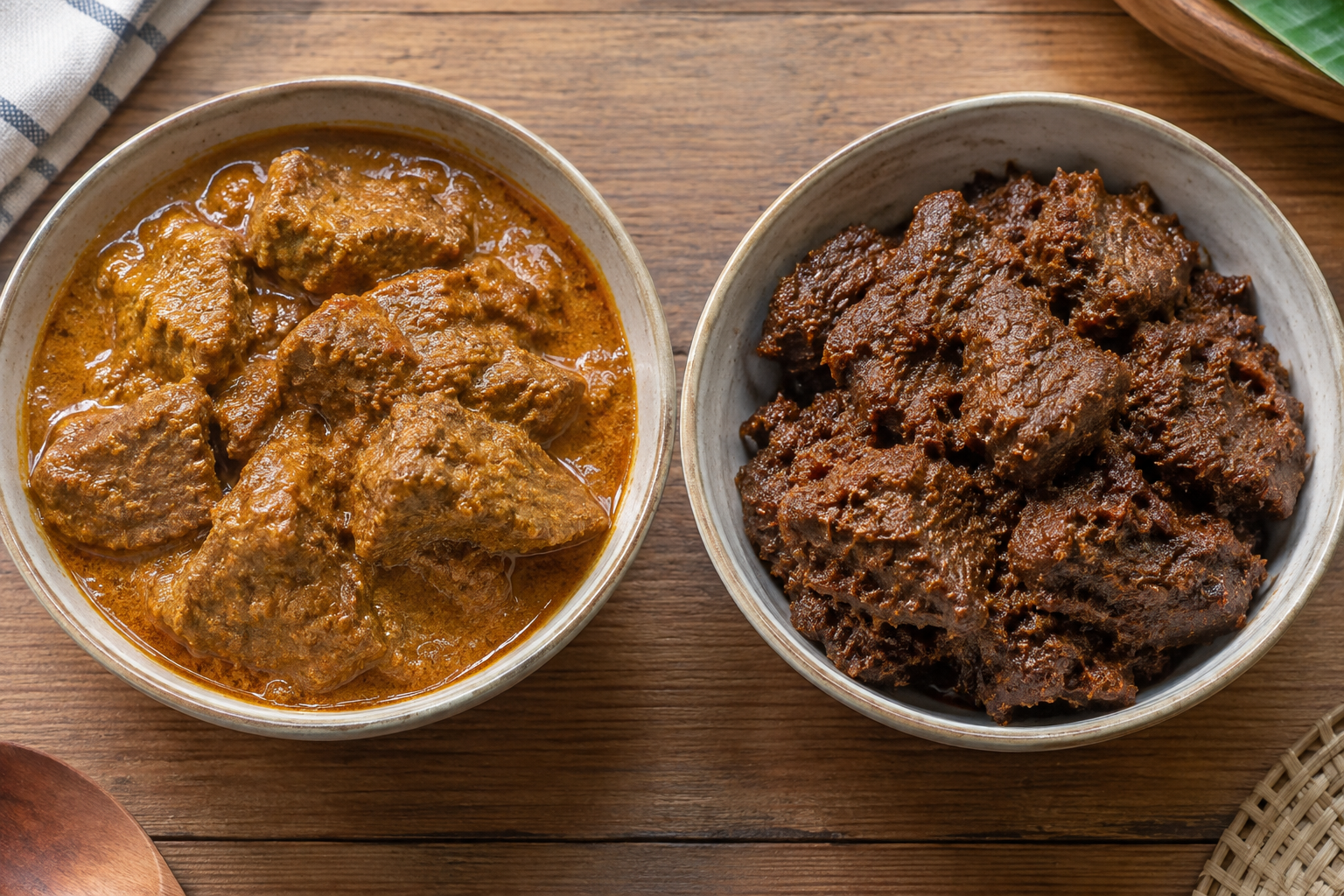
The cooking can be described as a progression from plenty of liquid to an increasingly dry result. But there is no universal timetable with sharply defined stages. The width of the pot, the amount of coconut milk, the water content of the meat and the heat all affect the process. Families may also prefer different finishing points. What matters is that a brown, saucy meat stew does not automatically correspond to the dry, dark rendang many people associate with West Sumatra.
At first, the coconut milk acts as the cooking liquid. The meat’s connective tissue softens during slow cooking, while the raw onion notes in the spice paste disappear. Gradually, water evaporates and the emulsion breaks: the fat becomes visible. In many Western sauces, separation would be seen as a fault. Here, it is expected and useful. The coconut oil becomes part of the final stage of cooking.
With less water remaining, the spice mixture can brown against the hot surfaces of the pot as the meat is turned in it. The dark colour comes from the prolonged concentration and browning of the ingredients, not from any need to add soy sauce. It is tempting to turn up the heat to save time, but this risks burning the onion, chilli and coconut before the meat is tender.
There is an important textural distinction to keep in mind: dry on the outside is not the same as dry within. The pieces of meat should be tender and juicy, with the spices clinging closely to their surface. This is why substantial pieces of a cut with connective tissue are used, and why the final stage must be handled gently. Stirring vigorously once the meat is cooked can turn the whole pot into shreds.
Nor does the colour need to be pushed to black for the result to count. Dark chestnut brown is a reasonable guide for the recipe here. The spices should smell deeply toasted, never acrid or burnt. Watch the base, listen to the sizzle and taste. The clock is a guide, not the judge.
The spices that build depth
Beef chuck is a good choice in Sweden. It contains connective tissue suited to slow cooking and is readily available in ordinary supermarkets. Look for a piece with visible marbling and cut it into large, even cubes. Very lean stewing beef can dry out before the sauce has reduced. Small pieces, on the other hand, may fall apart long before the dish is finished.
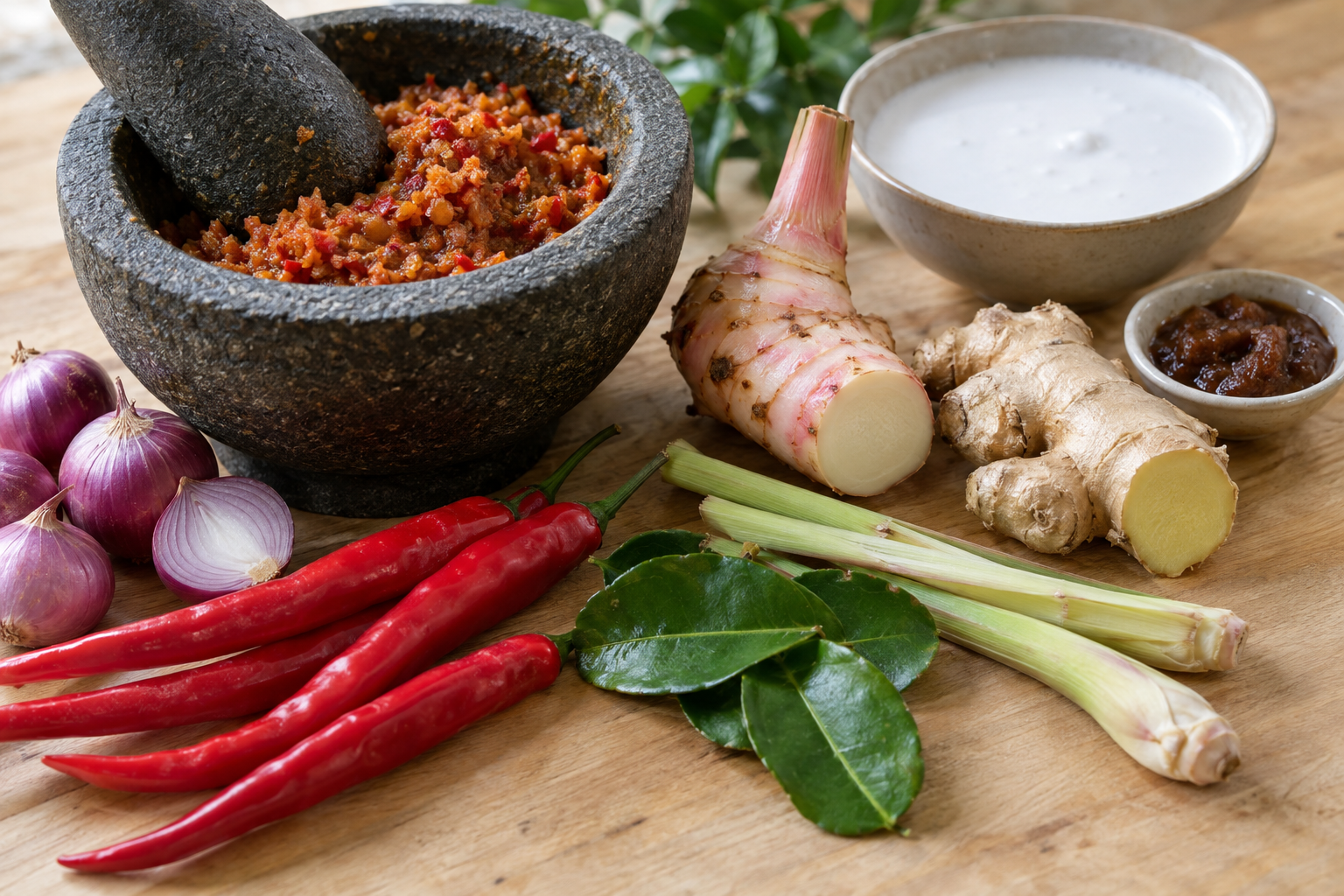
The coconut milk should be full-fat and unsweetened. Light versions provide less of the fat needed at the finish and change the balance between liquid and coconut. Ideally, choose a product with a short ingredients list and around 17–20 per cent fat. Stabilisers can affect how it behaves, but do not automatically make a product unsuitable. Coconut cream, however, is not necessarily a direct substitute by volume; it may need diluting.
Shallots give the spice paste sweetness and body. Small Asian shallots are common where the dish originates, but the larger varieties sold in Sweden work well when the quantity is given in grams. Brown onions can also be used, though the flavour will be slightly different. The paste should be fine enough to spread around the meat, rather than remaining as large pieces of onion in a sauce.
Ginger and galangal are related, but their flavours are not interchangeable. Ginger brings a warm, distinct heat. Galangal is firmer, more perfumed and peppery, with a fresh note that counters the richness of the coconut. Look for fresh or frozen galangal in Asian food shops. Frozen is an excellent practical choice. Extra ginger may save a shopping trip, but it will not recreate galangal’s aroma.
The lemongrass is bruised to release its fragrance. Makrut lime leaves contribute an intense citrus character that is not the same as the acidity of the juice. Many recipes also include fresh turmeric leaf. It can be difficult to find in Sweden, so it is optional here. Ground turmeric does not replace the leaf’s aroma; the powder in the spice paste serves a different purpose. Omitting a hard-to-find leaf is more honest than claiming that an entirely different spice does exactly the same job.
For acidity, some West Sumatran versions use asam kandis, a dried sour fruit. The recipe here uses a small amount of tamarind as a practical adaptation. It should add a subtle sharpness, not dominate. Tamarind products vary greatly in strength, so a regular purée and a potent concentrate cannot be used in the same quantities.
The chilli also needs to be chosen with care. Long red chillies often offer more flesh and colour relative to heat than small, fiery varieties, but their strength varies. Use a variety you know and cautiously taste a small piece before cooking. As the stew reduces, both the chilli and the salt become more intense. Start cautiously with the salt and adjust towards the end.
Celebratory food, hospitality and everyday rice
Rendang carries the weight of celebration, but it does not live only on festive tables. Restaurants, home kitchens and packed lunches have given it other settings. A dish can be readily available in everyday life and still retain its significance at weddings and family gatherings. The difference often lies in the quantity, the work, the company and what else is served.
When rendang is cooked on a large scale, the labour becomes visible. Someone prepares the onions, someone handles the spices, someone watches over the ever-thickening mixture. A large pan demands both strength and experience towards the end. It is easy to romanticise such work from a distance, but it takes real time. Serving rendang also means having devoted hours to another person’s meal.
The accompaniments help balance the concentrated flavour. Rice provides a mild, warm foundation. Boiled or briefly cooked leafy greens and beans add a fresher texture. Sambal can bring extra heat, but is not compulsory when the rendang itself is already fiery. A lightly tangy cucumber salad works well in a Swedish home setting, without needing to be presented as the only traditional accompaniment.
Drinks deserve the same care. Jasmine tea has floral notes that can complement the fragrance of the citrus leaves, but brew it gently rather than bitter. This is a flavour pairing, not a claim that jasmine tea is rendang’s particular ceremonial drink. Es teh manis, sweet iced tea, on the other hand, is a familiar part of Indonesian drinks culture. Here, the sweetness can be adjusted to suit both the heat of the food and personal taste.
Those who wish to serve wine can choose an aromatic Gewürztraminer with a little residual sweetness and moderate alcohol. The grape’s spicy, floral character has enough presence for the food, while the sweetness can soften the sensation of chilli heat. High alcohol and pronounced tannins, by contrast, risk making the meal feel fierier. Wine is an optional modern addition, not a necessary part of the dish’s cultural setting; many Minangkabau are Muslim and abstain from alcohol.
Making it work in a Swedish kitchen
Choose a wide, heavy-based pot or a deep pan with a sturdy base. Width is crucial for evaporation. In a narrow saucepan, the meat may be cooked while the coconut milk is still deep, leaving an awkward choice between overcooked meat and too much sauce. A pot around 28–30 centimetres across suits the quantities in the recipe, provided it is also deep enough.
Plan for an afternoon at home, not four hours of uninterrupted work. At first, the pot needs watching and regular stirring. Towards the end, you must stay close to the stove. Do not try to finish the rendang while juggling several other demanding tasks. The final half-hour can make the difference between a wonderful spice crust and a burnt base.
The meat and liquid do not always reach the right point together. If the pot is drying out before the meat is tender, add a little hot water and continue cooking slowly. If the meat is already very tender but there is still plenty of sauce, it can be lifted out temporarily while the sauce reduces. Return it before the final stage and turn gently. It is the temperature and water balance that need correcting, not your patience that needs abandoning.
Consider cooking it the day before. This also lets you work without hungry guests acting as timekeepers. Cool the food quickly in shallow containers and refrigerate. When reheating, a small splash of water can stop the spice mixture sticking; then let the water evaporate again and heat the meat thoroughly. Store rice separately and cool it quickly too if it is to be kept.
The recipe below is a beef rendang adapted for the home kitchen, aiming for the drier Minangkabau style rather than claiming to be the one authorised original. What matters most is the process: let the meat become tender, let the coconut milk give up its water, and let the spices finish their work in the fat. When the bubbling has become a gentle sizzle, it is time to set haste aside and stay by the pot.
Beef rendang – slow-cooked beef with coconut and galangal
A rendang adapted for the home kitchen in the drier Minangkabau style. Tamarind is used as an accessible alternative to asam kandis, and turmeric leaf is optional. Allow 3–4 hours for cooking, sometimes longer depending on the meat and the width of the pot. Makes four generous servings.
Ingredients
Method
- 1Prepare the spice paste. Roughly chop the shallots and chillies. Blend with the garlic, ginger, galangal, turmeric and coriander to make as fine a paste as possible. Use about 1 dl of the measured coconut milk to help the blender along. Scrape down the sides as needed.
- 2Remove the dry outer leaves from the lemongrass and trim off the hard root ends. Bruise the stalks with a knife handle or pestle, then cut them to fit the pot. Tear the lime leaves slightly. Tie the turmeric leaf in a loose knot, if using.
- 3Put the spice paste, remaining coconut milk, lemongrass, lime leaves and turmeric leaf, if using, in a wide, heavy-based pot, about 28–30 cm in diameter. Heat over a medium heat, stirring, until the mixture begins to simmer, about 10–15 minutes.
- 4Add the meat, salt and tamarind. Bring back to a gentle simmer and lower the heat. Cook uncovered for about 1.5–2 hours. Stir along the base every 10–15 minutes and turn the meat. It should bubble gently, not boil vigorously.
- 5Check the meat. It should be starting to yield to a fork but still hold together. Continue simmering uncovered for about 45–75 minutes. Stir more often as the sauce thickens. If the liquid has almost disappeared but the meat is still tough, add hot water 0.5–1 dl at a time and continue cooking.
- 6When coconut oil becomes visible and the sauce is very thick, reduce the heat to low or medium-low. Cook for a further 30–60 minutes or so. Scrape the base with a wooden spatula and turn the meat gently every few minutes, increasingly often towards the end. The spice mixture should darken and sizzle gently, not burn.
- 7Finish cooking when the meat is tender, almost no free liquid remains and the spices form a dark brown coating around the pieces. A little visible oil is normal. Taste and add more salt if needed. Remove the lemongrass and whole leaves where possible. Leave to rest for 15 minutes.
- 8Towards the end of cooking, cook the rice according to the packet instructions. Boil the beans in lightly salted water for about 3–5 minutes, until hot through but still crisp. Serve the rendang with rice, beans and sliced cucumber.
- The timing is a guide. A narrow pot slows evaporation. If the meat is ready long before the sauce, lift it out for a while, reduce the sauce and return the meat for the final stage.
- Galangal is often available frozen in Asian shops. If you cannot find it, use an extra 15–20 g of ginger, though the flavour will be different. The turmeric leaf can be omitted.
- For a milder rendang, replace some of the chilli with a pointed red sweet pepper. If using concentrated tamarind, start with considerably less and adjust to taste.
- Cool leftovers quickly in shallow containers and store at around 4 °C for 3–4 days, or freeze. Reheat gently with a splash of water until the entire dish is thoroughly hot.
What goes in the glass
- TeaGently brewed jasmine teaThe floral notes complement the lime leaves and lemongrass, while a light brew avoids bitterness alongside the chilli. Serve warm but not scalding, or cooled without sugar.
- WineGewürztraminer with a little residual sweetnessAromatic fruit and spice have enough intensity for rendang. A little sweetness softens the chilli heat. Choose a style with moderate alcohol and serve cool.
- Alcohol-freeEs teh manis – Indonesian sweet iced teaChilled black tea with sugar and plenty of ice provides a cooling contrast to the concentrated spices. Adjust the sweetness to suit the food and avoid steeping for too long, which can make the tea bitter.
Enjoy alcohol in moderation. Alcohol-free options go just as well with the food.
Sources
- Sri Owen, Indonesian Regional Food and Cookery (1994)
- James Oseland, Cradle of Flavor: Home Cooking from the Spice Islands of Indonesia, Malaysia, and Singapore (2006)
- Encyclopaedia Britannica, Minangkabau
- Maricel E. Presilla, The Peppers of the Americas: The Remarkable Capsicums That Forever Changed Flavor (2017)
Ask questions about "Rendang – the Minangkabau stew that rewards patience". Answers are based on the magazine's own articles.