A Roman Dinner – At the Table with Apicius
Fish sauce, pear patina and spiced wine in a kitchen where sweet and savoury happily met.
A lavish Roman table might smell of honey, pepper and fermented fish. But the cookbook known as Apicius is neither a menu for all Romans nor one gourmand’s life’s work. We follow its trail from the reclining couches of the triclinium to today’s Swedish kitchens – and make a pear patina with unexpected depth.
 By Arvid HolmFood historian · Historic dishes, old cookbooks and eating habits through the ages
Translated from Swedish with AI assistance.
Go to the recipes (2) ↓As dinner arrives
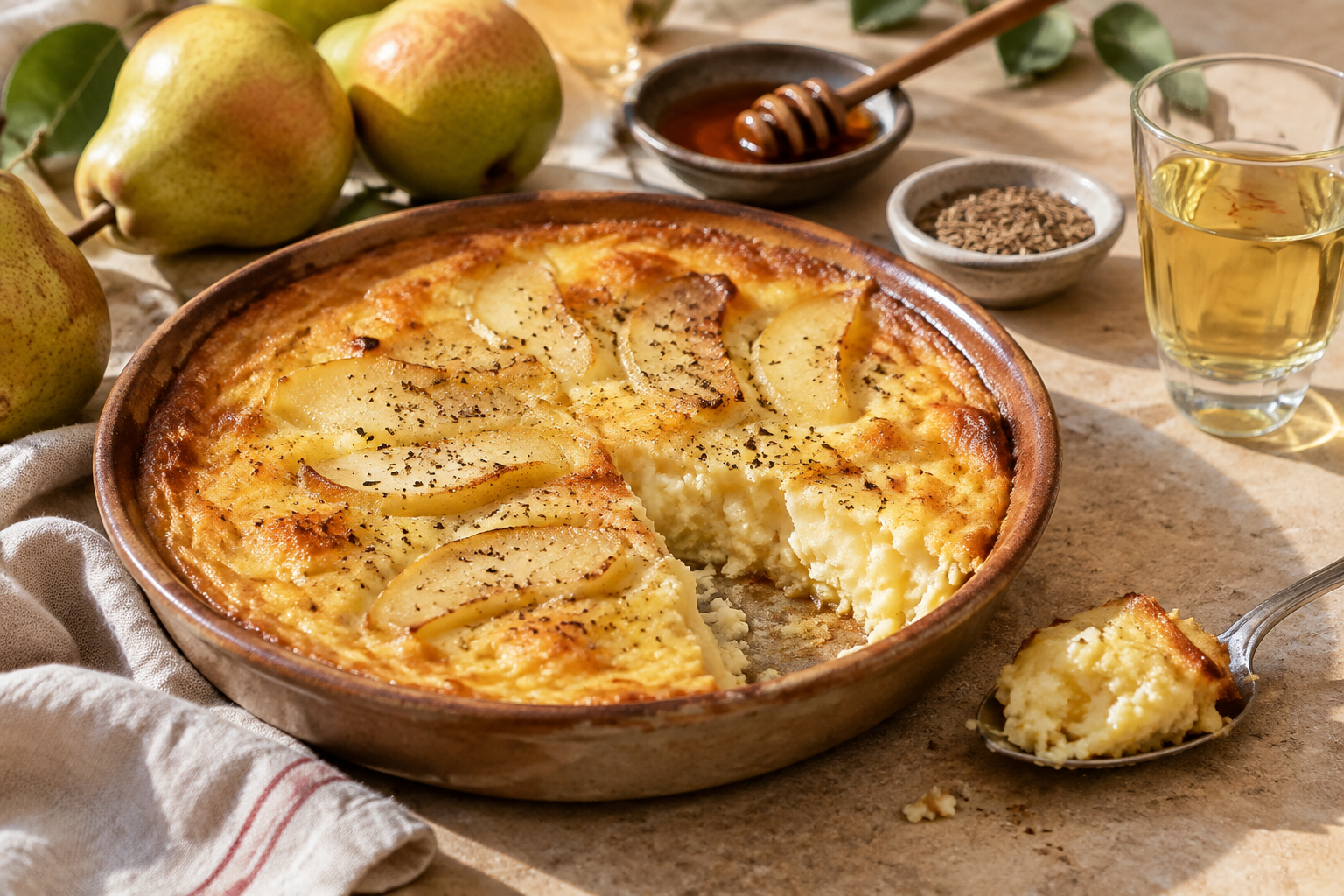
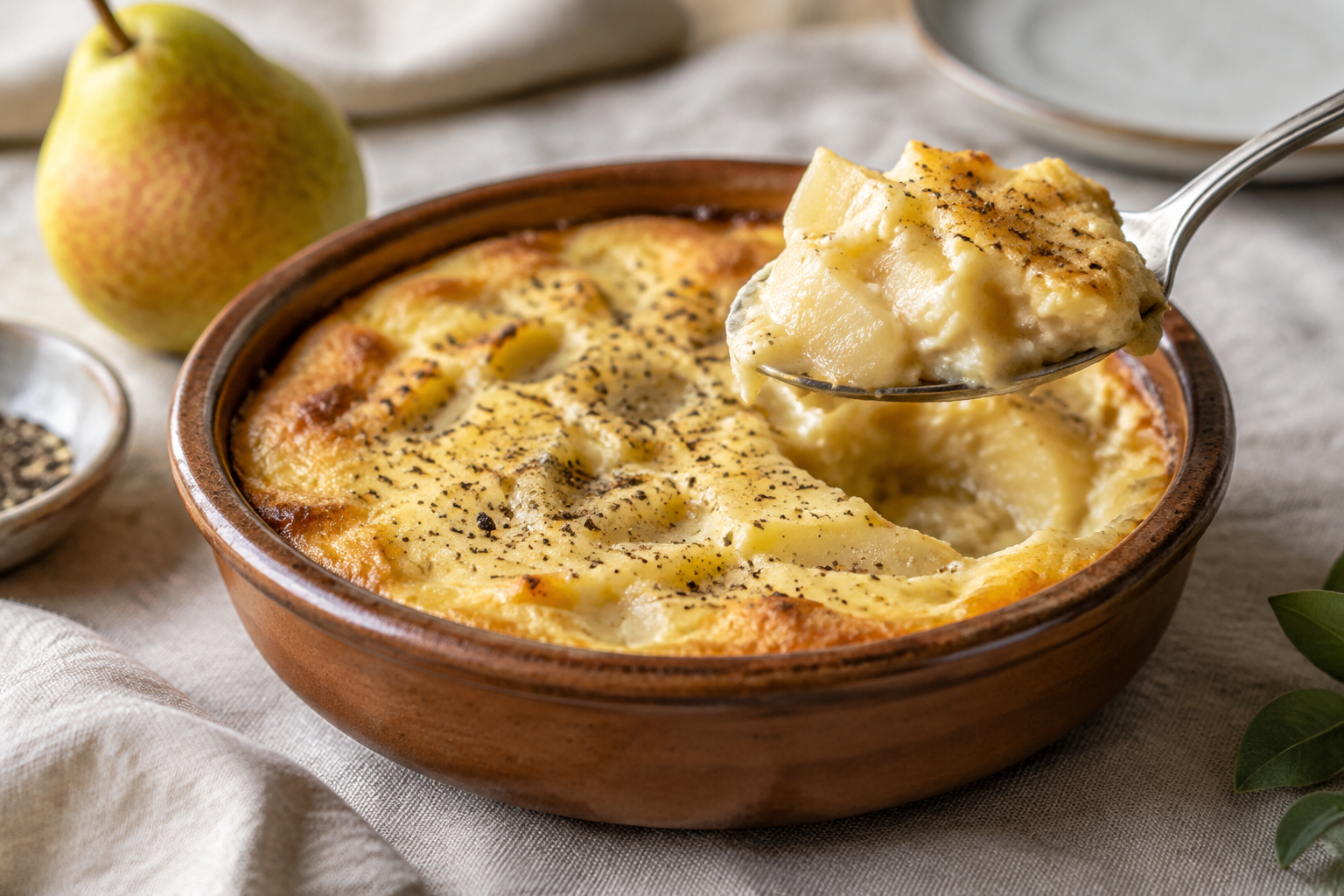
The oil lamps have been lit. From the courtyard comes the sound of water; from the kitchen, a muted scraping as spices are ground in a mortar. A dish is set down: its surface golden, its texture soft, the scent of ripe pears punctuated by pepper and something warm and earthy. Only on tasting it does the saltiness emerge. It comes not just from salt, but from a sauce made from fish.
Imagine the scene in a wealthy Roman household during the imperial period. This is an imagined reconstruction, not a surviving snapshot. The ingredients, however, are supported by the recipe collection we generally call Apicius. There we find pears with cumin, honey, pepper, eggs and liquamen, a Roman fish sauce. The combination feels unusual in a Swedish kitchen, yet follows a clear logic of flavour: the fruit’s sweetness gains substance from eggs, warmth from spices and depth from saltiness.
In the dining room, some guests recline at the table, propped against cushions. Other people stand, carry, carve and replenish. The elegant dinner rests on labour often performed by enslaved people. A Roman banquet table is thus both a place of pleasure and a reflection of society’s hierarchies.
We need to keep that duality in mind. Roman food culture encompasses inventive cooks, long trade routes and an impressive feel for sauces. It also encompasses vast differences between those who could order a rare fish and those trying to make grain, pulses and a little oil stretch far enough. Apicius opens a door to ancient kitchens, but not to everyone’s kitchen.
Apicius: one famous name, centuries of recipes
Marcus Gavius Apicius lived in the early imperial period and is particularly associated with the reign of Emperor Tiberius, AD 14–37. Ancient writers made his name synonymous with gastronomic luxury and excess. The stories of his extravagance are also moral tales: Roman authors often used food and money to discuss moderation, character and decline.
That does not mean this Apicius wrote the cookbook that survives today. De re coquinaria, roughly “On the Art of Cooking”, is a composite recipe collection whose surviving form is generally dated to late antiquity, around the late fourth or early fifth century. It contains older material, and it has reached us through medieval copies. The most important complete manuscripts date from the ninth century.
We are not, then, reading an untouched notebook from a dinner in AD 30. We are reading a layered work: recipes, kitchen knowledge and editorial interventions from different periods, preserved through the work of copyists. The name Apicius acts as a seal of authority, but authorship cannot be reduced to one person.
The collection is arranged in ten books. It includes advice on household management and preservation, minced-meat dishes, vegetables, poultry, four-legged animals and fish. Some recipes are very short: ingredients are listed, something is to be pounded, mixed, boiled or thickened. Quantities, timings and temperatures are often absent. The text assumes a reader who already knows how to cook.
That is an important difference from today’s recipe cards. When we specify half a teaspoon of cumin or an oven temperature of 160 degrees, we are doing more than translating Latin. We are making practical decisions. A successful reconstruction should therefore explain both what the source says and what the modern cook has added.
Nor is Apicius simply a catalogue of outrageous luxury. There are peas, lentils, leeks and everyday cooking techniques here. Yet access to spices, specialised labour and varied ingredients means that the collection chiefly helps us understand cooking in well-resourced households. It cannot, on its own, describe how soldiers, farm labourers or poor city dwellers ate.
For the broader picture, we need other kinds of evidence: bones and seeds from excavations, fish-processing facilities, mills, bread ovens, amphorae and texts from other genres. Satire can reveal what was considered ridiculous at a dinner table, but it is no neutral food diary. A painted bowl of fruit tells us about motifs and ideals, not exactly how many figs someone ate.
The triclinium – a dining room with a social map
The main Roman meal was called cena. When it began and how long it lasted varied according to period, social standing and occasion. A wealthy household’s dinner might occupy much of the late afternoon and evening. That is quite different from saying that all Romans always ate leisurely banquets.
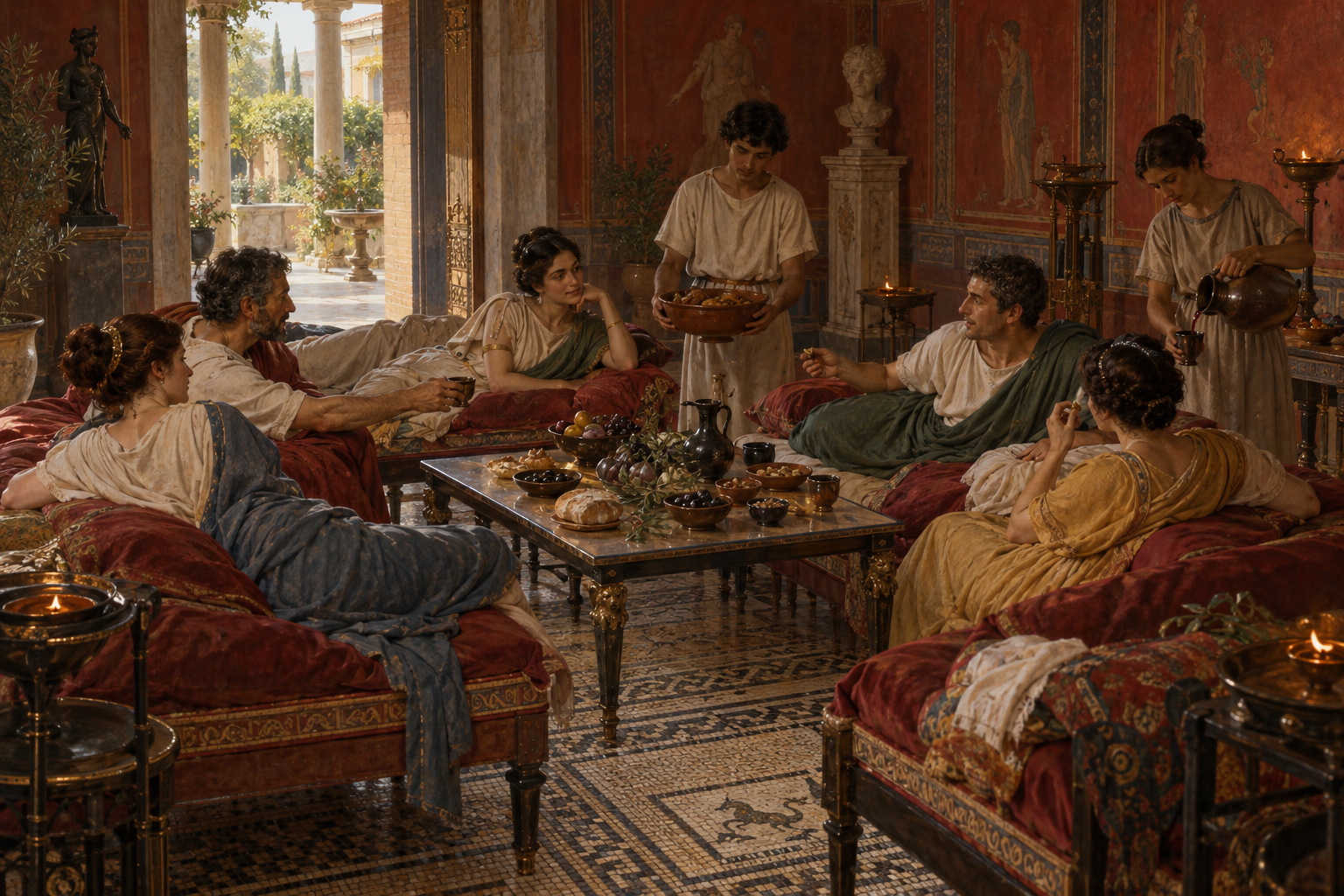
The word triclinium is associated with three reclining couches around a table, often in a U-shaped arrangement with one side left open for service. Three people on each couch was a common ideal. But nine guests was no immutable rule, and both furnishings and dining-room layouts changed. During the later imperial period, semicircular dining couches, often called stibadia, became increasingly important.
Those reclining at table usually supported themselves on their left arm, leaving their right hand free. Food might be cut up before serving; hands, spoons and other utensils were used as needed. Imagining antiquity as either entirely without table manners or almost identical to our own age misses the point. There were rules, but different rules.
Seating expressed rank and relationships. Proximity to the host, places of honour and the order of service could turn the meal into a social map. Even the food could mark distinctions between people at the same gathering, something ancient satirists were keen to attack. Hospitality and power were closely entwined.
Women could attend Roman dinners and also recline at table, although conventions varied. Children and people of lower status might sit. To say that “the Romans reclined when they ate” is therefore too sweeping. Some Romans reclined at some meals; others sat, stood or ate in entirely different circumstances.
A more formal dinner might progress from opening small dishes, gustatio, through larger courses and finally to fruit, nuts and sweets. But Apicius is not a continuous banquet menu, and its dishes do not always fit our categories of starter, main course and dessert. A sweet pear patina with fish sauce shows particularly clearly how risky it is to let today’s menu dictate yesterday’s tastes.
For a visual encounter with Roman food, the wall paintings from the towns around Vesuvius and Roman food mosaics are valuable. They depict fruit, fish, vessels and dining settings, for example. Yet these images must also be read as art: abundance could convey a message, and a decorative motif need not portray a table that was actually served.
Garum: the saltiness of the sea, not just a strong smell
If one ingredient has come to represent Roman taste, it is garum. Popular accounts often reduce it to rotten fish. That is both misleading and uninteresting from a culinary perspective. These sauces were made by salting fish and allowing it to break down under controlled conditions, with the fish’s own enzymes playing an important role. The result could be a strained, salty liquid used as a seasoning.
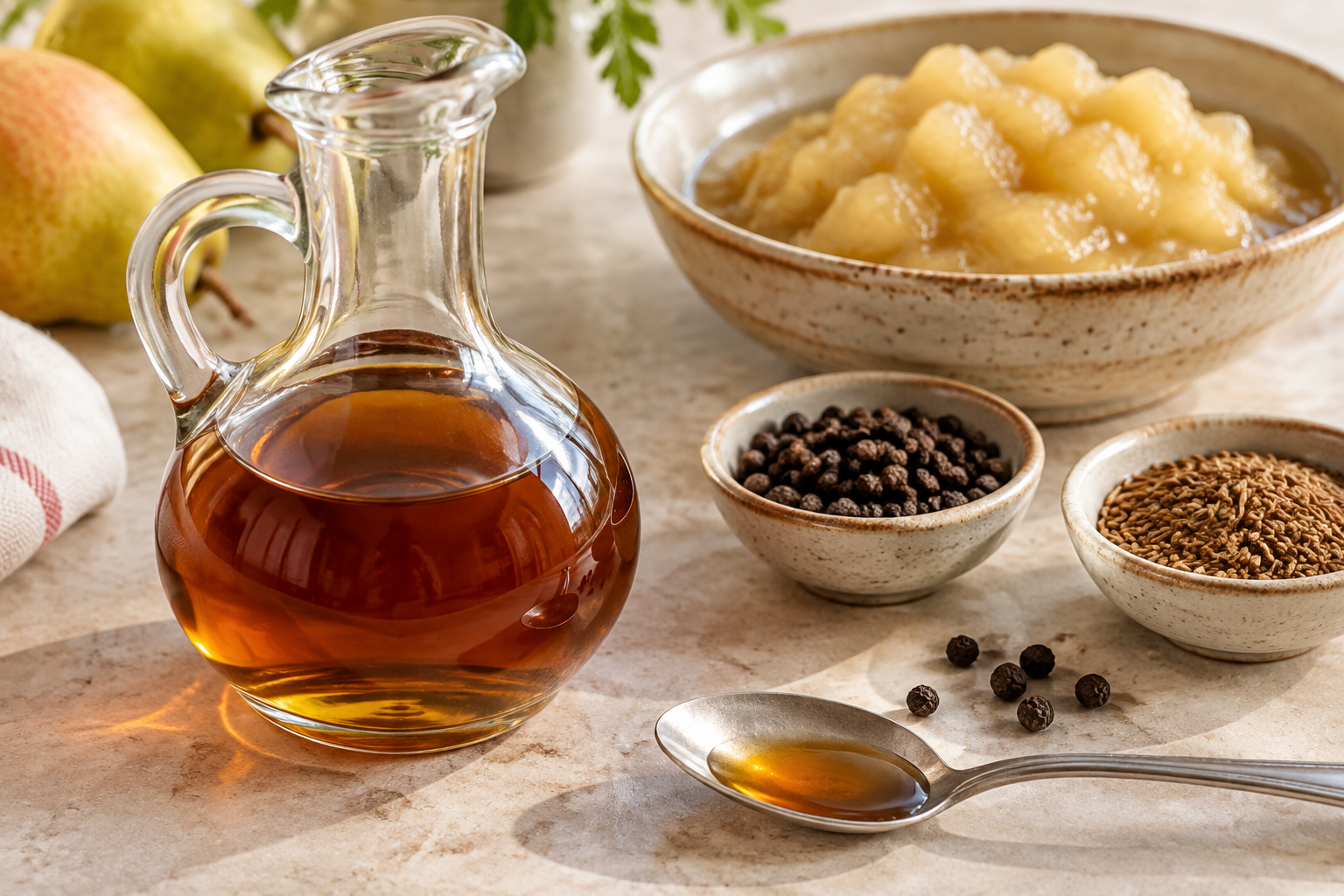
The terminology is more complicated than the modern label “Roman fish sauce” suggests. Ancient sources use terms including garum, liquamen, allec and muria. These words can denote different products or parts of the production process, but their meanings shift across periods and contexts. Liquamen appears frequently in Apicius. Exactly how these terms should be distinguished remains a research question, not a settled classification.
Fish-processing facilities and trading containers show that such products were made and distributed on a large scale in several parts of the Roman world, including the Iberian Peninsula and North Africa. Ingredients, quality and reputation varied. Just as “wine” does not describe a single flavour, fish sauce probably did not either.
In food, the sauce does more than add salt. Broken-down fish proteins contribute body and umami, a modern word for a taste effect that ancient cooks could exploit without describing its biochemistry. A small amount can round out a vegetable dish or make a fruit sauce less one-dimensional, without immediately making the diner think of fish.
For Swedish home cooks, Thai or Vietnamese fish sauce made from anchovies and salt is a practical substitute. It is not identical to every Roman product, but it serves a similar purpose. Look for one with a short ingredient list. Italian colatura di alici is another option, though it too should not be presented as an unchanged ancient original.
The quantity is crucial. The most common pitfall is trying to make history tangible by overdoing its most famous ingredient. In a delicate pear patina, the fish sauce should provide a quiet backbone, not dominate with the aroma of an open bottle. Taste the fruit mixture before adding the eggs, and use ordinary salt only if it is genuinely needed.
Homemade fish sauce requires knowledge of safe fermentation and handling. For this dinner, a commercially made product is the sensible choice. The interest of the reconstruction lies in the meeting of flavours, not in improvising a fish-processing facility on the kitchen counter.
Patina: pears between savoury and sweet
Patina can refer both to a vessel and to the food cooked in it. In Apicius, we encounter patinas with very different contents. Some resemble egg dishes or puddings, but the word does not correspond exactly to our omelette, gratin or pie. They have more in common in their form and cooking method than in any particular main ingredient.
The pear patina appears in the collection’s fourth book. Pears are cooked and worked into a mixture with pepper, cumin, honey, passum, liquamen and a little oil. Eggs bind the dish, and pepper also features in the finish. The source thus provides a clear pattern of flavours, even if it does not supply a complete modern recipe.
Passum was a sweet wine made with dried grapes. It should be distinguished from other grape products used in ancient cooking, including reduced grape must. A modern passito can be a useful counterpart in the kitchen, but grape varieties, production methods and final flavours vary. Our recipe uses white grape juice as a readily available alcohol-free alternative. This is a deliberate departure, not a claim of equivalence with the ancient ingredient.
The pears also affect the result. A firm, unripe pear needs more time and may produce a grainier purée. A very ripe pear softens quickly but can release plenty of liquid. Texture therefore matters more than following a precise number of minutes: the fruit should be soft enough to mash, and the purée thick enough not to dilute the egg mixture too much.
Cumin, not caraway, provides the warm earthiness. Pepper adds a drier bite. Both move the dish beyond the usual dessert flavours. The honey should lift the pear flavour, not turn the whole thing into confectionery. Olive oil adds fat and brings the flavours together, but a very bitter oil can take over.
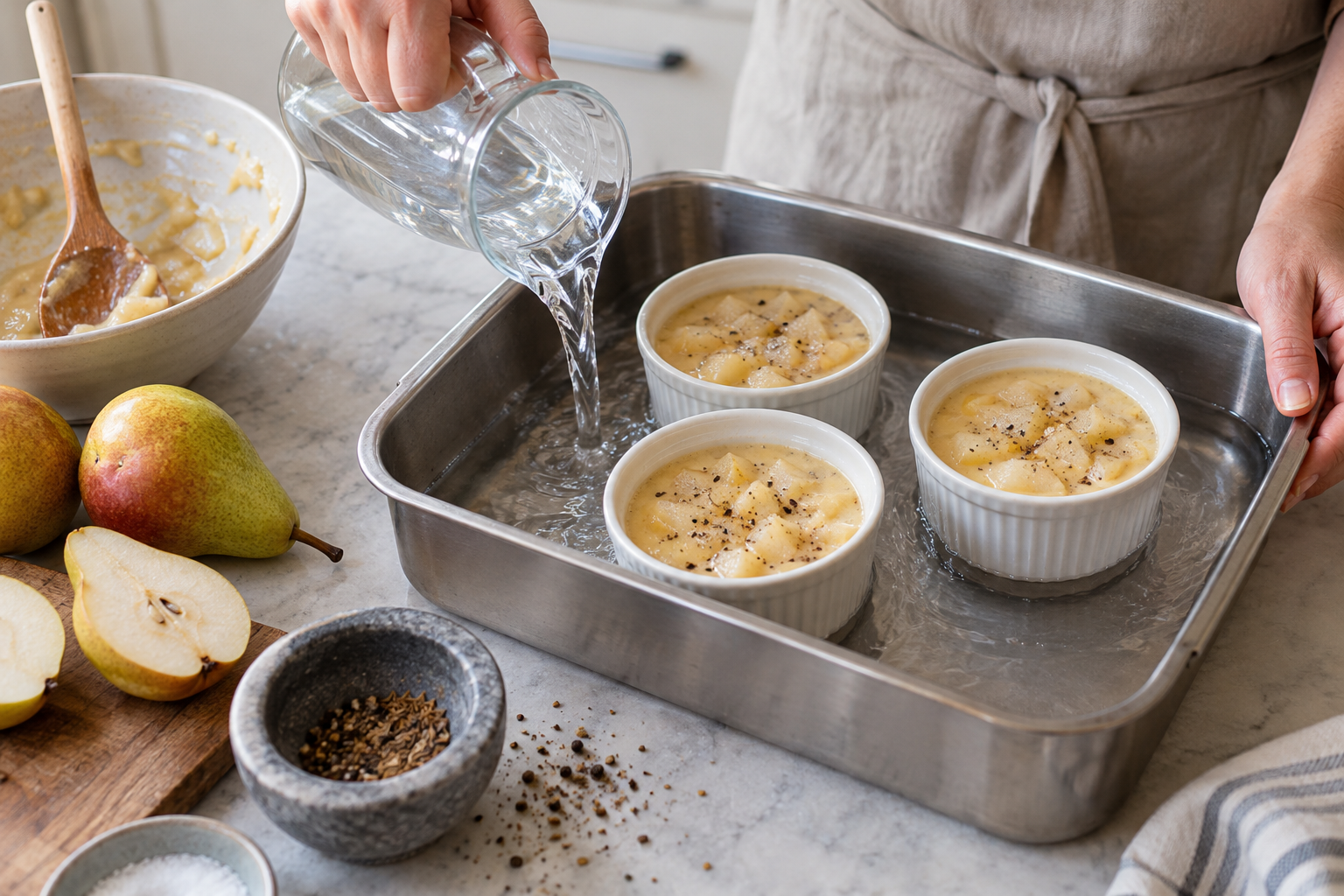
The ancient directions should not be read as precise instructions for our electric ovens. Roman cooks could work with embers, vessels, lids and various forms of indirect heat. Here, we use a low oven temperature and a water bath instead. This gives control over the setting of the eggs and reduces the risk of a dry, spongy edge around a still-runny centre.
The result is a soft, spoonable dish rather than a firm pie. Serve it warm, not hot, in small portions. At a modern dinner, it could make a surprising intermediate course or a gently sweet finale. That placement is ours, not something that can be confidently inferred from the recipe’s position in the cookbook.
Conditum paradoxum – wine with honey, pepper and prestige
The very first recipe in the Apicius collection is conditum paradoxum, a lavish spiced wine. Its name is generally rendered as something like a wondrous or remarkable spiced wine. Its position offers an enticing opening: before the food arrives, a drink that shows what the household’s stores and expertise can achieve.
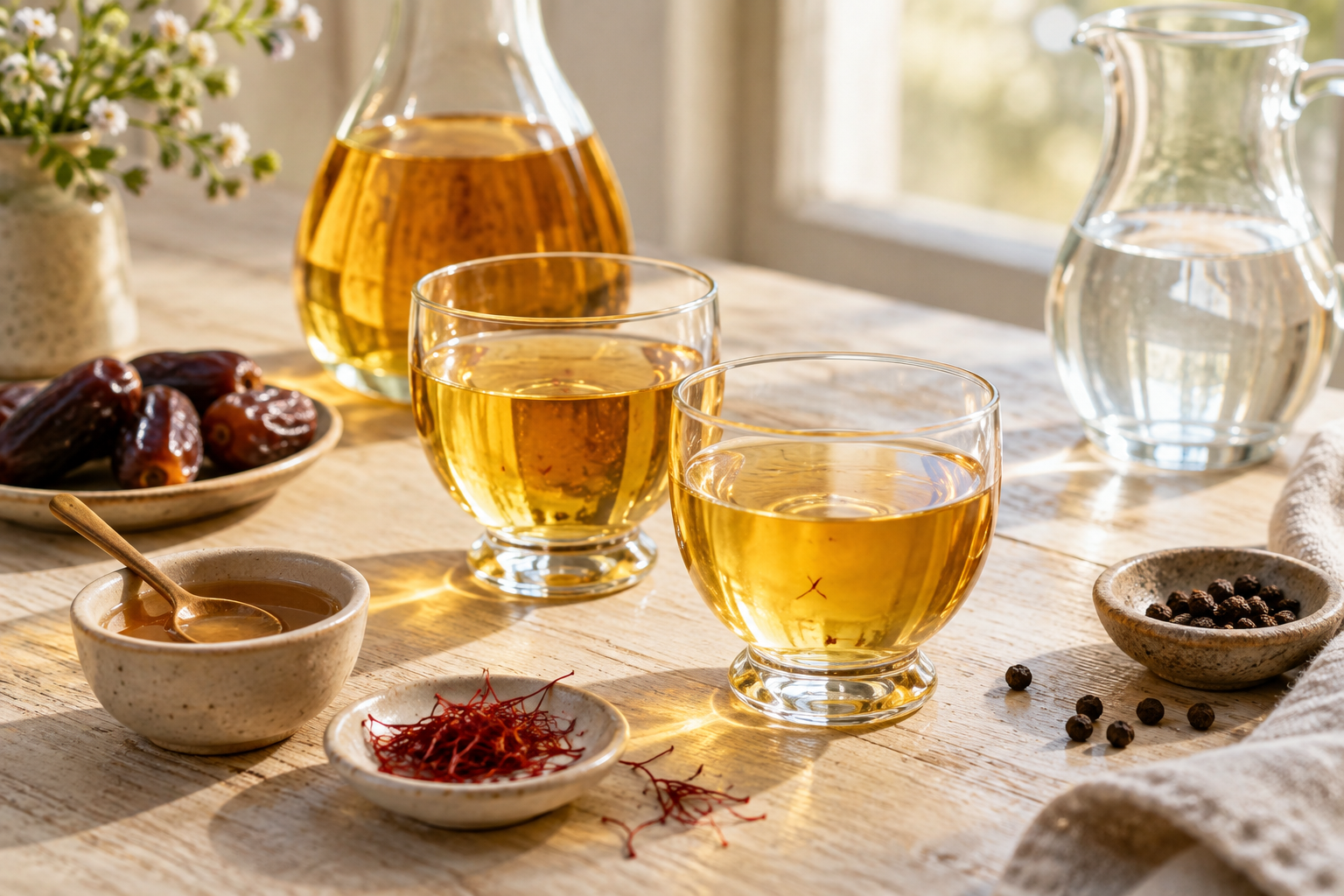
The recipe is unusually detailed compared with many of the food dishes. Honey and some of the wine are heated, foam is dealt with, spices are added and the mixture is diluted with more wine. It includes pepper, saffron, mastic, an aromatic leaf spice, dates and roasted date stones. The drink then undergoes further treatment, including clarification with charcoal.
Not every detail translates easily to a Swedish shop shelf. Mastic is an aromatic resin still used in eastern Mediterranean cooking. The Latin term for the leaf requires interpretation and is associated in translations with, for example, malabathrum, an aromatic commodity traded from Asia. Replacing it with an ordinary bay leaf without comment would give a false impression of certainty.
Our version retains wine, honey, pepper, saffron and dates. Mastic, the leaf spice, the stones and charcoal clarification are omitted. This simplifies the recipe and avoids questionable improvisation with ingredients not sold for that purpose. The amount of honey is also reduced considerably compared with the source’s proportions. The drink is therefore a source-based adaptation, not an exact copy.
Ancient measures must be treated with the same openness. Roman weights and volumes can be given approximate modern equivalents, but conversion does not resolve questions about the honey’s properties, the wine’s strength or the spices’ intensity. Calculating numerous decimal places would make the recipe seem falsely precise. Tasting and clearly stated choices are more honest here.
Wine was often mixed with water in Greek and Roman dining contexts, but strength and proportions varied. The spiced wine can therefore be served in small glasses and diluted to taste. It should not be called Roman glögg without qualification: the shared use of honey and spices is real, but neither the modern Christmas tradition nor serving it hot follows automatically from the ancient text.
The alcohol-free version is based on white grape juice and water, with less honey and a little lemon for balance. It is a contemporary alternative with the same aromatic idea, not a documented Roman drink. The alcoholic version remains alcoholic after its brief heating; heat does not turn wine into a safe alcohol-free choice.
An ancient dinner in a modern kitchen
There is no unbroken, uniform tradition in which people today eat exactly as in Apicius. Several ingredients and technical ideas do, however, live on in Mediterranean kitchens: olive oil, wine, pulses, processed fish products and an attention to sweet–sour balance. Similarities are interesting, but they do not prove that a modern recipe descends directly from an ancient one.
Cooking Roman food today is therefore about encounters between text and practice. A translator must decide what a word means. A food historian weighs the text against other evidence. A cook must finally decide how much pepper actually goes into the bowl. None of these tasks replaces the others.
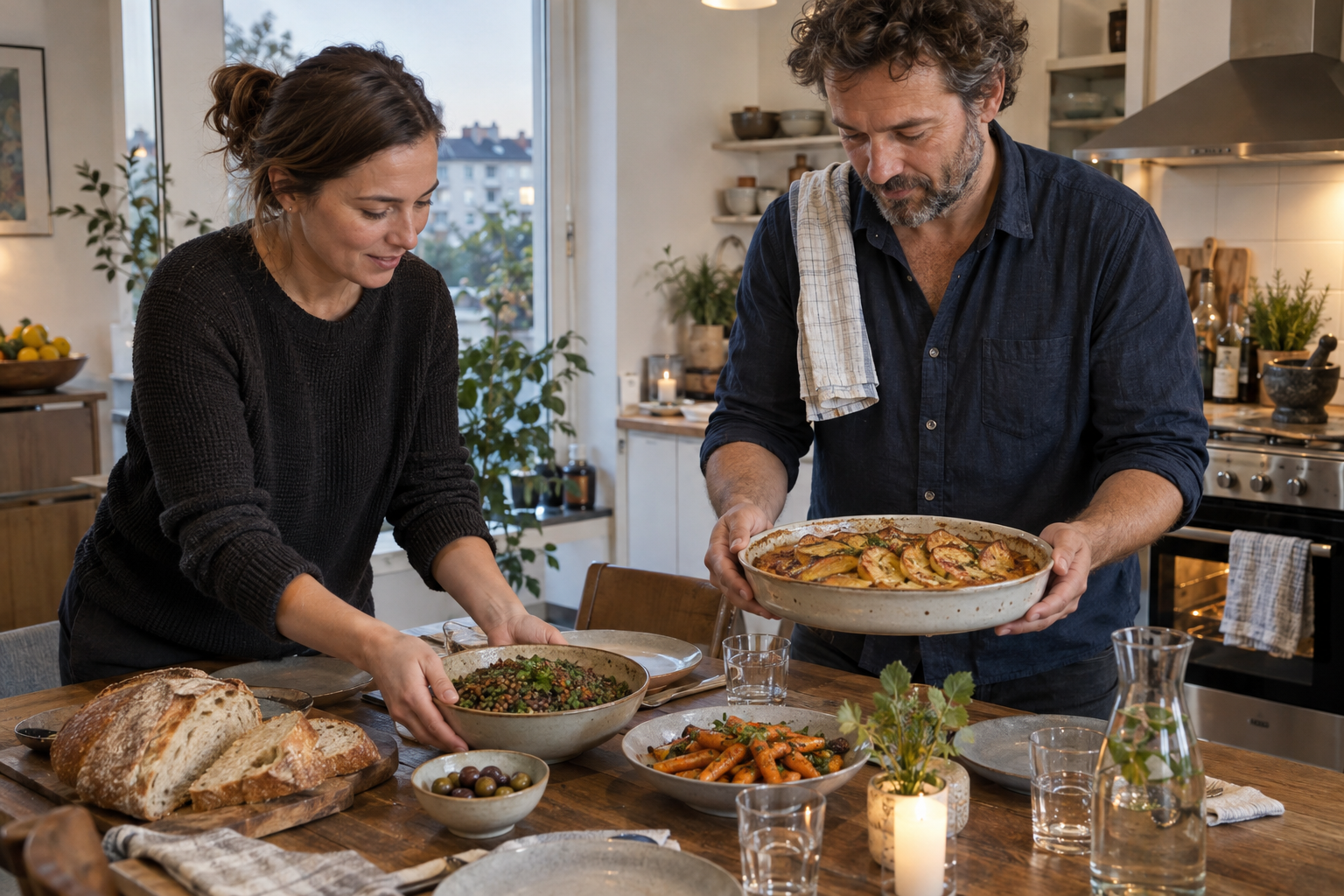
For a dinner at home, it is wiser to choose a few distinctive flavours than to pile every known Roman luxury onto the same table. Bread, olives, boiled lentils with herbs and a simple vegetable dish can frame the pear patina. The result is a Roman-inspired table, not a documented menu from a particular house.
Make the spiced drink the day before, if you like, and bake the patina close to serving time. Set out small glasses, water and an alcohol-free option on an equal footing. Explain that the fish sauce is there, both for anyone with allergies and because the surprise of the flavour becomes more interesting when it can be understood.
You do not need reclining couches. The most rewarding legacy of this cooking is, rather, its attention to combinations: how a little saltiness can give fruit a longer finish, how pepper can make honey feel less heavy, and how a simple egg mixture can carry several worlds of flavour at once. There, between the mortar and the first spoonful, the old text becomes food again.
Pear patina with honey, cumin and fish sauce
Reconstructed from the pear patina in Apicius, Book IV. The flavour combination comes from the source; the quantities, water bath and oven temperature are modern choices. White grape juice replaces passum, the sweet raisin wine of antiquity. Makes four generous or six small servings.
Ingredients
Method
- 1Preheat the oven to 160 °C, conventional heat. Grease an ovenproof dish with a capacity of about 1 litre. Have a larger dish ready to use as a water bath.
- 2Peel and core the pears, then cut the flesh into small pieces. Put them in a saucepan with the grape juice.
- 3Cover and simmer over a low heat for 10–15 minutes, until the pears are completely soft. Stir occasionally. Add a tablespoon of water if the pan is at risk of boiling dry.
- 4Mash the pears with a potato masher or blend briefly. If the purée is runny, simmer uncovered for another 3–5 minutes, stirring. It should become a thick fruit purée, not a soup.
- 5Stir in the honey, cumin, pepper, fish sauce and olive oil. Taste before adding the eggs: the pears should dominate, with the fish sauce adding a discreet saltiness. Leave to cool until lukewarm, about 10 minutes.
- 6Lightly beat the eggs without incorporating too much air. Stir them into the pear purée and pour the mixture into the greased dish.
- 7Place the dish inside the larger dish. Pour hot water into the outer dish to reach about halfway up the sides of the patina dish. Bake in the lower part of the oven for 35–45 minutes. The edges should be set and the centre should wobble gently as one pudding, rather than slosh.
- 8Carefully lift out of the water bath and leave to rest for 10–15 minutes. Grind over a little black pepper and serve warm, not hot, with a spoon.
- For a version closer to the source’s ingredients, replace the grape juice with the same quantity of sweet passito wine. The finished dish should then not be described as alcohol-free.
- Vegetarian variation: replace the fish sauce with 0.5 tsp light soy sauce and taste before adding the eggs. This is a modern substitution and changes the flavour slightly.
- Keep leftovers covered in the fridge and eat within two days. The patina is also good cool; prolonged reheating can make it grainy.
Conditum paradoxum – Roman-inspired spiced wine
A simplified reconstruction of the opening recipe in Apicius. The amount of honey is reduced; mastic, the hard-to-identify leaf spice, date stones and charcoal clarification are omitted. The alcohol-free variation below is a modern interpretation. Allow an additional 4–12 hours to infuse in the fridge.
Ingredients
Method
- 1Choose either the wine version or the alcohol-free variation. Use the same quantities of pepper, saffron and dates for both. Coarsely crush the peppercorns and chop the dates.
- 2For the wine version: pour 1.5 dl of the wine into a saucepan and add 120 g honey. For the alcohol-free version: use 1.5 dl of the water and 40 g honey.
- 3Heat gently, stirring, for 3–5 minutes until the honey has dissolved. Do not let the mixture boil vigorously. Skim if necessary.
- 4Add the pepper, saffron and dates. Keep the mixture warm over a low heat for another 2–3 minutes, then remove the pan from the heat.
- 5Stir in the remaining wine. For the alcohol-free version, add the grape juice and remaining 1 dl water instead. Leave to cool, cover and refrigerate for 4–12 hours.
- 6Strain through a fine sieve. For a clearer drink, you can then pass it through a clean, food-safe straining cloth. Do not press the dates hard if you want to avoid cloudiness.
- 7Taste and adjust. Add lemon to the alcohol-free version a little at a time. Dilute with cold water in the glass if needed. Serve cool in small glasses; the brief heating does not remove the alcohol from the wine version.
- Taste after four hours the first time you make it. Pepper varies in strength; strain early if the drink already has a pronounced bite.
- Keep covered in the fridge and use within three days. Stir before serving if any spice particles have settled at the bottom.
- Do not use barbecue charcoal or other improvised clarifying agents. The historical charcoal treatment is not part of this home recipe.
What goes in the glass
- Alcohol-freeDiluted white grape juice with lemonThe grape’s fruitiness complements the pear, while water and a little lemon keep the sweetness in check. Serve well chilled with the patina.
- WineMedium-sweet white wine with fresh acidityA little residual sweetness suits the honey and pear, while the acidity lightens the eggs’ gentle richness. Choose a style without heavy oak.
- Alcohol-freeAlcohol-free conditum, lightly dilutedSaffron and pepper echo the patina’s spicing. Dilute with a little water so that the honey in the drink does not overpower the food.
Enjoy alcohol in moderation. Alcohol-free options go just as well with the food.
Sources
- Christopher Grocock och Sally Grainger, Apicius: A Critical Edition with an Introduction and an English Translation (2006)
- Sally Grainger, Cooking Apicius: Roman Recipes for Today (2006)
- Barbara Flower och Elisabeth Rosenbaum, The Roman Cookery Book: A Critical Translation of The Art of Cooking by Apicius (1958)
- Andrew Dalby, Food in the Ancient World from A to Z (2003)
- Katherine M. D. Dunbabin, The Roman Banquet: Images of Conviviality (2003)
- Sally Grainger, The Story of Garum: Fermented Fish Sauce and Salted Fish in the Ancient World (2021)
Ask questions about "A Roman Dinner – At the Table with Apicius". Answers are based on the magazine's own articles.