Tahdig – the golden crust everyone waits for
On Persian rice, the fragrance of saffron and the art of making the bottom of the pot the highlight of the meal
First comes the scent of saffron. Then the sound of a spoon breaking through the crisp crust. Tahdig is the eagerly awaited bottom layer in a Persian pot of rice – a craft that brings fluffy grains and golden crunch to life at the same time. We follow the rice from the farmlands of the Caspian to the Nowruz table, and cook both saffron rice and herb-filled sabzi polo.
 By Sofia HaddadReporter · Middle East, Africa and Latin America – mezze, tagine, injera, mole and much more
Translated from Swedish with AI assistance.
Go to the recipes (2) ↓The moment the pot is turned
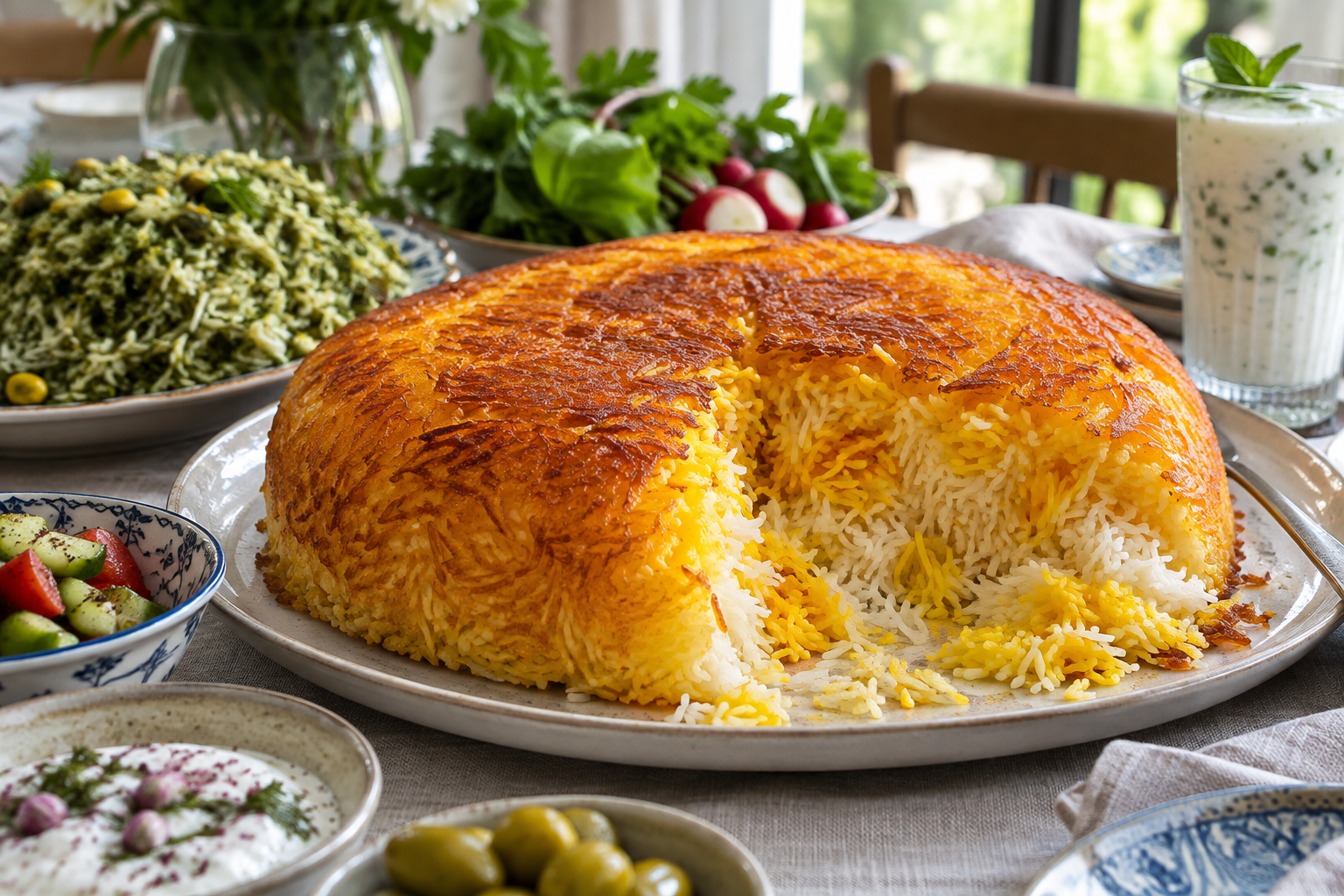
A serving platter is placed over the pot. Oven gloves go on, someone moves a bowl of yoghurt aside and the conversation pauses briefly. Then, with one confident movement, the whole thing is turned over. When the pot is lifted, if all has gone to plan, a mound of rice appears beneath an unbroken golden crust. Steam rises around the edges. The saffron smells warm and floral. A spoon meets the surface with a dry crack.
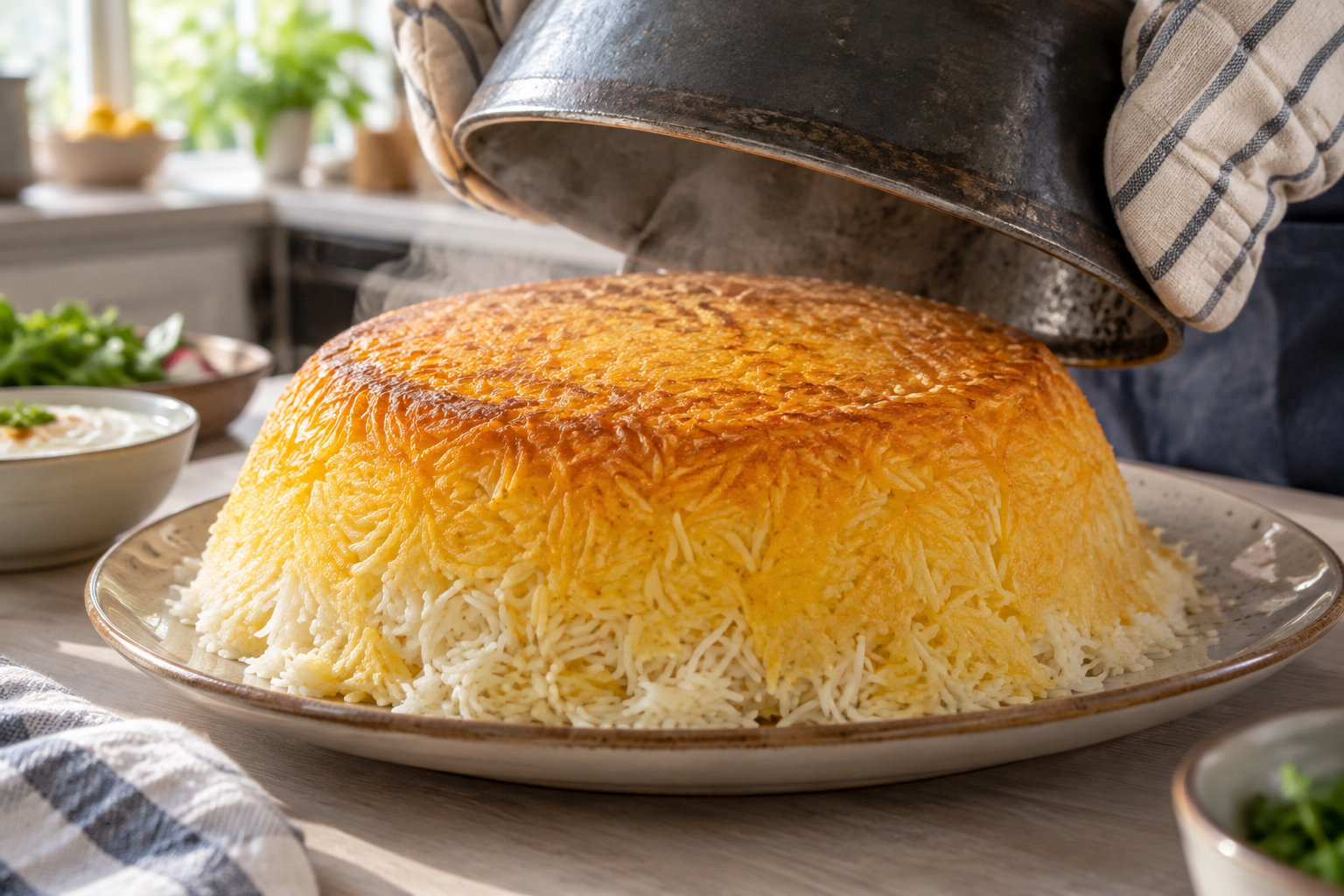
It is easy to see why this particular part of the meal draws attention. Beneath the crust lie soft, steamed grains of rice, long and separate. On top is their opposite: tightly joined grains made crisp by fat and heat. The same ingredient, the same pot, two entirely different experiences.
Tahdig means roughly “bottom of the pot” and, in cooking, refers to the coveted crust down there. It need not be made of rice. Slices of potato or a thin flatbread can also sit against the base of the pot and become the meal’s crunchy finale – or its opening act, because it is hard to wait. Here, the focus is on the rice version, in which the grains themselves form a golden lattice.
In many families, there is a playful contest for the best piece. Someone wants the darkest edge, someone else the thinnest, most brittle shard. Guests may be offered particularly fine pieces. But the famous flip is not compulsory: the fluffy rice can just as easily be spooned out first, with the tahdig loosened and served on its own platter. A broken crust still makes a successful dinner.
Rice’s long journey to the Persian table
There is no credible birth date for tahdig. The method developed within a wider rice culture, and stories of a particular cook or ruler discovering the perfect crust should be treated as stories rather than reliable evidence of its origins. It is also important to distinguish between the history of rice in Iran and the history of today’s technically refined rice dishes. They are not the same thing.
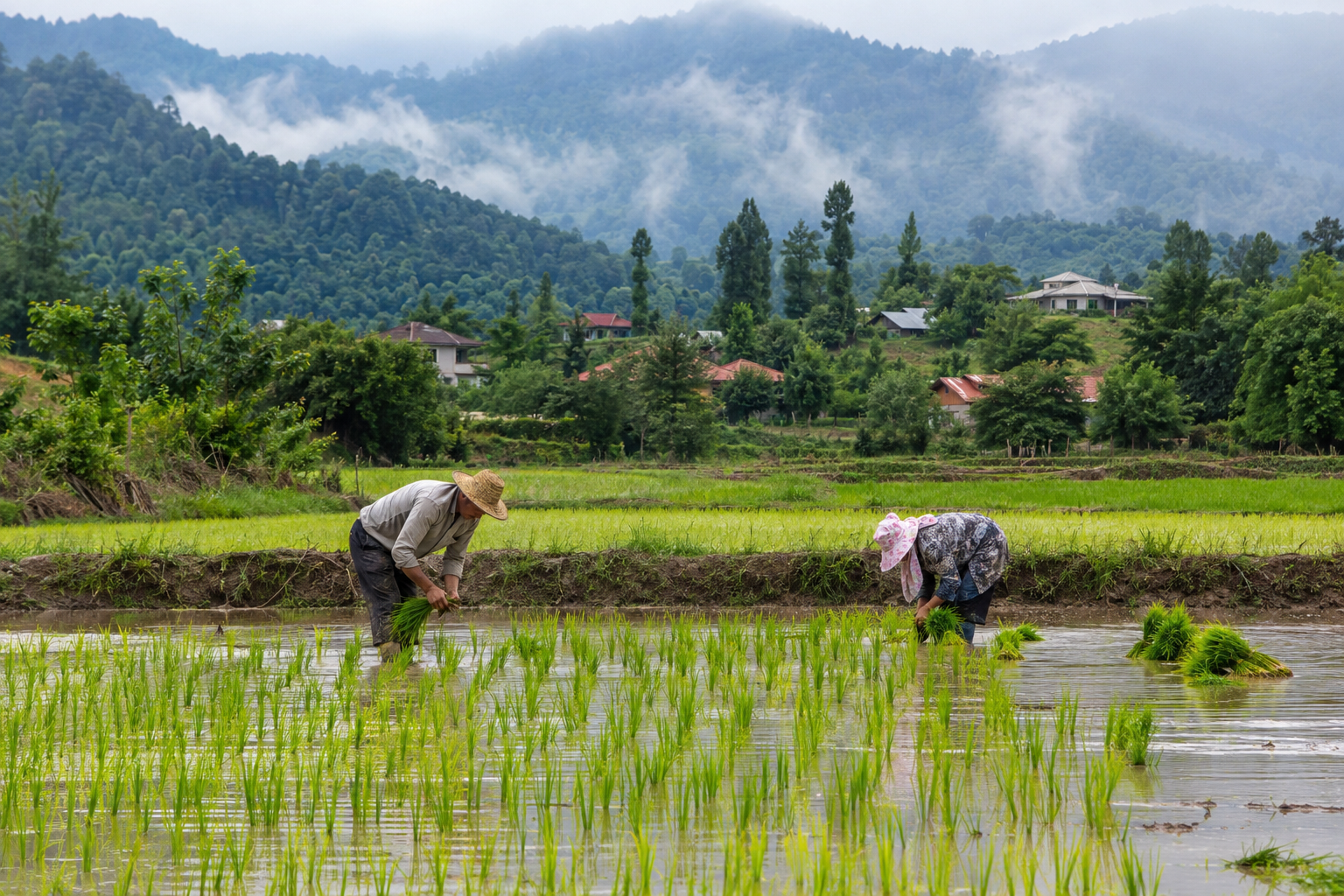
Rice has long been grown in the humid regions south of the Caspian Sea. Gilan and Mazandaran are central to Iran’s rice-growing geography: green farming regions with conditions quite unlike those of the country’s drier interior. Here, rice has deep local roots, both in agriculture and at the table. Anyone imagining Iran as one vast, dry landscape misses an important part of its food geography.
Availability, however, has never been the same everywhere. Across much of the country, bread has historically been the more established everyday staple, while rice was more closely associated with prosperity, feasts and special occasions. Changes in transport, trade and ways of life have helped rice dishes spread more widely. Yet regional differences endure: a country can share a love of rice without cooking or eating it in just one way.
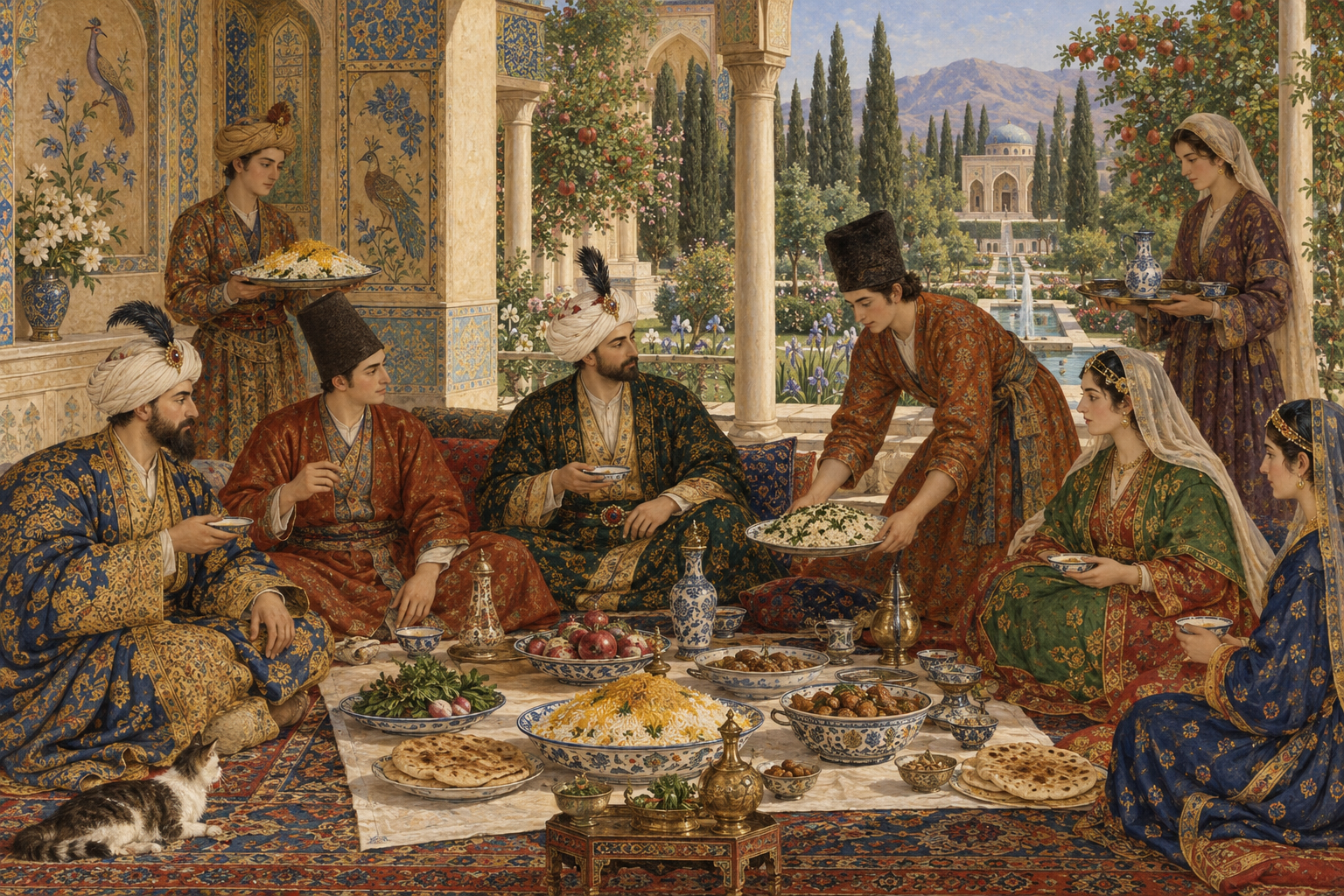
Cookbooks from the Safavid period, in the 16th and 17th centuries, reveal an already developed tradition of rice dishes incorporating other ingredients. This gives historical depth to today’s polo, but does not prove that every modern variation or every detail of tahdig technique was the same then. Food also changes as equipment changes. A heavy metal pot over an older heat source and a modern coated saucepan on an induction hob call for different skills, even when the aim is similar.
Persian and neighbouring courtly and culinary cultures have also influenced one another across vast areas. Rice dishes with names such as pilaf and pulao belong to this broader, intertwined history. That does not mean they are identical to Persian polo, or that all their origins can be mapped as a simple arrow leading from a single cuisine. Tahdig has its own distinctive place in Iranian cooking, while an appreciation of browned rice crust is shared by many other food cultures.
Chelow, polo and rice’s own voice
To understand tahdig, it helps to get to know two words: chelow and polo, also written chelo and polow. Put simply, chelow is white rice that is usually parboiled, drained and then steamed until done. It is often served with dishes such as kebab or khoresh, the Iranian stews that can be herbaceous, tangy, fruity or richly savoury. Some of the rice may be coloured and flavoured with saffron without changing its essential role.
Polo refers to rice dishes in which other ingredients are mixed or layered with the rice: herbs, broad beans, lentils, fruit or meat, depending on the dish. Not every cook uses these terms in exactly the same way in every context, but the distinction is a useful starting point. Sabzi polo, rice with herbs, is a clear example. Here, the greenery is part of the rice dish itself, not simply something scattered over it at serving time.
There are other cooking methods, too. Kateh is associated particularly with northern Iran and is made by allowing the rice to absorb its cooking water, rather than first parboiling it in plenty of water and draining it. This rice can also develop a bottom crust. Tahdig, then, is neither the name of a single complete rice dish nor a technique tied to just one style of serving rice.
For chelow and many polo dishes, the aim is long, intact grains with a distinct texture. Iranian rice varieties such as tarom and hashemi are prized for their fragrance and cooking qualities. They may be found in well-stocked Persian grocery shops in Sweden. Otherwise, a good basmati is a practical, reliable alternative, even if its aroma and behaviour in the pot are not quite the same.
The packet offers clues, but never the whole answer. Different varieties, harvests and storage times affect how quickly the grains soften and how much water they absorb. The most important test, therefore, is not the clock but a grain of rice between your teeth. Before steaming, the outside should have softened while the centre still offers a little resistance. If the rice is already fully cooked, there is too little margin left; further steaming can make it dense rather than fluffy.
Saffron’s fragrance and the physics of the crust
Saffron gives tahdig its colour, but colour is only half the point. Its fragrance can suggest hay, honey and flowers, with a slightly bitter note that tempers the sweetness. The spice should make its presence felt without drowning out the rice’s own aroma. A completely saffron-yellow mound of rice is therefore not necessarily more carefully prepared than white rice with a few deeply golden patches.
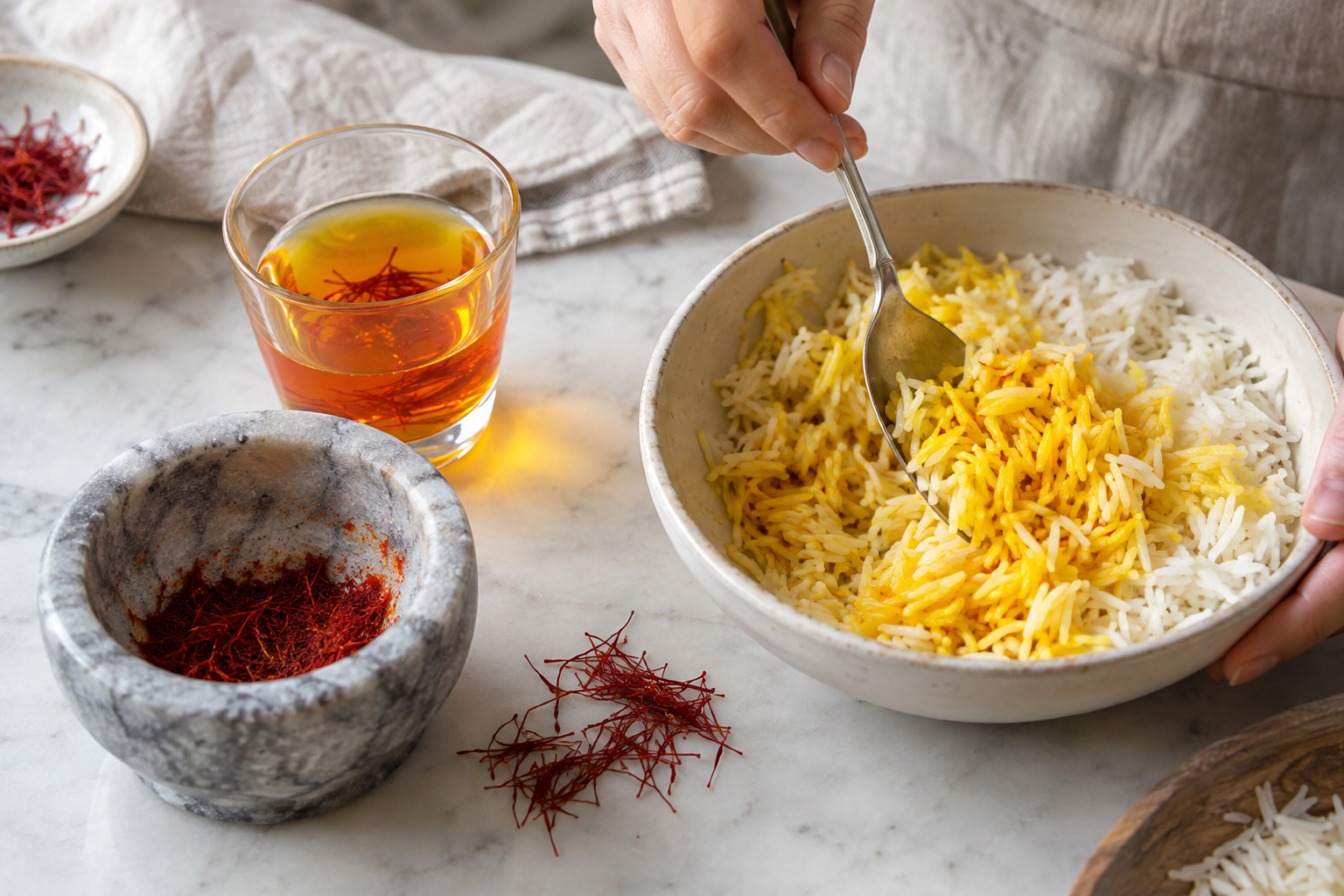
In many Persian kitchens, saffron is finely ground before being steeped in a little water. This makes it easier to distribute both colour and flavour. Hot water is a simple method for the home kitchen; others use ice, letting it melt over the spice. There is no need to turn the question into a test of culinary purity. What matters here is that the saffron comes into contact with water before being mixed with the rice, and that the liquid is used thoughtfully.
The crust calls for a different kind of precision. During cooking, there must be enough moisture to steam the upper grains of rice, but the bottom layer must eventually become dry and hot enough to brown. Fat helps the heat reach the grains evenly and makes the surface crisp. Too little fat can produce a lean, hard base that sticks. Too much makes the meal unnecessarily heavy, but tahdig is not the place to attempt entirely fat-free frying either.
A pot that distributes heat evenly is a good investment in peace of mind. An intact, undamaged non-stick coating makes things easier, especially for beginners. Stainless steel works, but requires greater familiarity with that particular pot and hob. The heat should be controlled, not aggressive. The most common shortcut to failure is turning up the heat too far in the hope of getting colour faster: the bottom can burn before the rest of the rice has finished steaming.
A clean tea towel wrapped around the lid catches condensation that might otherwise drip back onto the rice. The cloth must be secured firmly on top of the lid, well away from the hob, flames and other hot surfaces. A few small steam channels in the rice help the steam circulate, but should not be pushed through the bottom layer. Once the lid is on, restraint pays off. Every curious peek releases heat and steam.
Listen, too. A gentle sizzle is quite different from a sharp, angry crackle. The aroma should suggest toasted rice and butter, not acrid burning. The exact timing depends on the pot’s diameter, the thickness of its base and the power of the hob. The recipe provides a workable framework; the final nuances come from using the same pot several times.
One crust, many family traditions
Rice tahdig can be made with nothing more than rice, fat and seasoning. In other versions, a small amount of rice is mixed with yoghurt, sometimes with egg yolk too, to create a more cohesive bottom layer. These are well-established ways of making tahdig, but neither ingredient is compulsory. The basic recipe here uses neither, allowing the texture of the rice grains themselves to take centre stage.
Tahchin, the rice dish rich in yoghurt and sometimes egg, is a close relative, but it is not simply another name for tahdig. Tahchin is constructed as a more firmly bound rice dish, often with a filling, and has a character of its own. Keeping the terms distinct helps when reading cookbooks or trying to recreate a meal you have been served.
Potato tahdig offers a different sort of pleasure: thin slices turn golden underneath and soft where they meet the rice. With lavash or another thin flatbread on the bottom, you get a crisp bread crust instead, soaking up flavour from the fat and the rice’s steam. Different families have different favourites, and the same cook may choose a base according to what the rest of the meal needs. There is no reason to rank them as more or less authentic.
Serving also shapes the experience. A thin crust is at its best when brought quickly to the table and left uncovered, so that it does not soften in its own steam. A thicker piece can have both crisp and chewy patches, something some people particularly enjoy. With a saucy khoresh, you can dip an edge while retaining the crunch further in. The contrast between stew sauce, soft rice and browned crust is a large part of the pleasure.
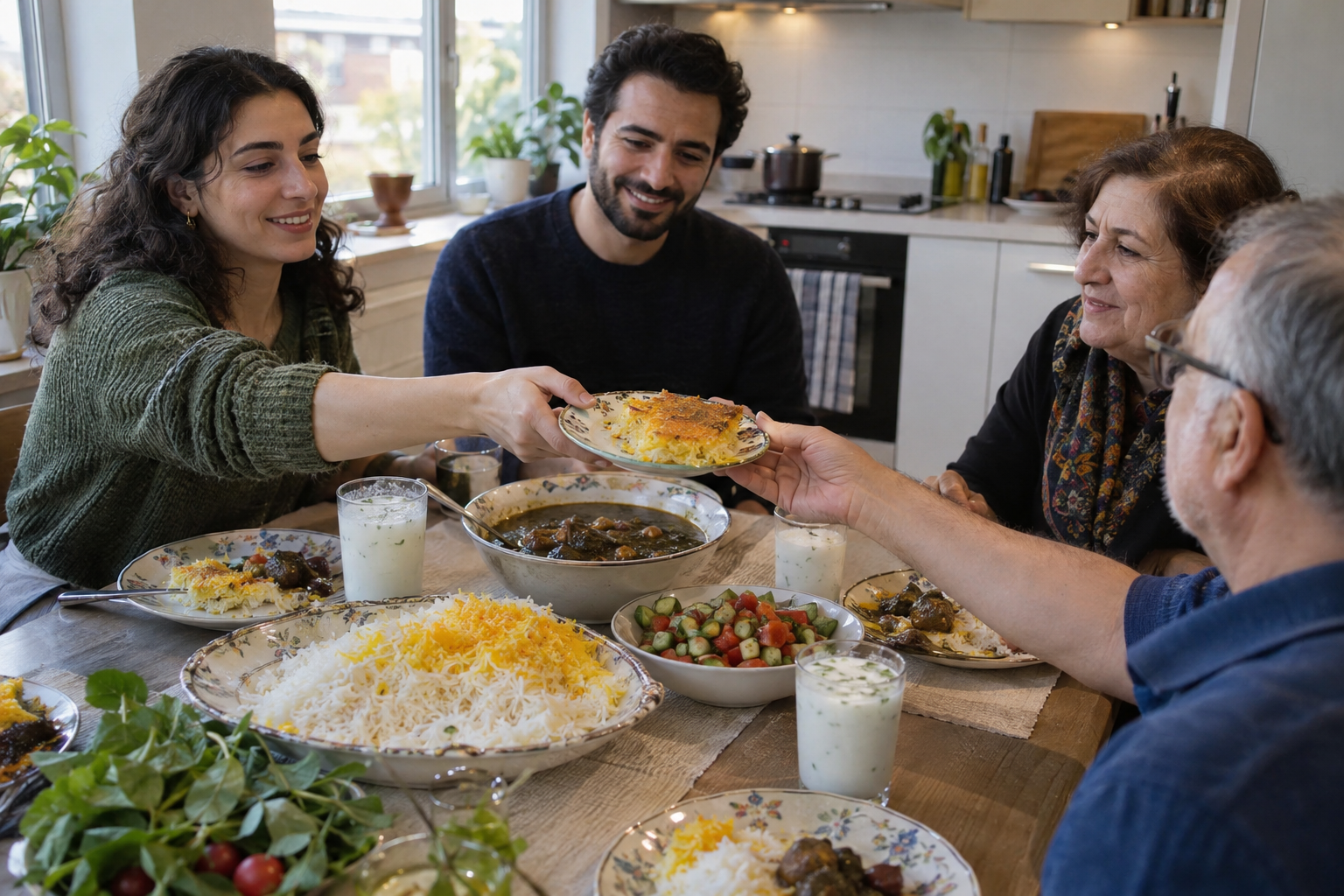
That is precisely why tahdig is more than a decorative top layer in a photograph. It is something shared at the table, divided up and talked about. Offering someone a piece can be a small expression of care. The playful competition over the crust is well known, but of course it is no rule for how every Iranian family behaves. Hospitality takes more forms than the moment that makes the best story.
Nowruz and the green rice
When Nowruz is celebrated at the spring equinox, greenery takes on a special significance. The festival marks the new year in Iran and is also celebrated by many other peoples and communities across a wide geographical area. There is therefore no single Nowruz table. Dishes, festive customs and family memories vary between regions and across national borders.
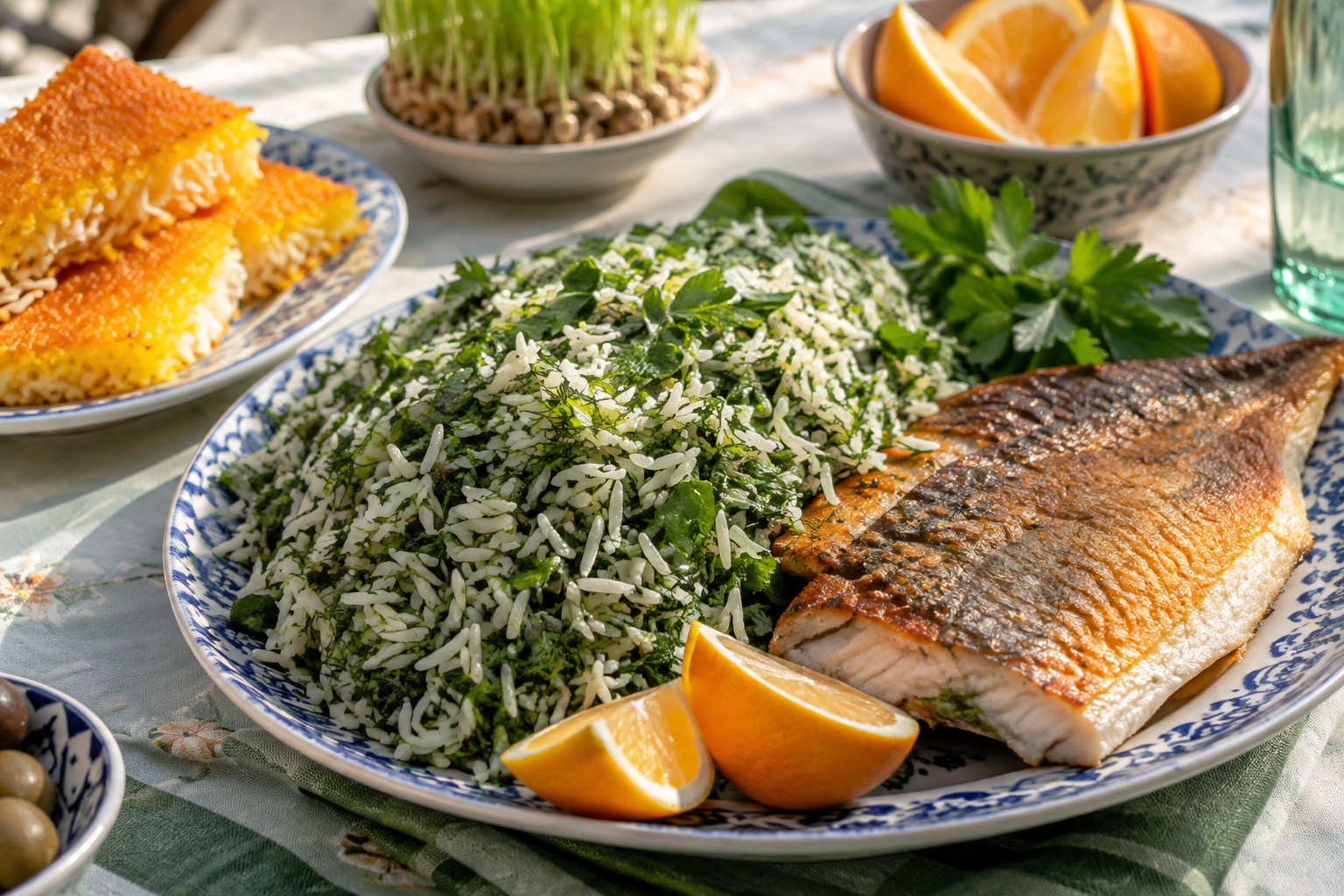
In Iranian tradition, sabzi polo ba mahi, herbed rice with fish, is closely associated with New Year celebrations. The herbs can be read as an expression of spring and renewal, but the dish is not merely a symbol. It is also delicious in a very tangible way: steamed rice carrying the fragrance of dill, parsley, coriander and gentle allium notes, alongside succulent fish and, ideally, something tangy.
The herb mixture varies. Dill is often prominent, while parsley and coriander bring other green notes. Tare, an allium used in Iranian cooking, can be hard to find in Sweden. Chives are a practical substitute here, though the flavour will not be quite identical. Fresh garlic or other mild garlic notes also feature, depending on the household and the season.
The technique must take the herbs into account. They should be clean, well drained and finely chopped, but not blended to a purée. Too much residual rinsing water makes the rice wet. Large, coarse stems disrupt the delicate texture. Layering the herbs with the parboiled rice allows their fragrance to spread during steaming without the need to stir and break the grains.
A layer of plain rice at the bottom is a simple way to protect the herbs from the strongest heat. Above it, the greenery can take its place. In this recipe, the sabzi polo also has a saffron-scented rice tahdig, but this is one possible combination, not a rule for how the festive dish must be cooked. Served with fish, the golden crust makes a beautiful, delicious bridge between the seared surface and the soft, herbed rice.
From a Swedish hob to the shared platter
Start by choosing a pot and getting to know it. For four servings, a diameter of around 22 centimetres works well with the quantities in the recipe cards. A very wide pot produces a thinner layer of rice and a different rate of evaporation; a tall, narrow pot requires different allowances. Use a cooking zone that fits the base, and keep your first attempt simple, without introducing several new flavourings at once.
Rinsing and soaking serve different purposes. Rinsing removes loose surface starch, while soaking helps the rice absorb water before cooking. The water need not become laboratory-clear. Work gently so the grains do not break, and start tasting early during parboiling. Much of the final result is determined at that point.
Plan the rest of the meal around the rice’s need for an undisturbed spell on the hob. A stew can already be ready and a salad chopped when steaming begins. If serving fish with sabzi polo, it is practical to cook it towards the end. That way, the rice can reach the table freshly made, with a crust that still crackles when broken.
Doogh, the tangy yoghurt drink often flavoured with mint and a little salt, is a good match for the meal. The yoghurt’s freshness complements both the fat and the toasted crust, while water makes the drink lighter than a yoghurt sauce. Cardamom-scented black tea is another lovely choice, especially after the meal; Persian tea is also often served without cardamom. For those who would like wine, a light, fresh white can work, but let the flavours of the whole meal guide the choice rather than the rice alone.
And if the rice will not release from the pot? Spoon it out, gently loosen the bottom with a utensil that will not scratch, and arrange the pieces on a separate platter. There is no reason to sacrifice those long grains for a perfect dome. An overly dark, bitter section, however, should not be served simply because it is crunchy. The goal is golden and toasted, not burnt.
The recipes below are two alternative rice dishes for four people, not two side dishes that need to be cooked at the same time. Start with the saffron rice, then move on to the herb version once the pot feels familiar. Tahdig rewards attentiveness more than showmanship. When the soft rice meets the crisp edge, and someone passes the last lovely piece to another person at the table, the dish has already succeeded.
Saffron rice with golden rice tahdig
Fluffy rice with a thin, crisp saffron layer at the bottom. A modern home-kitchen version of Persian rice technique, without yoghurt or egg. Use a heavy-based pot with an intact non-stick coating, about 22 cm in diameter, and a tight-fitting lid. Preparation time includes 30 minutes of soaking. Makes four generous side-dish servings.
Ingredients
Method
- 1Gently rinse the rice in several changes of cold water until the water is much less cloudy. Cover with fresh cold water and leave for 30 minutes. Drain.
- 2Grind the saffron finely in a mortar. Pour over 0.5 dl hot water and leave to steep for at least 10 minutes.
- 3Bring 3 litres of water and the salt to the boil in a large saucepan. Add the rice and boil uncovered, usually for 5–8 minutes. Start testing after 4 minutes: the grain should be soft on the outside but still have a distinctly firm, not rock-hard, centre.
- 4Immediately drain the rice in a fine-mesh colander. Rinse very briefly with lukewarm water to stop the cooking and wash away a little surface starch. Leave to drain thoroughly for 2–3 minutes.
- 5Gently mix about 2.5 dl of the parboiled rice with 2 tbsp saffron water and 1 tbsp of the oil. Dry the pot if it was used for boiling.
- 6Pour the remaining 2 tbsp oil into the pot and add half the butter. Heat over medium-low heat until the butter has melted. Spread the saffron rice evenly over the base and press very lightly with a spoon so that no large gaps remain.
- 7Spoon the remaining rice on top without packing it down. Shape into a low mound and make 4–5 steam channels with the handle of a wooden spoon, stopping above the bottom layer. Dot with the remaining butter and drizzle over the remaining saffron water.
- 8Put on the lid and heat over medium heat for about 4–5 minutes, until steam begins to form and you hear a gentle sizzle. Reduce the heat to low. Wrap a clean tea towel around the lid and secure all the ends on top, completely away from the heat source. Replace the lid.
- 9Leave the rice to steam over low heat for 35–45 minutes, avoiding unnecessary lifting of the lid. It should smell toasted, not burnt. Remove the pot from the heat immediately if the smell becomes acrid; hobs vary greatly in power.
- 10Leave the pot off the heat for 5 minutes. Remove the lid and towel. Gently loosen around the edge with a silicone spatula. Place a larger, heatproof platter over the pot and invert using sturdy oven gloves, turning away from your body. Alternatively, spoon out the rice and serve the crust in pieces on a separate platter.
- For your first attempt, it is wise to use low heat and accept a slightly paler crust. Note the timing and heat setting for your particular pot.
- For dairy-free tahdig, replace the butter with an extra 1.5 tbsp rapeseed oil.
- Serve immediately and do not cover the crust. Cool any leftover rice quickly in a shallow container and refrigerate, ideally at 4 °C, as soon as it has cooled. Reheat only the amount you intend to eat, until piping hot throughout.
Sabzi polo with herbs and saffron tahdig
Fragrant herbed rice inspired by sabzi polo, which, served with fish, has a special place in Iranian Nowruz celebrations. Here, chives replace the hard-to-find allium tare. Makes four generous side-dish servings, ideally alongside pan-fried or baked fish. Preparation time includes soaking.
Ingredients
Method
- 1Gently rinse the rice until the rinsing water is less cloudy. Soak in plenty of cold water for 30 minutes, then drain.
- 2Wash the herbs, remove coarse stems and dry thoroughly, ideally in a salad spinner followed by a clean tea towel. Finely chop and mix with the garlic. Do not blend to a purée.
- 3Grind the saffron and steep it in 0.5 dl hot water for at least 10 minutes.
- 4Bring 3 litres of water and the salt to the boil. Add the rice and boil for about 5–8 minutes, until the grains are soft on the outside but still firm in the centre. Start checking after 4 minutes. Drain, rinse briefly with lukewarm water and drain well.
- 5Set aside about 2.5 dl parboiled rice and mix with 2 tbsp saffron water and 1 tbsp oil. Heat the remaining oil and half the butter over medium-low heat in a non-stick pot about 22 cm in diameter.
- 6Spread the saffron rice evenly over the base and press down lightly. Layer the remaining rice with the herb mixture on top. Do not pack it down, and try to keep the herbs away from the exposed sides of the pot.
- 7Shape the rice into a low mound. Make 4–5 steam channels with a wooden spoon handle without breaking through the bottom layer. Distribute the remaining butter and saffron water over the rice.
- 8Put on the lid and heat over medium heat for 4–5 minutes until steam forms. Reduce the heat to low and replace the lid wrapped in a clean tea towel. Secure the cloth on top so that nothing hangs near the hob or flame.
- 9Steam over low heat for 35–45 minutes. Avoid lifting the lid. Once the rice is tender and the bottom smells toasted, remove from the heat and leave to rest for 5 minutes.
- 10Spoon the herbed rice loosely onto a platter without scraping through the crust. Loosen the tahdig with a silicone spatula and serve in pieces alongside, with the lemon wedges.
- Frozen chopped herbs work too. Thaw them and gently squeeze out excess liquid before using.
- If you would like less coriander, replace it with more parsley and dill. Herb mixtures vary between Persian home kitchens too.
- You can wash and dry the herbs earlier in the day, but chop them close to cooking time. Serve the rice freshly cooked for the best fragrance and crunch.
What goes in the glass
- Alcohol-freeDoogh with mintA lightly salted, tangy yoghurt drink diluted with still or sparkling water. Its acidity refreshes the palate alongside butter and browned crust, while the mint pairs particularly well with the herbed rice. Keep the salt subtle.
- TeaBlack tea with a hint of cardamomTea brewed not too strongly allows saffron’s floral notes to shine. Cardamom creates an aromatic link without needing to dominate. Lovely after the meal and completely alcohol-free.
- WineLight, dry Pinot Blanc without pronounced oakRestrained aromatics and fresh acidity suit the rice’s mild flavour and cut through the rich, toasted crust. Especially good if the sabzi polo is served with gently seasoned fish; a robust stew may call for a different wine.
Enjoy alcohol in moderation. Alcohol-free options go just as well with the food.
Sources
- Najmieh Batmanglij, Food of Life: Ancient Persian and Modern Iranian Cooking and Ceremonies (2011)
- Najmieh Batmanglij, Cooking in Iran: Regional Recipes and Kitchen Secrets (2018)
- Margaret Shaida, The Legendary Cuisine of Persia (1992)
- Encyclopaedia Iranica, Encyclopaedia Iranica: BERENJ
- Alan Davidson; tredje upplagan redigerad av Tom Jaine, The Oxford Companion to Food (2014)
Ask questions about "Tahdig – the golden crust everyone waits for". Answers are based on the magazine's own articles.