At Gustav Vasa’s Dinner Table
Beer in the jug, butter on the bread and power over food
Gustav Vasa’s meals began far from the castle dining hall: in cattle sheds, fishing villages and well-stocked storerooms. We follow the food to the king’s table—and cook a thoughtful interpretation of 16th-century cuisine with chicken, saffron and prunes.
 By Arvid HolmFood historian · Historic dishes, old cookbooks and eating habits through the ages
Translated from Swedish with AI assistance.
Go to the recipe ↓A table before potatoes
The air smells of woodsmoke, warm bread and meat broth. From the kitchen comes the sound of knives against wood and pots being moved close to the fire. Someone brings in a jug of beer; someone else makes sure the food is sent out before it cools. Imagine a meal at one of Gustav Vasa’s castles in the mid-16th century. This scene is a reconstruction, not a preserved snapshot. But its foundations are historical: a large household, extensive stores and many people’s labour behind every serving.
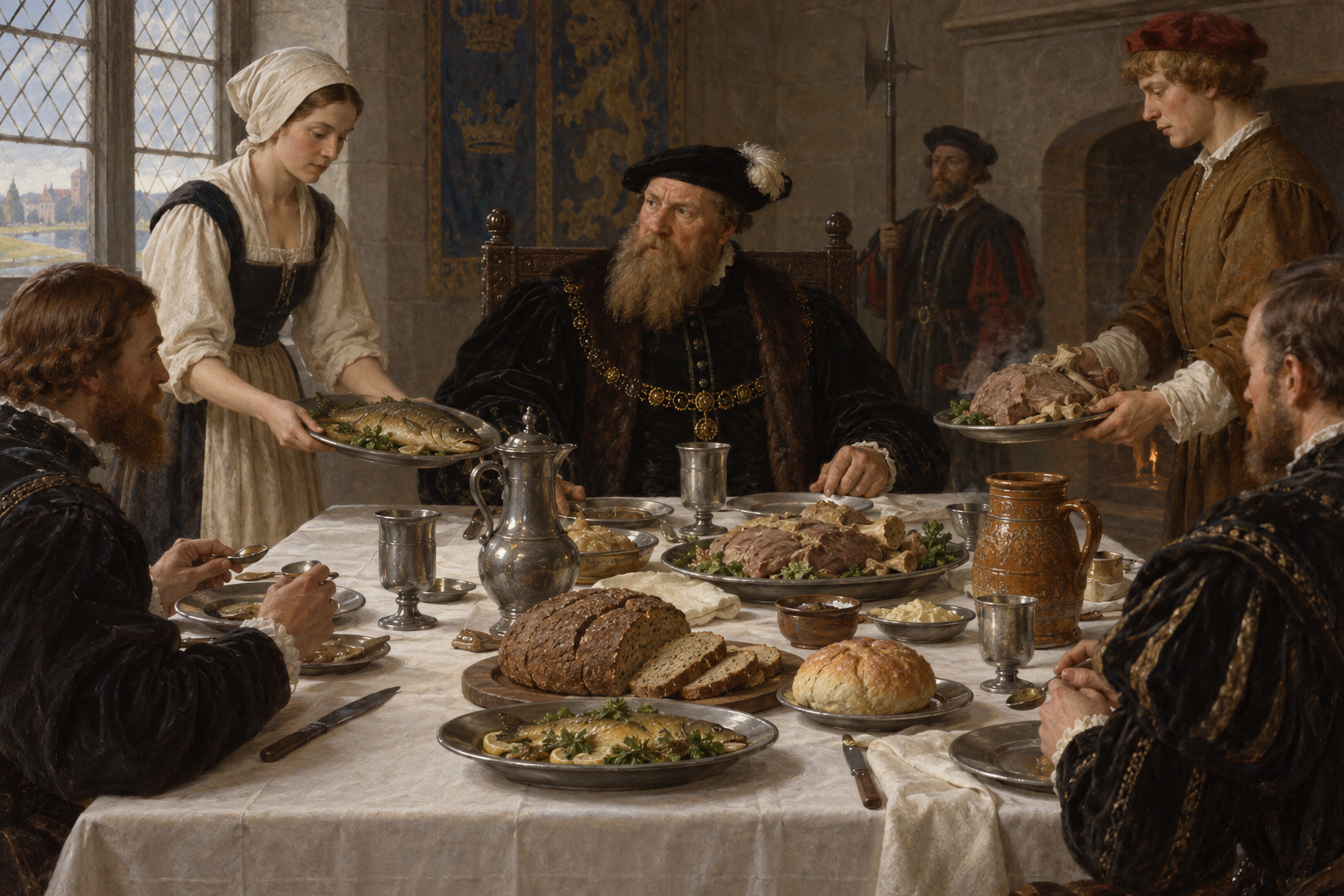
There are no potatoes on the table, and no cup of coffee to finish. Bread, beer, meat and fish, however, were part of the Swedish diet of the time. Imported spices and wine might also appear at an aristocratic table. The difference between the king’s meal and a peasant’s lay not only in the quantity of food, but in access to finer ingredients, variety and servants.
So what did Gustav Vasa eat for dinner? That is easier to ask than to answer. We can describe how the court was provisioned with far greater confidence than we can name the king’s favourite dish. Accounts tell us what was bought, delivered and consumed, but not always how it was cooked or whose plate it reached. The route to a credible Vasa table therefore leads through the storerooms rather than a supposedly authentic royal menu.
The king who wanted to know what the estates produced
Gustav Vasa was elected king in 1523 and ruled until his death in 1560. During these years, the Crown strengthened its control over the realm. The Reformation and the decisions taken at the Diet of Västerås in 1527 were important steps in transferring church resources to the monarchy. Land, income and food were intertwined: whoever controlled the estates could also feed soldiers, servants and courtiers.
The king’s surviving letters, collected in the register of Gustav I, reveal a keen interest in estate management and administration. Here we encounter not so much a royal gourmet describing a sauce as a ruler determined that resources should be managed and accounted for. Lars-Olof Larsson’s biography helps place this work in its political context. Food was part of the practical machinery of power.
Nor was the court a small dinner party. Around the royal family stood a sizeable organisation of servants and officials, and the number of mouths to feed could vary. When the king moved between castles and royal estates, food and labour had to be ready. A delivery of butter or grain therefore tells us nothing automatically about Gustav Vasa’s own portion.
There were distinctions of rank within the household, too. The same establishment could provide both everyday staff meals and a far more lavish princely table. Writing that “the court ate” is sometimes necessary, but it must not erase the difference between those who carried in the food and those who had their pick of the best cuts.
The taste of the storeroom: salt, smoke and season
To understand the meal, we must begin with keeping food from spoiling. Without refrigerators, much of the year’s surplus had to be salted, dried, smoked or preserved in other ways. Grain could be stored, peas dried and butter salted. Meat and fish often became provisions for the storeroom. This does not mean that all food was old or salty: fresh ingredients were available when season, proximity and resources allowed.
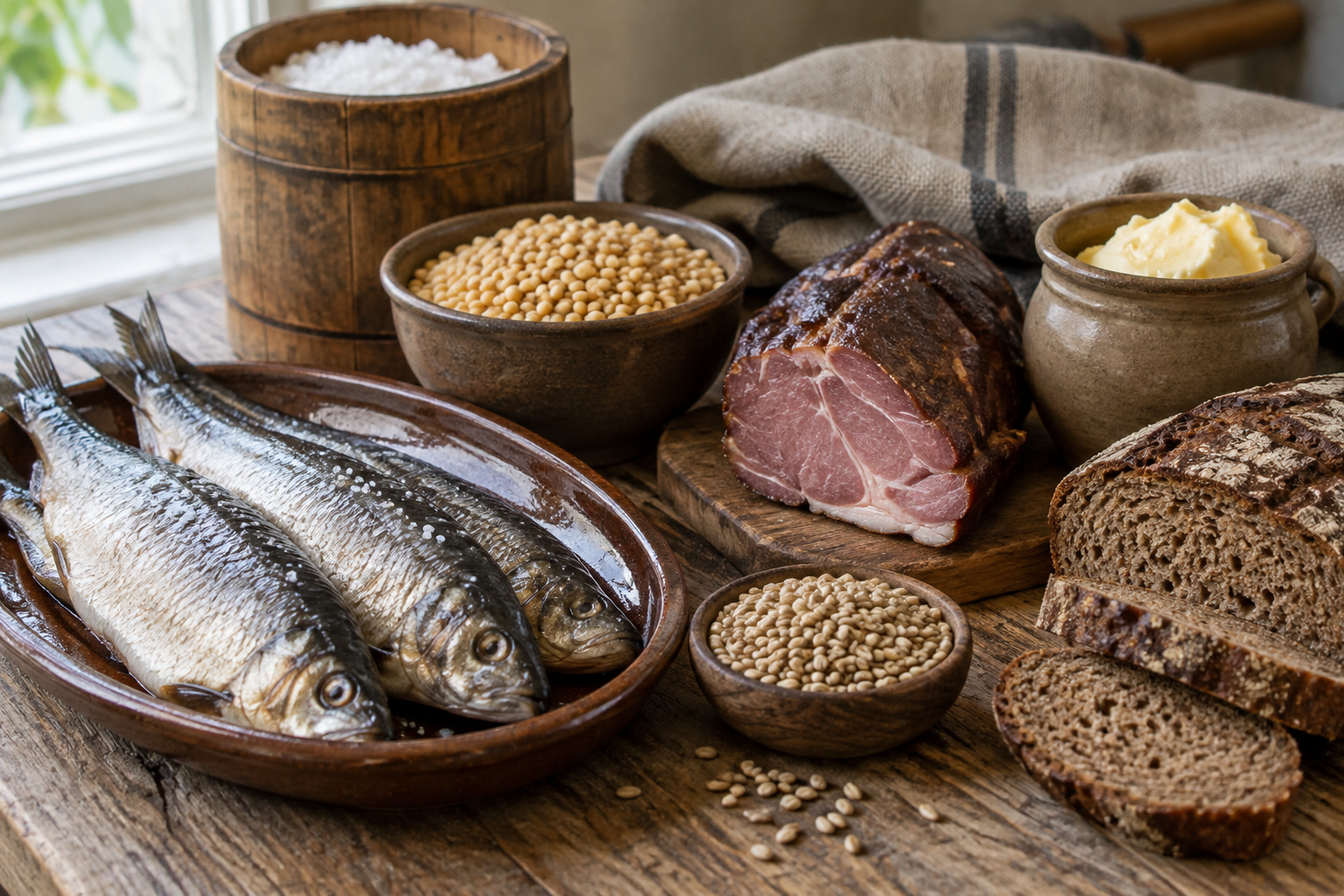
Olaus Magnus describes Nordic food practices in his History of the Northern Peoples, published in 1555. His work is rich in information on subjects including fishing, preservation and drinks. But it is not a kitchen log from Gustav Vasa’s court. The author lived in exile and wrote for a European audience; his accounts must be read as a broad, sometimes idealised portrayal of the Nordic region, not as a definitive record of a particular royal dinner.
Bread shows how social distinctions could be tasted. Rye and barley were important staples in Sweden, while fine wheat bread signalled greater means. Beer was an important drink, brewed in different qualities and strengths. The familiar explanation that people drank beer solely because all water was dangerous is, however, far too simple. Availability, habit, nourishment and status also played a part.
Fish could come from both the sea and inland lakes. The fast days of the Catholic calendar had long influenced demand. The Reformation changed the religious framework, but eating habits did not disappear with a single decree. Fish’s keeping qualities, trade and local availability gave it importance beyond fasting, too. A credible Vasa table must therefore offer more than an image of endless meat feasts.
Spices, sweetness and what we do not know
Fine 16th-century cooking belonged to a wider European world of flavour in which spices, acidity and sweetness often met. Ginger, pepper, cinnamon and saffron could signal both taste and wealth. Being imported made them valuable. Yet we should not assume that every everyday meal at the Swedish court was a lavish display of spices.
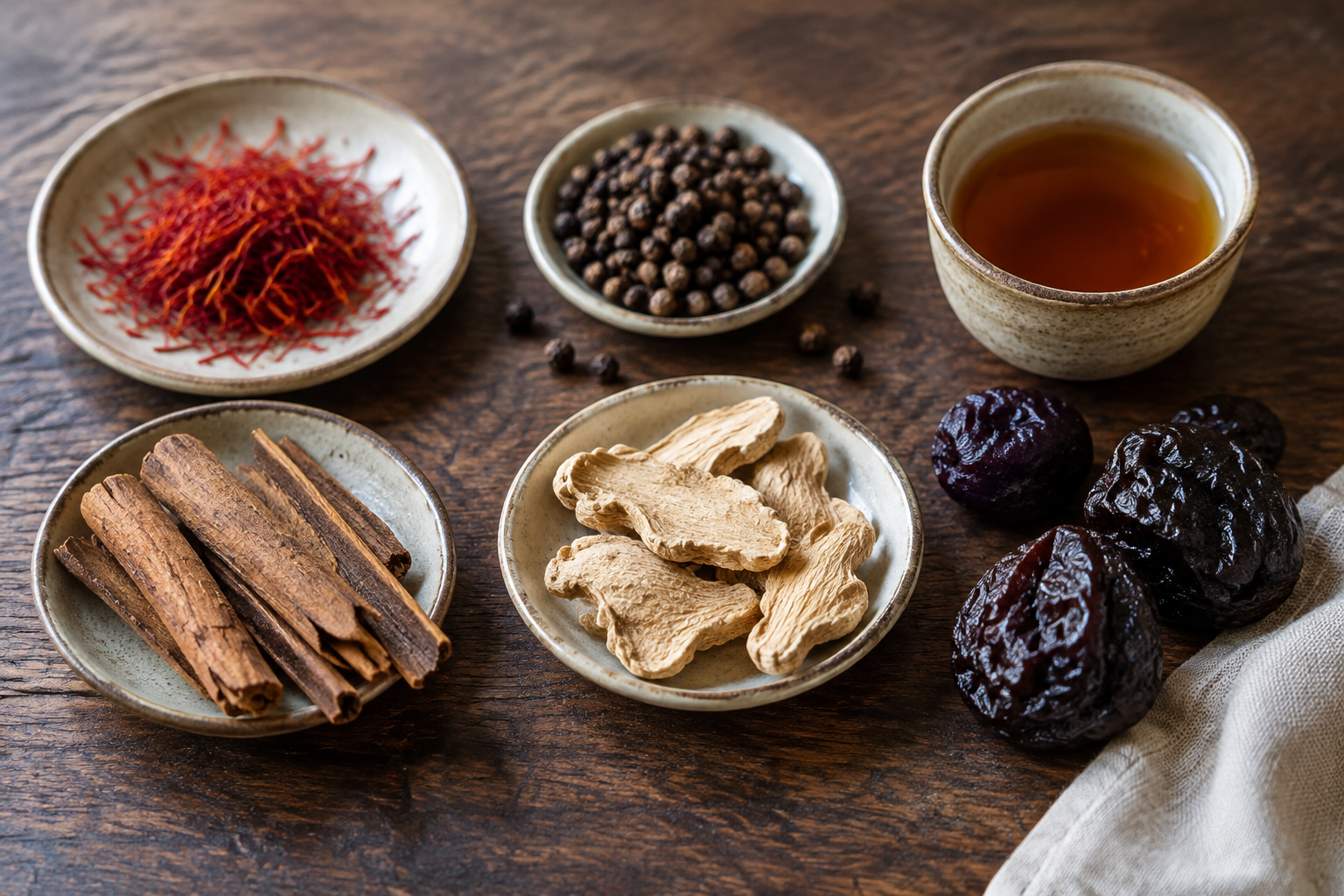
Nor does the familiar story that expensive spices were used mainly to disguise spoiled meat stand up to scrutiny. Seasoning was a valued culinary practice, and people who could afford imported spices could also have good access to ingredients. Problems with keeping food certainly existed, but they do not explain the period’s entire approach to flavour.
Dried fruit fits into this broader European cuisine, as does the combination of meat, sweetness and acidity. That does not mean we can place a stew of chicken, prunes and saffron before Gustav Vasa and call it his favourite. No such evidence underpins the recipe here. Instead, the dish is a modern, source-informed interpretation of a possible aristocratic flavour palette.
That distinction matters. A historical recipe can sometimes be translated line by line, with old measures converted into grams and decilitres. Here, there is no such original. We work with ingredients, methods and flavour combinations that belong to the food culture of the time, then make openly acknowledged choices for today’s kitchen. The result should be delicious and historically plausible, not pretend to be a rediscovered original.
The meal as labour and hierarchy
At a princely table, service was part of the experience. Who was allowed to approach the ruler, where someone was seated and what was brought to the table could express the social order. But here, too, we must be cautious about the details: a general description of European court culture is not automatically a record of how Gustav Vasa ate every day.
Forget, too, today’s familiar progression of starter, main course and dessert. Earlier meals could be organised differently, with several dishes available within the same service. Knife and spoon played central roles, while an individual table fork was not yet an everyday fixture in Sweden. Eating with one’s fingers did not necessarily mean a lack of table manners; different standards of propriety and cleanliness applied.
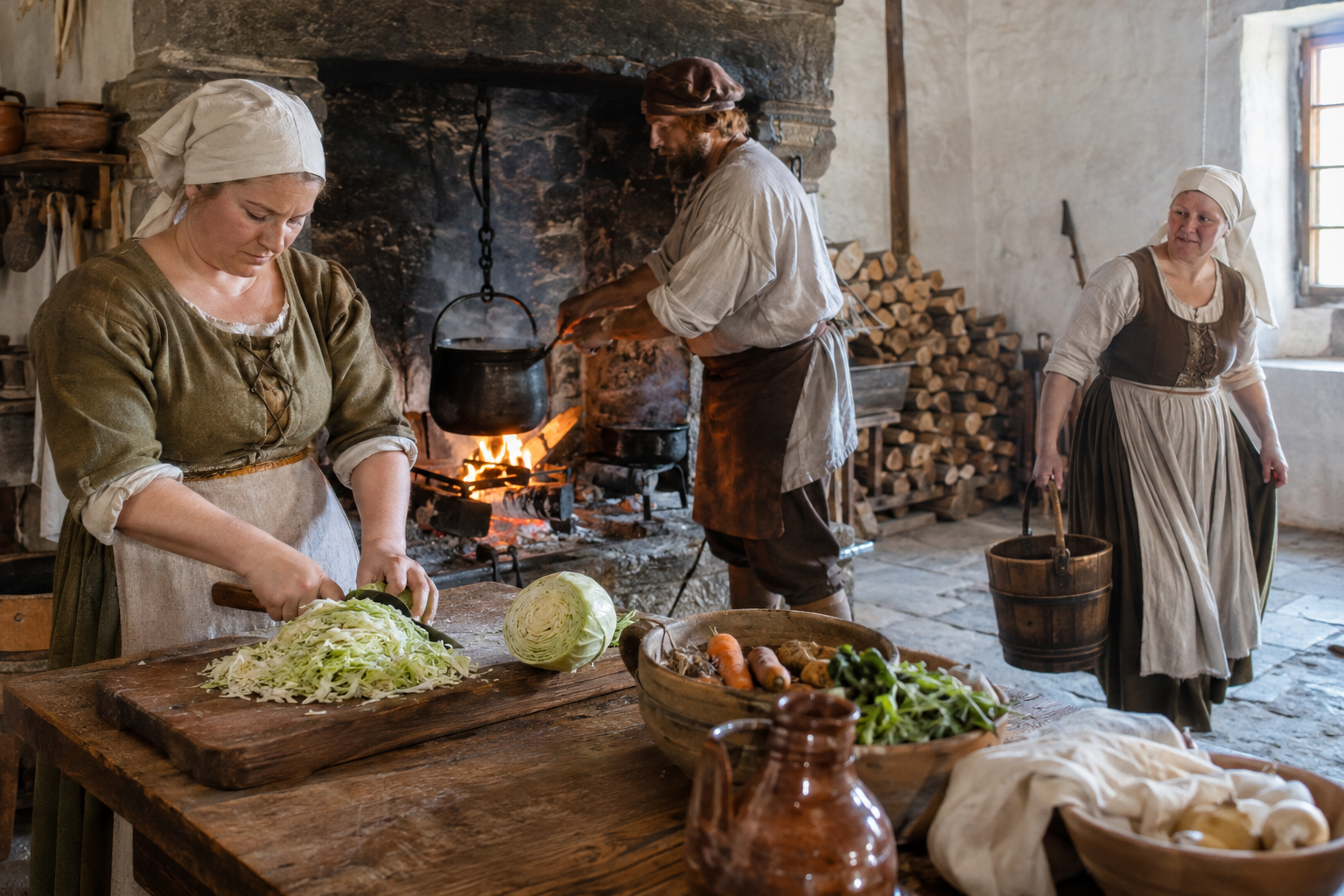
Behind the order at the table lay work that rarely receives the same attention as the king’s name. Someone had milled the grain, brewed the beer, carried the firewood and fetched the water. Animals had to be slaughtered and butchered, fish gutted and pots scoured. A castle meal depended on both skilled kitchen work and hard physical labour, as well as deliveries from people far from the dining hall.
When we cook a historically inspired dinner today, it readily becomes a pleasure shared around a beautifully laid table. There is nothing wrong with that. But the story becomes richer if these people, too, are given a place. Splendour on the platter and toil in the kitchen were two sides of the same meal.
A possible Vasa table in your kitchen
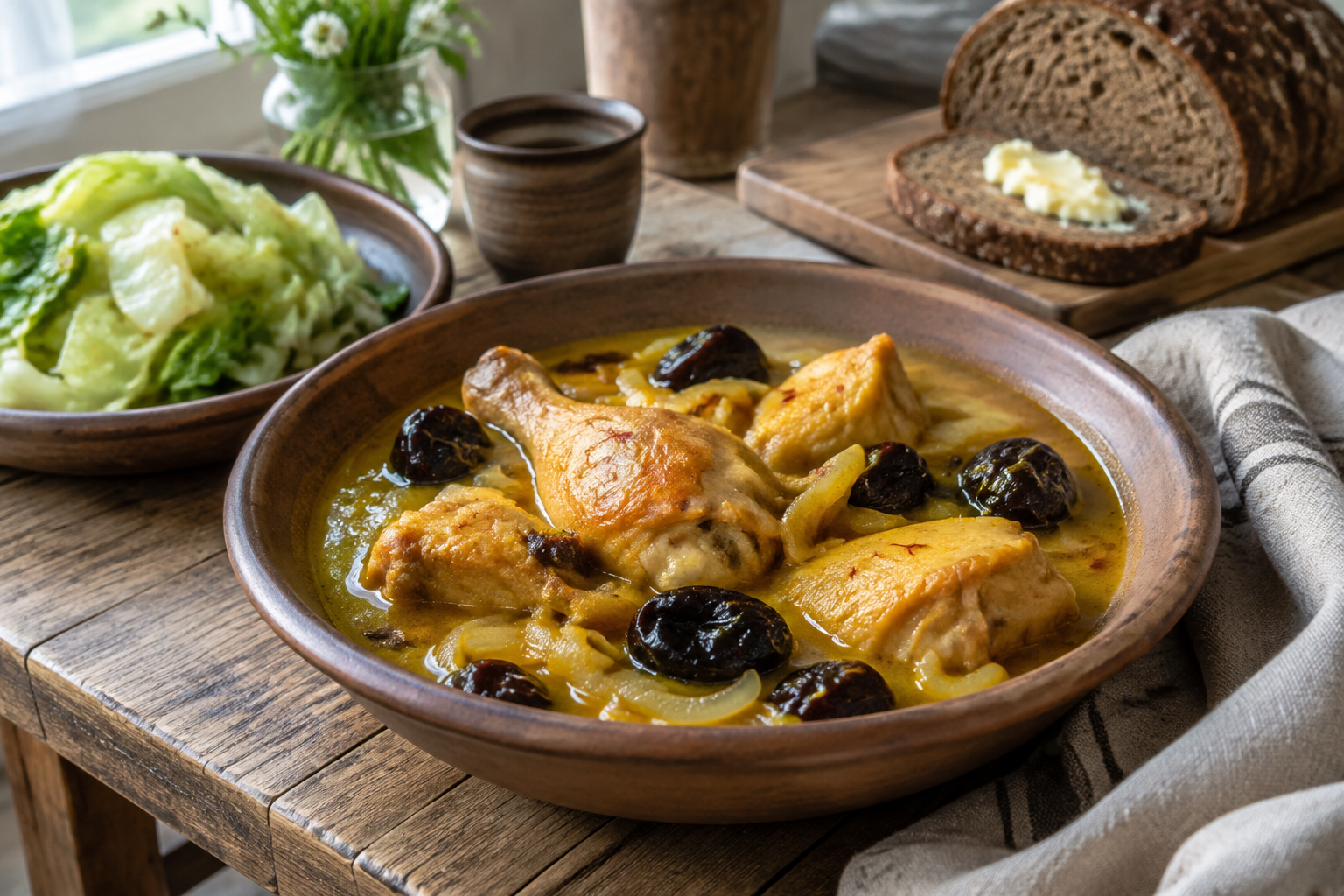
Our route into history is a gently simmered chicken stew. Thigh meat is a practical modern choice because it stays juicy. Prunes bring deep sweetness, vinegar provides a counterpoint, and a little saffron adds fragrance and colour. None of the measured quantities in the recipe card should be read as a royal 16th-century measure: these proportions are practical kitchen choices to try with today’s ingredients.
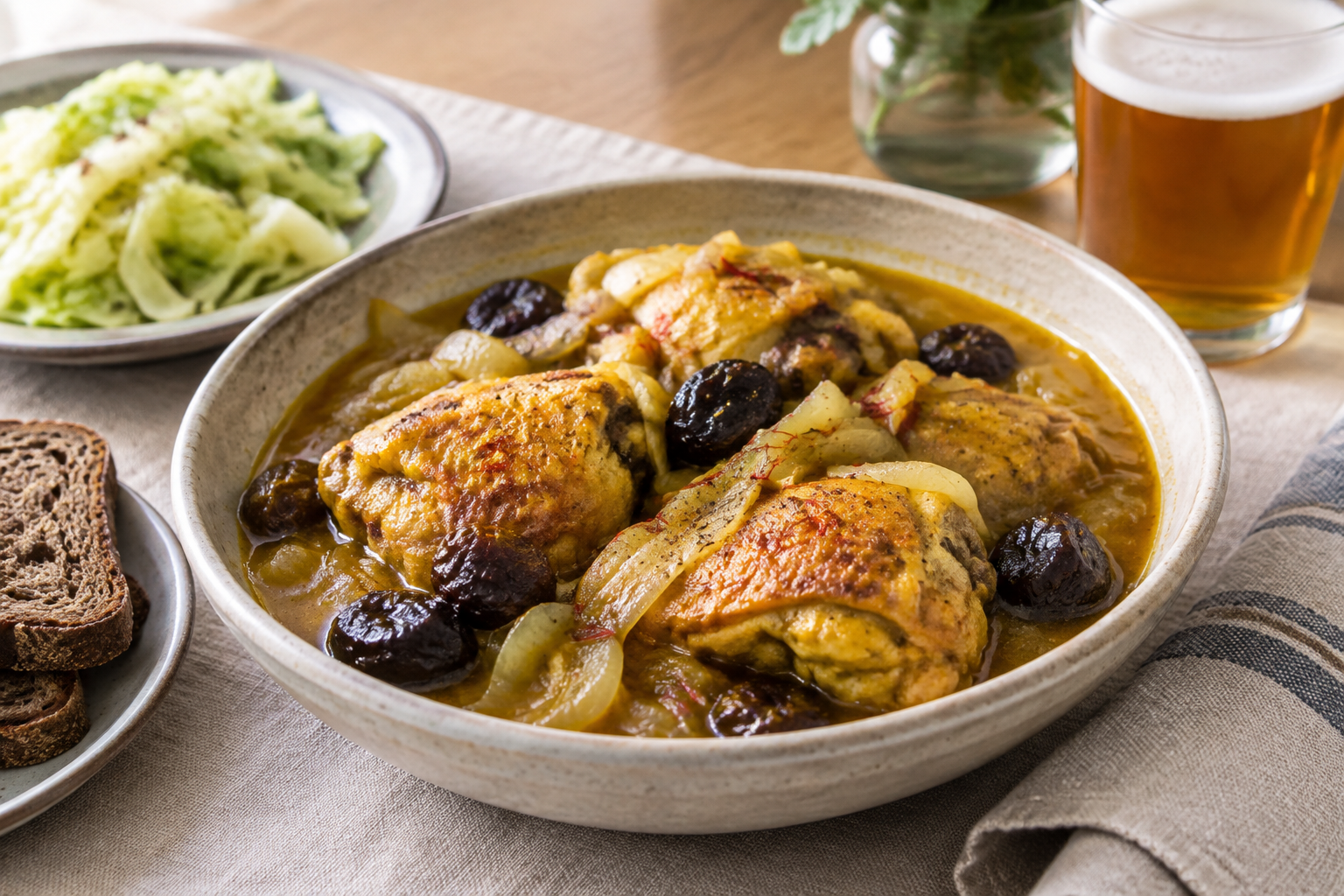
The technique is simpler than the flavour suggests. Let the onions soften without burning, and keep the stew at a simmer rather than a rolling boil. Do not add the fruit so early that it turns to mush. Finally, taste for the balance of salt, acidity and sweetness. The most common pitfall is letting the prunes dominate until the dish tastes like dessert.
Serve with rye bread and, ideally, simply cooked cabbage. This gives the meal a recognisable historical setting, rather than reproducing a documented combination from the king’s dining hall. Beer goes well with it, but an alcohol-free option is just as welcome at our table. Choose a malty alcohol-free beer that matches the stew’s richness without competing with the saffron.
Ultimately, the most interesting thing about Gustav Vasa’s dinner table is not a lost favourite dish. It is the glimpse of an entire kingdom behind the food: its farming, trade, household management and hierarchies. As the stew’s fragrance rises from the stove, history feels close—as long as we distinguish between what the sources tell us and what we cook ourselves.
Chicken Stew with Saffron and Prunes
A source-informed reconstruction of a possible aristocratic flavour palette from the 16th century, not a documented recipe from Gustav Vasa’s table. Olaus Magnus provides background on the period’s food culture; the combination of ingredients, quantities and cooking method are a modern interpretation.
Ingredients
Method
- 1Peel the onions and cut into thin wedges. Cut each chicken thigh into 2–3 large pieces. Use a separate chopping board for raw chicken, and wash your hands and utensils afterwards.
- 2Melt 2 tbsp butter in a large casserole over a medium heat. Let the onions soften for 7–8 minutes without browning deeply.
- 3Add the chicken, salt, pepper and ginger. Turn over a medium heat for 3–4 minutes. The chicken does not need a deeply browned crust.
- 4Lightly crush the saffron and stir it into a little of the stock. Pour the saffron mixture and remaining stock into the casserole. Bring to the boil, then reduce the heat.
- 5Cover and simmer for 15 minutes. Halve the prunes if large, then add them along with the vinegar.
- 6Simmer for another 10–15 minutes, now with the lid slightly ajar, until the chicken is tender and cooked through. Check that the thickest piece reaches at least 74 °C. Add a little water if the sauce reduces too much.
- 7Meanwhile, roughly shred the cabbage. Boil in lightly salted water for 5–8 minutes until tender but still with a little bite. Drain thoroughly and toss with 1 tbsp butter.
- 8Taste the stew and adjust with salt and, if needed, a little more vinegar. The sauce should be brothy yet full-flavoured, with a clear balance between the sweetness of the prunes and the acidity. Serve with the cabbage and rye bread.
- The saffron quantity is equivalent to half a standard Swedish 0.5 g sachet. This restrained amount allows the other flavours to shine.
- If the sauce is too thin, lift out the chicken and reduce the liquid uncovered for a few minutes. Then return the meat to the pan.
- Cool leftovers quickly and refrigerate. Eat within 2–3 days or freeze.
- For a modern vegetarian alternative, use cooked Swedish grey peas and chunky pieces of celeriac in vegetable stock. Simmer the celeriac until tender before adding the peas and prunes; this variation is not a documented court recipe.
What goes in the glass
- BeerMalty Swedish lager or mild aleBready malt notes complement the rye bread and prunes. Choose moderate bitterness so that the saffron and vinegar do not taste harsh.
- Alcohol-freeMalty alcohol-free lagerBrings bready notes and refreshing bubbles to the rich stew without adding much sweetness.
- Alcohol-freePressed apple juice diluted with sparkling waterApple acidity cuts through the butter and complements the prunes. Mix roughly equal parts for a less sweet drink with the meal; this is a modern pairing.
Enjoy alcohol in moderation. Alcohol-free options go just as well with the food.
Sources
- Gustav I; utgiven av Riksarkivet, Konung Gustaf den förstes registratur
- Olaus Magnus, Historia om de nordiska folken (1555)
- Lars-Olof Larsson, Gustav Vasa – landsfader eller tyrann? (2002)
- Richard Tellström, Hunger och törst: svensk måltidshistoria från överlevnad till statusmarkör (2015)
Ask questions about "At Gustav Vasa’s Dinner Table". Answers are based on the magazine's own articles.