Afternoon tea – England at four o’clock
Tender scones, strong tea and a pause that became an institution.
The cucumber should be thinly sliced, the scones still warm and the tea strong enough to hold its own against the cream. But behind afternoon tea lies more than porcelain and dainty pastries: trade, empire, class and a duchess whose part in the story has grown beyond what the sources can reliably establish.
 By Jonas EkDrinks editor · Wine, beer, spirits, coffee, tea and non-alcoholic drinks – and how to pair them with food
Translated from Swedish with AI assistance.
Go to the recipe ↓When the teapot sets the pace
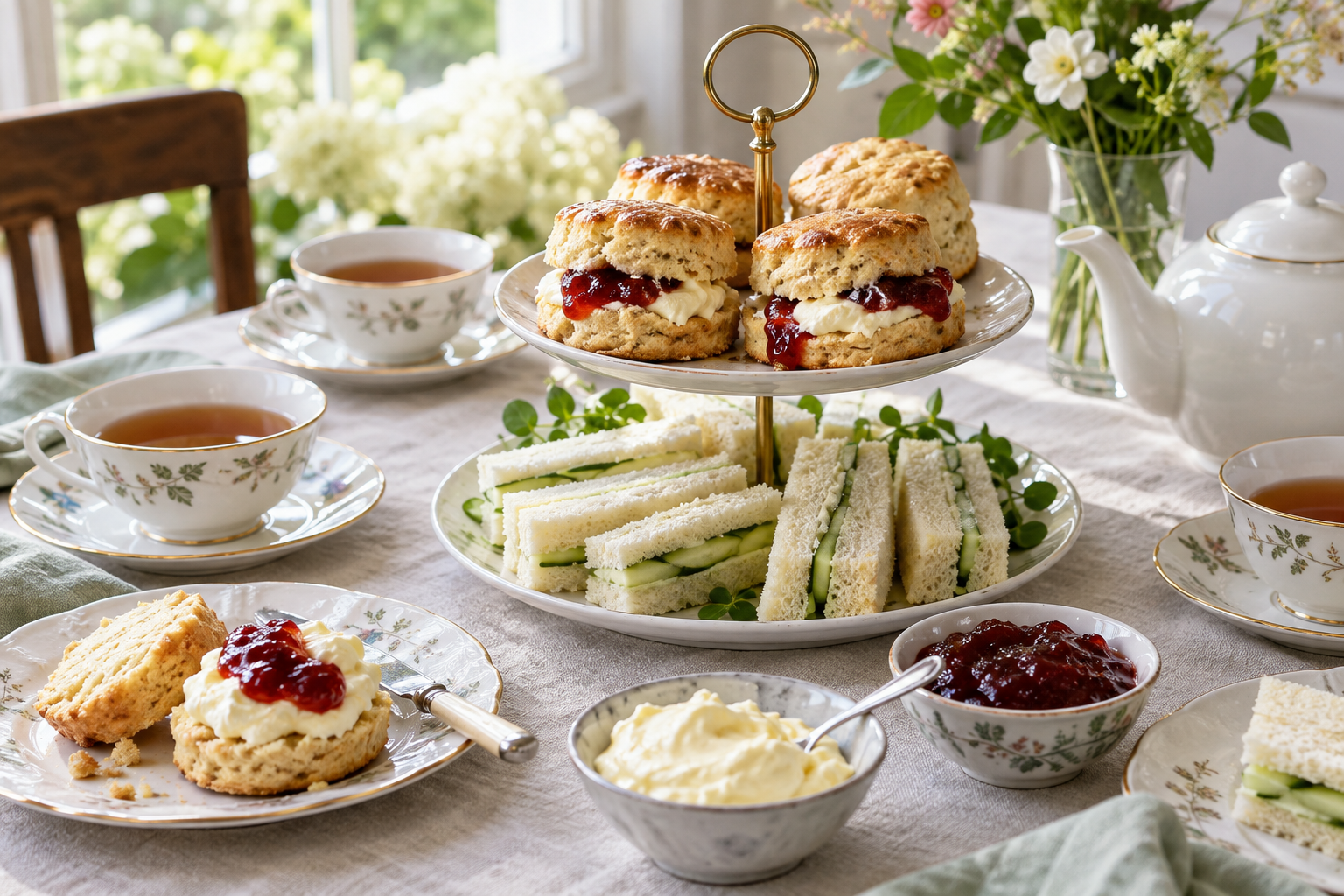
It begins with the sound of water being poured into a warmed pot. Then comes the aroma: black tea, warm baking and the cool, green note of freshly sliced cucumber. A knife cuts through a scone with a delicate crust and a soft, almost crumbly centre. Strawberry jam and thick cream sit on the table. Outside, there might be English drizzle or a Swedish November twilight; indoors, the afternoon has acquired a meal of its own.
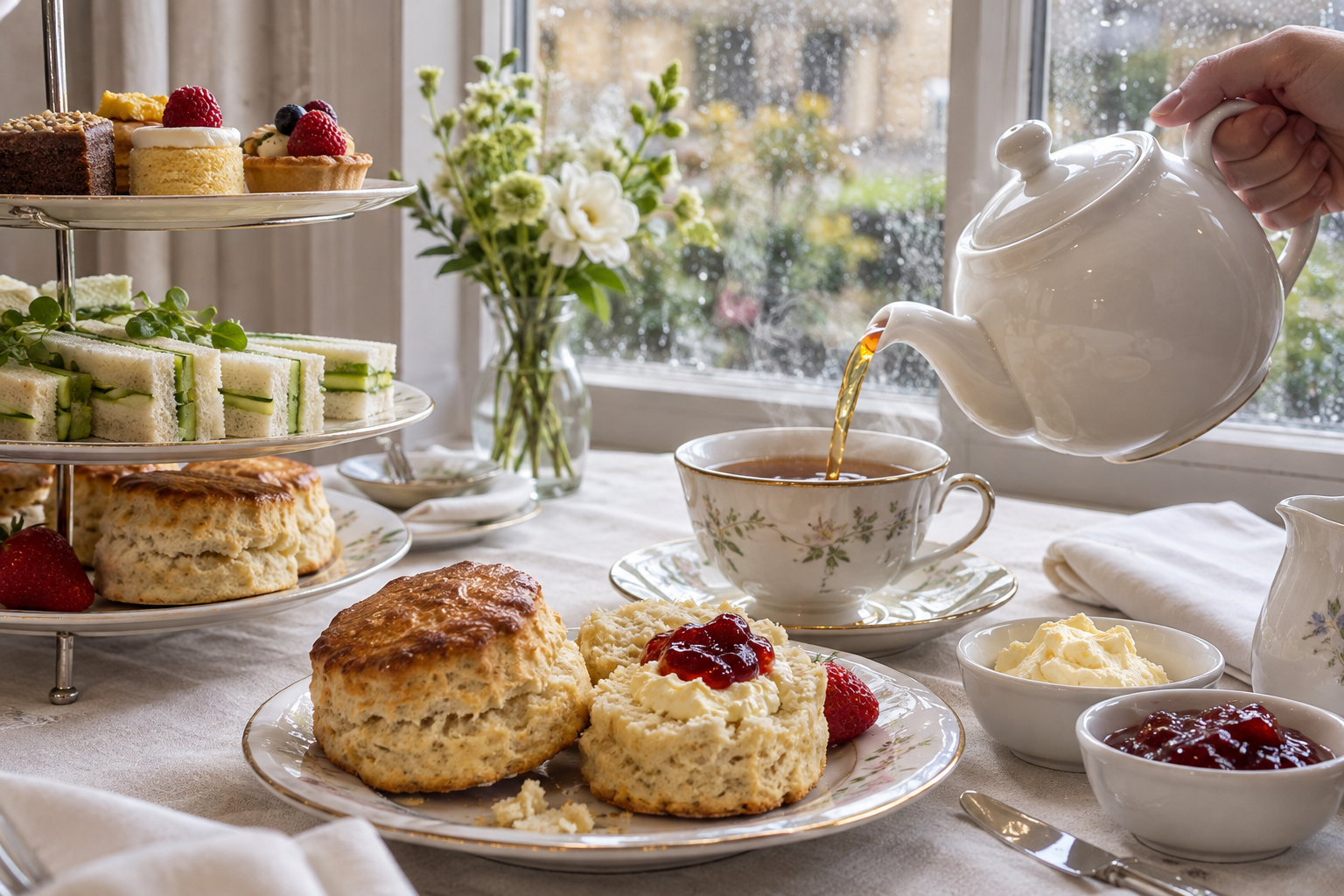
Afternoon tea is a break with ambitions. It is smaller than dinner but more than a quick cup of tea. In its familiar modern form, it includes small sandwiches, scones with cream and jam, and something sweet. There need not be an abundance of everything. The point is the variety: savoury and sweet, warm and cool, soft bread and fresh cucumber.
Four o’clock is a useful image, not a law of nature. Afternoon tea is often served somewhere between late lunch and early evening. At hotels, booking slots dictate the timing; at home, appetite and company do. What defines it is the interval: a moment that does not quite belong to the day’s main meals, yet is allowed to take its time.
It is also a tradition whose polished surface can deceive us. Tiered stands, silver teapots and starched tablecloths feel ancient when assembled together. Yet afternoon tea has changed with dinner times, women’s social lives, developments in the tea trade and the way restaurants package experiences. Today’s hotel service is not an unchanged snapshot of the 1840s.
And that is good news for anyone hosting at home. You do not need to recreate an aristocratic household. A sturdy teapot, a tray of scones and a few well-made sandwiches go a long way. What matters is that the tea gets some attention, the food is not left to dry out and nobody feels they are being tested on how to hold a cup.
A duchess, an appetite and a story that stuck
Anna Maria Russell, Duchess of Bedford, is usually credited with afternoon tea. The much-repeated story places her in the 1840s: dinner was served late, she grew hungry in the afternoon and asked for tea and something to eat. Eventually she invited friends, and a private habit became a social fashion.
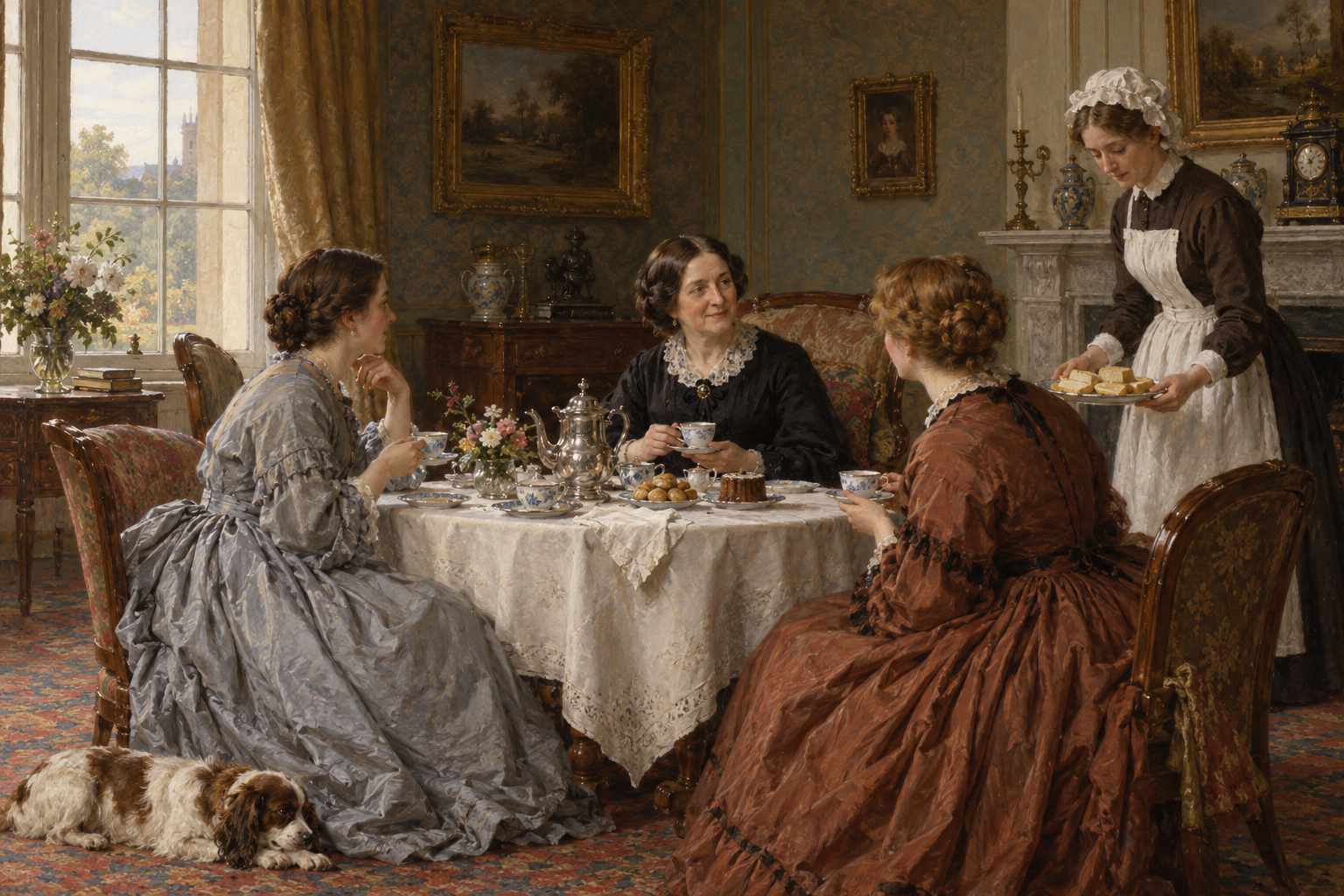
It is an appealing origin story. It gives the tradition a person, a setting and a very understandable problem. But it should be read as a widely accepted attribution rather than a securely documented moment of invention. Tea had been served with bread, butter or sweet treats long before. No duchess needed to invent the combination of a hot drink and a snack.
It is more reasonable to associate Anna of Bedford with popularising a particular kind of aristocratic afternoon gathering. During the 19th century, dinner grew later in parts of affluent British society. Between a light lunch and the evening meal, a gap opened up that tea and small dishes filled beautifully. The size of that gap naturally depended on the household, work and social class.
In the drawing room, the tea table became a place for conversation, visits and social connections. Women could host gatherings that did not require a full dinner party. That did not mean the occasion involved no work. For those with servants, the visible ease could rest on considerable invisible labour: baking, slicing, laying the table, boiling water and washing up.
During the latter part of the 19th century, tea found more public settings. Tearooms, cake shops and hotels made it possible to buy a tea service rather than arrange one at home. Such places also helped create respectable meeting spaces for women outside the home, although opportunities differed between places and social groups.
From there, a winding but clear path leads to today’s bookable afternoon tea. It might be a birthday outing, a hotel weekend or a way to meet someone without committing to a long dinner. The tradition has become both everyday and exclusive, depending on where it is served. Duchess or no duchess, its real strength lies in meeting a recurring human need for something delicious and a reason to linger.
Tea came first – and brought the world with it
Britain’s tea story begins not on an English country estate but in trade with Asia. The drink originated in China and reached England commercially during the 17th century. In 1660, Samuel Pepys recorded drinking tea, an early and well-known account of its presence in London. It was still far from a fixture in every kitchen.

Catherine of Braganza, who married Charles II in 1662, is often associated with tea’s rising prestige at court. Here, too, a distinction is needed between introducing something and making it fashionable. Tea was present in England before she arrived. Her significance lies more in the connection between the drink, court life and an already established Portuguese taste for Asian imports.
Consumption increased during the 18th century, but high taxes made legally imported tea expensive. Smuggling and adulteration became widespread problems. When tea duty was sharply reduced under the Commutation Act of 1784, trading conditions changed. Tea gradually became a more widely consumed commodity, although the journey from luxury to everyday staple was not the same for everyone.
This history is far from entirely cosy. The British East India Company’s trade, relations with China and the opium trade are all part of the context. So is the expansion of tea cultivation in colonial India during the 19th century. A vast plantation industry was built in Assam, while tea growing developed on the Himalayan slopes of Darjeeling. Behind the supply of cheap tea lay colonial power and often harsh working conditions.
Sugar joined tea in the cup, and the history of British sugar consumption is closely bound to Caribbean plantations and the labour of enslaved people. Porcelain, in turn, bore the marks of both Chinese models and British industry. A seemingly quintessentially English table was thus international from the outset, shaped by flows of goods, craftsmanship, inequality and encounters between tastes.
This need not make today’s cup of tea any less enjoyable, but it makes the story more truthful. Assam and Darjeeling are not merely flavour descriptors on a tin. They are places where people grow, pick and process leaves. Asking about origin and producer is therefore every bit as relevant for tea as it is for coffee or wine.
By the time afternoon tea took shape in the 19th century, tea was already deeply embedded in British daily life. The aristocratic service was one branch of a much larger tree. Workers, tradespeople and wealthy families drank the same kind of beverage in different grades, at different times and with very different accompaniments.
Afternoon tea is not high tea
The words make high tea sound as though it ought to be the grander version. That is why the term is sometimes used internationally for a particularly lavish hotel service. Historically, this is misleading. High tea generally refers to a more substantial meal later in the day, often with tea to drink and food intended to satisfy a proper appetite.
Bread, butter, cheese and cold meats might feature, along with hot dishes depending on the region and household. High tea is often associated with people who needed a substantial meal after the working day, but customs have varied. It is safer to distinguish between the meals’ functions than to make every cup a precise marker of class.
Afternoon tea, by contrast, is the lighter afternoon meal, historically associated with social gatherings and a later dinner. The usual explanation of the words high and low refers to dining tables and low drawing-room tables respectively. It works as a memory aid, but does not, on its own, capture every variation in how the terms have been used.
Then there is cream tea, which is more narrowly defined: tea with scones, clotted cream and jam. You do not need to serve sandwiches and little cakes to offer a cream tea. This version is particularly associated with south-west England and is ideal when you want to make an afternoon feel special without spending days baking.
Today’s full afternoon tea usually moves from savoury to sweet. Sandwiches come first, followed by scones and then cakes and pastries. On a tiered stand, the food is often arranged for that sequence, though layouts vary. Anyone who prefers a scone while it is warm has a strong culinary argument for not following the choreography too slavishly.
Above all, afternoon tea today is more often an outing or a special occasion than a daily British meal. The everyday cup of tea plays a much larger role. Distinguishing between them is rather like distinguishing an ordinary Swedish fika from a lavish kafferep: the family resemblance is clear, but the scale and occasion are different.
Scones, cucumber and the geography of cream
A good scone should break apart with a gentle touch. The crust can offer a little resistance, while the inside should be soft and airy without feeling like sponge cake. Historically, scones belong to a broader British baking tradition with strong Scottish roots. The modern round wheat-flour scone, raised with baking powder, is not identical to all the older breads that have borne the name.
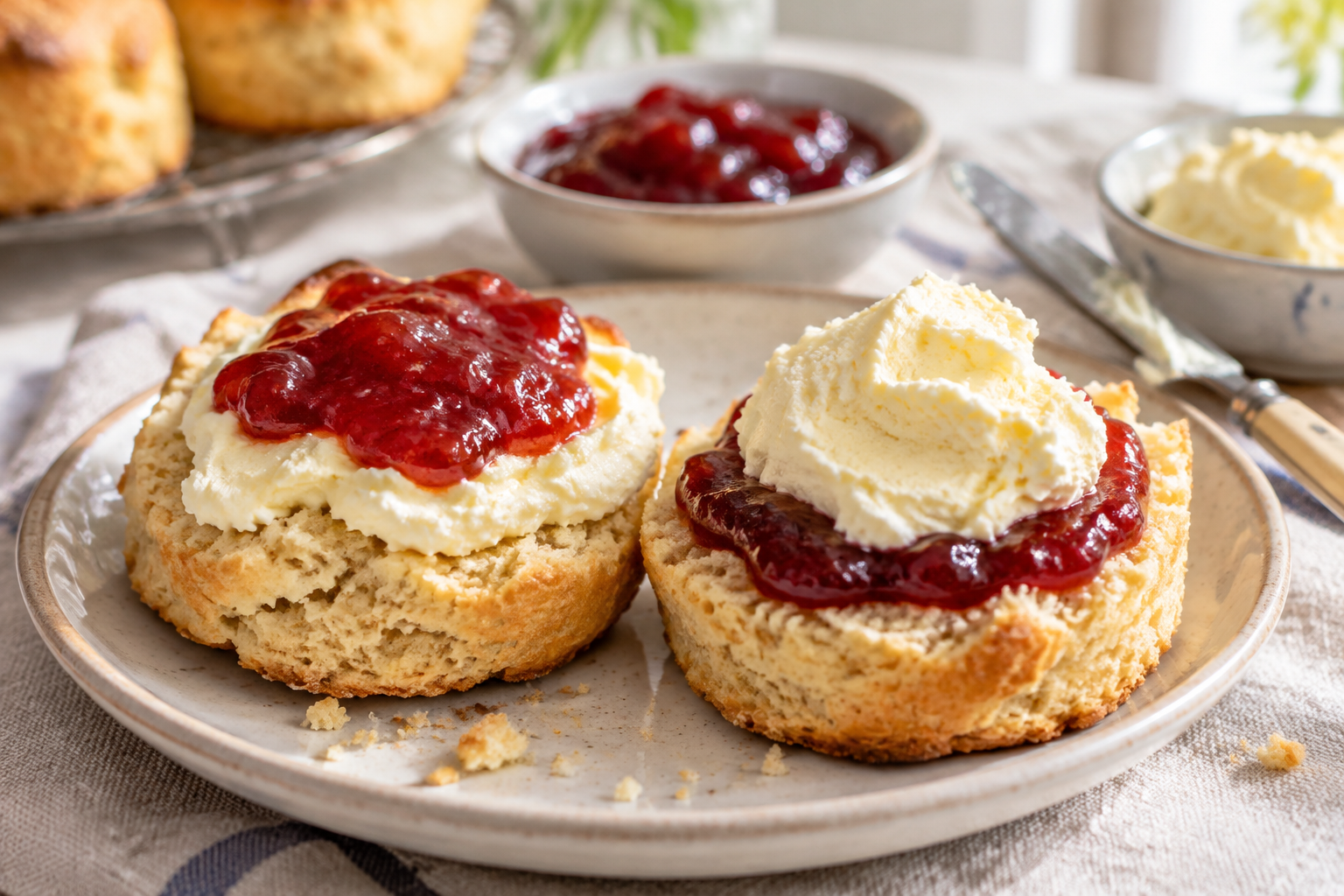
For afternoon tea, the British style is often less sweet than large American-style café scones. There is room for raisins, but plain scones give the cream and jam more prominence. Butter brings flavour and tenderness; the raising agent and oven heat provide the lift. Too much flour or prolonged handling can easily make the result dense.
The most common mistake at home is treating the mixture like bread dough. There is no need to knead it to develop a strong gluten network. The dough only needs to hold together. Cold butter, gentle mixing and leaving it thick enough when shaping do more good than sophisticated equipment. And because scones quickly lose their freshly baked charm, timing matters more than perfect symmetry.
Clotted cream is a thing of its own: very rich cream that develops a dense, spreadable consistency through slow heating followed by cooling, often with a golden surface. It is not simply stiffly whipped cream. Its flavour is rich and gently cooked, and its consistency allows it to sit generously on a scone without running off.
In Devon, the cream traditionally goes on first, with jam on top. In Cornwall, the familiar order is reversed: jam first, then cream. That is how the regional styles are usually described, though of course not every resident follows the same rule. The debate is part of the pleasure, not a reason to correct your guests.
In Sweden, clotted cream can sometimes be found in British specialist shops. Otherwise, mascarpone mixed with a little whipped cream makes a useful alternative. It lacks the original’s distinctive heat-treated character and should not be called real clotted cream, but it serves the same practical purpose: a dense, mellow richness that softens the tea’s astringency and supports the jam.
The cucumber sandwich works in the opposite direction. It is cool, thin and understated. White bread, soft butter and thinly sliced cucumber may sound almost too simple, but that is precisely why every detail shows. Bread that is too coarse takes over, wet cucumber makes the sandwich soggy and hard butter straight from the fridge tears the slices.
A thin layer of butter adds flavour while offering some protection against the cucumber’s moisture. The cucumber can be lightly salted, then dried thoroughly. There is no need to turn it into a pickle. Trim off the crusts if you want the classic dainty look, but save them for croutons or breadcrumbs. Tradition can be elegant without being wasteful.
What belongs in the cup – and the glass?
For a table with both sandwiches and scones, Assam is a reliable first choice. A full-bodied black Assam tea often has malty notes and enough strength to stand alongside butter, cream and jam. A splash of milk can soften the sensation of astringency. This is especially pleasant with a robust tea, but is by no means essential.
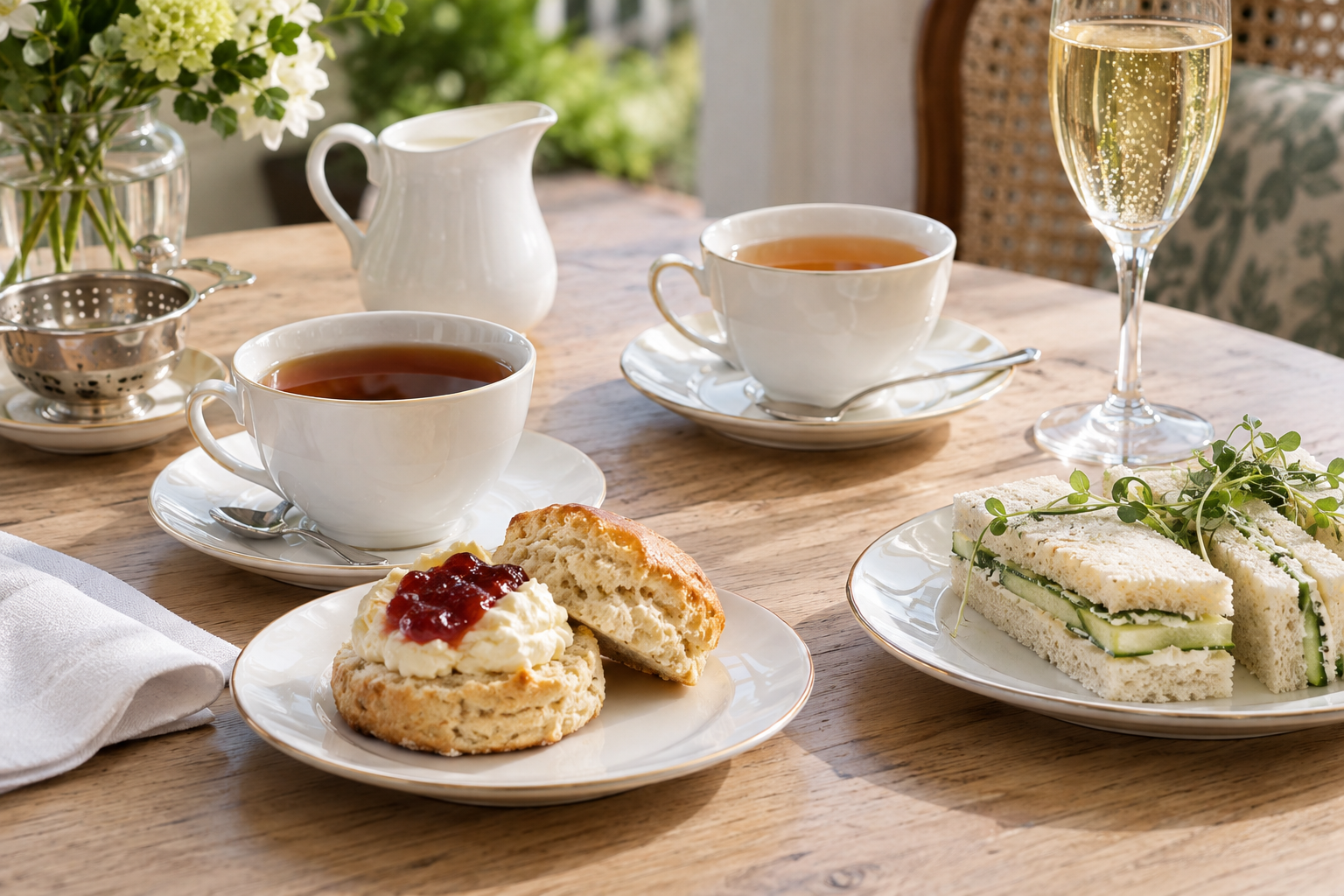
Darjeeling offers a different character. An early harvest, often called first flush, can be light, floral and greener in tone than you might expect from black tea. Later harvests can bring more body and the grape-like character usually called muscatel. There is considerable variation between gardens and batches, so the name alone does not tell the whole story.
A lighter Darjeeling can be particularly lovely with delicate cucumber sandwiches. It complements the food without overwhelming it. With scones generously topped with cream, a fuller-bodied tea often works better. The underlying principle is the same as with wine and food: the intensity of the drink needs to suit what is on the plate.
Astringency, however, is not the same as acidity. Tea’s polyphenols can leave a dry sensation in the mouth, while sparkling wine brings distinct acidity and carbonation. Both can provide a contrast to rich food, but in different ways. Overbrewing tea does not automatically make it more useful with food; it may simply make it bitter.
Start with the instructions on the packet. For many black teas, freshly boiled water and a few minutes’ brewing work well, while a delicate Darjeeling may benefit from slightly cooler water and a shorter steep. Remove the leaves or strain the tea into a serving pot. Leaving the leaves in throughout the conversation makes for an increasingly harsh second cup.
English sparkling wine is a lovely, optional addition when afternoon tea is a celebration. Many well-known examples are made by the traditional method from grapes including chardonnay and pinot noir. A dry wine with fresh acidity and bready notes works best with the sandwiches and with scones spread sparingly with jam. Alongside very sweet cakes, the same wine can seem sharp and less fruity.
The obvious alcohol-free choice is, of course, tea. If you would also like to offer something cold, choose an alcohol-free sparkling apple drink with moderate sweetness and pronounced acidity. Apple works beautifully with cream and strawberry jam; for cucumber, the less sweet end of the scale is best. Alcohol is not required for a complete tea. If wine is included, serve small glasses, offer water and keep quantities moderate.
Make room for a Swedish afternoon
At home, keeping the menu small pays off. Freshly baked scones and carefully made cucumber sandwiches are more tempting than seven varieties that have been sitting out since morning. If you want to add something sweet, one small cake per person is enough, whether bought or homemade. This is not a competition to see who can fill the most tiers.
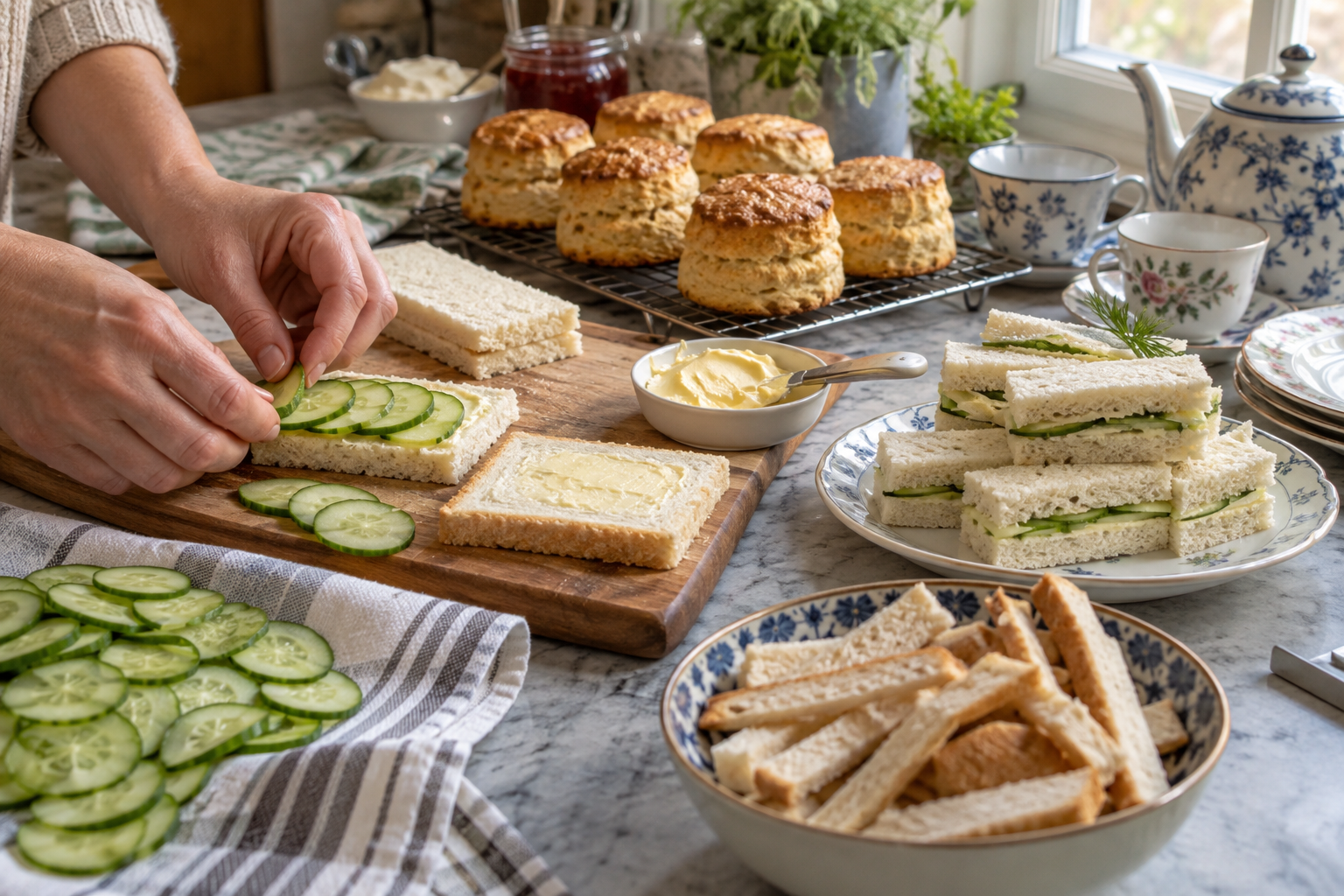
Plan the baking around serving time. The cream alternative can be made earlier and kept chilled. The cucumber can be sliced and dried a little in advance, but sandwiches are best assembled shortly before the meal. Ideally, bake the scones last and let them cool until warm rather than hot, so the cream does not melt immediately.
Put out milk and sugar separately so each guest can choose. Lemon can be offered for tea without milk, but is not needed to make the service feel complete. Warm the pot and use an infuser large enough to give the leaves room. If you only have tea bags, those are fine too: fresh water and the right brewing time matter more than ceremonial gestures.
The recipe card provides a small, complete tea for four, not a historical reconstruction of the duchess’s table. The scones follow a modern British style, the cream is openly adapted to what is available in Swedish shops and the cucumber sandwiches are kept simple. This is how a tradition becomes useful: by knowing what you are preserving and what you are changing.
Set the table with china you love, even if the cups do not match. Let one person pour while another passes the jam. The debate over cream or jam first can take its time. After all, the most important thing about England at four o’clock is not the hour, but allowing the afternoon to be, for a while, more than a stretch of time to get through before dinner.
Afternoon tea for four: scones, a cream alternative and cucumber sandwiches
A modern home version with eight small scones and twelve finger sandwiches. Mascarpone and whipping cream stand in for clotted cream in texture and use, but are not the same product. This makes a generous afternoon snack for four.
Ingredients
Method
- 1Preheat the oven to 225 °C, conventional heat. Line a baking tray with baking parchment. Let the butter for the sandwiches soften, but keep the butter for the scones cold.
- 2Whip the cream to soft peaks. Stir the mascarpone until smooth in another bowl, then gently fold in the cream. Stop when the mixture is smooth and thick; do not overwork it. Cover and refrigerate.
- 3Slice the cucumber very thinly, preferably using a mandoline with a finger guard. Toss with 1 pinch of salt and leave for 10 minutes. Lay the slices on clean kitchen paper or a clean tea towel and pat dry.
- 4Mix 250 g plain flour with the baking powder, sugar and salt. Quickly rub in the cold butter until the mixture resembles coarse crumbs. Small visible pieces of butter are fine.
- 5Pour in 1.5 dl milk and mix briefly with a table knife or spatula until the dough just comes together. If any loose, dry flour remains, add another teaspoon or so of milk. Do not knead.
- 6Turn the dough out onto a lightly floured surface and gently pat it to about 2.5 cm thick. Cut out rounds with a cutter about 5 cm wide, pressing straight down without twisting. Gently gather the scraps and cut out more, making about eight in total.
- 7Place the scones on the tray with a little space between them. Lightly brush the tops with milk. Bake in the middle of the oven for 10–12 minutes, until risen, with golden tops and lightly coloured bases. Cool on a wire rack for 10–15 minutes.
- 8While the scones bake, spread a thin layer of softened butter over every slice of bread. Divide the dried cucumber between four slices, add a very light sprinkling of pepper if you like, and top with the remaining slices, buttered side in.
- 9Trim off the crusts with a sharp serrated knife without compressing the bread. Cut each sandwich into three fingers. Arrange on a plate and cover until ready to eat.
- 10Serve the scones warm, with the chilled cream alternative and jam in separate bowls. Set out the cucumber sandwiches and freshly brewed black tea. Let guests decide for themselves whether cream or jam goes on first.
- Scones are best freshly baked. Freeze any leftovers the same day, then thaw and warm in a 150 °C oven for about 5–8 minutes.
- If you have real clotted cream, use about 200 g in place of the cream alternative. Lightly whipped cream also works, but gives a lighter, airier result.
- The cream alternative can be made up to a day before serving and kept covered in the fridge. Ideally, assemble the sandwiches no more than an hour ahead and keep them covered and cool.
- Save the trimmed bread crusts for breadcrumbs or croutons. Try splitting the scones by hand along their natural seam.
What goes in the glass
- TeaBlack Assam tea, with milk if you likeMalty fullness keeps pace with butter and cream. The tea’s astringency contrasts with the rich food, while a splash of milk can soften a strongly brewed cup.
- TeaDarjeeling, preferably a lighter harvest for the sandwichesFloral, fresh aromas suit cucumber’s subtle flavour. Serve without milk if you like, and avoid over-extraction so bitterness does not overwhelm the delicate sandwiches.
- WineEnglish sparkling wine, traditional-method brutFresh acidity and bubbles contrast with butter and cream, while bready notes complement the scones. Best with the savoury part of the tea and modest amounts of jam; very sweet cakes can make dry wine taste sharp. Serve a small glass if alcohol is wanted.
- Alcohol-freeAlcohol-free sparkling apple drink with fresh acidityApple’s fruitiness suits strawberry jam and cream, while acidity balances the richness. Choose moderate sweetness so the drink also works with cucumber sandwiches. Black tea is also a perfectly good alcohol-free main choice.
Enjoy alcohol in moderation. Alcohol-free options go just as well with the food.
Sources
- Jane Pettigrew, A Social History of Tea (2001)
- Erika Rappaport, A Thirst for Empire: How Tea Shaped the Modern World (2017)
- Beatrice Hohenegger, The Book of Tea (2007)
- Alan Davidson; tredje upplagan redigerad av Tom Jaine, The Oxford Companion to Food (2014)
- Samuel Pepys, The Diary of Samuel Pepys (1660–1669)
- Sidney W. Mintz, Sweetness and Power: The Place of Sugar in Modern History (1985)
Ask questions about "Afternoon tea – England at four o’clock". Answers are based on the magazine's own articles.