Feijoada – Brazil’s Saturday Table
Black beans, slow cooking and a table where the accompaniments are half the meal
In Rio de Janeiro, Saturday can smell of garlic, smoky pork and black beans slowly simmering together. Feijoada is generous food with a history that cannot be squeezed into a single origin myth. We follow the stew to the table – with crisp farofa, ribbons of greens and orange shining against the dark beans.
 By Sofia HaddadReporter · Middle East, Africa and Latin America – mezze, tagine, injera, mole and much more
Translated from Swedish with AI assistance.
Go to the recipes (2) ↓When Saturday leaves time to linger
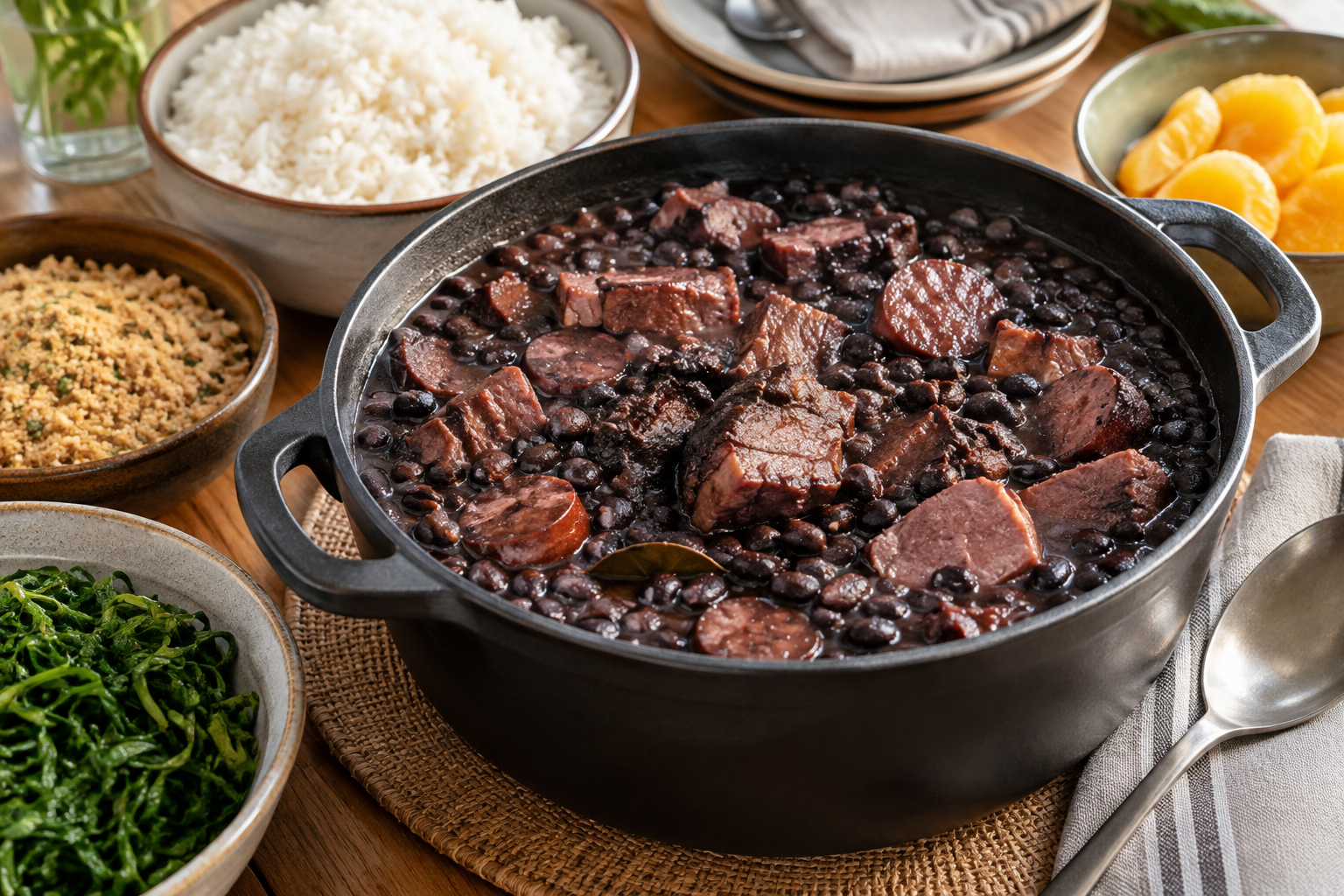
The lid lifts, and a warm aroma of beans, bay leaves and smoked pork fills the kitchen. The stew is almost black, but in the light its broth takes on a deep burgundy hue. A ladle sweeps along the bottom; the beans move slowly around slices of sausage and meat beginning to yield. Peeled oranges lie on the chopping board. The greens are waiting, cut into fine ribbons. Someone asks whether the rice is ready; someone else sets out another plate.
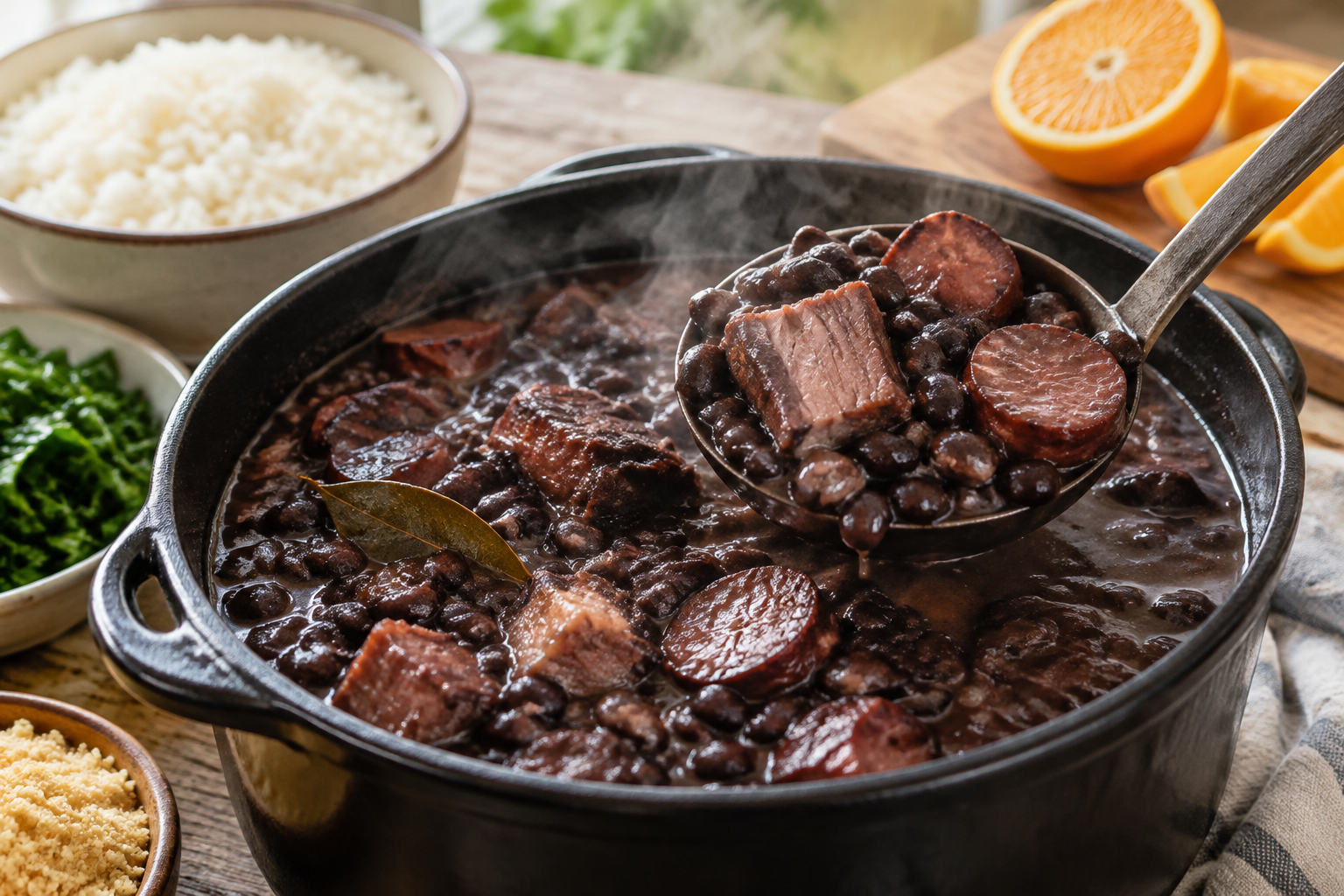
This is the kind of meal feijoada invites: not a quick stop between the day’s errands, but a table to linger at. In Rio de Janeiro, Saturday lunch is a particularly well-established time for feijoada, both in restaurants and at home. But there is no national clock dictating when the stew may be eaten. In São Paulo, Wednesday is also an established feijoada day at many lunchtime restaurants. Customs overlap, and Brazil is too big to fit into a single weekly menu.
What is often called feijoada completa is more than beans and meat. Around the pot sit white rice, farofa made from toasted cassava flour, quickly sautéed leafy greens and orange. Sometimes there is a tangy vinaigrette sauce, or a hot sauce with chilli and a little bean broth. Each element has a job to do: soak up, crunch, refresh, cut through.
This is also why feijoada works so well as a shared meal. Everyone can build their own plate. One person wants more broth in their rice; another searches out the sausage. The farofa goes around again. The stew stays warm, and the host need not stand plating up four identical portions while the conversation continues in another room.
A national dish without a simple birth certificate
The most widely told story of feijoada’s origins is also the one that calls for the greatest caution. According to this account, enslaved Africans on Brazil’s plantations were given the unwanted parts of the pig – ears, feet and tail – and cooked them with black beans. From these scraps, the country’s future national dish supposedly emerged.
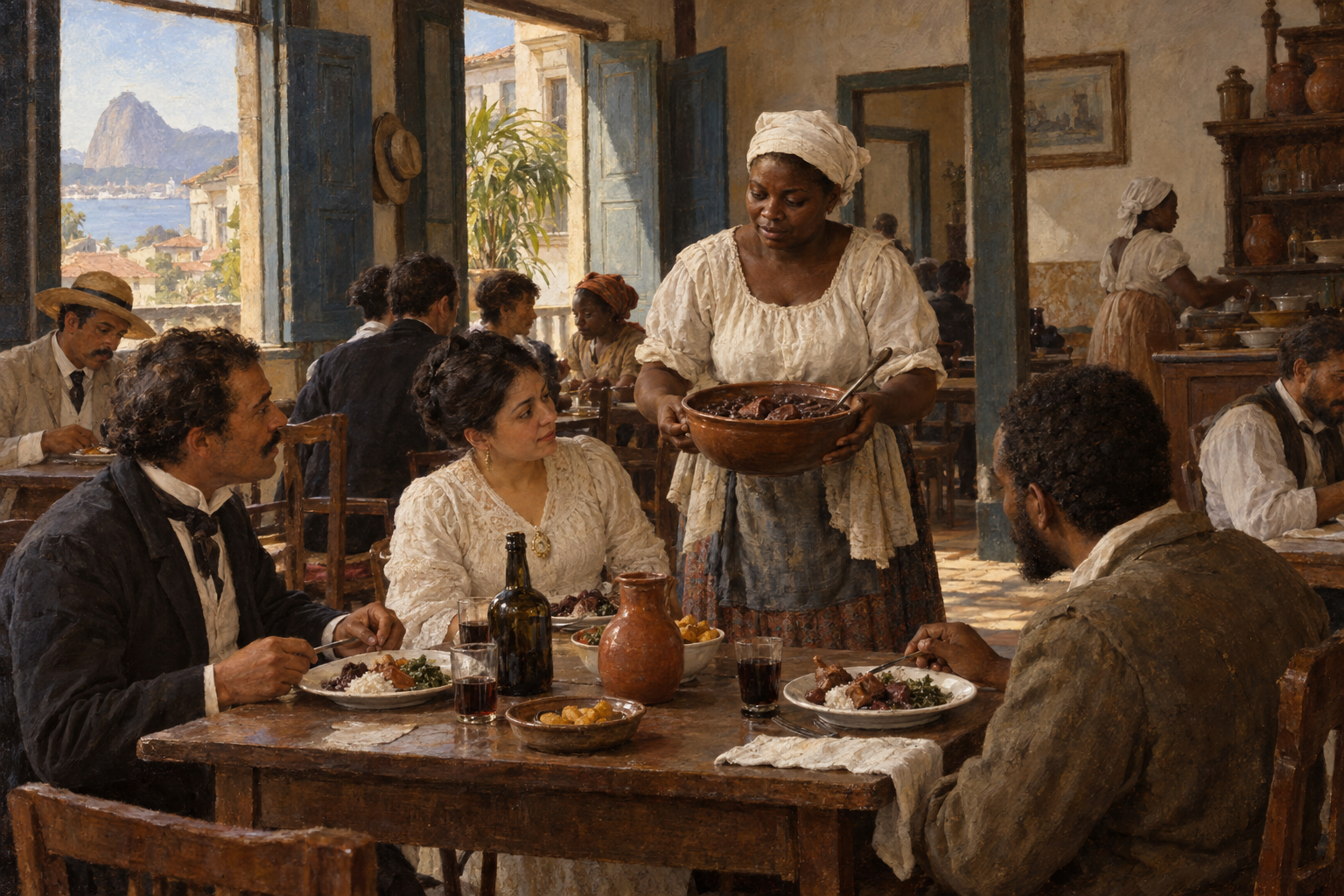
The story is easy to remember. It ties hunger, ingenuity and survival to a single pot. But it does not stand up as a definitive explanation of how feijoada came into being. Brazilian food historians have challenged it, partly because the cuts of meat in question were not necessarily despised scraps. Feet, ears and other gelatin-rich parts also featured in European cooking and could be prized ingredients. Who was allowed to eat what also varied greatly between places, periods and households.
That does not mean slavery is unimportant to Brazil’s food culture. On the contrary, agriculture, trade, households and professional kitchens were shaped for centuries by the labour of enslaved people. African and Afro-Brazilian knowledge is fundamental to the country’s food. But that history is not treated with greater respect by assigning a particular dish a dramatic origin without sufficient evidence. Rejecting a simplified myth does not mean writing out the people behind the food.
Portuguese bean and meat stews are an important part of the background. Portugal has feijoadas made with different beans, pork and sausages, while a broader European tradition brings pulses and preserved meat together in the same pot. The family resemblance is clear, but it does not prove that today’s Brazilian feijoada crossed the Atlantic as a fully formed recipe. Nor should it be confused with cozido, although both belong to a wider family of simmered meat dishes.
A more plausible picture is of a dish that took shape and evolved in Brazil: beans and cassava native to the Americas, Portuguese eating habits and preservation techniques, African and Afro-Brazilian culinary knowledge, local ingredients and the restaurant culture of growing cities. Feijoada appears in Brazilian newspaper and restaurant records during the 19th century. Such evidence shows that the dish had a name and was being sold, not exactly when someone first cooked it.
Naming a single creator or birthplace would therefore be misleading. Feijoada’s history is more about how a family of stews became a Brazilian meal rich in meaning – and how it later came to represent the country, both to Brazilians and to the wider world.
The beans give the stew its body
The dark feijoada so closely associated with Rio is built on black beans, feijão preto. But the word feijoada does not mean black beans everywhere. There are regional and local Brazilian versions with other beans and different combinations of meat and vegetables. What we are cooking here is a home version of the black bean and pork stew that many people outside Brazil encounter first.
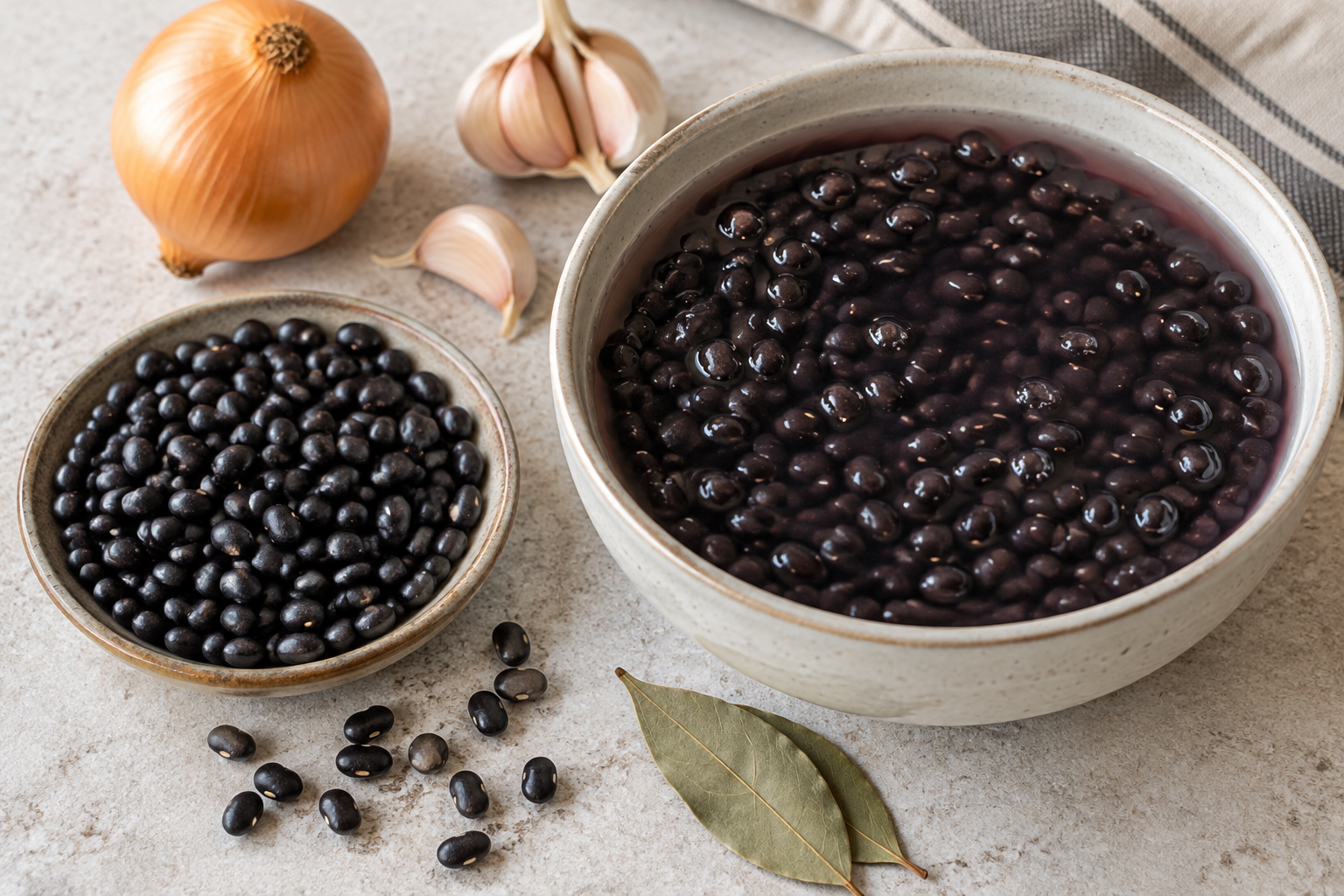
The beans are not an accompaniment to the meat. They are the very body of the stew. Their cooking liquid takes on salt, fat and smokiness; a few split or mashed beans give the broth a soft, lightly creamy texture. A good feijoada should flow into the rice without being as thin as soup. Nor should it set into a dense mass of beans.
Dried black beans give you the best control over this. They are available in many larger Swedish supermarkets and Latin American food shops. Choose black beans, not black soybeans, and preferably use a bag that has not spent years forgotten in the cupboard. Old beans can take much longer to cook and may still remain stubbornly hard.
Soaking makes cooking more predictable, although it is not the only way to prepare black beans. In our recipe they are soaked overnight, drained and cooked in fresh water. After that, time and steady heat do the work. Taste several beans before deciding that the stew is ready: their centres should be soft, not chalky.
There is no need for a complicated spice mix. Onion, garlic, bay leaves and black pepper go a long way. Some of the depth of flavour comes from frying the onion and garlic in fat before they meet the beans. Tipping in cumin, paprika and chilli out of habit when making a stew, however, risks taking the flavour in a different direction. Heat can be offered at the table instead, so everyone can choose for themselves.
Meat, salt and patience
A rich feijoada may contain salted or dried beef, various cuts of pork and sausages. Carne-seca, dried and salted beef, is an important ingredient in many versions. Paio and linguiça calabresa are sausage names that appear often. The latter is a Brazilian type of sausage; the name is no guarantee that an Italian or Swedish product labelled “calabrese” will have a similar flavour and texture.
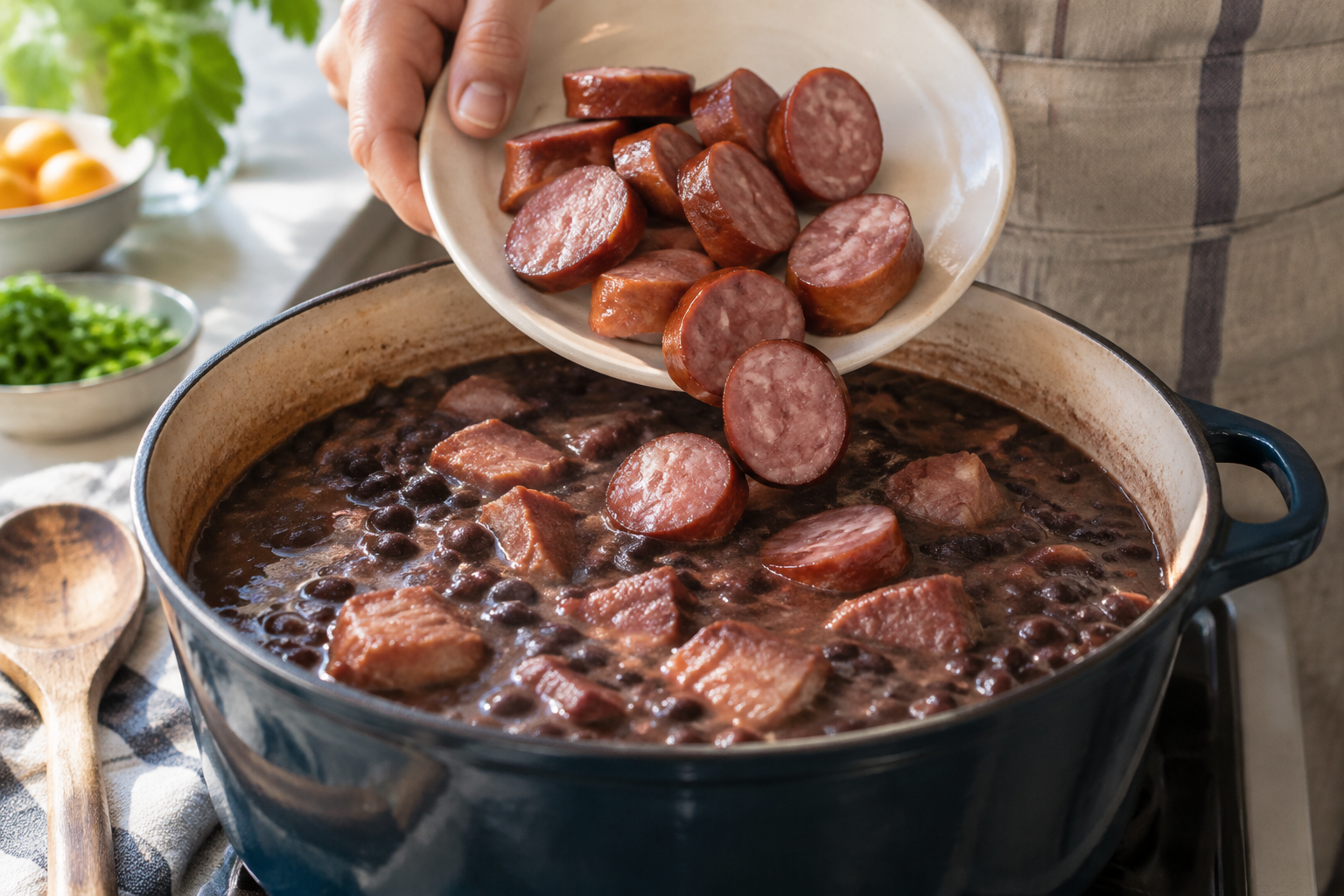
Here, choosing the right ingredients matters more than chasing labels. For a Swedish home kitchen, we choose pork collar, salt-cured pork belly and a firm smoked pork sausage with a distinct garlic flavour. Together they provide tender meat, salt, fat and smokiness without requiring days of planning. This is a practical adaptation, not a claim that these ingredients are identical to their Brazilian counterparts.
If you have access to carne-seca, follow the product’s instructions, usually involving thorough soaking to remove salt and sometimes separate cooking. You cannot simply substitute the same weight of very salty meat and put it straight into the pot. The same applies to heavily salted pork cuts. Salt levels need to be managed before everything has cooked together, not when the guests are already at the table.
Feet, ears and tail still feature in feijoada, contributing both flavour and gelatin. They are not essential for a good homemade stew, but neither are they curiosities to turn up your nose at. If you want to use these cuts, you need a recipe with cooking times suited to them. Our recipe is deliberately built around more readily available cuts.
The most common mistake is cooking everything for the same length of time, regardless of the ingredient. The beans need to soften, the pork collar to become tender and the sausage to retain a pleasant texture. That is why the sausage goes in later. Another mistake is boiling the nearly finished stew hard. This breaks up the beans more than necessary, makes the meat fall apart and can scorch the bottom. After the initial vigorous boil, a gentle simmer is the way forward.
Adjust the salt only towards the end. The broth concentrates during cooking, and both pork and sausage release salt. A stew that seems only lightly salted early on may be just right after another hour. If it feels too fatty, skim the surface; if you cook it the day before, the solidified fat is easy to lift off once the stew is cold.
Farofa, couve and orange – each has its place
Farofa looks unassuming in its bowl: a pale to golden, crumbly topping. But when it meets the soft bean broth, something central to the whole meal happens. The dry crumbs become moist, the toasted aroma grows, and every mouthful gains a gentle, grainy bite. Farofa is not decoration. It changes how the stew feels in your mouth.
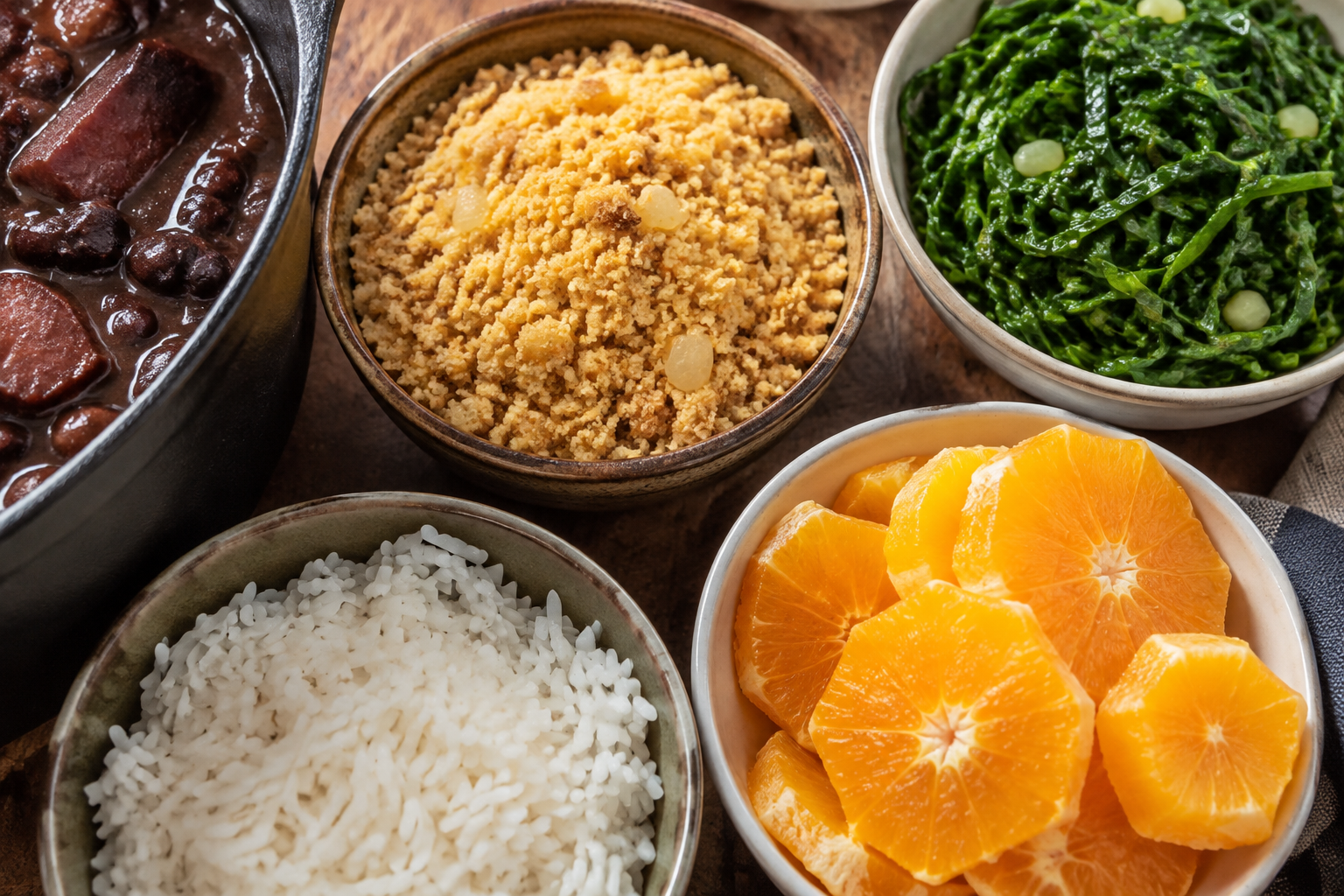
The base is often farinha de mandioca, a granular cassava flour rooted in the culinary knowledge of Brazil’s Indigenous peoples. Cassava’s history in the country long predates Portuguese colonisation. For farofa, the flour is toasted in fat and may be joined by onion, egg, bacon or banana, for example. There are many versions; ours is simple, with butter and onion, so that it sits comfortably beside the already flavourful stew.
There is an important shopping trap here. Tapioca starch, which also comes from cassava, is not the same product as farinha de mandioca. The starch will not produce farofa’s grainy, toasted texture. Look for a product specifically intended for farofa or labelled farinha de mandioca. Both raw and pre-toasted farinha are available; the pre-toasted kind needs less time in the pan. Ready-seasoned farofa is also available, but it is a different starting point from the plain flour used in this recipe.
Couve is the leafy green often served alongside, usually sliced very finely and quickly sautéed with garlic. Brazilian couve-manteiga resembles collard greens and is not quite the same as the curly kale common in Sweden. Cavolo nero is a practical substitute; tender curly kale also works if the tough central ribs are removed. The aim is tender but still vibrant green ribbons, not long-cooked greens.
Orange brings juiciness, freshness and a mild bitterness when a little membrane remains. It should not be presented as a proven way to neutralise fat or make a heavy lunch medically lighter. Its most important job is simpler and more delicious: to provide a contrast to the saltiness of the meat and the depth of the beans.
The white rice is equally thoughtful in its restraint. It welcomes the broth and leaves room for everything else. With farofa, rice, greens and orange on the table, there is no need to make the stew hotter or add more types of meat for the meal to feel complete. The balance is already there around it.
A table to share, not the whole of Brazilian daily life
Feijoada has a natural place in the image of Brazilian togetherness, but that image needs nuance. The country’s everyday food is much broader than this festive stew. Rice and beans appear in countless simpler combinations, and an elaborate feijoada with many types of meat takes both time and money. Calling it a national dish does not mean everyone eats it the same way or equally often.
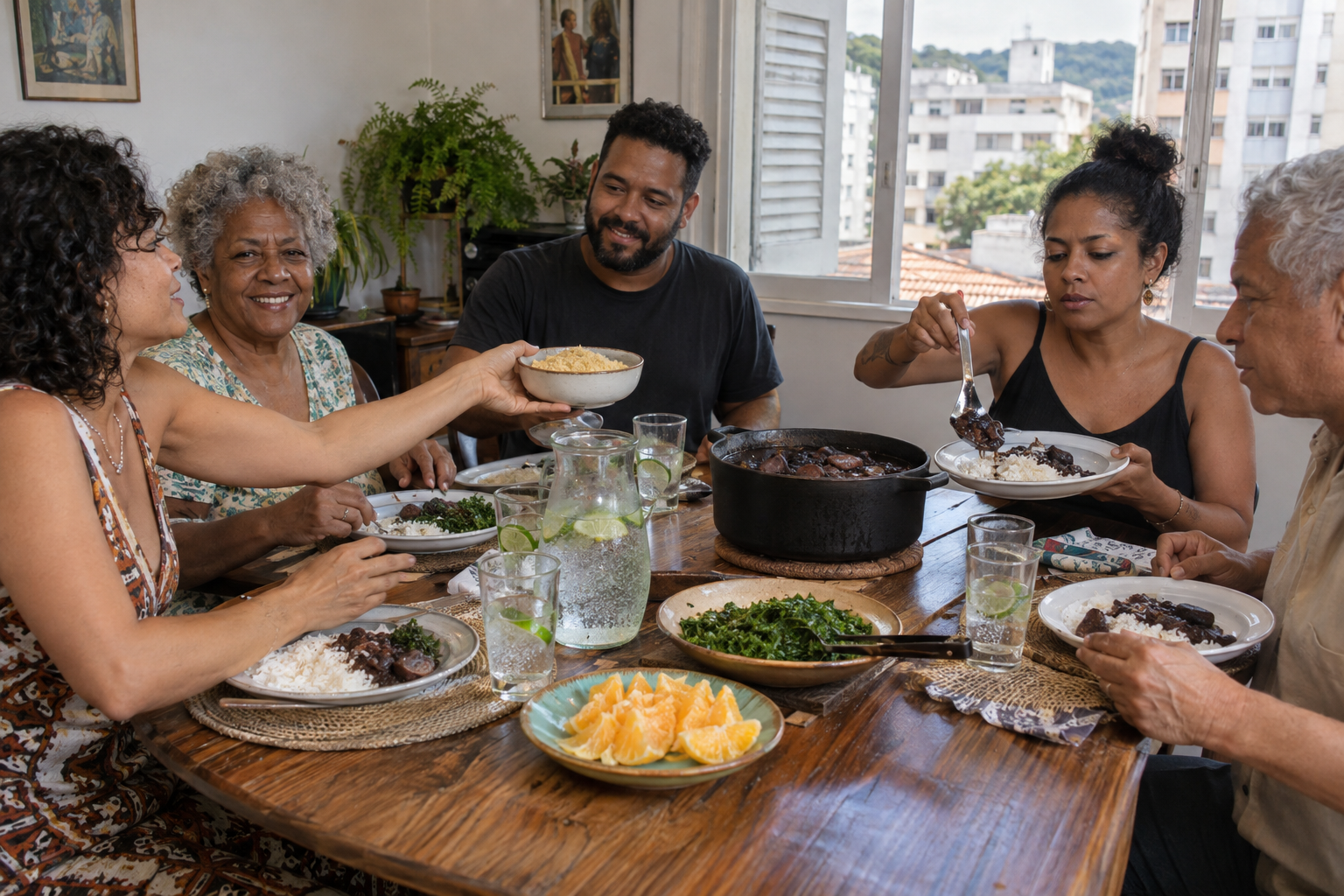
In Rio, feijoada can also be associated with music and social gatherings, including within samba communities. But there need not be a band, a courtyard or a special occasion. A family lunch with the pot in the middle of the table is just as much a part of the dish’s life. And within the same family, opinions can be firm: which cuts of meat belong in it, how thick the broth should be and whether the farofa should contain egg.
Drinks can happily play a supporting role. A pale Brazilian lager, or another light lager in a similar style, brings fizz and freshness without competing with the beans. Guaraná soft drink is a Brazilian alcohol-free option whose sweetness can complement the saltiness; serve it thoroughly chilled, and put water on the table too.
Caipirinha, made with cachaça, lime, sugar and ice, is a familiar companion to Brazilian food. A small serving, sipped slowly, suits this meal better than a glass topped up without thought. The fresh lime works beautifully, but the cocktail is strong even when it tastes light. Alcohol-free drinks should be an equally considered choice, not an afterthought. Sparkling water with lime is also refreshing when both the food and the soft drink are full of flavour.
Making the most of Saturday
The great advantage of feijoada for the home cook is that the work can be spread out. The beans are soaked the night before. The stew itself can be cooked the day before serving, while the greens wait until the last moment. Farofa is quick to make and can be prepared while the rice cooks. You need a roomy, heavy-based pot, not specialist restaurant equipment.
The recipe below is generous for four people with all the accompaniments. It uses raw salt-cured pork belly, boneless pork collar and an already cooked smoked sausage. Check the sausage packaging: fresh raw sausage requires different handling. The amount of water is a starting point, as the width of the pot, its lid and the age of the beans affect how much is needed. Keep hot water ready and make sure the beans stay covered during cooking.
If cooking ahead, cool the food quickly in smaller, shallow containers and refrigerate it rather than leaving the whole pot to cool on the hob overnight. When reheating, you will often need a little water, as the beans absorb more liquid as they stand. Heat thoroughly and stir gently along the bottom.
Then keep serving simple. The pot on a heatproof mat, the rice in a warm bowl, the farofa dry and loose in another. The greens straight from the frying pan at the last moment. Orange close at hand. It is not the number of meats or a perfectly laid table that makes the meal generous. It is having enough food, giving the accompaniments their space and letting everyone take their time.
Feijoada with black beans, pork and smoked sausage
A Swedish home version of the dark feijoada associated with Rio. Pork collar, salt-cured pork belly and smoked sausage replace the wider range of salted and dried meats used in many Brazilian recipes. Makes four generous portions with accompaniments. Allow an additional 8–12 hours for soaking; older beans may take longer to cook.
Ingredients
Method
- 1Sort through and rinse the beans. Place in plenty of cold water and soak for 8–12 hours, preferably in the fridge. Discard the soaking water and rinse.
- 2Cut the pork collar into roughly 3 cm pieces and the pork belly into smaller cubes. Thickly slice the sausage and set aside in the fridge. Chop the onion and garlic.
- 3Heat the oil in a pot with a capacity of at least 4–5 litres. Fry the pork belly over a medium heat for 4–5 minutes to render some of its fat. Add the onion and fry for another 5 minutes until softened. Stir in the garlic and fry for 1 minute without letting it burn.
- 4Add the beans, pork collar, bay leaves, black pepper and 15 dl water. The water should cover the contents by about 2 cm; top up if needed. Bring to the boil and boil vigorously for 10 minutes. Skim if necessary.
- 5Lower the heat and simmer with the lid slightly ajar for about 75 minutes. Stir gently along the bottom occasionally, and top up with hot water if the beans are no longer covered.
- 6Add the sliced sausage. Simmer for another 30–50 minutes, until the beans are completely soft and the pork collar pulls apart easily with a fork. Continue cooking if needed; the tenderness of the beans determines when the stew is ready.
- 7Mash about 1 dl of the beans with a little broth in a bowl and stir back into the pot. Simmer uncovered for 10–15 minutes until lightly creamy, or thin with hot water if the stew is too thick. Only now season to taste with salt and, if needed, more pepper. Remove the bay leaves.
- 8Cook the rice according to the packet instructions during the stew’s final half-hour. Peel the oranges with a knife, removing most of the white pith, and cut the flesh into slices or pieces. Make the farofa.
- 9Remove the tough central ribs from the greens and shred the leaves very finely. Heat the olive oil in a large frying pan, fry the garlic for about 30 seconds, then add the greens. Stir-fry for 3–5 minutes until softened. Add 1–2 tbsp water if they need a little steam to become tender. Season lightly with salt.
- 10Serve the feijoada hot, with the rice, greens, orange and farofa in separate bowls. Put any chilli sauce on the table so everyone can choose their own level of heat.
- Choose a firm, cooked smoked sausage without overpowering seasoning. Smoked garlic sausage is a practical Swedish substitute, but it does not taste exactly like paio or linguiça calabresa.
- Cool the stew quickly, store in the fridge, ideally at 4 °C, and eat within 3–4 days. It also freezes well. Thin with water and reheat thoroughly before serving.
- For a plant-based bean meal inspired by feijoada, leave out the meat and use fried mushrooms and smoked tofu. Add them towards the end and adjust the salt separately; the result is a variation in its own right, not the same stew.
Farofa with butter and onion
A toasted, crumbly accompaniment that brings contrast to feijoada. Use food-grade granular farinha de mandioca, not tapioca starch or a finely ground flour intended for baking.
Ingredients
Method
- 1Check the packaging: if it says torrada, the flour is already toasted and needs less time in the pan. Measure out all the ingredients before you begin.
- 2Melt the butter in a roomy frying pan over a medium-low heat. Add the onion and fry for 6–8 minutes until soft and beginning to colour.
- 3Add the cassava flour in batches, stirring so it mixes evenly with the butter and onion.
- 4Toast over a low to medium heat, stirring constantly. Raw farinha usually needs 8–12 minutes; pre-toasted farinha about 3–5 minutes. Follow the packet instructions too. The farofa should smell gently nutty, feel dry and crumbly, and be lightly golden, not dark and burnt.
- 5Season to taste with salt. Remove the pan from the heat and stir in the parsley, if using.
- 6Transfer to a dry bowl and serve warm or lukewarm. Let each guest sprinkle farofa over their portion or spoon it alongside the stew.
- Farinha de mandioca is available from Latin American shops and Swedish online retailers. Tapioca pearls and tapioca starch will not work as substitutes.
- If you cannot find the right flour, coarse breadcrumbs toasted in butter with onion make a tasty fallback. This is a different accompaniment, however, not cassava farofa.
- Replace the butter with 3 tbsp neutral oil for a dairy-free version. Store leftover farofa with onion in the fridge and reheat in a frying pan, stirring.
What goes in the glass
- CocktailCaipirinha, a small servingLime brings a fresh contrast to the saltiness of the pork and the richness of the stew, while restrained sweetness rounds things out. This is a strong cocktail: choose a small serving and have water and alcohol-free options on the table.
- BeerPale Brazilian lagerA light body, fizz and moderate bitterness suit the salty, deeply savoury food without dominating it. Another pale lager in a similar style works too.
- Alcohol-freeGuaraná soft drinkThis sweet, aromatic soft drink provides a contrast to smoked meat and saltiness. Serve well chilled in small glasses, preferably with plain water alongside.
- Alcohol-freeSparkling water with limeAn unsweetened option whose bubbles and fresh lime aroma lighten the rich meal, leaving the beans, greens and farofa in the spotlight.
Enjoy alcohol in moderation. Alcohol-free options go just as well with the food.
Sources
- Luís da Câmara Cascudo, História da alimentação no Brasil (1967–1968)
- Carlos Alberto Dória, Formação da culinária brasileira (2009)
- Alan Davidson; tredje upplagan redigerad av Tom Jaine, The Oxford Companion to Food (2014)
- Thiago Castanho och Luciana Bianchi, The Food of Brazil (2014)
Ask questions about "Feijoada – Brazil’s Saturday Table". Answers are based on the magazine's own articles.