Beef in puff pastry – a golden centrepiece for a celebration
Beef Wellington between British heroic legend, French culinary technique and the Swedish dinner party.
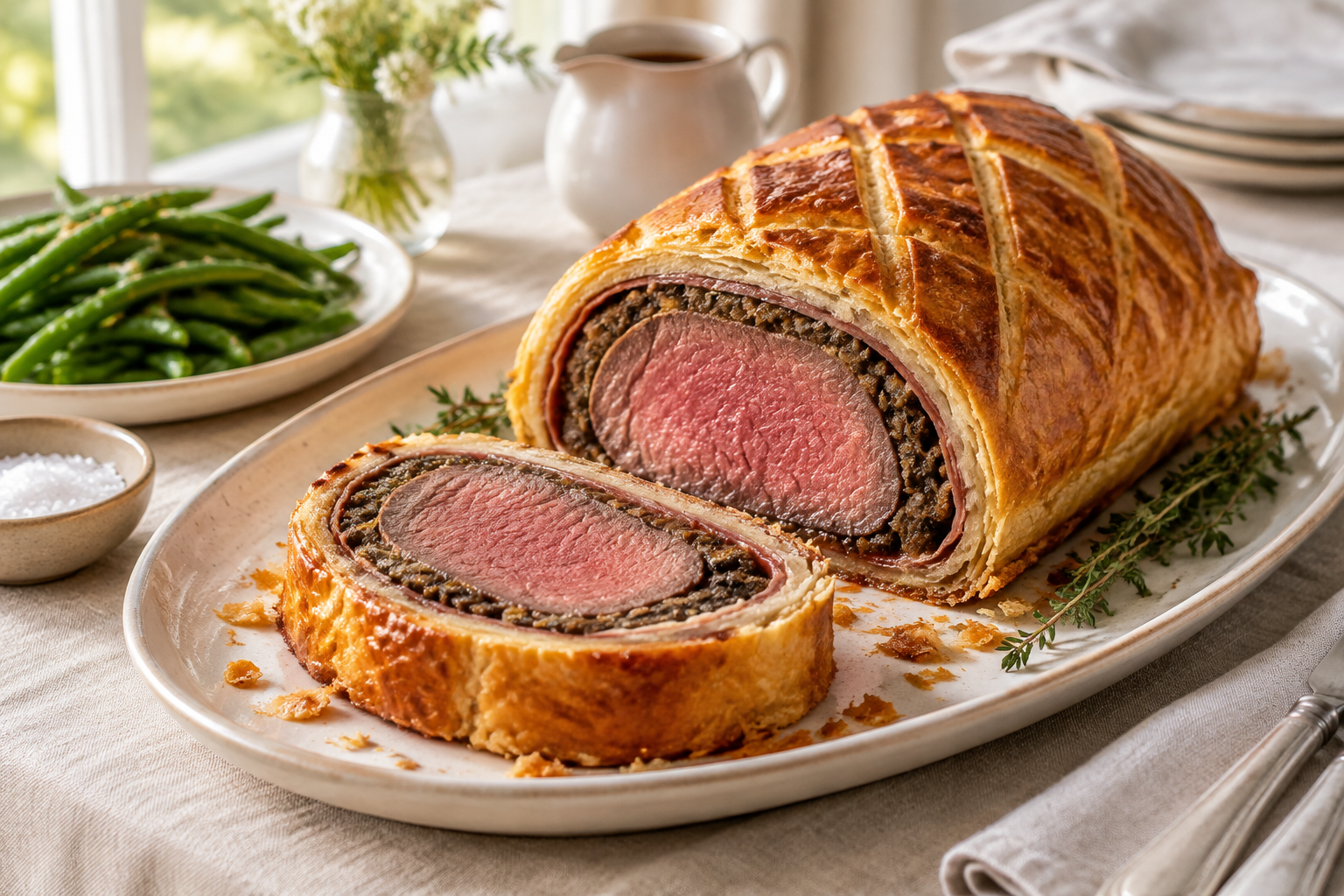
The knife breaks through a crisp shell. Beneath the puff pastry lie mushrooms, mustard and rosy-pink beef fillet. Beef wrapped in pastry is a celebratory dish built on contrasts – and on origins far less clear-cut than the story of the Duke of Wellington.
 By Arvid HolmFood historian · Historic dishes, old cookbooks and eating habits through the ages
Translated from Swedish with AI assistance.
Go to the recipe ↓When the parcel is opened
A brief hush often falls when the pastry-wrapped beef arrives at the table. On the platter sits something resembling an unusually magnificent loaf: glazed with egg, domed in the middle, with small slits where steam has escaped. It smells of butter and browned pastry. Only when the knife cuts through do you hear the dry crackle, and inside the shell a dark ring of mushrooms appears around the pink centre of the meat.
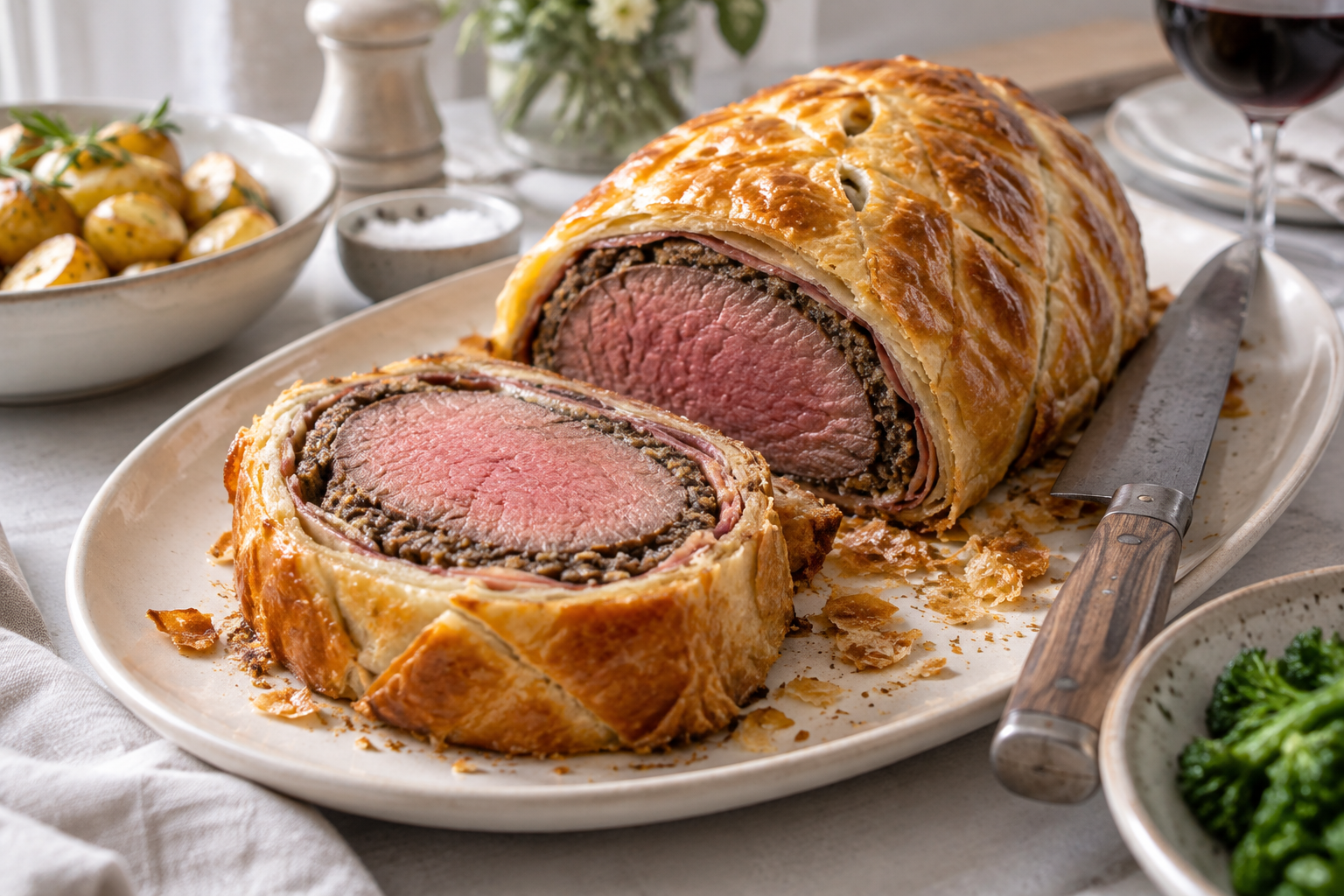
It is easy to see why this has become a dish for celebrations. It conceals its most expensive ingredient, then makes the reveal part of the meal. Unlike a casserole set out generously for everyone to share, or a roast already carved, it demands a moment of attention. Someone cuts, someone passes the plates, someone tries to catch the first flakes of puff pastry.
In Sweden, we often call it inbakad oxfilé – pastry-wrapped beef fillet. The name describes a whole family of dishes, whereas beef Wellington usually means beef fillet with finely chopped mushrooms, enclosed in pastry. Many modern versions also include mustard and air-dried ham. Others contain liver pâté or foie gras, and some use thin pancakes as a barrier against moisture. There is, then, no single immutable original to defend. There is, however, a clear idea: a tender cut of meat should meet a flavourful middle layer and a crisp shell.
A duke, but no reliable birth certificate
The name brings to mind Arthur Wellesley, the first Duke of Wellington, who, alongside allied forces, defeated Napoleon at Waterloo in 1815. From there, it is a short step to the appealing story that the dish was created as a tribute after the victory. The problem is that the story tends to be stronger than the evidence. There is no securely documented inaugural dinner in 1815 on which we can rely.
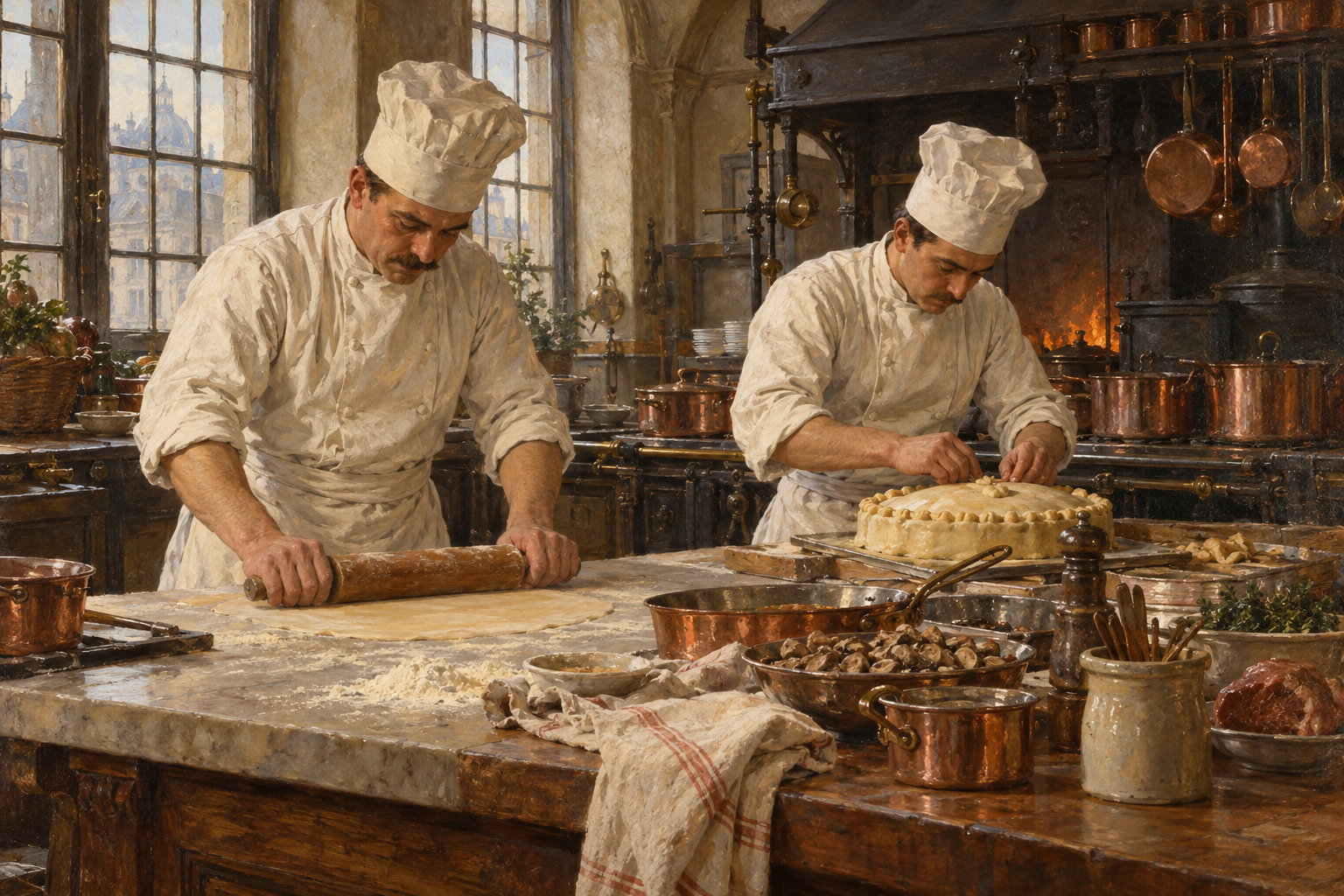
Other explanations link the name to the duke’s boots or his personal eating habits. These should be treated as legends, not as the recipe’s birth certificate. Food history reference works support a more cautious position: the dish’s exact origins are unclear, and the name’s connection to the duke does not prove when or by whom it was created. What is more certain is that beef Wellington became an established part of celebratory and restaurant cooking in the English-speaking world during the 20th century.
The technique itself is older than the name’s fame. European kitchens have long baked meat in pastry, both in pies and in more elaborate dishes. In French culinary terminology, en croûte means that something is cooked in a pastry crust. The classical French restaurant tradition also contributed much of the dish’s culinary vocabulary: fillet, puff pastry, intensely flavoured mushrooms and a carefully prepared sauce.
Auguste Escoffier’s Le Guide culinaire, published in 1903, is a useful source on this world of professional cooking, but should not be treated as a straightforward birth certificate for today’s Wellington. Reference works such as The Oxford Companion to Food and Larousse Gastronomique instead help us place the dish among related preparations and changing names. They show why we need to distinguish between the history of a technique and the history of a dish’s name.
Historically, a dish like this belongs in a well-stocked kitchen. Beef fillet is a premium cut, and making pastry, preparing the filling and judging the meat’s cooking all take work. During the 20th century, the combination became an easily understood language of occasion: a British name, French technique and a cut of meat that signalled the host had spared no expense. Ready-made puff pastry and digital thermometers have brought it closer to the home kitchen, without quite robbing it of its grand entrance.
The flavour lies between the meat and the pastry
The beef fillet contributes tenderness above all. It is lean and relatively mild, so much of the dish’s depth must be built around it. Searing gives it a roasted crust, mushrooms bring earthiness and umami, and mustard adds a sharp note that softens in the oven. Puff pastry supplies fat, aroma and the delicate crispness that makes every mouthful more than just meat.
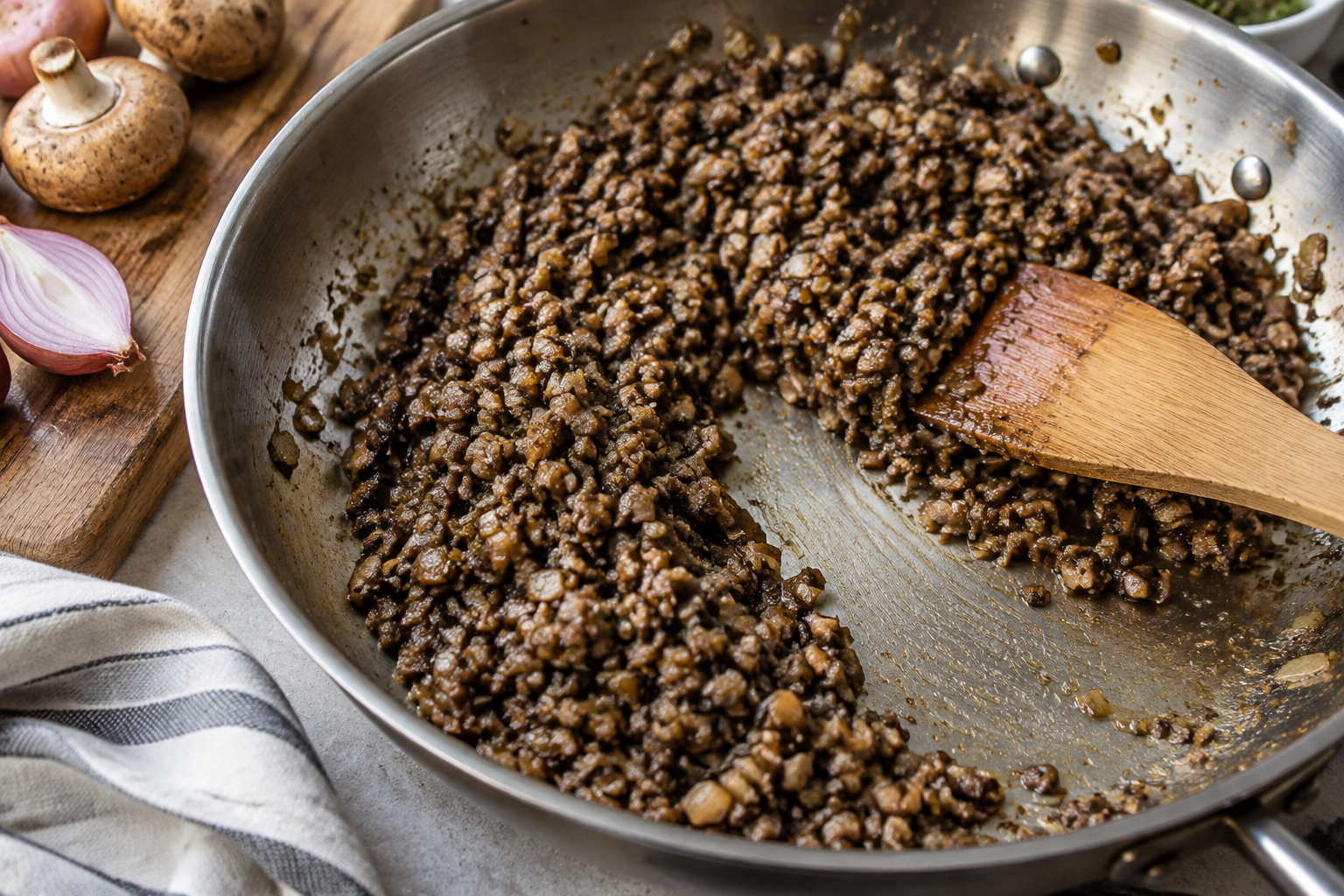
The mushroom filling is often called duxelles. At its heart are finely chopped mushrooms, usually with onion, cooked until much of their moisture has evaporated. It sounds modest, but this is where the dish’s real precision work lies. If the mixture is still wet when the parcel is sealed, it will dampen the pastry from within. No beautiful plait on top can rescue a base that has been made to act as a sponge.
Listen to the frying pan. At first, there is a wet sizzle as the mushrooms release water. Later, the sound becomes drier and the mixture begins to hold together. At that point it should still be moist with fat, but leave no puddle when pushed to one side. A wide pan helps more than the highest possible heat. Too many mushrooms in a small pan make the work slow and uneven.
Button mushrooms are no compromise; they work beautifully. Chestnut mushrooms often give a slightly deeper flavour. Porcini can add more aroma, but should not dominate to the point where the meat is lost. If you use soaked dried mushrooms, these too must be chopped and fried thoroughly dry. It is concentration, not the exclusivity of the ingredient, that determines the result.
Many cooks place air-dried ham or thin pancakes between the mushrooms and the puff pastry. Both help hold the filling in place and slow the passage of moisture towards the pastry, but no layer can make a wet mushroom filling harmless. The ham also adds salt, so season the mushrooms with a light hand. Liver pâté and foie gras appear in other versions and make the dish richer. They are possible variations, not mandatory passwords to an authentic Wellington.
A celebratory dish that needs company, not competition
Today, Wellington often appears when there is time to linger over a meal: at New Year, birthdays and dinners where the main course is the centrepiece of the evening. It is not tied to a single occasion or a shared British family tradition. Rather, it serves as a recurring formula for celebration, equally at home on a restaurant menu and in a home kitchen where someone has decided to cook something special.
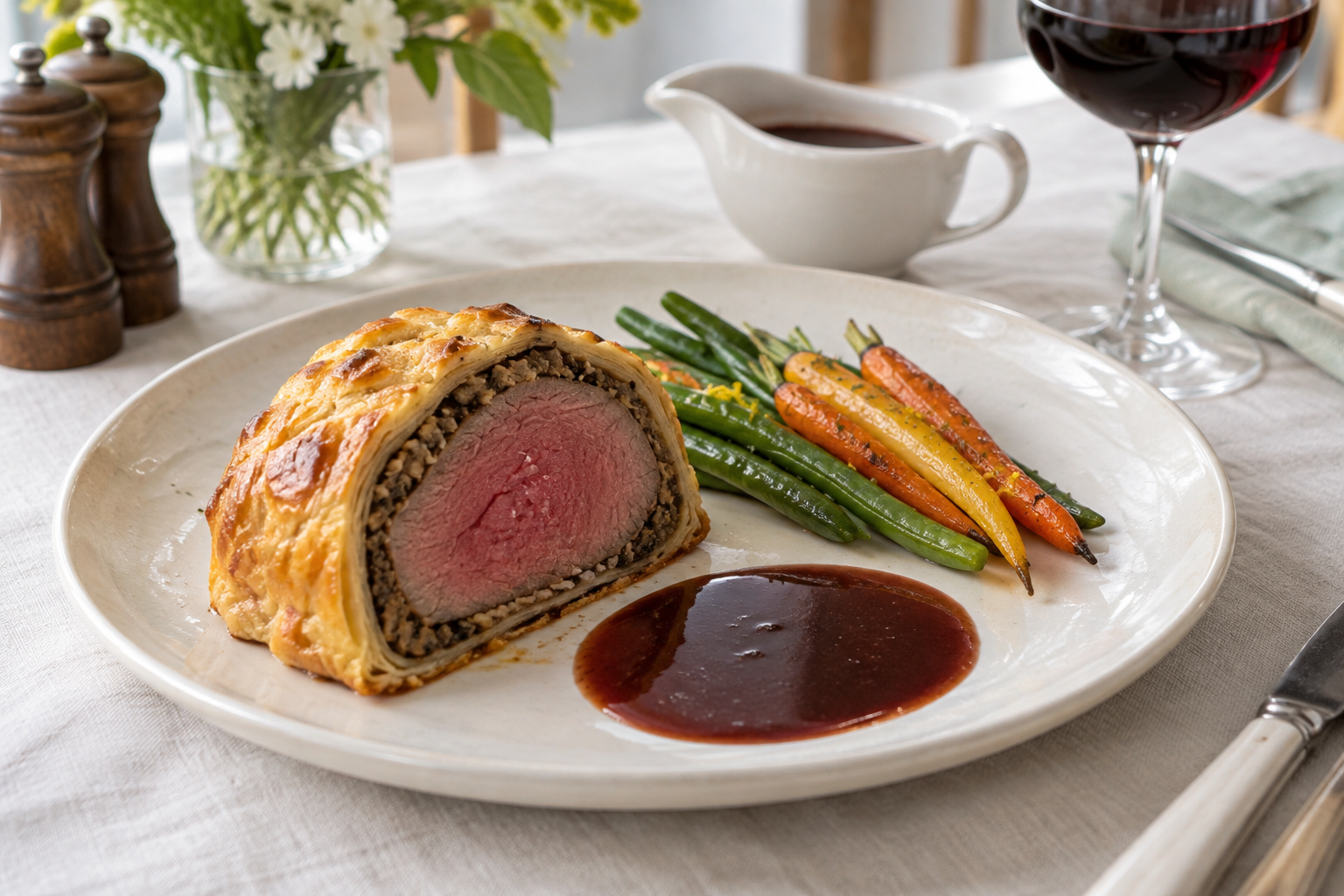
The sense of occasion also lies in the serving. A whole parcel on a warm platter does more to set the mood than elaborate decorations. The slices should be fairly thick so that meat, mushrooms and pastry hold together. A truly sharp knife and steady strokes are better than forcing your way through the crust. The first end slice is often less tidy; it tastes just as good.
Keep the accompaniments restrained. The puff pastry has already supplied both starch and richness. Green beans, butter-tossed cabbage or oven-roasted carrots with a little lemon bring freshness and colour. Anyone who wants potatoes can opt for a small helping of mash, but there is no need to build another monument alongside the main course.
The sauce is best served separately or on the clear part of the plate. Pour it over the puff pastry and the crispness quickly disappears. A concentrated jus works well, as does a red wine sauce that is not too sweet. In the glass, a dry red wine with freshness and moderate tannins is a good match, as is an alcohol-free dark lager. What matters is that the drink can stand up to the mushrooms and browned flavours without making the meal heavier.
Making a success of it in a Swedish kitchen
The great advantage of the modern home kitchen is not that it can work faster than a restaurant kitchen, but that the work can be spread out. The mushroom filling can be made the day before. The meat can be trimmed and the sauce prepared. That leaves fewer decisions to make when the guests arrive, and less risk of impatience putting warm filling against cold puff pastry.
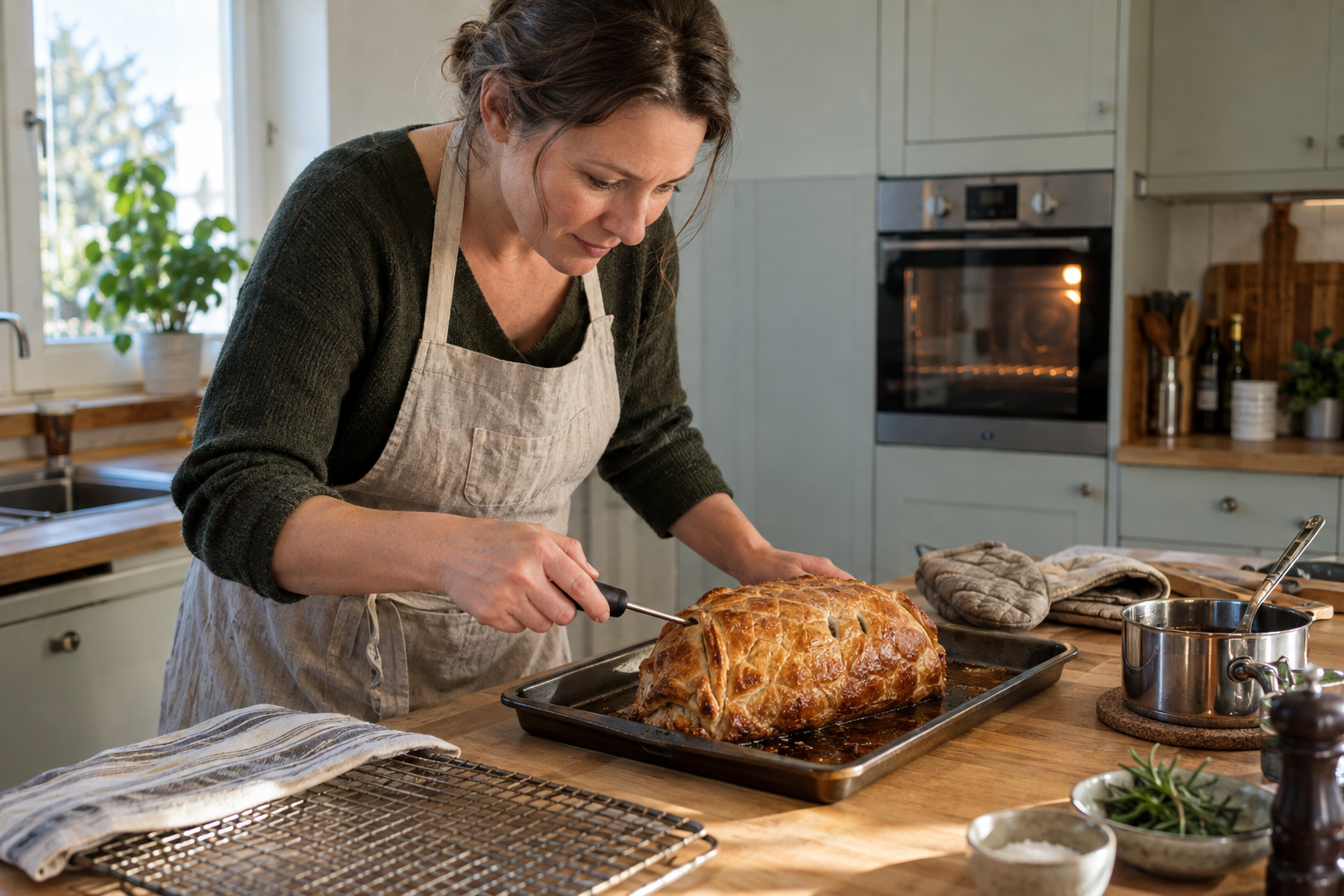
Choose an evenly thick centre-cut piece of beef fillet. A narrow tail end will cook long before the thick part, and a pastry shell hides the difference until it is too late. Buy with shape in mind rather than weight alone. Ready-made puff pastry made with butter gives a lovely flavour; check the packaging, as some products use other fats. Keep the pastry cold and do not roll it unnecessarily thin.
There is an inherent conflict here: the pastry needs a properly hot oven to rise and colour, while the beef fillet should ideally not cook too far. That is why cold filling, an even piece of meat and a thermometer matter more than an exact number of minutes. Ovens, pastry thickness and the meat’s starting temperature all vary. Measure the centre from the side, and allow for the temperature to continue rising as it rests.
The recipe below is a modern home version, not a reconstruction of some supposed Waterloo dinner. It uses readily available button mushrooms, Dijon mustard and air-dried ham. Focus your care on dry mushrooms, cold inner layers and a well-sealed seam. The reward comes when the knife meets the crust: first a crackle, then the aroma of butter and mushrooms, and finally that brief, deeply satisfying hush around the table.
Beef fillet in puff pastry with mushrooms and Dijon mustard
A modern Wellington for the home kitchen, built on the classic combination of beef fillet, duxelles and puff pastry. Air-dried ham holds the mushrooms in place. The preparation time includes about 45 minutes of chilling; start earlier if you can, so that all the layers have time to become cold.
Ingredients
Method
- 1Finely chop the mushrooms and shallots by hand or using short pulses in a food processor. The mushrooms should form small crumbs, not a purée.
- 2Soften the shallots in the butter in a wide frying pan over medium heat for 2–3 minutes. Add the mushrooms and thyme. Cook over medium-high heat for 15–25 minutes, stirring often, until no free liquid remains. Season cautiously with salt and pepper. Spread out on a plate, allow the steam to escape, then chill.
- 3Dry the meat thoroughly. Season with salt and pepper. Heat the oil in a frying pan and sear the fillet all over, including the ends, for 3–4 minutes in total. It should brown without cooking through. Brush with mustard, allow the steam to escape, then refrigerate until cold.
- 4Lay cling film on the worktop. Overlap the ham slices to form a rectangle large enough to enclose the fillet. Spread the cold mushrooms evenly over the ham. Place the meat on top and roll up tightly, using the cling film to help. Twist the ends closed and chill the roll for 20 minutes.
- 5If necessary, lightly roll out the puff pastry on a floured surface to about 3 mm thick. It should be large enough to wrap around the meat with a couple of centimetres of overlap and extra at the ends. Beat the egg with the water.
- 6Remove all the cling film. Place the meat roll on the pastry. Brush the pastry edges lightly with egg, wrap around the meat and seal the seam. Fold in the ends and trim off excess pastry so the layers are not unnecessarily thick. Place seam-side down on baking parchment and chill for 20 minutes.
- 7Heat the oven to 220 °C conventional, with a baking tray on the lower shelf. Brush the parcel with egg. Make a couple of small steam holes on top and, if you like, shallow decorative scores without cutting through the pastry.
- 8Transfer the parcel, still on its baking parchment, to the hot tray. Bake for 10 minutes, then reduce the temperature to 200 °C and continue for about 20–30 minutes. Insert a thermometer from one short end into the centre of the meat. For pink meat, remove at about 52–54 °C; the temperature will usually rise a few more degrees during resting. Let the temperature and pastry colour guide you rather than the clock. Cover the top loosely with foil if it darkens too quickly.
- 9Leave to rest for 10–15 minutes without covering tightly. Cut into thick slices with a sharp knife. Serve immediately with vegetables and any sauce on the side.
- Make the mushroom filling the day before and refrigerate, covered. Ideally, assemble the pastry parcel on the day it will be baked.
- Allow for chilling to take longer depending on the shape of the meat. Warm meat or mushrooms will melt the fat in the pastry and reduce its crispness.
- The temperature in this recipe gives pink meat, not well-done. Adjust the cooking to your guests’ needs; a higher core temperature will give firmer, less juicy fillet.
- Chill leftovers promptly and store in the fridge. Reheat slices in the oven at 175 °C until hot; the meat will cook further, but the pastry will fare better than in a microwave.
What goes in the glass
- WineDry Merlot-led BordeauxFresh acidity and moderate tannins balance the richness of the puff pastry, while the wine’s dark fruit and earthy notes meet the mushrooms and seared meat. Choose a style without excessively heavy oak.
- BeerBritish brown aleToasted malt and nutty notes echo the pastry crust and mushrooms. Moderate bitterness lets the mild beef fillet hold its own.
- Alcohol-freeAlcohol-free dark lagerThe malt’s bready, lightly roasted flavour suits the browned crust, while carbonation refreshes the palate between bites. Choose a less sweet version.
Enjoy alcohol in moderation. Alcohol-free options go just as well with the food.
Sources
- Alan Davidson; tredje upplagan redigerad av Tom Jaine, The Oxford Companion to Food (2014)
- Larousse; gastronomisk kommitté under ledning av Joël Robuchon, Larousse Gastronomique (2009)
- Auguste Escoffier med Philéas Gilbert och Émile Fétu, Le Guide culinaire (1903)
Ask questions about "Beef in puff pastry – a golden centrepiece for a celebration". Answers are based on the magazine's own articles.