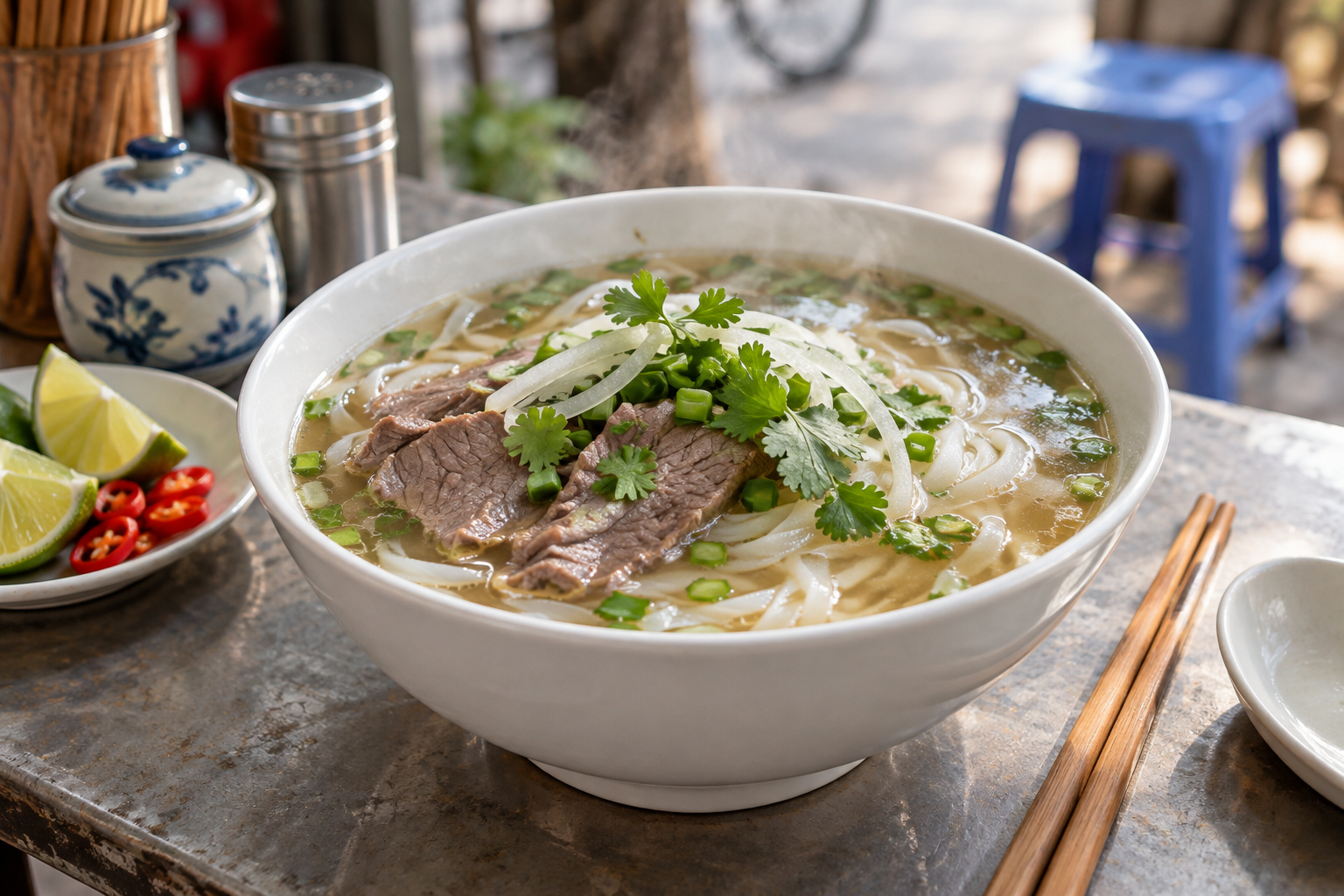
Pho – Hanoi’s Morning Soup
Clear broth, tender rice noodles and a history that cannot be boiled down to a single explanation.
In Hanoi, the day often begins with a bowl of phở bò. Behind this seemingly simple beef soup lie toasted spices, patient simmering and a century of migration. We trace pho from its disputed origins in northern Vietnam to today’s noodle stalls – and make a northern-inspired version at home.
 By Mai LindqvistReporter · East and Southeast Asian cuisine – Thailand, Vietnam, Japan, China and Korea
Translated from Swedish with AI assistance.
Go to the recipe ↓Hanoi wakes to the broth
A ladle clinks against the rim of a pot. A handful of white rice noodles is dipped into hot water, shaken dry and dropped into a bowl. Beef, finely sliced onion and a light green shower of spring onion go on top. Then comes the broth: clear, pale gold, with little glints of fat. The steam carries the scent of ginger and star anise, but beef should have the strongest voice in this conversation of flavours.
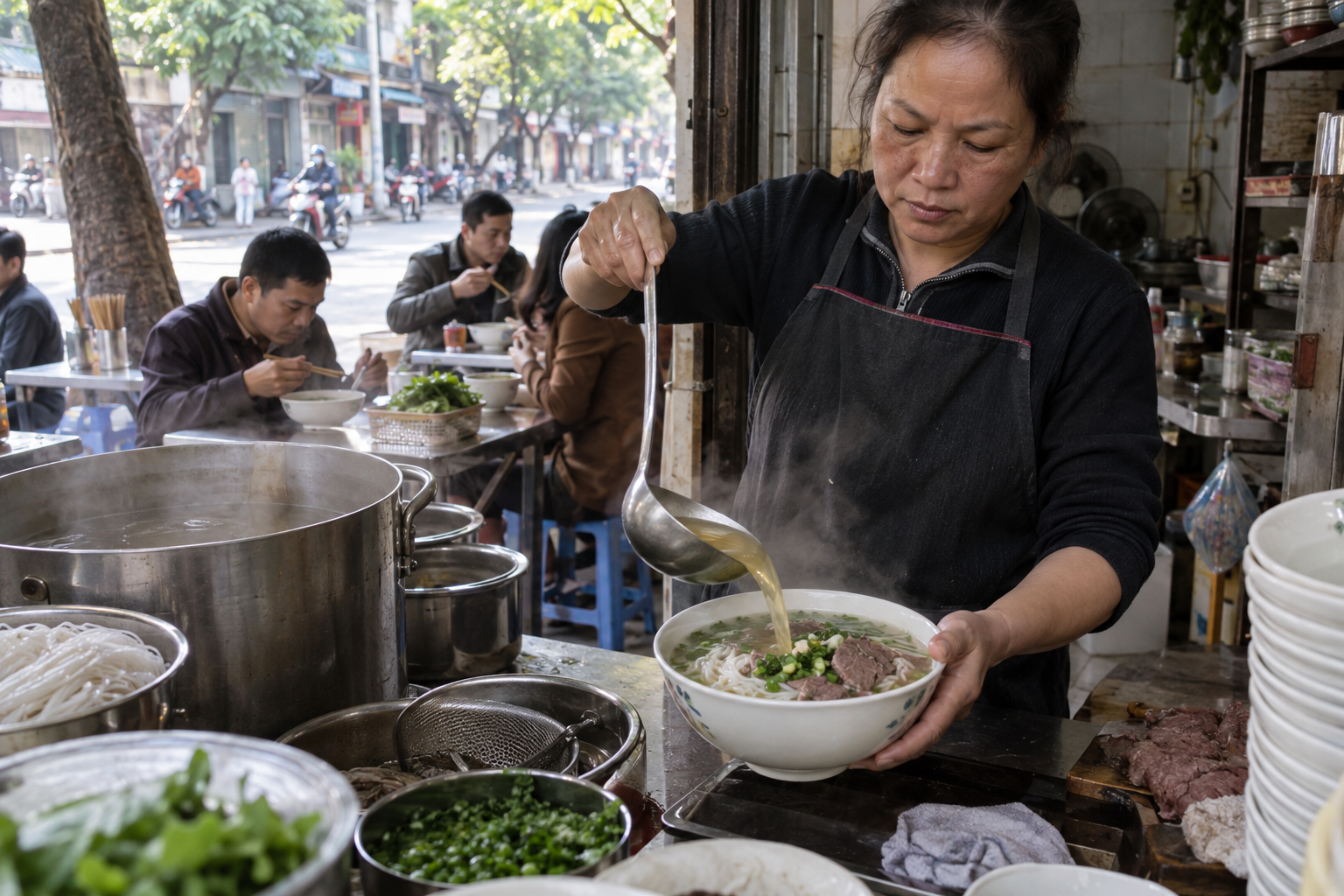
This is how a morning might begin at a pho shop in Hanoi. People sit on low stools, chopsticks in one hand and a soup spoon in the other. Some come alone before work; others eat with their families. The bowl is hot, quick to serve and slow to make. It is one of the dish’s loveliest contradictions: a customer can eat in fifteen minutes, while the kitchen has been working for hours.
Phở refers both to a type of flat rice noodle and, in everyday speech, to the soup in which it plays the leading role. Phở bò is the beef version; phở gà is made with chicken. Here we follow the beef soup, the one that leads most directly back to accounts of the dish’s emergence in northern Vietnam.
Morning is an important part of pho’s daily life, but it sets no time limit. Pho is also eaten at lunch, dinner and late at night. Calling it a breakfast soup therefore says more about a cherished habit than a rule. For anyone used to a cold sandwich, the first encounter may come as a surprise. Then the logic becomes clear: liquid, noodles, meat and warmth, without the meal having to feel heavy.
Try a spoonful before reaching for the table condiments. That first taste reveals what the kitchen has been working towards: saltiness, depth of beef flavour, subtle sweetness and the lingering finish of the spices.
An origin with several stories
Pho is generally traced to northern Vietnam in the decades around the turn of the twentieth century. Both Hanoi and Nam Định have strong connections to its early history. Hanoi became a major centre for its sale and spread, while Nam Định is often cited as a place of origin for the dish and for families of pho vendors. There is, however, no universally accepted, firmly documented birth date and no single inventor.
That uncertainty is worth pausing over. Food rarely emerges as a fully formed invention. A broth may switch from one meat to another, a noodle dish may find new customers, a vendor may move to a bigger city. Only later does the process acquire a clear narrative. In pho’s case, several such stories have become popular, sometimes told with far greater certainty than the sources warrant.
One explanation emphasises the French colonial presence and a changing market for beef. French demand helped reshape patterns of slaughter and consumption, and bones and cuts of meat could be used in local kitchens. This is a plausible part of the context, but not proof that pho is a French dish in Vietnamese dress. The claim that the French simply introduced beef to Vietnam is also far too sweeping.
Another familiar theory links the name phở to the French pot-au-feu. The similarity between the words and the connection to boiled beef make the story easy to remember. But a resemblance in sound is not the same as a secure etymology. Explanations linking the name to Chinese terms for rice noodles have also been proposed. Neither the name’s journey nor the dish’s full development should be presented as definitively settled.
Chinese food traditions belong to this same historical landscape: noodles, the sale of hot food and the use of aromatic spices. At the same time, pho is rooted in Vietnamese ingredients, tastes and ways of eating. The saltiness of fish sauce, the central place of rice and the organisation of local street food are not footnotes to a European story. They are part of the dish itself.
The most defensible account, then, describes pho as a northern Vietnamese soup that emerged amid local traditions, trade and colonial change. Its influences can be discussed without assigning the dish a single foreign parent.
From carrying pole to two flavour landscapes
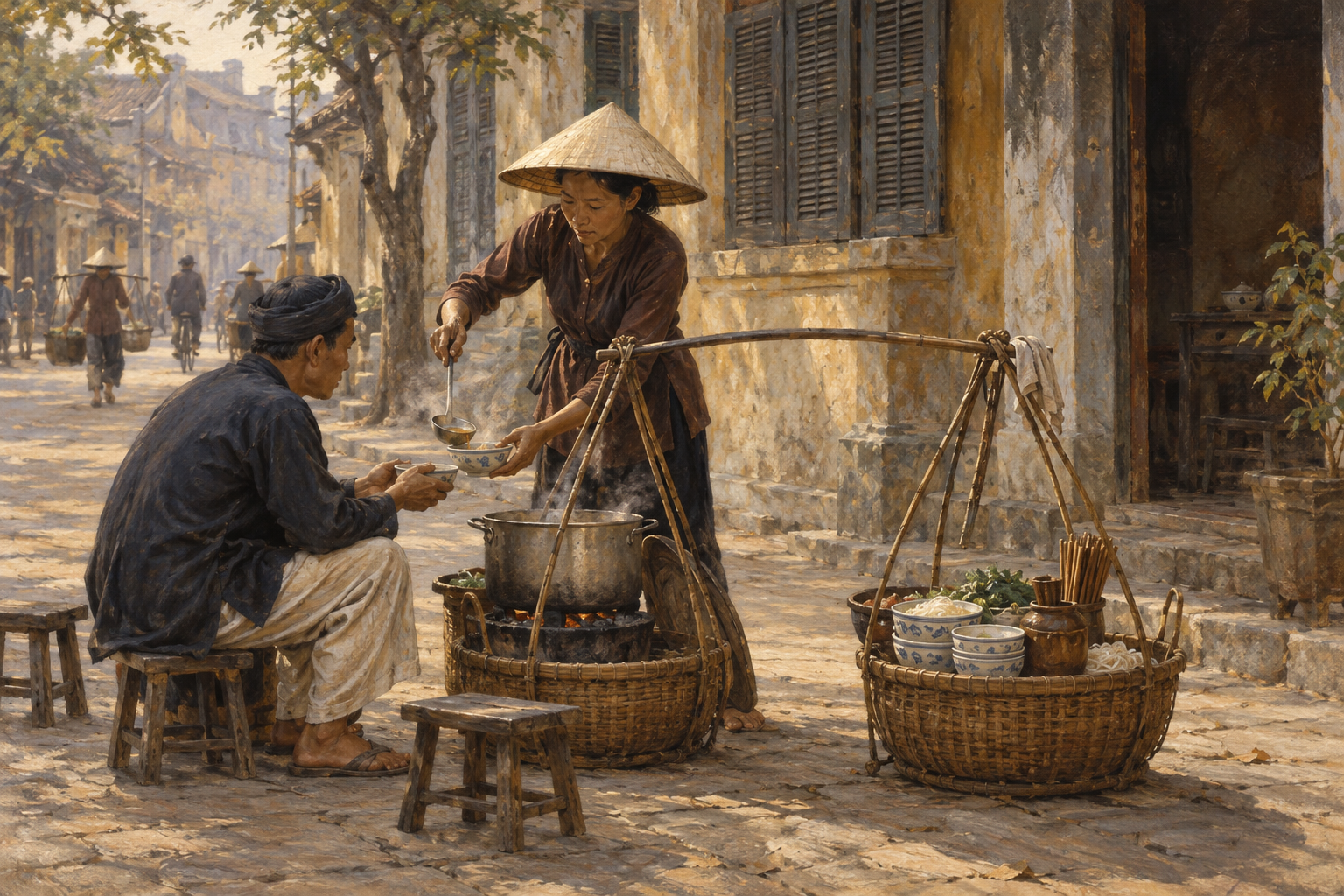
Early accounts of Hanoi associate pho with itinerant vendors who carried their equipment on a shoulder pole. There were the pot, the heat source, the bowls and the accompaniments: a small mobile kitchen. Once the dish had permanent outlets, customers could seek out the particular broth and preparation of meat they preferred. A place specialising in a single dish is not necessarily limited; it may represent an entire craft distilled into one bowl.
The beef version is generally considered the older form. Chicken pho later became an established tradition in its own right, not merely a substitute when beef was unavailable. Different ways of serving phở bò also developed: thinly sliced meat cooked in the hot broth, slow-cooked brisket and, in some places, other cuts with more fat or connective tissue. The menu may be short, yet the choices precise.
An important turning point in its spread south was the partition of the country in 1954 and the large movement of people from north to south. Pho travelled with them. This was not necessarily its first appearance outside the north, but migration played a major role in establishing and changing the dish in southern Vietnam.
Comparing phở Bắc, northern pho, with pho in Saigon means discussing recurring traits, not two immutable recipes. The northern bowl is often described as more restrained: a distinctly beefy broth, moderate sweetness, and onion and herbs without a large separate mound of greenery. In Hanoi, garlic in vinegar and chilli sauce may sit on the table. Fried dough sticks, quẩy, are a popular accompaniment, soaking up the broth.
In Saigon, now Ho Chi Minh City, the broth is often sweeter and the serving more generous with bean sprouts and fresh herbs. Thai basil is familiar to Swedish restaurant diners; culantro, also known as sawtooth coriander, is used too. Hoisin and chilli sauces may be served on the side. But there are overlaps, family habits and restaurants that follow their own path.
After 1975, Vietnamese migration helped make pho internationally known. Many diners abroad first encountered the dish in its southern form, with a plate of greens alongside. This is a genuine part of pho’s history, but not a template every bowl in Hanoi needs to follow.
The broth: deep flavour without cloudy heaviness
Good pho broth is not simply water that has been simmered with bones for a long time. It needs a balance of meaty flavour, gelatine, fat, salt and aromatics. Bones give structure, but a pot filled only with marrow bones can become fatty without developing the depth of beef flavour you want. A mixture of meaty joint or knuckle bones and a few marrow bones is often better. Brisket cooked in the same pot contributes both flavour and meat to serve.
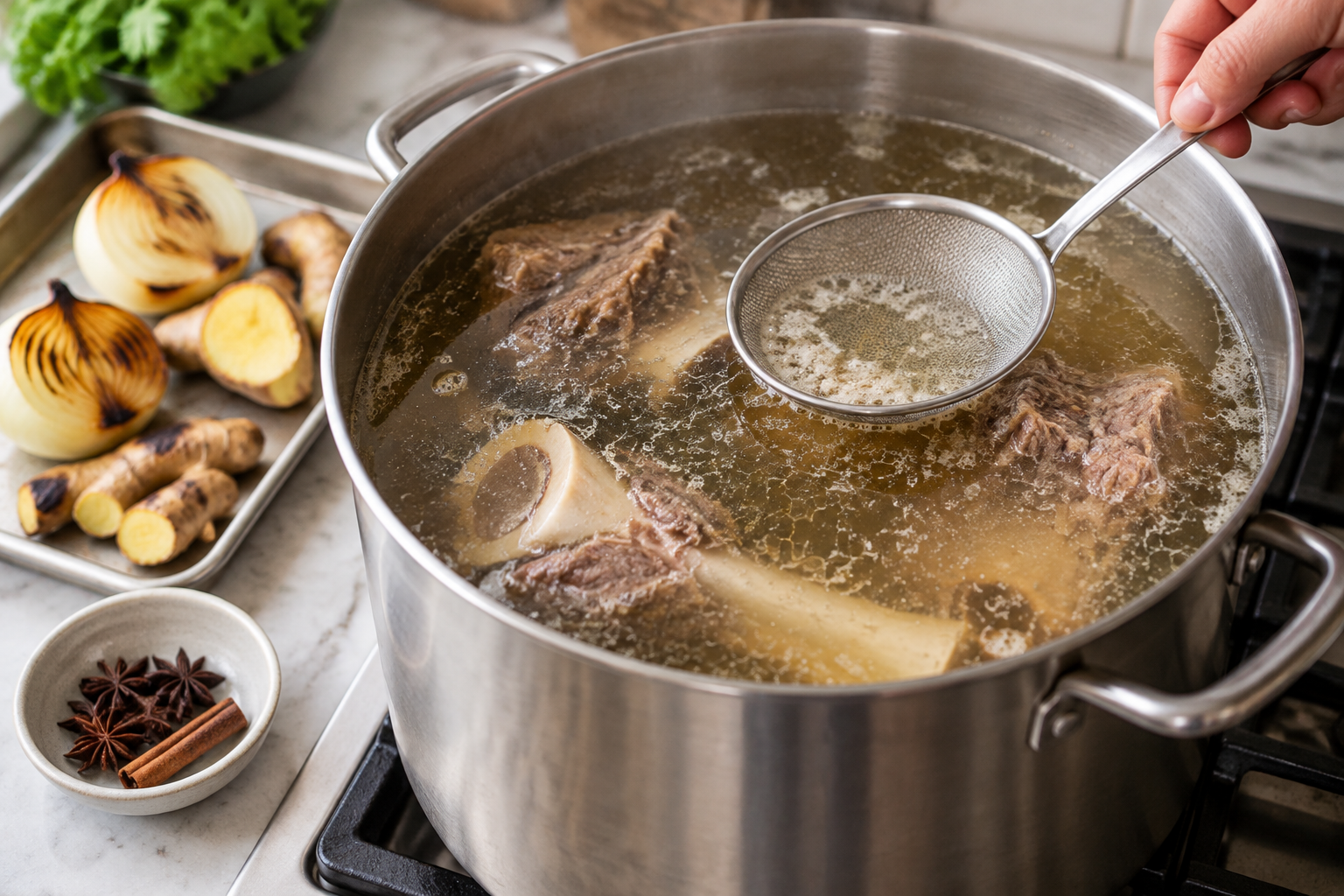
Gelatine gives the broth a slight fullness on the lips. Fat carries aroma and rounds out the flavour. Neither should dominate. A thin scattering of tiny fat droplets can be inviting; a solid blanket makes the soup feel heavy and dull. Chilling overnight makes excess fat easy to lift off, but save a little for the final adjustment.
Blanching the bones is a common technique for removing traces of blood, coagulated proteins and small particles. The water is discarded, the bones rinsed and the pot cleaned before the main simmer begins. It is a practical way to start clean, not a demand that the food be sterile or flavourless. After that, skim as needed and keep the pot at a gentle simmer.
A rolling boil is the classic mistake. Vigorous movement breaks fat into tiny droplets and churns up particles. The result may taste good, but it will be cloudier and have a different mouthfeel. Aim for a trembling surface with the occasional bubble rising. Leave the lid slightly ajar and top up with hot water if the level drops too far.
Let the onion and ginger develop dark patches before adding them. In a home kitchen, the oven grill works well. The heat develops sweetness and roasted aromas, but black, carbonised material can introduce bitterness. Scrape off any loose, burnt skin. In this recipe, it is the aromatics we char, not the whole pile of bones as you would for a dark Western-style stock.
Star anise and cinnamon are unmistakable signatures. Depending on the kitchen, cloves, coriander seeds, fennel or the smoky black cardamom thảo quả may also be included. There is no need to use them all. The spices should make the beef more expressive, not turn the broth into spiced tea.
Briefly toast whole spices in a dry pan and let them infuse for only part of the cooking time. This keeps the flavour under control. Fish sauce adds saltiness and umami; look for one with a short ingredient list and a distinct aroma of fermented fish rather than salt alone. A little sugar can round things out. Make the final seasoning adjustments once the broth has reached the right volume, or both salt and sweetness may become too concentrated.
Noodles, meat and greens in proportion
Pho uses bánh phở, flat rice noodles. In Swedish shops they are usually sold dried, sometimes labelled pho and sometimes marked with their width. A narrow to medium-width noodle, roughly three to five millimetres, is a practical starting point. Fresh noodles are lovely if you can find them, but good dried noodles make an excellent bowl at home.
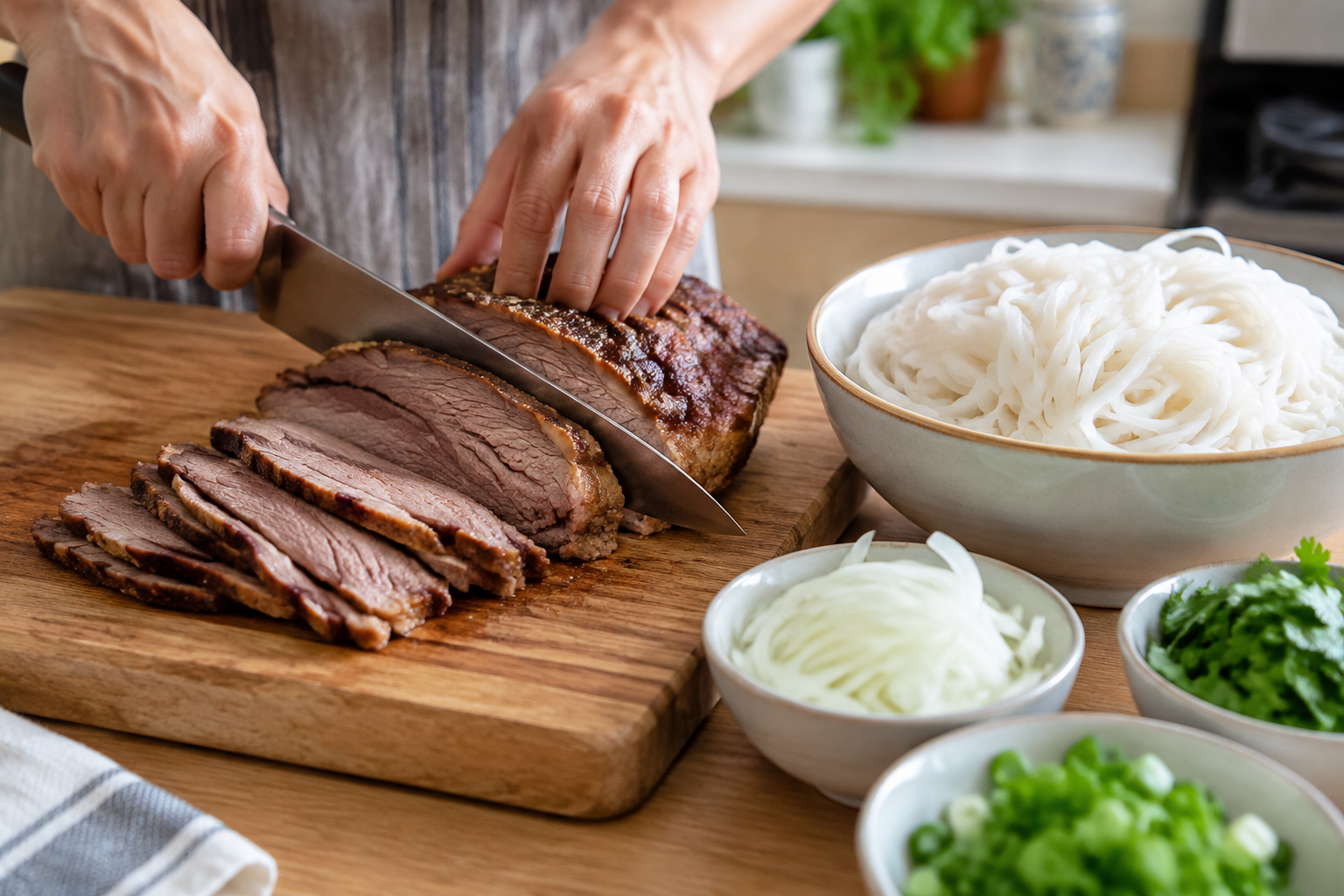
What matters is how you handle them. Rice noodles can go from springy to sticky quite quickly, and different brands need different soaking and cooking times. Follow the packet, taste early and cook them separately from the broth. Starch from the noodles should not cloud the whole pot. If the noodles have been rinsed cold, give them a brief hot dip before serving, or they will cool the bowl down.
The meat offers two different pleasures. Slow-cooked brisket, chín, gives tender slices with a pronounced beef flavour. Thinly sliced raw beef, tái, is often placed in the bowl and cooked by the broth. The latter requires truly thin slices and sufficiently hot liquid; thick slices and lukewarm broth will not do the job. Our home recipe uses only cooked brisket, making the result easy to manage even when four bowls need to be served at once.
Lift out the brisket as soon as it is tender enough. The bones may need longer, but the meat does not automatically improve by staying in until the end. Let it cool covered with a little broth, and slice across the grain. Chilled meat is easier to slice thinly; the slices can then be gently reheated before serving.
Spring onion, onion and coriander bring freshness without turning the meal into a salad. Slice the onion thinly and give it a short soak in cold water if it tastes sharp. For a more southern-inspired serving, you can add Thai basil and bean sprouts, but that is a deliberate stylistic choice, not something missing from a northern bowl.
Ordinary basil is not an exact substitute for Thai basil, and ordinary coriander does not taste like culantro. That need not be a problem. For our Hanoi-inspired version, spring onion and coriander go a long way. A few well-chosen accompaniments can offer a clearer expression of the dish than chasing down every herb on a long shopping list.
One bowl, one table, many ways to eat
Pho is usually served in an individual bowl for each person. Chopsticks lift the noodles and meat; the spoon catches the broth. Diners season in small steps: a little chilli, a few drops of something acidic, another spoonful to taste. There is no reason to police anyone else’s bowl, but immediately covering a well-made broth with sweet sauces can easily obscure its finer aromas.
Pho culture embraces both routine and strong preferences. A favourite place may be chosen for the way it cuts the meat, the aroma of its broth or the simple reassurance that everything tastes as it did last time. The vendor’s skill lies as much in repetition as in the recipe: noodles must be hot but not overcooked, meat tender but not falling apart, and every portion must receive the right amount of broth.
For a host cooking at home, this is a useful thought. Set out small plates of onion, herbs, lime and chilli, but keep the serving itself focused. Warm bowls and good timing matter more than a wealth of accompaniments. Pho is not a dish that benefits from sitting ready while guests gather. Call everyone to the table first, then assemble the bowls.
Choose a gentle drink alongside. Lightly brewed green tea works particularly well with or after the meal; bitter, over-steeped tea, on the other hand, does the broth no favours. For beer drinkers, a light lager with low bitterness is a good match. A small glass is enough, and an alcohol-free lager can play the same role.
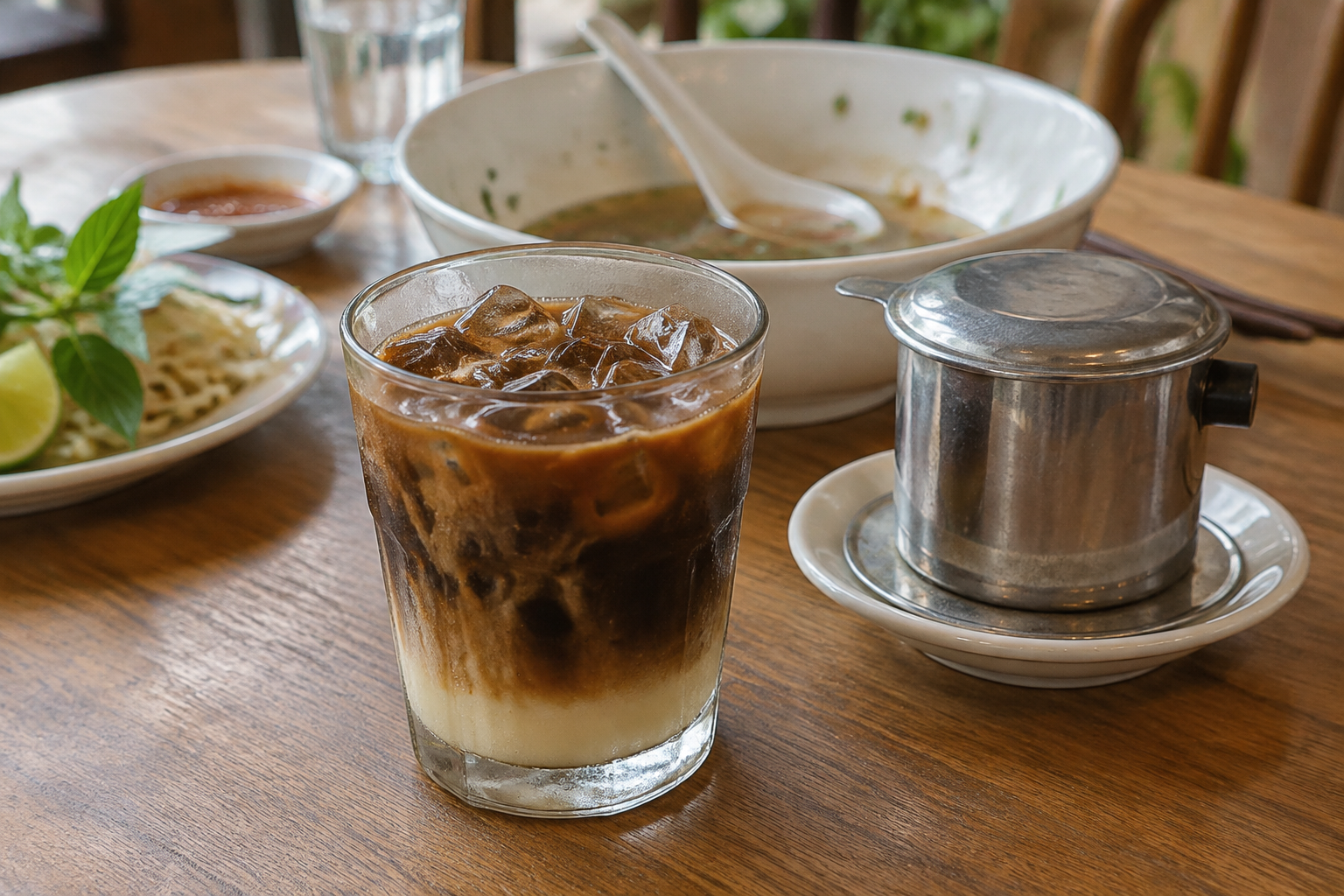
Vietnamese iced coffee with sweetened condensed milk, cà phê sữa đá, offers a different kind of contrast. The coffee’s roasted bitterness meets the sweetness of the milk and the chill of the ice. It is delicious around mealtime, preferably after the soup rather than between every spoonful. That gives both the nuances of the broth and the intensity of the coffee a moment of their own.
Making it work in a Swedish kitchen
Start at a shop with a meat counter or a butcher’s and ask for beef bones with both joints and some meat attached. If only bare marrow bones are available, replace some with bony oxtail or cross-cut beef shin. This often costs more, but brings more beef flavour too. Our brisket is fresh and unsalted; salt-cured brisket makes the seasoning harder to control and changes the flavour.
You do not need an enormous restaurant stockpot. A pot of about eight litres, a sieve and time are enough for four generous portions. The recipe yields around 2.4 litres of finished broth. It should be full-bodied and well seasoned before it meets the noodles, but not so salty that you only want to eat the contents and leave the liquid.
Ideally, do the long simmer the day before. You can then chill the broth, adjust the fat and slice the meat while it is cold. Divide the strained broth between smaller containers and cool quickly, for example in a cold-water bath, before refrigerating. Do not leave a large pot standing lukewarm overnight. This preparation reduces the next day’s work to reheating, cooking noodles and a few minutes of chopping.
The recipe below is northern-inspired, not a reconstruction of any particular historical vendor’s soup. The spicing is restrained, the beef does the talking and the herbs sit in the bowl rather than on a large side plate. The first time, it is wise to follow the quantities. Next time, adjust one thing at a time: a slightly shorter spice infusion, less sugar, more ginger.
This is where pho becomes more than a recipe. You learn to recognise the difference between a broth that is merely strong and one that is balanced. When the noodles slip apart, the onion just softens and the aroma rises from the warm bowl, the hours at the stove are no longer an abstract wait. They are there in every spoonful.
Phở bò with cooked brisket – northern-inspired
A clear, beefy pho with moderate sweetness and restrained spicing. This is a modern home adaptation of northern Vietnamese pho, not an original historical recipe. Ideally, make the broth and meat the day before. The cooking time includes blanching and reheating; any overnight chilling is additional.
Ingredients
Method
- 1Put the bones in a pot of about 8 litres and cover with cold water. Bring to the boil and boil vigorously for 8–10 minutes. Discard the water, rinse the bones carefully and wash out the pot. Avoid splashing the hot water.
- 2Set the oven grill to 250 °C. Halve the onions and split the ginger lengthways. Place on a baking tray and grill near the top of the oven for 15–20 minutes, watching closely, until dark patches develop. Turn as needed. Allow to cool slightly and remove any loose, blackened skin.
- 3Put the cleaned bones and brisket in the pot. Add 35 dl water and slowly bring to the boil. Skim for the first 15–20 minutes. Add the onion, ginger and 1 tsp salt. Reduce the heat until the surface barely trembles and only occasional bubbles rise.
- 4Simmer with the lid slightly ajar. Check the brisket after 2 hours; it usually needs 2–3 hours, depending on thickness. Lift it out when a skewer slides in with slight resistance and the meat is tender but still holds together for slicing. Continue simmering the bones for a total simmering time of about 4 hours. Top up with hot water if the bones begin to emerge above the surface.
- 5Keep the brisket in a smaller container with a little of the broth. If saving it for the next day, cool quickly in a cold-water bath, then refrigerate. If serving the same day, chill the meat too if there will be a long wait; do not leave it sitting lukewarm for the rest of the cooking time.
- 6Toast the star anise, cinnamon, cloves and coriander seeds in a dry frying pan over medium heat for 1–2 minutes, until fragrant. Transfer to a spice bag or tea infuser and submerge in the broth for the final 45–60 minutes. Taste after 30 minutes and remove earlier if the spices begin to dominate.
- 7Strain the broth through a fine-mesh sieve without pressing the contents. Spoon off excess fat, but retain a little for flavour. Measure out about 24 dl: dilute with water if there is less, or simmer to reduce if there is more and the flavour is weak. Add the fish sauce and sugar. Taste and add more salt or fish sauce as needed.
- 8Thinly slice the brisket across the grain. Gently warm the slices in a little broth for 3–5 minutes, until hot throughout. Soak the raw sliced onion in cold water for 10 minutes, then drain.
- 9Cook the rice noodles in a separate pan according to the packet instructions, checking their texture early. Warm four large soup bowls with hot water. If the noodles have been rinsed cold or have cooled down, dip them into boiling water in individual portions for 10–20 seconds and drain thoroughly.
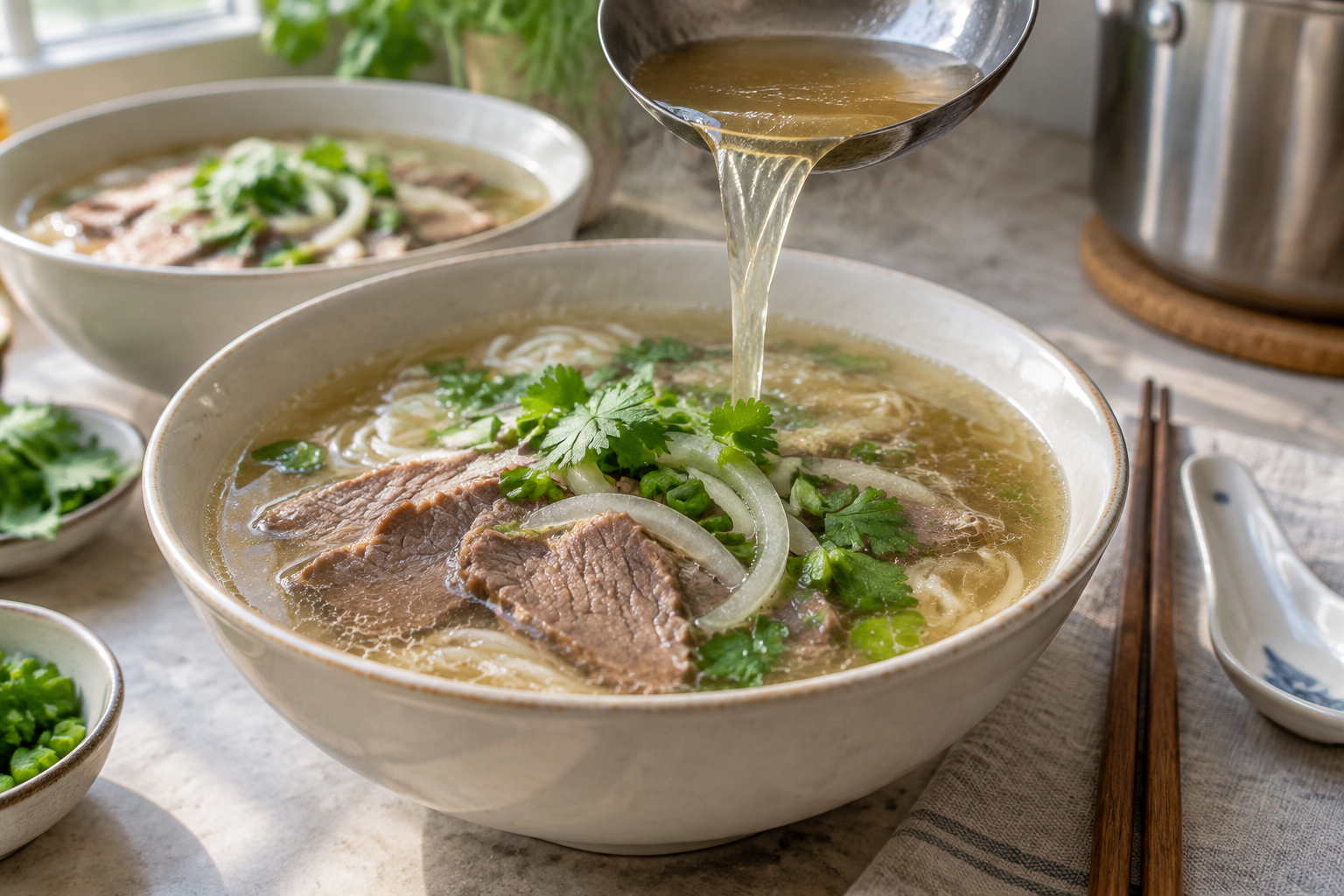
- 10Bring the broth to a brisk simmer. Empty the warming water from the bowls and divide the noodles, hot meat, onion, spring onion and coriander between them. Pour about 6 dl hot broth into each bowl. Serve immediately with lime and chilli on the side.
- Ideally, cook the day before. Cool the broth and meat quickly in smaller containers and store at about 4 °C. Use within 3 days or freeze. Store the noodles and herbs separately.
- If you can only find marrow bones, replace 500 g with bony oxtail or cross-cut beef shin for more beef flavour.
- Avoid ground spices: they are harder to strain out and can make the broth cloudy. If you do not have coriander seeds, leave them out.
- For a southern-inspired serving, add Thai basil and briefly blanched bean sprouts. Serve any hoisin sauce separately so everyone can choose.
What goes in the glass
- Alcohol-freeVietnamese iced coffee with condensed milk – cà phê sữa đáStrong, roasty coffee, sweetened condensed milk and plenty of ice make a cool, bittersweet finish. Enjoy it after the soup so the sweetness does not mask the nuances of the broth.
- BeerLight pale lager with low bitternessGentle maltiness and lively carbonation work with the noodles and meat without overpowering the spices. Choose low bitterness, especially if you add chilli. An alcohol-free pale lager is an equally good option with the meal.
- TeaLightly brewed Vietnamese green teaDelicate vegetal notes complement the herbs and onion. Start with water at around 75–80 °C and a short infusion of about 1–2 minutes, adjusting to suit the tea to avoid astringency.
Enjoy alcohol in moderation. Alcohol-free options go just as well with the food.
Sources
- Andrea Nguyen, The Pho Cookbook: Easy to Adventurous Recipes for Vietnam's Favorite Soup and Noodles (2017)
- Andrea Nguyen, Into the Vietnamese Kitchen: Treasured Foodways, Modern Flavors (2006)
- Vu Hong Lien, Rice and Baguette: A History of Food in Vietnam (2016)
- Erica J. Peters, Appetites and Aspirations in Vietnam: Food and Drink in the Long Nineteenth Century (2012)
Ask questions about "Pho – Hanoi’s Morning Soup". Answers are based on the magazine's own articles.