Texas barbecue – brisket, smoke and patience
From butcher shops in Lockhart to today’s long queues: the art of turning beef brisket into something worth waiting for.
A dark pepper crust, a delicate scent of oak and meat that yields to the knife without falling apart. Texas brisket is both a craft and a meal that brings people together. We follow the smoke through the state’s food culture and cook brisket with salt, pepper and plenty of time – on the barbecue or with help from the oven.
 By Sofia HaddadReporter · Middle East, Africa and Latin America – mezze, tagine, injera, mole and much more
Translated from Swedish with AI assistance.
Go to the recipes (2) ↓When the knife cuts through the bark
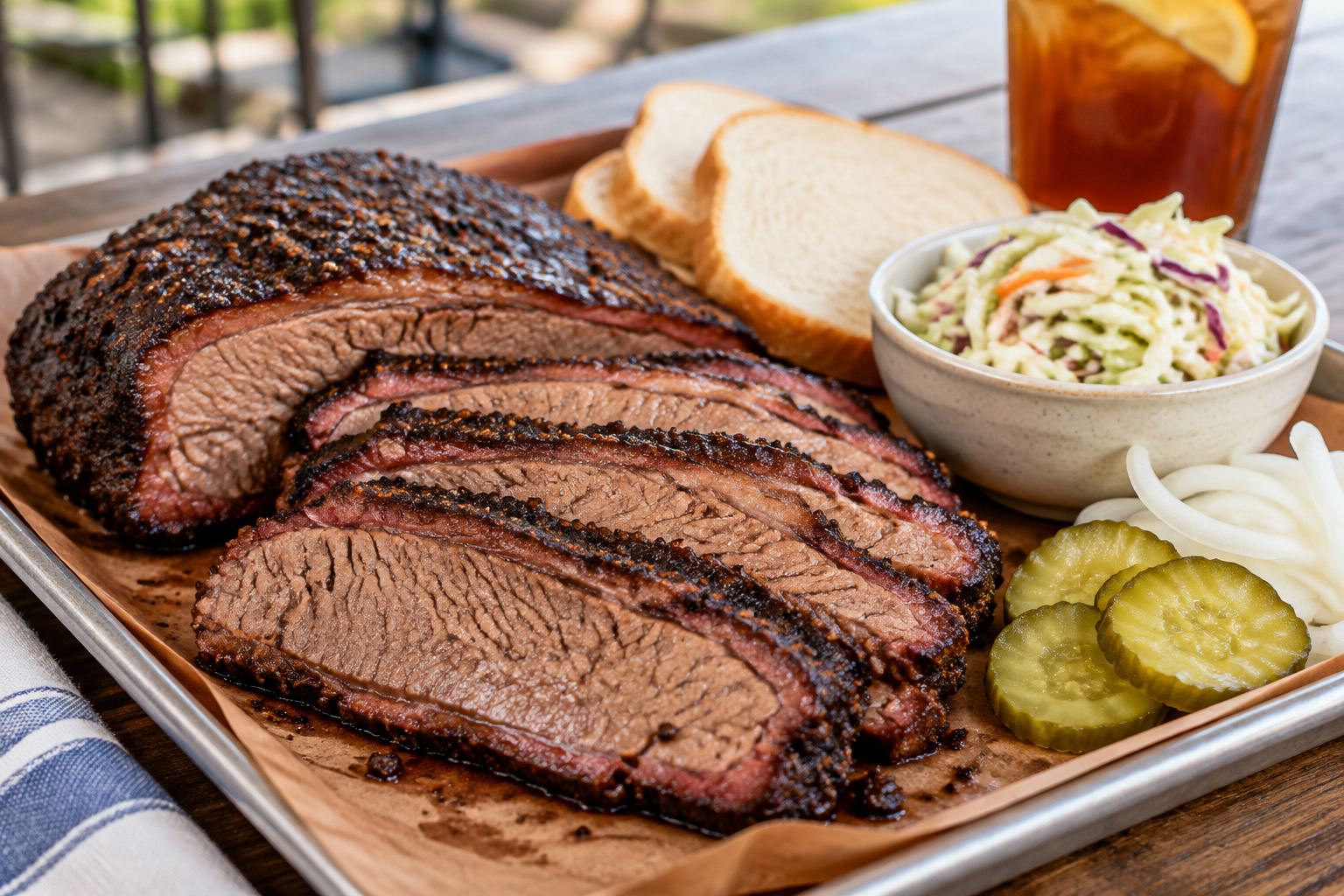
First comes the sound of paper. A large sheet is torn off, laid on the counter and covered with freshly cut slices of brisket. The knife cuts through an almost black surface, speckled with coarsely ground pepper. Inside, the meat is brown and glistening with juices, sometimes with a rosy-red ring just beneath the crust. Some slices are leaner and even, others marbled with soft fat. Pickles, raw onion and sliced white bread wait alongside.
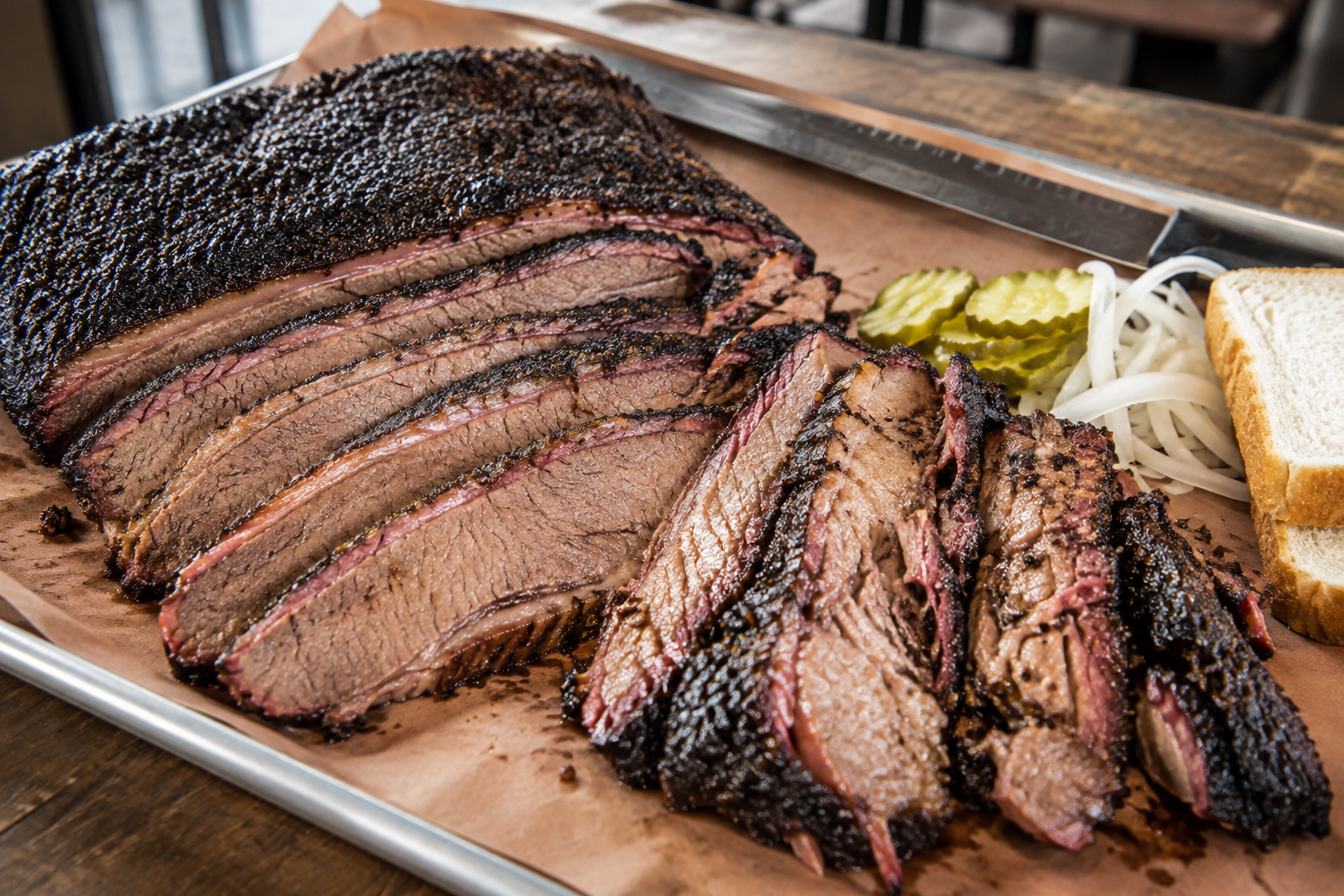
This is a typical serving at a Central Texas barbecue joint. Not fine dining in the tablecloth-and-silverware sense, but food that demands precision. Behind that stripped-back tray lie hours of tending the fire, judging airflow and heat, and one crucial decision: when is the meat actually done?
The aroma should not recall an extinguished campfire. Good wood smoke is a seasoning, not a blanket. It lifts the beef and meets the pepper’s heat, while salt brings the flavours together. The crust, known as bark, should offer a little resistance. Beneath it, the meat should slice without crumbling, yet yield easily when you eat it.
Brisket looks almost provocatively simple: beef brisket, salt, pepper and wood. Yet it is a dish that exposes every shortcut. Too much heat can dry out the thin end before the connective tissue has softened. Dirty smoke turns the surface bitter. Too short a rest sends the juices spilling across the chopping board.
The beauty is that the skill need not be mysterious. It can be understood, practised and shared. Texas barbecue is about reading a piece of meat and a fire, but also about making room at the table while the work takes its time.
Lockhart, the butcher shops and a bigger story
During the 19th century, Central Texas saw substantial immigration from German-speaking regions and the Czech lands. Along with the newcomers came sausage-making, butchery skills and traditions of smoked meats. At the region’s meat markets, the sale of cooked and smoked meat developed alongside the regular butchery business.
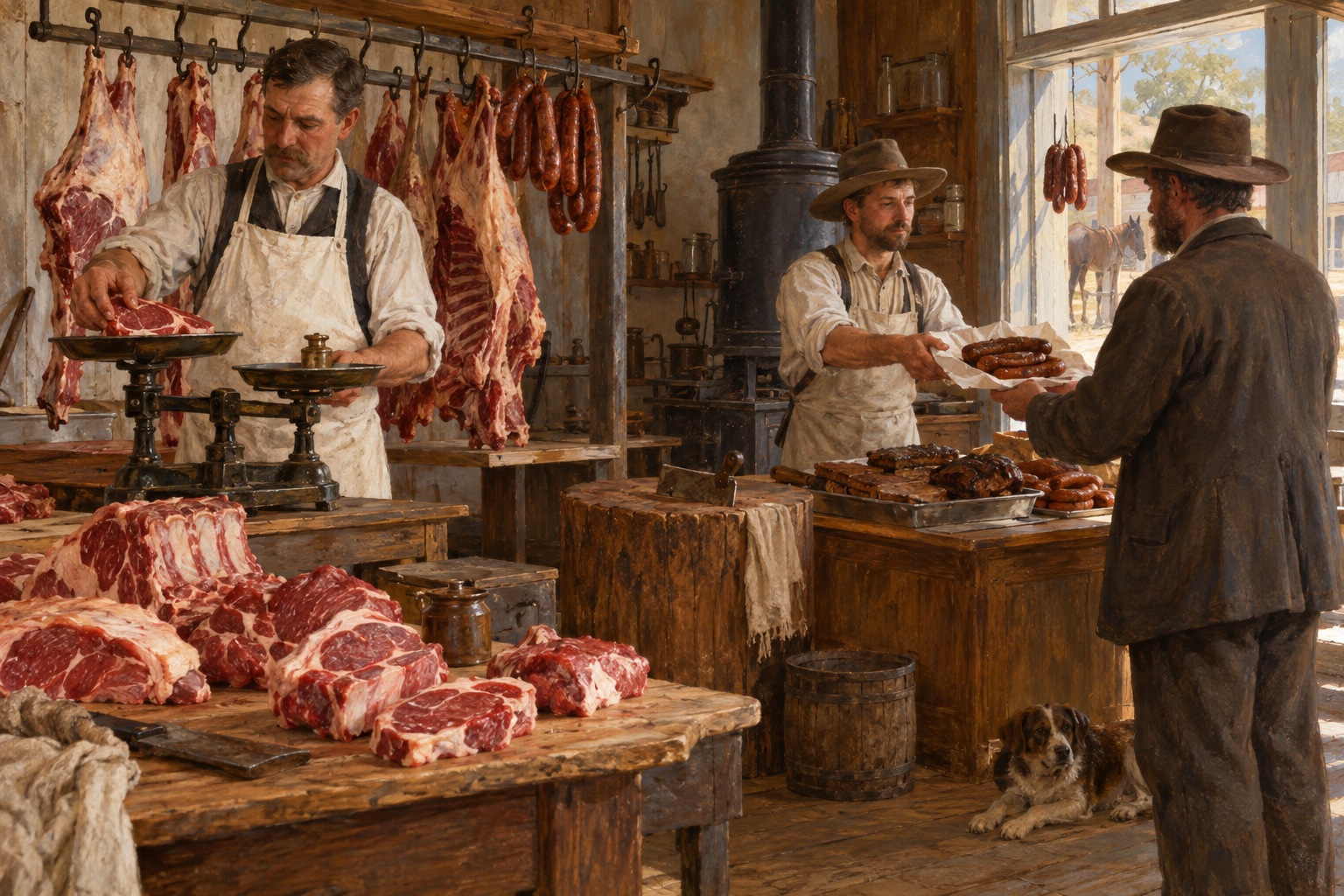
Lockhart, south of Austin, became one of the best-known hubs to emerge from this setting. Kreuz Market opened in 1900 as a grocery shop and meat market. The business moved to a larger building in 1999; in the old premises, the barbecue story continued under the name Smitty’s Market. It is a tangible reminder that tradition does not always mean the same sign hanging above the same door forever.
This helps explain features that still define the way the food is served: meat ordered by weight, sausages sharing the spotlight with beef, and a simple sheet of paper rather than formal china. Bread, onions and pickles make uncomplicated companions. The meal still bears traces of the shop and the working day.
But it would be misleading to trace all Texas barbecue back to European butchers. The broader history of American barbecue encompasses Indigenous cooking methods, colonial encounters and, above all, the extensive labour and expertise of Black cooks, both during slavery and after emancipation. In Texas, Mexican and Mexican-American food traditions have also shaped the landscape. The people whose names later appeared on signs and in books do not tell the whole story of who cooked the food.
Another oversimplification is the claim that today’s slow-smoked whole brisket has been served unchanged since the 19th century. Brisket has a long history as an ingredient, but the modern restaurant approach evolved over time. Changes in butchery, distribution, meat packaging and equipment helped make whole brisket more widely available and eventually turned it into a prized centrepiece.
There is no reason, then, to name a single inventor. The story becomes both more truthful and more interesting when it spans several generations: the butcher who understood the cut, the fire tender who learned the temperament of smoke, and the restaurant guest who began asking for that particular slice with its dark bark and soft fat.
Texas is bigger than a single style of smoke
The barbecue that often represents Texas internationally today is strongly associated with the central part of the state. Beef, wood fires and restrained seasoning take centre stage. Sauce may be available, but need not carry the meat’s main flavour. Some classic establishments have made the absence of sauce part of their identity; others serve it without fuss.
Broadly speaking, East Texas has closer ties to the barbecue traditions of the American South. Both pork and beef have a place there, and softer meat, chopped servings and sauce often play larger roles. In the west, people sometimes speak of a cowboy tradition of cooking closer to the coals, often with mesquite. In the south, barbacoa, with its strong Mexican and Mexican-American roots, is an important part of the story; beef head and cheek are among its familiar forms.
These regional maps are useful, but they are not rules. A family, a town or an individual cook may cook in a way that crosses straight over the boundaries. Today’s Texas also includes barbecue with distinctly Mexican, Korean and Vietnamese flavours, among others. This is not a break with some previously pure tradition, but another chapter in a food culture always shaped by people on the move.
Aaron Franklin has become one of the most influential figures in the modern brisket wave. Franklin Barbecue began as a small food trailer in Austin in 2009 and opened at its current restaurant address in 2011. The long queues became famous, but behind the attention lies a very specific craft: fire management, airflow, trimming, seasoning and careful hot holding.
Franklin did not invent Texas brisket. His importance lies more in helping a wide audience appreciate how much knowledge it involves. Through books and teaching, skills once passed on mainly beside the fire became accessible to home cooks far beyond Texas.
The modern wave has also made the cut more sought-after. Brisket is no longer necessarily cheap. That makes it wise to think of it as food for a gathering, rather than a solo barbecue project where half the result risks being left uneaten. A large piece of meat makes sense when people come together around it.
Brisket’s two muscles and clean smoke
The American term brisket refers to meat from the lower breast of the animal. A whole, untrimmed or moderately trimmed brisket for barbecue is often called a whole packer and contains two main muscles. The flatter, leaner section is called the flat. The thicker, fattier section is called the point. They partially overlap, with fat between them, and their muscle fibres run in different directions.
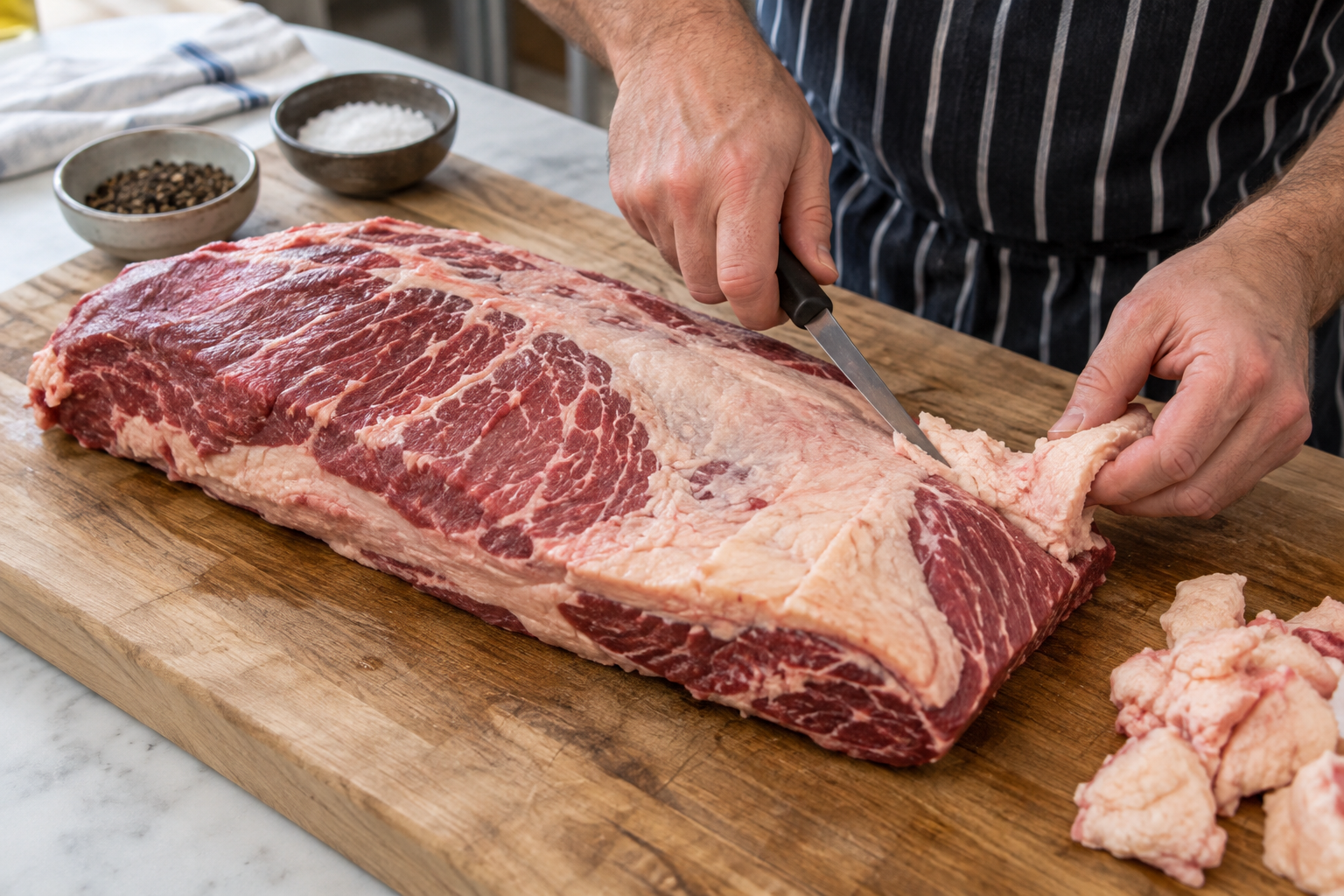
This matters both when shopping and when carving. A Swedish cut labelled oxbringa may be butchered differently, be considerably leaner or be sold cured. This recipe needs fresh, uncured brisket, ideally with both muscles intact. Ask for a whole brisket for barbecue, and have the butcher show you what is included. A very thin flat is harder to keep juicy than an evenly thick piece with good marbling.
Fat on the outside is not the same as fat within the muscle. An enormous fat cap cannot guarantee a juicy result, and it does not automatically melt into the meat. Thick, hard fat is therefore trimmed away, while an even layer is left as part of the whole. Trimming is also about shape: thin flaps and pointed corners risk drying out or burning.
In Central Texas, post oak, an American oak species with the scientific name Quercus stellata, is a classic fuel. It is part of the local landscape and produces smoke that works well with beef. For a home cook in Sweden, oak smoking wood intended for cooking is a practical alternative. The flavour will not be identical, but the principle is the same. Beech can also be used, though it gives a different character.
The wood must be clean and untreated. Do not use construction timber or wood containing paint, glue or preservatives. And do not restrict the airflow so much that the wood merely smoulders, producing thick, acrid smoke. Steady airflow and a well-burning fire matter more than a dramatically smoky barbecue. Light, almost transparent smoke can deliver plenty of flavour.
Salt and coarsely ground black pepper are the basic seasonings, but not a universal rule for every restaurant. Other seasonings are used. At home, though, the simple blend is instructive: it lets you taste the meat, wood and pepper clearly. A common beginner’s mistake is to over-season with smoke when what is really missing is better fire management.
The hours when nothing seems to happen
Brisket contains connective tissue that needs long cooking to soften. Under the right conditions, collagen gradually turns to gelatin. At the same time, the muscle fibres lose water as they heat up. The task is therefore not simply to get the meat hot, but to give the connective tissue time without drying out the rest more than necessary.
A smoking chamber at around 120–135°C is a useful starting point for the home cook. What counts is the temperature where the meat sits, not necessarily the reading high up in the barbecue lid. A separate probe at grate level makes the job much easier. The meat should sit over indirect heat, not directly above a bed of coals that scorches its underside.
After a few hours, something called the stall often occurs: the internal temperature rises very slowly or seems to stop altogether. This often happens somewhere around 65–80°C, though it varies. One important explanation is evaporation from the surface, which cools the meat much as sweat cools the skin. It is not evidence that the barbecue has stopped working.
Here, patience becomes practical rather than romantic. Constantly opening the lid, sharply raising the heat or spraying the meat with liquid can make the process harder to control. Spritzing is common in many kitchens, but it is not compulsory. When getting to know your equipment, fewer interventions are often easier.
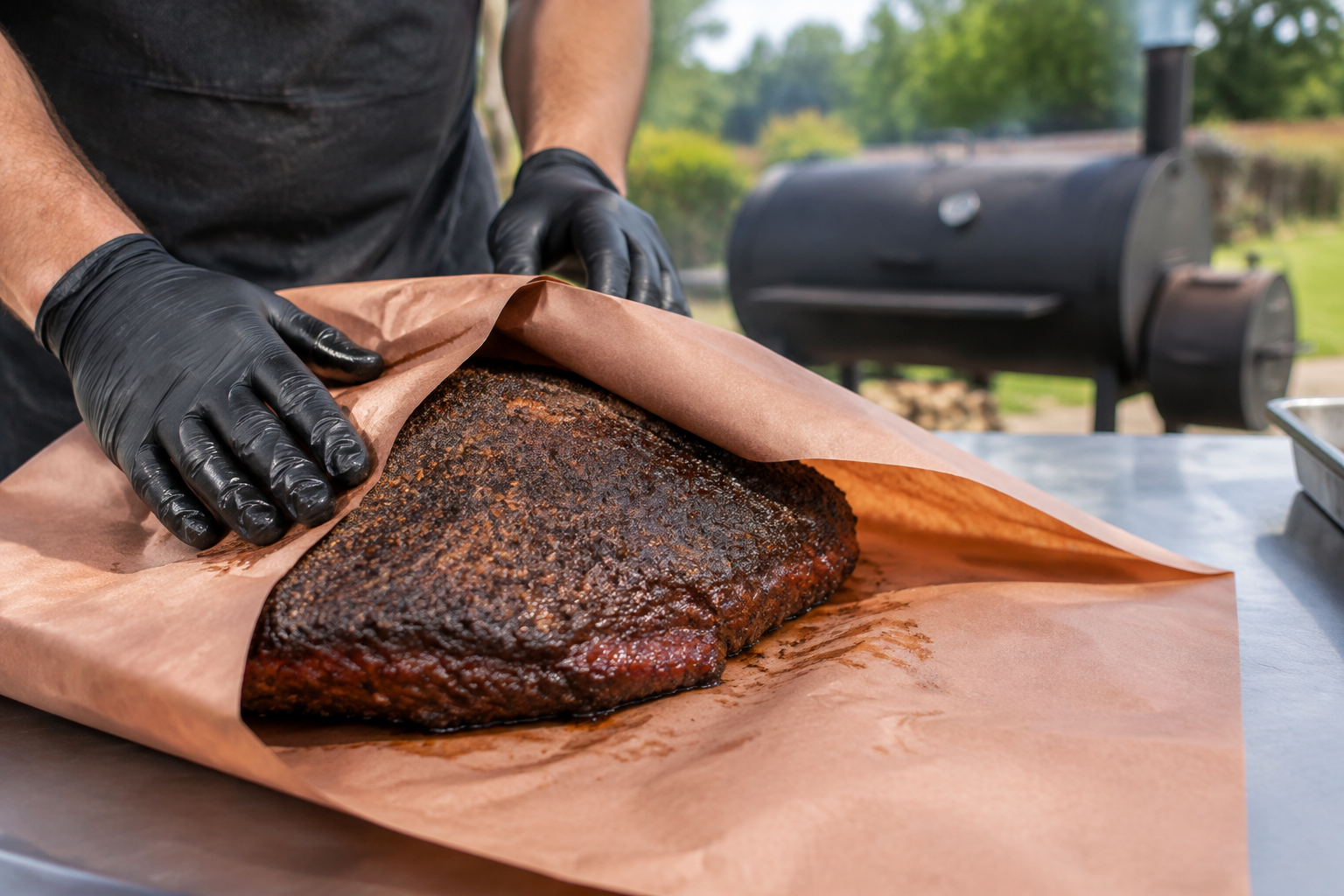
Once the bark has set, the meat can be wrapped. Food-safe, unwaxed butcher paper is often used because it lets some moisture escape. Foil seals more tightly and can shorten the process, but also softens the crust more. Wrapping is a tool for managing moisture and time, not a magical badge of authenticity.
The rosy-red band beneath the surface, the smoke ring, is no reliable mark of quality either. It forms through reactions between the meat’s pigments and gases from combustion. Meat can have a distinct smoke ring and still be dry, or lack a prominent ring and taste excellent. Judge tenderness, juiciness and the balance of smoke instead.
Towards the end, the thermometer is a guide, not a judge. Many briskets become tender at an internal temperature somewhere around 93–98°C, but the number alone does not decide it. A thin probe should slide in with little resistance in several places, particularly in the leaner section. If the meat feels tight and rubbery, it usually needs more time, not a sharper knife.
Rest, carve and gather everyone round
A finished brisket needs a proper rest or controlled hot holding. In restaurants, this is an important part of the workflow, not simply a wait between cooking and serving. At home, it also helps solve the dish’s great logistical problem: the meat is ready when it is ready, while guests tend to arrive at a set time.
Plan to finish early and hold the meat safely rather than trying to time serving to the minute. An oven set to around 70°C can work, but check the actual temperature and make sure the meat stays above 60°C. A switched-off oven or insulated box does not offer an unlimited safe holding period; the temperature needs monitoring there too.
Carving is the final stage of cooking. Cut across the grain, not along it. Since the flat and point have different grain directions, you will need to turn the meat or separate the sections where they meet. The leaner section usually works well in slices about five millimetres thick. The fattier section can be cut a little thicker. Slice only what will be eaten straight away, as whole pieces retain heat and juices better.
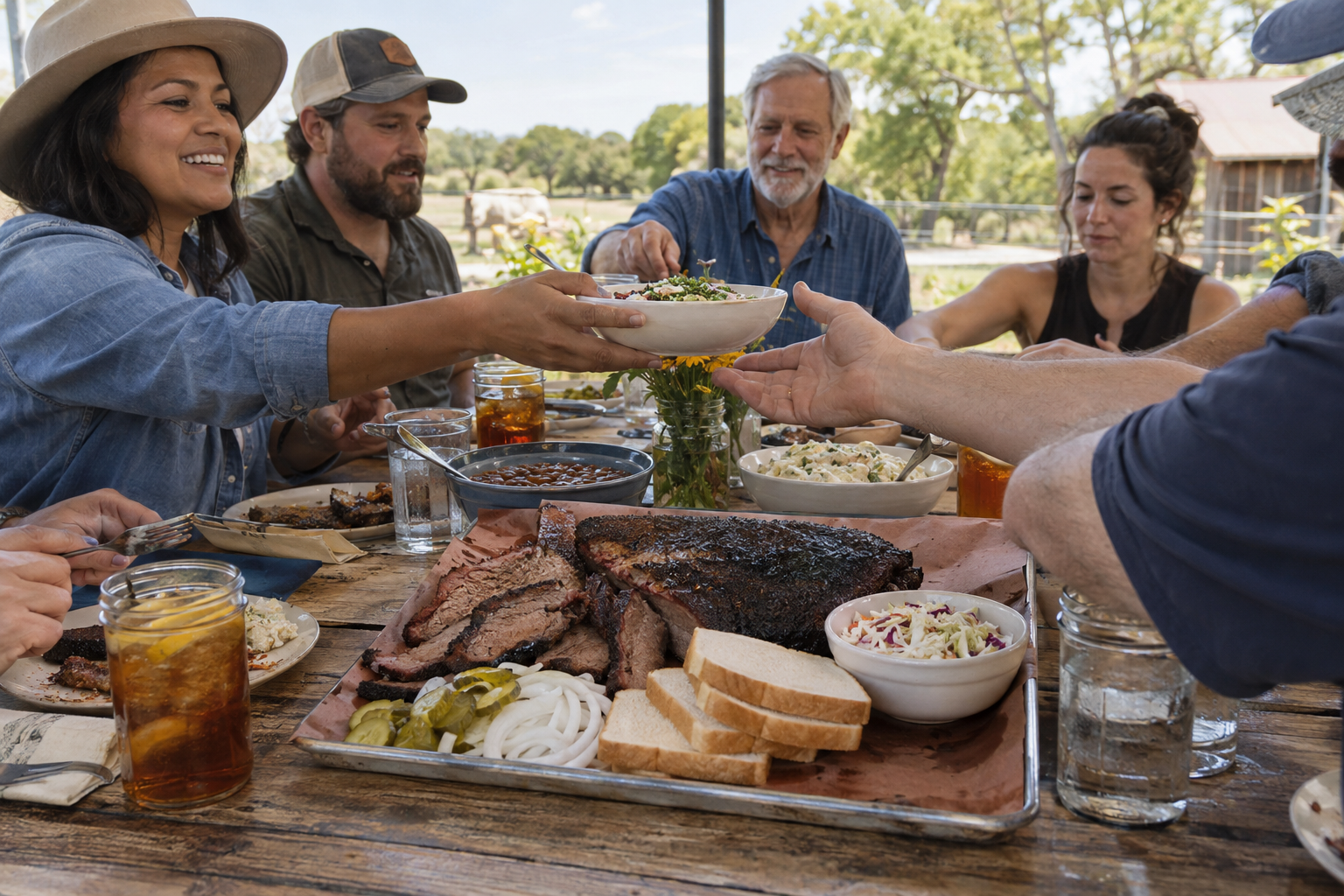
At the table, small contrasts make a big difference. Pickles bring acidity and crunch. Raw onion cuts through the fat. White bread soaks up the meat juices and lets the flavour linger a little longer. Coleslaw is a familiar accompaniment across the broader American barbecue landscape, though it does not define every traditional Central Texas meat market. Here, it is fresher than it is sweet, with mustard and apple cider vinegar.
Drinks can be just as uncomplicated. A cool American lager brings fizz and a light malty sweetness without competing with the meat. A moderately bitter IPA meets the bark’s roasted notes, but very high bitterness can heighten the harshness of smoke and pepper. Zinfandel can work for wine drinkers; favour fruitiness over high alcohol and heavy oak.
An alcohol-free iced black tea with lemon and a restrained amount of sugar is just as considered a choice. The tea’s gentle astringency meets the fat, the lemon adds freshness and the sweetness can be adjusted to the food. Pour water too. A long meal need not be a heavy one, and conviviality does not depend on the alcohol in the glass.
Making it work in a Swedish kitchen
The biggest adjustment is often the shopping. Look for a whole, uncured brisket at a well-stocked butcher’s, or order ahead. The roughly four-kilo piece in this recipe is large enough to let both muscles come into their own, yet still manageable on many home barbecues. Check that it actually fits before lighting up.
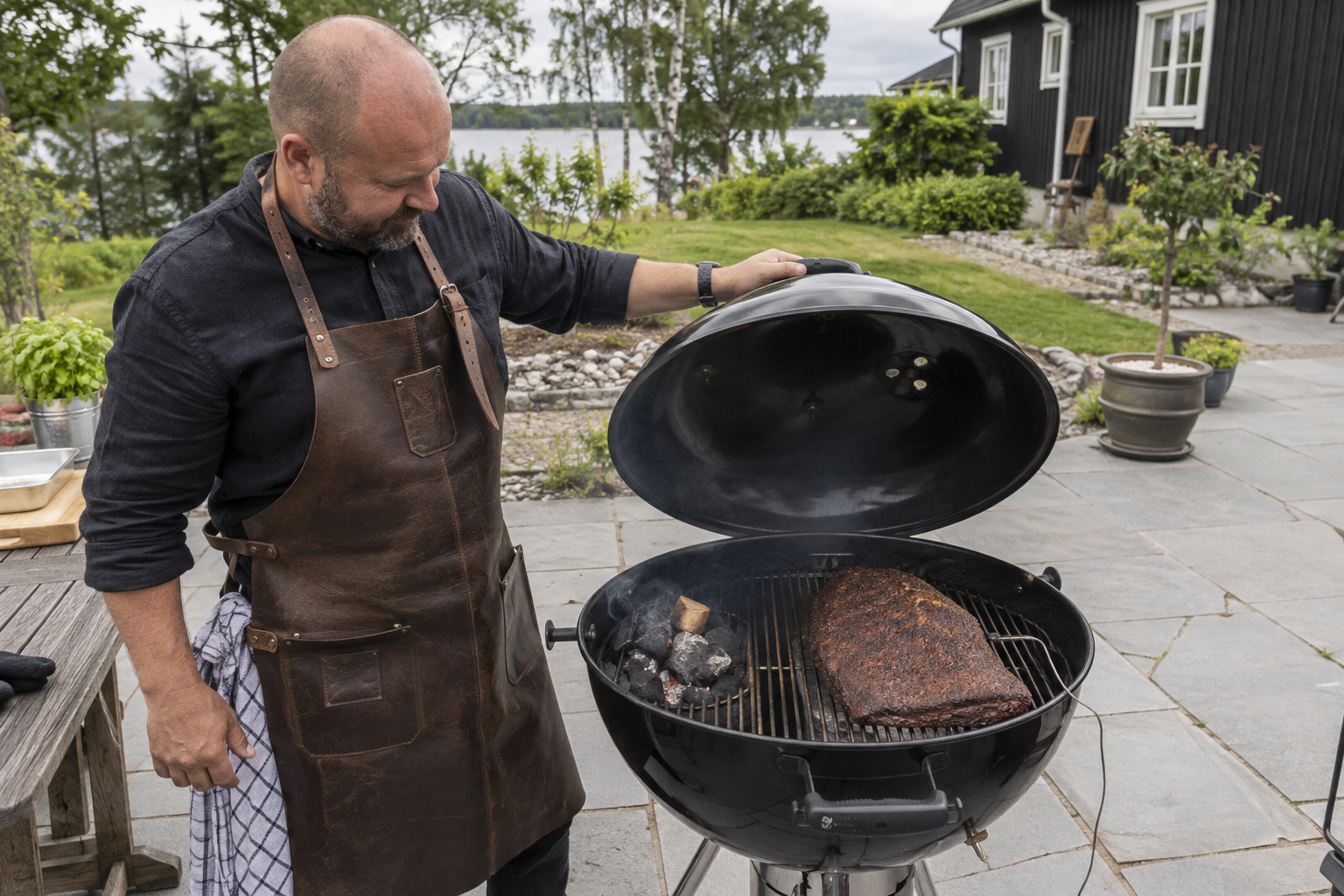
You do not need an enormous wood-fired smoker. A kettle barbecue, kamado or other equipment capable of maintaining steady indirect heat will work. Use barbecues and smokers outdoors only, at a safe distance from flammable materials. On a charcoal barbecue, add a few chunks of smoking wood to the coals according to how the equipment operates; the aim is steady, clean smoke, not the biggest possible cloud.
One particularly practical option is to give the meat its initial cooking and bark on the barbecue, then move the wrapped brisket to the oven. This saves you feeding a fire during the final hours. Once the meat is wrapped, the wood contributes considerably less to its surface anyway, so the oven’s even heat is a perfectly reasonable aid.
Brisket can also be cooked entirely in the oven. That gives you pepper-seasoned, slow-roasted beef, not wood-smoked Texas brisket in the strict sense. The difference should be stated openly: an oven does not create smoke flavour. But the same care over the meat, tenderness and resting can still produce an excellent meal. The oven option in the recipe card is therefore a separate approach, not a promise of an identical result.
Expect a long project and build in a buffer. Thickness, marbling, equipment and temperature matter more than a simple formula per kilo. Keep notes on your own barbecue, but let the resistance of the meat beneath the probe carry more weight than the clock. Make the coleslaw while the brisket rests, set out pickles and bread, and leave the knife alone until everyone is ready to eat.
That is where patience finds its reward. Not in having clocked up a certain number of hours beside the fire, but in turning a tough cut into something tender, fragrant and ready to share. The paper rustles, the bowls make their rounds, and someone asks for another slice.
Texas-inspired smoked brisket with an oven option
A whole, uncured beef brisket seasoned with salt and black pepper. This recipe follows the basic principles of Central Texas barbecue, adapted for a home barbecue and a Swedish oven. Cooking usually takes 10–16 hours, sometimes longer, plus 2–3 hours of resting and hot holding. The stated cooking time is a planning estimate, not a guarantee.
Ingredients
Method
- 1Prepare the equipment. You will need a barbecue or smoker set up for indirect heat, oak smoking wood intended for cooking, a barbecue thermometer, a probe thermometer and food-safe unwaxed butcher paper or heavy-duty aluminium foil. Read the oven option in step 8 before starting if you will not be smoking the meat.
- 2Trim the brisket while fridge-cold. Remove hard lumps of fat and thin, loose flaps of meat. Even out the fat cap to around 5–7 mm without removing all the fat. Note the grain direction in the flat, ideally with a photo, as it will be harder to see after cooking.
- 3Mix the salt and pepper and distribute evenly over all sides. The seasoning quantity is intended for roughly 3–3.5 kg of trimmed meat; adjust slightly if the trimming loss is very different. Refrigerate the meat while you prepare the barbecue.
- 4Stabilise the barbecue at 120–135°C at grate level, with an indirect heat zone. Add smoking wood according to how your barbecue operates. The smoke should be light and smell pleasant, not thick and acrid. Position the meat with the thicker section towards the hotter side and the fat cap facing the strongest heat source.
- 5Smoke with the lid closed as much as possible. Check the barbecue temperature regularly and replenish the fuel as needed. After roughly 5–8 hours, the surface will usually be dark and firm, and the internal temperature often around 70–80°C. Do not wrap simply because the thermometer reaches a particular number: the seasoned bark must also have set.
- 6Wrap the brisket tightly in butcher paper or foil. Keep any meat juices inside the parcel if possible. Continue cooking at 120–135°C on the barbecue, or place the parcel in a roasting tin in a conventional oven at 130°C. Foil generally produces a softer bark than paper.
- 7Start checking for tenderness as the internal temperature approaches 92°C. Probe through the wrapping in several places, particularly the thickest part of the flat, and avoid taking readings only in the fat pocket between the muscles. The meat is ready when the probe slides in with very little resistance, often at 93–98°C. Otherwise, continue cooking and check again after 30–45 minutes.
- 8To cook entirely in the oven: follow steps 2–3 and place the brisket fat-side up on a rack over a deep roasting tin. Cook in a conventional oven at 125°C until the surface has darkened and become firm, roughly 5–7 hours. Then wrap in foil and continue at 130°C as in step 7. This produces slow-roasted, not smoked, brisket. Never use smoking wood or glowing charcoal in a conventional oven.
- 9Carefully open the parcel and let the strongest steam escape for 15–20 minutes. Close it again and let the meat rest and hold warm for 2–3 hours in an oven at around 70°C. Use a thermometer to check that the meat stays above 60°C; low oven temperatures can vary considerably.
- 10Save the meat juices. Slice the flat across the grain into slices about 5 mm thick. At the point, change cutting direction or separate the muscles and cut the fattier section a little thicker. Moisten with a little meat juice if needed and serve straight away with pickles, onion, bread and coleslaw. Slice only as much as you need.
- Allow at least a couple of hours’ buffer. A smaller but thinner brisket is not automatically easier to get right; an evenly thick, well-marbled piece is more forgiving.
- Ordinary oak smoking wood intended for cooking is a good substitute for post oak, but will not give exactly the same aroma. Avoid adding so much wood that the smoke becomes heavy and bitter.
- You can use just the flat, but it dries out more easily. Start checking earlier and consider wrapping in foil to limit evaporation.
- Cool leftovers quickly in smaller, shallow containers and refrigerate within two hours of the end of hot holding. Store at around 4°C and eat within 3–4 days, or freeze. Reheat covered with a little meat juice until hot throughout, around 74°C.
Fresh, tangy coleslaw with apple cider vinegar and mustard
A crunchy, gently sweet slaw that brings acidity and cool freshness to the rich brisket. The recipe makes ten small side portions and can be halved.
Ingredients
Method
- 1Finely shred the cabbage with a knife or mandoline. Peel and coarsely grate the carrots.
- 2Place the cabbage in a large bowl, sprinkle with the salt and massage gently for about 1 minute. Leave for 10 minutes so it softens slightly but keeps its crunch.
- 3Meanwhile, whisk together the mayonnaise, yoghurt, vinegar, mustard, sugar and black pepper in a separate bowl.
- 4Pour away any liquid in the bottom of the cabbage bowl. Add the carrots and dressing and toss thoroughly.
- 5Taste with the food it will accompany in mind: the slaw should taste fresh rather than sweet. Serve straight away for maximum crunch, or chill for 30 minutes to let the flavours meld.
- Shred the vegetables and make the dressing the day before, but keep them separately in the fridge and combine close to serving.
- For an egg- and dairy-free slaw, use vegan mayonnaise and unsweetened plant-based yoghurt.
- The dressed slaw keeps for around 2–3 days in the fridge, but softens over time.
What goes in the glass
- BeerAmerican lager or a moderately bitter American pale ale/IPAThe lager’s fizz and light maltiness offer a refreshing break between bites. A balanced pale ale or IPA brings more citrus and aroma to meet the pepper bark; avoid extreme bitterness, which can make the smokiness seem harsh.
- WineFruity Zinfandel with restrained oakDark berry fruit meets the beef’s roasted flavours, while fresh acidity cuts through the fat. Choose a lower-alcohol style and serve slightly cool so that pepper and alcohol do not dominate.
- Alcohol-freeIced black tea with lemon, lightly sweetened or unsweetenedThe tea’s mild astringency balances the rich meat, and lemon adds freshness. Brew without over-steeping, chill and serve with plenty of ice; let everyone choose whether to sweeten it.
Enjoy alcohol in moderation. Alcohol-free options go just as well with the food.
Sources
- Aaron Franklin och Jordan Mackay, Franklin Barbecue: A Meat-Smoking Manifesto (2015)
- Daniel Vaughn, The Prophets of Smoked Meat: A Journey Through Texas Barbecue (2013)
- Robb Walsh, Legends of Texas Barbecue Cookbook (2002)
- Adrian Miller, Black Smoke: African Americans and the United States of Barbecue (2021)
- Kreuz Market, Kreuz Market
- Franklin Barbecue, Franklin Barbecue
- USDA Food Safety and Inspection Service, Smoking Meat and Poultry
- Meathead Goldwyn med Greg Blonder, Meathead: The Science of Great Barbecue and Grilling (2016)
Ask questions about "Texas barbecue – brisket, smoke and patience". Answers are based on the magazine's own articles.