The kitchens of Topkapı – power, rice and a thousand layers
Behind the sultan’s meals lay an entire community of cooks, storerooms and carefully orchestrated hospitality.
Beneath the tall chimneys of Topkapı Palace, ingredients from a vast empire became meals that both fed people and signalled rank. We follow the food from the kitchen fires to the court’s tables and Ramadan’s baklava trays – and cook imam bayıldı, a dish whose fame is better documented than the story of the fainting imam.
 By Arvid HolmFood historian · Historic dishes, old cookbooks and eating habits through the ages
Translated from Swedish with AI assistance.
Go to the recipe ↓Where fire could never be left to chance
Imagine standing in the second courtyard of Topkapı Palace one morning in the late 16th century. From the kitchen buildings come the clang of metal, footsteps on stone and the scent of woodsmoke. Someone carries in rice; someone else inspects meat. Onions soften in fat, a stock simmers, a sweet mixture needs stirring before it catches. Above the roofs, the chimneys rise like a little city of their own.
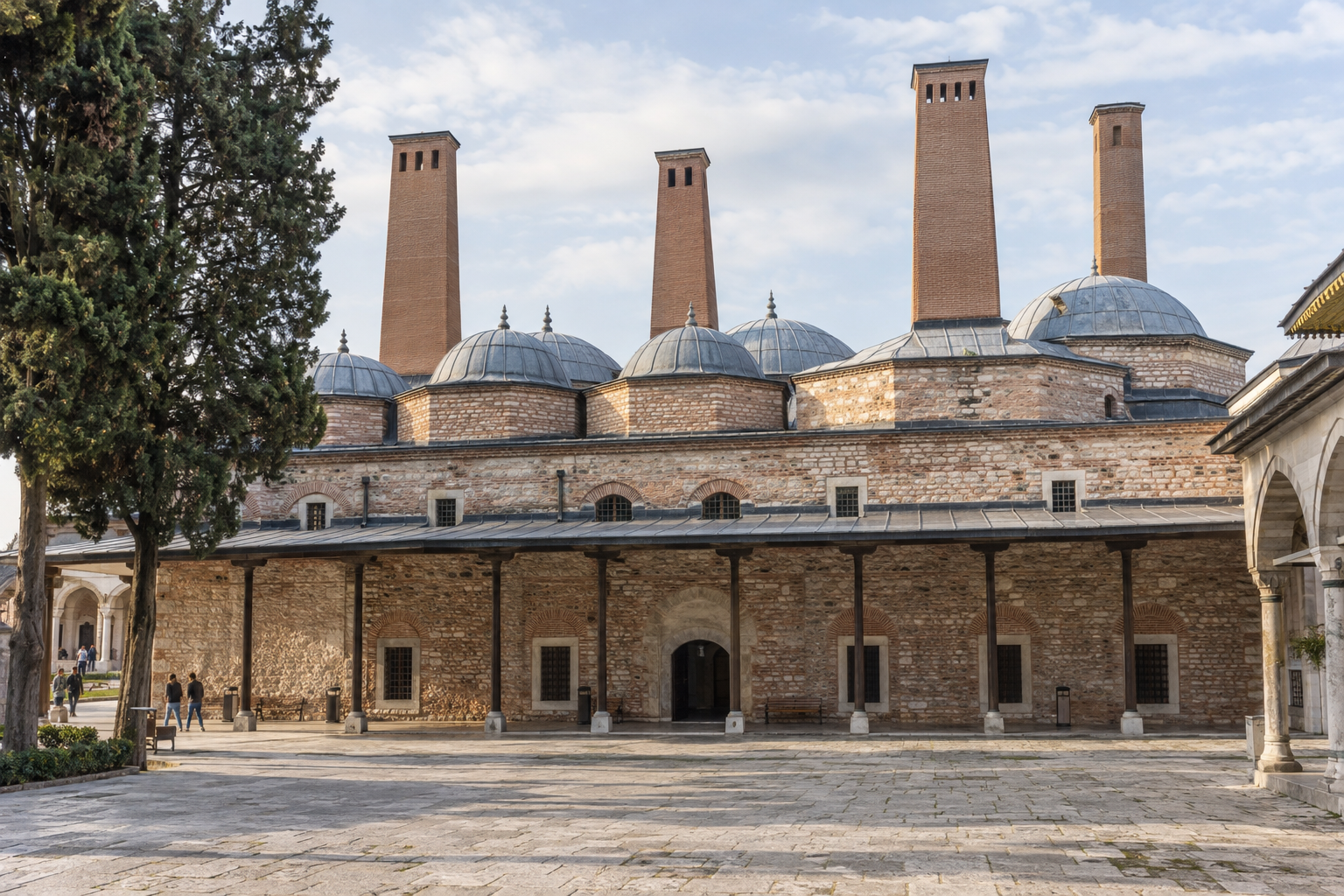
This is an imagined scene, not an eyewitness account. But the scale and organisation of the work are documented. Palace accounts, staff and purchasing records, and descriptions of court life reveal a food operation employing hundreds of people. At certain periods, kitchen staff numbered more than a thousand. Not all were cooks: assistants and staff responsible for stores and supplies were needed too, among others. Numbers changed over time and depended on who was included.
Nor was it only the sultan’s dinner that had to be served. Topkapı was a residence, an administrative centre and a stage for imperial power. Courtiers, servants, guards and other groups were entitled to their allocations. Who ate what, where and when followed a hierarchy as real as the walls around the palace.
So the story does not begin with a lone master chef inventing something fabulous. It begins with logistics. Water had to be available, firewood dry and stores sufficient. A powerful ruler could offer costly sweets; a functioning court also had to serve thousands of fairly predictable portions of food.
It is in this tension between splendour and routine that Topkapı’s kitchens become most interesting. Here we find both the ambitions of a great empire and the everyday knowledge familiar to any home cook: rice given too much water cannot be rescued with gold.
A palace fed by an entire empire
After the Ottoman conquest of Constantinople in 1453, Mehmed II commissioned the palace later known as Topkapı. Construction began in the late 1450s. Over the centuries, the complex expanded and changed, and the kitchens were reshaped too. After a major fire in 1574, the kitchen complex was rebuilt and enlarged under the direction of the imperial architect Sinan.
The palace’s location in Istanbul was essential to its supply. The city stood between seas, trade routes and extensive agricultural regions. Grain, rice, livestock, fruit, fats and spices could reach it from different parts of the empire and through trade beyond its borders. Deliveries were organised through several systems, which could include both purchases and specific obligations to the state.
It is tempting to describe every meal as a showcase for the whole empire: rice from one place, sugar from another, pepper from a third. But such a map must always be tied to a particular time and a particular source. Availability, trade routes and political control changed. What appears in one account book need not have been commonplace a hundred years later.
Ottoman food also developed through encounters between several culinary cultures. Turkish and Central Asian traditions interacted with Persian-influenced court culture, Anatolian agriculture, the cities of the eastern Mediterranean and the landscapes of the Balkans. Muslim, Christian and Jewish communities all took part in the empire’s trade and food supply. This does not mean everyone cooked alike, but that ingredients and skills travelled across linguistic and religious boundaries.
At court, this diversity could take a concentrated and costly form. Fine flour, rice, meat, sugar, nuts and dried fruit were transformed into dishes whose value lay partly in the labour involved. Rolling many thin sheets of dough or sorting large quantities of rice took time and hands.
Yet we should be careful with the word abundance. Palace purchases tell us about the institution, not what every inhabitant of Istanbul ate. And even within the walls, meals differed. The sultan’s kitchen and an employee’s food ration belonged to the same system but offered very different eating experiences.
A meal could be a political language
The palace kitchens, often referred to collectively as Matbah-ı Âmire, were divided by task and by whom they served. There were specialist skills and hierarchies, not one enormous pot for everyone. Behind every serving lay a chain of responsibility: someone received the goods, someone stored them, someone cooked them and someone made sure the food reached the right people.
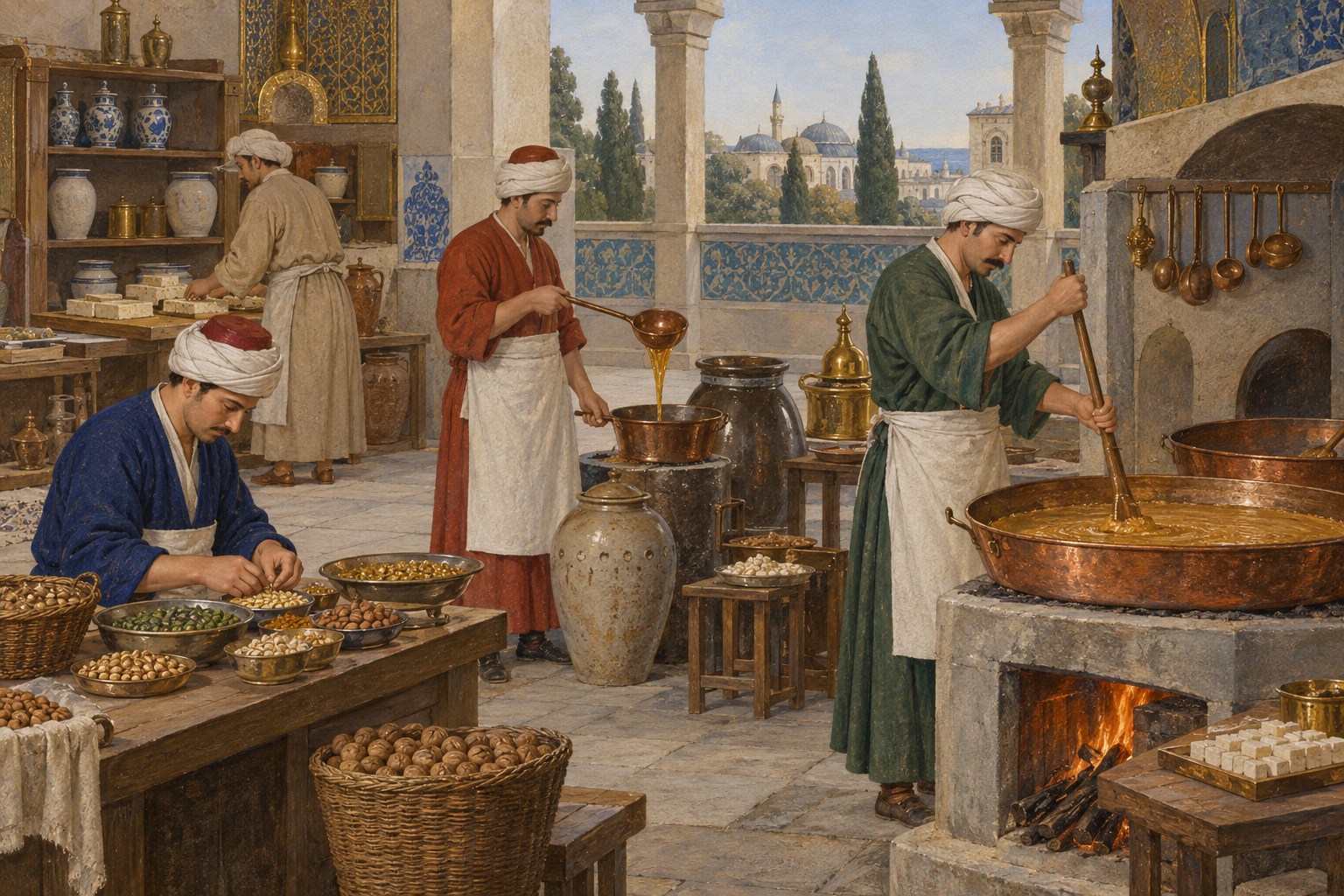
The confectionery department, the helvahane, is particularly revealing. Its work was not confined to what we now call helva. It also produced other sweet preparations, preserves and various syrups. The boundary between pleasure, household provisioning and contemporary ideas about health was less clear-cut than in a modern restaurant kitchen.
A meal might be laid out on a low tray or table, a sofra, with a cloth as part of the arrangement. Spoons and hands were used as the dish and occasion required. But there was no unchanging Ottoman table setting: ways of serving and the objects used varied with rank, occasion and century. During the 19th century, European table manners and furniture became more prominent at court.
Nor did the sultan constantly dine at a long banqueting table surrounded by his entire court. Seclusion and controlled access to the ruler were central to palace organisation. Rules associated with Mehmed II emphasise the ruler’s special status even at meals. The image of an endless communal sultan’s feast conceals more than it explains.
For other groups, however, a shared meal could express belonging. Receiving food from the ruler’s household meant standing in a particular relationship to his power. On ceremonial occasions, service became a visible sign of order, generosity and rank. Who was allowed to sit, who had to wait and what was brought out all mattered.
This is especially clear in the relationship with the Janissaries, the military corps that was long a central part of the Ottoman state. Their cauldrons carried strong symbolic meaning. Food, and the acceptance of food, could express loyalty; opposition to the established order could also be enacted through kitchen objects. In this world, a cauldron was not necessarily just a cauldron.
Pilaf, baklava and the aubergine’s uncertain place at court
Which flavours, then, connect Topkapı with today’s Turkish cooking? Pilaf is one of the clearest threads. Rice dishes are well documented in Ottoman food culture and held an important place at court too. They could be relatively simple or enriched with meat, pulses, nuts and dried fruit. The stock, the fat and the handling of the rice determined the result.
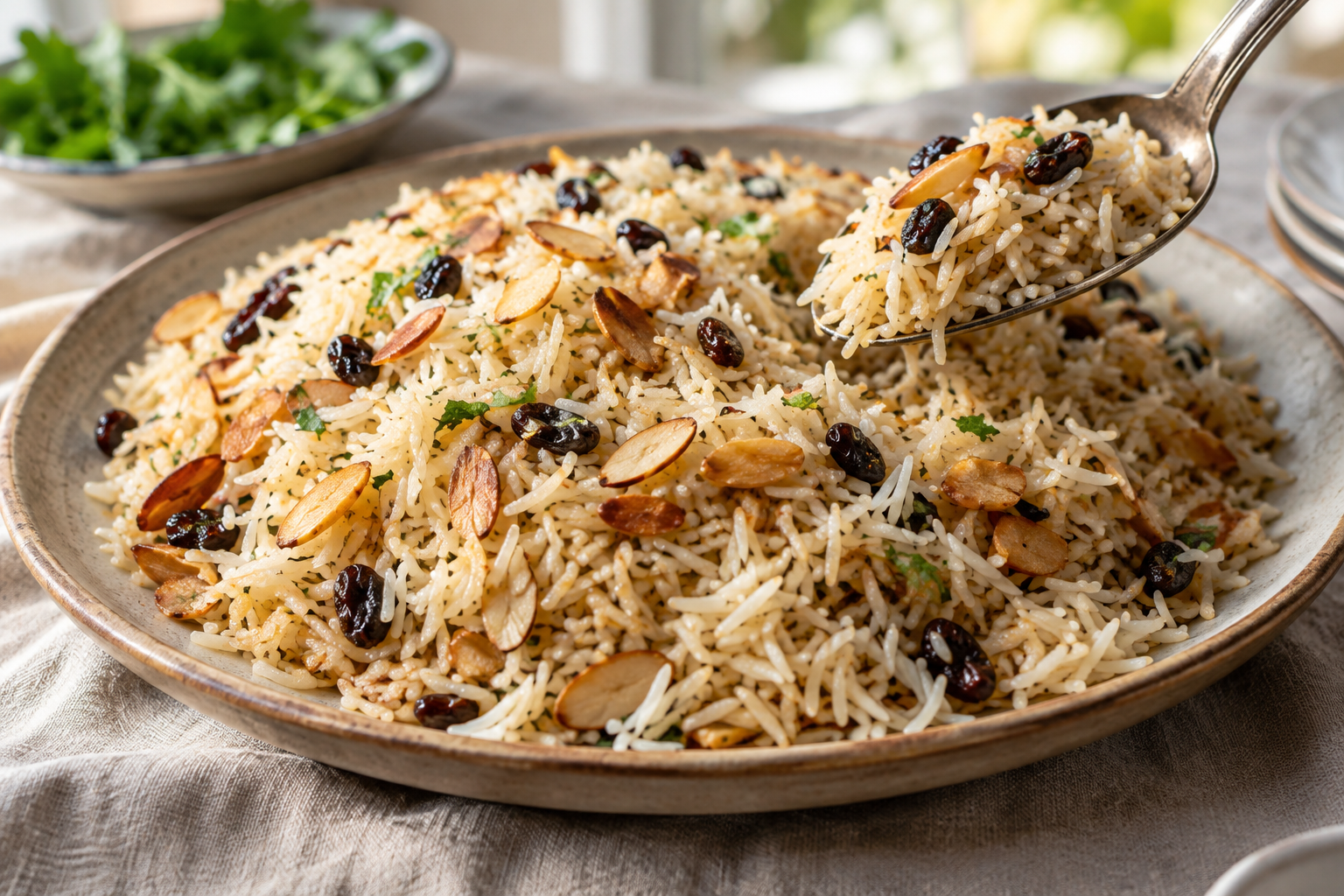
The history of pilaf does not, however, begin at Topkapı’s gates. Rice dishes and techniques for preparing them have a broad history in the Persian-influenced world, Central Asia and South Asia, among other places. The palace was a setting in which certain forms developed and gained prestige, not a credible sole inventor of every dish later associated with it.
Baklava offers the same lesson. It is documented in the Ottoman palace setting as early as the 15th century. Over the following centuries, the pastry’s thin sheets of dough, fat and sweetening became an expression of craftsmanship and celebration. But its ultimate origins remain disputed. Earlier layered pastries and thin-bread traditions have been cited in various explanations; they are not enough to establish a single, indisputable birthplace.
Today’s regional baklavas also show how much one name can encompass. Pistachios, walnuts, the thickness of the dough, the shape of the pastry and the character of the syrup all vary. The fact that a modern version is delicious tells us nothing certain about the filling used on a particular court occasion in the 16th century.
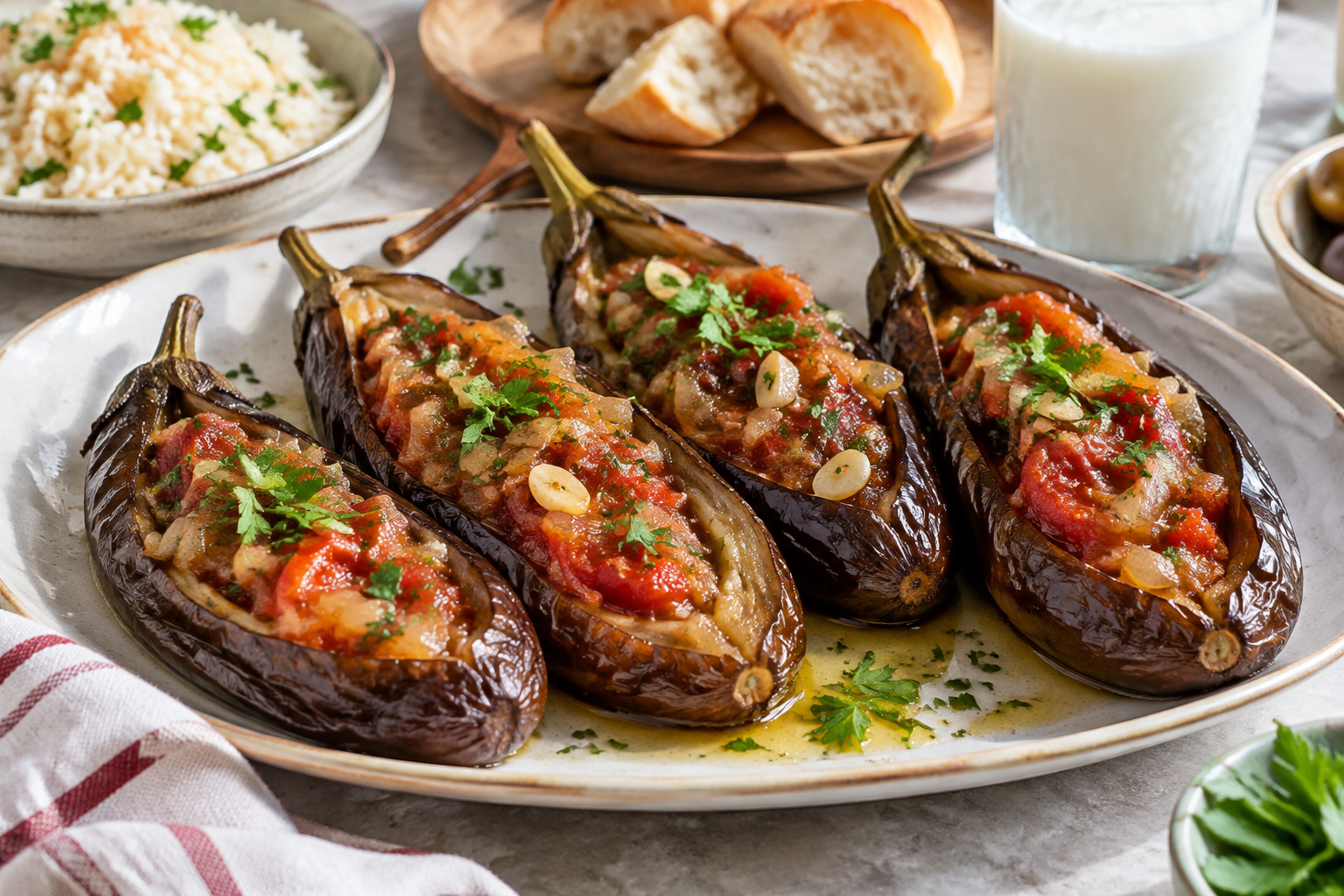
With imam bayıldı, the question of sources becomes even more important. In its familiar modern form, the dish consists of aubergine with onion, tomato, garlic and olive oil. It belongs to the Turkish family of zeytinyağlı: vegetable dishes cooked with olive oil and often served cool or at room temperature. But without specific evidence, we cannot place this particular dish on a named sultan’s table.
The name is usually translated as “the imam fainted”. Stories explain his fainting in different ways: the food was overwhelmingly good, the oil too expensive, or the oil supply suddenly exhausted. These are folk explanations, not evidence of how the dish originated. None provides a securely identified imam, time or place.
Aubergine has a long history in the region’s kitchens, whereas the tomato reached the Old World after contact with the Americas and gradually found its place in Ottoman cooking. A tomato-rich imam bayıldı is therefore not a neutral reconstruction of 16th-century palace food. Instead, the recipe here is a modern interpretation of a later Ottoman-Turkish culinary tradition. The connection lies in the development of food culture, not in a supposedly preserved recipe from the sultan’s private kitchen.
Ramadan: from waiting to trays of baklava
During Ramadan, the rhythm of meals changed for those who fasted. The day’s abstinence was followed by iftar after sunset and the meal of sahur before dawn. What appeared on the table depended on time, place and resources. Water, dates, bread, soups, small bites and larger dishes belong to traditions surrounding the breaking of the fast, but today’s iftar table should not be read as an exact likeness of a palace table several centuries earlier.
For the kitchens, the month meant coordinating a great deal of work around specific times. It is easy to imagine how the waiting sharpened everyone’s attention: the bread that had to be ready, the soup hot, the trays prepared. This is a plausible picture of working conditions, not a quotation from a kitchen log.
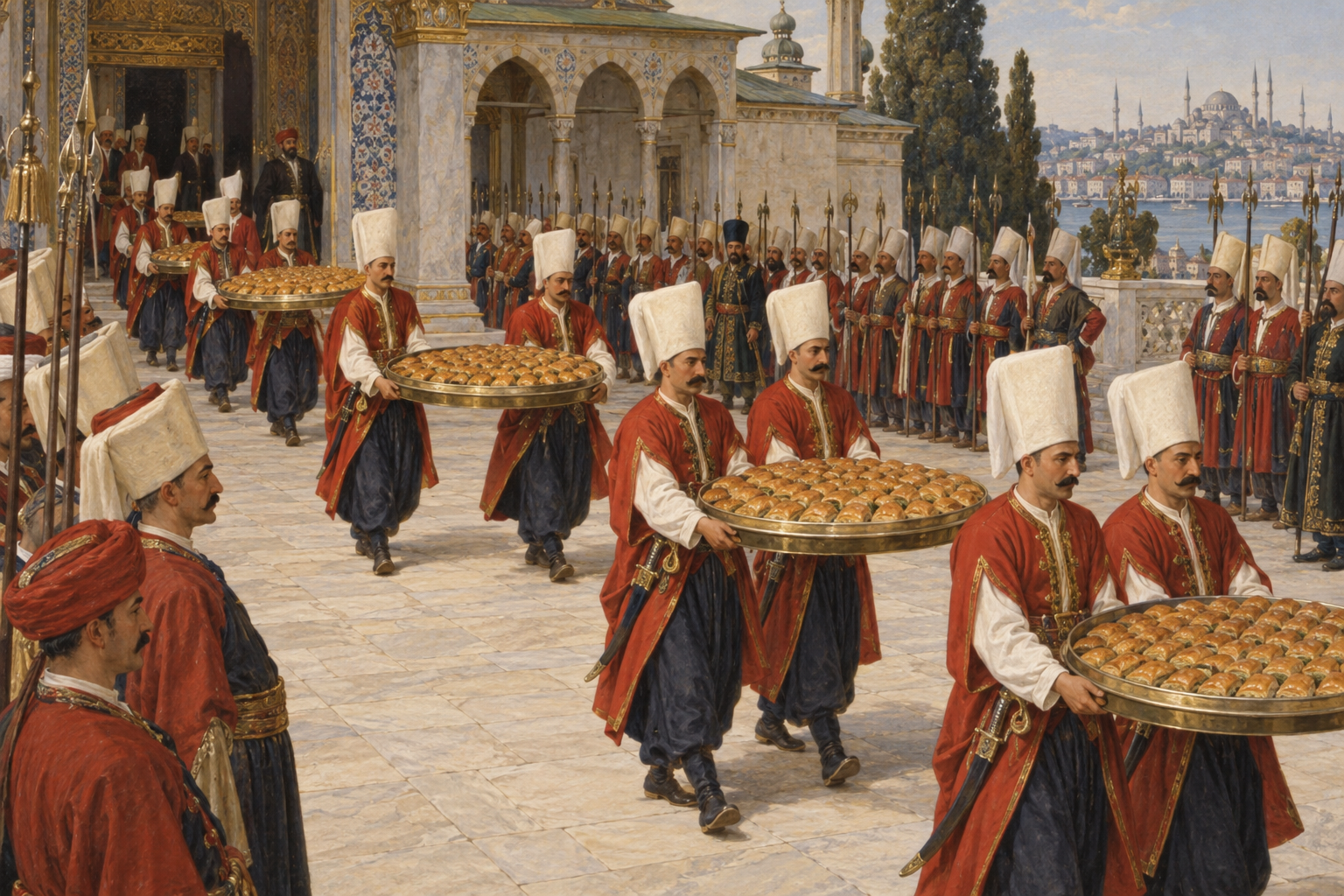
Ramadan also gave the ruler’s generosity a public form. The so-called baklava procession, Baklava Alayı, is associated with the palace’s distribution of baklava to the Janissaries on the fifteenth day of Ramadan. The tradition is documented from the late 17th century onwards. The trays were carried ceremonially: the sweet pastry became a tangible bond between the sultan and his soldiers.
This was more than a dessert on its way to hungry recipients. Labour-intensive pastries, assembled men and an orderly procession made the empire’s hierarchy visible. The ruler’s care and his claim to loyalty rested on the same tray. The tradition’s connection to the Janissaries also explains why the dissolution of the corps in 1826 brought this form of the ceremony to an end.
Beyond the palace, Ramadan also occupied other spaces: households, mosques, streets and charitable institutions. The fellowship of iftar could bring people together, but differences remained between those who offered hospitality and those who needed to receive it. Hospitality was both an ideal and a practical matter of access to food.
In Turkey today, iftar meals continue in homes and public settings. Baklava may feature, but no single menu represents everyone. Family recipes, regional customs, finances and personal choices shape the table. The historical legacy is most evident in the meal’s social significance: the waiting ends, food is shared and the table becomes a place of belonging.
Flavour lies in the work, not just the spices
Anyone expecting Ottoman court food always to be hot or heavily spiced will need to reset their palate. In documented dishes, spices, fruit, acidity and sweetness can play important roles, but the cuisine also included gentle preparations in which stock, fat and the ingredients’ own flavours carried the whole. A single word such as “oriental” erases precisely the differences that make the food interesting.
Pilaf shows how much technique matters. Rinsing away surface starch, choosing the right quantity of liquid and letting the rice rest all affect whether the grains remain separate or stick together. The variety of rice and its prior processing matter too. A historical liquid measure therefore cannot automatically be applied to any bag bought in a Swedish shop.
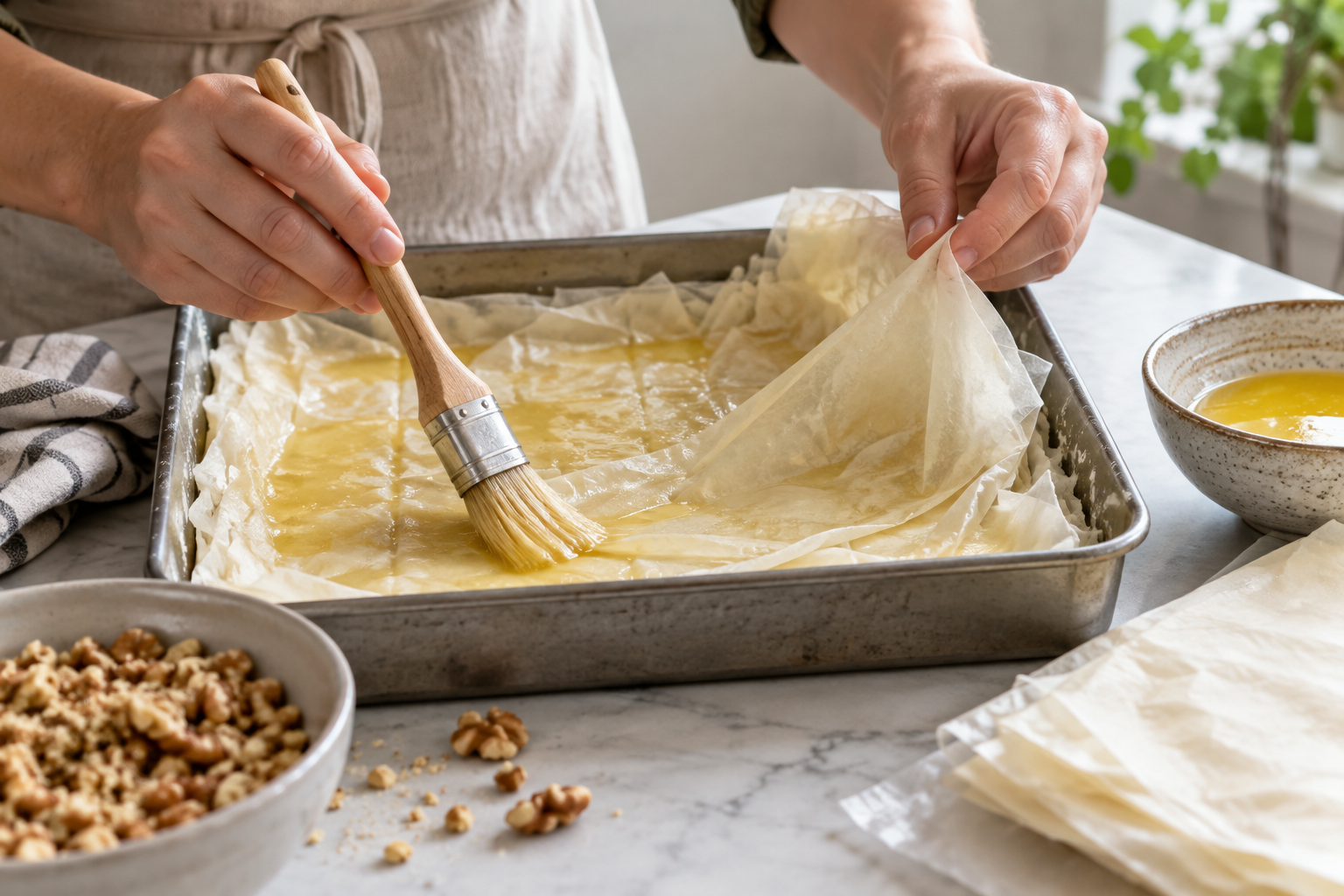
Baklava demands a different kind of precision. The sheets of dough must be thin and even, the fat distributed, and the pastry baked through before the syrup does its work. Plenty of sugar cannot compensate for pale, damp dough. Ready-made filo saves the modern home cook an enormous amount of work, but does not in itself guarantee a crisp result.
Imam bayıldı seems simpler, yet it is full of small decisions. The aubergine must become truly tender, not merely dark on the surface. The onion needs time to lose its raw sharpness. The tomato should bring acidity and juiciness without turning the filling into a thin soup. The garlic should melt into the dish, not burn.
The oil is central. Aubergine can soak up a great deal during frying, especially at the start. This recipe therefore uses the oven to make cooking more predictable. It is a deliberate modern adaptation, not an attempt to imitate a wood-fired palace hearth. The oil is still needed for flavour and mouthfeel; the point is to use it in a controlled way, not to make the dish fat-free.
Finally, it needs to rest. As the aubergine cools a little, the olive oil’s fruitiness and the tomato’s acidity become clearer than when everything is piping hot. This is one of the dish’s great gifts to a host: it need not rush from stove to table. Make it well ahead and let dinner revolve around the guests rather than the oven door.
An Ottoman echo in a Swedish kitchen
How, then, do you bring Topkapı home without pretending to recreate the sultan’s dinner? By choosing a clearly defined element. Here, imam bayıldı represents vegetables cooked in olive oil, with plain rice or a simple rice pilaf and bread as possible companions. This is a contemporary table with historical connections, not a museum menu.
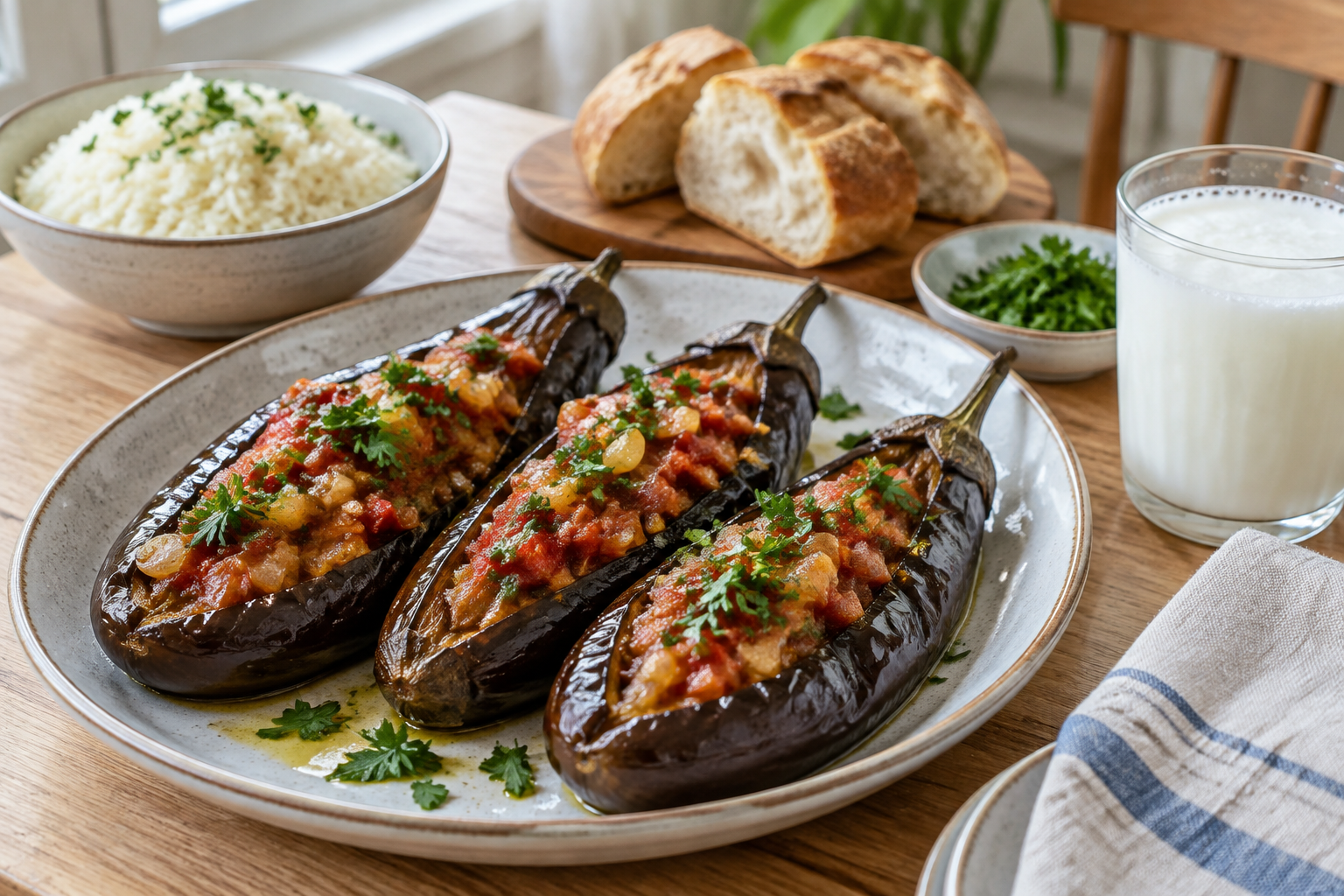
Choose small or medium aubergines with firm, taut skins if possible. Very large ones can work, but need longer cooking and often make less manageable portions. Brown onions, ordinary garlic and tinned tomatoes will take you a long way. A good tinned tomato is usually a better choice than a watery winter tomato that contributes little beyond colour.
The olive oil should taste good cold, too. It need not be exclusive, and the most peppery variety is not necessarily the best. Here, the oil should bring together the sweetness of the onion, the aubergine and the acidity. Parsley adds freshness; chilli is optional and should not be needed to make the food feel full of flavour.
The recipe below is not taken word for word from an old cookbook. It is a modern home interpretation of the dish’s established form, mindful of the historical evidence, with oven-baking and metric quantities. Saying so openly makes the history more useful. We know what we are cooking and avoid giving a contemporary recipe a false pedigree.
Ayran, the salty yoghurt drink, goes well with the food, its freshness balancing the aubergine’s softness. Water works too, of course. Turkish coffee is better suited to after the meal: small cups, concentrated aroma and time to linger. Coffee became part of Istanbul’s urban life during the 16th century, but today’s serving ritual should not simply be projected back onto every earlier palace meal.
Rakı has its place in Turkish drinking and meze culture, but it is not a neutral accompaniment to a story about Ramadan fasting and should not be presented as the sultan’s inevitable drink. For those who choose alcohol, a small serving can suit a contemporary meze table; an alcohol-free option is equally valid.
When the aubergine finally rests on the platter, it is not the palace’s splendour that has come home with us. It is something more useful: respect for ingredients, care in cooking and the understanding that a meal always tells a story about who we are together. Topkapı’s cooks worked within a world of rank and obligation. At our table, the same patience can serve a simpler purpose – making everyone welcome.
Imam bayıldı – olive oil-baked aubergine with onion and tomato
A modern home interpretation of the Ottoman-Turkish olive oil tradition, not a reconstruction of a documented Topkapı recipe. The aubergines are pre-baked in the oven rather than fried in plenty of oil. Makes four servings with rice and bread, or eight smaller portions for a meze table. Allow an additional 20–30 minutes for resting before serving.
Ingredients
Method
- 1Preheat the oven to 200 °C conventional heat. Using a vegetable peeler, peel lengthways strips of skin from the aubergines to give them a striped appearance. Leave the stalks attached if they are in good condition.
- 2Cut a deep lengthways slit in each aubergine without cutting through the underside or the ends. Place slit-side up in a fairly snug baking dish. Rub with 0.5 dl olive oil and 0.5 tsp salt, including inside the slits.
- 3Bake in the middle of the oven for 30–35 minutes. They should begin to collapse and be soft enough to open gently; they will finish cooking after being filled. If they topple over, prop them against one another.
- 4Meanwhile, peel and thinly slice the onions. Slice the garlic. Heat the remaining 0.5 dl olive oil in a wide frying pan over a medium-low heat. Cook the onions for 15–20 minutes, stirring, until soft. They should become sweet and yielding, not deeply browned.
- 5Add the garlic and cook for 2 minutes. Stir in the tomatoes, salt and pepper. Simmer uncovered for 10–15 minutes until the filling is juicy but not runny. Taste and add the sugar only if needed. Fold in the parsley.
- 6Remove the dish and lower the oven temperature to 180 °C. Gently open the slits with two spoons, pressing the flesh slightly to the sides to form pockets. Divide the onion and tomato filling between the pockets; some can sit on top.
- 7Pour the water around the aubergines, not over the filling. Cover the dish with a lid or foil and bake for 25 minutes. Uncover and bake for another 15–20 minutes. A small knife should slide through the aubergine flesh without resistance. Give large aubergines more time and add a little water if the dish becomes dry.
- 8Leave to rest for 20–30 minutes. Spoon a little of the cooking juices over the aubergines and top with parsley. Serve lukewarm, or chill for serving later. Let guests squeeze over lemon to taste.
- This dish is entirely plant-based. Serve with rice, bread and, if you like, a bean salad for a more substantial meal.
- During tomato season, replace the tinned tomatoes with 500 g ripe, chopped tomatoes. Simmer the filling until excess liquid has cooked away.
- Ideally, make it the day before. Cool promptly and store covered in the fridge at about 4 °C for up to 3 days. Take out the portion you plan to eat shortly before serving, or warm it gently.
- If only large aubergines are available, use two large ones, halve them lengthways and bake the four halves cut-side up. Make a shallow hollow for the filling and check carefully that the flesh is tender.
What goes in the glass
- Alcohol-freeAyranA cold, lightly salted yoghurt drink brings refreshing acidity to balance the olive oil and the aubergine’s soft texture. Choose a mild version so the tomato and onion still have room to shine.
- CoffeeTurkish coffee after the mealThe concentrated roasted notes of this finely ground, unfiltered coffee make it better suited to finishing the meal than accompanying the aubergine itself. Serve a small cup with water, perhaps alongside a small piece of baklava.
- SpiritsRakı, a small serving with a contemporary meze tableIts anise notes can complement parsley and olive oil-based small dishes. For adults who choose alcohol: serve sparingly, dilute to taste and offer water alongside. This suggestion is for a contemporary table, not a reconstruction of the court’s iftar.
Enjoy alcohol in moderation. Alcohol-free options go just as well with the food.
Sources
- Priscilla Mary Işın, Bountiful Empire: A History of Ottoman Cuisine (2018)
- Marianna Yerasimos, 500 Years of Ottoman Cuisine (2005)
- Gülru Necipoğlu, Architecture, Ceremonial, and Power: The Topkapı Palace in the Fifteenth and Sixteenth Centuries (1991)
- Suraiya Faroqhi, Subjects of the Sultan: Culture and Daily Life in the Ottoman Empire (2000)
- Mary Işın, Sherbet and Spice: The Complete Story of Turkish Sweets and Desserts (2013)
Ask questions about "The kitchens of Topkapı – power, rice and a thousand layers". Answers are based on the magazine's own articles.